
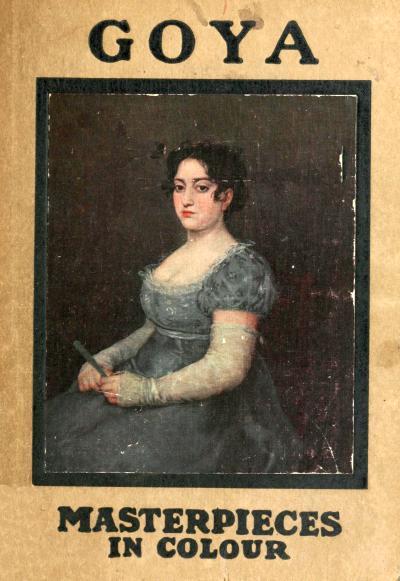
PLATE VII.—LA TIRANA
(Museum of the Prado, Madrid)
La Tirana was a famous actress in Madrid during the reign of Charles IV. Goya painted her at the time when he was in the full height of his renown, and celebrities of every kind at the capital quarrelled with one another for the privilege of being painted by him.
On the 25th of April, 1789, a few months after Charles IV. ascended the throne, a royal order raised Goya to the dignity of Pintor da Camara, which corresponded to Peintre Ordinaire du Roi, a title formerly bestowed upon French artists. This distinction gave him, as in the case of Gentlemen of the Bed-chamber, free entry to the palace. Under the new king the Court had taken on a new aspect. During the reign of the devout Charles III. it was constrained to all the outward show of austere piety which recalled the morose years under the monarchs of the House of Austria. Under the new king everything was changed, laughter was revived, festivals recommenced, and with them, intrigues of gallantry and licentiousness. Scandals multiplied, and the example came from high up; Queen Maria-Luisa herself set the pace for a society that had been parched with thirst for pleasure, and she flaunted before the whole nation her absolute contempt of decency and her unbridled appetite for dissipation. The epoch of the high favour of the Prince de la Paix began. Goya, whose marriage had but poorly reformed him, welcomed this change of regime with enthusiasm. He was already something more than celebrated in Madrid because of his prowess with the fair sex, famous for his duels, an adept at all the nicer usages through his constant association with the upper circles; consequently he felt himself fully at ease in this atmosphere of shamelessness and incontinence. He had some famous intrigues and illustrious liaisons, which he did not even take the trouble to conceal. Possessed of a caustic and subtle wit, and untroubled by scruples, he was much sought after for the brilliance and the daring of his conversation. Those who did not like him learned to fear him. Before long he had scored an even bigger success as a man than as an artist. Through contact with men of rank, he had acquired not only assurance but a certain air of haughtiness verging upon insolence. Being drawn into the circles of the Duchess of Alba and Duchess of Ossuna, who at that time, like rival queens, were disputing the sceptre of fashion and pleasure, he witnessed and shared in many a boudoir intrigue, taking sides in these women’s quarrels, at one time supporting the one side, then again going over to the other, and at last coming out openly in favour of the Duchess of Alba, who at that time was waging a silent warfare with Maria-Luisa. Having become the cavaliere servente of the Duchess, he no longer contented himself with plotting intrigues or launching epigrams; but he translated his opinions into the form of satiric caricatures, in which he mercilessly ridiculed the adversaries of his fair lady. The arrows that he launched flew so high that the outraged queen exiled the Duchess from her court and gave the Pintor da Camara a leave of absence. Goya and the Duchess set forth side by side on the road to Andalusia, sharing the period of their disfavour on a distant estate belonging to the Duchess of Alba.
This exile, however, was of short duration and only served to increase the artist’s reputation for gallantry. The king, who loved him in spite of his follies, recalled him and entrusted him with the frescoes for the chapel of San Antonio de la Florida. The task was a considerable one; it included the painting of a vast cupola and several smaller vaults, tympanums, and arches. Behold then our libertine philosopher transformed once more into a religious painter. Within three months he had completed the entire scheme of the decoration. The subject chosen was as follows: St. Anthony of Padua resuscitating a Dead Man in Order to Make him Reveal the Name of his Murderer. Goya placed his saint upon an eminence, from which he calls upon the dead man to come forth; the latter has already arisen from his tomb, has joined his hands, and is about to speak. On the right and left the compact throng press forward, anxious to see the miracle accomplished. All around the cupola the artist has pictured a sort of gallery on which the spectators lean, and among them we see a child with its legs dangling in space. This composition is remarkable in its sense of movement and varied interest. But what distinguishes it especially from other works of its type is that Goya, through an obstinate adherence to realism which cannot fail to cause some little surprise, thought that he was bound to adopt for all the personages in his picture both the costumes and the types of his own time. “His women are true manolas, draping themselves in their mantillas, and his men are men of the people, arrieros proudly wrapped in their mantles of motley colour. In the corbels of the arches Goya painted cherubim, haloes, and angels, and he endowed these celestial beings with feminine charms and carnal graces that were far too reminiscent of the seductions of the earth. It is related that Goya used the ladies of the Court as models for these feminine countenances, and that on the day when the frescoes were unveiled, Charles IV. expressed his displeasure to the artist in unmeasured terms.”
From 1796 to 1797 Goya published that curious series of compositions done in etching and in water-colour which he entitled Caprices. And they were quite literally caprices through their infinite diversity of subject and the oftentimes extravagant fantasy of their execution. Scenes of local manners ironically interpreted, mocking allusions to popular superstitions, trenchant criticisms of public men and political institutions, attacks of unheard-of violence upon the established religion and its dogmas, pitiless satires upon the Inquisition and more especially upon the monastic orders, and finally prophetic dreams and visions of the future make up the contents of this singularly complex work which concealed a most audacious motive underneath its apparent fantasy. And all this treated with a sparkling brilliance, a diabolical cleverness that is carried sometimes to the point of brutality, with a realism that often causes a sort of revulsion. As to the execution, it is remarkable: the lines are clear-cut and vigorous, the design is solid, almost schematic in places for the purpose of enhancing the energy; with incomparable art, Goya makes use of contrasts for the purpose of obtaining astonishing relief, perfect modelling, and effects of light that produce the illusion of painting. In these compositions he shows the variety and flexibility of his talent, which undertook with equal felicity the most widely diverse branches of his art.
In Spain these Caprices enjoyed a very considerable success, but they caused considerable discomfort to their author. At one time their publication was suspended. The Inquisition, which had been especially maltreated in these designs, became once more threatening, and showed an implacable ardour in its quest for vengeance. Nevertheless, it failed of its purpose, thanks to the kind offices of the Prince de la Paix, who was himself hostile to the monks and took Goya under his protection. In accordance with his advice, Goya offered his Caprices to the king, Charles IV., who, acting in accord with his minister, accepted them for his collection of copper-plates. Having thus found shelter behind the august presence, Goya became invulnerable; and the Inquisition had to let its prey escape.
On the 31st of October, 1799, Goya became First Painter to the king. He was at that time fifty-three years of age. Neither years nor indulgences had undermined his robust organism or diminished his talent. On the contrary, it was at this epoch that his manner underwent a transformation which bears witness once again to the resources and the vitality of this exceptional nature. A study of the works of Rembrandt had awakened in him a violent passion for the effects of light and of chiaroscuro, and from this time forward we find him practising this difficult art and manifesting in it a remarkable mastery and originality. In this style of painting, which was new to him, he achieved masterpieces from the first attempt, such for instance as the Betrayal by Judas, in the cathedral at Toledo, which might have been signed by Correggio or Rembrandt. The patch of light, which throws into strong relief the suffering face of Christ and the hideous countenance of Judas, is distributed in a masterly fashion and in no wise detracts from the luminous transparency of the shadows.
PLATE VIII.—JOSEFA BAYEU
(Museum of the Prado, Madrid)
Josefa Bayeu was the sister of the painter Francisco Bayeu, like Goya, a native of Aragon, and his intimate friend. It was in the home of his comrade that Goya fell in love with Josefa and married her. He had one son, Xavier Goya. This portrait is considered as one of the best executed by the artist.
In this work, as in all others by this artist, both the personal and the national note are found to be strongly imprinted; all the participants in this scene are authentic Spaniards, whose classic types may still be recognized to-day in every city throughout the peninsula.
Mention also should be made, among the works in which Goya ventured upon chiaroscuro, of the celebrated picture in the Escuelas Pias in Madrid, representing The Communion of St. Joseph Calasanz, and of the spacious and original canvases with which he decorated the walls of his own home.
We now arrive at that turbulent period, extending from 1800 to 1814, which marked an era of national calamities for Spain. The facts are familiar: as a result of court intrigues, the luckless and unhappy Charles IV. found himself in 1808 forced to abdicate in favour of his son; then came the invasion of Spain by the imperial armies, the odious treachery of Bayonne which made Ferdinand II. a prisoner and a dethroned king, while Napoleon, following his mad dream of universal conquest, placed his own brother, Joseph, on the throne of Charles V.; and finally there came the awakening of invaded Spain and its splendid national defence, resulting in the expulsion of the enemy and the fall of the Empire.
All these years of struggle and patriotic frenzy Goya passed in his quinta, where he had shut himself up in complete isolation, taking no part in the events which were shaking Spain to its foundations. This attitude of his gave rise to a great amount of comment. In the eyes of many, Goya was an afrancesado, a partisan of the French invasion; but there seem to be no grounds that would justify anyone in offering him such an insult. It may be that, pledged as he was to ideas of justice and liberty, he was not displeased to see the downfall of a corrupt regime, under which Spain had been slowly dying. But that he had looked on light-heartedly at the misfortunes of his native land, and that he had not suffered to the very depths of his Spanish soul, would indicate a depravity which no one has a right to impute to him.
And if proof of this were needed, we could find it in his masterly series of The Misfortunes of War, eloquent and melancholy commentaries upon that troubled period, giving a gruesome panorama of military executions, conflagrations, pillage, and famine; in a word, the habitual and tragic accompaniment of a foreign invasion. Could an artist who was indifferent have expressed himself in such pathetic accents? Could a renegade have been stirred to such a point by all these horrors? Furthermore, Goya made no overtures to the invaders. While other Spaniards, willingly or unwillingly, figured at the court of Murat and of Joseph, Goya remained in close retirement in his own house, notwithstanding his natural fondness for adventures and festivities. “But above and beyond his incontestable patriotism, a more generous sentiment, loftier and more profoundly humane, emanates from these sinister pages. What Goya hated beyond all else was war: it spelled iniquity, despotism, and above all, tyranny. Nothing more eloquent than this avenging protest has ever been formulated against the spirit of conquest and the barbarous struggle of nation against nation.” In about the year 1814, upon the return of Ferdinand II., Goya added to his Misfortunes of War seventeen new plates, the strangest and most daring of them all. This is the last and most strenuous battle that he ever waged on behalf of all he loved against all that he hated. What phials of wrath he poured out against intrigue, conservatism, and falsehood, which stifle liberty and repress human thought! What outbursts against the rogues who strive desperately to destroy liberty and justice! Here is a picture in which hypocrisy has conquered and has confiscated liberty: Contra el Bien General! Further on is another, in which truth is in its death agony: Murió la Verdad! But she will rise again: Si Resusitará! for it is impossible that she should disappear forever. Lastly, as a conclusion to this work, Goya prophesied in an eloquent page the return of a glorious era which should inaugurate the reign of liberty, love, happiness, and peace. And it bore this legend: This is the Truth!
But the reign of Ferdinand VII. did not fulfil the generous hopes of the great artist. With this king, the worst days of absolute monarchy were revived in Spain; the triumphant reaction manifested itself by persecutions, cruelties, and tyrannies of the most odious kind. Whoever was even suspected of liberalism was marked for exile or for prison. More than anyone else, Goya’s personal prominence exposed him to the attacks of the reactionists, but his very fame protected him. Ferdinand VII., when he received him one day, informed the aged artist that he “deserved exile, and more than exile; he deserved death!” but he consented to forget the past and he reappointed the artist to the office of First Painter. It would seem as though such protection should have sufficed to protect Goya from the machinations and hostilities of his adversaries. But it did nothing of the sort. The reactionary party would not consent that a liberal should escape its vengeance, even though protected by royal immunity; so it continued to hound him by means of secret intrigues and calumnies.
Goya, impatient and irascible by nature, could ill bear the malevolent insinuations, allusions, and contemptuous terms; he found himself stifling in such a poisoned atmosphere. Residence in Madrid had become impossible for him; the greater number of his friends, less fortunate than he, had already been forced into exile; and since the persecution showed no signs of abating, he saw his circle of friends dwindling day by day. At last he made up his mind to leave a native land that had grown so inhospitable and hostile. He asked the king for a leave of absence, and upon obtaining it crossed over into France.
THE CLOSING YEARS
Goya went first of all to Paris, but he made a stay there of short duration. Almost all his friends from Madrid, whom Ferdinand VII. had driven from Spain, had taken refuge in Bordeaux, where they formed a veritable colony. He proceeded to join it and decided to settle down among them.
He did not, however, remain inactive. This prodigious worker, who was now nearly eighty years old, could not resign himself to rest; he once again took up his brush with a hand which his great age could not yet cause to tremble. Besides, he was not well off, possessing scarcely anything besides his house in Spain and his pension as First Painter.
Accordingly, he continued to paint genre pictures and numerous portraits. Those of Don Juan Maguire, M. Pio de Molina, and M. J. Galos date from this epoch. He also painted another of his friends, also exiled, whom he met again at Bordeaux—Moratin, the celebrated Spanish poet, who, carried away by his passion for democracy, had sung the French invasion in eloquent stanzas and now expiated his error in exile.
Besides the portraits, Goya painted some very beautiful miniatures on ivory, and he renewed his experiments in lithography, which he had already undertaken in Madrid some years previous. His four large examples representing Bull Fights are masterpieces of colour and of movement.
In 1827 Goya had to journey back to Madrid, in order to make a personal appeal to the king for an extension of his leave of absence. Since he could not persuade Goya to remain, the king freely granted the favour requested; but he imposed one condition, and a very flattering one to the artist: namely, that he would first allow his portrait to be painted by Don Vicente Lopez, at that time Pintor da Camara. This portrait is now to be seen at the museum in Madrid.
That same year he returned to Bordeaux and once more resumed his cherished habits and his brush and palette. Many of the works of this later period remained in France, and the museum at Bordeaux possesses a considerable number of them.
Goya still continued to work, but his hands had begun to tremble and he could no longer see without the aid of a lens. His strength was failing and he felt that the end was drawing near. He sent for his son, Xavier, who had continued to reside at Madrid; and a few days later, on the 15th of April, 1828, he passed away in the arms of his friends, at the age of eighty-two years and fifteen days.
Goya was truly a great artist in the noblest sense of the term. He possessed qualities which were at one and the same time substantial and brilliant; he was versatile and original, a spirited genre painter and a remarkable portraitist. “In the tomb of Goya,” writes Théophile Gautier, “the ancient art of Spain lies buried; gone forever is the world of the toreros, the majos, the manolas, the contrabandists, the alguazils, and the sorceresses, the entire local colour of the Peninsula. He arrived in time to gather all this together and to preserve it on his canvas. He fancied that he painted only ‘caprices;’ yet what he really did was to paint the portrait of bygone Spain, all the time convinced that he was giving his service to the new ideas and new beliefs.”