
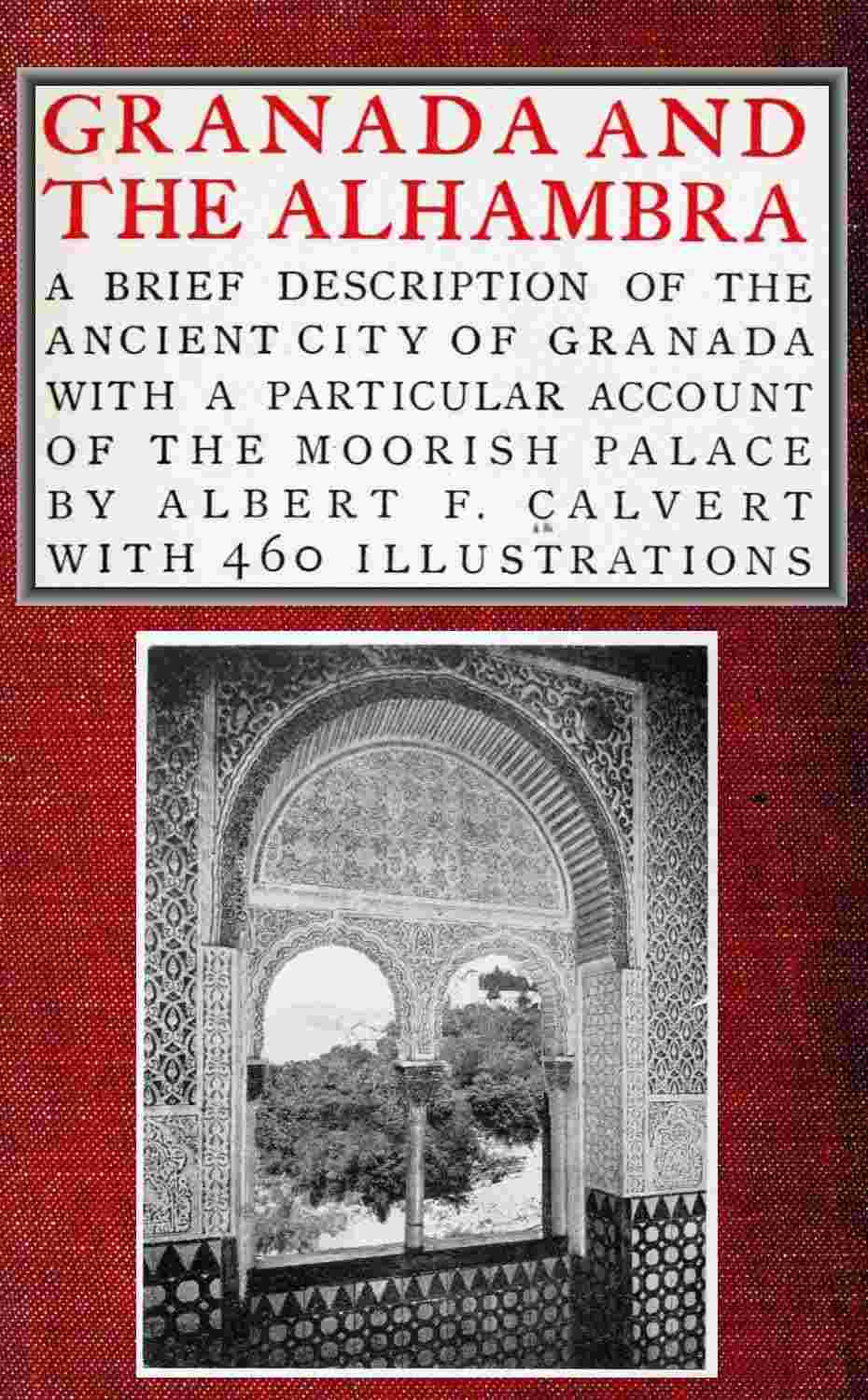
G R A N A D A
THE CITY OF THE MOOR
Granada is the creation of the Moors. Its history is all of them—the record of their glory and their fall. The Pomegranate, as its conqueror styled it, ripened only in the warm sunshine of Islam, and withered with its decline. Under the Christian, it fell from the rank of a splendid capital to a poor provincial town. Now it subsists merely as a great monument to a vanished race and a dead civilisation.
With Granada before it became the centre of an independent kingdom, we need concern ourselves but little. Its real interest dates from the establishment of the Nasrite dynasty in the first half of the thirteenth century. It was the time when the great Almohade Empire was breaking up. Probably all Andalusia would have shared the fate of Cordova and Seville, and the conquests of the Catholic kings been anticipated by two centuries, had not a young man of Arjona, Ibn Al Ahmar by name, determined to fashion for himself a kingdom out of the fragments of empire. With an ever-increasing following, he seized upon Jaen in 1232, and obtained possession of Granada itself in 1237. City after city opened its gates to him, including Malaga and Almeria, and in 1241 he was recognised as Lord and Sultan of all the territory between the Sierra Morena and the Pillars of Hercules, from Ronda to Baza.
A great man, in every sense, was this founder of the Nasrite dynasty. His presence was fine and commanding, his manner bland and amiable, his courage worthy of the heroic age. For all his valour and prowess on the battlefield, no monarch prized peace more highly. He proved himself a true national hero and the father of his people. He fostered industry and agriculture, was a patron, like all his race, of arts and letters, and encouraged immigration by every means in his power. A far-sighted statesman, he perceived that a state so limited in area as his own could only hope to exist by virtue of an unusual density of population, and he offered every inducement to Muslims from the provinces conquered by the Christians to settle within his dominions. Granada was the last hope of Islam in Europe, and he resorted to all possible means to safeguard it. He concluded alliances with the rulers of Morocco, Tlemsen, and Tunis, and even of distant Baghdad. Above all, he neglected no means of humouring and conciliating the irresistible Castilian. He negotiated an alliance with Fernando III., binding himself to attend the Cortes (a curious stipulation for a Mohammedan) and to attend the king in his wars with 1500 lances. This latter part of the bargain he was speedily called upon to fulfil, and against his own co-religionists of Seville. It seemed an unnatural warfare, but, to palliate the iniquity, let it be said that Ibn Al Ahmar probably looked upon the Almohade citizens of Ishbiliah as heretics. At all events, whether his conscience approved his action or not, he contributed in no small measure to Fernando’s success, and was hailed enthusiastically as a conqueror upon his return to Granada. That the assistance he rendered was not looked upon as altogether voluntary by the people of Seville is shown by the fact that thousands of them migrated to his dominions and settled there.
Ibn Al Ahmar dreaded the might of Castile. The only hope for the Mohammedans of Spain lay, he knew, in rest and consolidation. Careful not to give offence to his dreaded neighbour, he courteously received the revolted and exiled Infante Don Enrique when he sought refuge at Granada, but sent him on to Tunis with letters recommending him to the Sultan of that country. All his diplomacy, however, could not avert a war with Alfonso, and to add to his troubles, the Walis of Guadix, Malaga, and Gomares revolted against his authority. But an insurrection soon after broke out in Castile, and Alfonso was compelled to leave the Walis to fight their own battles. Ibn Al Ahmar, an old man of eighty years, wearily girded on his armour for another of the campaigns he had learned to hate. But his time for rest had come at last. A few miles beyond the gates of his capital, his charger threw him, as he rode at the head of his army. He breathed his last at sundown, by the roadside, surrounded by his weeping warriors. It was a dark night for Granada.
Al Ahmar’s son, under the style of Mohammed II., succeeded him at the age of thirty-eight years, on January 21, 1273. Arabic historians have lavished their encomiums upon him, as indeed upon most of his dynasty. He is described as a warrior and a statesman, as a man of letters and a poet of considerable ability. During his reign of twenty-nine years, he was almost continuously at war. Soon after his accession he crushed the rebel Walis at Antequera, and then paid a visit to Alfonso X. at Seville, with a view to detaching the Castilian king from his alliance with the defeated insurgents. In this he was successful. Queen Violante, however, at the conclusion of his visit, asked of him a boon, which, according to the custom of the times, as a true knight, he was bound to grant. He then discovered, too late, that he had been tricked into granting a year’s truce to the Walis. Smouldering with rage, he returned to Granada and spent the year in maturing plans for the complete overthrow of his enemies. This he effected with the aid of the Sultan Yusuf of Morocco, whose army of 100,000 men landed at Tarifa in 1275. The Africans, as on previous occasions in Moorish history, proved dangerous allies. Mohammed found himself embroiled in a long and absolutely unprofitable war with Castile, and had the mortification of seeing the Africans possess themselves of Algeciras, Tarifa, and Malaga. He recovered possession of the latter town by bribing the governor to exchange it for the town of Salobreña, to be held as a personal acquisition; and rid himself at last of the troublesome Africans by means of an alliance with Sancho of Castile. But in 1302 we find him again at war with the Christians, fighting against whom he died.
Mohammed III. was the worthy son of his father, and is specially commended for his indefatigable energy. He took a short way with traitors, even for those rough times. Ibn Nasr, the governor of Guadix, having been removed from his office by the Sultan, exerted himself to form a faction in his favour. Mohammed III., hearing of this, summoned him to court, and had him slain there and then in his presence. A more honourable exploit was his conquest of the town of Ceuta, opposite Gibraltar, in the year 1306. With the rich spoils of the foray, he built a magnificent mosque at Granada, resplendent with gold and silver, jasper and marble. His success perhaps excited the jealousy of the Catholic powers. Attacked on either side by the Kings of Castile and Aragon, he was forced to conclude a humiliating peace. On his return to his capital he was seized in the Alhambra itself by a band of conspirators and forced to abdicate in favour of his brother, Muley Nasr. The new Sultan began his reign with some military successes (1309). He forced Jaime of Aragon to raise the siege of Almeria; but as a set-off, he had to deal with conspiracies and rebellions at home, the most formidable of these being headed by his nephew, Abu-l-Walid. In the midst of these complications a curious incident occurred. Nasr was stricken with apoplexy and left for dead. His deposed brother, Mohammed III., was then released by some courtiers and brought to Granada, only to find that the usurper had recovered his health and his crown. The luckless Mohammed did not long survive his partisans’ mistake. But retribution speedily overtook his brother. He was forced to yield to Abu-l-Walid, and was glad to be allowed to retire to Guadix, the sovereignty of which was allotted to him. Usurper though he was, Nasr conducted himself with the dignity of a philosopher. His rival’s triumph chagrined him not at all, and when invited by Pedro I. to join him in an attack on Granada, he patriotically declined. He was a brave man, who did not complain at meeting the fate to which he had subjected others.
The new monarch of Granada, Abu-l-Walid Ismail, was a fighter and a fanatic. He was fond of saying that he believed only in God and his good sword. His faith in the latter weapon was justified. He annihilated a Spanish army which had approached Granada, among the slain being the Infantes, Don Juan and Don Pedro; and carrying his victorious arms eastwards, wrested Baza and Martos from the enemies of his race. But others also reposed their faith in the sword. Like another Agamemnon, he appropriated a beautiful captive, the prize of the young Mohammed of Algeciras. Three days after his triumphal entry into his capital he fell at the gates of the Alhambra, a victim to the poniard of the man he had injured. Perceiving his sovereign to be at the point of death and resolving to avert the horrors of a disputed succession, the Wizir summoned the chief men of Granada to the palace, and announced that Abu-l-Walid was recovering from his wounds. The royal order was that all present should take the oath to the boy-prince, Muley Mohammed Ben Ismail, as successor to the kingdom. When this command had been obeyed, the wily Wizir announced the death of Abu-l-Walid and the accession of Mohammed IV. This was in the year 1325.
When he had freed himself from the control of an unpopular regent, the young Sultan displayed qualities of heart and mind in no way inferior to those of his progenitors. It must be admitted that Arab historians have been somewhat too partial to this line of kings, for there is hardly one who is not described more or less explicitly as a paragon of all the virtues. Mohammed IV. had to fight hard to hold his own against the Spaniards on one side and the Africans on the other. He took Gibraltar, and lost it again to Abu-l-Hasan of Fez. But the African king was soon after obliged to ask his help to hold the fortress against the Christians. Mohammed generously responded to the appeal, fell like a thunderbolt upon the Spanish camp, and raised the siege. He was ill repaid. In August 1333, he was imprudent enough to reproach his African allies with their inability to hold the fortress; and a day or two later, having sent his army home, made an excursion to the summit of the Rock. He was followed by some among those he had reproached, and quickly despatched by their poniards. His body, naked and mangled, was found at the foot of the Rock, and conveyed to Malaga. No attempt seems to have been made to identify or to punish his murderers.
The ill-fated Mohammed was succeeded by his brother, Yusuf I., Abu-l-Hejaj. While possessed, of course, of the virtues which seem to have been inherent in the Nasrite dynasty, this prince was exceptional in being an ardent, almost a passionate, lover of peace. He believed, says Don Francisco Pi Margall, that it was more glorious to remedy evils than to attempt perilous enterprises. Assisted by his able Wizir, Redwân, he revised the laws and purified the administration of justice. He built a magnificent palace at Malaga, and the great aljama or mosque at Granada, of which no trace remains. Abandoning for once his settled policy, he joined the Africans in a war against Castile. He was badly beaten, and was glad to negotiate a truce of ten years. At the end of that time, Alfonso of Castile died, and the Sultan of Granada was stabbed to death by a madman, while at his prayers in the mosque, in the year 1354.
Mohammed V. was as virtuous and as unfortunate as his father. He had reigned but four years when he was attacked in his own palace by the partisans of his half-brother, Ismail. Narrowly escaping death, he fled to his harem, and in the disguise of a slave eluded his pursuers and made his way to Guadix. Ismail II. ran a brief and inglorious career, and was dethroned and slain (1360) by the “Red King,” Abu Saïd. Meantime, Pedro I. of Castile espoused the cause of the lawful sultan and invaded the territory of Granada. But the magnanimous Moor would not consent to remount the throne at the cost of his people’s blood. Pedro accordingly withdrew, but freed Mohammed from his enemies by murdering Abu Saïd when the latter incautiously paid a visit to Seville. Mohammed was reinstated on his throne, and mindful of the services rendered him by Pedro, advanced to his support with a Grenadine army against Enrique de Trastamara. The tragedy of Montiel made a continuance of the struggle useless, and the Moorish sultan devoted the remainder of his reign to improving the condition of his subjects. He founded charitable institutions and asylums, and raised Granada to a high pitch of prosperity. The city, according to the contemporary writer, El Khattib, became the metropolis of the Mediterranean, the emporium of commerce, and the common fatherland of all nations. Under Mohammed V., the kingdom may be considered to have reached its zenith. Thence to its nadir we count but a century of years.
Yusuf II., who succeeded his father in 1391, was so averse to war that his subjects suspected him of Christian sympathies. His son rose against him, and the pacific monarch was disposed to abdicate rather than draw the sword. The exhortations of the Moroccan ambassador induced him to take a manlier course, and putting himself at the head of the army lately arrayed against him, he ravaged Murcia with fire and sword. It was against this peace-loving sultan that Don Martin de la Barbuda, the Quixotic Master of Calatrava, directed his wild expedition—defeated, of course, and emphatically disavowed by Enrique III. of Castile. Yusuf’s younger son and successor, Mohammed VII.,[A] was a prince of a very different stamp. Accompanied by only twenty-five horsemen, he penetrated to Toledo, and negotiated in the heart of Castile with Enrique III. The peace thus concluded was soon interrupted, and Mohammed was quickly waging war throughout the length and breadth of Andalusia. The war continued with varying fortunes, and was carried on, as was usual in those days, by a series of forays, neither side making any determined effort to take the other’s capital or to secure his conquests. On feeling his end approaching, the warlike Sultan bethought him of his elder brother, Yusuf, whom he had confined in the castle of Salobreña. Fearing that the captive might now supplant his own son, Mohammed sent a messenger to command his execution. Yusuf was playing chess with the governor of the castle when the fatal mandate arrived. He asked leave of the emissary to finish the game, and before he had made the final move, the news arrived of the death of Mohammed and of his proclamation as Sultan of Granada. Yusuf showed himself as calm and unmoved at his accession to the throne as when he had stood upon the threshold of death.
As peaceably disposed as his father, Yusuf III. had to withstand some of the most determined assaults upon his doomed kingdom. In his reign took place the celebrated siege of Antequera by the Castilians, the survivors of which founded the suburb of Antequeruela adjacent to Granada. Yusuf ultimately found peace and a valuable ally as the outcome of a strange story of fraternal animosity. The people of Gibraltar revolted against Granada and proclaimed themselves the subjects of Fez. The Sultan of that realm sent his hated brother, Abu Saïd, to take possession of the town, and treating him as David did Uriah, left him at the mercy of the enemy. Yusuf, however, treated the captured prince with generosity, and showed him a letter which he shortly after received from the Sultan of Fez, requesting that he might be poisoned. Thirsting for vengeance, Abu Saïd procured arms and soldiers at Granada, and, invading Morocco, drove his perfidious brother from the throne. Thereafter he was the sworn ally of the Sultan of Granada, whom Castile and Aragon no longer ventured to trouble. Yusuf III. passed away in 1417.
The history of Granada is henceforward one of almost continuous revolution and tumult. Mohammed VIII. was driven into exile by a namesake reckoned as the ninth of his name, and then restored by a counter-revolution. A Castilian army ravaged the Vega up to the walls of the capital. Granada itself would have fallen, had not Juan II. and the great Constable, Alvaro de Luna, been recalled to Castile by the disorders which resulted in the latter’s overthrow. An earthquake desolated the distracted kingdom; and we may suppose that Mohammed VIII. was not altogether sorry when he abandoned his throne to a pretender and fled to Malaga.
The new sultan, Yusuf IV., held his throne as a fief of Castile, the support of which he had to purchase with humiliating concessions. He anticipated inevitable assassination by dying after sixteen months of authority; and for the third time, Mohammed VIII. was proclaimed at Granada (1432). Hostilities with Castile were at once renewed. This time the fortune of war was with the Moors, who routed their opponents at Illora, Archidona, and Castril. But Mohammed VIII.’s star was never long in the ascendant. He quarrelled with the powerful family of the Abencerrages; and, deprived of their support, was finally expelled from his kingdom, by his kinsman, Aben Osmin.[B] The usurper was victorious over the Christians and took several strongholds, but his army suffered at last a bloody defeat at Alporchones. This reverse seems to have maddened Osmin, who henceforward conducted himself as a tyrant of the old Roman type. Revolutions had now become as frequent in Granada as in some South American states. The usurper ran his brief career, and was then forced to make room for Mohammed VIII.’s cousin Saïd. Granada was all for peace. Tribute was paid to Enrique IV. of Castile, Christian captives released—all in vain. The intermittent warfare went on as before. Jaen, Archidona, Gibraltar, were lost, despite the desperate valour of the Prince, Muley Hassan, and of the Chieftain, Ibrahim, who, on being vanquished, plunged on horseback into the depths of a ravine. At last, however, the distracted Ibn Ismail obtained peace for his wretched country by a personal interview with Enrique, outside the walls of Granada. He devoted the remainder of his reign to the encouragement of commerce, industry, and agriculture in his dominions—labour that did not benefit even those who were to succeed him; and died at Almeria in the year 1465. The knell of the Moorish Empire in Europe was sounded over his bier.
The reigns of Ali Abu-l-Hassan, Mohammed XI. (Boabdil), and Mohammed XII. (Az-Zaghal) covered the years 1465-1492, during which the downfall and extinction of the kingdom were accomplished. The history of these events has already filled many bulky tomes, and has been made familiar to English readers by the works of Prescott. Even our brief survey, however, cannot be concluded without a summary of the last chapter of the story of Granada.
The character of Muley Ali Abu-l-Hassan was the reverse of his predecessor’s. He was arrogant, impetuous, and warlike, a fanatical hater of the Christians, and a zealous Muslim. In the first years of his reign he gained some successes over the feeble Enrique IV., and proved himself strong enough to quell a revolt at Malaga. But he let slip the opportunity of attacking the new sovereigns of Spain, Ferdinand and Isabel, when they were engaged in war with the partisans of “La Beltraneja,” nor did he make any attempt to effect an alliance with their numerous enemies. State-craft does not appear to have been possessed to any great extent by the descendants of Al Ahmar. In 1476, Abu-l-Hassan condescended to sue for a renewal of the alliance with the Queen of Castile; but when Ferdinand of Aragon made the payment of the tribute stipulated by Ibn Ismail a condition of the treaty, the Moor’s proud nature revolted. “Return to your sovereigns,” he said to the Spanish ambassadors, “and tell them that the sultans who paid tribute to the Christians are dead; that here we manufacture only iron spear-heads for our enemies.” These words sealed the fate of the Moors in Spain, though the ruler who uttered them probably thought them merely the prelude to just such a frontier war as had raged intermittently for so many years.
The first act in the long-drawn-out drama was the capture of Zahara by the troops of Granada, in 1481—provoked by the predatory incursions of the Marquis of Cadiz. The Christian garrison was surprised during a furious tempest, and put to the sword. The rest of the inhabitants were carried off in captivity to Granada. Abu-l-Hassan, inflated with pride, returned to his capital. There were popular rejoicings, but the wiser Moors shook their heads and predicted that the ruins of Zahara would fall upon their own city.
The fiery chivalry of Andalusia were not slow to retaliate. Two months after the capture of Zahara, the more important Grenadine stronghold of Alhama was taken by storm by the forces of the Marquis of Cadiz. The news produced the utmost consternation in Granada. Abu-l-Hassan at once set out with 53,000 men, and invested the place. Ferdinand the Catholic, who had now conceived the idea of reducing the whole kingdom of Granada, hurried to its relief; but he had only reached Lucena when tidings arrived of the raising of the siege by the Marquis’s hereditary foe, the Duke of Medina Sidonia. Abu-l-Hassan returned to the attack a few weeks later, and Ferdinand resumed his advance, before which the Moors retired. The Catholic sovereigns made their triumphal entry into Alhama on May 14, 1482.
Great preparations were made throughout Castile and Aragon for the prosecution of the war, but the army actually assembled before Loja on July 1—16,000 men—fell far short of Ferdinand’s requirements and expectations. The town was ably defended by one of the bravest Moorish chieftains, Ali Atar, who repulsed the Christians with severe loss. The King of Aragon narrowly escaped with his life, and was compelled to beat a retreat. Abu-l-Hassan swept the country as far as the Rio Frio.
Such a success, if it had been followed up, might have turned the scale in favour of the Moors. But at Granada, treason always followed closely on the heels of victory. Years before, a beautiful Christian captive, Doña Isabel de Solis, daughter of the Governor of Martos, had been added to the Sultan’s harem. Under the name of Zoraya, in the course of time, she bore him a son, Abu Abdullah, and rose to the rank of favourite Sultana.[C] Now, jealous, it is said, of a Greek slave, or perhaps antagonised by the first Sultana, Ayesha, she fomented a conspiracy against her aged lord, and was imprisoned with her son in the Alhambra. Thence they contrived to escape, and, exciting the populace in their favour, obliged Abu-l-Hassan to seek refuge at Malaga. Abu Abdullah, better known as Boabdil, or el Chico (the little), reigned in his stead, but Baza, Guadix, and other eastern towns remained faithful to their old allegiance.
These dissensions among the Moors, though ultimately benefiting the Spaniards, contributed indirectly to one of the most serious disasters that befell the latter during the campaign. For an expedition against Malaga, headed by the Marquis of Cadiz and the Grandmaster of Santiago, while threading its way through the passes of the Ajarquia, was attacked by the lieutenants of the old lion, Abu-l-Hassan, and cut to pieces. Eight hundred Spaniards were left dead on the field. Boabdil, emulous of the glory his father had acquired, marched out of Granada with 9700 men, and gave battle to the enemy under the Count of Cabra, near Lucena. The Moors were totally defeated, their bravest general, Ali Atar, was slain, and Boabdil himself captured by a private soldier, named Martin Hurtado.
Had this unlucky prince been left in the hands of his enemies, the war might have had a different result, but his mother and followers at once made proposals for his release. This was finally effected by a most dishonourable treaty. Boabdil was accorded a two years’ truce, covering all places that acknowledged his authority, and in return bound himself, not only to pay a tribute of twelve thousand golden ducats, but to assist with supplies the Spanish troops passing through his dominions to attack his own father. Having thus exchanged his honour for his liberty, the miserable Sultan returned to his capital, to find that the old King had possessed himself of the Alhambra. A collision between the two factions deluged the streets of Granada with blood. The alfakis and ancients at length arranged an armistice, and Boabdil was suffered to retire to Almeria, which was assigned to him as capital and residence.
For the next four years, the Catholic sovereigns abstained from any important military demonstration, contenting themselves with ravaging the wretched country and harrying its frontiers with incessant forays and marauding expeditions. Meanwhile, a strong man appeared on the scene in the person of Abu-l-Hassan’s brother, Abdullah Az-Zaghal. Determined to put an end to the divisions which, more than the prowess of the Spaniards, were bringing about the ruin of his country, this prince swept down upon Almeria, slew the governor, took prisoner Zoraya, but failed, alas! to secure the person of Boabdil, who fled to Cordova and placed himself under Ferdinand’s protection. Not long after, Abu-l-Hassan, aged and worn out, abdicated in favour of his warlike brother, and died at Mondujar. This event strengthened Boabdil’s claims upon the tottering throne; and he entered into a compact with his uncle, whereby both were to reign in Granada, the one in the Albaicin, the other in the Alhambra. Anxious to redeem his reputation, the newly restored monarch attacked the Christians near Loja with vastly inferior forces. He was soundly beaten and forced to take refuge in the Alcazar of Loja, whence he was only allowed to emerge on renewing the humiliating treaty he had concluded at Cordova. He was not, however, disposed to yield the crown to his rival, and returning to Granada, surprised and seized the Alcazaba. One of the most desperate conflicts recorded in the history of the city then occurred between the partisans of the rival sultans. Further bloodshed was at last averted by the intervention of ambassadors sent by Ferdinand. The old dual arrangement seems to have been temporarily resumed. Meanwhile, Ferdinand and Isabel once more took the field, and, in 1487, they invested and captured Velez-Malaga and the important city of Malaga, notwithstanding Az-Zaghal’s efforts to relieve both places. The brave Sultan now abandoned the capital to his nephew, and established his headquarters at Almeria. He succeeded throughout the year 1488, in repelling an invasion of his province; but in the following year, after the fall of the strong city of Baza, he bowed, as he himself expressed it, to the will of Allah, and surrendered all the places in his possession, including Almeria and Guadix, to the Catholic sovereigns. Mohammed XIII., as he is styled by Moorish historians, retired to Algeria, where he died, years afterwards, in indigence and obscurity.
There remained now, of all the Moorish dominions in Europe, but the single city of Granada, of which Mohammed XII., Boabdil, was at last undisputed sovereign. He formed the manly resolution to sell his hard-won crown as dearly as possible. He sallied from Granada, took Alhendin and Marchena by assault, and laid waste the country in possession of the Christians. Summoned by Ferdinand and Isabel to surrender the city in accordance with an alleged treaty, he replied, and probably with truth, that his proud and exasperated subjects would not permit him to do so. The population of Granada was swollen by refugees from all parts of the kingdom to thrice its normal figure. The Spanish king perceived that the surest method to reduce it was by blockade. With 20,000 men, including some of the first chivalry of all Europe, he entered the Vega, and built the town of Santa Fé, almost at the gates of the threatened city. This permanent establishment of the Infidels on their native soil plunged the Moors into profound gloom. No ray of hope remained to the unfortunate Boabdil. The city endured the horrors of a famine. The Spanish fleet precluded all hope of supplies from Africa, towards which country the wretched people still turned in expectation of help. The negotiations for the capitulation which the Sultan most reluctantly entered upon in October 1491, had to be conducted, through fear of the populace, with profound secrecy. Indeed, at the last moment, Boabdil, in danger of his life, besought Ferdinand to accelerate his entrance into the city. On January 2, 1492, accordingly, the Moorish king, attended by fifty horsemen, surrendered the keys to the Catholic sovereigns on the banks of the Genil, passing on to the domain allotted him by the conquerors in the rocky Alpujarras. The story of his stopping to gaze for the last time on his former kingdom, and of the rebuke administered to him by his mother, is well known. We are not told whether his eye caught the gleam of the great silver cross hoisted over the Alhambra by Cardinal Mendoza by way of signal to the Spanish host that the occupation of Granada was completed and that the dominion of Islam in Spain was for ever at an end.
It had endured seven hundred and eighty-one years—a period only sixty years short of that which has elapsed since the Norman Conquest of England. More remarkable still, the Sultanate of Granada had survived the virtual break-up of the Saracen empire by over two centuries. When we consider its limited area, its isolated position, the might and the inveterate hostility of the neighbouring states, and the attacks to which it was unceasingly subjected, we cannot but feel the liveliest admiration for the valour and sagacity of its rulers and the stout-heartedness of its people. Had not the Court been too often the theatre of contending factions, had not those factions turned their swords against each other, the Sultanate of Granada might have outworn Spain’s military and national vigour, and have endured to our own day as a western Turkey. For the spirit of Tarik, of Abdurrahman, and of Almansûr was not altogether dead, even in the brave but ill-starred sovereign to whom alone historians ascribe the downfall of the kingdom, and whom they, strangely enough, accuse of effeminacy and weakness. The Moors of Granada knew how to fight a losing fight; in gambler’s parlance, when they had lost the tricks, they struggled to win the honours. They proved themselves worthy of their ancestors; and the finest, as it was also the latest, monument of the Mohammedan dominion in Spain is Granada the noble and the memorable.
THE ALHAMBRA
The Alhambra, or Red Palace, the Acropolis of Granada, is the finest secular monument with which the Muslims have endowed Europe. It belongs to the last period of Spanish-Arabic art, when the seed of Mohammedan ideas and culture had long since taken deep root in the soil and produced a style which might more properly be called Andalusian than Moorish. If the Muslims left a deep impression upon Spanish thought and art, it must not be supposed that they altogether escaped the influence of their Christian neighbours. During the last two centuries of their occupation the rigid puritanism of their creed was greatly relaxed, especially as regarded art—always the reflection of the customs and spirit of a people. The wave of the Renaissance did not leave untouched the shrunken Moorish empire, and if Castilian kings did not hesitate to employ Muslim artisans in the construction of their cathedrals, the Sultans of Granada did not disdain the advice of Christian artists in the embellishment of their palaces. The Alhambra remains a thoroughly Mohammedan monument, but one which symbolises a phase of Mohammedan culture and institutions almost peculiar to one country and epoch. Nowhere else and never since has Islam reached such a pitch of refinement. The Alhambra stands as the high-water mark of its art and civilisation.
There will never be produced a new Alhambra, any more than a new Parthenon or new Pyramids; for these great buildings were the expressions of ideas and aspirations peculiar to societies which have long ago perished. Thus, the Red Palace of Granada is not interesting merely as a Mohammedan edifice left isolated in the far west of Europe, but as the monument of a people and a civilisation long dead and gone. A sadness, too, attaches to it, proceeding from the memory of the violent extinction of that people with a mission unfulfilled—fraught, as it seems to have been, with so much of light and beauty to the Christian and the Muslim worlds.
The Sierra Nevada thrusts forward a spur which overlooks Granada on the south-east, and is divided by two clefts or barrancos into three eminences. The easternmost of these is crowned by the Generalife, the westernmost by the ancient fortifications known as the Torres Bermejas or Vermilion Towers. The hill between the two—in shape aptly compared by Ford to a grand piano—is that on which the various buildings, collectively styled the Alhambra, are reared. Here there existed a settlement in remote Celtiberian days; and the later city of Illiberis or Elvira stood here, and perhaps extended to the Torres Bermejas. When the Moors came they erected a fortress—the Alcazaba—on the point of the Alhambra hill, overlooking the Vermilion Towers. To this they gave the name of Alhamra, “the red,” as Riaño thinks, to distinguish it from the Alcazaba in the Albaicin quarter, or perhaps from some confusion of the new building with the old. The builder, according to Al Khattíb, was one Sawar Alcaysi, who lived in the second half of the ninth century; though Contreras says it was known as the Tower of Ibn Jaffir, and Ford names Habus Ibn Makesen as the founder. At all events, the structure dated from the earliest period of the Arabic domination, and Al Ahmar found here, on taking possession of Granada, a small town girdled with walls and defended by a citadel.
Al Khattíb refers to the Citadel of Granada in these terms: “The southern part of the city is commanded by the suburb of the Alhambra or Medina Alhamra, the court of the sultanate, crowning it with its turrets, its lofty towers, its strong bastions, its magnificent Alcazar, and other sumptuous edifices, which by their splendour ravish the eye and the soul. There is, too, such an abundance of waters that, overflowing in torrents from the tanks and reservoirs, they form on the declivity streams and cascades, whose sonorous murmurs are heard afar on. At the foot of the walls are spacious gardens, the domain of the Sultan, and leafy groves, through the dense greenery of which the white battlements gleam like stars. There is, in short, around the circuit of the walls, no spot that is not planted with gardens and orchards.” The scene has not greatly changed since the Arab wrote. Gurgling brooks still run down the slopes of the Alhambra Hill, and nightingales sing in the thick woods of elm.
The Alcazaba, being the oldest part of the palace-fortress, should be studied first. It is entered by the Torre and Casa de las Armas, through a horseshoe arch in red brick, with fine azulejos or glazed tiles. To the left is the Torre de Homenage, with which war and time have not dealt too gently. It contains, it is interesting to note, a Roman votive altar, embedded by the Moorish builders in the masonry, and inscribed by “the grateful Valerius to his most indulgent wife, Cornelia.” At the opposite extremity of the Alcazaba is the Torre de la Vela, or Watch Tower. It is in two storeys, communicating by a dark and narrow staircase, with loopholes in the wall.[D] In this tower is hung a famous bell, to be heard, it is said, at Loja, thirty miles away. It is rung on the anniversary of the Conquest of Granada, on which day it is the custom, according to local superstition, for damsels, desirous of husbands, to strike it with all their strength. On the summit of this tower the cross was first planted by el tercer rey, Cardinal Mendoza. The view from the platform, of city and snow-clad Sierra, luxuriant Vega, and white-walled towns and villages, is as extensive as it is beautiful. At the foot of the Torre de la Vela extends the place of arms, defended by two towers, now styled de los Hidalgos and de la Polvora, and formerly known as the Paniagua and Cristóbal del Salto—names suggesting legends now forgotten.
An ancient document at Simancas names among the towers connecting the Alcazaba with the rest of the fortress, the Torre del Adarguero, “the Tower in which dwelleth the servant of Doctor Ortiz,” the Torre de Alquiza, the Torre de Hontiveros (now the Torre de las Gallinas), and the Tower and Room of Machuca. Of these remains exist, but of another tower, referred to as the Torre de la Tahona, no trace remains.
The Alcazaba, according to the most recent researches, was separated from the site of the palace by a ravine where, after the Conquest, cisterns were constructed by order of the Conde de Tendilla and over which the existing Plaza de los Algibes was formed. These works appear to have necessitated the demolition of a wall which ran across from the Torre de las Gallinas on the north to the beautiful Puerta del Vino on the south. This gateway is now quite isolated from the wall of circumvallation. Over the horseshoe arch is an inscription in stucco, of the usual Moorish character, invoking the Divine protection for the builder, Sultan Mohammed V. It appears to commemorate some striking victory. Over the arch again is a fine double window or ajimez. On the keystone is seen the key, so often figuring as a symbol in all parts of the Alhambra, with a G in Kufic characters—perhaps the initial letter of the city. The interior façade has a large horseshoe arch and the twin-windows above. The Puerta del Vino was probably the entrance to the courts and gardens of the palace.
Having crossed the Plaza de los Algibes, we leave behind us the early Moorish works, and approach the buildings which owe their foundation to the Nasrite or Grenadine dynasty. The story which credits Al Ahmar (Mohammed I.) with the creation of the Red Palace in the middle of the thirteenth century appears to be well-founded, for when the Alhambra is referred to as existing in earlier times, it is undoubtedly the Alcazaba that is meant. To the same hands may be safely attributed the great outer wall of the Alhambra which girdles palace and fortress, following the inequalities of the hill’s contour. Al Ahmar has left his device, Wa ha ghalib ila Allah (There is no conqueror but God), in many parts of the building. These words were uttered by him in mournful deprecation of the acclamations of his subjects on his return from assisting the Christians in the Conquest of Seville. During the two and a half centuries of the Nasrite rule, the palace underwent many radical transformations and renovations, so that it is difficult to distinguish between the works of the various sultans. Ford infers, rightly as it seems to us, from the frequent repetition of their names upon the walls, that Yusuf I. and Mohammed V. had the largest share in the embellishment and restoration of the edifice. Since the Reconquest many changes and additions have been made—notably the Palace of Charles V., to which detailed reference will be made later.
The summit of the Alhambra hill was probably peopled in Al Ahmar’s time, and it continued to be so during the reigns of his successors. The population thus dwelling at the foot of the throne was mainly composed, in later times at least, of hangers-on at the Court, ex-favourites and discarded sultanas, ulemas and doctors of the law, soldiers of fortune, and ambassadors, permanent and extraordinary. Such powerful tribes as the Beni Serraj, which exercised so much influence in the last stages of Nasrite rule, would also have had quarters for their leaders here. The little town—which seems to have had no parallel before or since—extended from the eastern extremity of the hill to within as near the doors of the palace as the temper of the monarch for the time being may have permitted.
The precise limits of the palace, even at the time of the Conquest of the Catholic sovereigns, have never been ascertained. Portions of it were undoubtedly demolished to make room for the palace of Charles V. On the other hand, it is recorded in the archives of the Alhambra that various private houses were acquired for the purpose of enlarging the older building. But making due allowance for demolitions, extensions, and restorations since the fifteenth century, we have before us in the Palace of the Alhambra a magnificent example of the last or third period of Hispano-Arabic architecture.
On the general plan of the edifice, the remarks of Contreras are worth quoting in extenso: “We penetrate into every Arabic monument through an outlying tower, or between two towers, except in the dwelling-houses of the people, in which case the entrance is by a small, square opening, a portal useless among us, though seen with frequency in the ancient houses of Andalusia. A long, narrow hall cuts the axis perpendicularly, thus determining the distribution into two wings of the edifice. By the meeting of the two axes is found the entrance, before which we find those effects of perspective which are so fantastic in these buildings. Following the ingress we find a court with tanks and fountains, with light and graceful arcades. Behind the second gallery, following the same central axis, are oblong naves which cross each other at right angles to the extreme end of the building, where the cupolas or turrets of the innermost dwelling apartments rise majestically above the level of the edifice and are reflected in the waters of the basins. The halls of a house of this kind, according to its rank or grandeur, were arranged in little pavilions on the long sides of the courts, as various in their style of decoration as the tents of a Turkish camp, where the quarters of an Amir may be found beside those of the common soldiers. And if these rows of chambers are now found disposed according to the strict alignment of Mudejar eaves, it is an indication that the severe genius of the Christian conquerors has transformed them, not permitting those crests, cupolas, or steeples which disturb the symmetry of the decoration.
“Outside this plan, absolutely classical, which we may compare to a cross with the transverse arm prolonged and cut at various distances by perpendicular arms parallel to each other, but of different length, the Spanish Arabs found no other easy method of building, so that, while diminishing or prolonging the arms of the axis as much as the dependencies of the largest palaces might require, they never departed from the system, wherever they might build.... This, then, is the true scheme of the Alhambra, and it is quite other than that conceived by the classicists of the eighteenth century, with its façades, angles, and squares.”
It must, however, be admitted that order is much more conspicuous in the decoration than in the ground plan of the palace. All Moorish ornamentation is based on a strictly geometrical scheme, and every design may be resolved into a symmetrical arrangement of lines and curves at regular distances. The intersection of lines at various angles is the secret of the system. All these lines flow from a parent stem, and no figure or ornament is introduced at random. Moslem ornamentation abhors irregularity and rejects symbolism. The law of Islam which forbade the delineation of living objects was not, however, always observed in this palace of half-Europeanised Arabs.
Simplicity and a love of the elementary characterise also the colouring of the decorations. On the stucco work only the primary colours were used: blue, red, and yellow. The secondary colours occur only in the dados of mosaic. The green groundwork of much of the ornamentation as it is to-day was formerly blue, time having changed the tint of the metallic pigment employed. The decoration of the surfaces seems to have been planned with strict regard to the colouring they were to receive. Both as regards decoration and colour, allowance must always be made for innovations since the Alhambra passed into Christian hands.
“Let us look for a moment,” writes Mr. John Lomas, “at some points of detail—more especially of the ornamentation. Wherever the eye falls, it may rest upon some fine bit of arcading or peristyle, so delicate in the transparent tracery of its spandrils, in the rich work of its capitals, and its slenderness of pillar, that one marvels at first how such fairy-like construction could stand for even a single generation. ‘Lovers’ tears’ they call this lace-work, and they tell one to stand just within the dim hall or vestibule, and get a vision of the blue sky that appears beyond as a little cloud of sapphires. But it is surely better—an insight into a piece of truer art—to stand outside the eastern kiosk of the Lion’s Court and looking through spandril, vestibule, and sala, catch the light glinting through the distant opposite windows. That is transparency of effect, indeed! One would like to meet with the architect who thought it out.
“Some of the irregularities which obtain here seem almost incredible. What could be more satisfactory than this range of exquisite arcading, its slender palm-like stems, its gracefully stilted arches, and the fairy filigree-work of the spandrils? There seems to be not one single point that can offend the justest eye, and yet there are nearly a dozen different archings, differing in form, or height, or width; the cloister varies in breadth at every turn; the upper galleries are uneven; the doorways are the personification of self-will; the columns are placed, sometimes singly, sometimes grouped, and the numbers of them on the respective sides in no way correspond.... And, nevertheless, there is an all-prevailing symmetry—and harmony. The whole is a triumph of accurately judged effect.”
In a foot-note Mr. Lomas adds: “As an instance of the careful way in which the architects of these olden days went to work, it may be mentioned that the exact relation between the irregular widths of cloistering on the long and short sides of the court is that of the squares upon the sides of a right-angled triangle. This obtaining of beautiful symmetry through irregularity is a strangely lost art.”
We will now proceed to a more detailed description of the Palace of Al Ahmar.
The Patio de la Mezquita and adjacent Buildings.
Recent researches have shown that the ancient ingress to the Palace of the Alhambra was by a doorway leading into what is now the chapel. It is square in shape and has long been walled up. Above it may be deciphered the following inscription: “O place of the high kingdom and asylum of prodigious aspect! Thou hast achieved a great victory, and the merits of the work and of the artificer [are] the glory of the Imam Mohammed. The Shadow of the Most High [be] upon all!” This text is believed to refer to Mohammed III. (1302-1309).
The chapel, which had been established by Ferdinand and Isabel adjacent to the Patio de los Leones, was transferred to this part of the Palace of Philip IV. in 1621. At that time a fine chimney-piece in the Renaissance style was converted into an altar. The apartment contains but few remains of its Moorish builders. Without, is the Patio de la Mezquita, with an exquisite façade, much disfigured by a modern gallery. The walls are adorned with the oft-recurring device, “God alone is Conqueror,” and with sentences extolling the sultans, in various sorts of arabesques. The inscription round the central window refers to Mohammed V. (1354-1391).
The grand Mosque of the Alhambra was built in 1308 by Mohammed III., and was in good preservation until the occupation of the French, who, according to Gayangos, entirely destroyed it. An account of it has been left to us by Ibn-ul-Khattíb, the Wizir of Yusuf I.: “It is ornamented with mosaic work and tracery of the most beautiful and intricate patterns intermixed with silver flowers and graceful arches, supported by innumerable pillars of polished marble; indeed, what with the solidity of the structure which the Sultan inspected in person, the elegance of the design, and the beauty of the proportions, the building has not its like in this country, and I have frequently heard our best architects say that they have never seen or heard of a building which can be compared with it.” Little more remains of this superb temple than the small oratory entered through a door in the wall opposite the altar of the chapel. Here the mihrab is still to be distinguished. Before it, Yusuf I., in the act of prayer, fell a victim to the poniard of an assassin in the year 1354.
Adjacent to the mihrab is the ruined tower of Puñales, which presents many architectural points of difference from the rest of the palace, and has features which may have suggested these characteristics of the Mudejar style seen in other parts of Andalusia. The principal window of the tower was furnished with a wooden balcony with lattices similar to those seen in Constantinople and Cairo.
Retracing our steps across the Patio de la Mezquita, we reach the spacious Court of the Myrtles or of the Fish-pond (Patio de los Arrayanes, or de la Alberca). This is the court first entered by the visitor through the modern entrance. It is one of the most beautiful parts of the palace, and gives a foretaste of the glories that lie beyond. One feels immediately transported to the East. “The originality of the architecture [says Don Francisco Pi Margall], the airy galleries, its rich alhamis or alcoves, the splendid apartments of which glimpses are obtained through its arches, the fountains and foliage, the reflection of its stuccoed walls in the waters of the pond, the murmur of the breezes that agitate the dense myrtles, the transparency of the sky, the silence that reigns all about—all oppress the soul at the same time, and leave us for some moments submerged in a sea of sensations which reveal to us little more than the harmony of the whole scene.” The court forms an oblong, bounded at the north and south by two galleries supported on eight columns of white marble, and to the east and west by walls pierced with doors and twin-windows covered with arabesques, but differing in degree of ornamentation. At each angle we find an alhami or alcove, where the Moors were accustomed to laze away the day, extended on rich carpets and divans. The walls of these little places are encrusted with reliefs in stucco, their roofs are of the stalactite pattern. Along the middle of the court extends the alberca or fish-pond, its margins hidden by orange trees and myrtles. The clear water gushes up into two round basins at either end. To the north, the prospect is closed by the battlemented Tower of Comares, to the south by the walls of the Palace of Charles V. Through one of the entrances can be seen the fountain in the Patio de los Leones. The court is redolent of the languor, voluptuousness, and splendour of the East.
Each arcade is composed of seven semicircular arches, the central one reaching up to the cornice, while the others, much lower, are closed with perforated woodwork or lattices. The roof of the southern gallery is of artesonado or troughed form, and bears seven small cupolas; over the central arch of the northern gallery is a single cupola painted with little gold stars on a blue ground.
In this court there are numerous inscriptions, of which the following are the most important.
“Go and tell true believers that Divine help and ready victory are reserved for them.”
“I am like the nuptial array of a bride, endowed with every beauty and perfection.”
“Truly Ibn Nasr is the sun, shining in splendour.”
“May he continue in the noontide of his glory even unto the period of his decline.”
In the Patio de la Alberca is an arch differing altogether from all others in the Palace. Only one surface is decorated, and that with a principal or guiding figure made out by colours. The ornaments approximate more closely than is usual in Moorish architecture to natural forms, and the arch has very much of a Persian character.
This court is believed to have constituted the division between the male apartments, frequented by the general public, which we have already described, and the Harem, or private quarters, including the Patio de los Leones, &c.
We pass through a beautiful arch decorated with tasteful floral designs, into the Sala de la Barca, or ante-room of the Hall of Ambassadors. This fine apartment, formerly radiant with colours, was seriously damaged in the fire of 1890. The ceiling of this hall, says Owen Jones, “is a wagon-headed dome of wood of the most elaborate patterns, receiving its support from pendentives of mathematical construction so curious that they may be rendered susceptible of combinations as various as the melodies which may be produced from the seven notes of the musical scale; attesting the wonderful power and effect obtained by the repetition of the most simple elements.”
Beyond this hall rises the Tower of Comares, appearing to rest on the slenderest pillars and almost to be balanced in the air. The real supports have been purposely kept out of sight. The view from the summit of the massive battlemented tower is magnificent. From this platform, Washington Irving remarks, the proud monarchs of Granada and their queens have watched the approach of Christian armies, or gazed on the battles in the Vega. The walls of the tower are of surprising thickness.
The interior, which is a square of 37 ft. by 75 ft. high up to the centre of the dome, is occupied by the Sala de Embajadores, the reception-room of the Sultans. It is the largest and perhaps the most imposing of the halls of the Alhambra. Lifting our eyes, we behold a glorious, airy dome, of artesonado work, with stars and painted angles. Owen Jones is of opinion that the present ceiling replaced an earlier one, which was supported by an arch of brick. The hall lacks its former pavement of marble, its central fountain, and the lattices that filled in its twin-windows. But it is still adorned by a beautiful mosaic dado (known as sofeisfa) reaching to the wooden cornice. Numerous are the Kufic and African inscriptions introduced into the decoration, the motto of Al Ahmar being frequently repeated. Opening on to the hall are nine alcoves, each with twin-windows, which have replaced balconies. The alcove opposite the entrance was the site of the Sultan’s throne, as the long poetical inscriptions testify. What gorgeous assemblies must have filled this saloon in bygone years—and what tumultuous scenes and fateful decisions must have been here enacted!
The Patio de los Leones and adjacent Apartments.
The Patio de los Leones (Court of the Lions) occupies, with the chambers opening on to it, the south-eastern quarter of the Palace. “There is no part of the edifice that gives us a more complete idea of its original beauty and magnificence than this,” says Washington Irving, “for none has suffered so little from the ravages of time. In the centre stands the fountain famous in song and story. The alabaster basins still shed their diamond drops; and the twelve lions, which support them, cast forth their crystal streams as in the days of Boabdil. The architecture, like that of all other parts of the palace, is characterised by elegance rather than grandeur; bespeaking a delicate and graceful taste, and a disposition to indolent enjoyment. When one looks upon the fairy tracery of the peristyles, and the apparently fragile fretwork of the walls, it is difficult to believe that so much has survived the wear and tear of centuries, the shocks of earthquakes, the violence of war, and the quiet, though no less baneful, pilferings of the tasteful traveller: it is almost sufficient to excuse the popular tradition, that the whole is protected by a magic charm.”
The court is an oblong measuring 116 ft. by 66 ft. On each side is a peristyle or portico, and at either end a graceful pavilion with a fine dome. The supporting marble columns are 124 in number and 11 ft. high. They are placed irregularly, sometimes singly, sometimes in pairs—an arrangement which does nothing to mar the general impression of harmony. The arches exhibit a similar variety of curve, and spring from capitals decorated with rich foliage of various designs. The space above the arches is filled in with the usual arabesque work, and adorned with verses from the Koran. The ceilings of the porticos are enriched with delicate stucco work, and the walls are covered to a height of five feet with a dado of blue and yellow azulejos, bordered with blue and gold enamelled escutcheons bearing an Arabic motto on a bend.
In the centre of the court is the fountain from which it derives its name. This is composed of two basins (in Moorish times there was but one) supported by twelve marble lions. These Arabian sculptures, remarks Ford, are rudely but heraldically carved, and closely resemble those to be seen supporting Norman-Saracenic tombs in Apulia and Calabria. “Their faces are barbecued, and their manes cut like the scales of a griffin, and their legs like bedposts, while a water pipe stuck in their mouths does not add to their dignity.” Indeed, the consolatory reminder contained in the tremendously long inscription round the basin, that there is nothing to be feared from these creatures, for “life is wanting to enable them to show their fury,” seems ludicrously unnecessary. As specimens of Arabian sculpture they are in all probability unique; the builders of the Alhambra were evidently not over-strict in the observance of their religion. The inscription referred to has been versified by Valera, and runs into forty-four lines of Castilian.
On the south side of the Patio de los Leones is the Sala de los Abencerrages (Hall of the Beni Serraj), so called because it is believed to be the scene of the massacre of thirty-six chiefs of that tribe by order of Boabdil. A reddish vein in the marble flooring is pointed out as the victims’ indelible bloodstains. The story has only the slenderest historical foundation, and was first circulated by a writer of the name of Ginés Perez de Hita, who lived in the sixteenth century. According to some, the usurper Aben Osmin (1446) was beheaded here by order of the prince Muley Hassan; but others, writing of that confused period of Granadine history, say the tyrant fled to the mountains. This chamber, perhaps the most elegant in the Alhambra, does not seem a likely place for deeds of blood. It is entered through a wonderfully graceful arch, growing out of, rather than springing from, marble shafts. The chamber is a square, prolonged on the east and west by two alhamis or alcoves, which are entered through exquisitely-curved arches. But the glory of the Sala de los Abencerrages is its roof—its plan like that of a star, with pendants or stalactites, and sixteen windows in its vaultings.
“Its thousand stalactites,” writes Don Francisco Pi Margall, “its colours, its innumerable archings, its crowns of stars, its complicated depressions and projections, its cones, its polygons, its accidents of light, the effects of chiaroscuro, present it at first sight as something confused, indefinable, indecipherable, resplendent, and vague, like that broad band, the Milky Way, which crosses the pavilion of the heavens. Yet in reality it is most regular, although irregular in appearance; the compass of the geometrician had more to do in planning it than the genius of the artist; but its lines are so many, and their combinations change so rapidly, that the scheme is only to be comprehended after a long and patient study.”
The azulejos which face the walls date from the time of Charles V. In the centre of the hall is the marble basin beside which the Beni Serraj are fabled to have been slain.
Opposite this hall, on the north side of the Lions’ Court, is the Sala de las Dos Hermanas (or, of the Two Sisters), so called after two twin slabs of marble let into the pavement. An exquisite arch gives admittance from the court to a narrow corridor, which communicates on the right with the upper storey, and with the mirador or latticed balcony, from which the ladies of the Harem would gaze into the patio below. The hall is as rich, as graceful, as suggestive of Eastern luxury and repose as that which we have just left. In each wall is an arched opening, two being entrances, the others admitting to alcoves somewhat more shut off than in other parts of the Alhambra. Above each arch is a window corresponding to the apartments in the upper storey, now vanished. The roof exhibits the same marvellous combinations of geometrical forms, the same confused symmetry, as are seen in the Sala de los Abencerrages. Indeed, this hall is generally (but not universally) considered the more admirable of the two. The surface of the walls is hidden beneath costly reliefs of stucco and azulejos. Inscriptions on the sixteen medallions and cartouches have been deciphered into a long poem by Ibn Zamrek, composed in honour of Mohammed V., and translated into eleven verses of Spanish by Valera. One verse exhorts us “to look attentively at my elegance and reap the benefit of a commentary on decoration; here are columns ornamented with every perfection, the beauty of which has become proverbial.”
In this magnificent apartment formerly stood the famous vase (el jarron), which tradition says was discovered in one of the subterranean chambers of the Palace, full of gold. It is now in the little Alhambra Museum. The vase, which dates from the fourteenth century, and is beautifully enamelled in white, blue, and gold, is described by Baron Davillier in his work on Spanish Pottery.
Beyond the Hall of the Two Sisters is a long, narrow apartment called the Sala de los Ajimeces (Hall of the Twin Windows). Its ceiling and decorations are little inferior to those of the larger hall. On the north side opens the exquisite Mirador de Lindaraja, or prospect-chamber, affording a delightful view of the garden beyond. In wealth of detail and ornamentation, this little bower of fifteen by ten feet surpasses all other parts of the Palace. In Moorish days the Sultanas could look from behind the lattices of the three windows across the town and the plain of the Vega. When their eyes wearied of the prospect they could scan the numerous poetical effusions traced upon the walls.
Returning to the Patio de los Leones, we enter, at its eastern extremity, the Sala del Tribunal, or de la Justicia. This hall consists of seven chambers opening on to a common vestibule. The four small rooms are square, and are separated by three larger oblong apartments. The same gorgeous colouring, the same profusion of geometrical ornamentation, here as elsewhere in the Alhambra! The arch over the central small chamber, or divan, is perhaps the finest in the whole Palace. But what renders this hall the most remarkable in the edifice is that it contains what are probably the only existing specimens of mediæval Muslim figure painting. The ceiling of the central alcove or alhami is adorned by a painting representing ten personages, who were formerly supposed to be judges, whence the name given to the hall. They were intended, more probably, to represent the first ten sultans of the Nasrite dynasty. The painting, like those in the other alcoves, is done in bright colours (gold, green, red, &c.) on leather prepared with gypsum. The designs appear to have been sketched in brown. The paintings in the other alhamis are of an even more interesting character. In the first, a castle with square towers and battlements is seen; outside it is a lion led in chains by a maiden, whose hands are rudely grasped by a savage with shaggy hair and beard. A rescuer hurries to her assistance in the person of a Christian knight, armed cap-à-pie. On the other side of the picture, the same knight is shown attacked by a Moorish cavalier, who plunges a lance into his breast. The Moor is evidently out hunting, for beneath the combatants’ horses his dogs are chasing the wild boar and fox. From the towers of the castle two fair ladies observe, with evident pleasure, the Christian’s overthrow. In another part of the picture both knights are shown, following the chase; and a page is seen, leaning against a tree, with sword and shield, presumably awaiting his master’s return.
The second painting is entirely devoted to hunting scenes. Moors are seen chasing the wild boar, while the Christians occupy themselves with bears and lions. The huntsmen are also seen returning and offering the spoils of the chase to their ladies. The Moor greets his sultana with a benign and condescending air; the Christian warrior kneels to the lady and offers his prize.
The most competent critics have now arrived at the conclusion that these paintings are of the fourteenth century, and therefore executed under the Muslim sovereigns, in defiance of the precepts of the Koran. Whether they were the work of a Mohammedan it is not so easy to say. Gayangos has pointed out remarkable similarities between these paintings and those in the Campo Santo at Pisa; and on the whole it is probable that they were executed by an Italian artist, whom the Muslims may not have scrupled to employ to do a thing for them unlawful. A parallel instance of casuistry is that of London Jews, who on certain feasts employ Christians to perform forbidden menial offices. It should also be said that in the opinion of some modern Muslim doctors the prohibition of sculpture and painting is not to be taken as absolute.
In the Sala de la Justicia was found a basin for ablutions, now in the Museum, on which are interesting reliefs of lions, deer, and eagles. According to the inscription, this was designed in 1305 for the service of the mosque, a fact which seems to support the view of the authorities just mentioned.
It was in this hall that Ferdinand and Isabel caused Mass to be celebrated after the Reconquest, and here that the cross was set up by Cardinal Mendoza. The devices of the Catholic sovereigns—the Yoke and Sheaf of Arrows—have been introduced into the decoration of the alcoves.
The ruinous tower and apartment to the south of the Hall of Justice, called the Rauda, appears to have been the mausoleum of the Sultans. The niches in which the turbehs were placed may still be distinguished, and the long, narrow trough used for the purification of the corpse. In the Museum may be seen three tablets with the epitaphs of the Sultans Yusuf III. and Mohammed II. and of a prince Abu-l-Hejaj, probably the former’s son.
Of the few remaining apartments of the Alhambra, the most interesting perhaps is the Tocador, or Queen’s Dressing-room, at the side of the Patio de Lindaraja, opposite the Mirador de Lindaraja. This was the apartment occupied by Washington Irving, according to his own showing: “On taking up my abode in the Alhambra, one end of a suite of empty chambers of modern architecture, intended for the residence of the governor, was fitted up for my reception. It was in front of the Palace.... I was dissatisfied with being lodged in a modern apartment.... I found, in a remote gallery, a door communicating apparently with an extensive apartment locked against the public.... I procured the key, however, without difficulty; the door opened to a range of vacant chambers of European architecture, though built over a Moorish arcade.... This fanciful suite of rooms terminated in an open gallery with balustrades, which ran at right angles with a side of the garden.... I found that it was an apartment fitted up at the time when Philip V. and the beautiful Elizabeth of Parma were expected at the Alhambra, and was destined for the Queen and the ladies of her train. One of the loftiest chambers had been her sleeping-room, and a narrow staircase leading from it ... opened on to the delightful belvedere, originally a mirador of the Moorish sultanas, which still retains the name of the tocador. I determined at once to take up my quarters in this apartment. My determination occasioned great surprise, but I was not diverted from my humour.”
This exquisite apartment is adorned by four sixteenth-century paintings, representing the legend of Phaëton. On the artesonado ceiling, painted and gilded, may be read the invocation: “The help and protection of God and a glorious victory for our Lord, Abu-l-Hejaj, Amir of the Muslims!” Round the boudoir runs a gallery of nine arches on Arabic pillars, painted and decorated with the figures of Faith, Hope, and Charity, Justice, Strength, and Temperance, Jupiter, Neptune, Plenty, and the Vestals’ Fire. These paintings were the work of two Italians, Giulio Aquila and Sandro Mainere, both pupils of Raphael.
The charming little garden or patio of Lindaraja or Daraja, which intervenes between this regal boudoir and the Moorish mirador, appears to have been originally called Jin Dar Aja, or garden of the palace of Ayesha. The old Moorish garden that used to extend as far as the Tower of Comares is now confined by the walls of the Sala de las Ajimeces and three arcades of modern construction. The fountain in the centre dates from the seventeenth century. An enchanting spot is this, with its cypress, orange, and citron-trees rising from trim hedges of myrtle and rose.
Between this garden and the court of the Alberca lie the baths—those indispensable adjuncts to the Muslim household—most skilfully and artistically restored by Contreras. The plan is that usually followed throughout the East. Passing through the Sala de las Cámas or Unrobing Room, where, from a high gallery the songs of the odalisques were wafted down to the sultan reclining in one of the alcoves, we enter the Sala de Baños, with its white marble bath and pavement of glazed tiles. This corresponds with the apartment called by the Arabs, the hararah, or vapour-bath, and described in Lane’s “Manners and Customs of the Modern Egyptians”; and it was under the graceful arcades which support the dome that the bathers underwent the kneading and rubbing processes lately introduced among us. The chamber is lighted from above through star-shaped apertures. The inscriptions refer to the felicity awaiting men in this palace of delight. The bathing-apartments consist of three halls and two smaller chambers, vulgarly called the Infantas’ Baths.
The Towers and Gates of the Alhambra
“The wall of the Nasrites,” writes Señor Fernández Jiménez, “of which scarcely a patch remains unimpaired, measured about 1400 metres from one extremity to the other, and was defended by twenty-six towers, counting as one the two buttresses that defended the gate of the Siete Suelos. To this number should properly be added the Torre de las Armas, which is pierced by a gate common to the Alcazaba and Alhambra, and is therefore also a Nasrite work. The citadel was fortified, moreover, by five bastions, corresponding to as many gates, and by various external defences, of which traces remain in the modern alamedas. The thickness of the towers varies according to their situation and purpose, the distance between them ranging from 34 to 64 metres approximately.” At the present day we can count only fifteen towers, the names of which are: las Aguas, los Siete Suelos, las Cabezas, la Justicia, la Polvora, los Hidalgos, la Vela, las Armas, las Gallinas, los Puñales, las Damas, los Picos, del Candil, de la Cautiva, and las Infantas.