
CHAPTER IV.
New Homes.
MR. RUSSELL and Dr. Turner had soon found out how
extremely ignorant Peter was. In the neighbourhood of his poor home,
the name of God was seldom used except in blasphemy. That name Peter
knew, and that was almost all. They were anxious to teach him better
things, and now that he was obliged to lie quiet, they wished to sow
the precious seed of God's Word, in the hope that it might take root
and bring forth fruit to God's glory and Peter's eternal good.
"I believe a child would be the best teacher for Peter," said Dr.
Turner. "Let your little girl come and read to him. She is sure to
repeat her mother's lessons in the boy's ears, and we can guide her as
to what she should read."
Little Alice knew nothing except that she was to be allowed to read to
the poor boy in the hospital, but she was delighted to go and ask her
mamma for a copy of "The Old, Old Story," first to read to, then leave
with Peter. This was readily given to her, as we have seen.
To Peter the little book was a great treasure. He read it again, and the more he read, the more he wondered. He wished for his child visitor's return, and his face flushed with pleasure as he saw her coming softly towards his corner of the ward.
"I've read the story three times over," he said, without waiting for any greetings from Alice.
"And you like it, don't you?"
"Yes, only I don't understand what it means."
"I've brought my Bible, and that will tell you. Doesn't it seem strange to have such a big book to make us understand that little thing? But you see that 'Old, Old Story' is just Bible story turned into verses."
It would take too long to tell the particulars of Alice's lessons to Peter. She was eager to tell, and he to learn. He asked endless questions, and she began by reading first the story of Adam and Eve, and then other portions of Scripture, so that he might learn about Jesus.
How the lad was charmed with the account of the Babe of Bethlehem, cradled in a manger! Then of the Great Physician healing all manner of sickness, and enabling the lame to walk, all in a moment, the blind to see, and the dumb to speak.
He learned that Christmas, with its gaily-decked shops, its ruddy holly-berries and shining mistletoe, its good cheer and kind wishes, had a deeper better meaning. He saw that it was a remembrance of the time when the angels came with their song, "Glory to God in the highest, and on earth peace, goodwill towards men."
He, lying there helpless, realised as few can do, what joy it would be to hear the Saviour say, "Arise, take up thy bed and walk." And he, who had often known what hunger was, seemed to see the bountiful Giver blessing the loaves and feeding the hungry multitude in the wilderness. He wanted to know what had become of Jesus. Where was now this Saviour?
So, day by day, little by little, Peter heard the whole story, not only of the life, but the death of Christ, and of His being now exalted "a Prince and a Saviour" at the right hand of God. He lay and thought of these wondrous things—so old a story, yet to him so new. And then he said, "Surely He could not die for me. I was not living then."
Then the elders came in to little Alice's aid as teachers, and strove to make plain what she could not. When Peter understood at last that he too had a share in that great Saviour, his heart was filled with grateful gladness and a wish to do something to show his gratitude.
Many read the story without a thought of love to this dear Saviour. But, to the poor lad who now heard it for the first time, it seemed wonderful that anybody could help loving Jesus.
Time sped, and Peter continued to recover steadily. He wondered whether, after all, he should have to go back to Number Three Court, Back Potter Street, and begin his old trade again. He shrank from the thought of it. He had had a glimpse of a new and better life, and he longed to see more. The hospital had been to Peter a precious ark of refuge. He would never think of it as the scene of his pain and suffering, but of healing and peace for soul and body.
Back Potter Street and its courts had dirt and squalor, rough, coarse actions, and impure words as their constant surroundings. And even old Sally, with all her love, had been able to tell him nothing of that love "which passeth knowledge." He wanted to go on learning himself, and that his old friend should become a scholar too. How was this to be brought about?
The day drew near when Peter would be discharged cured. While anxious to work, he was almost afraid to think about going out into his world again. He would have to bid farewell to the motherly nurse who had been so tender and kind; to the doctors, whose skill had been the means of his cure; and, above all, to the child-teacher who had first brought to him the message of the gospel. Why, in leaving the hospital, he would turn his back on the best home he had ever known. Peter's fears and doubts were soon set at rest. His friends had been busy for him, and, after having shown so much kindness, would not now leave him to battle with the world alone.
"So you are to go out to-day, Peter," said Dr. Turner, on the morning fixed for the lad's discharge.
"Yes, sir," answered Peter. "I told Sally about it last time she was here."
"That is all right enough; but we are not going to let you out of our hands altogether yet. We have a nice place belonging to the hospital, a few miles away in the country. It is called a 'Convalescent Home,' and it is for patients to go to, who, like you, are well, but not very strong. You are to go there for three weeks to get up your strength and learn something about flowers and fields and green trees."
Peter could hardly believe his ears. What, go away into the country, where little Alice told him the sky was so blue and the air so fresh, and filled with the smell of flowers and the song of birds!
"By the way," said the doctor, "it will be rather early for flowers, but the air of spring time is sweeter than any. You will come back with checks like roses."
The boy tried to speak his thanks, but broke down in the attempt, and then said something about what old Sally would do without him.
"She has managed so far, Peter, and you may safely trust her to Mr. Russell and me. She is coming to see you before you go to the 'Home.'"
Peter said good-bye to his old friend, and was a little surprised to see her in such good spirits.
What a delightful three weeks was that which followed. All was new, strange, and beautiful. Peter's delight was only equalled by his wonder at the marvellous works of God. Peter saw Dr. Turner two or three times, and that kind friend promised that, at the appointed time, he would take him home. And so he did.
Was it to the poor cellar in Back Potter Street, Number Three Court? No, indeed. The doctor took him to a neat little cottage with just two rooms—one of a long row, and farther out of the town, and there he saw his old friend Sally Graham.
"Eh, my boy!" shrieked the old woman, as she seized his hand, her eyes overflowing with gladness. "See what the doctor and Mr. Russell have got for me; this nice little house, and I'm to have it as long as I live, and a bit of money to keep me in victuals, too. And you 'are' looking red and stout! Who'd have thought such luck would come out of your broken leg on New Year's Eve?"
Who, indeed? But there was more "luck" still, as Sally called it. The two gentlemen had exerted themselves so well that they had gained a place for Peter in an excellent school, where he would be fed, taught, lodged, and clothed almost free of cost.
This arrangement would not allow Peter to live under the same roof with his old friend, and at first she could scarcely bear the idea of parting with him. But the school and the almshouses in which Sally was to find a home belonged to the same institution.
She would see her lad often, and he could spend his weekly half-holiday there. Beside, it would be "a grand thing for the lad;" and this conquered all objections.
What a change it was both for the boy and the old woman! Instead of the racket, the dirt, and the evil habits and language of Back Potter Street, were quiet, order, cleanliness, and decent behaviour. And, instead of jacket-mending by old Sally, and marble-playing in the court for Peter, they both sat on Sunday in the same church, learning more of that old, yet ever new story of "Jesus and His love."
With all Peter's desire to do his best and show his deep gratitude to the kind friends who had been so good to him, he found it very hard at first to obey rules and learn lessons. After the free, uncontrolled street life to which he had been accustomed from infancy, it was a most difficult matter to sit still for any length of time. But Peter fought against inclination, because he knew restraint was for his good; and his friends encouraged him to persevere. Above all, Peter had by this time learned another, and very precious lesson—he had learned to pray; and when the battle was too much for him to fight alone, he sought strength from God.
Peter was, of course, a very backward scholar, and had to sit side by side with boys not much above half his age for a time. But a boy who works and prays is sure to get on, and Peter made fair progress. When three more New Years' Days had passed, there was a consultation between Dr. Turner and Mr. Russell as to what Peter must do to earn his living. No boy could stay in that school after sixteen years of age; and if Peter had not been so very backward to begin with, he must have left earlier still.
"I like the lad," said Dr. Turner; "and I would take him to learn my own profession, but he began his education so late that it would require many years of study beyond the ordinary time to fit him for it."
"Peter is cut out for a tradesman," said Mr. Russell. "His early experience and natural sharpness will come in well behind a counter, though a hard student he could never be."
PETER'S NEW MASTER.
The doctor agreed to this, and Peter was apprenticed to a grocer. He gained great favour from his master, and repaid it by doing "with his might" whatever his hand found to do.
Old Sally lived to see her lad prospering in the world. Amongst the lady customers whom Peter served with his own hand was one whom he first knew as the little girl—Alice Russell—that read to him the "Old, Old Story" as he lay helpless in the hospital, many years before. We may be sure that it was with willing service, he supplied her wants at all times.
Twenty years after Peter was apprenticed, and longer still after that New Year's Eve which was the turning-point in his life, he sat at his desk writing a letter.
It was the last evening of the year, and his thoughts were going back to that stormy December night when he was carried, hurt and senseless, to the hospital. What changes these four and twenty years had brought!
Here was Peter Grant, once a seller of baked potatoes, and living in a cellar, now the prosperous and wealthy tradesman. He had followed kind Dr. Turner to the grave with a heavy heart, several years before. Yet his good friend had not forgotten the lad whom he had helped to lift out of vice and poverty. He had no son of his own, or any very near relative, so he left Peter a sum of money, which enabled him to become a partner in the business. He is sole master now, for his old employer and partner has retired.
And Peter has little children of his own, and a bright home, and he is "Mr. Grant" to everybody. He has heard that the hospital which sheltered him is in want of more help than usual; that there is not room enough, and that if one thousand pounds could be given, and a new wing built, the sick and poor might find shelter enough and to spare.
Peter was a grateful lad; he is a grateful man now he has the means to do good. And as he writes the letter I spoke of, there is a happy look on his pleasant face.
The children are drumming at the countinghouse door, for "father" has promised to come and romp with them. He always gives the little folks a party on New Year's Eve, and enjoys inside the shutters a repetition of those sounds to which he once listened while leaning against the railings outside, amid the falling snow.
"I will come directly, children," he says. And while he answers, he seals his letter, first enclosing a slip of paper torn out of a book, to which he adds some writing.
Then father joins the children and the romp begins anew.
On New Year's Day, the treasurer of the hospital received a letter, and after reading it, he went with a joyful face to tell some good news.
"A gentleman," said he—"I am not to tell his name, or any particulars—has sent a note enclosing a cheque for a thousand pounds to build the new wing we want so much. He writes that, as a poor boy, he received shelter, healing, and, what is better than all, the first sound of those 'glad tidings' that the angels brought at Christmas-tide, while he was under the roof of the hospital. And now God has prospered him, and he desires to impart to others the same benefits so freely bestowed on him many a year ago."
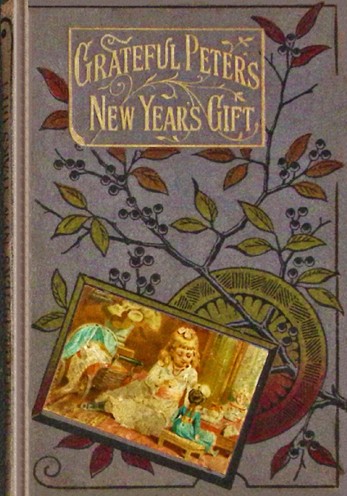
There were many, dear children, who had no idea where that letter and the money came from. But I can tell you that the thousand pounds which paid for building the new wing to the hospital was nothing else but Grateful Peter's New Year's Gift.
God will take care of you. All through the day
Jesus is near you to keep you from ill,
Waking or resting, at work or at play.
Jesus is with you, and watching you still.
He will take care of you, All through the night
Jesus the Shepherd, His little one keeps;
Darkness to Him is the same as the light,
He never slumbers, and He never sleeps.
He will take care of you. All through the year
Crowning each day with His kindness and love,
Sending you blessings, and shielding from fear,
Leading you on to that bright home above.
He will take care of you. Yes, to the end
Nothing can alter His love for His own;
Children, be glad that you have such a Friend;
He will not leave you one moment alone.
————————————————————————————————————————————————————————
LONDON: KNIGHT, PRINTER, MIDDLE STREET, ALDERSGATE, E. C.