
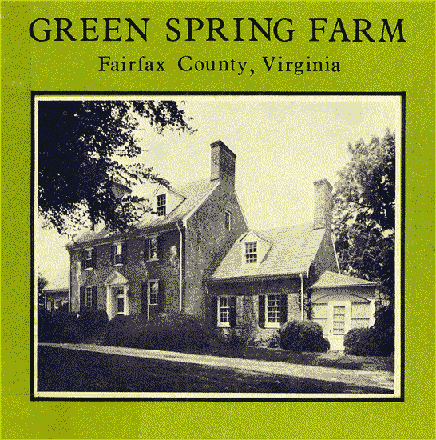
II. ORCHARD AND DAIRY: FOUNTAIN BEATTIE (1878-1917)
A. W. Moger, The Rebuilding of the Old Dominion (New York: Columbia University, 1940), p. 46. Citing census data, the thesis notes that “the value of farm implements and machinery on farms in Virginia and West Virginia combined was only two-thirds of what it was in Virginia in 1860, while the value of livestock in the two states was only four-fifths of that in Virginia in 1860. Not until 1880 did the number of cattle and not until after the turn of the century did the number of swine in Virginia and West Virginia equal the number in the Old Dominion before the war.”
“Status of Virginia Agriculture in 1870,” in Report of the Commissioner of Agriculture, 1870 (Washington, D.C.: Government Printing Office, 1871), pp. 267-291, 273, 291.
Virginia Good Roads Convention, Programme (Richmond: Stone Printing Co., 1894). While railroad and water transportation were available from Alexandria to major metropolitan markets for farm products, the farmer faced the obstacles of traversing Virginia’s notoriously poor farm-to-market roads.
R. H. Abbott, “Yankee Farmers in Northern Virginia: 1840-1860,” Virginia Magazine of History and Biography, v. 76, No. 1, pp. 56-66 (January 1968).
See also the Report of the Commissioner of Agriculture, 1870, p. 291, which states “a striking mark of progress is the change of the policy of the planters toward the outside world. Formerly they were indisposed to encourage immigration from other States. There was, therefore, no accession to the population of the rural district from abroad. The same traditions and habits descended from father to son through successive generations. Now all this is altered. Strangers from every State and every country are cordially welcomed whenever they show any disposition to become permanent settlers and industrious citizens. The consequence is that in many counties a strong tide of immigration is setting in, bearing with it improved stock and better implements, which cannot fail to impart a healthy impulse to improvement.”
Moger, Rebuilding, p. 45. See remarks of Governor Henry Wise in 1867 and A. H. H. Stuart in 1866, cited therein.
W. Fullerton, Address to Piedmont Agricultural Society, October 18, 1876. Speaking to the Society in 1867, William Fullerton of New York chided Virginians by asserting that “there is no other calling in life in which there is manifested such an indifference to new discoveries, as is seen among the tillers of the soil. If a mechanic or manufacturer should in like manner fail to avail himself of improved implements or machinery, he would be compelled to relinquish his business. It is the farmer alone who resists anything new appertaining to his calling. This arises mainly from a deep-seated prejudice to what is called scientific or book farming.”
See also Moger, Rebuilding, p. 54, citing the fact that farmers in the area of diversified agriculture, such as Northern Virginia, had the highest number of agricultural clubs, farm newspaper subscriptions, etc., of all areas in Virginia.
Main steps to assist agriculture taken by the state in the 1870’s are summarized in Moger, Rebuilding, p. 54.
J. S. Mosby, Mosby’s War Memoirs and Stuart’s Cavalry Campaigns (New York: Pageant Book Co., 1958), p. 10. Mosby records in his memoirs that in Richmond, before being sent to the Shenandoah Valley, the men were issued uniforms of very rough quality from the state penitentiary. There was almost a mutiny as the men piled them up in front of the captain’s tent and refused to wear them—all except Mosby and Beattie. Mosby then states, “I do not think any clothes I ever wore did me more service than these. When I became a commander, I made Beattie a lieutenant.”
This story is corroborated in Charles W. Russell (ed.), The Memoirs of Colonel John S. Mosby (Boston: Little Brown, 1917), p. 30.
Beattie is mentioned frequently in histories of Mosby’s campaigns. In addition to the references noted above, see V. C. Jones, Ranger Mosby (Chapel Hill, 1944), and James Williamson (ed.), Mosby’s Rangers (New York: Sturgis & Walton, 1909).
From 1861 to July 1864, Beattie served as an enlisted man. In July 1864, a new company was organized, and Beattie was elected first lieutenant. Such regards as still exist regarding Beattie’s service with Mosby relate to this period. See Compiled Service Records of Confederate Soldiers Who Served in Organizations from Virginia. Microcopy 324, Roll 207 (National Archives, Washington, D.C.).
Ibid., pp. 242-3. Reprints a letter from Thomas Moss to Captain Walter Frankland describing a fight near Front Royal as follows: “We charged and routed the guards, and I was fortunate in saving Beattie’s life by shooting a man who had a pistol within 12 inches of Beattie. I then caught a horse ... [and] Beattie and I ran down the road a short distance and went up into a piece of pine woods.”
John Mosby Beattie, August 22, 1968, interview. Fountain Beattie’s wife, Annie Elizabeth Hathaway, was the daughter of James Henry Hathaway of “Western View” in Zula, Virginia, between Rectortown and Middleburg in Fauquier County. Annie Hathaway was born and married at this home place. Her son, John Mosby Beattie, states that his father bought Green Spring Farm with money realized from the sale of “Western View” on the death of Mrs. Beattie’s parents.
Fairfax County Deed Book W-4, p. 271. Also see Hannah C. O’Brien v. John W. Green, Fairfax County Circuit Court, 1878, Suspended File No. 10.
John Mosby Beattie, August 22, 1968, interview. John Beattie recalls that his father, Fountain Beattie, sold garden produce to the local grocery store of one John Carter, located on the Little River Turnpike (Route 236) approximately where it now crosses Shirley Highway (I-95).
W. C. Funk, “An Economic History of Small Farms near Washington, D.C.”, U.S. Department of Agriculture Bulletin 848 (Washington, D.C.: Government Printing Office, 1920), pp. 16-17.
John Mosby Beattie, August 22, 1968, interview. Mr. Beattie does not recall the date of this fire, but remembers the event vividly from his boyhood days.
Mosby served as Consul in Hong Kong from 1878 to 1885. He was an attorney in the U.S. Department of Justice from 1904 to 1910.
Official Register of Officers and Employees of the Civil, Military and Navy Service, issued biennially, lists Fountain Beattie as an employee of the Internal Revenue Service in the registers issued during the years 1875 to 1913, inclusive. Beattie’s Service Record Card (Treasury Form 426) shows the first employment record date as 1872. His appointment was discontinued in 1914.
“Fairfax County as Portrayed by the Virginia Business Directory and Gazetteer—1906. Published by the Hill Directory Company, Richmond, Virginia,” Yearbook of the Historical Society of Fairfax County, Virginia, v. 10 (1969), pp. 92-104.
Fountain Beattie sold Green Spring Farm in 1917. Annie Hathaway Beattie had died the year before, after they had moved from the farm to a house in Alexandria.[71] Beattie’s deed to George R. Sims of Florida is dated January 23, 1917, and conveyed the entire tract of 339 acres.[72] Ownership changed again in 1922, 1924, and 1931,[73] and ultimately led to the subdivision of the tract into smaller parcels. In 1942, one of these parcels, containing the farmhouse and the principal related buildings, was purchased by Michael and Belinda Straight.[74]
The Straights did not occupy the main farmhouse immediately but set about having certain changes made in the interior design and structure. These were completed late in 1942, and the family moved from the cottage to the main house.[75] A few months later, in January 1943, their occupancy was interrupted as Michael Straight was called to service in the U.S. Army Air Force; and, during World War II, the house was occupied by tenants. The Straights returned to Northern Virginia in 1948 and took up residence at the farmhouse from that time until they moved to Georgetown in 1965.
Upon their return to the farm in 1948, they also began to restore and redesign the grounds surrounding the farmhouse. During the 1920’s, when the farm was owned by Frederick Segesserman, a great many boxwoods had been planted. They had been raised for sale, and in 1948 the pattern of their location on the grounds was erratic. Therefore, in 1948, a new landscape plan was worked out by Mrs. Max Farrand, a friend of the Straights and the designer of the gardens at Dumbarton Oaks in Georgetown. Under her supervision, the boxwoods were transplanted into a great semicircle behind the house, the level of the lawn was raised, and retaining walls were placed at several points. This area comprised the farm’s only formal garden; but, in addition, extensive plantings of white pine were placed as a screen between the house and the road, and the grounds surrounding the house were planted with a variety of trees and shrubs, including hemlocks, cherries, and crabapples, and later, lilacs, azaleas, and rhododendron.
During the years the Straights lived at the farm, farming operations consisted of the raising of Hereford cattle. Purchasing yearlings in the markets of the lower Shenandoah Valley near Winchester, they kept this stock at the farm for fattening and resale as two-year-old beef cattle.[76]
A variety of other animals were kept on the farm, but these were mainly pets of the children.[77] In addition to their horses and dogs, certain of the Straights’ animals acquired reputations of extraordinary extent. In particular were a goat which was presented to the 33 Straights by the author and journalist Eric Sevareid,[78] a mule acquired from the Alexandria SPCA, and a flock of Canada geese which eventually became the subject of a special bulletin by the Audubon Society to prevent local naturalists from erroneously reporting them as migrants.[79]
During these years of residence at Green Spring Farm, Michael Straight served as editor and publisher of The New Republic magazine, wrote three books, and served on the governing boards of several organizations active in international affairs.[80] These activities brought to the farm many visitors whose accomplishments in politics, literature, science, and the arts were nationally and internationally recognized. Some of the distinguished visitors to Green Spring Farm during these years included scientists Julian Huxley and Leo Szilard, authors Aldous Huxley and Saul Bellow, poet Dylan Thomas, Supreme Court Justice Hugo Black, and political leader Hubert Humphrey. The farm also was a visiting place for distinguished journalists from all parts of the United States and many foreign countries, including Soviet Russia, when they came to Washington. An account of one of these visits, written by one of the foreign journalists, is set forth in appendix G.[81]
The farm became well known in the community of which it was a part as it was the scene of numerous festive community gatherings when the neighbors from the immediate area joined the Straights and their guests to celebrate such special events and holidays as the Fourth of July and to enjoy dinner, games, and discussions under the trees.
With the departure of the Straights, active farming operations ceased. During their occupancy, fundamental changes in the character of Northern Virginia’s development brought the era of farming to an end and ushered in an era in which this region became part of the social and economic system centered in Washington. Intensive subdivision and establishment of commercial service facilities became the highest and best uses of the land as population growth in the National Capital area rose at a rate which led other parts of the United States. Outsiders moving into Northern Virginia and Washington residents seeking to move from the central city into the outskirts filled up the open spaces of Fairfax County at a rate of over 1,000 new residents per month.[82]
Along with the temptation of high land prices, rising taxes added to the pressure on the farmer to “sell out” to the land developer. It was said, with much truth, that one could not afford to be a farmer in Fairfax County as the 1950’s ended and the 1960’s began. For the 33 acres and buildings on Green Spring Farm, as for many other residences, taxes rose sharply. In 1943, the farm was evaluated at $7,819, and the tax bill was $194.69; by 1960, the evaluation was $36,050, and the taxes $1,351.88.[83]
So, gradually, Green Spring Farm became an island of open space in a sea of houses and highways. The Little River Turnpike (Route 236) was widened and modernized in 1959. 34 In 1948, this road had been an 18-foot-wide, two lane black-top roadway. Twenty years later, it had been transformed into a 106-foot-wide, four-lane dual highway, much of which was lined with concrete curbs and gutters to accommodate roadside commercial or residential development. The old turnpike had been redesigned and, in the late 1960’s, carried over 26,000 vehicles per day.[84] Its function as a major interregional artery of transportation had been taken over by others, leaving to it a new role as a major connector in the network of roads and streets serving primarily local traffic. In contrast to earlier times when proximity to the road was to be desired, the attractiveness of the farmhouse in the 1960’s was enhanced by its surrounding space which furnished a shield from the highway and a setting for its activity.
III. THE END OF THE FARMING ERA: MICHAEL STRAIGHT (1942-1969)
John Mosby Beattie, March 1969 interview. Annie Beattie, afflicted with arthritis, died in 1916, after she and family had moved into Alexandria to a house on Peyton Street owned by her husband, Fountain Beattie, and Walton Moore.
Michael and Belinda Straight, interview December 8, 1968. During the remodeling, the Straights lived in the spring house, which they called “The Cottage.”
Ibid. Aberdeens were also brought to the farm, but did not thrive as well as Herefords. The Straights’ herd ranged from 15 to 25 at any one time. Bought at weights of about 500 pounds, these cattle were held until they weighed 1,100 to 1,200 pounds and then were sold for beef.
Ibid. The fondness of the Straight children for animals drew pets from field and pond, including rabbits, birds, snakes, spiders, and the like. These were housed mainly in the enclosed side porch.
Ibid. The gift goat was the subject of one of Mr. Sevareid’s columns entitled “It is More Blessed to Give Than to Receive.” During his stay at Green Spring Farm, the goat established a reputation for eating various valuable articles (such as a canvas automobile top) and ringing a number of the fruit trees.
Ibid. The flock of Canada geese started from a pair that was attracted to one of the farm ponds, which in earlier times had been used to furnish ice for the farm. As the flock of geese grew, it ceased to migrate, and frequented the Straights’ pond and nearby Lake Barcroft.
Who’s Who in America, 1966-1967, contains the following information on Mr. Straight: In 1943, he wrote Make This the Last War; in 1954, Trial by Television; in 1960, Carrington; and in 1963, A Very Small Remnant. In 1943, he also served as Vice President of the Fight for Freedom; and in 1946-1947 as Secretary of the Emergency Committee of Atomic Scientists.
Michael and Belinda Straight, interview December 8, 1968. This visit occurred when Mr. Straight was actively engaged in editing and publishing The New Republic and had occasion, from time to time, for journalistic contacts in the Soviet Embassy. From one of these contacts the suggestion was made that a group of Soviet Russian journalists touring the United States might be interested in visiting Green Spring Farm.
Fairfax County Tax Books, 1943, 1960. The 1968 evaluation, at 40 percent of market value, was $93,415, and the total tax was $4,016.85. In 1923, when the property consisted of 332 acres and was owned by J. M. Duncan, it was valued at $8,240, and the taxes were $20.60.
GENERAL SETTING
Green Spring Farm is located in Mason Magisterial District, approximately one-eighth mile north of Little River Turnpike and one-eighth mile east of Braddock Road. Via the Little River Turnpike, the farm is approximately six miles west of Alexandria and approximately two miles east of Annandale.
The terrain in the vicinity of the farm is mainly flat, with some very gentle rolling areas. It is well watered, being crossed by Turkey Cock Run. During 1946-50, three ponds were dug in back of the house. They are spring-fed, and their runoff drains into Turkey Cock Run. With the original forest cover cleared off at least 200 years ago, the present clusters of pine and oak, and the incidence of hemlock, cherry, crabapple, and other flowering species, represent a reforestation several generations removed from the original, and, in other instances, the landscaping done by the Straights in the late 1940’s.
HOUSE SITE
The mansion house faces south and is connected with the Little River Turnpike by a black-top (asphalt-surfaced) road which passes on the west side of the house and runs north to Braddock Road. Inside the post and rail fence, alongside this road, the driveway up to the house is lined with trees, and the yard in front of the house is open and flat. Between the lawn and the road, a line of cedars in the fence row serves as a screen.
The back (north side) of the house faces a semicircular open grass lawn, bordered with hedges which provide both a screen for the lawn and a background for several stone carvings and cement castings which decorate a lawn approximately 1,500 square feet in size. At the northeast corner of this open space is located the log cabin; beyond the log cabin, approximately 110 feet in a northeasterly direction, is the barn, which is converted into living quarters.[85]
Northwest of the main house, facing on Green Spring Road, is the spring house. Originally built over a series of natural springs in order to have water for cooling dairy products, this stone house was converted into a small dwelling house by the Straights in 1942.
GENERAL ARCHITECTURAL DESIGN AND HISTORY
In its present condition, the mansion house at Green Spring Farm cannot be considered to represent any particular period of American architecture. The original core of the building illustrates a design which was typical of the colonial era in Tidewater Virginia. This portion of the house is of brick construction, two stories plus attic and cellar, with the rooms in each end of the house separated by a center hallway. Large chimneys at each end of the house made possible heating by fireplaces in each room.
It seems probable that this structure formed the core of the mansion house when it was occupied by the Moss family (1770’s to 1835). To this core, various outbuildings and dependencies were added; a separate cookhouse or kitchen annex to the main house was one of these related structures, as were the family’s sanitary facilities. Clothes washing, churning, candlemaking, and various other household tasks were also performed in separate buildings. No direct evidence of the appearance of the main house or the various related outbuildings has been discovered; some inferences about these matters may be drawn from the inventory of personal property sold from the farm at auction in 1835 and a drawing of the house on an 1840 survey (figure 2).
Photographs of the south side of the house show the building as it appeared in 1885 (figure 5). At this time, a one-story porch had been built across the entire length of the front. The entry into the house across this porch was open, but on each side of the front door the porch was enclosed, making small rooms approximately 9 by 12 feet in size. From each room a door opened out onto the porch. The porch was roofed with sheet metal, and carved wooden brackets were in the corners of the center section (figure 5). A sidewalk led from the entrance in the center of the ivy-covered front porch straight across the spacious, shaded lawn.
Photographs in 1936 show the front porch removed but with clear signs of its recent presence showing in the whitewash on the front wall of the house (figure 7). At this time, the roof of the main house was sheet metal in place of the earlier use of shingles. However, shingles still constituted the roofing of the dependency on the east end of the house.
The 1885 photographs show a one-story brick addition on the east end of the house. This was a kitchen, built sometime after the main portion of the house but still probably in the first half of the nineteenth century. The notice of sale of the farm following Thomas Moss’s death in 1835 speaks of “a Brick Dwelling, containing eight rooms, Brick Kitchen, Meat House, Servants’ House, ...” and other farm and outbuildings.[86] Of all the buildings mentioned in this notice, the kitchen appears to be the most logical and appropriate use for this addition. Later occupants of the house (1880-1917) used this wing for a kitchen and describe it as not only the center for preparation of food but for numerous other household activities, such as candlemaking.[87]
The arrangement of rooms during the nineteenth century is not known with certainty. The 1839 reference to eight rooms suggests that as originally built the house had four rooms on each floor, with perhaps no effort to use the attic as living space, at least until the time of Fountain Beattie who added dormers to the attic and used this top floor to help accommodate his large family. This inference is strengthened by the fact that prior to the 1940’s the central core of the house was laid out in this manner.
The major renovation of the house in the early 1940’s was planned and carried out by Walter Macomber and resulted in the addition of a wing on the west end of the central block (in which a new kitchen was installed), conversion of the old kitchen wing on the east end of the central core into a living room with a small sunporch attached, rearrangement of the stairways and central hallway, and certain other interior changes. This involved removal of substantial amounts of the original materials in the house and replacement by material considered to be suitable in terms of age and texture. These changes are reflected in the exterior appearance and interior room arrangement of the house at the present time.
Further structural changes were made in 1960. At this time it was discovered that the second floor was sagging because of the removal of bearing walls in 1942 when the first floor was converted from four rooms into two.[88] This situation was corrected by pouring concrete footings in the basement and setting in them a series of steel columns. These columns ran up through the wall on the west side of the central hallway and were topped by a steel beam running the width of the house. The joists for the second floor were anchored in this new beam.[89]
At the same time this structural reinforcement was being added, several closets, cabinets, and bookcases were built into the rooms on the second floor and attic, making use of space under the eaves.
The remodeling done in 1960 was designed and supervised by Keyes, Lethbridge & Condon, Washington architects.
At the present time, the exterior fabric appears to be sound and well maintained. On the interior, a certain amount of deterioration is evidenced in the looseness of the joints in the flooring and stairs and in the uneven settling of door frames in the original portion of the house. The grounds adjacent to the house are in good condition and appear to be well maintained.
TECHNICAL DESCRIPTION—EXTERIOR.
Overall Dimensions. Width: 78 feet by 25 feet in central section, and 20 feet in wings. Height: central section, two and one-half stories; wings, one and one-half stories; sunporch, one story.
Foundations. The central section of the house stands on brick foundations which are carried up through the basement walls.
A brick wall extending upward to the second floor divides the basement into two sections and served as part of the original foundations. In the basement, a series of arches in this wall permitted passage between the two sections. In 1960, the upper portions of this wall 40 were found to have deteriorated to the point that it was necessary to pour concrete footings in the basement and erect a series of steel columns up through the wall to relieve it from bearing the weight of the second-floor beams and floor joists.
The east wing (present living room, former kitchen) rests on brick foundations, with the present wooden flooring laid over the original cobblestone floor of the old kitchen. The west wing (present kitchen) rests on concrete footings and slab at grade.
Wall Construction. Walls are constructed of medium red brick (3 by 9 by 12 inches), using the following bonds: central block front—Flemish bond; central block rear—English bond; central block end walls—English bond; east wing—American or common bond, with seven courses of stretchers to each course of headers; west wing—American or common bond, with six courses of stretchers to each course of headers.
Chimneys. Interior brick chimneys are located in the center of the east and west ends of the central block. These chimneys have separate flues for four fireplaces (two each on the first and second floors) and measure 5 feet by 2 feet 8 inches. Three courses of brick are corbelled to make the capping of the chimneys.
The end walls of the east and west wings of the house also each have an interior chimney centered in the wall. The chimney in the east wing, measuring 3 feet by 1 foot 8 inches and having three courses of brick corbelled for a capping, was used for the fireplace in the old kitchen which occupied that part of the house prior to 1942.
Doors and Doorways. The front doorway is inset (1 foot 8 inches) in an entrance faced with white painted wooden panels. The entrance is framed by a plain triangular pediment and pilasters without decorations on either shafts or capitals. The front door is a six-panel door, designed to harmonize with the interior doors which are originals. Over the door is a four-light rectangular transom.
The rear entrance is a 6 by 8-foot portico, built up three steps from ground level. Along the sides of the portico are 3-foot railings, inside of which are wooden boxes which serve both as storage boxes and as seats. The portico roof is supported by wooden Doric columns set at its outer edges, and the front end of the roof is a plain triangular pediment. The rear doorway has a transom and door similar to the front doorway.
The kitchen door opens onto a 4 by 4-foot wooden porch with railing and three steps to ground level.
The sunporch door has interchangeable screen and glass panels for winter and summer use and opens on the front of the house at ground level.
Windows and Shutters. In the central block, the front doorway is flanked by French windows, with 12-over-9 lights in double-hung wooden sash. The rear windows on the 41 first floor are 9-over-9 lights in double-hung wooden sash. Windows on the second floor front and rear sides are 6-over-6 lights in double-hung wooden sash, as are the dormer windows and gable end windows. The windows on the first and second floors of the central block have 2-foot 10-inch wooden sills and full-length louvered shutters hung on pintles (two on each side of the window frame). Window frames, sills, and muntins are painted dark green.
In the east and west wings of the house, the front windows are 6-over-6 lights in double-hung wooden sash. The rear window in the east wing (living room) has a dead-light picture window (6 by 4 feet) flanked by windows with 6-over-9 lights in double-hung wooden sash. Window frames, sills, and muntins are white, and full-length wooden shutters are dark green.
In the brickwork of the house, flat arches have been laid over all of the windows on the first floor, except over the windows on the rear of the central block.
The sunporch on the east end of the house is of frame construction and has nine windows (2½ by 5 feet) on three sides.
Roof. Photographs taken about 1900 show the house with an enclosed porch across the front and a sheet metal roof on the porch. In contrast, the central block of the house and the kitchen (east) wing have shingled roofs (figure 5). Photographs in 1936 show the central portion of the house with a sheet metal roof (figure 7). In 1942, the roofing on all parts of the house was replaced with specially made concrete shingles, which are still in place.[90]
The roof is a simple medium-pitched roof with plain gable ends. Interior chimneys are centered in each end of the center section and in the east end of the living room (former kitchen) wing.
Full-length copper gutters are incorporated into the eaves and project approximately six inches above and beyond the cornice.
Cornices on the front and rear of the center section of the house are composed of dentils, running approximately three segments per foot. Identical plain wooden cornices are used on the front and rear of the two wings of the house.
Each wing has one dormer centered in the front and two on the rear sides of the roof. The center section of the house has three dormers on the front side of the roof. All dormers have a single window, consisting of 6-over-6 lights, set vertically in the front face. All dormers have beaded ship-lap siding laid parallel to the pitched roof. This latter feature appears to be a change made in 1942 since photographs of the house in 1885 and 1936 show the siding on the dormers laid parallel to the ground.
Enclosures. A post and rail fence stands at the edge of the front lawn and, together with a line of hemlocks growing immediately inside the fence, forms a screen between the house and the entrance road leading in from the Little River Turnpike. In the rear, a semicircular screen of boxwood frames the lawn.
TECHNICAL DESCRIPTION—INTERIOR.
Central Block. The central block of the house, comprising the portion which was built first (possibly as early as 1760), is laid out on the traditional pattern used by many colonial Virginia homes—a central hallway with one or two rooms on each side, with chimneys at each end serving fireplaces in each room. In the case of Green Spring Farm, a narrow (4-foot 6-inch-wide) central hallway runs straight through from the front door to an opposing rear door. Floor boards are of random width (5 to 6 inches), and walls are paneled 3 feet 6 inches up from the floor, with wallpaper above. Doorways open off the central hallway into a library (east side) and a dining room (west side).
Prior to 1942, the rear portion of the center hallway contained stairways to the second floor and to the basement, while still allowing access to the rear door. In 1942, however, the stairway to the basement was shifted to the west (new kitchen) wing, which was built at that time; and the stairway to the second floor was shifted into the library.[91]
In the library, at the rear of the room a narrow (2-foot 6-inch-wide) stairway rises from the corner nearest the hallway to the second floor hallway above (figure 13). This stairway extends over the hall doorway and, together with a panel-and-spindle partition, forms a covered entryway into the room. A small closet utilizes the space underneath the stairs.
The present library is a designed room, created in 1942 by Walter Macomber. The design utilizes the full width of the house and thus replaces two rooms (approximately 12 by 12 feet) which originally had comprised the first area east of the central hallway. This original room design had had a fireplace in each of these two rooms, and in 1942 both were replaced. The one serving the rear room was taken out entirely as the doorway into the living room wing was cut through at that point. The one in the former front room was replaced by another fireplace, specially designed by Mr. Macomber, and built of materials from a late eighteenth century tavern near Peace Cross, Maryland.[92]
Built into the east wall of the library on each side of the fireplace are identical cabinets, the lower parts of which are enclosed and the upper parts are open shelves. The overmantel area is wallpapered, as are the portions of the room’s wall occupied by the window facing the front yard and the wall between the library and central hallway. Open shelving for books occupies part of this latter wall, to a height of eight feet.
The entire room has a cornice molding of stained wood, matching the paneling used for the stairs, the fireplace, and the built-in cabinets flanking the fireplace. 45 Across the central hallway, the present dining room was designed and created in 1942. As in the case of the library, brick interior walls separating two smaller rooms (approximately 12 by 12 feet) were removed to allow the dining room to utilize the full width (25 feet) of the house. The fireplace serving the rear of the original rooms was replaced by a doorway into the new kitchen wing through a butler’s pantry. The fireplace serving the front of the original rooms was retained in the present dining room. Beside this fireplace and extending to the front wall is a butterfly cupboard specially designed for that location. Chair rail, baseboard, and door trim in the room are thought to be original; but the ceiling cornice was added in 1942 and consists of double-ogee design over beaded plasterboard which is typical of the period of the house.[93] A cupboard by the doorway to the butler’s pantry is of modern design and was installed as an added convenience in the dining room.
The doors to the central hallway and to the butler’s pantry are thought to have been originally on the second floor of the house.[94] The hallway door has six panels, with beaded edges and quarter-round molding in the panels. A fillet molding (4½ inches) surrounds the doorway frame. The door has been drastically trimmed to fit the frame. The door to the butler’s pantry has four panels but with a flat raised panel and no quarter-round molding at the panel edges—a style typical of the later nineteenth century.
The second floor of the central block of the house originally was laid out identically with the first floor—that is, two rooms on each side of a central hallway. In the 1942 renovation, this same room arrangement was retained for the west side of the central hall (above the dining room), while on the east side of the hall a single bedroom (12 by 25 feet) was created using the full depth of the house. In this bedroom, cabinets with louvered double doors were installed on each side of the fireplace and painted white to match the fireplace mantel. This fireplace is one of the features retained from the original house and has a mantel which is plain except for a denticulated molding. Chair rail, also thought to be original, is installed on all exposed areas of wall in the room.
Across the central hallway, the two bedrooms retain the same basic design of the original house. Both are approximately 11 by 11 feet and have random-width flooring and chair rail on two sides of the room. The original fireplaces have been retained in these rooms. In the front room, the fireplace mantel is entirely plain; in the rear room, the mantel has two supporting columns and has three diamond shapes carved in the wood. Both rooms have built-in cabinets, shelves, and closets, some of which were installed in 1942 and some which were added in 1960. Also added in 1942 is the door connecting the front bedroom with the staircase from the first floor of the west wing. Through the passageway at the head of these stairs, there is access to the second floor of the west wing.
The third floor (or attic) is entered by a stairway in the central staircase. At the head of this stairway is a hallway connecting bedrooms in the east and west ends of the house and 46 providing access to closets at the rear of the house and a small bathroom (7 by 7 feet) at the front of the house. The bathroom has a dormer window to the front of the house, and each of the bedrooms has a dormer window to the front and a window in the gable end wall. The gable end windows are set in plaster arches, flanked in each case by a 4-foot-high candle shelf. Both bedrooms have built-in closets, cupboards, and shelves. Bedroom walls have plain plaster finish and plain wooden baseboards, no cornices, and no chair rail.
East Wing. The east wing of the house presently includes the living room and a sunporch. The floor level of this wing is 1 foot 8 inches lower than the floor level of the central block; and the connecting doorway has three steps, with double doors at the top step.
The date when the east wing was built is not certain, but it is probable that the basic structure comprising the wing was constructed around 1840 and thereafter used as a kitchen or combination kitchen-dining room until the renovation of the house in 1942. Photographs taken about 1900 and in 1936 show this wing with a door opening to the front of the house at ground level. The floor of the old kitchen was laid with cobblestones, and the east end of the room had a great hearth and Dutch oven. Food was cooked here and taken up the stairs into the main part of the house. Many other household chores (such as soapmaking) were performed here.[95]
When the house was renovated in 1942, the cobblestone floor of the room was overlaid with wooden flooring and pine wainscotting was added to the walls. On the north side, looking out onto the semicircular lawn, a picture window was installed. On the south side of the room, the outside door was replaced with a window similar to the one already in that side (figure 9). The large hearth and fireplace were replaced with a smaller one similar to what had been installed in the library (with the unusual wooden lintel).
According to the renovator, the paneling for the doorway connecting the living room and library came from Lancaster, Pennsylvania. The overmantel and paneling around the living room fireplace and over the doorway connecting the living room and sunporch came from a tavern near Peace Cross, Maryland, where it had been used as shuttering.[96] The architraves around the fireplace and pilasters were designed by the renovator from materials obtained in Pennsylvania.[97] The cornice in the living room is of cypress wood.
Entrance to the sunporch from the living room is through a doorway trimmed in material from an old building in Pennsylvania.
Wrought iron H hinges are used on the built-in cabinets in the east wall (next to the fireplace). The sunporch door has wrought iron hinges and a brass box lock.
The sunporch, added to the east wing in 1942, is frame construction on a concrete slab floor. When built, it was a screened porch, but later was converted to glass window panels to accommodate plants and pet animals in all seasons.