
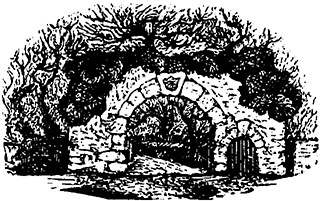
Ancient College Gate-way.
Consuls.—
For the protection of trade, these have been established by the following powers: France, Spain, Portugal, Naples, Sicily, Belgium, Holland, Prussia, Russia, Denmark and Sweden.
Court, Royal.—
The present building where the Royal Court holds its sittings was erected in the year 1799, on an elevated spot at the upper end of Smith-street, at a cost of about 7000l. The Greffe Office is to the right, in which are kept all registries both of public and private ordinances and private agreements. On the left is the common Court, where justice business is transacted; behind this is the room for the advocates, the witnesses and officers of the Court. Above stairs is the Grand Hall for the meetings of the States, and where law and criminal causes, not decided upon in the Court below, are heard and determined. Here are the full-length portraits of our late Governor, Sir John Doyle, Daniel De Lisle Brock, Esq., Baillif, Lord Seaton, a former Governor of the island, and the late Lord De Saumarez.
The Royal Court House.
Cows.—
Those commonly known by the name of "Alderney Cows" in England need but little description, save that the Channel Isles being their natural soil, they thrive well and produce almost double the quantity of butter to what they do in England[A], France, or elsewhere. Hence it often comes within the range of an observer to witness upwards of fifteen pounds of butter from a cow per week throughout the summer. Foreign cows, according to law, are not permitted in the Island, and even a farmer would not allow a Jersey one to be seen on his land. Cheese is not made in the Island, though it is said the Duke of Bedford tried the experiment by sending dairymen, who reported the milk was too rich. By the tethering system no grass is wasted, for the cow is only allowed range of from twelve to fifteen feet, and is shifted three or four times per diem.
[A] According to a memorandum dated April 4, 1829, Guernsey cows degenerate and become extremely feeble in England; that whereupon their bones protrude through the skin, and such was the case at Cheddington in Dorset, where I then resided. In another memorandum, when living at St Martin's, Jersey, I find an old woman of that parish had a remarkable fine cow that produced 18 and 19 lb. of butter per week throughout the months of May and June.
Tethered Cows.
Cyder.—
Is plentiful and in most cases particularly good, though an evil report gives it out as water dashed. The price varies according to the season; at times being as low as 14s. whilst at others 30s. per hodgs. Several hundred hogsheads are annually shipped for England.
Diseases.—
From the climate being open and healthy are few, and chiefly consist of rheumatic complaints. Should the reader be over critical on this head, he had better consult the "History of Guernsey," by Jonathan Duncan.—Vide Climate.
Doctors and Physicians.—
Considering the healthiness of the clime we are somewhat overstocked, there being no less than twenty-four practising the profession. There is no regular physician in the Island.
Donkeys.—
Are few, as they are merely employed in carrying corn to the country wind-mills, or with families rusticating in the country. A number may be generally seen browsing on Lancresse Common. They may be hired at 2s. or 2s. 6d. per day; if by the hour, 3d. is the general charge.
Doubles—
Are the current copper coin of the Island, eight of which form an eight double piece, which represent an English penny.
Eggs.—
Native eggs in summer are 6d. to 8d. per dozen, and during the winter from 1s. to 1s. 6d. French ones being imported in large quantities are from 5d. to 6d. per dozen.
Exciseable Articles.—
Groceries being exempt from all kind of duty and imposition are a luxury as well as novelty to those just arrived from a heavily taxed country; thus it is very common to hear recent visitors walking home under a burden of untaxed articles, exclaiming: "Well! we can't do this in England;—we can't get 3 lbs. of sugar for 10d.!" Tobacco is 1s. per lb., snuff 1s. to 2s. per lb. Sugars 3d. to 5d. per lb. Teas 2s. to 5s. per lb. Coffee (raw) 4d. per lb. Fried 8d. per lb. Ground do. 1s. Soap 4d. per lb. Candles (dips) 6½ d. per lb. Moulds 7d. per lb. Cocoa 1s. per lb. Best Chocolate 13d. per lb.
N.B. There being no duty on mahogany, deal, or any other kind of wood, furniture is much cheaper than in England.
Fish.—
Abundant, and considered by strangers remarkably cheap. That generally seen in the market in the greatest abundance are: turbot, brill, whiff, megrim, sole, lemonsole, plaice, dab, marysole, dorey, mullet, surmulet, mackerel, red gurnard, basse, wrasse, bream, gilt-head, herring, pilchard, horse-mackerel, gar-fish, common cod, pollock, ling, atherine, conger, ray, sand-eel, with numerous others. Lobsters, crabs, shrimps and cray-fish are equally abundant, and may be obtained at the following reasonable prices: Lobsters[A] 9d. crabs, (exceedingly large) 2d. to 8d., shrimps 3d. per pint, turbot 6d. per lb., soles 1s. per pair, dorey 1s. bream 2d., whiting (exceedingly large) 6d. The ormer, a very delicate fish, scarcely known in England, represents a veal cutlet, and is rather common with us.
[A] Lobsters would be much cheaper were they not taken in considerable quantities to Jersey, France, Portsmouth, Weymouth and Southampton; hence it has been remarked that early in the morning the market is glutted with lobsters, whereas immediately on the arrival of the steamers they are all gone.
Fish Market, the—
Is a beautiful structure and has been erected of late years. The interior is light and airy, and the slabs, which are handsomely cut and groved are of black and variegated marble, being well supplied with abundance of fresh water from pipes, which by means of cocks is brought over the slabs at a moment's notice, thereby washing them immediately. The Arcade is a spacious area, upwards of a hundred and ninety feet in length, and proportionably broad, having two lines of sittings extending the length of the building. The exterior towards the vegetable market, or facing the Assembly Rooms, is handsomely occupied in shops, the Mechanics' Library, and other offices. By an ordinance of the Royal Court every person selling fish is obliged to do it in this arcade, for the use of which they pay one penny a day. The whole arrangements, as well as variety, abundance, and excellency of fish, at once impress the stranger with high notions of the public spiritedness of the people, who have taken so much pains to provide a fit receptacle for one single article of human sustenance.
Farms—
Are hardly ever beyond fifty or sixty vergées, and in their arrangements are contrary to every thing English. The yard is simply a few out-houses, consisting of a stable, hay-loft, cart-house, and cyder-factory, which latter apparatus is a set of large groved stones set in a circle, around which passes a stone wheel guided by a wooden machine, and drawn by a horse or ox. The apples being thus mashed in the trough or grove are turned out, pressed, and racked off secundum artem. The corn is thrashed in an out-house on the ground floor, and afterwards winnowed in the air with a sheet and sieve.
Farm.
Flies.—
In entomology little can be said, unless by the most acute observer. As far as annoyance is produced, perhaps England or France would exceed us; for, in no single instance, can be traced a multitude of insects that work mischief either to cattle, trees, or any thing else, unless it is the scarcely perceptible nuisance wrought by a species of the millipedes,[A] which abound in dry lands, and occasionally disfigure the healthy appearance of potatoes, if not timely destroyed.
[A] According to a memorandum dated October 4, 1841, these insects do not injure or impair the quality of the potatoe, but only disfigure it. However voracious their attack, they cannot represent the evil of the moles in Jersey, which plough up as it were whole fields, and overthrow the year's produce.
Flowers.—
Floriculture has long been a favourite pursuit among the inhabitants, which no doubt has been the chief cause of rendering this department of gardening so famous. Although the best gardens are of no great extent, yet they often contain beautiful, rare, and valuable plants; and there are few cottages which have not a considerable space dedicated to flowers. The mildness of the climate is such, that a variety of tender plants are grown in the open air, which would hardly endure the same exposition in the warmest spots of Devonshire or Cornwall. When the temperature falls to 6 degrees below freezing point, the season is considered unusually severe; consequently, many of the Cape heaths and hardier geraniums, together with a number of Australian shrubs and plants, and even those from central America endure our ordinary winters in screened situations without the least injury whatever. Thus, the eobœa scandens, maurandia barclayana, and other creepers of a similar nature are found to spring up naturally from seed under the walls where they are planted; and even the Bath scarlet geranium has for several years been an ornament to cottage walls, to the height of ten or eleven feet. Fuchsias make such rapid progress that they finally become shrubs, when from their encumberance they are trained to poles like standard roses. Bulbs are cultivated with considerable advantage, as the frost is of such short duration, that it rarely ever freezes more than an inch or two in depth, and should a slight fall of snow happen it is their complete protection. From a garden review, given by the late Horticultural Chronicle, it appears there were orange trees laden with fruit in every respectable garden; and in that of the dowager Lady De Saumarez there was one remarkably curious, from its rind being grown out into a kind of spar. In these gardens, and also in those of Sir Thomas Saumarez and Mr Brock, of Belmont, were montanariums, sanguisorb, large tree myrtles, creeping serius (eight yards long), mimosa (tree), paradoxia, candula, clematis azuria grandiflora; and in the green-house of Mr Brock were no less than from twelve to fifteen hundred calceolaria, together with innumerable others, all teeming with health and vigour.
Fogs and Mists.—
At times rise up from the Channel, and consequently pass over the island, not unfrequently involving, throughout November, the Northern or lowland parishes in mist.
French Women.—
As the island is almost wholly supplied with provisions from France, these women may be seen located in the market in considerable numbers; and the English stranger at first sight wonders who and what they are. Sometimes they perambulate the country with baskets containing eggs, poultry, nuts, &c., and in this way things are often procured at the door exceedingly moderate. Their dress is peculiar to the provinces of France from whence they come, and as they never wear bonnets, the head-dress is most fantastically arranged. The annexed engraving represents one of their caps.
Frogs.—
Are few, and only seen in marshy wet ground. There are no toads in the island, neither will they exist here, for the experiment has been tried from Jersey, where they abound in myriads, especially in umbrageous lanes. From a memorandum dated July 4, 1834, while living in Jersey, I find they creep from their lurking holes in the banks or hedges, throughout the summer evenings, in numbers almost incredible, especially in St Martin's parish, at times oft approaching in size nearly the Surinam toad.
Frost and Snow.—
Neither are severe, and the latter seldom remains on the ground beyond three days. One may be here two or three winters without witnessing both together, and not unfrequently without the least appearance of either. Like other maritime situations, the cold seems to be mitigated by caloric imparted to the atmosphere from the surrounding ocean; and the exuberance of the various exotics which flourish unguarded at all seasons in the open air, puts forth sufficient evidence of the mildness of the climate. The double camelias bloom abundantly in November, and orange-trees endure the winter with only a slight occasional covering of matting. A correspondent of the Horticultural Chronicle observes that on riding towards St Saviour's he was much pleased to see two magnificent orange-trees hid in boxes as a shelter from the side winds, at the house of a Mr Hartley, and which then looked exceedingly handsome, as they were ornamented with some two or three dozen of fine ripe fruit.[A]
[A] In a memorandum, Saturday, Feb. 6, 1841, I find that the winter of that year was the severest we have had for many years past. It destroyed many precious plants, especially myrtles and orange-trees, indeed its ravages were so extensive as to strip down huge limbs from the most robust trees, and in such quantities in the sister-isle, that many dreaded the consequences. This frost appears to have been very remarkable, for the preceding evening was marked by a dense mist, which in contact and in co-operation with a sudden frost, glazed the trees and shrubs with masses of ice, and gave them the appearance of solid icicles, which gave rise to the following witticism: "If the whole island were not christianized, it was at least crystalized." It proved fatal to several interesting exotics, which had been the pride of many a garden. The Cape heaths and Australian shrubs were almost all destroyed. Every species of leptospermum, which had braved our winters for forty years, were killed. The general scenery at the time was so exceedingly beautiful, from the ramifications of the trees being wrought up into so many magical and fantastical shapes, that I endeavoured to make a sketch of one, but the cold was too intense to allow me to accomplish my object. The snow and frost continued to increase from Monday the 1st, and on the 3rd and 5th all creation was white.
Furniture.—
Of all kinds may be obtained on reasonable terms, as it has of late been contrived by some speculative people to enter on a business of this kind. Families, ere they determine on taking up their abode here, would do well in being accommodated with a loan of furniture. On the contrary, should they purchase new, with a view to sell it hereafter, they will have just cause to repent, as it will not realize one quarter of its original value.
Gardens.—
Are considered, by eminent horticulturists, not only numerous, but beyond every thing exuberant and flourishing. Some few years ago, gardening was considered but an indifferent occupation; but as things take a change for the best, Guernsey was one of the foremost to bring this elegant amusement to its proper bearing. Aided and abetted by the natural good qualities of soil and climate, horticulture made rapid strides, and soon out-stripped some of the vaunted paradises of Europe, and the fruits, flowers, and vegetables that the Channel Isles' markets continually teem with, sufficiently testify the same. Among the list that may be seen continually pouring into our market, in their various seasons, may be enumerated the following: peaches, apricots, figs, strawberries, melons (rather inferior), walnuts, chesnuts, raspberries, mulberries, medlars, cucumbers, varieties of grapes, (in-door and out,) and abundance of apples and pears; the latter are exported to England in considerable quantities, together with grapes, figs, and melons; the last mentioned are imported from Lower Normandy and Britany, and are of a delicious flavour. Large chaumontel pears, being generally destined for presents in England, fetch a good price, and at times 3l. to 5l. per hundred is readily obtained for them, and even more, if they weigh from twelve to eighteen ounces. The small ones, which are generally the largest crop, may be obtained exceedingly reasonable by the bushel. The Guernsey fig being also much esteemed, large quantities are brought into the market, where they only fetch from 3d. to 4d. per dozen. Whole vergées of strawberries may be seen in the country for the same purpose, and yield 1½d. per lb. Grapes (out-door) are from 2d. to 3d. do., Spanish muscatel 6d. do. Melons are from 6d. to 1s. The principal nurseries are Nant's, Luff's, and Lumby's.
Gas.—
Is supplied to houses in town and the suburbs, from two spacious gas-holders sufficiently large to supply three times the present consumption. The town is but partially lit with gas; the old oil-lamp being still in general use. The proprietor of the works is Mr Thomas Edge, of Westminster, who erected them in 1830.
George, Fort.—
Is the principal fortification of the island, and is constructed on the improved form of a square, having four bastions connected by curtains, with a ravelin to the South, and a counter-scarp to the South-West. It will admit about three thousand men, and has thirty-four pieces of cannon, four mortars, and a caronade. Most of the batteries are erected in a form for repelling the enemy at sea, and some of them are very formidable. From the ramparts or parade ground there is one of the most extensive and diversified prospects in the island; and underneath the former are spacious casemates, which in case of a siege can be converted into barracks. It was completed in the year 1812, at a national cost of 200,000l., but was commenced immediately after the breaking out of the American war, in 1782.
Goal.—
The public goal was erected in 1811, and cost the island 11,000l. It is a solid structure, built entirely with blue granite, and has a neat front elevation, in which are two galleries; the lower one for debtors, the upper one for criminals. The debtors have five cells, in all of which are fire-places, and the creditors by whom they are incarcerated are obliged to find them in blankets, a bedstead and straw palliasses; but must supply themselves with bed, bedding, and other furniture at their own expence. They are unlocked throughout winter and summer at eight o'clock in the morning, and are locked up at sun-set every evening. They have a large court yard to walk in. The cells are provided with bell-pulls, communicating with the bed-room of the Governor, in case of sickness.
The felons' cells are ten in number, eight for the men, and two for the women; but it has been observed by the benevolent Mrs Fry, that the cells for the latter are not sufficiently apart from those of the men, insomuch that when locked up they can converse with each other, especially when taking air, being only separated by a partition of sheet iron and bars. Felons and criminals are allowed exercise on the gallery in front of their cells, and according to the prison regulations are to be unlocked from ten in the forenoon till two in the afternoon; though, in point of fact, this space of time is generally extended by the Governor, particularly in the summer season. In four of the cells are fire-places, and prisoners are allowed straw palliasses, three blankets and a rug; firing they must provide at their own expence. On a prisoner becoming refractory he may be deprived of his liberty, and by a report of the case to the Baillif within twenty-four hours, may be confined to the black-hole. Irons are not used on felons about to undergo the last penalty of the law, and prisoners under solitary confinement perform no work. There is no sick ward nor chapel, neither is there a chaplain appointed to visit the prisoners, but bibles and religious tracts are provided for their use.
The Governor has a house within the prison walls in which debtors may be accommodated, provided they pay an additional sum of 1s. 9d. per week. Debtors not having the wherewithal to maintain themselves, are allowed 9d. per day, which the creditor at whose suit they are imprisoned is bound to pay them, otherwise they are set at liberty. Criminals are provided for out of the revenue belonging to the Crown. Strangers are permitted to visit debtors from nine in the morning until four in the afternoon, from the 1st of October to the 1st of April, and from nine in the morning until seven in the afternoon from the 1st of April to the 1st of October.
The Goal.
Herbs and Medical Plants.—
Are in great abundance in every part of the island, but as a list of them would be out of place in a work of this kind, it only remains for me to mention those which are in the greatest profusion under foot, and which, from close observation I have found to be most useful in medicine, cookery, and other purposes. They are:—wood-sage, camomile, samphire, lords and ladies, fools-stones, blue-bells, pennyworth,[A] ladies' smock, hagnebuts, eryngo,[B] fox-glove, night-shade, high-taper, mugwort, robin-run-in-the-hedge and mouse-ear, with numerous others.
[A] From a memorandum dated April 3, 1832, I find that pennyworth or hart's-tongue steeped in vinegar for twenty-four hours, to be the most efficient remedy for corns I ever knew, and on communicating it to a few others, they were pleased to acknowledge the same. I have many other memorandums on Guernsey herbs; but as they are written in Latin, and were mislaid up to the hour of publishing, are consequently omitted.
[B] Hops are antiseptic, and are an excellent thing for packing game in, for in a memorandum, Wednesday, September 7, 1842—"Received a hamper of grouse from a friend in Newcastle; were a fortnight at sea, and perhaps had been killed for upwards of a month: nevertheless, from their mouths and other parts being well stuffed with hops, arrived in pretty tolerable condition." Wild hops may be observed growing in several parts of the island, especially about some of the hedges in the Valle, and near the Friquet. Camomile flower is also remarkably abundant in this vicinity, and in a field called the Queen's meadow the ground is literally covered with it.—Memorandum, August 12, 1842.
Lords and Ladies.
Hay.—
Varies in price, but is hardly ever beyond 6l. per ton, if so, the season must be unusually bad. The upland hay is generally esteemed the best.
Horses.—
Are small, cross grained, and given to biting; but are lusty and hard workers. They are cheaper than in England, and a hack may be kept in the best order for about 20l. per annum. Horses at the livery stables may be hired at from 4s. to 7s. per day. There are no taxes on horses, carriages or livery servants.
Hospital.—
This excellent institution, the admiration of every stranger, is under the direction of a Treasurer, Vice-Treasurer, six Directors, and six Collectors, elected by the rate-payers: and although called an hospital, partakes of the properties of a poor-house, a refuge for the destitute, a work-house, a penitentiary, and for the destitute youth of both sexes a seminary of instruction; and, but for the receptacle for lunatics, its interior economy reflects the greatest credit on the island. There is a chaplain whose salary is 30l. per annum, and the medical department is under the most liberal regulations. The boys and girls have schools, in which they are educated in all things useful for their future occupations through life. Indeed, the system pursued is in accordance with the most approved methods of modern times, for the expences are partly defrayed by the labour of the inmates, together with a strict performance of all the other in-door work, which is effected with the utmost regularity, order and cleanliness imaginable. So much is the general system admired, that it is spoken of in exceeding high terms by Quail and several other writers and travellers. A late visitor says:—"On entering the hospital, the scene was an active one, insomuch that almost all the men were occupied, some in weaving cloth, some as tailors, others as shoe-makers, &c., whilst the women were engaged in washing.[A] On the whole, whether we regard this hospital as an asylum from misery, or as a school of morality, I must say that I have never yet seen any institution in the kingdom that would stand in competition with it."
[A] In addition to washing for the hospital, a great deal is taken in from families living in the neighbourhood; by which means the women do much towards paying the expence of their maintenance. The greater part of the cloth, shoes, &c., which the men manufacture, is sold. The men are also employed as scavengers.
The number of inmates admitted in 1840, were 121 men, 100 women, 34 boys, and 27 girls, forming a total of 282. In the same year were indentured, 6 boys and 2 girls, whilst those discharged, escaped, or expelled were 33 boys, and 25 girls. The total expenditure of the said year was £4,358 8s. 5d. The following items pretty clearly indicate the comforts that reign within, as also the good feeling and humanity of the people of Guernsey:—14,526 lbs. of beef; 4,085 lbs. of bacon and pork; 471 qrs. of wheat; 115½ hhds. of beer; 3,964 lbs. of butter; 1,400 faggots; 2,562 gallons of milk, together with many other things in due proportion. The average yearly expence of each inmate, is not more than seven pounds, notwithstanding that at least half of those in the hospital are boys and girls who produce but little, being the greater part of the day in school; and then there are also many lunatics and infirm people who are totally unable to do any thing towards their own support, and who are treated with great kindness, and allowed abundance of good food and clothing.
The Country Hospital is nearly on the same principle, and is situated in a secluded kind of valley, in the Câtel parish.
Hospital Bread Knife.
Hospital Bread Machine.
Inns and Hotels.—
In town, these are replete with every accommodation and comfort. The principal are Marshall's and Gardner's, and from both being situated in High-street, a very little distance from the pier, the porters are enabled without delay to set the visitor at ease. At the country inns may be obtained good plain fare, such as bread, butter, eggs, bacon, milk, cream, fish, cider, beer, spirits and wine, which latter article is not always to be had, and if so, is sometimes of an indifferent quality. Besides inns, there are other houses in the country that entertain pic-nic parties throughout the summer, some of which are very superior in their accommodations, and exceedingly moderate in their charges. They may be easily discovered as the drivers of the coaches and omnibuses which run round the island, either know or put up at them.
Marshall's Hotel.
St James's Church.
James's Church, St.—
Was erected in 1818, and was consecrated on the 6th of August in the same year. It is situated opposite the side of the new Prison and near the College play ground, and is generally allowed to be a handsome specimen of Grecian architecture, the tower, portico and dome being considered the chief features. The funds for erecting it were raised in part from the sale of the pews, and from liberal donations granted by the late Lord De Saumarez, of which 400l. went in purchase of four hundred free sittings for the poor and the children of the national schools; 120l. for the dome and tower, and latterly a donation of 400l., together with many other contributions and assistance, amounting in the whole to upwards of 1000l. The rest was raised by public subscription.
The church contains 1300 sittings, amongst which are four for the use of the minister, and twelve for casual strangers. The service, on Sundays is at half past ten in the morning, and in the evening at half past six. Prayers are also read on Wednesdays and Fridays at noon, and also on festivals. The sacrament of the Lord's supper is twice in the quarter. The bell of this church cost 100l. and the organ 500l.
John's Church, St.—
Was erected in the year 1836, and in its style emulates the early English, though many of those genuine features are lost sight of. Contrary to every other church, the tower is at the East and the altar at the West end. It is built of well-wrought blue granite, and from being situated in the centre of a woody district, forms a considerable addition to the landscape. The foundation stone was laid by the late Lord De Saumarez, and it contains 600 sittings, 200 of which are free for the poor. The services are in English; two full services on Sundays, and weekly evening lecture. The endowment consists of a parsonage-house, adjoining the church, and 13l. per annum secured on rents; together with the surplus of the pews, which after payment of the current expences of the church, may amount to about 90l. per annum, provided the pews are all let.
St John's Church.
Land.—
The price at which it is rented will scarcely be credited by strangers, as it must be exceedingly inferior, if it does not fetch 3l. per vergée, which is at the rate of 7l. 10s. per statute acre. The Couture, which is the best sample, may be valued at 5l. per vergée per annum. Land for building, in the vicinity of the town, is so enormously high, that at times it has fetched one thousand pounds per English acre.
Letters.—
Are delivered in the town and suburbs, almost immediately after the arrival of the packet. In the country it is not so, for it sometimes happens that the packet is signaled as early as eight o'clock, whereas the letters have not been delivered until four o'clock in the evening.[A] The Post-Office Packets come in regularly twice a week, Sundays and Thursdays, unless prevented by exceedingly severe weather.
[A] This delay evidently proceeds from want of more letter-carriers, and which I have since heard is the case. According to my Jersey diary, letters were regularly brought to my house at Le Hocquette, about two miles and a half from town, between one and two o'clock, provided the packet had a tolerable passage.—Mem. Aug. 10, 1840.
Light-house.—
Also called the Round-house, is situated at the head of the South pier, and was erected for the convenience of mariners approaching the road-stead and harbour in the night. It is a large lantern, in which several gas-burners are introduced, and the light may be seen coming through the Small Russel from the Northward, the Great Russel from the Eastward, and from the Southward when rounding St Martin's Point.
Light-House.
Libraries.—
There are two: one belonging to the Mechanics' Institution, and Redstone's circulating library, in both of which are reading rooms. In the former lectures are delivered throughout the winter.
Manufactories.—
Are few, the principal being those for potatoe spirit, vinegar, Roman cement, bricks, soap and candles, paper and cordage. The main portion of the spirit, vinegar, cement and bricks is for exportation; whilst the soap, candles, and cordage are for local consumption. The largest distillery is at the Bouet, near Ivy Castle, belonging to Messrs Valpy and Lainé. It has a steam-engine, and every necessary apparatus for distilling spirit from native potatoes, when it is exported for the London market, where it is rectified. Three years' export of this article is as follows: 1834, 8,468 gallons; 1835, 52,639 gallons; 1836, 17,644 gallons.
Margaret Church, St.—
The parish church of the Forest was consecrated on the 3d September, 1163. It has a nave, North aisles and chancel; and has a low tower and octagonal spire at the junction of the chancel and nave. The North aisle is of modern structure, with plain granite lintels, and a square-headed piscina in the East wall. One of the South windows appears to have been divided into two lights, with an orbit between, and the rude ornamented heads cut out of blocks of granite. Like every thing else, this window has submitted to the chisel of modern art, wherefore the ornamental portions have been worked off in order to form a segmental head. The inside wall of the chancel is splayed, and the East window semi-circular and cinque-foil. The East and West sides of the tower are longer than the others, consequently impart to the spire an ugly and deformed appearance.
The Forest Church.
Martellos.—
Are round towers situated on the coast in different parts of the island, at stated distances, particularly on the Northern or vale side, and are garrisoned with soldiers in time of war.
Martin's Church, St—
Consists of a nave, chancel and aisle. The two former, with the tower, which is at the junction of the two, are of the early English style, and the latter with the windows of the building of modern formation. There was once a slab that contained a brass plate representing a lay-man or merchant with his lady. The stone is still there, but much defaced, and probably in a few years will entirely disappear. The porch, facing the South, which is of the decorative style, is the most elegant in the island. The corner buttresses are terminated with ornamental pinnacles of crochets and finials, and are set diagonally at one stage. According to the "Dédicace des Eglises," this church was consecrated on the 4th of February, 1199, in the tenth year of the reign of Henry II, king of England.
St Martin's Church.
Meat—
Is very good, and surpasses that of Jersey, but is dearer than in England, though to an English resident, if he draws his income from England, it will not appear so, considering there are 18 ounces to the pound, and that he gets from 5 to 6 per cent premium for his money. Beef sells at 5d. to 8d. per lb.; mutton, 6d. to 8d.; veal 5d. to 7d.; pork 4d. to 6d.; bacon, 6d., 9d. and 11d.
Meat Market, the—
Is commodious, clean and airy, and is perhaps one of the most convenient, both for buyer and seller that can be found in any part of the world, and is as well furnished with meat as any market in England.
The Meat Market.
Mechanics' Wages—
Are regulated according to occupation and ability. Journeymen smiths and ironmongers earn from 12s. to 24s., carpenters average about 18s., masons and plasterers 15s., tailors (in the busy season) 20s., printers 10s. to 18s., shoe-makers 10s. to 15s., shopmen 15s. per week.
Militia.—
In time of peace, all subjects of her Majesty, not being natives of the island, and who do not possess real property therein, are exempt from the said service; but otherwise, after a residence of a year and a day, are as liable to be called on as the natives themselves. Also every subject exercising for his profit any trade, business, calling, or profession whatever, shall, after a year and a day, be subject to the laws, ordinances, and regulations thereof.
Mills.—
In the country wind-mills are common, as they may be seen in almost every parish, where from their being situated on eminences, occasionally beautify the landscape. They are not exactly after the English fashion, as they have a vertical top that shifts with the wind. There are also both in town and country water-mills driven by small rivulets, and steam-mills, but of the latter there is only one in the country, in the parish of St Martin. Of late years a new method or mill for grinding apples has been adopted. It consists of two cylinders furnished with knives crossing each other as they revolve; by which simple but improved process the apples are cut, bruised and prepared for the press cheese at the same time.
Miscellaneous Societies—
Are, the Guernsey Mutual Insurance Society for Shipping[A], Provident Society, Society for promoting Christianity among the Jews, Church Pastoral Society, Church of England Society, Irish Society, Société Evangelique, Irish Scripture Readers Society, Society for the Promotion of Christian Knowledge, Bethel Union, Amie des Pauvres, Humane Society, Benevolent or Stranger's Friend Society, Charitable Association, all of which have been instituted since 1811.
[A] This Society commenced on the 31st December, 1838, with a mutual risk of only £14,000 and consists of a chairman, secretary, and a Committee of six persons. The amount insured in 1842 was more than £70,000. The amount of the present year is upwards of £66,000. Each vessel entered carries a flag composed of a white lozenge on a red ground, and the number is marked in blue figures on the white lozenge. The number of vessels on the Society's books for the present year is 87.
Missionary Societies.—
Are, the Church Missionary Society, Society for the Promotion of the Gospel in foreign parts, Wesleyan Missionary Society, London Society (Independents), Methodist, New Connexion Society, Moravian Society, Primitive Methodists Society, Bible Christian Society, Baptists Society, &c., all of which have been established from 1817 to 1840, and whose united contributions amount to 1,333l.
Money.—
French frank pieces form the current silver coin of the island, twenty-four of which are the legal tender for the Guernsey pound currency. The frank is ten pence English, and is divided into single, double and five frank pieces. Notwithstanding the above is the active and lawful specie of the island, all things are bought and sold by the shilling English. Of late years the Government were about to introduce the English currency, but for great interests best known to the island, it was vigorously resisted. On an English shilling there is a premium of one half-penny, but on the sovereign fourteen pence.
New Ground—
Is a fine piece of table land, purchased by the inhabitants of the town, in 1782, h for the purpose of forming a promenade, and which now from the luxurious growth of the trees, and other ornamental displays, vies with any thing of the kind on the Continent. The lower part figures as a grove, through which is a spacious gravel walk, canopied in summer with dense foliage. The smaller walks are only partially shaded, but have seats and resting places tastefully arranged. On the North side is Beau Séjour, the residence of Mr Harry Dobrée, which has all the character of an English villa, and may strikingly remind one of those in the New Forest.