
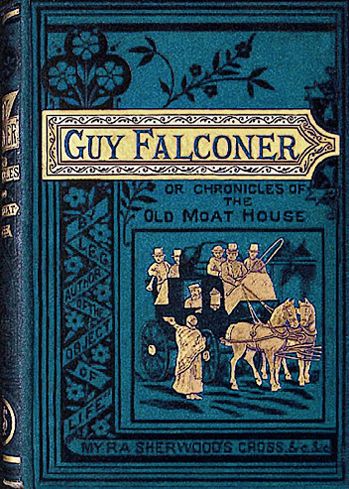
The Project Gutenberg eBook of Guy Falconer
Title: Guy Falconer
or, The chronicles of the old Moat House
Author: Lucy Ellen Guernsey
Release date: August 5, 2024 [eBook #74189]
Language: English
Original publication: London: Sunday School Union, 1876
Transcriber's note: Unusual and inconsistent spelling is as printed.
THE OLD MOAT HOUSE.
GUY FALCONER;
OR,
The Chronicles of the Old Moat House.
————————
A BATTLE OF FORTUNE.
————————
BY
L. E. G.
AUTHOR OF "THE OBJECT OF LIFE," "MYRA SHERWOOD'S CROSS,"
"HOMES MADE AND MARRED," ETC., ETC.
THIRD THOUSAND.
London:
SUNDAY SCHOOL UNION, 56, OLD BAILEY, E.C.
Hazell, Watson, and Viney, Printers, London and Aylesbury.
CONTENTS.
——————
CHAPTER I. ONLY A STROKE OF THE PEN
CHAPTER III. STILL UNDER THE ELM TREES
CHAPTER IV. THE TOMB BENEATH THE CEDARS
CHAPTER V. A LADY OF THE OLDEN TIME
CHAPTER VIII. THE PLACE OF THE BEAUTIFUL
CHAPTER XV. UNDER THE ELMS AGAIN
CHAPTER XVI. CLOUDS WITH SILVER LININGS
——————
ILLUSTRATIONS.
FRONTISPIECE-THE OLD MOAT HOUSE
GUY FALCONER:
A BATTLE OF FORTUNE.
CHAPTER I.
ONLY A STROKE OF THE PEN.
"THE papers have arrived, sir, and the witnesses are ready. Only a stroke of the pen, and the thing is done. It will not fatigue you much."
The old gentleman to whom this was spoken in a tone of gentle entreaty turned himself with difficulty on his bed, and looked earnestly at the speaker.
"You have decided, then, Geoffry," he said; "you are sure you don't mind? You won't regret it by-and-by? I had thought that perhaps you had given it up."
"I have quite decided; I shall not regret it; and I never thought of giving it up, but it was of no use to talk about it until the requisite documents were prepared. Penacre has not been in a hurry, but what he does is well and safely done. Shall I read over the particulars to you?"
"No, no, I must trust to you. My debts will all be paid, as well as yours, and there will be no stain upon my name, that's one comfort," and he groaned as if other comforts just then were not many.
"Phœbe, Phœbe," said he as his son left the room; "what are you doing there?"
"Tinking, sar," and a dark face, trimmed round with white and yellow muslin, instantly appeared at the bed-side with the next cordial for the patient. "Thinking, eh? What are you thinking about pray?"
"Tinking about one bery bad debt, sar. Wondering if it's going to be paid along de rest."
"What do you mean, woman? How dare you think about my concerns, or listen to what I say to my son?"
"Couldn't help it, sar. 'Sides, if dat 'ar debt ain't paid, him leab a bery big stain dat never come out nohows."
"What debt, woman? You shall be paid well, for you've been a faithful nurse to me, Phœbe."
"Dat's noting, sar; Phœbe not tinking about pay down here, but de big bill up dere," and she pointed upward, "must be paid by somebody, sar. By de good Lord on His cross all blot out in His precious blood, or—don't disb'lieve it 'cause poor old Phœbe say it—or by massa his own self in de eberlasting prison, whar de poor debtors neber reach de end ob der 'count."
"Stuff and nonsense, woman," said the old man angrily.
"True as de Bible, sar. How's massa going to do 'bout it?" persisted the nurse.
"Do! Why I've nothing to do with it. I shall take my chance with you, I suppose."
"Phœbe havn't noting to do with chance, sar. De kind good Lord find poor lost sheep, an' He say, 'Come unto Me.' Den I say, 'What for poor Phœbe come?' He say, 'You know you a sinner,' and 'De wages ob sin is death,' but 'God so lub de world dat He gabe His only begotten Son, dat whosoever b'lieveth in Him should not perish, but hab eberlasting life."
"Ah, yes; I heard that years ago, Phœbe, when I was a child."
"Why you not mind it, den? Phœbe neber hear it till she got old, and she come, and she b'lieve, and now noting to do but go up to be eber wid de Lord one ob dese days; all her sins washed away, and sing hallelujah! No chance 'bout it."
"Well, you foolish old woman, if you like it so, have it so, but it doesn't suit me."
"Phœbe like it very much; just suit poor old sinner like Phœbe; suit eberybody dat wants to go to hebben white and clean. Better tink 'bout it, sar, 'fore you feels de grip ob Satan on yer soul; too late den, he'll neber leave go."
"There, go away; here's another sort of sermon coming, and I'm very tired. Oh, for some rest!" And the old man groaned wearily.
"'Come unto Me all ye dat are weary and heby-laden, and I will gib you rest,'" said the old nurse, as she straightened the pillows, and made way for the party just entering the room.
The parchments were spread, and the right place indicated. The old man, after a moment's bewilderment, did what he had to do with dignity and calmness. He signed his name legibly; his son followed; then the witnesses, two respectable clerks from the Government offices, and the business was settled to the satisfaction of, at least, one person concerned.
"Geoffry," said the old gentleman, when they were again alone, "you will not forget some provision for poor Guy's widow and children? You see, I spent all Guy's money that came of his mother's property; he had nothing but his commission out of it, poor lad, and it ought to be refunded to his family out of the estate; in fact, I think there's some deed or document to that effect somewhere."
"Very well, sir; it shall be sought and acted on."
"Very good, all right; for you see, Geoffry, what with debts at home, and the expenses of my establishment here, I have saved nothing; you understand, Geoffry, saved nothing."
"I must be stupid, indeed, if I do not, sir, for you have told me so fifty times this week."
"Have I? Well, but it's important to be remembered when you are settling things for them. They must remain there, you know, until you pay that money, due to Guy, out of the proceeds."
"You did not mention it until to-day, sir."
"No, I believe I didn't; but that old fool, Phœbe, reminded me somehow, with her talk of some bad debt, and I'm glad I've mentioned it, for they may want it, you know. Now let me rest."
As the son retired, the nurse stole softly in.
"Rest, poor massa; no rest 'cept you come to de dear Lord Jesus," said she softly. "'No rest,' saith my God, 'to de wicked;' and who's dey? Why, old Phœbe and eberybody, 'cause 'All hab sinned and come short de glory ob God,' but bless de Lord, for 'Behold de Lamb of God dat taketh away de sin ob de world.' 'Though your sins be scarlet, dey shall be white as snow.' Only b'lieve; dere's de blessed rest, dere's de peace ob God for Phœbe and eberybody who come; no more wicked den, but de Lord's own dear children welcome home! Poor massa! Hope him go dat way 'fore he die."
In the night there came a cry from the bed, "Mother, mother!"
Phœbe moved forward and knelt down.
"Oh, massa, goin' to be a child again, and listen to de words ob Jesus: ''Cept ye be as a little child ye shall not enter de kingdom ob hebben.'"
THE STROKE OF THE PEN.
"You are right, Phœbe; she says so, and the proud old man is wrong—lost, lost!"
"De dear Lord Jesus can save to de uttermost: him dat cometh He will in nowise cast out. Oh, come, dear massa! Look to Him."
"Too late—call Geoffry. I'm dying. I've lived without God, and now I must die without Him. It is just, and it is perdition. But let me tell my son."
They watched and ministered, and Phœbe wept and prayed unchecked for some hours while the mortal struggle lasted, and then there was rest,—for the body at least. The poor neglected soul was gone to its own experiences—somewhere, and the "stroke of the pen" that morning was to leave no pleasant experience of the last act on earth. For wonderful things a stroke of the pen can do. It can sign away an estate of hundreds of years of entailed possession; it can exile the widow and disinherit the orphan, and lay broad acres and stately oaks under the salesman's hammer. It can set idle clerks to work in attorneys' chambers, and make land agents and appraisers speak and look like "monarchs of all they survey."
But that stroke of the pen did a great deal more.
CHAPTER II.
VILLAGE POLITICS.
ONLY a signature! Nothing more, and only occupying two or three moments, but, nevertheless, it roused the scattered population of a certain quiet district in an island thousands of miles away, and caused more eyes to open in amazement, and more heads to be scratched in perplexity, than had been known within the memory of the oldest inhabitant.
The loyalty of England's people, and the stability of her government presented a happy contrast to the restless experiments which agitated all classes in a neighbouring country; the law of primogeniture still upheld the dignity of rank, while constitutional rights secured the liberty of all. Landowners and tenants mutually sympathised for the common welfare, and this exception on one side excited general surprise and indignation.
For there suddenly sprang up, at all points of the doomed estate that skirted a thoroughfare, huge boards, either hung to trees or mounted on poles, bearing large printed advertisements, which also placarded barn doors and wayside gateposts for miles in every direction, while newspapers echoed the eloquent praises of,—
"All that valuable, desirable, and fertile estate known as the Falcon
Range, comprising every charm, indulgence, and delight that human
taste, desire, or imagination could conceive or covet. Game for the
sportsman, fish for the angler, views for the artist, and traditions
for the poet; relics for the antiquary, and specimens for the
naturalist."
In fact, an Eden of bliss for the happy purchaser, were he either of these accomplished amateurs, or all in one.
Even the dull wits of the villagers could not avoid connecting these strange advertisements with the appearance of a gentleman in a gig, with his clerk and a blue bag, who drove through the village street without stopping at the Falconer's Arms (as all respectable travellers invariably did), and up the avenue to the Moat House without favouring anyone with an idea of his business there.
It was a dismal day; the wind in the east, and provoking in the extreme that gentlemen with blue bags should presume to excite curiosity without satisfying it, especially when people felt out of sorts and had nothing particular to do.
So when towards evening the great placards began to appear, the cat had jumped out of the blue bag, and an endless theme of wonder and remark was provided.
"TO BE SOLD"
First caught the eyes of Mr. Spadeley, the village clerk and sexton, as he came past the gates of the principal entrance to the park.
He stopped, stared, put on his spectacles, and read carefully again, "To be Sold." Yes, there it was and no mistake.
"Why sure the old master must be mad, and Mr. Geoffry, too," said he to himself. "To be sold, indeed! How can they? How dare they?" And the very spade in his hand seemed to share his indignation as it bounced down upon the road with a cutting remark upon the hardness of the world and its ways.
Still more disgusted was he, as he approached his own peculiar province, to find one of the obnoxious placards stuck upon the churchyard gate without his leave asked or cared for! And an assembly of village urchins spelling out the whole particulars and slowly apprehending their meaning.
"Well," said Mr. Spadeley, clerk and sexton of Falcon Range, before whom the rising generation were not wont to play pranks, but on whose countenance there was something they construed sympathetically just now.—"Well, what do you think about it?" he asked.
"Do it mean selling her house over her head?" asked a sharp-looking lad at his elbow, and pointing towards the Moat.
"Yes, that's what it means, seemingly."
"Then here goes! I say, stand out of my way, will ye?"
And, with sudden inspiration in his legs, the boy clambered up the gate-post, balanced one foot on an iron spike, and tore down the great placard in shreds. The little rabble shouted and jumped about with energy and triumph, and dared some other presumptuous feats before Mr. Spadeley's eyes, while instead of clutching the hero by the hair, as had happened more than once, the sexton only patted him on the shoulder, quietly dropped a halfpenny into his dirty cap, and edged himself out of the noisy demonstration.
* * * * * *
The errand of the gentleman in the gig to the lady at the Moat House was not a pleasant one. He knew that he must look very like a deputy tyrant, and she like an innocent victim, and it required a wonderful amount of coolness and self-possession to face the gaze of pained inquiry which met the first unfolding of his mission.
"How lovely she is still," thought Mr. Penacre; "I wish my client had written direct, instead of thrusting his ugly errand upon me."
But, to his credit, he executed it with as much courtesy as it permitted, trying to veil the abominations of pride, malice, and covetousness, beneath professional technicalities, providential circumstances, and naturalization in a foreign land.
But threading her way through the maze and gloss of an eloquent peroration, Mrs. Falconer traced at last the real core of its meaning.
"Then I am to understand," said she calmly, "that the Moat House is to pass into other hands, and is no longer my home, or that of my children?"
"I regret to say that your view of the matter is correct, madam," replied the attorney bowing.
"But my son is presumptive heir, unless Mr. Geoffry Falconer were to have a son," said she thoughtfully.
"Not now, madam. I thought I had explained that the entail is cut off by a deed legally executed by the owner and his heir, old Mr. Falconer and his son Mr. Geoffry. This enables them to sell the estate."
"And is there no charge upon it on my late husband's behalf, sir?" asked the lady. "His father had appropriated a large sum due to him, and now of course due to his widow and children."
"I am instructed to say, madam,—hem!—a—it is difficult to explain these things to ladies unused to business; but my client's idea is this: that having had the benefit of a home at the Moat so long—somewhere about ten years, I think—any debt on the proprietor's part is cancelled by that tenancy, for which no rent has ever been paid. Moreover, the house is greatly dilapidated, and must be sold at a loss in consideration of repairs, which would have been exacted from any other occupant."
The lady seemed to comprehend at last, and her pale face became paler still, as some of the consequences of this cruel act began to loom into view.
"One thing more I have to add," said Mr. Penacre; "that you are at liberty to remove any articles of the family plate which bear Mr. Guy Falconer's initials. The rest will be sold with anything else that the purchaser of the estate may wish to dispense with, and a valuation is to be made immediately—that is, at your convenience, madam."
"Whenever you please," said the widow; "we shall not waste any time in opposition to this unexpected change, for armed with the authority you represent, it would be useless to remonstrate. I had thought, however, that during the life of my father-in-law—"
"Pardon me, madam, for interrupting you, but though the fact was not positively announced by the mail which brought my instructions, I have reason to believe that Mr. Falconer died even before the ship sailed. So that you perceive there is no redress—no hope, I mean, of any alteration of purpose."
"I will give orders that every attention is paid to you here, in the execution of your business, Mr. Penacre. Of course you will remain at the Moat until you have settled everything."
"If it is no intrusion, it would certainly convenience me much, and I shall be grateful for the hospitality."
"And in the meantime you will, I am sure, kindly excuse me."
Whereupon Mr. Penacre rose, and bowed solemnly.
The lady rose also, curtsied, and left the room, no more to re-enter it as the mistress of Moat House. The last item in the information conveyed that day was for a time first in her thoughts. Her husband's father was, probably, no more on earth, and what that fact might involve to him was a matter of trembling apprehension. Probably she would never know more until "the day should declare it." And now, in her worldly circumstances, she seemed at the mercy of one who knew little of sympathy or liberality, who disliked her with the mortified vanity of a selfish unforgiving spirit, because a younger brother had many years before been preferred to himself.
* * * * * *
Passing events had many commentators beside the demonstrative heroes of the rising generation, and Mr. Spadeley's meditations led him as usual to the society of his intimate friend, the landlord of the Falconer's Arms, whose sympathies had been born and grown up in, and were limited like his own to the region of the Falcon Range.
"Who'd have thought of him quartering himself on the Moat House with his mean pitiful business?" said Timothy Turnbull, shaking the ashes from his pipe, and replenishing his own and his companion's tankards with his best "own brewed." "It's just like her to allow it though."
"Just like her, as you say; but I reckon she don't understand all about it yet. You see it's a hard, shameful crush for the poor young gentleman, and they say, leastways the housekeeper told Mrs. Tribe, who told my daughter, and she told me, that he went into an awful rage when he heard it."
And Mr. Spadeley sipped his ale to drown his decided approbation of this particular rage, though known to advise people in general to keep their tempers under all provocation; for he made it a rule to confirm the opinions expressed in the pulpit as decidedly as those from the desk, more especially since the fact that the young minister who succeeded the old one not long deceased, had entirely hindered his little nap in his little den during the sermon, thus enabling him to follow up the exhortations with more practical impressiveness.
"Ah, yes, poor boy! I'm right sorry for them all," said Timothy.
And the two gossips shook their grey heads, and looked gloomily at each other, and up to the interlacing branches of the grand old elms that overshadowed their bench and table, the comfortable trysting-place where they had discussed the affairs and fortunes of their neighbours for more than a quarter of a century.
"We all hoped poor Mr. Guy's son was born to the honours as well as the name of his ancient house," he continued, glancing round at the sign of "The Falconer's Arms," which swung over the porch of the village inn behind him.
"You see," said the sexton, "when men can bring themselves to cutting off entails, there ain't much hope of the family hanging together. It's who's the highest bidder after that. I wonder who's to be highest bidder here?"
"There's one coming along who could tell us, if he'd a mind," said Timothy, lowering his voice, as a gentleman on horseback approached along the road, and stopping before the inn, permitted his horse to accept the refreshment ready in a moment from the ostler's pail.
It was the owner of the blue bag returning from a ride over the estate, and his authority would certainly be trustworthy in such a matter.
"Good evening, friends." said he pleasantly. "This is a pretty spot, this Falcon Range; some fine timber left yet; rich meadows, quite justifying the description given of it."
The landlord could never resist a cheery voice, or a civil speech, so he felt bound to speak.
"True, sir; more's the pity that it's got to change hands. I suppose nobody's offered yet—it would take all the county by surprise."
"It is a pity, and I'm very sorry for the family," said the stranger, rising instantaneously in the estimation of at least one of his hearers; "but if we get Mr. Hazelwood here, there will be nothing to regret in the matter of the landlord."
"Mr. Hazelwood! Squire Hazelwood of Hazel Copse! You don't say so!" said Timothy.
"Yes I do; he is anxious to purchase, seeing that the lease of Hazel Copse is running out, and he can't agree to terms of renewal."
"Well, he's a fine man, they do say. I've heard of him many a time, for I've a friend as come from his parts."
The sexton began to feel impatient of this praise of a purchaser of the Falcon Range, and put in a word.
"Whoever and whatever he be, sir, it's a shame to blot out a good old family from their neighbourhood and inheritance. So Squire Hazelwood, if he was my lord mayor himself, needn't think to come in triumphant here. Money won't buy no hearts in Falcon Range."
"No, no," cried Timothy, shaking his fist at the singular animals, of species unknown, which represented the Falconer's Arms; "there hangs the old sign put up by my great grandfather, when his honoured master set him going in business in this very house, and no other shall swing there while Timothy Turnbull can hold his own."
"It is a very ancient painting apparently," said the lawyer, looking at it as respectfully as if it had been a Rembrandt, or a Holbein; "time-worn and weather-beaten."
"Aye, sir, that's true enough, but we do brighten it up a bit now and then; I've a nephew in the oil ana colour trade, and he puts a fresh coat on it beautiful; the feathers and claws looks ready to fly and clutch the game, I'll warrant you, after that!"
"No doubt of it, Mr. Turnbull; you stand up for the old families, I see, and the Falconers seem to be of a venerable stock."
"Aye, sir. Find a venerabler one in the three kingdoms, if you can," exclaimed the sexton proudly. "Why, they came in with the Conqueror, the Falconers did!" And he gave a complacent puff to the tobacco, as if to say, "There, you are annihilated now!"
"Well," said Mr. Penacre undauntedly, "it is nevertheless a fact that Mr. Hazelwood's family can trace back to the time of King Alfred and the old Saxon parliament, with certain grants then made to an ancestor for service rendered to the king. What do you say to that?"
"You don't go for to set a Saxon churl before a Norman knight, I hope, sir," said Mr. Spadeley, with great disdain.
"Put earl for churl, and adventurer for knight, and give each his due," said the lawyer good-humouredly. "You know it was Saxon plenty that attracted lackland knights, and since they've shaken so well together, and bygones are bygones, it doesn't much matter whether we quarter arms with a Saxon bow or a Norman lance. For my part, I'm content to trace back to Noah, with whom your progenitor and mine, good friends, outrode the storm that swept away all landmarks. Good evening to you, and don't despise Squire Hazelwood himself, whatever you may think of his bluff ancestors."
And dropping a silver coin into the ostler's empty pail, he trotted away, raising his hat smilingly to the village parson, who just then came up and heard his concluding remarks.
VILLAGE POLITICS.
CHAPTER III.
STILL UNDER THE ELM TREES.
"RATHER a pleasant sort of gentleman after all," remarked Timothy Turnbull, looking after the stranger, and rising respectfully to greet the new-comer, who, begging both the gossips to keep their seats, sat down on the opposite bench to rest, and leaning forward, began to trace lines in the dust at his feet with his walking stick, and to speak as if musing on the lawyer's parting words.
"Yes, quite true; our ancestors survived that storm, and it will be well for us if we are lodged in a better ark with a greater than he, and safe to outride the more awful storm which will some day sweep away the usurper's frail barriers and false distinctions, and restore the lost inheritance to its rightful heir."
"Sir!" said the landlord, taking out his pipe and gazing curiously at the speaker.
"Eh!" said the sexton, rubbing his forehead with a puzzled air. "Surely you think that poor Master Guy may come to his own again, sir?"
"I fear not, friends; but I hope he will come to something better—'an inheritance that fadeth not away,' and if his name and ours are 'written in heaven' in the Book of Life, it will matter very little where they stand in the pedigrees of men, and the title deeds of earth. So let us all see that we hold our own by the safe and lasting title."
"And what may that be, sir, to your way of thinking?" asked Timothy, feeling that he must say something to break an awkward pause.
"By faith in the Son of God; 'whosoever believeth,' that is the deed of transfer which makes eternal life and glory ours. And if we do cast in our lot with Him who gave Himself to be 'made sin for us, that we might be made the righteousness of God in Him,' we shall share the triumph of that hour for which all creation groans, when the once rejected King and Saviour shall come to assert His blood-bought rights, and receive His redeemed inheritance."
"Amen," said the clerk solemnly. "But, sir, we should like to hear what you think about this bad business of selling the property away from its right owners, for the whole village is downhearted about it."
"And justly so," said the young clergyman; "I am of the same mind in the matter, and it would do no good to attempt to excuse such a cruel, selfish act."
"I'm right glad to hear you say that, sir!" exclaimed Timothy, throwing down his pipe, and slapping his knees with both hands. "It's no true religion that makes black anything but black, is it Spadeley?"
"It does me good to hear things called by their right names," said Spadeley; "I thought you'd begin to preach about resignation and the like of that, and make it out somehow to be the right thing after all."
"But you see there are two aspects of the case, friends," said Mr. Herbert, determined to set himself right with the downhearted villagers in the matter, and aware that what he said would be repeated in many forms amongst them. "There is the side of the human actors in the circumstances which have occurred, and before God and man a great wrong is done, and the widow and the fatherless are oppressed. God is displeased, and will make it felt at the right time and way, so far as the oppressor is concerned; and He does not require us to close our eyes and hearts, and not see and feel with indignation and disgust, as honest, true men should. But as He has not seen it good to interfere and hinder their doings, we are constrained by the knowledge of His word and ways to the conclusion, that in His providence He has something better in view—some yet unseen benefit to work out for His troubled children, which shall far exceed and outvalue all they are losing now. And in this aspect we are bound to cultivate resignation and exercise patience. We are to trust God in fact, and be sure that He will never fail them that trust in Him."
"Amen," said Mr. Spadeley; "and is that the way the poor lady feels about it, sir?"
"Yes, I am glad to say that I have quoted nearly her own words, and what I am sure she wishes all her friends to feel. And it is the right view to take of all the disagreeable things of life when once we take our stand upon the 'Rock of Ages,'—eh, my friends?"
"Very good, sir," said the landlord; "and if one turns to making the best of it, it do seem as if the old place might have fallen into worse hands than Squire Hazelwood's."
"That is true, Mr. Turnbull; he will not let things go to ruin, and perhaps may help forward some of our little plans among his tenantry, so let us hold by God's promises and hope for the best. You know where to find them, for I saw the good old book upon your parlour table the other day. Ana you, Mr. Spadeley, must have much knowledge of them from your position and duties among us."
"Well, sir," said Mr. Spadeley graciously, "I do have to look out for pretty texts for the tombstones often, for you see when the country folk bring no verses of their own composing, and not boasting much of a gift that ways myself, I fall back upon the Bible, and we're sure to come at something comfortable. But that reminds me of poor old Hayes. Have you seen him lately, sir?"
"The gardener at the Moat? Yes, I see him every day, and a more true, simple-hearted believer in our Lord Jesus Christ does not lie ready for the summons home."
"Amen, and right, sir. Well, you see when I knew he wasn't going to get better, I thought I would ask him about his epitaph, for he must have a head-stone, and it shall be a good one, and I naturally wanted something nice to carve on it. And what do you think he chose, sir? It do downright get over me. None of the pretty verses I told him of would do."
"'Chief of sinners,'" suggested Mr. Herbert. "I know he feels like that."
"Well, he did name it, and I said out flat, No, I wouldn't put it; I'd have more words to make my work worth while. So he thought a bit, and then he said, 'Few and evil have the days of the years of my life been,' and there he's stuck ever since, and I can't move him, so I shall have to do it, I s'pose, for I wouldn't rile a passing spirit."
"And," said the clergyman, "since you don't mind the work, my kind friend, you shall add something to it at my expense whenever the time comes, and it shall be this, 'Blessed is he whose transgression is forgiven, whose sin is covered.' 'Unto Him that loved us, and washed us from our sins in His own blood, be glory and dominion for ever.' I feel sure our dear old brother will not object to that addition."
"Well, he's a real gentleman, our young parson is, though I say it, that's part of the profession in a way," said the clerk and sexton, resuming his pipe, as the clergyman bade them good-night and walked away.
"A real Christian, too, I should say," added Mr. Turnbull; "though they did say he'd been among the Methodies. Never mind that; he's the right sort to comfort the poor lady and her children in their troubles."
"Ah! Poor, dear lady!" ejaculated the sexton. "I mean to beg a last favour of her before she goes, that she'll be sure to come back to be buried in the old vault under the cedars,—for I shouldn't like anybody to do it for her but me, nor for her to lie anywhere but amongst her own kin, and I dare say our parson would like to read the service over her his own self. Good-night, and thank you, landlord; I shall just call in and see how Hayes does to-night, and tell him about the epitaph, and cheer him up a bit."
* * * * * *
"Joe," said the landlord of the Falconer's Arms a few days after to his ostler and factotum,—"Joe, we've got to horse the carriage that's to carry away the family from the Moat, d'ye hear?"
"Yes, sir."
"Well, Joe, somebody must drive;" and the landlord smoothed his grey hair, and rubbed it up again, and looked perplexed, while Joe looked stolid.
"Joe, my lad, you must drive them," at last said the landlord, well knowing how hard a task he was setting to one whose whole family and lifetime had been comforted and helped by the kind lady at the Moat.
"Sir, master, don't ye now; I can't do it, indeed I can't. I'd sooner be thrashed." And poor Joe looked almost tearfully earnest.
"So would I, Joe, but I can't do it myself; and after all, it will be better for a friend to do it; they'll feel it less themselves than if I got a stranger, and they always like your driving, Joe; yes, you must do it, that's all about it."
After a pause, during which Joe might have been cogitating the possible consequences of a flat refusal,—
"Which 'osses, master?" said he gloomily.
"The black ones, Joe—black harness and all—just like a funeral. I shan't let my spanking bays go on no such an errand. And if Squire Hazelwood should be here, he'll see mourning, that's all."
"Mourning enough," thought Joe, walking off, and grumbling to himself. "The beautifullest, nicest, best lady in all the country round, and as good a pair of children as ever was set eyes on! What will us do to show our love and our trouble all at once, I wonder? Why, if ever poor Joe gets to heaven, it's cause she taught me the way. And I'm to drive her away from the only home she's got on earth! I wish I could take her straight to paradise among the angels she's like; wouldn't I! And never come back no more. Well, don't be a fool, Joe, but do your duty as she's bid you; that's the best way to show gratitude and love to her. But if we goes with them old black 'osses' funeral paces, we'll have all the village sobbing round us, and none of us can't stand that. I must drive and whip and shout my best for all sakes, and so you old 'osses must just step out for once."
"It's quite true, Joe," said his particular friend, Jane Spadeley, whom he met quite by accident as he went to look after the black horses in the lower meadow; "Squire Hazelwood has ended the bargain, and they say he's coming as soon as possible, so missus will be off in a day or two."
"But you are going with 'em, I suppose, Jane. As for Squire Hazelwood, I don't want to hear nought about him, but what about the missus, and poor Miss Maude, and Master Guy?"
"Why, Joe, they won't let me go with them, that's my trouble," and Jane's tears began to struggle into her eyes, though all through a trying interview with her mistress she had bravely bidden them back.
"Won't let you go?" said Joe in amazement; for the thing seemed incredible. He would have let her do anything she wished.
"No; and why they won't breaks my very heart to think of. They can't afford to keep a maid to wait upon them now. I've begged and begged, and I've offered to go without any wages, and eat next to nothing, but it's of no use; and missus cried, and took my poor hand as if I'd been a lady, and dear Miss Maude put her arms round me and kissed me, and we were all in a pretty state, when in burst Master Guy. He looked round for a moment, and though he seemed choking, he said,—
"'Cheer up, mother, cheer up all of you! We'll all come back to the old place some day when I'm a man,' and with a great stamp of his foot, he rushed away again. But it brought us to, and did us good, even to think of such a thing."
"Poor Master Guy! Poor dear lady!" said Joe. "What can we do for them?"
"Why, Joe, she says we can do the very best thing for them all—we can pray for them, and ask that they may say truly and honestly, 'Thy will be done.'"
"It's very hard," said Joe, slashing the grass with his whip, "and goes right agin the grain."
"It's part of the victory, she says," continued Jane, "and must be fought for, and won."
"Gee up, whoa," said Joe, throwing his halter over the neck of one of the calm black horses as he came up with the creature, out of which all frolicsome spirits had long departed. "Thee's got a bit of ugly work to do, so see thee does it kindly."
It was a bit of ugly work, enough to displease all the animal creation of the Falcon Range.
Captain Guy Falconer, the younger son of the late owner of the Moat, had come home from active service with his regiment abroad, to die in the prime of manhood of a neglected wound.
But not before having, both by precept and example, impressed all around him with the conviction that to him "to die was gain," and that his triumphant faith had enfolded the young wife and children whom he must leave behind, and placed them in his heavenly Father's arms, to be cared for, and brought to Him in due time.
And this treasured remembrance now soothed the pain of an uprooting from home and its associations, such as neither she nor her husband had ever contemplated. For the elder Mr. Falconer had long held a lucrative and honourable appointment abroad, and only used his inheritance at home to drain its resources, and to supply his own and his elder son's extravagances, leaving the mansion and grounds to the tenancy of Captain Falconer's family with the impression that the estate must one day follow its long antecedent history by descent in the male line to the lawful heir-presumptive, the only son of Guy and Blanche Falconer.
Mr. Geoffry, the elder son of the now deceased proprietor, had neither inclination nor health for the English climate, hated the responsibilities of a landlord, was childless, and devoid of affection or sympathy for the brother whose interests he did not scruple to set aside, and whose admired and devoted wife he rejoiced to humble and oppress.
The late turn of affairs had revealed something of this to the boy, who had hitherto considered himself born to a respectable though encumbered inheritance, and the tumult of feeling roused within taught him an unexpected lesson upon the very unsatisfactory foundation of earthly hope, and the treacherous failure of human character unsustained by Christian principle.
For Master Guy had found himself in several violent passions, had indulged in more unbecoming language concerning his uncle and grandfather than had ever been heard from his lips before, had flung his lesson books into a corner, trampled down the flowers in his own particular garden, shaken his young fist at the aggravating birds that sang on cheerily among the trees, and exhausted himself in a flood of tears, with his arms clasped round the neck of a sympathising pony.
The ferment of feeling among tenants and dependents did not serve to lessen his disgust and indignation; wherever he went, kind hearts resented, and thoughtless tongues commented, until poor Guy regarded himself as the most injured of mortals, and his own the most blighted of prospects, to say nothing of those of his mother and sister.
In a state of utter self-abandonment, dreading the event of the morrow, hating to think of the last night in the dear old home, the boy had wandered from spot to spot endeared by happy childish memories, until he could bear no more, and as if the tomb would be a desirable end to all his troubles, went last to the quiet resting-place beneath the cedars.