
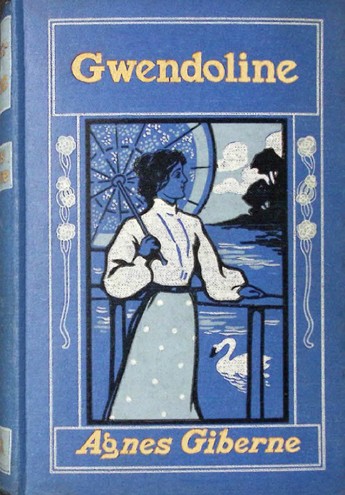
The Project Gutenberg eBook of Gwendoline
Title: Gwendoline
Author: Agnes Giberne
Illustrator: Joseph Finnemore
Release date: November 27, 2025 [eBook #77349]
Language: English
Original publication: London: The Religious Tract Society, 1905
Transcriber's note: Unusual and inconsistent spelling is as printed.
GWENDOLINE WAS THE FIRST TO LIFT HER HEAD.
GWENDOLINE
BY
AGNES GIBERNE
AUTHOR OF
"ANTHONY CRAGG'S TENANT," "STORIES OF THE ABBEY PRECINCTS,"
"THROUGH THE LINN," "NEXT-DOOR NEIGHBOURS."
With Three Illustrations by J. Finnemore
LONDON
THE RELIGIOUS TRACT SOCIETY
4 Bouverie Street and 65 St. Paul's Churchyard E.C.
BY THE SAME AUTHOR.
Anthony Cragg's Tenant.
Illustrated. Crown 8vo,
2s. 6d.
Next-Door Neighbours.
Illustrated. Crown 8vo,
1s.
Stories of the Abbey Precincts.
Illustrated. Large crown 8vo,
2s. 6d.
Through the Linn; or, Miss Temple's Wards.
Illustrated. Crown 8vo,
1s. 6d.
Easy Lessons on Things around us.
Illustrated. Crown 8vo,
1s. 6d.
CONTENTS
CHAP.
LIST OF ILLUSTRATIONS
GWENDOLINE WAS THE FIRST TO LIFT HER HEAD Frontispiece
SHE LEAPED BOLDLY IN, STRIKING THE RIGHT SPOT
LADY HALCOT'S KEEN BLACK EYES RAN SWIFTLY OVER GWENDOLINE
GWENDOLINE
CHAPTER I.
LONDON FOG.
"YOU won't go into the city to-day of course, Stuart?"
The voice betrayed anxiety. It was breakfast-time, but gaslights shone overhead, glittering on chased silver and on broad blue borders of delicate china. Beyond the panes of the two windows only a dense yellow haze was visible.
Mr. Selwyn looked up from a deluge of morning correspondence, following his wife's glance. "It will lessen," he said tranquilly.
"Just this once," she pleaded. "Such a day! Could you not be content to spend one day at home?"
"How about appointments, my love?"
"I daresay you have none of any importance."
"Gwendoline Halcombe, at twelve,—for instance."
"The pretty girl that we met in the Academy with her father? But that need not take you out. You don't seriously suppose any lady would keep an appointment in this fog."
The lawyer's grey eyes laughed pleasantly beneath their broad brows. He was unlawyer-like in aspect, according to conventional notions, being strong and upright in build, with ruddy colouring and particularly straightforward expression.
"I don't for a moment suppose so of 'any' lady," he said. "I suppose it to be not improbable in the case of Miss Halcombe."
"I do not like young women to be too independent,—very young and pretty ones especially."
"Perhaps Miss Halcombe does not like it either. Independence becomes a matter of necessity in certain instances,—with the eldest of ten, for example."
"Is she that?"
"Ten is the number, I believe—ranging from nineteen to three in age."
"What made her fix on to-day?"
"She wrote and asked if she might have a few words with me. I named the day and hour."
"Why not telegraph to put her off?"
"That is far from being my only engagement. Also, I could not reach her. She will be at her painting in the Academy or Kensington, I don't know which."
"Painting! Yes, you promised to take me some day to see her drawings. She is clever, is she not?"
The lawyer was becoming absorbed in another letter. His wife surveyed the window afresh, trying to glean encouragement thence. Failing to do so, the conclusion at which she arrived was uttered aloud, with a sigh of despair.
"It is perfectly awful."
"Eh?" said Mr. Selwyn.
"The fog! It is awful, Stuart."
"It is rather thick, but I have seen worse," mildly admitted Mr. Selwyn.
"If this is only 'rather,' I don't know what 'very' thick may be. You will never get back from the city alive."
"That will scarcely be the fate of every city man. I hope I shall be among the survivors."
"Oh, Stuart, don't joke about it. Suppose something really did happen."
She had been married only nine months, and was as yet unaccustomed to the vicissitudes of the London atmosphere, after twenty-six years in the clear air of a country village. There was something country-like still about her soft plumpness and rosy cheeks. She was rather a pretty little woman, over twenty years her husband's junior. Mr. Selwyn had been married once before for a brief space, and had spent a long widowhood before finding a second wife to his mind. He was still in the prime of life, a lawyer in good practice, a man of considerable private means, and a general favourite, greatly esteemed by all who knew him for his unswerving rectitude and for his kindliness of heart. He had one son, Mortimer by name, four or five and twenty in age.
"Never expect evils, Isobel. I am an old hand at fogs. But, as you say, no need to jest. I have a note from Miss Withers. Lady Halcot desires an interview."
"Halcot! Isn't she the old lady at Riversmouth, who gives you so much trouble?"
"I should not like that description to reach Lady Halcot."
"Not very likely. I don't know any one belonging to her. And Miss Withers is the lady-companion, is she not? I remember. What do they want you to do?"
"I shall have to run down to Riversmouth to-morrow."
"So soon?"
"Lady Halcot expects me to-day. Impossible, unfortunately."
"I am sure I would rather have you go into the country than into the city. There would be some likelihood of your leaving this horrible fog behind you."
"Yes, but I am tied to city work to-day,—no help for it. I think the fog shows signs of lifting."
"I wish I could see them," sighed his wife.
Mr. Selwyn went to his office as usual, only not so quickly as usual, for traffic was under serious difficulties, and the promised "lifting" of the fog took place but slowly. If other people kept to their appointments that day, however, Gwendoline Halcombe unexpectedly failed in hers.
Riversmouth was a seaside place within tolerably easy distance of London, but it was by no means a seaside place of the fashionable description. No railway station existed within four miles of the village—called flatteringly by some of its inhabitants a "town." No trim parade was laid down above or below the beetling low cliffs which overhung the shingly beach, parted by only one sharp and narrow cut, through which trickled a tiny brooklet beside a rough pathway. Houses stood irregularly above, tier above tier, and two or three of the oldest buildings jutted almost over the edges of the cliffs.
Lady Halcot, the aged owner of the land in and about Riversmouth, strenuously resisted every attempt at improvement or "innovation;" her one aim being to keep the place precisely in the same condition as she had known it sixty or seventy years earlier. The traditions of her family sternly prescribed "selectness," forbade admission of strangers, discouraged popularity, abhorred excursionists, fought against social and religious changes of any kind or description. The old lady strove to carry out these traditions to the letter, and where she failed, she lamented sorely.
That the place had so far increased as to possess two churches in lieu of one was a distress to her, and no one yet ventured to suggest in her presence the growing need for a third. She was regularly to be seen each Sunday, once, if not twice, in the cushioned square pew of the parish church, where her ancestors had sat from time immemorial; but she had little to say to the Riversmouth clergy. The Rev. Charles Jay, of the chapel of ease, she had always disliked and ignored, simply from the fact that he belonged to a building the very existence of which she deprecated. The Rev. William Rossiter, of the parish church, appointed to it by herself some twelve years earlier, had long been honoured with her friendship and confidence.
But three or four years ago a change had crept quietly over the dream of peaceful parish slumbrousness, wherein the old lady delighted. Nobody knew exactly when or how it began. Only, somehow, Mr. Rossiter's placid moral essays grew into earnest expositions of Bible truth and vigorous appeals to his congregation to repent and be saved; also an active young curate came upon the scene, and Bible-classes were started, and cottage-lectures sprang into being.
"Such things as were never even mentioned in my grandfather's days," Lady Halcot said in her disgust.
She remonstrated with Mr. Rossiter, but was met by a gentle resistance, on which she had not calculated. Mr. Rossiter had reached that point where the question becomes one of obedience to God rather than man. He would have spoken of a change in himself, and in his views of work to be done for his Lord and Master, but she would not listen. If he did not choose to conform to her will, she had nothing more to say to the matter—or to him. Mr. Rossiter was permitted only to bow and withdraw, and from that day he was admitted no more at the Leys. He went quietly on with what he believed to be his duty, scattering the Word of Life to right and left, as he found opportunity, and meeting with much happy encouragement at times. But he saw no more of Lady Halcot, except in her pew and her pony-carriage. She vouchsafed him occasionally an icy bow in passing; and she studiously placed every possible obstacle in the way of his labours. It never occurred to her that she was thus actually hindering work for God. The idea might have startled her, had she looked it in the face.
No London fog had found its way to Riversmouth next day, when Mr. Selwyn stood upon the eastern cliff, enjoying the strong sea-breeze. He unbuttoned his greatcoat, threw back his shoulders, and drank in large gulps of salt air, with a Londoner's appreciation of the same. Waves below were tumbling in, one upon another, with reckless haste, as the breeze helped onward the rapid spring-tide. There was not a gale, but the wind possessed sufficient force to whisk off the white wave-crests, scattering them in small spray around, and to wail weirdly among roofs and chimney-pots. Rock-boulders lay upon the beach, where at intervals in the past they had fallen from the cliffs above, and amongst them the waves splashed roughly, swirling round, and drawing back, and leaving trails of white foam to die upon the stones.
A zig-zag flight of narrow steps, guarded by a stout hand-rail, led down the face of the cliff. Mr. Selwyn, standing at the top, had made up his mind not to descend, when his eye was caught by a figure below. "If it is not!" he ejaculated.
He paused for another look. The figure was that of a girl, standing upon a low boulder near the margin of the water. Her ungloved hands were clasped lightly together, and a grey closely-fitting ulster, swaying in the breeze, encased the slim figure from head to foot. The neat little feet showed below, and the little head wore a cap of the same material as the ulster, from beneath which peeped short curly brown hair.
"What is she after here?" asked Mr. Selwyn half-aloud.
He made his way down the steps with no further hesitation, strode over the crunching shingles, and drew near. She glanced round at the sound of footsteps, and turned to meet him with a gesture of surprise.
"Mr. Selwyn!"
It was a lovely face, oval and delicate, with large brown eyes like those of a deer, liquid and wistful. The boyish shortness of the hair, and the severe simplicity of the grey suit, rather enhanced than detracted from the general effect.
"You here!" the lawyer said, in accents of unmitigated astonishment.
"I couldn't help it. I had the chance, and—I came. Was it wrong?"
"What chance?"
"Honora Dewhurst offered to bring me for two nights. It is just a reviving breath. We work together at our painting, and she is my friend. Mother said I ought to use the opportunity, but I could not feel sure about the 'ought.' Still—a third-class return doesn't come to so very much."
"No, no," Mr. Selwyn assented.
"Of course we can't really afford it," she remarked ingenuously. "But then it is a question what one ever can afford. There is always something else wanted which seems just as needful. If it comes to a question of necessaries, I suppose one could 'do' in a hovel, with dry bread and water. But, on the other hand, I can't afford another illness, and I have felt like that lately."
"Time you had a change, then. How has the work gone on?"
"Which work? The 'stitch, stitch' never does go well. Mother and Ruth have done my share as well as their own the last week, for I just 'couldn't.' And then my painting began to fail, and life was looking awry, and I began to see it was time for a change, as you say; yet I could not feel sure. Perhaps I ought to have fought on without it. How is one to know which is the right thing to do, Mr. Selwyn?"
She looked at him questioningly.
"Generally by the exercise of common sense," he said.
"Is that always enough? Common sense sometimes points in two directions equally. Mother would tell me to pray to be shown the right way."
He did not exactly smile. His was not a cynical face by any means; but his expression for a moment was curious.
Gwendoline's brown eyes had a sudden flash in them.
"And mother is right," she said. "For what we want to do is God's will—of course; and how are we to know what His will is, unless He shows us? So it 'is' the exercise of common sense to ask Him!" Gwendoline's bright eyes met Mr. Selwyn's steadily again, seeking to discover whether he agreed.
Mr. Selwyn contrived to banish from his face any manner of decisive expression. He did not wish to enter into a discussion upon this question. "So you settled to come," he said.
"Yes, they all said I ought. And, besides, I had another reason—" She stopped, and coloured brilliantly.
"Your journey prevented your coming to me yesterday, I suppose?"
"No; we did not start till the afternoon. I was near your office at twelve; but I changed my mind."
Mr. Selwyn showed surprise.
"I changed my mind," she repeated, looking down. "It was only something I wanted to consult you about, and just at last I decided not to ask you. I thought you would discourage me, and I wanted to be free."
"You would rather not tell me what the 'thing' is?"
"I'll think about it. Not now, please," she said sedately. Then, with a sudden change of manner, turning towards the sea, "Oh, that wave!"
She wrung her hands with delight, as a massive billow rolled in upon its predecessor, rising in a broad green wall of water, and curling over to fall with booming crash and hissing swirl.
Mr. Selwyn uttered a word of warning and stepped back.
Gwendoline did not move, and the foam rushed in a flood round her feet and ankles. She said only, "There!"
CHAPTER II.
LADY HALCOT.
"WHAT are you going to do now?"
"I have only this pair of boots with me. It does not matter. Nobody ever takes cold with salt water."
"You have shoes, I suppose?"
"Yes, but I couldn't stay indoors to-day."
"Where does your friend live?"
"Honora? She does not live here at all. We are visiting her uncle and aunt—dear kind little old people, Mr. Selwyn, but not the very least bit in any august circle of 'society.' It is a mite of a house, some way from the beach. Honor is coming to me presently. I could not bear to lose a moment of the sea."
"But you will go back now, and look to your wet boots," he said, with polite persuasiveness.
She gave an impatient gasp, then said, "If I 'must—'" and turned to spring lightly up the steps.
At the top they paused. "I wish I could go farther with you," Mr. Selwyn said. "But I am due at the Leys."
"I wondered what you were here for. Oh, what a delicious little carriage!"
The carriage, low and open, drawn by two exuberant ponies, went past rapidly. An old lady sat beside the drab-liveried young driver,—small and shrunken in figure, muffled well in ermine wraps, with thin snowy hair, bushy grey eyebrows, and two bright black eyes, which scanned Mr. Selwyn and his companion sharply.
Mr. Selwyn lifted his hat with an air of profound politeness, and the old lady's head made a slight movement in acknowledgment of the same.
"Who is that?" asked the girl.
"Lady Halcot."
"It is! Mother wondered if I should see her. She looks—severe."
"She is severe."
"She has a splendid Roman nose,—if only she were a taller woman to match it."
"When you are a famous artist, you may offer to take her likeness."
"Ah,—when!" she said, sighing deeply. "The poor old lady will scarcely live so long. But I really am taking a likeness now—of Mrs. Hobbs, our grocer's wife. She hasn't exactly classical features, and she wears an astonishing cap. I am to have a guinea for it, however." Gwendoline looked up laughingly.
"Most of us have to begin on the lowest rung of the ladder," said Mr. Selwyn, liking her courage.
"I think I am glad to have seen Lady Halcot," she said abruptly. "I understand better now."
Mr. Selwyn looked for more.
"About the state of things. You know I am a believer in physiognomy, though not always in my own reading of it. But Lady Halcot has a face easy to make out. If she made up her mind to any one course of action, she would not soon swerve from it."
"Your knowledge of the past gives you fair reason for supposing so."
"I was not sure till I saw her face. But I am now. I am afraid I should meet with a cold reception, if I ventured to call on her."
"I fear so, indeed. I could not recommend the step."
"Good-bye," said Gwendoline.
He shook hands and passed on.
Gwendoline stood still, sighing deeply once more.
"It will not do," she said. "No, it will not do. I have been indulging in day-dreams. I am glad I did not mention my idea to any one. Things looked different from a distance, but now I am here, I see it will not do! I just 'couldn't' take any such step. Mother says one's way always becomes clear, if one prays and waits. I suppose this is the becoming clear of my way. It isn't what I wished and dreamed. But to go to the Leys uninvited!—Oh, no! What was I about, to think of such a thing? And yet—oh, mother, if I could but bring you ease somehow—anyhow! What could I not bear for your sake, if only it were God's will!"
Half an hour later, Lady Halcot, having reached home, was seated in her favourite arm-chair,—a large chair for so small a woman. The greater portion of her time was spent in this plainly furnished morning-room or boudoir, more correctly a study, since it contained two handsome writing-tables, besides a davenport, and was almost lined with books. The study proper, usually called "the library," was seldom used by her.
Divested of fur wraps, Lady Halcot might be found slightly deformed as well as small. One shoulder was a little raised, and the shape of her hands was singular, the knuckles being exaggerated in size. She sat upright, making no use of her chair-back. The davenport, close beside her, was covered with correspondence; and one of the said bony hands wielded a pen rapidly, filling page after page with bold handwriting.
Opposite the old lady, at the largest writing-table, sat a light-haired young man, of depressed look and generally timid aspect.
"You may address these for me," Lady Halcot said suddenly, tossing some note-sheets towards him.
The young man's depressed look deepened into positive unhappiness. He took the letters slowly, examining one after another in a hesitating manner.
Lady Halcot surveyed him with her bright cynical eyes, and finally broke into a—"Well?"
"I—I—am not quite sure—that is to say—I—"
"Ring the bell," said Lady Halcot impatiently.
The young man obeyed with a nervous start of response, and a man-servant appeared.
"Call Miss Withers."
The servant disappeared, and presently came back with a deprecating air. Miss Withers was out, and had not yet returned.
"Where is she gone?"
The man-servant was not aware. Lady Halcot looked at the young man for information, and with a second start, he immediately turned over a small inkstand, deluging two of the notes. He stared at the results of his own awkwardness in blank despair.
"That will do for to-day," Lady Halcot remarked frigidly. "Give those papers to me, Bryce. Take care, here is a sheet of blotting-paper. I shall not require any further assistance this morning, Mr. Withers. You had better remove the cloth, Bryce, immediately, or the table will be ruined. Dear me, it is one o'clock. Mr. Selwyn will be here soon."
"Mr. Selwyn has just arrived, your ladyship," Bryce said, as he gathered up the ink-bedewed table-cloth.
"Bring him here to me, at once. You may go, Mr. Withers," for the young man seemed at a loss what to do. "Cannot you understand? I wish to see Mr. Selwyn alone."
Mr. Withers in alarm bowed, and precipitately retreated. Outside the room, his face assumed a boyish expression of relief, and he sped at a headlong pace along the broad corridor. Passing below the draped curtains which divided it from the entrance hall, he nearly ran down a slim and quiet lady, over thirty, perhaps even over thirty-five, in age, dressed with unexceptionable neatness, having calm light blue eyes and smooth washed-out fair hair.
"Really, Conrad!" she said.
"I beg your pardon, aunt—didn't mean to hurt you. I'm sure I'm very sorry," said the dismayed Conrad, staggering back from the collision.
"Where are you going?"
"I turned over an inkstand, and Lady Halcot ordered me off."
"You never get through a day without a blunder of some sort," the lady said in hushed tones, moving with him towards the ponderous front door. "Lady Halcot will grow tired of it soon, and dismiss you altogether."
Mr. Withers looked as if a worse event might happen, in his own opinion, than such dismissal.
"Yes, that is all very well," she said. "But think what the disappointment would be to me—and to your sisters. Remember, Conrad, you have had difficulty enough before this in finding any work for which you were fitted."
"I don't really think I am fitted for this," said disconsolate Conrad.
"Yes, you are, quite sufficiently, if you would determine to do your best. You are not brilliant, but you have sense enough for all that Lady Halcot requires," she said, lowering her voice to almost a whisper. "What you have to do is to make yourself 'necessary' to her, Conrad. You understand? Make yourself necessary in her every-day life. You should be incessantly on the watch to forestall her slightest wish; yet you must take care never to seem obtrusive. It is far more a matter of tact and attention than of cleverness. If you let this opportunity slip, you will never in life have such another."
Conrad Withers' expression was not responsive, but he said meekly, "I'll try, aunt; I'm sure I mean to do my best." Whereupon Miss Withers released him.
CHAPTER III.
GLADIOLUS COTTAGE.
MR. SELWYN went through a certain stage of perplexity in Lady Halcot's presence, as to the immediate cause of his summons to Riversmouth. Usually her plan was to plunge headlong into business, allowing scant space for polite greetings beforehand. Now, for once, she seemed disinclined to speak plainly, and showed an unwonted disposition to "beat about the bush." Some minor questions were brought up, relative to the management of her property, but these were questions which might have been quite as easily discussed by post. Mr. Selwyn was perfectly well aware that they had not yet come to the point. He began to doubt whether after all he would get away by the early afternoon train, which he had set down in his mental plan.
"You have Miss Withers still with you," he remarked, when a pause occurred in the conversation.
"Yes, I have," responded Lady Halcot. "With me, and likely to remain. She is an invaluable person. I can rely entirely upon her memory, and my own plays me false occasionally. I suppose I must expect as much at my age."
"You are to be congratulated, Lady Halcot, if it never played you false until now."
"I do not say that, but my memory has been remarkably good. Time was when I could read a stanza once through which I had never seen before,—not a short one, either,—and repeat it afterwards without a mistake. I cannot do so now."
"And Miss Withers' memory serves to fill up gaps?"
"Precisely so." She looked at him keenly. "You do not like Miss Withers."
The lawyer made a slight deprecating bow. "Pardon me! Miss Withers and I can boast but the barest possible e acquaintance with one another. You appear to find her well suited to her post."
"She is exactly that—quiet and ladylike, always helpful, and never in the way. I wish Mr. Withers were her equal."
"Your secretary?"
"He calls himself so. I allow him to hinder me in my work for two or three hours every day, by way of giving satisfaction to Miss Withers. She foretells that the hindering is soon to develop into helping. I have my doubts, but I am willing to give him a fair trial."
"Miss Withers is a near relative of Mr. Withers?" the lawyer said inquiringly.
"His aunt. He has two sisters, I believe, but no parents living. Miss Withers seems to have acted a motherly part to the three. Very praiseworthy, of course. Mr. Selwyn—"
Now it was coming! The lawyer looked expectant.
"Who was that charming girl upon the cliff yesterday—speaking to you? I was not aware that you had friends in the place."
"She 'is' a charming girl—a London acquaintance, down here for two days. We met accidentally on the shore," Mr. Selwyn said slowly, his mind taking a rapid survey of the situation.
"I was struck with her appearance. A clever girl, I should imagine."
"Yes—in many respects, no doubt, and she certainly has marked artistic talent."
Lady Halcot's withered face brightened with a look of interest. "Talent?" she repeated. "Not genius?"
"Perhaps I should rather have said genius,—but really I do not know. I imagine that she has power to originate, though at present she chiefly copies. It is uphill work, and she is the eldest of a large family."
"What is her father?"
"A clerk, Lady Halcot."
"In your office?"
"No,—in a house of business. I have only seen him once. He is much occupied, and has very poor health. I do not know what would become of them all if he broke down."
"Then they are poor. What is their name?"
"They are poor unquestionably. If this young lady succeeds by and by—"
"As an artist!" Lady Halcot shook her head. "How old is the girl?"
"Not twenty yet, I believe."
"She may get butter to her bread by picture-making ten years hence,—and possibly a competence twenty years later. That is all you can hope from even first-rate talent. Possibly a competence."
"Some do better."
"Some have genius. Has she it, or not? That is the question. You do not know,—no, but I could soon judge. How long does she remain? Only till the day after to-morrow? And of course she has no pictures here. I might be able to give her a helping hand, if there is genuine power. I never lend my aid to passing off mediocrity for genius. We must consider what to do. Meanwhile,—if you think it would be acceptable,—I have no objection to sending a five-pound note to the parents."
Mr. Selwyn decided on his line of action. "I think, your ladyship, that it would unquestionably be acceptable if sent direct from yourself, with a few kind words accompanying."
"Very well. The name and address, if you please."
She passed a slip of paper and a pen. Mr. Selwyn wrote slowly and handed it back.
"James Halcombe, Esq."
Lady Halcot read so far aloud, stopped, and lifted her black eyes to Mr. Selwyn's face. Inwardly he was just a little nervous. Gwendoline Halcombe interested him, and he was anxious to do his best for her; but naturally he did not wish to offend his wealthy client.
"James Halcombe," repeated Lady Halcot.
"Gwendoline Halcombe's mother, and James Halcombe's wife, 'was' Eleanor Halcot."
The old lady's start was irrepressible, and her hand shook, but she said in a stern and unfaltering voice, "Then Eleanor Halcombe is dead?"
"No—she is living. I meant 'was' only in the sense of before her marriage."
Lady Halcot folded the paper, and slipped it into a drawer, with hands that trembled still. She was evidently vexed with herself for the display of weakness.
"You may send the five-pound note for me, if you choose," she said. "But it must be a strictly anonymous gift. I was not aware that you knew these people, Mr. Selwyn."
"Mr. Halcombe called on me once to consult me upon a difficulty, and his daughter has been two or three times since. Also, I have met her in the Royal Academy and elsewhere. One is naturally drawn to a struggling young artist."
Lady Halcot offered no reply. The luncheon-bell rang, and she rose to lead the way out of the room. The express object of Mr. Selwyn's journey had not yet been broached.
Gwendoline had truly described Gladiolus Cottage as "a mite of a house." It had one tiny parlour in front with a single window, and a tinier kitchen on the same level behind, and two bedrooms above, and two sloping-roofed garrets at the top, one of which was the servant's domicile, and the other a receptacle for lumber. Of the two best bedrooms, one was tenanted by Mr. and Mrs. Widrington; the other was reserved for guests.
Mr. and Mrs. Widrington had no children of their own. One little baby had come and had vanished, in days long gone by, leaving tender memories behind it. Mr. Widrington, after fifty or sixty years of steady work, had made his little competence, and had retired into an easy life, his chief trouble thenceforward being to know what to do with himself. He had many a longing for his old city home and old interests. The sleepy quiet of Riversmouth palled upon him, and the rumble of carts and omnibuses would have been as music to his city-bred ears. But the step, once taken, could not easily be reversed, even so far as a home was concerned, and could not be reversed at all so far as business was concerned.
Thus, Mr. Widrington found himself in for the somewhat tiresome leisure of a healthy and objectless old age. Literally and actually objectless. His leading aim through long years past had been to make enough money for present needs, and to secure a sufficiency for comfort in declining years. He had made enough; he had secured the sufficiency; and declining years were coming upon him gently. What next?
That was the question. Mr. Widrington had no "next." He had attained to his life-goal, and no loftier goal lay beyond. He was conscious of this, and he was dissatisfied in the consciousness. Hitherto a pleasant prospect had always lain ahead, in the shape of this same "comfortable old age," spurring him on to exertion. He had lost the spur now, and he missed the stimulus. The happiest old age cannot last for ever, and Mr. Widrington began to dislike the thought of being an "old man," to object to the term being used in respect of himself.
For there lay now no pleasant prospect ahead. Mr. Widrington was not exactly troubled by fears as to his future. He counted himself to have done his duty, on the whole, towards himself, towards his family, towards his neighbours; and—towards God? Mr. Widrington did not care to look very closely into that last question, but he hoped things were all right, and he hoped to get to heaven somehow, a vague and shadowy heaven, not particularly attractive to his imagination, only, of course, desirable.
Thus, Mr. Widrington's hopes, as well as his heaven, were vague. He had also a vague knowledge of his Bible, which he seldom read, and a vague belief that Christ had died for men generally. But in all this he found no real comfort for the future or joy for the present. How should he? So Mr. Widrington, though to superficial observers seemingly a chatty and contented old man, was in fact by no means a happy one.
The change of life to Mrs. Widrington was less severe. A stout little old lady, good-humoured and kind, often ailing as to health, but always even in spirits, she could be well satisfied with the mild excitements incidental to "pottering" about the house all the morning, taking a turn out of doors in the afternoon, knitting and sleeping through the evening. The comforts of husband and household had been her aim during nearly half a century, and that aim was before her still. She had not even a wish for anything beyond this tame level of her existence.
A visit from Honora Dewhurst was a great event in their lives, and the interest of the event was doubled by the presence of Honora's friend, Gwendoline Halcombe.
"She 'is' a pretty girl, and there's no denying it," Mr. Widrington said emphatically, as he and his wife awaited the return of the two walkers to early tea; a primitive tea of bread and butter and cake, shrimps, and water-cresses. "She's a downright pretty girl, and uncommon nice too. Now there's Honor, as good and nice a girl as can be, and clever too, there's no denying, for her pictures are amazing good. But nobody ever called Honor pretty. The goodness is all of an inside sort, and not of an outside—though it shows through, and no mistake. But this young thing has got both, and there's no doubt she's greatly favoured. For a pleasant outside is by no means a thing to be despised."
"I wonder if they don't mean to come back soon. The tea will spoil," rather irrelevantly observed Mrs. Widrington, who, dressed in her best black silk, was seated in her easy-chair, with the invariable knitting in her plump round hands, and the invariable content on her plump round face. Mrs. Widrington was better born than her husband, and forty-five years earlier her family had counted the marriage a serious downward step for her. Perhaps for a while she had felt it so herself. People grow used to new levels, however, and Mrs. Widrington was most happily accustomed to the platform upon which she stood. She looked up to her husband with dutiful wife-like submission; and if in particular instances she usually counted her own judgment superior to his, this was not at all because of any original difference in social position, but simply because she was a woman, and he was, as she would have said, "only a man."
"There they come,—just in time," Mr. Widrington said, gently striking his hands together, as he stood at the window. "Just you look, wifie; now don't you call that a pretty picture?"
Mrs. Widrington moved to his side obediently. "But it's a dreadful mess," she said.
The two girls were approaching at a quick pace, laden with spoils from the seashore. Honora Dewhurst, a strongly-built and upright person, four or five years Gwendoline's senior, walked steadily as well as swiftly, looking little to right or left. But Gwendoline, dressed still in her severe grey suit, seemed to be rippling over with frolicsome enjoyment, and the sound of her clear laugh came through the open window, and was matched by the half-dancing step. Honora's hands were full of stones and shells, and Gwendoline bore a big pile of sea-weeds. One long ribbon spray had been caught by the breeze and twisted round her head, and the brilliant cheeks and merry eyes looked out from an unwonted surrounding.
"She's better for the change already," Mr. Widrington said, and he opened the door.
"We are not fit for the drawing-room," exclaimed Gwendoline. "Our boots, Honora!"
"Now you are going to have some tea before ever you take one step up-stairs," said Mr. Widrington decisively, avoiding his wife's eyes, lest he should read disapproval. "Just you throw all that rubbish down in the passage, and take off your cloaks."
Neither would consent to this manner of proceeding. Possibly they saw the disapproval in another quarter, of which he preferred to be ignorant. They vanished up-stairs, and speedily reappeared, Gwendoline still in a glow of enjoyment, Honora quiet and staid, with her plain strong face, and broad forehead.
"And you like the sea, my dear, eh?" Mr. Widrington said to Gwendoline.
"It is lovely, past words," she said. "If I could just live within sight and hearing of it, I think I should want nothing else in life."
"It's lively, there's no doubt," said Mr. Widrington. "But it isn't a cheerful sort of liveliness, by any manner of means. Now you'll think me odd, maybe, but I'd a deal rather have a 'bus going past the door every five minutes, than I'd look on the finest sea that ever was,—a deal rather."
Gwendoline refrained from remark.
"Riversmouth is a pretty little place, and it has got capabilities. Take some cresses? Yes, do, Miss Halcombe, and lay your butter on thick, and have a little jam a-top; don't you stint yourself. Yes, Riversmouth's a pretty place. But, dear me, as long as that poor old lady is alive, the village will never grow to what it should be. Why, it might become a first-rate watering-place of the fashionable sort in no time; just lay down a double line of rail, and put up a station, and have a good band and an excursion train or two in the week. Now that 'would' be lively-like."
The two girls exchanged amused glances. Honora Dewhurst knew of the relationship between Gwendoline and Lady Halcot, though the Widringtons did not.
"My dear, you needn't suppose anything of that sort is likely to be," Mrs. Widrington said. "There are ever so many things wanted in the town, and nobody dares name them to Lady Halcot. She has everything her own way, and not a man ventures to cross her will. She's regular queen here, and that's what it is."
"I am afraid some of her subjects are in a rebellious state of mind," said Honora. "But as for excursionists, the longer the place can escape that infliction the better. Here comes a visitor to disturb our meal."
"Mr. Selwyn!" exclaimed Gwendoline.
"A friend of yours, Miss Halcombe?" asked Mr. Widrington.
"Yes—at least, I know him. He is a friend really. He is down from London for a few hours,—Lady Halcot's lawyer."
"My dear, you take an old man's advice, and you beware of lawyers," whispered Mr. Widrington very audibly, as the door-handle turned. "You take my advice, and be warned. There's always a six-and-eightpenny charge behind, sure as he takes a step in your behalf. And I may say it, if anybody may, for I know it to my—"
"Mr. Sellon," announced the bewildered maid-servant, unused to so much company.
And Mr. Selwyn entered, bowing and apologizing for the interruption, but might he have a few words with Miss Halcombe?
"To be sure, to be sure, as many as ever you please, sir," Mr. Widrington said eagerly, forgetting that he addressed a lawyer, and delighted with a fresh addition to the party. "But we are having our tea, and tea is a beverage that doesn't improve by keeping beyond a certain stage,—not beyond a certain stage, sir,—and these young ladies are hungry. So you just sit down, and take a cup of tea with us, and then we'll all clear out—eh, wifie?—and leave you two in undisputed possession of the parlour."
Mr. Selwyn was slightly troubled. "The parlour" was evidently the only parlour, and he did not relish the idea of "turning out" its lawful inmates, though he would much have preferred a few words alone with Gwendoline. He sat down, however, and consented to take a cup of tea, declining substantials. "I dine at half-past seven," he said.
"You will hardly reach home in time for your dinner," suggested Gwendoline.
"Lady Halcot has persuaded me to remain over the night. I must leave by the 7.20 train in the morning."
"Mrs. Selwyn will be disappointed."
"I am afraid so. I have just sent her a telegram."
After a few minutes of general conversation, he turned again to Gwendoline, having decided to forego the private conversation. "I bring you an invitation, Miss Halcombe. Could you dine at Lady Halcot's this evening?"
"This evening!" The proposal seemed to take away her breath, and she turned pale.
"You would dislike it?" asked Mr. Selwyn, while Honora watched her gravely, and the old people were flustered at the magnitude of the proposal.
"No—oh, no!—not at all. I am only—surprised," said Gwendoline, hardly able to speak. She sat quite still for two seconds, putting a strong restraint upon herself. "I will do exactly what you advise."
"I should recommend you to accept the invitation."
"To-night, at half-past seven?"
"Punctually. Lady Halcot never waits. I think you should arrive ten minutes earlier."
"But I have no dress, except this."
Mr. Selwyn surveyed the dark tweed, neatly fitting, but almost devoid of ornament. Heavy trimmings were just then in vogue, and he was dimly conscious of something unusual.
"It must do, of course," he said. "I suggested that matters might be so, and Lady Halcot said you could come as you were."
Gwendoline sat lost in thought, and Mr. Selwyn rose, with the air of a man who has discharged himself of his office.
"Gwen, you had better open the front door for your friend," suggested Honora, guessing that the two might wish for a few more words; and she kept her uncle back, and shut the parlour door.
"What does this mean?" asked Gwendoline, laying her hand on the slab, for she was positively trembling.
"It means simply that Lady Halcot desires to use this opportunity to form your acquaintance, Miss Halcombe."
"How does she know that I am here?"
"She saw you with me on the cliff this morning, and has since inquired your name."
"Strange," murmured Gwendoline. "I had a feeling when I came that I might perhaps see her—might perhaps say a word about—"
"A word about what, if I may ask?"
"My mother, and our circumstances. But I found that it would be impossible."
"I think you would be wise to count it impossible still," Mr. Selwyn said with gravity.
"But if an opening came—"
"I think you will, in any case, be wise to avoid a single word which might leave an impression that you were seeking anything from her. Pardon my frankness," he said, as the colour rushed again into her face. "I understand the state of affairs, and your true motive; but she would not."
"Thank you, I will take care," said Gwendoline in a low voice. "I don't suppose I should have dared, after all. I am frightened of Lady Halcot."
"Don't be afraid to-night," he said, shaking hands. "She is interested in art, so you will have one subject in common. The carriage will bring you home at half-past nine. Lady Halcot keeps early hours—excusable at seventy-five. Good-bye."
"One word," said Gwendoline hurriedly. "Mr. Selwyn, do you suppose she means anything by this?—Do you think it hopeful?—Do you think we may count—for the future—"
"No," Mr. Selwyn said at once. "I should be wrong to encourage hopes. What may come of it by and by no one can predict. At present I see no signs whatever of any softening towards your family, though she is disposed to feel some interest in yourself personally."
Gwendoline sighed. "Thank you—good-bye," she said; and she went back to the parlour.
"Honor, would it be very rude of me to run away to the shore for half an hour? I don't want to be nervous and shy at dinner, and a look at the sea would give me back my balance." Gwendoline spoke beseechingly.
"You silly child," Honor said, smiling. "Yes, go, of course; only come back in good time. I must find some lace for your throat and wrists."
"You don't mean to say you are a friend of Lady Halcot?" the old people chimed in, with accents of respect and amazement. "Why, you are quite a grand young person, my dear. Fancy never saying a word about it!"
Gwendoline laughed and vanished. "Her mother is Lady Halcot's cousin," Honora said quietly,—"first cousin once removed, I believe. But it had better not be talked about in Riversmouth, please, uncle. Lady Halcot has had nothing to say to Gwen's mother since her marriage with Mr. Halcombe. I don't know who was most in the right or in the wrong. I only know that the less said about the matter, the better pleased Lady Halcot will be—and probably Mrs. Halcombe also."
"Trust a city man to keep a secret, Honor," said Mr. Widrington, nodding his head energetically.
CHAPTER IV.
THE ROCKS.
HONORA came into the back bedroom ten minutes later, to find her friend, attired in ulster and cap, gazing out of the window into a little back yard.
"Dreaming, Gwen?" she asked.
"Yes," Gwendoline said, turning, with something like tears in her eyes. "Doesn't it sometimes feel to you as if life itself were more than half a dream?"
"No," Honora answered. "It seems to me altogether a tremendous reality."
"I know it is so. But sometimes I feel as if we were just leaves tossed to and fro on irresistible waves of circumstances—straws carried away on a strong current."
"Is Lady Halcot's invitation an irresistible wave?" asked Honora drily. "Why not say no at once?"
"Say no! I am only too eager to go, only too frightened lest I should make a mistake, and undo possible good for my mother and father by some silly blunder. I can't guess what Lady Halcot wants or expects in me. If I get a self-conscious fit, it will take away all ease; and if I talk too much she will count me forward; and if I talk too little she will find me dull."
"And if she does, what then?"
"You don't know how much may depend upon this evening, Honor," said Gwendoline deprecatingly.
"You mean—"
Gwendoline's cheeks were burning again. "She ought to be kind to my mother. She ought to be willing to help. I would not say this to anybody except you, but mother was her adopted child for twenty years, and everybody thought she would be heiress to some of the property. I suppose she would have been, but for—but for—her marriage. Can it be right for Lady Halcot to cast her utterly off?"
"I suppose your mother took her choice, Gwen," said Honora gently and gravely.
"Yes, and it was not Lady Halcot's choice. But Lady Halcot allowed the engagement for a time, and then refused permission, and turned against my father. That is where the wrong lay. It was tyranny, Honor. Could mother have forsaken him? Could you have given him up in her place?"
Honora moved her head negatively. "Had Lady Halcot a reason?" she asked.
"She had not known before that my father's family were so poor, and she disliked some of his connections, I believe. It was nothing in himself. She ought to have inquired more fully before giving permission. Once given, she had no right to withdraw it,—for such a reason, at any rate."
"And she has held no intercourse with your mother since?"
"None; not a word or a message. She told mother that it would be so, that if the marriage took place she would never see her or speak to her again. Mother has not the faintest hope that she ever will. She says she never knew Lady Halcot change in her purpose, or forgive an offence. But sometimes I have thought that if I could see Lady Halcot, I might persuade her to feel differently."
"She might be willing to help, even if she would not be on former terms," said Honora. "This looks like a possible step in that direction."
"If it only were—if it might be!" said Gwendoline, in a low voice. "I have such a craving sometimes just to see a possible way out of our difficulties. I feel like the man who was shut up in a room, and saw the walls drawing slowly nearer and nearer, day by day, till at last they crushed him to death between them. That story always had a dreadful sort of fascination for me, and now I seem to see the walls closing and closing in. And we cannot escape; and I can do nothing. Lady Halcot could help so easily; it would be nothing to her. If I stood alone, I could fight my way, and I would scorn to wish for one farthing of her money. But the pressure is terrible now, and it gets worse and worse. Mother is wearing out under it; and father—Honor, I don't think he ever forgets that he is the cause of my mother being cut off from ease and luxury."
"And you are looking to yourself to bring about a reconciliation? Gwen, if I were you I would 'lift up mine eyes' higher."
Gwendoline was silent.
"The thing is not in your hands at all. It is in God's hands. The chasm may be bridged over any day, if He so will. And He may will to use you for the purpose. If not—"
"Ah!" sighed Gwendoline. "That 'if not' is my difficulty."
"Because you are bent upon having it your own way. But you cannot choose. It must be His doing; and it must be done, inch by inch, as He wills. Better be content to have it thus, Gwennie dear,—to rest quietly under the shadow of His hand, and to let Him order things for you as He sees best. The walls will not close in and crush you, if you are waiting on Him to know the way out, but they may be allowed to come a little nearer. And the way of escape may be other than this."
Honora spoke in an earnest manner, and she laid a hand lovingly on Gwendoline's arm. It was a true and close friendship between the two, and Honora had not only a warm affection for this fair young creature, but a strong desire to shelter and protect her. Practically she could do little, however. She was a portionless orphan herself, and had to make her own way in the world.
"I ought to be able to trust," said Gwendoline. "We have always been helped so far,—only when I look forward, and see things growing worse, I am afraid."
And Honora said softly, "'Be not afraid;' 'Let not your heart be troubled.' 'Trust in Him at all times.'"
She added, after a pause, "I suppose we are so changeable ourselves by nature, that we really cannot imagine what absolute changelessness means. Gwen, your Master will not love and care for you one whit less to-morrow than He did yesterday. Only be willing to have things brought about as He chooses, and then follow carefully each indication of His guidance. The quieter you can be in heart, the less likely you are to undo His will for you by rash action. He knows what is best."
"It does seem as if it would be so very much best for Lady Halcot to forgive mother," said Gwendoline sadly. "Not that I like the word 'forgive.' I cannot think my mother was wrong."
"It might or might not be best. You and I don't know. Now you are going to have your little run, and you will come back the better for it. I wish I could go too, but I must not leave my uncle and aunt. By-the-bye, I thought it best to speak plainly of your relationship to Lady Halcot, that I might warn them not to talk. I know you do not wish your affairs to be made the subject of Riversmouth gossip."
Gwendoline went off somewhat soberly, taking her course down the crooked principal street, through the cliff-opening, and over the beach.
The tide was at its full height, and, indeed, was already on the turn, and the breeze had somewhat increased in strength since the morning. Waves of considerable size rolled in, to break upon the shore in a succession of crashes, grinding the rounded pebbles. Three poor children, neatly dressed, a boy and two girls, were playing near the margin of the water, and two fishermen were loitering on the top of the cliff; otherwise, the shore appeared to be deserted. Gwendoline, fresh from city crowds, revelled in the sense of stillness, and delighted in the freedom of being thus practically alone.
Somewhat to the right of the cliff-opening, a long line of jagged rocks ran straight out into the sea. Gwendoline could not resist the temptation to climb along them. She did not find the task quite easy; for, though at low-water they lay high and dry, they were now a very focus for splashing waves. Albeit a Londoner, she had a sure foot and steady brain, and she feared no slips. A dash of fine salt spray now and then was exhilarating; but she managed to keep her feet dry. At the further extremity of the chain a huge square boulder rose well out of the water, and here Gwendoline found for herself a comfortable seat. One or two passers-by, noting her from the cliffs, counted her rather an adventurous young woman, and were relieved to see her reach a place of safety. A false step half-way might have entailed serious consequences.
Gwendoline gave herself up to enjoyment—not exactly to thinking. Trains of clear thought, definitely carried on, are not often induced by the presence of Nature in her fairest moods. The mind is at such a time rather receiving new impressions than working out old impressions. Gwendoline was content to sit with clasped hands, thinking definitely about nothing, but drinking in with her lips the sweet fresh air, and drinking in with her eyes the varying blue tints of sea and sky, and drinking in with her ears the grand bass chords and softer treble accompaniments of the musical symphony played upon the pebbles by breaking waves and splashing waters; while vague musings crept unbidden through her mind. And the sense of restful trust in a Father's love, which she had not quite felt while Honora was speaking, seemed now to fill her heart.
"For He made all this," murmured Gwendoline. "How easy for Him to do just what He wills!"
Gwendoline's dreamy happiness was suddenly broken in upon by a sharp shriek. The little children on the beach, observing the movements of the young lady, had apparently been fired thereby to follow her example. Two of them were perched timidly on a rock at the beginning of the range, and showed small inclination to proceed farther; but the third, a boy of about seven, had succeeded in reaching nearly half-way towards the end boulder. There his footing slipped, or his presence of mind failed; for, with the scream which disturbed Gwendoline, he fell over, still grasping a point of rock with both hands.
The children wailed piteously, and Gwendoline sprang up. "Hold tight—hold on—I'm coming!" she cried, though doubtful whether her voice would reach him through the ceaseless splashing of the water. And even as she spoke, a large white-crested billow swept past, and the boy was torn away.
The accident had been seen from the top of the cliff, and men were hurrying down the steps, but Gwendoline knew there was no time to be lost. She stood perfectly still, considering what to do. Would the child be flung on the beach? For a moment she thought so, and then gave up the hope—if hope it were, since such a manner of landing must have been perilous to life and limb. The tide had by this time thoroughly turned, and the flow of the stream was seaward. As the wave passed on, to boom upon the shingles, the child was left behind, and the next instant, in the strong return-rush of water, he was borne farther back, to give a moment's sport to the following wave. Then he disappeared, to rise again near the boulder on which Gwendoline stood.
She had not been idle. In that brief space of time, while her eyes were strained in watching, she had flung off gloves, boots, and ulster, and had even dropped the skirt of her dress. She knew well that her only hope of keeping afloat, if the attempt proved needful, would be to find herself as far as possible unencumbered. She could swim, having learnt as a child, but she was entirely out of practice.
Would the little figure come within reach? Gwendoline gave a glance at the shore, and saw help still distant. Then she knelt down at the edge of the boulder; but that would not do. She flung herself flat, and hung over, with outstretched arms, striving to grasp him, but in vain. The waves, tossing him to and fro, seemed to mock at her efforts.
Down again into the green water the little form was helplessly sinking, and another broad billow was rolling up. Gwendoline felt that one hope only remained. She sprang to her feet, took one steady look, and leaped boldly in, striking the right spot, and seizing the child. The two went down together, and rose again, just as the big wave came up to catch them in its grasp, rolling them over, bearing them on, then leaving them in its rear.
Beaten and breathless, Gwendoline found her unpractised swimming powers of small avail. She could just keep herself afloat, and that was all. Even that could not be for long. Her best efforts were directed towards holding the mouth of the unconscious child above the waves; but water dashed over her own face, blinding and choking her. Would help never come? Was this to be the end? Gwendoline thought of her mother, and dimly pictured the coming sorrow in her home. Then she remembered Lady Halcot, and even wondered what the old lady would think, not to see her at dinner that evening. A vision of her last unfinished painting rose next, surrounded by a halo of girlish aspirations, perhaps never to be fulfilled. Again she found herself in the grasp of a powerful wave, and she knew her strength was gone. All around grew dark, and she felt that she and the child were sinking together. Yet in the deadly struggle for breath there came sweetly the thought of One who had died on the cross for her; for Gwendoline knew and loved and trusted Him, and He never fails His own.
Then something grasped and drew her out of the water; and someone took from her the little body to which she had so resolutely clung; and somebody else wrapped a cloak round her, and laid her at the bottom of the boat. Gwendoline was conscious of so much; and she even opened her eyes, and saw the weather-beaten faces of three fishermen, and also a grave face of a different stamp, bending over her. But after that, she knew no more.