
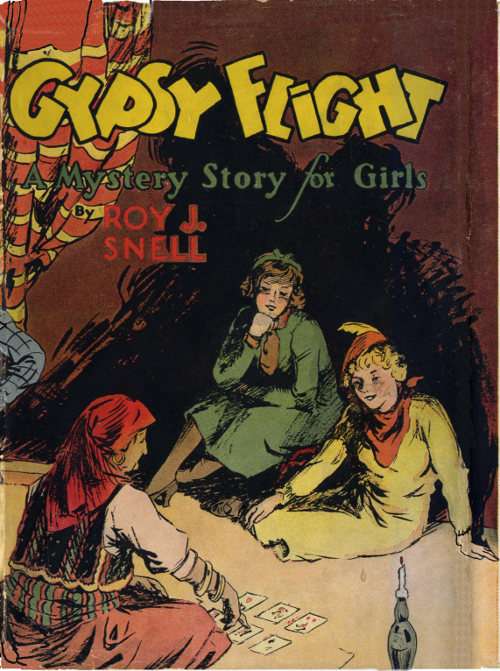
“Madame Bihari!” Florence exclaimed, delighted. “And you have the gypsy witch cards. You shall tell my fortune, for tomorrow I am to begin a splendid new adventure.”
“You shall find beauty and happiness.” Madame smiled a glad smile. She did not look at the cards. “You have learned a great secret. Health, strength, sunshine, the wide out-of-doors—they are your great joy. With these alone anyone may find happiness. You are a true gypsy at heart, my splendid Florence.”
“Thank you. That is kind.” Florence favored her with a rare smile. “But Madame, please, my fortune! You have never told it.”
“There is no need,” the gypsy woman murmured. “It is written in your face.
“But sit you all down upon my rug. Order me a good cup of black tea and you shall have as good a fortune as I can bring you. But beware, child! You have insisted. If the cards turn up wrong, do not blame your poor old Madame Bihari. It is you who shall shuffle, cut and deal—not I.”
When tea had been brought on a silver tray, Florence shuffled the cards, cut them with her left hand, then placed them one by one in their proper positions. Then Madame, bending forward, began to study them. The four friends, forgetting their tea, sat upon their feet, waiting in eager expectation. Moving in from their corner, the gypsies too watched in silence.
Over one who has seen them often an indescribable spell is cast by the gypsy witch cards. The serpent striking at some unseen object; the eye, gleaming at you from the half darkness; the fire leaping from the hearth; the mouse; the clasped hands; the lightning—all these and many others appear to take on a special meaning. And so they do in very truth to the teller of fortunes.
When at last Madame began to speak, an audible sigh rose from the little group of watchers.
“You have friends.” Her voice was low and even as the murmur of a slow moving stream. “Many friends. It is well, for there shall be perils. There is one you may wish to trust, even to love a little; but you must not, for that one is a traitor.”
“The spy!” Jeanne whispered in her companion’s ear.
“The spy!” Florence shuddered.
“You shall serve and shall be served,” Madame went on. “You shall travel—high in air.”
“Tomorrow,” Danby laughed a low laugh.
“You are entering upon a fresh adventure. Will you succeed?” Madame stared long at the cards. “It is not written here. The cards are silent. Perhaps another time.” She looked up with a slow smile on her face.
“And now, Jeannie, my little one, my tea.”
A long sighing breath from every pair of lips, a light nervous laugh, then the spell was broken. Florence knew her fortune. They might all drink their tea, then scatter to their homes for a short night of repose. To Florence, at least, the coming day would bring new scenes and fresh promise of adventure.
CHAPTER XII
FLYING THROUGH THE NIGHT
Just twenty-four hours after she had stood disconsolate before the airport depot, watching giant man-made birds sail away into the blue sky, Florence stood, traveling bag in hand, all radiant, waiting for her silver ship to wheel into position for flight. Beside her stood Danby Force and the little French girl. Danby too was going. It was to be a night flight. “All the more thrilling!” had been Jeanne’s instant prediction. “Flying by night! Seeming to play among the stars! Ah, what could be more delightful!”
Rosemary Sample, whose plane did not go out until the following morning, was there to see them off. So too, quite dried out from the previous night’s adventure, was Willie VanGeldt.
Florence found herself thrilled to the very tips of her toes. As a blue and gold plane with three motors thundering glided away, then with a roar of thunder rose in air, as a small yellow one followed it into the sky, she counted the moments that remained before the number of her own plane should be called and she, walking with all the care-free indifference of the much air-traveled lady (which she was not at all), should march to the three iron steps leading to the plane and climb on board.
“You may think it strange,” Danby was saying to Jeanne, “that we should go to so much trouble to catch one industrial spy, and a lady at that.”
“But no!” Jeanne exclaimed. “Lady spies, they are the most clever and most difficult of all. The great and terrible war proved that.”
“Yes,” Danby agreed. “And in this peace-time war of industry, when great secrets are being guarded, secrets that might win or lose another great war—which, please God, there may never be—the ladies bear watching, I assure you.
“And there are secrets,—” his tone became animated. “Chemical secrets that have made work for thousands, secret processes for heat-treating steel that have revolutionized an entire industry.”
“And secrets that give us better and more beautiful dresses. Ah!” Jeanne laughed a merry laugh. “This is the most wonderful secret of all. For where there is color there is beauty. Beauty brings happiness. Life must be beautiful. So—o, my good friend—” She put forth a slender hand—“I wish you luck! May you and my good friend Florence catch those so very wicked spies and may they be shot at sunrise!
“And now,” her tone changed, “I must say adieu, for see! There is your silver ship wheeling into position. Do not be surprised if some day you see my own little dragon fly coming to light on the top of your flag pole or the landing field nearby.
“And now, Florence!” She gave her good pal a merry poke. “Shoulders up, eyes smiling, the good and jaunty air. Tell the world that this is nothing new. And bon voyage to you both. I shall be seeing you. And I shall be watching, always watching for that dark lady, the most terrible spy.”
Smiling, Florence touched her lips to Jeanne’s fair brow, then putting on her very best air of indifference, which was very good indeed, marched to her plane, climbed the steps, then sank into a soft low seat to let forth a sigh that was half relief and half deep abiding joy.
Having seen them off, Jeanne went in search of her flying gypsies. They had planned to join in a reunion of their tribe a hundred miles away. Jeanne was to fly them there.
“Now,” said Willie VanGeldt when he and Rosemary were alone, “You said last night you would not fly with me. Why not?”
“Because—” an intent look overspread Rosemary’s usually smiling face. “Because you are grown up, and yet you insist on playing about, on making life a joke and because flying with you is not safe.”
“Not safe!” He stared. “I’ve a pilot’s license. Didn’t get it with a pull either. Earned it, I did.”
“I’m not questioning that,” she went on soberly. “All the same, it’s flyers like you who are spoiling this whole aviation business. Look at me—I’m a worker. Being a flying stewardess is my job. I work at it every month in the year. The pilots and their helpers, the mechanics in our shops, the radio men on duty all day, every day, depend on it for their living and the support of their families. Together we hope to make our transportation safe, comfortable and inexpensive for all. We—”
“Well, I—”
“No! Let me finish,” she insisted. “Look at our planes. Sixty of them, cost seventy thousand dollars apiece. Multiply that and see what it comes to. Shows that men with money believe in us.
“See how those planes are cared for. Looked over in every port. Least thing wrong, out they go. Motors taken off and overhauled every three hundred hours. Always in perfect condition.
“And you—” there was a rising inflection in her voice. “You go round the world proclaiming to all the world that life is a joke and that airplanes are grand, good playthings. You flirt with death. And in the end death will get you. Then thousands will say, ‘See! Flying is not safe!’ See what I mean?”
“Well, I—”
“Tell you what!” she exclaimed. “It’s a safe guess you don’t even know when your motor was last overhauled and cleaned.”
“No, I—” the play-boy was not smiling now. “Well now, Miss Sample, you see this crack-up has cost a lot of money. So I—”
“So you ask me to risk my life flying with you. And I say ‘No!’
“I—I’ll have to be going.” Her tone changed. “Got a report to make out. I’ll be seeing you. And I only hope it won’t be under a high bank of cut flowers.”
She was gone, leaving Willie staring.
“Queer sort of girl!” he grumbled after a time. “But I—she sure is a good one!
“She might be right at that,” he murmured as he left the building.
For Florence, speeding away through space with the stars above and the earth below, that was a never-to-be-forgotten night. First the broad expanse of the city’s gleaming lights and after that, in sharp contrast, deep, sullen blue below that suggested eternity of space.
“We’re over the lake,” Danby Force smiled. “Way over there is the light of a ship.”
“And still farther there is another,” Florence replied. “How rapidly we leave those lights behind! How strange to be speeding along through the night.”
Soon the deep blue below changed to varying shadows. They were over land once more. The panorama that passed beneath them never lost its charm. Here, faintly glowing, were the lights of a tiny village. Were they asleep, those people? Probably not. Too early for that. Some were reading, some studying, some playing games, those simple kindly people who live in small villages.
The village vanished and only a single light, here and there, like reflections of the stars, told where farm houses stood. A city loomed into sight, then passed on into the unknown.
“It’s like life,” Florence said soberly. “We are always passing from one unknown to another.
“And speaking of unknowns—” her voice changed. “Do you think the industrial spy who is still in your employ is a man or a woman?”
“We have no means of knowing.” Danby spoke soberly. “To find this out if you can, this is to be part of your task.”
“If I can,” Florence whispered to herself, after a time.
So they rode on through the night. Danby Force seldom spoke. This riding in an airplane appeared to cast a spell of silence over him. Perhaps, at times, he slept. Florence could not tell. She did not sleep. The experience was too novel for that. Twice she caught the gleam of colored lights and knew they were meeting another plane. She tried to imagine what it would be like when everyone traveled by air. But would that time come? Who could tell?
It was still dark when Danby Force, after looking at his watch, said:
“We’ll be there in ten minutes. You shall go to my house for ten winks of sleep.”
True to his prediction, the plane went roaring down to a small landing field. They disembarked, were met by a small man in a green uniform and were led to a powerful car. Having taken their places in the back seat, they were whirled away to at last mount a hill by a winding road and stop before a tall gray stone house surrounded by very tall trees.
“My mother and I live here,” Danby said. “I should prefer greater simplicity, but a beautiful old lady you call ‘mother’ must always be humored.” Florence could have loved him for that speech.
She understood more clearly what he meant when, once inside the wide reception room, they were met by a butler and a white-capped maid whisked her away to a spacious bedroom all fitted up with massive furniture.
Sleep came at once. Before she realized it a rosy dawn ushered in another day. “What shall this day bring forth?” she murmured as, with a chill and a thrill, she leaped from her bed to do a dozen setting-up exercises, and at last to dress herself in her most business-like costume.
“Mademoiselle the detective,” she laughed as she looked in the mirror. “I surely don’t look the part.”
CHAPTER XIII
SUSPECTS
The small city—scarcely more than a large village—that Florence found herself entering that morning was, at this season of the year, a place of enchanting beauty. Half hidden by the New England hills, its white homes surrounded by trees and shrubs turned by the hand of a master artist, Nature, into things of flaming red and gold, it seemed the setting for some marvelous production in drama or opera.
“It—it seems so unreal,” she whispered to herself. “The hillside all red, orange and gold, the houses so clean and white. Even the women and children in their bright dresses seem automatic things run by springs and strings.”
Finding herself half-way up a hill, on one side of which a whole procession of very small houses, all just alike, appeared to be struggling, she paused to stare at a sign which read: “Room for rent.”
“How could they rent a room?” she asked herself. “The house is little more than a bird’s nest.”
Consumed by curiosity, she climbed the narrow steps and knocked at the door.
A small lady with prematurely gray hair appeared. “I came to ask about the room,” Florence said in as steady a tone as she could command.
Next instant she found herself in a house that made her feel very large. The hall was narrow, the doors low, the rooms tiny.
“This is the room.” She was led to what seemed the smallest of the four rooms.
“But this is already occupied.” She looked first at the display of simple toilet articles on the dresser, then at the half-filled closet.
“Oh yes, our daughter Verna has it now,” the little lady hastened to explain. “But she—she’s to sleep in our—our general room.”
“The one they use for parlor, living room and dining room,” Florence thought to herself. “How terrible!”
She was about to say politely, “I guess I wouldn’t be interested,” when a young and slender girl of surprising beauty stepped into the doorway.
“Here is Verna now,” her mother said simply.
“Yes, here she is,” some imp appeared to whisper in Florence’s ear, “and you are going to take this room. You will have to now. You are going to buy a small bed and share the room with this beautiful child. You will cast your lot with this little family. You have seen her. It is too late to turn back now.”
Perhaps if he had been a very wise imp he might have added, “This step you are taking now will bring you into grave danger, but that does not matter. You will take the room all the same, and like it.” But the imp, being of a very ordinary sort, did not say this.
Florence did take the room. She did buy herself a very narrow bed and she did share this small room in this canary-cage of a house with the beautiful girl. And, strangest of all, she became very happy about it almost at once.
The life into which she found herself thrown was strange indeed. She had lived in a small mid-western city where there was no mill or factory. She had lived in a great city. In each place she had found companions of her own sort. But here she was thrown at once into a community of small homes owned by people whose incomes had always been small and who looked out upon the world beyond their doors with something akin to awe. To Florence all this was strange.
Her task, that of finding the industrial spy, she believed to be an easy one. In the privacy of his inner office, she said to Danby Force, “Most of these people have lived here all their lives. You could not make a spy of them if you chose. All I have to do is to find out the ones who have been here a short time. It must be one of these.”
“You are probably right,” the young man agreed. “Not so many of them either, perhaps a dozen. I shall see that you have their names tomorrow.”
On the morrow she had the names. And, after that, one by one, in the most casual manner she looked them up. There were, she found, two middle-aged, dark-complexioned sisters named Dvorac, expert weavers who lived in a mere shack at the back of the city. Miriam, the taller of the two, appeared to be the leader. “Might be these,” she told herself. “They resemble the one who escaped.”
There was a little weasel-faced German who excited her suspicion at once. He was an expert electrician of a very special sort. He was in charge of the hundreds of motors that ran the looms and spinning machines. He was, of course, all over the place. “Finest chance in the world,” she told herself. “And he appears to be always prying about, even when nothing seems wrong.” This man’s name was Hans Schneider.
There was a girl too, one about her own age, who came in for her full share of suspicion. She worked in the dyeing room. The very first day Florence caught her slipping out with an ink bottle. The bottle was filled with dyeing fluid. “I only wanted to dye a faded dress,” the girl explained reluctantly. “You’d want to do that too if you hadn’t had a new dress for four years.”
Florence guessed she would. She wanted to accompany the girl home, but did not quite dare. So she suggested that the bottle be taken to the floor supervisor and permission obtained for its removal.
The girl, who called herself Ina Piccalo (a strange combination of names) flashed Florence a look of anger as she obeyed instructions.
“Her eyes are black as night,” Florence told herself. “She’d look stunning in a gown of deep purple and the dye is just that. I’ll be looking for that gown,” she told herself as a moment later, with a flash of her white teeth, Ina passed her, the bottle still in her hand.
This was the only instance in which Florence interfered in any way with the actions of the employees of the mill. She was, to all appearances, only a young welfare worker whose business it was to make everyone happy, with special interest in the children of the city.
This part she played very well. Long hours were spent in the mill’s gymnasium and social house, and upon its playgrounds. Not a week had passed before this stalwart, rosy-cheeked girl was known to every child of the city, and nearly every grown-up as well. “That’s her,” she would hear them whisper as she passed. “That’s the Play Lady.” Yes, she was the Play Lady; but much more than this, she was the Lady Cop, the detective who, she hoped, in time was to free their happy little city from the dark cloud that, all unknown to the greatest number, hung over them.
Yes, this truly was a happy city. Florence grew increasingly conscious of this as the days went by. The mill she found enchanting. The little city with its clean white homes, surrounded by the golden glow of autumn, was indeed a place where one might long to linger.
“Just now,” she said to herself, “I feel that I could love to live here forever.”
This mood, like many another in her strange, wandering life, she knew all too well, would pass. “And I must not allow myself to be lulled into inaction by it all,” she told herself. “There is the spy. I must find the spy. Even now he may be gathering up his stolen secrets and preparing to carry them away to some other city, or even across the sea.”
But how was one to catch a spy? Every moment of each day she was watching, watching, watching. And yet, save for the rather simple matter of Ina Piccalo’s carrying away a bottle of purple dye, nothing unusual had caught her eye.
“I may fail,” she told herself, “fail utterly.” Yet she dared to hope for a turn of the wheel of fortune—“the lucky break” as the smiling Willie VanGeldt would have called it.
CHAPTER XIV
GYPSY TRAIL
If life, for the moment, had been robbed of its adventure for Florence, the little French girl Petite Jeanne had not fared so badly. To her life had come one more thrill. It happened in a strange and quite unexpected manner. Having left the gypsy child with friends in Chicago, she and Madame Bihari had gone on a true gypsy tour of the air. Their destination was anywhere, their home the landing field that appeared beneath them at close of day. Never had Jeanne been so buoyantly happy as now. And who could wonder at this?
One evening just at sunset they came soaring down upon a landing field in the open country. Many years ago some great lover of trees had planted here a long row of hard maples. These now formed the farthest boundary of the landing field. The most glorious days of autumn had arrived. Never had there been such a gorgeous array of colors. Here red, orange, yellow and green were blended in a pattern of matchless beauty.
The light of the setting sun presented all this to the little French girl in a manner that delighted her very soul. As if attracted by some great magnet, her little plane taxied toward them. The planes were all but touching the leaves when at last the ship came to a halt.
“Madame,” Jeanne said, all but breathless with delight, “this is where we stay tonight.” Her tone became deeply serious. “Why do men from Europe say America is ugly? Nowhere in the world is there a moment more beautiful than this!” She took up a handful of golden leaves, lifted them high, then sent them sailing away into the breeze.
“Here is a little pile of wood,” she said a moment later. “There is a bare spot just out from the trees. We shall make a little fire and boil some water for tea. We shall dream just this once that we are back in our so beautiful France on the Gypsy Trail.
“And Madame!” she exclaimed joyously, “Why shouldn’t all gypsies travel in airplanes? How wonderful that would be! When the frost comes biting your toes in this beautiful northland, when the trees lose their glory and stand all bleak and bare, then they could fold their tents to go gliding away to the south. One, two, three, four, five hours racing with the wild ducks in their flight, and see! there you are! Would it not be wonderful?”
“Quite wonderful.” Madame Bihari beamed. Already she had the fire burning, the water on to boil.
They had traveled far that day. Jeanne was tired. Dragging out the pad to her cot, she spread it beneath one of those ancient maples. Stretching herself out upon it, she lay there looking up into the labyrinth of red and gold that hung above her.
“Oh,” she breathed, “if only heaven is half as beautiful as this!”
“Madame,” she said after a very long time, “why is there always trouble? Why do people struggle so much, when all this beauty may be had without asking?”
“If I could answer that,” Madame said soberly, “I should be very wise. But this you must remember, my Jeanne: wherever you go, whether you succeed or fail, you will find people ready to drag you down. Shall you let them? Surely not, my Jeanne. We must fight, my Jeanne.”
“Always?” the little French girl asked as a wistful note crept into her tone.
“Always, my Jeanne.”
For a time after that they sat staring dreamily at the fire. Then, seeming to recall half forgotten words, Jeanne murmured softly, “Does the road lead uphill all the way?” Then, as if answering her own question, “Yes, my child, to the very end.
“Trouble,” Jeanne whispered. At once she thought of her good pal Florence, then of Danby Force and the problem they were trying to solve.
“Madame,” she whispered, “do you suppose Florence has found her spy?”
“Who knows?” Madame’s words were spoken slowly. “Spies are hard to find. Some, I am told, went all through the great war and were not captured.”
“We should help her,” Jeanne decided quite suddenly. “We shall go to that little city. Perhaps tomorrow we shall go.”
At that moment some wood sprite might have whispered, “No, Jeanne, not tomorrow.”
With the lightning bugs flashing about them and the song of tree toads in their ears, they drank their tea, munched some hard crackers, and felt that life was indeed very beautiful.
“Shall you sleep now?” Madame asked a half hour later. “The tent is ready.”
“No. Not yet.” Jeanne wrapped herself in a blanket, then stretched out beneath her canopy of gold. “How wonderful autumn is!” she sighed. “It makes you wish that life were all like this and that one might go on living forever. But this we cannot do, so it is best to sing.
“‘Dance, gypsy, dance.
Sing, gypsy, sing,
Sing while you may, and forget
That life must end.’
“I should go in,” she told herself after a time. But she did not go. Dry leaves, rustling in the breeze, seemed to whisper, stars, peeping through the trees, appeared to wink at her. The whole world seemed at peace. Even the dog that barked from some place far away appeared to be singing in the night.
“How like it is to one of those lovely nights in France,” she thought to herself. “I was only a small child. There were many gypsies, sometimes fifty, sometimes a hundred. They sang and they danced. Their violins! Ah yes, how sweetly they sounded out into the night!
“And yet—” her mood changed. “Would I go back to that? Perhaps not. This is America. This is a new day. There are exciting things to do. There are mysteries to solve, people to be helped. I shall solve those mysteries. I shall help those people. I—the little French girl they call Petite Jeanne!” She laughed a low laugh.
“I should go in,” she said again. She took in three deep breaths of the pure night air, yet she did not move. Very soon after, had one been passing, he might have said, “She is asleep.” He would have spoken the truth.
When she awoke some time later, a sense of strangeness filled her mind. A spot of light in the sky caught her eye. An exclamation escaped her lips. “I am still dreaming,” she murmured. She pinched herself hard. It hurt. She must be wide awake, yet, up there in the sky, gleaming as a white tower gleams when a hundred spotlights are upon it, was a silver ship—an airplane.
“Angels!” she murmured. “They too must have taken to the air in planes.” This, she knew well enough, was pure fancy. What could this silver ship be? And what kept it glistening like a star? That there were no spotlights near, she knew well. And if there were, their beams of light would stand out against the darkness.
The silver ship began to circle as for a landing. Jeanne shuddered. What if this strange visitor of the night should land close to her own tiny plane! She was about to spring up and dash for the tent, when a vision of extraordinary beauty caught her eye. The plane, having arrived at a point directly above her leafy bower, formed a gleaming white background against which the red and gold of maple leaves stood out like the colors of the most costly tapestries.
So lost in her contemplation of this was the little French girl, she did not miss the plane when it was gone. The after-image lingered on the picture walls of her mind.
“It is gone!” she cried softly at last, “Gone!” So it was. As if swallowed up by the night, the silver ship had vanished.
“Perhaps it has gone over to the depot,” she told herself. “I may see that mysterious ship in the morning.”
Then, as if in need of companionship and protection, she rolled up her thin mattress and disappeared within the tent.
“There is a plane by the depot, a silver plane!” Jeanne exclaimed excitedly the moment she thrust her head from the tent next morning. “I must see it. There was one that glowed white all over last night. Is this the one? I must know.”
Since it was some distance to the depot Jeanne, using her plane as another might an automobile, warmed up the motor and went taxiing over.
To Madame’s vast astonishment, ten minutes later as the silver plane went gliding over the field to at last rise in air, Jeanne’s dragon fly went speeding on its trail and, in an astonishingly short time, both planes were lost in the blue.
CHAPTER XV
LADY COP OF THE SKY
But we must not forget Florence. At Danby Force’s request, she had arranged for a dance in the Community House. “Call it a waltz night,” he suggested. “All these older people love the old-fashioned dances and the waltz is the best of them all.”
“Yes,” she agreed, “there’s nothing quite like a waltz.”
She took great pleasure in arranging for this simple social affair. She sent a bevy of girls into the hills to gather branches of maple and sumac. These, all afire with colors of autumn, turned the rather drab social hall into an elfin grotto. High in one corner she hung a cardboard moon. Behind this was a powerful electric lamp.
“For the last waltz,” she whispered to Verna who was helping. “We will turn off all the other lamps and waltz by the light of the golden moon.”
“That,” said the happy girl softly, “will be grand.”
Their waltz night came and with it such a crowd as the Community House had never before known.
From the musicians of the community Florence had managed to assemble an excellent orchestra.
To the swinging rhythm of “The Beautiful Blue Danube,” Danby Force and Florence led the merrymakers away for the first dance.
“They’re happy,” Danby Force said as a pleased smile passed over his face. “Truly, peacefully happy. This waltz night idea is going to be fine. We’ll have several of them, have them all winter long.”
“Has he forgotten?” Florence asked herself. “Has the spy and my mission here slipped from his memory so soon?” It surely seemed so, for here he was planning her social service work for the distant future.
“Some day,” she told herself with a little shudder, “there will be a big blow-up around here. The spy will be found. Perhaps I shall find him. And then there will be no more social work done by little, big Florence.”
She resolved to forget all this and, for one night at least, enjoy life to its full.
The fourth waltz had come to a close with a glorious swing. She was seated on the side line with Danby Force when, of a sudden, a figure appeared on the narrow platform. A jolly-faced young man he was. His dark eyes were sparkling, his bushy black hair tumbled about his ears. His was a face to charm the world. From some woman’s gown he had snatched a broad belt of red cloth. A fantastic, romantic figure he cut indeed as he stood there waving his hands. “Well now, that was wonderful!” he shouted. “Beautiful! Artistic! Entrancing! Marvelous!
“And now—” his face became animated like a thing glowing with inner fire. “Now let’s have a little jazz.”
The orchestra leader beckoned. He bent low to listen. Then,
“No music? Bah! Who wants music? It goes like this!”
Like a clown in the circus, he produced a saxophone from nowhere at all, put it to his lips and began a series of strange sounds which everyone knew was jazz.
“Now!” He beckoned to the orchestra. His body swayed. His eyes shone. “Now!”
Who could resist him? Whether they could or not, no one did. The orchestra followed his lead. Dancers swarmed out upon the floor. Soon the place was a mad house of wild, hilarious dancing. Only Florence and Danby Force did not dance.
“Who is he?” Florence asked as a puzzled frown overspread her face.
“Hugo?” Danby Force said in a tone of surprise. “Haven’t you met him? Well, of course you might not. He’s an inspector, works in a back room. But in a place like this he’s what’s known as the life of the party.
“In fact,” he added, “that’s why I employed him. I thought, with his saxophone and his high spirits he’d stir things up. We’re a bit dull in this old town. Well—” he laughed an uneasy laugh. “He’s done it all right. He’s stirred us up. See for yourself. He’s only been here three months and he practically runs the town. Jolly fellow, Hugo.”
“Three months,” Florence was thinking to herself. “Then he’s one of the newcomers. He might be—”
Her thoughts broke off suddenly. Had she caught some movement behind her? A door stood ajar. Her keen eyes caught sight of a figure that vanished instantly. It was the little hunchback German, Hans Schneider, one of her suspects,—she was sure of that.
As if he had read her thoughts, Danby said: “The German people are the cleverest dye makers in the world. While the World War was on and we could not get their dyes, we made some very poor cloth I can tell you. But now—”
He did not finish. She knew what he would have said: “Now if we can but find this spy, if we can protect our interests, we shall lead the world and our little city may become the center of a great industry.”
“You don’t dance to that sort of music?” he said, nodding his head toward the squealing, squawking, sobbing orchestra.
“Is it music?” Florence smiled.
“I wonder!” He did not smile. He was watching the younger people in this mad whirlpool of motion and sound. “Sometimes I wonder,” he repeated. “I’ve been told that this jazz started in the dark heart of Africa, or perhaps in the black Republic of Haiti. That it used to be practiced as a wild, frenzied dance, mingled with a sort of madness, by the Voodoo worshippers before they performed something terrible—perhaps human sacrifice.
“Anyway—” his voice changed, “this wild revel does things to our people. There’s sure to be things happen tomorrow, a whole batch of color spoiled perhaps, or bolts of cloth ruined, perhaps valuable machines wrecked. People are nervous and jumpy after just one wild night. You can’t trust them to be themselves.
“Last time we had a revel like this,” he laughed low, “one of the girls was working near a vat of indigo blue coloring matter. She—she tried a new jazz step, I believe,—and—fell in! She was blue for a week after that.” He laughed aloud. Florence joined him and felt better. Her night of waltz music was spoiled, but here at least was amusement. “She would have been blue for life,” Danby went on, “only the coloring material wasn’t in its last stages.
“Well—” he rose. “I’ll be going. Got a lot of work to do. No more waltz tonight.”
“No—no more waltz!” Florence looked up at her imitation moon. She was disappointed and unhappy. She had pictured that last dance as something unusual and beautiful.
“Your Hugo is attractive at any rate,” she said to Danby.
Just at that moment Hugo went whirling by. He was dancing with Ina Piccalo, the dark-eyed girl who had carried away the dye.
“She’s wearing a purple dress,” Florence said to herself, “the very shade that was in the ink bottle. I wonder—” she was to wonder many times.
It was not many hours after Florence had returned to her small room in the bird-cage cottage, when Jeanne, in quite a different part of the country, started on her strange flight following the small silver plane.
“What can have happened?” Madame Bihari asked herself in utter astonishment as she watched the two planes, like homing pigeons, rapidly disappearing into the distance.
That which had happened was truly very simple. As Jeanne, after taxiing down the field, came in sight of that silver plane, she caught sight of a tall dark figure just entering the plane. One look was enough. Her lips parted in sudden surprise as she hissed under her breath: “The dark lady! The spy!”
She was about to spring from her place when the silver plane, whose propeller had been slowly revolving, started gliding away. There was nothing left but to follow.
Jeanne followed, not alone on the ground, but in the air. And did she follow? Miles and miles the two planes roared on. Perhaps some early milkman, looking up at the sky, wondered where they were going. Jeanne wondered also, but not once did she think of turning back. In her mind’s eye, she could see the earnest look on Danby’s face. She could picture his happy little city and her friend Florence working there.
“I’ll catch that so terrible spy,” she told herself. “Somehow I must!”
We feel certain that she would have accomplished her purpose, but for one thing. She and Madame had traveled far on the previous day. Their supply of gas was low. Just when Jeanne fancied that the silver plane was slowing up for a landing, her motor gave an angry sput-sput-sput, then went quite dead.
“No gas!” she exclaimed in sudden consternation.
Wildly her eyes sought the earth beneath her. There were plowed fields to the right and left of her, very soft and dangerous, she knew. Directly before her were corn shocks, hundreds of them. There were wide spaces between the shocks. Could she land between them?
With a little prayer to the god of the air, she set her plane to go gliding in a circle and land as nearly as possible in one particular spot.
She missed the spot and the space between the shocks completely. With a sudden intake of breath, she saw herself headed for an endless row of shocks.
“God take pity on one poor little gypsy girl!” she whispered.
The plane bumped softly. A brown bundle shot past her, another and another, five, ten, twenty. The earth and sky turned brown. Then, her plane quite buried in brown, she came to a standstill.
Realizing the danger from fire, she leaped from the plane to begin dragging at the bundles of corn fodder that covered her motor. To her surprise, she discovered that someone on the other side was engaged in the same occupation. When at last the motor was quite clear, a freckled youth, with two front teeth gone, came round the side to grin at her.
“Now you’ll have t’set ’em all up ag’in, I reckon.” He cackled a merry cackle.
“Oh no; you set them up.” Jeanne joined him in the laugh. Then, digging deep in her knickers pocket, she dragged forth a new five dollar bill. “You take this and get me some gas. You can keep the rest. Just enough gas to take me to the landing field. Where is the nearest one?”
“Thanks! Er—” the boy paused to cackle again. “Them shocks was just husked. I husked ’em. Weren’t tied none. If they wasn’t husked you’d might nigh cracked up, I reckon.
“I’ll get the gas,” he added hurriedly. “Sure I will. Landin’ field over thar.” He pointed north. “Ten miles. How come you all didn’t stop thar?”
“No gas.” Jeanne smiled a happy smile. “But say! You hurry!” she put in as he moved slowly away. “I’m a lady cop of the air. I was chasing a spy.”
“Gee Whillikins! A spy!” The boy was away on the run.
CHAPTER XVI
A SUSPICIOUS CHARACTER
Jeanne had lost her spy. She had lost herself as well. Only after much flying and four landings was she able to find her way back to the spot where Madame Bihari patiently awaited her. When she arrived the sun was setting once more and it was again time for tea.
As on the previous night, Jeanne lay long beneath her canopy of red and gold. But no silver plane came to shine down upon her.
“Marvelous plane,” she murmured. “Wonder if I shall ever see it again, or learn the secret of its shining beauty?”
On the day following the dance, Florence took a forenoon off to climb to the crest of a hill that overlooked the city. She sat herself down upon a heap of fallen leaves, then proceeded to indulge in an occupation quite unusual for a girl. Selecting a fine smooth stick that had lain long enough upon the ground to become brittle and all sort of “whitty,” she began to whittle. A boy cousin had long ago introduced her to the joyous art of whittling. What did she make? Mostly nothing at all. She just whittled. And as she carved away at the brittle wood, she thought. Long, deep thoughts they were too. Ah yes, there was the charm of whittling—it made thinking easy.