
NOTES.
All-Saints’ day, as all good Christians should remember, is the first day of November. Halloween, is a sweet Scotticism for its vigil, familiar to the reader of Burns, but which I have grudged to the degrading use which has been made of it, by that unhappy bard.
Instead of the profane rites by which it has been desecrated, I have supposed it observed in Christian homes, by fire-side tales and recollections of the departed, and conversations about the state of Intermediate Repose. Such would be a less unfitting way of preparing for a Festival, in which the Church commemorates her Saints and Martyrs, and all the dead in Christ, as part of her Holy Communion, expecting with her the resurrection of the body, and the final award of the life everlasting.
This Festival is the counterpart of Easter—telling of Death, as Easter does of Resurrection; and as God has given to the latter, the reviving blossom and the sweet Spring-time; so He has set the former in the Autumn, and strewed the sere leaves in our path to Church, as its becoming symbol. And thus the true Catholic always finds himself living in harmony with nature; for the Author of Nature is the Author of his Holy Religion. He has a joy which the world knows not, in beholding all the works of God. They have a place in that system of the universe, of which the Catholic Church is a part; and Niagara, and Mont Blanc, possess for him a ritual character, as really as the Te Deum, in which he sings, “All the earth doth worship thee the Father Everlasting.”
The warlocks are at their play.
Strophe vii.
Such is one of the familiar superstitions concerning Halloween.
There is a world, &c.
Strophe ix.
See Ps. 78; 49. Zech. 13; 2. Eph. 6; 12. 1. Tim. 4; 1. And for Guardian Angels see S. Matt. 18; 10, and the service for Michaelmas, in the Prayerbook.
But one whose soul hath been in Hell.
Strophe x.
The word Hell is here used, as in the Creed, to signify Hades, or the place of departed spirits. I have purposely shunned any imagining of its secret things, whether in the Paradise of the just, or the Phylace of the wicked; and have simply employed some of the revelations of the Apocalypse, in a reverent hint at the employment of the Angels in Heaven. The episode of Ulla and Arah is introduced to illustrate the received doctrine of the recognition of friends in the final abodes of the righteous.
A pig from Epicurus’ stye.
Strophe xix.
The reader will recognize this truly Horatian, though some what inelegant metaphor, as borrowed from “Porcus de grege Epicuri.”
And I could see when there above.
Strophe xlv.
This passage was written with Southey’s famous lines in memory, beginning “Oh when a mother meets on high.”
As God in flesh did once declare.
Strophe lxv.
See the Gospel for the second Sunday in Advent.
That hath all colours bright.
Strophe lxvi.
A year or so after this was written, I read some of the Dialogues of Plato, and found in the Phædon, (I think,) a passage, which might be supposed to have suggested this whole strophe.
Such as ye ken through the telescope.
Strophe lxvii.
The appearance here described may be observed through a telescope in an inverted order, when the moon is nearly full and rises about sunset.
Green Earth is all around reviving.
Strophe lxxxii.
The reader is referred to a sweet description of Easter, in the charming book entitled “Scenes in Our Parish.”
Christ is arisen.
Strophe lxxxvii.
The famous chorus of the women in Faust, suggested this little ode, which is partly translated from the German of Goethe.
And risen, seek the things above.
Strophe xcv.
See Epistle for Easter-day, in the Church Service. The moral of all is, in the words of Augustine, “Ibam longe a te in plura sterilia semina dolorum, O tardum gaudium meum!”
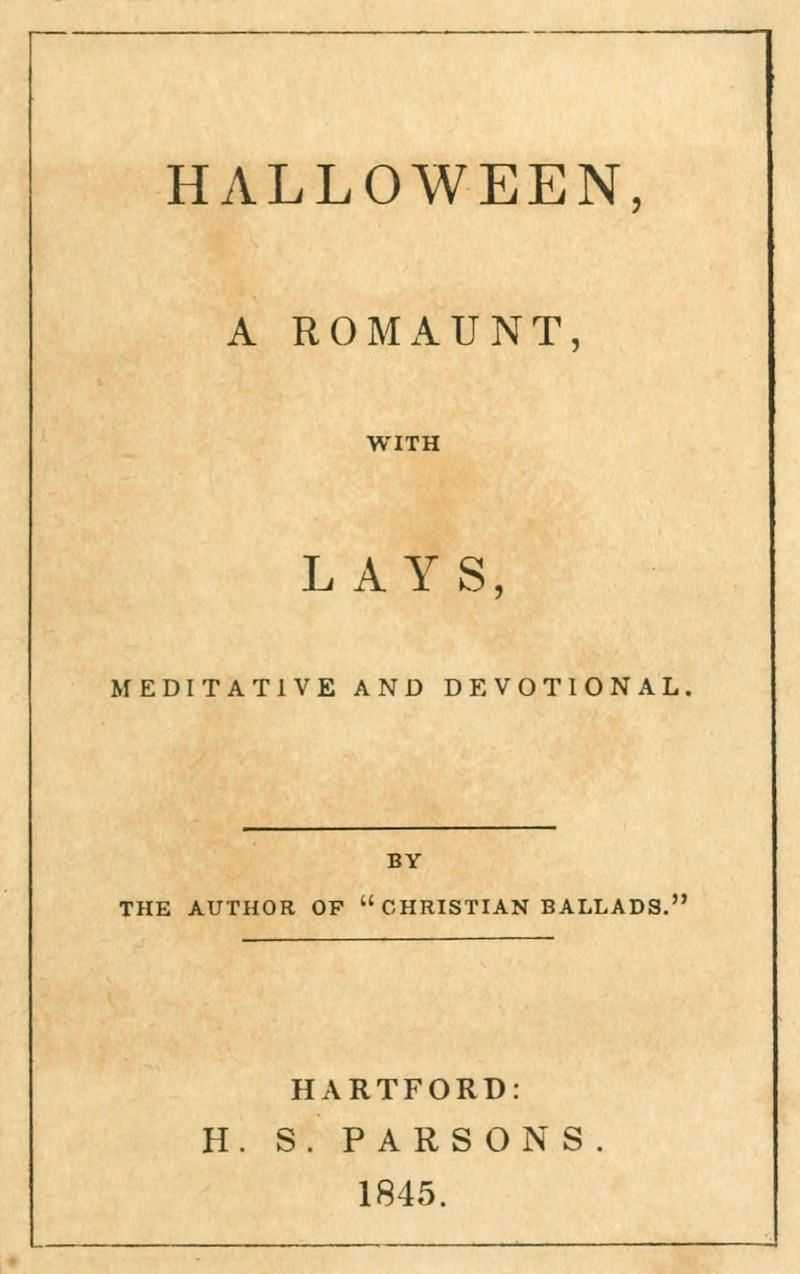
LAYS,
MEDITATIVE AND DEVOTIONAL.
The lyre my boyhood chose for idle lays,
Of its own impulse found a holier strain.
Personne.
TO
THE MEMORY OF
JOHN FINLEY SMITH, M. A.
LATE OF HAMILTON COLLEGE,
THESE LAYS,
PRESERVED CHIEFLY FOR THE SAKE
OF
THEIR ASSOCIATIONS WITH HIM,
ARE NOW INSCRIBED,
IN SAD FULFILLMENT OF A PROMISE
MADE
WHEN WE WERE BOYS TOGETHER.
A. C. C.
PREFACE.
When the Christian Ballads first appeared, I appended to the book several little poems of a different character, with the announcement that they were selected from a forthcoming volume. Although I afterwards determined not to publish that volume in a collected form, its contents have, to a great extent, found their way into print; and are from time to time reviving, and dying newspaper deaths, sometimes with the loss of limbs, and even parts more vital. I have been induced therefore to collect and arrange them, and, in an unostentatious form, to present them to the public: supposing that my friends will not be unwilling to have these early efforts, in a legitimate shape, and that others will find the volume too unpretending to deserve their censure.
These poems, except a few introduced in place of others destroyed, were written in my early years. They were begun in the Summer of 1836, when I was passing a college vacation under my father’s roof, at Auburn, in Western New York. It was my privilege there to meet the friend, to whose memory I have inscribed them; and to his musical taste, and his frequent suggestion that I should give him words for some of his favorite airs, the production of the songs and hymns in this collection, was chiefly owing. Little did I foresee that they would be published as a tribute to his beloved memory!
As motives of ambition would dictate the suppression of this boyish book, after the favorable reception bestowed by the public, on my later productions, I shall find every anticipation satisfied, if in the opinion of goodnatured critics, these Lays are not unworthy of the years in which they were written.
A. C. C.
The Sycamores, Hartford West,
August 15, 1843.
LAYS.
GIVE ME THE HOUR.
GIVE ME THE HOUR.
1.
Give me the hour of day’s decline
To muse upon my own,
To call from Earth each wish of mine,
And dream of Heaven alone;
And let nor voice, nor foot intrude
Upon my meditative mood,
As stretched in lonely cell or bower,
I feel the shades, that o’er the lea,
Come lengthening till they fall on me
And veil my pensive hour.
2.
For I have loved the Eventide,
While yet I knew not why;
But now, since early friends have died,
’Tis dear as memory.
It minds me of their quiet sleep
’Neath many a grassy mound; or deep
The floods of far-off seas below!
It tells me how my years steal on,
How strong and lovely ones have gone,
And how we all must go!
3.
My name shall ne’er be writ with those
Whose friendships death can end;
No grave upon my love can close,
No tomb take all my friend;
Not only in communion blest,
I share their beatific rest,
But oft to ev’n mine earthly ken,
Their Death seems but a signet set,
To love, whose converse passeth yet,
All life with worldly men.
4.
To think of names, once daily heard,
That now are read in stone,
And know each gesture, look, and word,
Familiar smile and tone,
As all would be, could they but still
Give hand and heart with thine to thrill,
This is a pure though sad delight!
And such is mine, at that sweet hour
When wakes the star, and dies the flower,
As sunset turns to night.
5.
Thus ye come back, my own dear dead,
From Paradise’s door,
To fill with feelings hallowed,
The world ye blessed before!
When we were mates, ye drew with mine,
Life’s pictured way, in equal line,
Nor dreamed we, ye were near its goal;
Where hand-in-hand we thought to be,
Ye’ve left a lonely race to me;
Ah, shall I run the whole!
HYMN OF THE WREATH.
HYMN OF THE WREATH.
1.
Ah gentle flowers!
Long time enough my life has run,
To twine dear thoughts, with every one,
That blooms in bowers.
2.
My couch beside,
When I am sick,—each flings a scent
Of its own story redolent,
O’er memory’s tide.
3.
There’s pert heartsease!
The boy’s own flower shall still be mine
While thoughts of childhood’s auld-lang-syne,
My heart can please.
4.
The parlour’s pride,
Sweet hyacinth—thy full perfume
Reminds of home—the curtained room,
And warm fireside.
5.
The primrose lone,
I see it ever on its stalk,
Flush in my favorite woodland walk
Spring’s first full-blown.
6.
And crocus, too,
I’ve seen it up on Easter-day;
Sweet symbol, from the frozen clay
Rising anew!
7.
The coiled woodbine,
Brings some fair cottager to sight,
That to her lattice, trails aright
Its tangled vine.
8.
Rose—red or pale,
Yellow or mossy—who shall sing,
Thy fragrant memories, queenly thing,
Or tell their tale!
9.
Starred jessamine!
Thy glory shall adorn my bride’s,
With orange-blossoms, wreathed besides
Her tresses in!
10.
And by her bower,
I’ll plant the falling eardrop’s grace,
Whose lady-blossoms hide their face
From sun and shower.
11.
And she shall set
The lily near, to favour me,
And myrtles, and sad rosemary
And mignonette.
12.
And I will plant
One flower beside—and say to her,
I’ve nursed it for my monitor;
This thou shalt grant;
13.
In life’s last hour,
To tell me of the Crucified,
Oh set alone my couch beside
The passion-flower.
14.
And on my tomb,
Plant deathless amaranth, for I
Would rise in immortality,
And endless bloom.
STAR THAT HAST.
STAR THAT HAST.
Hymn to the North Star.
I. 1.
Star that hast thy bright abode
In the skies for ever,
Like the sleepless eye of God
Never resting—never
Star of glory—holy star,
Chiming in thy sphere
Glorious creature, from afar
If thou hearest—hear!
I. 2.
Deem not I upon thee call
As to God I bow;
I before thy Maker fall;
I am more than thou!
But I’ve pleasant words for thee!
And my heart is flowing;
Dear is thy sweet light to me,
And I love its glowing!
II. 1.
I, with wonder in my soul,
See thy ray in heaven,
Thinking, thus while ages roll,
Still thy light is given.
Would I might my story give
Deathless star, to thee!
Then, as long as earth shall live,
Men would think on me.
II. 2.
Stars of earth on thee have gazed,
Ever-glorious flame!
They have burned away and blazed,
Thou art still the same!
Thou art ever bright as now,
Far above all sorrow;
Born for endless ages thou!
I must die to-morrow!
III. 1.
Nay, thou ever-watching star,
Of the heavenly portal,
Long as thy dull ages are,
I am more immortal!
’Twas for this I called thy name,
Star that dwell’st so high,
For the skies shall melt in flame,
Even thou shalt die!
III. 2.
Thou shalt perish!—I endure
When thy lamp is dim,
Dark thy place in ether pure,
Hush’d thy sphery hymn!
Thou shalt fade: and ne’er be found,
Never more, oh, never:
I shall live a deathless round,
Ever—and for ever.
STANZAS.
STANZAS.
1.
She shone upon the bright saloon
Mid mirth and music’s sound,
Like moonlight, on the glimmering
Of tapers dim around,
And where she walked, ’twas wonderful
How all our hearts she bowed,
And how she tamed the manliest,
And how she awed the proud.
2.
Some shapes there are, though dear and rare,
By grudging Nature given,
To teach us here, how beautiful
The angels are in heaven;
And such was she, the queen of all,
The fairest of the fair,
The lady of the gentle heart,
And soul-subduing air.
CANZONET.
CANZONET.
1.
My heart is like the twilight sky
For there thou shin’st, its only star;
And giv’st me all the radiancy
That others worship from afar!
2.
Oh may this twilight be as those
That linger o’er the arctic air,
Where one mild star, as fable shews,
Goes round and round, but sets not there.
3.
For I have known no cheerful day,
Till soft this twilight calm was given;
Star of my heart—sink ne’er away,
Nor seek too soon thy further Heaven!
THOU ART GONE TO THE LAND.
THOU ART GONE TO THE LAND.
1.
Thou art gone to the land of thy bloom and thy birth,
Thou fairest of beings that die:
We knew that thy spirit was purer than earth,
We knew that thy home was on high;
But we loved thee too well not to weep at thy flight,
And we said it was hard thou shouldst go:
There are angels enough in the regions of light,
But whom hast thou left us below?
2.
Ah! well did we fear thou wast budding for Heaven,
Though nurst in a climate so cold,
And marked as a warning too faithfully given,
The wings of thy spirit unfold:
And rainbow on rainbow thy pinions displayed,
And thy gaze was, in love, on the sky,
And we said, ’tis an angel a moment delayed,
But plumed, and just ready to fly.
3.
Thou art gone to the land of thy bloom and thy birth,
Though here was thy glory begun:
Ah! why hast thou left us a desolate earth,
Ere half of thy journey was done?
Ah! why was thy spirit so eager to fly,
And lose the dear shape that it wore?
Thou hast left to the grave, what was worthy the sky,
For scarce could an angel be more!
SONG.
SONG.
Written for a Swiss Air.
1.
Weep for the lovely, that are fled,
With years their smiles made bright;
The lovely that are vanished,
Like unreturning light;
Like Stars that set and leave no ray,
Like Summer’s bloom forgot,
From Earth their glory died away,
But Earth remembers not.
2.
How still they slumber ’neath the turf,
The faded spoil of grief;
The sore-tossed pearls of Ocean’s surf,
The forest’s withered leaf!
Remembered—as a fancy fled,
Or as a vanished sound,
Where once their light a lustre shed
On meaner things around!
3.
Weep for the lovely, sent to bless
The world’s unlovely clime,
And oft, in all their loveliness
To fade before their time;
Made often in their guileless years
Some soulless mortal’s prey,
To feel the waste of secret tears,
And all the heart’s decay!
CANZONET.
CANZONET.
1.
Love like theirs was never lighted,
With a season to be blighted;
It was deeper than emotion,
Deep as their deep souls’ devotion,
Fixed in their fond hearts forever,
Like the soul—to perish never.
2.
They were friends in that sweet season,
When the heart is foe to Reason:
Loving fondly, loving kindly,
Blind to fate—yet loving blindly;
Happy in the passing minute;
Naught the next, though Death were in it.
3.
They were friends whom fortune parted,
Severing sad and broken hearted:
God’s own law their trothal hind’red,
For their souls were near a-kindred;
Lovers not—twin-children rather
Of the same all-glorious Father.
4.
Worlds there are, above all sorrow,
And that world is theirs to-morrow:
There where love is brighter, purer,
Shall their friendship be the surer;
And when dreary life is over,
Each shall be the happier lover.
CAUTION.
CAUTION.
1.
Break not tryste with tender hearts,
They ask not oaths for trust;
A look—a smile—to them imparts
What—answered with a tear that starts,
Is sealed, if thou art just!
2.
Learn this lesson, not too late;
’Twill save some gentle eye,
That often at her garden gate,
Strains sight and ear to watch and wait,
And droops—she tells not why.
OH WHERE’S THE HOPE.
OH WHERE’S THE HOPE.
1.
Oh where’s the hope like morning’s star, that lit my childhood’s hours,
And smiled upon my dawn of life like sunrise over flowers!
’Tis gone, alas—or faintly seen, is as a rainbow’s ray,
Far—far afield! and as I chase, the phantom flies away.
2.
Sure never have I been too young to sigh o’er vanished hopes;
As if life’s wishes all were made, before an eyelid opes!
Sure never came an hour to me, that brought not in its train,
Some blight to fair and fond desire, and longings nursed in vain.
3.
They dream who tell of life’s long hours, its brightest is its first,
When o’er the sparkling dews of youth, the hues of morning burst;
Those morning hues dispel the mists that made its flowers so gay,
And boyhood’s joys are only bright, as they are borne away.
4.
And all the hopes those dews inspired, like dews dissolve in air,
And melt in fickle forms away, and leave unveiled the glare:
And childhood mourns like hoary Eld a thousand pleasures gone,
And weeps o’er disappointed hours, while yet ’tis early dawn!
5.
Oh can it be that we have lived, before we wept on earth,
And measured out our spirit’s path, before our body’s birth!
Howe’er it be—the babe new-born, begins its life with tears,
And age that weeps o’er childhood gone, but mimics childhood’s years.
CANZONET.
CANZONET.
To the Music of Von Weber’s last Waltz.
1.
I’d die mid soft music,
And whispering the lay,
I’d breathe in sweet singing
My spirit away.
Bend o’er me, though weeping,
Thou beautiful one
With thy long flowing tresses
Till sinks my life’s sun:
Then round me, ye lovely,
Sigh sad to the lute,
And warble your sorrow
While breathes the soft flute.
I’d die, &c.
2.
I’ve lived mid the lovely,
And dying, I’d hear
The voice of the lovely
Sound last on mine ear.
In life, and in blooming
I’ve loved the soft lyre,
And music shall soothe me
Till faint I expire.
Till Earth’s music failing
I join as I rise,
The far fading echoes
That float from the skies.
I’d die, &c.
I’VE LEFT THE GIDDY THRONG.
I’VE LEFT THE GIDDY THRONG.
1.
I’ve left the giddy throng:
The dance is o’er: mine ear
Hears but a phantom song,
And I am lonely here.
Oh, in the dark still night
When shadows round us be,
How vain all earth’s delight!
Whom have I, Lord, but thee?
2.
It is a fearful thing
To be with self alone;
To bear a closeting,
With conscience on her throne:
For who but feels, when still
The heavy night hangs round,
The boding dews that chill
The sleepers under ground!
3.
Oh, who but thinks how soon
Such sleep his own must be;
The cold damp sod aboon,
And earth-worms feasting free:
Oh, who but feels full oft
His body rotting there,
His robes of beauty doffed,
The winding-sheet, his wear!
4.
And who but trembles then,
At what we dare to be,
When mixt with thoughtless men,
We too live thoughtlessly!
Poor pilgrims unto death,
Poor insects of a day,
How dare we spend our breath
As if we lived for aye.
MARCH.
MARCH.
Man goeth to his long home.
WORDS TO STRANGE MUSIC.
1.
March—march—march!
Making sounds as they tread,
Ho-ho! how they step,
Going down to the dead!
Every stride, every tramp,
Every footfall is nearer;
And dimmer each lamp,
As darkness grows drearer:
But ho! how they march,
Making sounds as they tread;
Ho-ho! how they step,
Going down to the dead!
2.
March—march—march!
Making sounds as they tread,
Ho-ho, how they laugh,
Going down to the dead!
How they whirl—how they trip,
How they smile, how they dally,
How blithesome they skip,
Going down to the valley;
Oh ho, how they march,
Making sounds as they tread;
Ho-ho, how they skip,
Going down to the dead!
3.
March—march—march!
Earth groans as they tread!
Each carries a skull;
Going down to the dead!
Every stride—every stamp,
Every footfall is bolder;
’Tis a skeleton’s tramp,
With a skull on his shoulder;
But ho, how he steps
With a high tossing head,
That clay-covered bone,
Going down to the dead!