
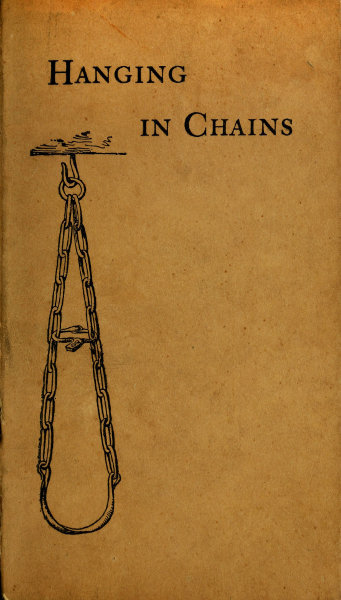
MILES’S IRONS, 1791.
(From “Obsolete Punishments,” by C. Madeley.)
Five months after the death of the last-mentioned criminal, Edward Miles was executed and hung in chains, not only for robbing the mail, but for murdering the postboy also. It was a serious case, and the man was hung, and gibbeted in irons on the Manchester road, near the Twystes. These irons, of a very careful manufacture, were dug up on the spot in 1845, and falling into the hands of the late Mr. Beaumont, are now preserved in the Warrington Museum.
In 1796 James Price and Thomas Brown were hung in chains on one gibbet at Trafford, between Chester and Tarporley. A print in the account of the trial shows the carcasses in iron frames shaped to the body like the Warrington example.[75]
To take again a southern case. In 1799 two brothers named Drewett, for attacking the Portsmouth mail, in the delightful district of Midhurst, were executed on Horsham Common, and their bodies taken to the scene of the robbery, and hung up in irons. This event still lingers in memory in the district, and the more so, perhaps, because the younger of the two convicts is believed to have had the nobility to suffer for his father, whose guilt he would not disclose.[76] The “last dying speeches” of these two men, printed with uncouth verbiage, and picturesque deformity of language, is still occasionally to be met with.
Chapter IX.
Few persons of taste have failed to make themselves acquainted with the works of Bewick, the father of English wood-engraving. In them we have everything the most truthful and poetical. Wide, wild moor, the desolation of winter, with the solitary worn-out horse, forgotten in the snowy waste; the falling fane, the crumbling tower; scenes on northern shores,—rocks and sea-fowl, wrecks and tempests.[77] He delights to show us in his famous tailpieces such pictures as the ragged rapscallions that abound in streets, graceless and cruel; beggars and strollers with bear, monkey, or trumpet; lame soldiers and wounded men, real or sham; the belated traveller in the rain; the snow-man of our childhood; the tipplers with their delightful tall, twisted-stemmed wine-glasses, all “regardless of their doom,” or returning with faltering steps from the tavern; the man on the stepping-stones, bowed down with his burden, the poor mewing cat turning round and round at sea in a tub. Among his principal engravings Bewick gives us in his “Quadruped,” and with a delicacy and force that no modern workman has equalled, for instance, the lion rearing a majestic crest, and “we seem to hear his awful voice, rolling like thunder along the ground, and cowing all nature into silence;”[78] the tiger with his fearful glittering eye, that only Rubens or Rivière can paint. Among birds we may recall the woodcuts of the moping thoughtful owl; the water ouzle, with his white waistcoat, sacred to the rocks of the Dove; and the carrion crow wheeling round the gibbet. All these are capital examples of Bewick’s skill; they are, indeed, as fine as they can be, and rendered with the magic touch, with that wonderful feeling for nature which just make the difference between the plodding draughtsman and the born artist. Many persons can “draw,” but very few can draw even tolerably. And Bewick chose, like Hogarth, to portray humanity in some of its degradations, and to call up our feelings against violence and wickedness and the abuse of man’s high quality. He shrank not from the gibbet, he saw its educational value, and, with absolute fidelity, he gives us many examples of the time-honoured horror, standing out stark and bare against the bleak sky.
In a late year of the last century a man was hung in chains in the north of England,—but the particular place we have not been able to identify. And we lift the long-forgotten crime up to notice now because it forms the subject of a tailpiece by Bewick to the Introduction to “Carrion Birds.”[79] The print is here roughly reproduced because it exhibits some particular features. The head is tied up in a white cloth, with a tender touch of feeling, and the body fastened up in irons with Doric simplicity; the post is stuck full of thousands of nails, like the example near Carlisle, to prevent men from coming and climbing and stealing the body away—a precautionary measure recalling the sentry of Roman times.[80]
Chapter X.
About the year 1800 a man named Watson was executed at Lynn for the murder of his wife and child. The body was taken to Bradenham Heath, and there gibbeted in irons. Some few years ago the gibbet was still standing, and at the foot of it Mr. H. Rider Haggard and his brother found, imbedded in the sod, the upper portion of the iron framing, including the headpiece, with a portion of the skull remaining in it. So it had been withdrawn from sight by kindly nature, in her pitying mood, and covered by the greensward. A lady of that neighbourhood, who died a few years ago, aged ninety-four, used to relate, that when she was a girl, she once crossed the gibbet common, and noticed that a starling had built her nest in the man’s ribs; later on some lovers of nature came from Shipdam and stole away the young birds. The remains of Watson’s irons are now deposited in the Norwich Gaol, among a very interesting collection of chains, gyves, irons, gang-chains, and burning girths for the “pale martyrs in their shirts of fire.”
A noteworthy feature in this case was, as in that of John Whitfield, before mentioned, that it got about, in latter days, in the neighbourhood, that the man had been hung up alive, and watched till he died. Similarly, we have a story from Durham, showing that one Andrew Mills, gibbeted alive in 1684, for murdering his master’s three children, was kept in existence for some time by his sweetheart (of course), who, until she was prevented, gave him milk in a sponge at the end of a stick.[81]
These kind of stories usually fall to pieces when they are examined, and it so happens that on the tombstone of the three unfortunate little children, in Merrington churchyard, are the words:—“He was executed and afterwards hung in chains”; but “executed and” have been nearly obliterated by deep chisel marks,[82] thus forming at once both the post hoc and the propter hoc of the story. As to the milk, and the sweetheart, this part of the fable is nothing but a free rendering—necessary under the circumstances—of the classical legends of Euphrasia and Evander, of Xantippe and Cimonos.[83] Tradition often does, but just as often—or oftener does not justify itself.[84]
This suggests a few words upon the question of hanging alive in chains. Hollingshed, in his “Description of England”[85] says:—“In wilful murder done upon pretended (premeditated) malice, or in anie notable robbery,” the criminal “is either hanged alive in chains near the place where the fact was committed, or else, upon compassion taken, first strangled with a rope, and so continueth till his bones come to nothing.” Chettle, in “England’s Mourning Garment,”[86] speaking of the clemency of Elizabeth, says:—“Where-as before time there was extraordinary torture, as hanging wilfull murderers alive in chaines; she having compassion ... said their death satisfied for death.”
These, and many other similar arbitrary statements, might seem conclusive evidence; but, on the other hand, the “Statutes at Large” may be vainly searched to find one directing the punishment of gibbeting alive. And when we recall the calm language in which persons are directed by statute to be boiled, disembowelled, or burnt alive, we may be quite sure that, if the English law had ever contemplated the infliction upon a subject of such lingering torture as gibbeting alive, it would have been as coldly and legally set forth, and, by this time, as legally repealed,—which is perhaps, more to the point still. And, further, it is difficult to believe that any English official would, at any time,—whether under the pressure of the hardening influences of religious intolerance, or politics,—have taken upon himself so serious a responsibility, or that any section of the English people would have suffered such wanton barbarity. The conclusion we are happily driven to is that both Hollingshed, Chettle, and all the old and modern hare-brained irresponsible chatterers have been carried away by a superstitious belief in a poor, vulgar fiction, “a vain thing fondly imagined,” and to which the multitude of to-day still appear to cling with a fatuous devotion which, probably, no amount of education or refutation will ever entirely eradicate. This shows the strong vitality of fiction.
With regard to the punishment of hanging and boiling, alluded to above, a single example will suffice. After the suppression of the Northern Rising the king attacked the Friars. Their popularity and poverty alike had saved them when the lesser monasteries fell; but their independence and boldness, in preaching against the Marriage question and the Supremacy, proved their ruin. Those who had not fled the country were treated with the utmost harshness. Thus Father Stone, an Austin Friar of Canterbury, for obstinately maintaining his opinion that the king may not be head of the Church of England, was hung, cut down, and his body boiled and quartered, as appears from the following very curious document preserved among the records of the city of Canterbury:—“A.D. 1538-9. Paid for half a ton of timber to make a pair of gallaces to hang Father Stone. For a carpenter for making the same gallows and the dray. For a labourer who digged the holes. To four men who helped to set up the gallows. For drink to them. For carriage of the timber from stable gate to the dungeon.[87] For a hurdle. For a load of wood, and for a horse to draw him to the dungeon. For two men who set the kettle and parboiled him. To two men who carried his quarters to the gate and set them up. For a halter to hang him. For two half-penny halters. For Sandwich cord. For straw. To the women that scoured the kettle. To him that did execution.”[88]
An obliging correspondent tells us that he remembers riding with his father, in 1819, under a gibbet near Evesham, and the creaking of the irons as they were swayed by the wind.
Chapter XI.
Towards the year 1808 a man named Thomas Otter, alias “Tom Temporal,” was hung at Lincoln for the murder of a woman with whom he cohabited there. It appears that she had followed him when returning into Nottinghamshire where his wife lived. At the junction of the two counties he turned on her, like a wild beast, and slew her—in a lane near Saxilby, still called “Gibbet Lane”—and flung the body into a drain dividing the two counties. Not exactly knowing which way to go at the moment,[89] the bewildered miscreant fled back as quickly as he could to Lincoln, was captured, and nearly proved an alibi at the trial. But he was convicted and executed, and hung in chains on the fatal spot. This custom had then, fortunately, fallen somewhat into disuse; but even desuetude had its drawbacks, for crowds came to see the spectacle,—just as all Sheffield and Rotherham flocked to the gibbet of that famous highwayman, Spence Broughton, on Attercliffe Common in 1792, and a stall with that curious cloying refreshment—gingerbread—was set up, after the English rural fashion. Subsequently some inquiring tomtits were attracted, and made their nest, and hatched seven young ones, in the upper part of the iron frame where the head was fixed; and a local poet, in the fulness of his heart, produced the following riddle:—
9 living and one dead,
I flew forth to fetch some bread,
To feed the living in the dead.”
(Answer) “The tomtit that built in Tommy Otter’s head.”
Years after, our informant,[90] riding in Gibbet Lane, came to the gibbet and saw bones and rags of clothing lying upon the ground, and the skull remaining in the iron headpiece. Parts of these irons are now preserved at Doddington Hall, near Lincoln.
Another courteous correspondent[91] informs us that nearly seventy years ago, in Malta, on the occasion of a public festival, the body of one of two brothers, between whom a feud had long existed, was found murdered. Circumstantial evidence pointed so strongly to the survivor as the assassin that he was tried, condemned, and executed. In accordance with the Code Rohan, the right hand was separated from the body, and gibbeted in an iron cage. Some years had passed by when a man dying in the Civil Hospital confessed himself to be the murderer; he earnestly begged that something might be done to remove the stain from the memory of the blameless brother, and presently passed away. The gibbeted hand was now lowered and followed to a grave by an impulsive multitude in sobs and tears, uttering prayers and entreaties for the repose of the soul of the innocent victim, and trusting that the ordeal of martyrdom through which he had passed in this world might prove to him a crown of glory in the next.
The same correspondent vividly recalls the bodies of pirates hung in chains on the walls of the fort of Ricasoli, at the entrance to the harbour of the island of Malta, as seen by him in 1822.
“A Lady Pioneer” describes an ancient rusty cage, here illustrated, seen hanging from a tree by a friend in Eastern Bengal. This was said to have been used as a punishment for dacoits, the tradition being that they were hung up alive.[92] The shape and careful manufacture almost seem to bear this out. In the Asiatic Society’s Museum at Calcutta an iron apparatus for the same purpose is preserved. Another exists in Jamaica, and to both the same legend is attached.[93]
IRON CAGE IN EASTERN BENGAL.
(From an engraving in “The Indian Alps.”)
In the year 1827 a chimney-sweep committed a murder on the high road near Brigg, and was tried at Lincoln. It so happened that the new Assize Courts were then being erected, and the Dean and Chapter lent their majestic Chapter House for the trial. This building was temporarily fitted up as a criminal court, the trial took place in it, and lasted all day, and in the deepening gloom, under the shadow of St. Hugh’s great minster, Judge Best sentenced the prisoner to death, and ordered the body to be hung in chains on the spot where the crime was committed. It is well remembered, by a gentleman who was present, what a strange, solemn, and striking scene it was. The inhabitants of Brigg petitioned against the gibbeting, on account of the scene of the murder being so very near the town, and this horror was accordingly remitted.
In 1832, on the occasion of a pitmen’s strike at Shields, Mr. Nicholas Fairles was the only resident magistrate, and, as such, had to take active steps to preserve the peace. On June 11th he was riding to Jarrow Colliery when he was attacked and pulled from his horse by two men, and so ill-treated that he died on the 21st. One of the men escaped, the other, William Jobling, was taken, tried at Durham, and hung on August 3rd. The body was escorted by soldiers to Jarrow Slake, stripped, covered with pitch, and reclothed. It was then carefully encased in a framework of iron,—the face being wrapped in a white cloth,—and hung on a gibbet twenty-one feet high and bound with iron bands. The post was fixed into a stone of one and a half tons’ weight which was sunk into the Slake about a hundred yards within high-water mark, and nearly opposite the spot where the murder was committed. Jobling’s gibbet was covered for about five feet up by the high tide. During the dark night of August 31st the body was stolen away, and is said to have been buried in the south-west corner of Jarrow churchyard.
It is a curious coincidence that while these pages have been passing through the press Jobling’s widow has died (April 14, 1891) at the great age of ninety-six. Thus the last personal link with the Gibbet has been severed.[94]
The last example of hanging in chains:—
That ends this strange eventful history,”[95]
is that of a man named Cook, a bookbinder, who murdered Mr. Paas, with the iron handle of his press, at Leicester, in 1834. He was sentenced to death, and the body ordered to be gibbeted. This was done in Saffron Lane, outside the town, and the disgraceful scene around the gibbet, as described by an eye-witness, was like a fair. A Dissenter mounted upon a barrel and preached to the people, who only ridiculed him, and the general rioting soon led to an order for the removal of the body.[96] In the same year (4 William IV.) Hanging in Chains was abolished by statute. The irons which proved so strong a magnet are now preserved in Leicester Gaol.
Finally, an accomplished Northamptonshire antiquary[97] informs us that many years ago he came to a lone hill at Elsdon, near Morpeth, in Northumberland, and found a gibbet with a wooden head hanging from it; this still exists. It seems that the murderer, whose crime it recorded, William Winter, who slew Margaret Crozier, in 1791, sat down to his lunch in a sheep-fold, and a curious shepherd-boy abstractedly counted the nails in his boots, and noticed his peculiar knife, and this led to his apprehension. The wooden head is a memorial of the savage past, a relic of “the good old times,” which we may truly rejoice to think have passed away for ever.
We have now dealt with some of the changeless passions in what the immortal Castaway calls “that strange chequer-work of Providence, the life of man.” We have traversed the gory path of dishonour from end to end, at times with wide steps, a way often obscure, and ever slippery with blood. It has not been necessary to go to mendacious chroniclers, or scandalous diaries, for this story of man’s high nature in some of its degradations, for we have, verily, as in the “Visions of Mirza,”[98] essayed to cross the bridge over the Vale of Misery; we have “unloaded all the gibbets, and pressed the dead bodies.”[99]
It has been impossible to treat of such a ghastly subject—of which the horrors seem to burn themselves into the mind—without a certain amount of ghastliness; indeed, without the plea of attempting to throw a ray of light into some of these dark corners of history, we should almost have flinched from bringing forward these melancholy topics, making sensibility shudder, and which our readers may, perchance, find it a pleasure to forget. And in imagination we already hear the cry—
That would upon the rack of this tough world
Stretch him out longer.”[100]
THE END.
Note.—Any notice of Gibbets in England would be incomplete without a reference to the Halifax Gibbet. This instrument of speedy but rough justice resembles the Guillotine. It remained in use until 1650, and records exist showing how numerous were the sufferers under its swift blade. The Earl of Morton, passing through Halifax about the middle of the sixteenth century, witnessed an execution, and is said to have been so much pleased with it that he had a similar machine made for Scotland, where he was Regent. It long remained unused under the name of “The Maiden.” But on June 3, 1587, the Regent was himself executed by it. Thus, as we have it in Hudibras, he “made a rod for his own breech.” The Maiden is now preserved in the Museum of the Society of Antiquaries of Scotland, at Edinburgh.—See “Halifax and its Gibbet Law,” &c., 1756.
INDEX.
- Achæus, his end, 9.
- Alfric, Archbishop, Vocabulary of, 13.
- Amasa, fate of, 5.
- Anastatius, Saint, martyrdom of, 12.
- Anglo-Saxons, the; use of gallows with, 13.
- Azariah, burial of, 1.
- Baker, the Chief, fate of, 4.
- Bewick, his woodcuts, 87;
- his representations of the gibbet, 89, 91.
- Boiling and quartering, example of, 100.
- Brunne, Robert, 14.
- Chains—see Hanging in.
- Chettle, on hanging alive in chains, 97.
- Coligny, hung on gibbet of Montfaucon, 40.
- Colman, Saint, martyrdom of, 12.
- Constable, Sir Robert, 16.
- Cross, the, the gibbet, 6, 9;
- the Christian emblem, 11.
- David, burial in city of, 1.
- Despencers, the, execution and quartering of, 19;
- burial of their remains, ib.
- Douai, gibbet at, 51.
- Dreghorn, Lord, on hanging in chains in Scotland, 29.
- Egyptians, the, their treatment of the bodies of criminals, 4.
- Etruscans, their gibbeting on a cross, 9.
- Ferreolus, Saint, martyrdom of, 12.
- Fourches Patibulaires, 31.
- Furca (Gibbet), use of, with the Romans, 11.
- Galga (Gallows), use of, with the Anglo-Saxons, 13.
- Gallows and Gibbet, difference between, in England, 25;
- in France, ib.
- Gallows, the, in England, 14;
- in Scotland, 29, 30;
- in France,—fourches patibulaires,—31;
- their monumental character, 32;
- in Spain, 42;
- in Holland, 46;
- at Douai, 51.
- Germans, the, punishments with, 26.
- Gibbet of Montfaucon, description of, 33;
- mode of operation, 35;
- ancient poetry concerning it, 38;
- of Montigny, 39;
- in England, 74;
- effect on travellers and traffic, ib.;
- of Halifax, 114.
- Gibbet riddle, 104.
- Gibbeting of animals, in France, 40;
- in Holland, 45.
- Gloucester, Robert of, 14.
- Gower, John, 16.
- Halifax, gibbet of, 114.
- Hand gibbeted in Malta, 105.
- Hanging in chains:—At Easthampstead, 15;
- at Hull, 16;
- at York, ib.;
- in Jersey, 22;
- in England, 1631—the usual custom, 27;
- in Scotland, 1637, 29;
- near Edinburgh, 1688, 30;
- noticed in the “Pilgrim’s Progress,” 49;
- at Bourne, Cambridgeshire, 53;
- at Hampstead, 54;
- near Rugby, ib.;
- at Cawood, near York, 55;
- near London, 58;
- in the Orkneys, 61;
- by petition, 64;
- at Rye, 66;
- at Carlisle, ib.;
- at Rake, Sussex, 67;
- at Long Marston, Buckinghamshire, 69;
- first legally recognized, 70;
- terror evoked at prospect of, 72;
- preparation of the body for, 73;
- Thames Pirates, 75, 78;
- in Epping Forest, ib.;
- near Penrith, 80;
- at Tring, 81;
- near Wetheral, Cumberland, ib.;
- on Brandon Sands, double gibbet, 82;
- near Belper, triple gibbet, 83;
- near Chester, 84;
- near Warrington, 85;
- near Chester, double gibbet, ib.;
- near Midhurst, 86;
- examples illustrated by Bewick, 90, 91;
- near East Dereham, 93;
- near Durham, 95;
- at Deal, 96;
- near Lincoln, 103;
- near Sheffield, ib.;
- in Malta, 106;
- in Bengal, ib.;
- at Calcutta, 107;
- in Jamaica, ib.;
- ordered near Brigg, but remitted, 108;
- on Jarrow Slake, ib.;
- near Leicester, last example of, 110;
- abolition of, by Statute, ib.;
- wooden head in memoriam, near Morpeth, 111.
- Hanging alive in chains, fable of, 94;
- statements of Hollingshed and Chettle, 97;
- the fiction examined, and set aside, 99.
- Hector, his desire for burial, 8.
- High Treason:—Punishment for, 16;
- description of, 18;
- Statute of 1351, ib.;
- first example of, 1241, ib.;
- Wallace, ib.;
- the Despencers, 19;
- Hotspur, ib.;
- executions for “the —45,” 21;
- pardon of five gentlemen for, 1447, 22;
- definition of, 63;
- Jemmy Dawson, 79.
- Hollingshed, on hanging alive in chains, 97.
- Hotspur, execution and quartering of, 19;
- the remains again brought together, ib.
- Jehoiakim, denunciation of, 3.
- Jeremiah, prophecy of, 3.
- Jersey, hangings in chains in, 22.
- Jews, the, treatment of their dead, 4.
- Jotham, burial of, 1.
- Justice, La, La Grande, 32.
- Kerrich, Mr., his sketches, 82.
- Leoninus, Albertus, on suicide with the Romans, 10.
- Lincoln, the Chapter House at, a criminal court, 107.
- Malta, a hand gibbeted, 105;
- pirates at, 106.
- Marise, William, a pirate, 1241, 18.
- Medecis, Catherine de, views Coligny on the gibbet of Montfaucon, 40.
- Mezentius, his desire for burial, 7.
- Montfaucon, gibbet of, 33.
- Montigny, gibbet of, 39.
- Norfolk, Duke of, 16.
- Northern Rising, 1536, 16.
- Northampton, behaviour at, 76.
- Our Saviour, gibbeted, 11.
- Peine forte et dure, 61, 62.
- “Pilgrim’s Progress,” the, hangings in chains in, 49.
- Piracy in the Orkneys, 60.
- Pirates gibbeted, in Jersey, 22;
- on the Thames, 75, 78;
- in Malta, 106.
- Preacher, the, on lack of burial, 4.
- Quartering:—At Carlisle in 1536, 16;
- of a pirate, in 1241, 18;
- of Wallace, ib.;
- the Despencers, 19;
- Hotspur, ib.;
- for “the —45,” 21.
- Rack, the, 62.
- Rizpah, watches of, 5, 6.
- Rhodez, Count of, his seizing of justice, 31.
- Robbing the mail, 83, 85, 86.
- Romans, the, their dread of exposure, 9;
- their use of the furca, or gibbet, 11;
- their laws as to gibbeting, 72.
- Saints, gibbeted, 12.
- Smugglers, gibbeted, 67.
- Standing Mute, 61, 62.
- Statute of Westminster the First, 1277, 14;
- of treason, of Edward III., 1351, 18;
- of George II., 1752, 70, 72;
- of William IV., 1834, 110.
- Tarquinius Priscus, orders gibbeting on a cross, 9.
- Thames Pirates, 75;
- chains of, ib.
- Villon (Corbeuil), his poetry on the gibbet of Montfaucon, 38.
- Vincent, Saint, martyrdom of, 12.
- Voltaire, his gallows at Ferney, 31.
- Wallace, execution and quartering of, 18.
- Weever, on punishment for treason, murder, &c., 27;
- on hanging in chains, ib.
- Witchcraft, 68.
- Women, punishment of, in England, 52;
- in France, 53.