
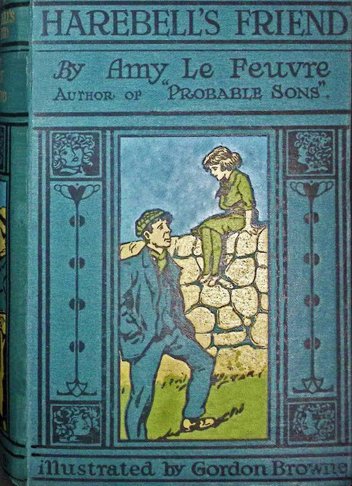
The Project Gutenberg eBook of Harebell's friend
Title: Harebell's friend
Author: Amy Le Feuvre
Illustrator: Gordon Browne
Release date: February 16, 2024 [eBook #72970]
Language: English
Original publication: London: The Religious Tract Society, 1914
Transcriber's note: Unusual and inconsistent spelling is as printed.
"I SHOULD SAY YOUR WORK WAS TONGUE-WAGGING," SAID ANDY.
HAREBELL'S FRIEND
BY
AMY LE FEUVRE
AUTHOR OF
"A LITTLE LISTENER," "LADDIE'S CHOICE,"
"PROBABLE SONS," ETC., ETC.
LONDON:
THE RELIGIOUS TRACT SOCIETY
4 BOUVERIE ST. AND 65 ST. PAUL'S CHURCHYARD.
CONTENTS
CHAPTER
HAREBELL'S FRIEND
CHAPTER I
NOT WANTED
SHE stood watching the crowd on the pier; a slim upright little figure, in a shabby waterproof, and a woollen cap crammed down on her head, and hiding the soft silky curls underneath it.
Her small face with its clear pallor, dark speaking eyes, and sensitive lips, struck more than one observer with peculiar interest.
"An intelligent child that," remarked the ship's doctor, as he lounged over the bulwarks, waiting for the gangway to connect them with the shore; "but it's a type that is bound to suffer—too much feeling!"
His companion—a pretty woman of uncertain age—gazed at the small girl reflectively.
"She will be one of the many lonely unattached women, I suppose. No parents or brothers and sisters, I hear; being brought home by the Commissioner of the district in which her parents died. He seems rather in a quandary about her, for there is a doubt as to whether any relatives will turn up. Poor mite! I suppose a school or orphanage will be her fate."
Their voices reached the child's ears. She did not turn her head, but big tears rose to her eyes. Then she brushed them away with the back of her hand. Another voice, and a hand on her shoulder, made her glance up, and in an instant her face was glowing and radiant with delight.
"Well, little Harebell, we're home at last! Now for a scrimmage at the Customs, and then we'll dine together at some hotel! We won't think about to-morrow, will we? I don't fancy anybody on the pier belongs to you, do you think so?"
The big Commissioner—six foot in his stockings—glanced down at his protégée with laughing eyes; but there was a big pity at the bottom of his heart for her future. She slipped her hand into his with great content.
"We'll have a beautiful evening," she said in clear soft tones. "And do you think we might have ice-pudding to-night?"
"We'll have the best of everything! A perfect feast! Now then—come along!"
There was a rush to the gangway; laughter, tears, and fervent embraces were in the atmosphere around them; but he piloted her safely through the crowd. He cast a quick glance around him. Was there any one ready to greet this lonely little one? He had decided in his own mind that there was not.
"I believe you'll have to come to Scotland with me to see my old mother," he said cheerily.
Harebell laughed aloud at the thought. It was what she had been hoping. She cried fervently:
"Oh, I do hope there's nobody here who wants me!"
And neither of them noticed that at the sound of the child's clear voice, a tall stately figure moved towards them.
Mr. Graham was startled when he was confronted by a very beautiful woman, with a cold grave face.
Her tone was haughty in the extreme:
"May I ask if that child belongs to you?"
"I wish she did, madam; but she is in my charge."
"Is her name Felicia Darrell?"
"It is, though she is accustomed to be called Harebell."
"I am her aunt, Mrs. Keith. Mr. Capel has forwarded me your letters."
"Ah, yes. Well, I was her father's executor! He was ill but twelve hours, poor chap! And I had only the address of his lawyer. I did not know of any relation—there seemed to be no letters—I'm glad she'll have some one to look after her—"
"I was her mother's sister," said Mrs. Keith severely, "but we never corresponded."
Harebell looked up at her new aunt with wondering eyes, then drew back, and clung with a desperately tight grasp to her friend the Commissioner.
"I don't know you," she said falteringly. "Please don't take me."
There was not a glimmer of a smile upon her aunt's face.
She held out her hand.
"You will soon learn to know me," she said.
And Harebell, somehow or other, dared not resist any longer. With drooping head she dropped Mr. Graham's hand, and placed her own in her aunt's firm clasp. They all went together to the Customs, Harebell's luggage was found, and transferred to a cab awaiting them. There was a hurried agonising farewell taken of Mr. Graham, and a few minutes after, the child found herself driving in a taxi alone with her aunt.
She gazed at her with frightened, miserable eyes. Mrs. Keith looked out of the window and said nothing. She was handsomely dressed in velvet and furs. It was a March day, and cold enough to make the Indian child shiver.
Tears came to Harebell's eyes again, and rolled down her cheeks. Suddenly Mrs. Keith turned to her, and spoke very sharply.
"When did your mother die?"
"Long, long ago," said Harebell, choking down a sob. "I was very little, for I didn't know she died at all; I thought she had just walked away to heaven—"
"And your father? How long has he been dead?"
"Oh, it seems a long time too, but they say it's only ten months."
"I need not get you any black clothes, then," her aunt said decisively.
Harebell stared at her. Black garments were unknown to her. She wondered what they were like.
The taxi took them to another station, and then a long railway journey began. Mrs. Keith was silent most of the time. Harebell, from her corner seat, surveyed the strange country with eager interested eyes. She did not want to talk; she was entirely wrapped up in the present. Childlike, she accepted the inevitable, and had no anxiety about the future. Her aunt was merely an aunt, and a grown-up; a necessary belonging, not half so interesting as the plump little lambs playing in the fields, the rabbits darting along a hedge-side, and the quaint country cottages and farms.
But as time went on, Harebell's head and back began to ache, then her eyes were too weary to gaze out any more, and finally sleep came to her.
She was barely conscious of being helped out of the train and placed in a country fly.
As they rumbled along the country roads, she slept again, and it was only when they reached her future home, that she thoroughly roused herself.
Mrs. Keith did not live in a big house, but it was comfortable, and had a rambling garden surrounded with high red-brick walls. When the door opened to them, an old man-servant appeared, and Harebell, looking at him, loved him on the spot.
He was a short square-built man, with grey hair and a round smiling face, and the merriest eyes that Harebell had ever seen.
She looked up at him with confidence, and then to her astonishment, he winked one of his eyes slowly at her.
Then Harebell laughed aloud. Her aunt turned upon her sharply.
"What is the matter?"
"He is so funny!" said Harebell, pointing with her finger to the old man, who was now shouldering her heavy luggage as if it were only a featherweight.
"Do you mean Andrews? It is rude to laugh at people, even if they be servants."
Harebell's smile disappeared at once. She followed her aunt up a short wide staircase, and was shown into a room. It was small, but there was a blazing fire in it; bright pictures were on the walls, a little white bed in the corner, and flowered chintz curtains hung in the windows.
"Is this for me?" Harebell asked timidly.
"It is your room, and I shall expect you to keep it tidy."
Then Harebell wheeled round upon her aunt with clasped hands.
"It is beautiful," she cried with shining eyes; "and I think you beautiful too!"
Mrs. Keith stared at her in silence; then turned round and swept out of the room. Speaking over her shoulder, she said:
"Wash your face and hands, and take off your hat and coat, then come downstairs to supper."
Harebell waited till the door was closed upon her. A little ache and longing was in her heart for one kind word. But she had never remembered a mother's love, and was accustomed to grave grown-up society. She never expected much from any one. Now she began to dance in the middle of her room. And as she danced she chanted some words she had learnt from her ayah:
"It's good to be happy and sing—
The birds and the flowers agree—
There's music to make for us all,
And some must be made by me."
Her cap and her coat had been flung off. She was dressed in a soft blue woollen frock; her small head of curls, rather a delicate little neck, and her fragile wisp of a body impressed one who was looking on as peculiarly appropriate to her name. She looked like a nodding blue harebell swaying in the wind.
"Not hungry or tired! How wonderful children are!"
Harebell started, and stopped her dance in an instant. A grave motherly-looking woman stood in the doorway. She wore a lace cap, and for a moment Harebell wondered if she were another aunt. She saw she had kind eyes, and precipitated herself into her arms without any hesitation.
"I've been so frightened, it's all so strange, but I feel happiness in the room; it has come to me, and so I can't help dancing."
"Bless your little heart, I'm glad to think you're so easy made happy! I'm your aunt's maid and housekeeper, dear; I've been with her twenty years, and I don't know which I loved best when they were little girls, she or your dear mother. You must call me Goody, the same as they did—my name is Goodheart, but I'm still Goody. And I shall have time to slip in and wait on you and dress you. It will be like old times. We're not a very big household. There's only Mr. and Mrs. Andrews, and Lucy and myself. Now let me put a brush to your curls."
"I'm glad you're in the world," said Harebell, as she resigned herself into Goody's hands at once. "I shall be able to talk to you; that lady who brought me here is like a princess in my fairy book. 'Slowly, slowly she turned into stone, very beautiful but cold she was, her face got stiller and whiter, when she spoke she hardly seemed to breathe.' Shall I go on? I know it by heart, and then one day she gets soft, you know! I shall be looking for that day, won't you? What is her name?"
"Your aunt? Dear me, I feel quite bewildered with such talk. Your Aunt Diana she is. Now you must walk downstairs nicely like a little lady, for it's getting late, and supper has been ready this half-hour or more."
Harebell slipped downstairs without another word. In the hall she met Andrews. He took her little hand in his.
"You're going to be friends with old Andy, I know," he said, and his eyes began to twinkle again. "He's an old sailor, and an 'Andy man, see the joke? 'Tis no use dressing him up as a sober butler, he can't play the part! But he's butler and gardener, and carpenter and jack-of-all-trades here. And now he has the honour to tell you that supper is served."
His tone turned from gay to grave, and at the same moment, Mrs. Keith crossed the hall. Harebell followed her into the dining-room.
It was a long low room with red walls and dark oak panelling. Harebell seated herself opposite her aunt, and Andrews waited upon them in deferential silence. Some hot soup, chicken, and a sponge-cake pudding refreshed and exhilarated Harebell so much that silence seemed impossible.
"I like it here, aunt! I like my room, and Goody and Andy, but I want to see Mr. Graham again. Will you ask him to come and stay here?"
Her aunt looked at her slowly and reflectively; then she said shortly:
"No."
Harebell's little head dropped at once. She spoke no more, but when the meal was over, her aunt took her into another room. It was daintily furnished. Mrs. Keith took a seat by the fire, then she made Harebell stand in front of her.
"I want you to understand," she said, "that I am willing to give you a home on certain conditions. I am not fond of children. I have taken you in because you have no other relations, not because I wished to have you. If you are obedient and truthful, you can make this your home; if I ever find you out in a lie, or any kind of deceit, I shall send you off to a boarding-school, which will become your home until you can earn your own living. You will have to do that, for your father's affairs are in a shocking state; and there will be no money left for you after his debts are paid."
Harebell knitted her brows, then she looked up and said quietly:
"I suppose a boarding-school is a dreadful place? We haven't got them in India, not for white children. Is a mission school a boarding-school? I think they're made with boards, but I'm not sure."
"We won't discuss the matter," Mrs. Keith said coldly. "I have told you the conditions under which you stay in my house."
Harebell looked at her aunt in silence for a minute. Her extreme composure irritated her aunt.
"If you understand me, you had better go to bed. It is getting very late."
"I have told lies," Harebell said slowly and thoughtfully. "When I was very little I did. I had an ayah who frightened me, and I said I hadn't picked some flowers when I had. I'll try not to tell any to you. Daddy told me it wasn't playing the game if I did. Good-night, Aunt Dinah."
"My name is Diana. Good-night."
She did not offer to kiss her. Harebell went upstairs very slowly. There was a little choke in her throat. She suddenly felt an overwhelming sense of loneliness and misery come over her. She crept into her little bedroom; then throwing herself down on the hearthrug before the fire, she burst into a passion of tears.
"Oh, what shall I do! What shall I do! Nobody loves me here; nobody wants me! Oh, I wish I could run away to Mr. Graham. I wish he'd taken me to see his old mother!"
She was tired and overwrought. Half an hour later, Goody found her lying in the same position, but she had sobbed herself asleep. It was with difficulty that she roused her sufficiently to undress her.
"I never knew you had come to bed. I meant to have sent Lucy to you. We have been having our supper. It's so strange to have a child in the house that I keep on forgetting it. Now won't you say your prayers before you get into bed? You do say some prayers, don't you?"
"Who to?" asked Harebell, looking at Goody with wistfulness. "I used to say them to daddy, but he has gone away, and I haven't said any prayers since!"
"But you say your prayers to God," said Goody in shocked tones; "don't you know that?"
Harebell shook her head.
"I talk to God very often," she said; "but I don't say my prayers to Him. It was 'Our Father' I used to say to daddy. I never did understand what it meant, but I learnt it when I was a baby, and he liked to hear me say it."
Goody looked quite horrified, but she tried to give a satisfactory explanation.
"Saying your prayers is talking to God; asking Him to forgive you for being naughty, and begging Him to watch over you while you sleep."
"I don't talk like that," said Harebell with a superior smile.
"Well, kneel down now," said Goody, impatiently.
"I talk to God in bed. I don't kneel. I only used to kneel to daddy."
"It's most irreverent not to kneel; you kneel to God in church."
"So I do!" said Harebell, a light springing in upon her. "So I do. I never thought of that."
She went down on her knees at once, closed her eyes, and began to whisper. Goody folded up her clothes, but she was rather scandalized at scraps she heard the little girl say.
"I expect you laughed when you made him, God, but I'm so glad he has such a funny face—and if I could find a spell to melt her—would you advise me not to think about it? I should like it soon, please—I must have something to cuddle!"
As the whisper went on, Goody cleared her throat, then coughed. Harebell looked up.
"Do you want to speak to me? It doesn't matter interrupting; God is dreadfully accustomed to interrupting. You see, such millions of people are talking to Him all day long!"
"I think you had better get into bed," said Goody severely.
Harebell meekly obeyed her, but the whispering went on even after she had left the room.
"Never in my life have I seen such a child," was Goody's verdict downstairs. "I would say one minute she was fifty years old, and the next as ignorant as a savage! Uncanny, I call her! And yet I feel my heart warm towards her!"
Later that evening Mrs. Keith visited her small niece, candle in hand. She looked down upon the sleeping child with cold bitterness.
"More like her mother than father. I suppose deceit and dissimulation is ingrained in her nature. She will be a continual reminder to me of how I was duped."
Harebell's tired little face looked very sweet and content in her sleep; her dark silky curls clustered round her forehead, and accentuated the whiteness of her skin. She turned over on her side, muttering:
"She turned into stone."
Mrs. Keith hastily left the room.
CHAPTER II
FIRST DAYS
HAREBELL arrived downstairs the next morning in the best of spirits. Andy and she had managed to have a good deal of talk together before Mrs. Keith came into the dining-room. They had discussed the weather, the neighbourhood, the difference between black and white skins, the cure for snake bites, and the possibility of a puppy taking up its abode at Gable Lodge. Prayers were had; then Andy brought in the breakfast, and when he had left the room, Mrs. Keith addressed her niece.
"Till I find a governess for you, you can amuse yourself as you like. I am always busy in the morning, and I do not wish to be disturbed. In the afternoon you will walk out with me. There is a small sitting-room at the end of this passage which has been got ready for your use. I expect you to be tidy and always punctual at meals."
Harebell listened attentively. She nodded when her aunt had finished speaking.
"It sounds very nice," she said, "but there's only one thing in the world I want here, and I really don't know how I'm going to live without it—I could do with a very little tiny one! And Andy thinks it could be got if you let him look for it."
She paused, but Mrs. Keith was not in a mood to guess at a child's requirements; so there was absolute silence for a moment or two.
"Quite a baby would do," Harebell went on insinuatingly, with her head on one side; "before its eyes were open, and that would make it cheaper."
"I don't know what you are talking about," said her aunt sharply; "but I must insist upon your talking straightforwardly, and not beating about the bush. It is a most objectionable practice."
"It's a puppy."
Harebell's tone was desperate; then she added hastily:
"I had to leave all my pets behind. I had a white kid, and a kitten, and three dogs and a puppy, and my pony, and you see they all knew me, and we always talked together. I feel like—you read at prayers this morning—'Rachael weeping for her children, and not being comforted.' I'm simply thirsting for a puppy."
"I never have any animals about the house," was the stern response.
"But—"
"Do not argue. Be silent. Finish your breakfast."
For a moment, Harebell looked as if she meditated a rush from the room. Her cheeks got scarlet, and she stamped with her foot under the table.
Her aunt wisely took no notice of it. In a few minutes the cloud of passion passed away from Harebell's face.
She crept away from the table very silently when breakfast was over. She passed Andy in the hall.
"It's no use," she said tragically; "I shan't be able to live here. I shall die of a broken heart!"
"Oh!" said Andy with his merry twinkle. "You won't die of it with me at hand. I know how to mend hearts when they're broken. I can mend most things, and people's hearts are stronger than they think. Mostly cracks, not breakages."
Harebell looked at him with eager interest.
"How do you know the difference?" she said. "My fairy book tells me of broken hearts—it says nothing of cracks."
"Ah!" said Andy with a nod. "You let me feel yours later in the day, when my work is done, I'll soon tell you; but I'm clearing away the breakfast now."
He went on into the dining-room. Harebell gave a little skip along the passage; her heart felt lighter already. She put her small hands upon it, or upon the place in her chest in which she thought it was.
"I suppose it isn't exactly broken yet," she said to herself, "but I never know how soon it will be, if I don't get a puppy!"
She went on into the little room that was to be her schoolroom. Andy had let her see it before breakfast.
It was plainly furnished; a square table, an armchair, and two others, a cupboard in the wall, and a bookshelf, but the window opened out upon a green lawn, and there were bright crocuses and hyacinths in the flower-beds.
Harebell went straight to the bookcase. A very dingy row of books were there, and though she took them down one by one, there was not one story-book amongst them. The only book she thought might prove interesting was an illustrated encyclopædia. That she decided she would look at and read some other day. She opened the low window, but shivered at the cold blast of air which swept into the room. Then she ran out into the passage again and up the stairs.
In a very few minutes, she got into her warm coat and cap, and a little later was dancing and skipping round the old garden. Presently she came to a green door in the old wall. She tried to open it, then found it was bolted, but after a few valiant efforts she unbolted it, and discovered that it led out into the road.
"Now," she said to herself, "I am going to see what England is like!"
England seemed extremely dull, as she walked along, for it was a country road, and the two tall hedges on either side quite prevented her from seeing over the tops of them.
"I haven't anybody to talk to," she said, with a pang of self-pity; "all my darlings left in India, and I'm sick, quite sick of grown-up people! They don't understand, and they never will!"
She walked along discontentedly; then suddenly looked up in delight. Round a corner, came a little girl and boy followed by a lady. In an instant Harebell had darted forward, and had held out her hand.
"How do you do?" she said to the little girl. "What is your name? Mine is Harebell, and I only came to England yesterday."
The little girl stared at her, and then smiled in a hesitating sort of way. She was shorter than Harebell, and much fatter; she had pretty flaxen hair which fell down to her waist.
The boy was very much the same height and had the same colouring. He laughed out loud at Harebell's speech.
"Where do you come from? Timbuctoo? Isn't she a funny-looking girl, Miss Forster?"
But the lady, who was the children's governess, passed on.
"Hush!" she said. "Don't be so rude, Peter; and how often am I to tell you that you are to take no notice of strange children."
"But she isn't a common child. Who is she?"
This much Harebell heard, but no more. They passed her by as if she had been a stone upon the road. She looked wistfully after them.
"In India, I would have asked them to spend the day with me, and they would have been glad. They're very rude and horrid!"
Tears came to her eyes.
"I shan't be able to live, unless I find somebody to play with. Oh, I wish I had a puppy! I wish I had something to cuddle in my arms, something that would be able to look at me with living eyes!"
She retraced her steps. It seemed no good to go farther on. Evidently people would not make friends with her in England!
"I shall have to make up a friend," she said to herself, and before she had reached her aunt's house she was in the world of dreams.
At lunch she asked her aunt about the children whom she had met.
"They are the Rectory children," said her aunt. "Of course they would not speak to you. They did not know who you were."
"But I could have told them in a minute," said Harebell promptly; "I was ready to tell them everything."
"You ought not to have spoken to them at all. We don't do those kind of things in England."
Harebell said no more. In the afternoon she walked out with her aunt, and for the greater part of the time they walked in silence.
At last Harebell gave a little chuckling laugh.
"I can't help it," she said, looking up, and seeing her aunt's glance of surprise; "we never do this kind of thing in India, except the natives, when they're doing a pilgrimage. I was pretending to myself that you and me was doing one; and I wondered when we should stop, and then I began to count your slow, solemn steps, and it made me think of a walking doll I had; and then I thought p'r'aps you walked out for your sins; my ayah told me of some fakirs who did it, and I wondered what your sins were like, and then I laughed, for I was making up some for you!"
She paused for breath.
"I don't think you are called upon to tell me all your thoughts," her aunt said gravely.
"But I shall really burst if I don't. I feel just like that, unless you would tell me yours. That would be most interesting!"
"If you want to talk," her aunt said, "you can repeat me the dates of the Kings of England, or the multiplication tables."
"Oh," cried Harebell, "I don't know any of them. I won't talk another word! I'll think hard instead."
The walk was over at last. They only met a few countrymen with waggons, and when Harebell returned home, she flew out to the garden, where Andy was weeding. Then her tongue rattled away at an alarming pace; but Andy talked quite as hard, and worked too.
"You'd best help me with my work if I help you with yours," he said.
"What is my work?" said Harebell.
"I should say 'twas tongue-wagging," said Andy promptly.
Harebell felt snubbed; but she set to weeding under his direction, and enjoyed herself thoroughly until tea-time.
Her aunt talked a little more to her then, and asked her many questions about her life in India.
She was astonished to hear that Harebell had never held a needle in her hand, and after tea was over, gave her her first lesson in sewing. At half-past seven she sent her to bed.
Upstairs Harebell told Goody what she thought of her first day in England.
"It's very amusing to see all the new ways and things," she confided to her; "but this is a very dull house—at least it's a frozen one—that's what I call it. Andy is the only one who can laugh. You must be frozen if you can't laugh. And Aunt Diana is the snow queen; she'll slowly freeze me as she froze poor little Kay. Do you know Hans Andersen, Goody? Gerda found Kay at last, and melted him. I think she did it by crying over him. Kay had got a heart of ice. I couldn't cry over Aunt Diana if I tried ever so! I simply couldn't do it, so she must just go on as she is. But I won't get frozen myself if I can help it. Oh dear, it just seems like a year to-day. Will every day be the same, Goody?"
"I really can't keep pace with you, child! Never did I hear such a chatterer; and you mustn't talk of your aunt so. It isn't nice. She's very kind to have you in her house at all. She was never one for children, and she's lived too long alone now to get any different."
Goody sighed as she spoke. Harebell looked at her very gravely.
"I don't think you're frozen," she said slowly; "but I can't say anything but that this is a very dull, frozen house!"
The next few days passed in much the same way. A little dressmaker, from the village near, came to measure Harebell for new frocks. She was slightly deformed, but had a good patient face, and Harebell suddenly informed her that she loved her.
"There's a look in your eyes which I haven't seen since a nice missionary lady in India took me on her lap and talked to me about heaven," she said.
Miss Triggs smiled at the little girl.
"I'm glad you've had talks about heaven," she said, taking some pins out of her mouth and pausing in her fitting. "Is it your home, dearie? It's mine."
"It belongs to all of us," said Harebell, "doesn't it?"
Miss Triggs shook her head.
"Well, it ought to by rights, but there's some who would feel mighty strange there, and 'tis only for the children of the Kingdom—them that have stepped through the Door?"
"What door?" asked Harebell interested at once.
"The Lord Jesus Christ is the Door," said the little dressmaker gravely. "Don't you know He says: 'I am the Door, by Me if any man enter in, he shall be saved'?"
"I don't see how Jesus Christ can be a door," said Harebell slowly and reflectively.
Then she looked up at Miss Triggs, smiling.
"I think I know how it's done. He holds out his arms and we run underneath them."
"You run into them, dearie, that's it. 'He shall gather the lambs with His arm, and carry them in His bosom.'"
Harebell was silent for a moment.
"I like that idea about the door," she said. "I always love strange doors, and I always try to get through them to the other side. I wonder if I'm through the Door, Miss Triggs?"
"You can go through to-night," said Miss Triggs.
Goody interrupted the conversation at this point, and Harebell's frock was discussed.
When Miss Triggs went away, Harebell said:
"It's a funny thing, Goody, but there's something in the eyes of people that tells you when they're good. Do you think God is inside them, and looks out now and then?"
Goody was, as usual, shocked by Harebell's speeches. The little girl was so much in earnest that she could not see why she was wrong in speaking so, and then Goody went on to talk about Miss Triggs.
"She is a good little woman if ever there was one. She keeps an old mother and a worthless scamp of a drunken brother on what she earns, and the house is like a new pin, never a speck of dust to be seen. She do suffer cruelly, sometimes from her back—and that was done as a child by her drunken father. She's always suffered for the sins of others, I say, and always smiling and happy. If everybody lived as she lives, the world would be a different place."
"I should like to go and see her," said Harebell thoughtfully; "and I'd like to see her brother too. I'm so interested in wicked people. All drunkards are wicked, aren't they?"
But Goody went away. She told Andy downstairs that Harebell gave her such continual shocks when she talked to her, that she was quite "dumbfounded to hear her."
The day after this, Mrs. Keith said to Harebell at breakfast:
"I have made arrangements for you to do lessons with the Rectory children. You are to be at the Rectory every morning at nine o'clock, and leave again at half-past twelve. I hope you will be very good and give no trouble to their governess. It is very kind of her to be willing to take another pupil. Mrs. Garland will be here this afternoon; she wants to see you."
"Is Mrs. Garland the governess?"
"No, the Rector's wife."
Harebell's eyes shone with joy.
"It will be perfect!" she exclaimed. "And now those children will have to speak to me, and I shall have somebody to talk to. Shan't I do lessons with them in the afternoon?"
"You may have to go for music lessons in the afternoon, but that has still to be settled. I have another matter to speak to you about. Mr. Graham has written to me, and wants to come down to see you, as he is passing through this part of the country this week. I have asked him to lunch to-morrow."
"Oh, it's too much!" cried Harebell. "Why does it all come at once? And this morning when I got up, I thought you and me were going to live alone together for ever. Isn't it strange how sudden things alter! What a happy time I'm going to have!"
She could hardly finish her breakfast for excitement. She ran out into the garden afterwards and worked off her superfluous spirits by racing round and round the paths.
Then she went to find Andy, who was busy in his pantry.
"Of course," he said; "I knowed good times would come. They always does to all of us. The most dismal day in the year isn't more'n twelve hours long; you go to sleep and, like a Jack-in-the-box, a fresh day is on you, bringing you all sorts of surprises!"
"Do you know the Rectory children, Andy?"
"You've asked me that dozens o' times, and I tells you 'Yes' and 'No.' They be ordinary children, mischievous at times, and forgettin' their manners, but their mother be a fine woman. She has the ways of the quality, for she's one of 'em. Used to live at Cumberstone Hall, fifteen mile from here—her father were my father's squire—and I well remember our school treats at the Hall when Miss Mary used to come and join us—a pretty little maid in white frocks and golden curls."
"Mrs. Garland is coming to see me this afternoon," said Harebell, importance in her tone. "But that's nothing, when I think of my dear Mr. Graham coming to-morrow!"
Mrs. Garland appeared at tea-time, and Harebell came into the drawing-room in her new blue serge frock. She held herself very straight, and put out one little slim hand in silence.
Mrs. Garland was a youngish woman still, and had a good deal to say for herself. She had a bright kind face, and drew Harebell towards her, giving her a kiss.
"Why, Diana, I can see Frances over again! She's the image of what her mother used to be."
Mrs. Keith did not seem pleased at the resemblance, but she said nothing.
Something in Harebell's eyes made Mrs. Garland add:
"But her eyes are her father's. Well, little one, we shall welcome you for your parents' sakes here. Do you like the idea of coming to learn with my boy and girl?"
Harebell squeezed her hands tightly together.
"I'm simply yearning for it!" she said.
Mrs. Garland looked at her with the greatest amusement.
"And are you yearning for lessons? I must tell my youngsters that."
"Oh no," said Harebell hastily. "I don't know anything about them, but it's the company I want."
Her aunt looked at Mrs. Garland with a slight smile.
"Harebell is a great talker," she said, "and wants more outlet for her tongue than she can get in this house."
"Oh, well," said Mrs. Garland quickly, "children will be children, and ought to be amongst their kind. We're poor company for them, Diana. But this seems a bit of originality. I hope she'll do my little ones good. They're hardly brilliant—I must own it! I suppose I expect too much; and, after all, genius brings much danger in its path. They're dears, both of them!"
Then she took hold of Harebell's hand and patted it.
"You want fattening up," she said; "too thin! She's much too thin, Diana. Have you tried Grape-nuts? And Benger's Food?"
Harebell looked horrified.
"I've come from India," she said; "it's only babies and old people who are fat there!"
"She has a good appetite," said Mrs. Keith indifferently.
"What is your little girl's name?" Harebell asked, looking up at Mrs. Garland with earnest eyes.
"Not such a pretty name as yours. We call her Nan. Her real name is Anne, and my boy is Peter. There are a good many Peters in the world just now."
"Do you think they like me coming to lessons? I saw them out the other day, and they wouldn't speak to me. It was a dreadful disappointment; it almost broke my heart. You see, I was simply longing to talk to them."
"They told me about it; but they did not know who you were."
"But they could see I wasn't a native," said Harebell quickly.
Mrs. Garland laughed.
"You must tell us all about India. I suppose you love it, don't you?"
Harebell's eyes grew misty. She looked across at her aunt, who had moved to the other end of the room on purpose that Mrs. Garland and Harebell should talk together.
"I feel quite sick for India," she said, putting one small hand on her chest. "It's a frozen house here. Do you think Aunt Diana will ever melt? She's the snow queen, and isn't she beautiful?"
A light kindled in her eyes. She went on in an earnest whisper:
"Some day she will melt, when she can get anybody to cry over her."
"Ah!" said Mrs. Garland, catching her breath, "you are a little witch, I believe! How much do you know, I wonder! More of people than of books, I expect. I wish I was going to teach you. Well, Diana, I must be going."
Harebell was dismissed. When she had left the room, Mrs. Garland said:
"She is a most interesting study, Diana. Don't you like having her?"
Mrs. Keith spoke almost fiercely:
"You know how I dislike children. It's a daily penance to me. I mean to do my duty by her, but nothing else. Do you forget that her mother stole my lover? I find myself looking for the same traits in the child. My sister deceived me systematically for two years. She lied and hoodwinked me with a smiling face. Is it any wonder that I cannot bring myself to fondle her daughter?"
"Poor motherless mite!" said Mrs. Garland; but she knew it was useless to say any more.
CHAPTER III
CHRYSOPRASUS
MR. GRAHAM arrived the next day. Harebell flew into his arms with a little choking sob.
"I've not properly enjoyed myself once, since we said good-bye," she cried pathetically; "and England isn't 'home' as everybody calls it in India. It isn't one bit home to me! And I haven't even seen an animal since I came! Not a single one!"
Mrs. Keith had left the room, so Harebell poured out her soul with perfect freedom.
"How very disobliging of the animals!" said Mr. Graham with twinkling eyes. "For we do have some in England, you know."
"There ought to be horses, and cows, and cats, and dogs, and all kinds of pigs and chickens," went on Harebell gravely. "I've seen them in books that come from England, so I know. And there isn't one; no, not a little one in this house!"
She spread out her small hands tragically.
"At the bottom of the garden there is a stable," she continued. "Andy uses it for wood, and all kinds of rubbish. He says when this house was first built, the man of it kept a horse and trap. Aunt Diana doesn't like animals; but then, she can't like anything, poor thing—"
Harebell dropped her voice to a whisper.
"She's the snow queen, and has a lump of ice where her heart used to be!"
With big eyes she waited to see the result her statement would have upon Mr. Graham.
He looked at her gravely; then he said:
"Ice is easily melted, you know."
"By tears, hot tears," said Harebell very thoughtfully; "or by fire and sun. That's what people tell me. I haven't seen any ice yet, you know. But I feel it from the top of my head to the bottom of my toes. It's all over the house."
Here she waved her hands again.
"And, Mr. Graham, I'm getting silenter and silenter; and if it wasn't for doing lessons with the Rectory children, I think my heart would break."
"It's only grown-up hearts that break," said Mr. Graham. "I assure you that yours will be quite safe for a long time yet."
"That's how Andy talks; but I thought you'd understand better. Andy laughs at everything I say—every single thing!"
"I'm not laughing, but I'm glad to hear about the Rectory children. Who are they?"
"Well, you see, I haven't really got to know them yet; but they're sure to be nice, don't you think so? The boy is called Peter, that's an ugly name I think. I wonder and wonder who will be my real friend. I don't think I can like them both; not for a private and special friend, you know. It must be one or the other."
"I should think you and the girl would chum up; you would have the same tastes."
"But we mightn't at all," said Harebell hastily. "I like animals, not dolls; and I like men and boys much better than women and girls. I always wish I'd been born a boy."
"You're a thorough little woman," said Mr. Graham emphatically. "Don't you make any mistake about it. You're mass of contradiction and moods."
Harebell's under-lip quivered.
In moment Mr. Graham altered his tone.
"My dear child, you'll enjoy both your young friends. And now listen to an idea that has just come into my head!"
Harebell brightened up and clapped her hands.
"There! That's how you used to speak on board! And your ideas were always lovely."
"I know what a daring little rider you were in India. Supposing I were to produce a small pony from somewhere, do you think your aunt would give him a home in her stable?"
Of course Harebell went into ecstasies. She danced up and down and flung her arms round Mr. Graham's neck.
"Oh, you darling! Oh, what a glorious idea! Oh, let me call Aunt Diana at once!"
"No, no; I am a prudent man. I will talk to her about it when you are not here."
She sobered down then, but her tongue went chattering on, and when Mrs. Keith came back into the room, she could not keep it still.
Mr. Graham stayed to lunch, and then had his private interview with Mrs. Keith. She was very hard to persuade.
"I have no one to attend to a pony."
"Couldn't a lad come in from the village? Let me stand the extra expense. She has always ridden. It seems a pity to drop it."
"She will not be able to indulge in such expensive tastes when she grows up."
"We will hope her future husband may be able to gratify them," said Mr. Graham. "I don't think Harebell is the sort to remain unmarried for long."
Mrs. Keith looked very stern; then suddenly she gave way.
"If you really wish to make her a present of a pony, I will make arrangements for its keep. But I do not know who will accompany her when she rides out."
"Let her trot about the country lanes alone. It won't hurt her. Limit her to a certain time and locality, if you like. You will find her obedient; but she needs a certain amount of freedom to grow. I have known her since she was a baby."
He got his way, and his departure was sweetened to Harebell by the thought of the pleasure in front of her. She got hold of her aunt's hand and squeezed it in her excitement.
"I do thank you. I shall always and for ever be good now. A pony of my own will be simply glorious! You see, Aunt Diana, horses really understand you if you talk to them; they're like dogs, and I do want somebody to talk to."
"You will have the Rectory children as companions," said her aunt coldly. "I want you to understand that this pony must not distract you from your lessons. You are a very ignorant little girl, and have a great deal of lost time to make up."
Harebell could not be quenched. She fled out to Andy and informed him that she was simply "riotously happy."
"I can't think where you get your words from!" he said, shaking his head. "'Happy' is good enough for any one."
"Daddy used to say 'riotously.' I've heard him often. It means, Andy, that I'm bursting with joy! Just think what I've got in front of me!"
In a few days' time her lessons began. She walked to the Rectory one bright morning and was received by Mrs. Garland, who took her straight to the schoolroom. It was not yet nine o'clock. The governess was not there; but Peter and Nan came forward and shook hands with her.
"You'll have to know me now," said Harebell with twinkling eyes.
Mrs. Garland left them together. The little girls eyed each other silently.
"I wish you were a boy," said Peter gloomily.
Harebell laughed.
"So do I! But I like to play with boys. I knew two boys in India; they had a screechy whiny sister, who always wanted to play with us, and then cried when she did. They had to go to school in England. I was sorry when they went."
"I'm not a screechy whiny sister," said Nan, tossing her head like a war horse. "I can do everything the same as Peter, and I can run as fast."
Then Harebell began to tell them of the pony she was going to have.
"I feel he'll be a more deep friend than you," she announced. "Because he'll belong to me, and to no one else."
"We have a donkey," said Nan, "who gallops faster than a horse."
"Then we can have races."
Miss Forster's entrance at this moment stopped further conversation. She greeted Harebell kindly, but in a business-like fashion, and lessons began without further delay.
Of course Harebell was woefully backward, though in reading and writing she was as good as the other two children. But though backward, she was intelligent, and interested in everything that she was told. In the middle of lessons, she suddenly looked up at the governess with her bright eyes.
"I suppose you know all about everything?" she said.
"Not by any means. I only know so much more than you do, that it is my business to teach you."
Harebell thought over this, then she leant her arms on the table and asked earnestly:
"Are there enough books in the world to tell you about everything? There are simply thousands of things I want to know!"
"Take your arms off the table and go on with your sum. After lessons are over, you can ask me questions."
Harebell obeyed instantly, but she was ready with her questions before she went home.
"Grown-up people always turn away when I ask them about things, or they laugh," said Harebell. "Now you promise not to do either, will you?"
Miss Forster promised, a glint of amusement in her eyes, which happily Harebell did not see. Nan and Peter stared at her with open mouth and eyes. She talked to their governess as if she were her equal.
"The first thing I want to know is about spells," Harebell said earnestly. "Spells for making ice people melt specially. There must be some. And spells for making poor dumb things talk; or for making us understand what they say. Chairs and tables have their lives as well as us, haven't they? They were alive and moving when they were trees. You see, I like talking, and if I'm in a room by myself, I look round to see who I'd like to talk to. But they never answer back, and I'm perfectly certain if I could find the right spell, they would. Perhaps I mean I want to break the spell and make them speak; that's what I want."
"You're a funny child," Miss Forster said gravely. "I suppose you believe in witches, and fairies, and all that sort of thing?"
Harebell's eyes glowed. She gave a little mysterious nod.
"In India I've seen—oh, I can't tell you—but I know there are fairies in England! Dad used to tell me about them. They dance in the woods. I haven't seen a wood yet. It's like a jungle without the wild beasts and snakes. Do tell me if there's a book of spells."
"Oh yes, there are a good many," said Miss Forster; "but they belong to a past age. I can give you a spell for making an ice person melt—only one thing will do it."
"Do tell me."
"I'll write it on a paper and give it to you. You can read it, and think over it, and try it when you get home."
Harebell was enchanted. She hardly spoke to Nan and Peter, but trotted home with a piece of paper squeezed tightly in her hand. When she got up to her room she read it. Only two words:
"Love them."
She was very disappointed at first; then she thought about it, and nodded approval.
"Gerda loved Kay, and I have to love Aunt Diana, but mustn't say anything about it to any one. I must do it in secret. I don't quite know how to do it, but I'll try."
It was a happy day when her pony arrived. Andy insisted on taking charge of it himself. He only asked his mistress for a little lad, three days a week, to help him in the garden.
"I was brought up in a stable myself," said Andy proudly, as he patted the brown, silky coat of the little Welsh pony. And Harebell promptly added:
"Like Jesus Christ. I'm sure you must have been a very good child, Andy. You ought to have been."
"There you go now," remonstrated Andy, "like lightning for coupling up things, and never very seemly or respectful to the Almighty, I says! My father was head groom to Lord Walters, and I sat on a horse afore I was in breeches."
Mrs. Keith inspected the pony in silence. Harebell covered him with kisses.
"I am so glad Mr. Graham did not tell me his name. For I shall choose one myself for him. He is my pony and he must have a beautiful name."
When she went to the Rectory the next day her thoughts were full of it. The children had half an hour's interval in the morning, when they generally played in the garden; but it was wet, and Harebell was perfectly content to be in the schoolroom.
"I have to find a name for him, and I shall get it from the Bible," she announced. "It's sure to be a good one, then."
"There are no ponies mentioned in the Bible," said Peter. "I can give you a dozen. 'Soft Eye,' Tommy, Brownie, Silky. Is he a he?"
Harebell nodded.
"I shall choose it from the Revelations," she said, "because that's the book of glories."
She took hold of her Bible, which was in her satchel, and sat down on the floor by the window to study it.
"Let me help you," said Nan.
But Harebell shook her off.
"You don't understand what I want, Nan; it must be a name which no one else on earth has. He is so very special!"
"You make such a fuss over everything," said Nan a little sulkily.
She and her brother were not quite sure whether they liked this new comrade of theirs. She was so very self-sufficient and dictatorial. They longed to snub her, but at present were rather afraid of her. The half-hour had nearly gone, before Harebell found her name, then she lept to her feet.
"Hurrah! I've found it. I shall call him 'Chrysoprasus.'"
She could hardly pronounce the word.
"I've never heard that before," said Peter.
"It's almost the last chapter; it's one of the precious stones in the beautiful city. I love a long name, don't you? A precious stone is a jewel. All the natives have lots of jewels in India. I know all about them, and my pony is a jewel to me, and very, very, very precious."
Then her thoughts took another turn.
"Do you know Miss Triggs? She likes Revelations, she told me so. She talks very interesting about heaven."
"She's a dressmaker," said Nan; "what a funny girl you are, to talk to a dressmaker about heaven!"
"Why? She likes it. She was talking to me of the Door into the Kingdom. Have you got through yet? Sometimes I think I have, and sometimes I think I haven't!"
"What door?" asked Nan with interest.
"The Door," replied Harebell a little impatiently. "We're all outside or inside the Kingdom, and the Door gets us in."
"Do you mean the Kingdom of England?" questioned Peter. "We only read about kingdoms in our history-books."
"No, I mean God's kingdom. The Kingdom of Heaven."
"We can't get into heaven before we die," said Peter conclusively.
"We can get into this kingdom any day we want to; Miss Triggs said so."
Harebell was beginning to get rather hot in the discussion. Then Miss Forster came into the room, and lessons were recommenced. When they were over, Harebell put on her hat and coat to return home, and Peter and Nan accompanied her to the garden gate. They met the Rector who was coming in. He always had a kindly word for Harebell, and she at once seized the opportunity.
"Mr. Garland, you know all about God's Kingdom, don't you? And what you say must be right. Peter and Nan won't believe me. Can't we get into the Kingdom of Heaven before we die?"
"Indeed you can," said the Rector, smiling down upon the eager face uplifted to him. "We ought to be the subjects of that kingdom down here."
Then he looked at the children in front of him, and said: "Of such is the Kingdom of Heaven."
"And we ought to get inside it, oughtn't we?" pursued Harebell. "Not stay outside."
"I hope you are inside it," said the Rector gravely.
Harebell shook her head doubtfully. "I'm not so sure about it."
Then she remembered her pony, and flew off along the road, waving a farewell to the children.
"She's a funny girl," said Peter, "her mind is all tumbled up and pours out anyhow!"
His father laughed.
"I think I like her," said Nan, "because she says things so different to everybody else; but, dad dear, she's going to call her pony a most awful name in Revelations—a Chris—something!"
"That doesn't tell me much," said the Rector. "Now run along in, I want to speak to your mother."
"Aunt Diana," said Harebell at dinner; "do you know much about christenings? When I was in India a lady—the governor's wife—christened a yacht. There were pictures of it, and dad told me she poured a bottle of wine over it. Babies have water—what should my pony have? Would it be wicked to christen him like a baby? God made him, didn't he? He belongs to God just as much as a baby does."
"Don't you know that animals have no souls?" said Mrs. Keith. "You cannot play at such games. Ponies don't require christening."
"But I'm giving him a name," said Harebell. "Couldn't I have a little drop of wine, just in a medicine bottle?"
"Most certainly not. You are talking nonsense. Go on with your dinner."
Harebell next consulted Andy.
"I don't see why Chrysoprasus shouldn't have a proper christening. Will you come into the stable this afternoon and let us do it?"
"Oh, I'll come fast enough. But I don't like your name. 'Tis a foreign one, reckon. Indian, I should say."
"It's in the Bible; it's a beautiful one."
She insisted upon having a ceremony, and dragged Andy off with her. Then she persuaded Lucy, the housemaid, to come as a looker-on. She robed herself in a soft Indian shawl, and having coaxed Mrs. Andrew to give her some home-made lemonade in a bottle, she poured it very solemnly over her pony's head.
"I name thee Chrysoprasus. And Chrysoprasus thou shalt be called to the end of thy life."
Then she made Lucy and Andy cry out with her: "Long life to Chrysoprasus! Hip, hip, hurrah!"
And after this performance was over she went out for her first ride.
Her Aunt had stipulated that Andy should go with her for the first time. The old man came back and informed his mistress that Harebell was a born rider, and had a perfect seat and hand.
"And the pony is as quiet with her as a sheep," he ejaculated. "She won't come to harm in our quiet lanes."
So Harebell was allowed an hour's ride every day, directly after lunch in the afternoon, and that hour was a golden time with her. Her cheeks began to get rosy, and her thin little face to fill out.
Mrs. Keith took very little notice of her, beyond seeing her at her meals, and for a short time in the evening before she went to bed. Harebell grew accustomed to her aunt's silent ways, and lost her first awe of her; but she told herself over and over again that she could never love her. She talked a great deal to her pony, and no longer felt lonely.
And her lessons at the Rectory became more and more interesting to her.
Peter, Nan, and herself soon became the greatest friends.
"England is a very nice place after all," she told Goody one day.
And Goody assented to the sentiment with much fervour.