
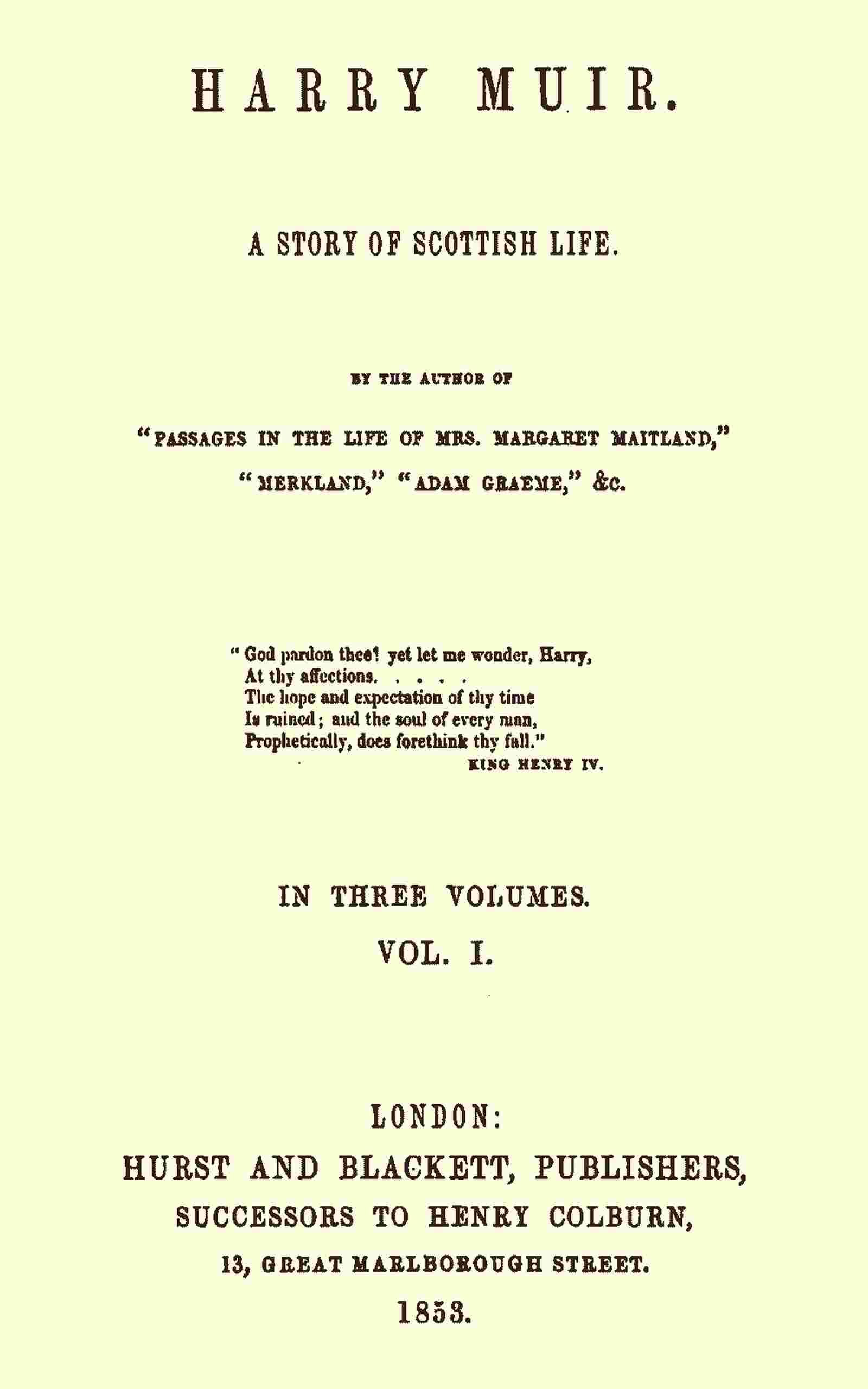
LONDON:
Printed by Schulze and Co., 13, Poland Street.
HARRY MUIR.
CHAPTER I.
TWO GENTLEMEN OF VERONA.
“And this is the pillar that Rob Roy hid behind, the Sabbath day that he warned the young English gentleman in the kirk. It’s the very place itsel. Here was the pulpit—and the seats were a’ here, and this is the pillar that hid Rob Roy.”
A party of young men were in the crypt of Glasgow cathedral—the little sleek, humble-looking man, who very unobtrusively acted as Cicerone, was pointing out to them the notability, with these words.
One of the visitors turned away with a grave smile, and leaving his companions, began to wander slowly down one of the long black aisles. The dim withdrawing vistas—the pillars with their floral chaplets—the singular grace and majesty of those dark and ponderous arches—impressed him with very different associations. The young man’s smile, slightly scornful at first, melted as he reached the lower end, and looking up through this grand avenue, saw the little knot of dim figures in the distance. He was glad to escape from their laughter, and unsuitable merriment. These noble old cloisters were too grave and solemn, to have their stillness so invaded.
But he was not suffered long to remain uninterrupted in his contemplative mood. “What ails Cuthbert?” said one of the younger of the party, a lad in the transition state between boy and man. “See to him down yonder at the very end, like a craw in the mist—I say, Cuthbert!”
As the piping shrill voice called out his name at its highest pitch, the young man began slowly to advance again. The lad came forward to meet him. “What are you smiling at—what did you go away for?”
“I was smiling at myself, John,” answered the accused.
John was curious. “What for?”
“For thinking there were things more interesting here, than the pillar that hid Rob Roy. Come along—never mind. Where are they all bound for, now?”
They were bound for a very dissimilar place—no other than the crowded Broomielaw, where John’s brothers were bent upon showing their Edinburgh cousin, Cuthbert Charteris, and an English stranger who accompanied them, one or two fine ships belonging to “the house” then in port. These young men were the sons of a prosperous merchant, all of them already in harness in the office, and beginning to make private ventures on their own behalf. There were three of them—Richard, Alick, and John Buchanan; the two elder had reached the full dignity of young manhood, and rejoiced in mighty whiskers, which John, poor fellow, could only covet intensely, and cultivate with all his might; but even John had begun to have the shrewd man of business engrafted on the boy, and was sometimes precociously calculating, and commercial—sometimes disagreeably swaggering and loud—though not unfrequently simple, foolish, and generous, as better became his years.
“I say, Cuthbert,” said the communicative John, as he swung his arm through his grave cousin’s, and followed his gay brothers on the way to the river, “did you ever see Harry Muir? Dick says he’s going to make him come and dine with us to-night.”
“And who is Harry Muir?” asked Charteris.
“Oh, he’s nobody—only a clerk in the office you know—but you never saw such a clever chap. He can sing anything you like. He’s a grand singer. And when Harry’s in a good humour, you should just hear him with the fellows in the office. My father looks out of his own room sometimes to see what’s the row, and there’s Gilchrist sucking his pen, and Macauley and Alick close down over their books, writing for a race, and Muir quite cool, and looking as innocent as can be. You should just see them, and see how puzzled my father is, when he finds that there’s no row at all!”
“And in such emergencies, how do you behave yourself, Johnnie?”
“Johnnie! I wish you’d just mind that I’m not a boy now.”
“Jack, then! Will that please you, young man,” said Charteris, smiling.
“Me? I behave the best way I can,” said the mollified John. “The best plan is, to set to working, and never let on that you hear the door open; but we like to get him among a lot of us when there’s nobody in the way; and you’ll just see to-night, Cuthbert, what a grand fellow he is for fun.”
Cuthbert did not look very much delighted. “And when is this famous dinner to be?” he asked. “Is Dick to entertain us at home?”
Master John burst into a great laugh. “Man, Cuthbert, what a simple fellow you are! You don’t think my mother would ask Harry Muir to dine.”
“And why not, my boy?” asked the Edinburgh advocate.
“Why not! Man, is that the way you do in the east country? He’s only a clerk, and everybody knows you Edinburgh folk are as proud as proud can be. Would you ask your clerk to dine with you?”
“I don’t possess such an appendage, Sir John,” said the briefless barrister, “except it be a little scrubby boy like what you were the last time I was west here—and he certainly would need some brushing up. So he’s not a gentleman, this wit of yours? He would not be presentable in the drawing-room?”
“Hum! I don’t know,” said honest John, hesitating. “He looks quite as well as Dick or Alick, or that Liverpool man there.” The lad drew himself up and arranged his neckcloth complacently. “There’s handsomer men, to be sure; but I think Muir’s better looking than any of you, Cuthbert.”
Charteris laughed: “Is he not well-bred, then?”
“Oh yes, he can behave himself well enough. He’s got a way of his own, you know; but then he’s a clerk.”
“And so are you, Jack, my man,” said Charteris.
“Oh yes, but there’s a difference. He’s got no money—and more than that,” said the juvenile merchant, “he’s got no enterprise, Cuthbert. There’s Alick, he had a share in a plan, sending out a lot of things to San Francisco on a venture, just when the news came about the gold, you know, and he cleared a hundred pounds; that’s the way to do. But then, that fellow Muir, he never tries a thing; and worse than that, he went away and married somebody last year, and he had three sisters before, and them all living with him. Just think of that. Four women all dragging a young man down when he might be rising in the world. Isn’t it awful?”
“A very serious burden,” said Charteris, smiling, “but what is his salary, John?”
“His salary’s sixty pounds; my father gives very good salaries. He’s just a clerk, you know. The cashier has two hundred.”
“Sixty pounds! and five people live on sixty pounds!” said the lawyer.
“And they’ve got a baby,” said John, solemnly.
It was the climax; there was no more said.
The respectable firm of George Buchanan and Sons had its office in a dingy business street near the Exchange. The early darkness of the February night had almost blotted out the high sombre houses opposite, except for the gleaming gas-light streaming from office windows in irregular patches from garret to basement. It was not a very busy time, and at five o’clock the clerks were preparing to leave the office.
“I say, Muir,” cried Richard Buchanan, bursting in hastily, “come and dine with us.”
Charteris was behind. The famous Harry Muir was certainly handsome—very much better looking than any other of the party, and had a fine, sparkling, joyous, intelligent face—but the lines of it had everything in them but firmness.
“Not to-night,” said the clerk, “you must not ask me to-night.”
“Why not to-night?” said the young master. “Come along now, Harry. Do be a good fellow. Why it’s just to-night of all nights that we want you. There’s my cousin Charteris, and there’s an Englishman; and we’re all as flat as the Clyde. Come along, Muir, don’t disoblige us.”
“I am very sorry,” said Muir, “but I can’t stay in town to-night. Let me off to-night; I will be more obedient next time.”
“He wants to get home to nurse his wife,” said Buchanan, with a sneer.
“My wife is quite well,” answered Harry, with a quick flush of anger; “she does not need my nursing, Mr. Buchanan.”
“Mr. Buchanan! don’t be ill-natured, Harry—come along.”
“No, no; I cannot go to-night. I don’t think I can stay to-night,” said the brilliant facile clerk.
The entreaties continued a little longer; the resistance became feebler and more feeble, and at last, stipulating that he was to leave them early, the genius of the counting-house consented.
“Harry, my man, send a message to your wife,” said a grave snuffy person, who enjoyed the two hundred pounds a year of which John had boasted, and was cashier to the Messrs. Buchanan.
Harry wavered a moment. “Where is the boy?”
“Perhaps she’ll come for you, Harry,” suggested the malicious Buchanan.
The poor clerk threw down, angrily, the pen he had taken up, and lifted his hat. In another minute, with quickly recovered gaiety, they went out in a band to the adjacent square where they were to dine.
“There’s the makings of a capital man in that lad, and there’s the makings of a blackguard,” said the grave Mr. Gilchrist, shaking his head ruefully, and taking a pinch of snuff; “it’ll be a hard race—which of them will win?”
The dinner in George’s-square went off very well, and the young clerk, as he warmed, dazzled the little company; he was only a clerk—they were inclined to patronize him at other times—but now the unmistakeable, undesired, pre-eminence, which these young men yielded to their poor companion, was a noticeable thing. The matter of ambition now, was, who should seem most intimate with—who should most attract the attention of the brilliant clerk.
Cuthbert Charteris was a more completely educated man than any other of the party. The thorough literary training will not ally itself to the commercial, as it seems. None of the young merchants had time for the long discipline and athletic mental exercises of the student. They were all making money before they should have been well emancipated from the school-room—all independent men, when they should have been boys—and the contrast was marked enough. There was a good deal of boisterousness in their enjoyment, and they were enjoying themselves heartily, while Cuthbert, getting very weary, felt himself only preserved from utter impatience of their mirth by the interest with which the stranger inspired him—this poor, clever, facile Harry Muir.
The quick mind of this young man seemed to have attained somehow to the results of education without the training and discipline which form so principal a part of it. He seemed to have been a desultory reader, a devourer of everything which came in his way, and while the Buchanans knew few books beyond the serial literature of the time, Harry threw delicate allusions about him, which it seemed he made only for his own enjoyment, since the arrows flew most innocently over the heads of all the rest. Threads of connection with those great thoughts which form the common country of imaginative minds, ideas radiating out from the centre of these, like the lessening circles in the water—the student Cuthbert heard and understood, and wondered—the Buchanans applauded, and did not understand.
One of them at last proposed to go to the theatre—the rest chimed in eagerly. Cuthbert, anxious to have the evening concluded as soon as possible, and resolving to seek no more of the delectable society of his young cousins except at home, where they were tolerable, remonstrated only to be laughed at and overpowered. The grown-up, mature, educated man resigned himself to their boyish guidance very wearily—and what would their wit do now?
He said he would go home—he took up his hat, and played hesitatingly with his gloves. He was excited with the company, the applause, and a little with the wine, and was permitting himself to parley with the tempter.
“Come along, Muir, it’s only for once; let us just have this one night.”
“No, no.” The noes grew faint; the hesitation increased. He consented again.
And so, louder and more boisterous than before, they again entered the busy streets. John Buchanan was a good deal inclined to be obstreperous. It was all that Cuthbert could manage to keep him within bounds.
They had reached the Trongate, and Cuthbert stopped his young companion a moment to look down the long gleaming line of the crowded street. It had been wet in the morning, and the brilliant light from the shop windows glistened in the wet causeway in long lines, and the shifting groups of passengers went and came, ceaselessly, and the hum and din of the great thoroughfare was softened by the gloom and brightened by the light of traffic that illuminated all.
“What are you looking at? See they’re all away across the street. What’s the good of glowering down the Trongate? Man, Cuthbert, how slow you are,” said John Buchanan, dragging the loiterer on.
There was a crowd on the opposite side which had absorbed the others. Cuthbert and John crossed over.
The accident which attracted the crowd was a very common one—an overtasked horse, wearied with the long day’s labour, had stumbled and fallen; and now, the weight of the cart to which it was attached having been removed, was making convulsive plunges in the effort to rise. The carters, and the kindred class who are always to be found ready in such small emergencies, were leaping aside themselves, and pressing back the lookers on, as the poor animal struck out his great weary limbs, endeavouring to raise himself from the ground.
Suddenly there was a shrill cry—“The wean—look at the wean; the brute’s fit’ll kill the wean.”
John Buchanan had pushed his way into the crowd, dragging with him the reluctant Cuthbert—and there indeed, close to the great hoofs of the prostrate animal, stood one of those little pale, careworn, withered children whom one sees only in the streets of great cities, and oftenest only at this unwholesome hour of night. But the acuteness peculiar to the class seemed to have forsaken the very little wrinkled old man of the Trongate. He was standing where the next plunge would inevitably throw him down, with the strange scared look which is not fear, common to children in great peril, upon his small white puckered face. Again the panting horse threw out his hoofs in another convulsive exertion. The child was down.
A shadow shot across the light. There were several cries of women. The child was thrown into somebody’s arms uninjured. The horse was on its feet, and a man, indistinctly seen in the midst of the eager crowd, struggled ineffectually to raise himself from the ground, where he had fallen.
“I am hurt a little,” said the voice of Harry Muir. “Never mind, it is not much, I dare say. Some of you help me up.”
There was a rush to assist him; a burst of eager inquiries.
“I got a blow from the hoof; ah! I can’t tell what it is,” gasped the young man, over whose face the pallor of deadly sickness was stealing. He could not stand. They carried him—these rough strong men, so gently—with his friends crowding about him, to the nearest surgeon’s. Everybody was sympathetic; every one interested. But Harry Muir’s head had sunk upon his breast, and the fight had gone from his eyes. He was conscious of nothing but pain.
The accident was a serious one; his leg was broken.