
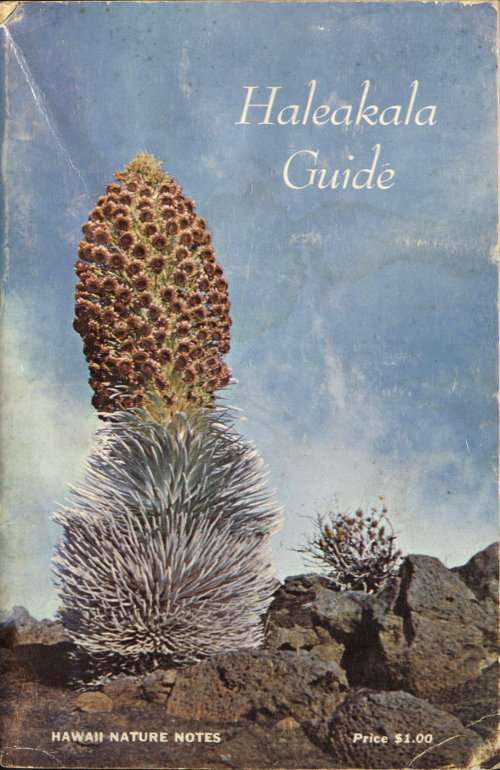
The Haleakala silversword has a short, simple, woody stem 2-3 inches in diameter crowded with thick, dagger-like leaves arranged spirally around it. After growth from 7 to as much as 20 years, a foliose raceme 3-8 feet high develops on which 100-500 flower-heads nod. Each has a central disk of hundreds of bright yellow florets surrounded by a score of short reddish-purple ray florets. The flowering season is from June through October. The whole plant dies after flowering but once.
The greensword, A. virescens Hillebr., a much rarer plant with green leaves, once grew from 6,000 to 9,000 feet. Today it has all but vanished; a few plants are still to be found in Koolau Gap just outside the park, and between rocks on the edges of cliffs at Kaupo Gap.
Visitors once gathered specimens of silversword as evidence that they had been up the mountain, even as the mountaineer gathers edelweiss in Switzerland. Thoughtless people uprooted the silvery globes merely to watch them tumble down the slopes. Goats eat the growing heart of the plant. Grazing stock are incompatible with its existence. It has many insect parasites (see The Insect Life). All of these, singly and in combination, threaten the existence of the species.
The outer slopes of the mountain had thousands of silverswords according to early accounts, while today they are rare. In the crater, some of the cones were so thickly covered that they appeared to be bathed in moonlight. Except for strong, enlightened action, this beautiful plant might have completely vanished from the mountain.
SUMMARY LISTS
The following are incomplete lists of plants reported at various places within the park. They may serve as the start or a check for those wishing to know something of the plants in a certain area. The names given are those most commonly used locally or those used to head the corresponding sections above.
COMMONEST SHRUBS ALONG THE HIGHWAY above Headquarters. Sandalwood, mamane, geranium (N. tridens), aalii, ohia, ohelo, pukiawe, mountain pilo, kupaoa.
WIDESPREAD below 8,500 feet. Stereocaulon lichen (mostly on barren lava), pellucid polypody, maidenhair spleenwort, cliffbrake, swordfern, bracken, sedge (Gahnia), sheep sorrel or dock; ulei, mamane, aalii, tarweed, ohia, evening primrose, ohelo, pukiawe, selfheal, plantain, kukaenene, mountain pilo, kupaoa, pamakani, hairy cat’s-ear, horseweed.
SUMMIT FLORA (above 8,500 feet). Mountain pili (grass), trailing pukiawe, tetramalopium sp., kupaoa, common dandelion.
CRATER FLOOR on ash or barren lava. Mountain pili, sheep sorrel, ulei, mamane, bur clover, white clover, cranesbill, aalii, tarweed, ohia, evening primrose, ohelo, pukiawe, selfheal, common plantain, kukaenene, mountain pilo, catchfly, kupaoa, pamakani, hairy cat’s-ear, Canadian horseweed, Tetramalopium humile, silversword.
KOOLAU GAP. Amaumau, rush, mauulaili, tree orchid, sandalwood, pawale, Hawaiian buttercup, trailing akala, native strawberry, nohoanu, apeape, highbush ohelo, trailing plantain, lobelia, wormwood, trailing kookoolau, greensword.
PALIKU. Amaumau, ekaha, akaha akolea, twayblade, alaalawainui, hoawa, akala, kawau, olapa, kolea, manono, lobelia, naenae.
KAUPO GAP. Rush, mauulaili, sandalwood, hoawa, puaainaka, poha, common potato (naturalized), Jerusalem cherry, tree plantain, lobelia, naupaka, Dubautia sp., Railliardia scabra.
Figure 1—SEDGE, Gahnia
Figure 2—HAWAIIAN ORCHID, Liparis
Figure 3—SANDALWOOD, Santalum haleakalae
Figure 4—MAMANE, Sophora chrysophylla
Figure 5—HAWAIIAN RASPBERRY, Rubus hawaiiensis
Figure 6—HINAHINA, Geranium tridens
Figure 7—NOHOANU, Geranium (Neurophyllodes) arboreum
Figure 8—AALII, Seed capsules, leaf detail
Figure 9—OHIA LEHUA, Twig with flower beginning to open
Figure 10—OLAPA
Figure 11—OHELO
Figure 12—PUKIAWE, Twig, flower magnified
Figure 13—KOLEA, showing fruit
Figure 14—MOUNTAIN PILO. Twig, fruits, leaf shapes, magnified flower and leaf showing veination
Figure 15—KUKAENENE, fruiting twig, male and female flowers
Figure 16—CATCHFLY, Silene struthioloides
Figure 17—MAUI WORMWOOD, leaves, magnified flowers
Figure 18—NAENAE, Dubautia plantaginea
Figure 19—KUPAOA, Raillardia menziesii
Figure 20—TETRAMALOPIUM
THE BIRDS AND MAMMALS
It is a general rule that, as among plants, numbers and species of birds decrease as one goes up a mountain. It is true also that native Hawaiian birds are to be found mostly in upland forests. Of the members of the endemic nectar-sipping family, DREPANIDAE, ’apapane and ’i’iwi may be seen up to 8,500 feet. They are associated with ohia which give them their food. ’Amakihi are fond of the mamane blossoms, so it is not surprising to find them widespread although not numerous in the park. Far rarer is the little Maui creeper, ’alauahio, which finds insects and spiders for food in the bark of trunks and branches of trees and shrubs. It follows the latter up to the Alpine Zone.
Except for migrants and sea birds, other natives nowadays are absent. Occasionally an Hawaiian owl, pueo, has been seen flying over grasslands near the park entrance and at Paliku. Tropic birds, koa’e, occasionally soar around the cliffs inside the crater. The dark-rumped petrel, ’ua’u, a vanishing species, is heard at night back of Holua and Kapalaoa cabins, and at Leleiwi Overlook. This pigeon-sized bird of the ocean nests in burrows 4-6 feet deep, at the bases of cliffs in the crater. Both young and adults were formerly hunted, often with nets, because they were highly prized as food. Bird catching was an important occupation of Hawaiians; at times one stumbles upon the remains of shelter caves and campsites used by them in a lonely mountain vastness. Except the period from early May to mid-August while it is away on its migration to Alaska, the golden plover, kolea, is a most conspicuous bird inside and outside the crater.
Introduced birds are everywhere. The Japanese white-eye or mejiro can be found in vegetation up to the Alpine Zone. It is especially common at Paliku, the most rewarding bird area in the park. The Pekin nightingale or Japanese hill robin, sochi-cho, goes all the way to the summit. I observed a pair at the structure on Red Hill, and picked up a dead one above the elevation of the Observatory. They sing in the trees around Paliku. Linnets and skylarks are often seen or heard anywhere up to the Alpine Zone. Commoner at low elevations, a mockingbird appears infrequently above Park Headquarters, and mynahs visit the inn grounds in summer. They also appear at Paliku. English sparrows may linger around the horse barns, as expected.
The most conspicuous and commonest Haleakala birds are introduced game-birds. Ringnecked pheasants are flushed or heard up to 8,500 feet, while Chukar partridges are numerous from 7,500 to 10,000 feet. Both of these are abundant in the crater. The Chukar, only a newcomer here, is already definitely at home. California quail scurry from the road or trail at elevations up to 7,500 feet. In 1958, 27 Erchel’s francolin were released just below the park line near the inn, but success of their establishment is still a question.
The bat was apparently the only mammal living in Hawaii at the time when Polynesian navigators first visited here. They carried the pig, dog, and tramp rat along with them on their voyages. After Cook, many mammals were brought in, some of which readily reverted to a wild state. These include sheep, goats, cattle, horses, burros, dogs, cats, and mongooses.
The feral goat is the problem child of the Haleakala area. Often a beautiful creature, with long, black, flowing hair, it soon exterminates silversword, mamane, and desirable vegetation wherever it is left uncontrolled. Upon being forceably separated from its mother, the terrified kid quickly becomes tame and attaches itself as closely to the human associate as it did to its natural parent. Occasionally a stray dog that has reverted to the wild is seen in the park area. It is only a reminder of the days of the past century when packs roamed the side of the mountain and harassed visitors with their ferocity. Joining their members were wild bullocks that also constituted a threat. These were inevitably mentioned in all journals of early visitors. In the wet forested areas below Koolau Gap, on the fringe of upper Kipahulu Valley, and along the rim at Waianapanapa, pigs flourish in bliss that is broken only occasionally by a local hunter who seeks them just outside the boundary of the park.
THE INSECT LIFE[21]
Hawaii National Park is rich in insect life although, as is typical of insular areas, insects are much more sparse than in continental regions. Most of our insects are endemic species, i.e., are found only in these islands; many are very limited in distribution. For the most part the endemic insects are associated with the native plants. Most of our insects are comparatively small and inconspicuous; nevertheless, a great many are strange and unusual so that our fauna is particularly interesting to the scientist. We have none of the larger, showy butterflies and other insects which the visitor often expects to find here. No noxious or harmful species are present in areas used by park visitors, but the large blowflies which breed in goat carcasses in Haleakala Crater sometimes become a nuisance, due to their presence in large numbers. These are mainland species which have been accidentally introduced into Hawaii and which are now restricted to the highland areas where the climate is temperate. With the exception of lice and domestic flies, which were brought here by the Hawaiians themselves, Hawaii was free of pestiferous insects before the arrival of the Europeans.
One of the best known endemic Hawaiian insects is the butterfly named after King Kamehameha, Vanessa tameamea, a highly colored relative of the painted lady, the tortoise shells, and the red admiral butterflies of the mainland. This species is highly prized by amateur butterfly collectors since it is found no place else in the world. Its colors are orange, brown, and black. The female has small white spots in the apical portions of the front wings; these spots are rosy colored in the male. The caterpillars, green or purplish, feed on the leaves of the mamaki. Adults are found in forests throughout the islands. They are attracted to the native hydrangea, kanawao, to the introduced thimbleberry, or to the sap exuding from koa or naio. This butterfly is a strong flier, and ranges from the seacoast to the top of Haleakala. The female of Hodegia apetala, an endemic genus of only one described species, is an Hawaiian moth unable to fly.[22] The male is unknown. This jumping insect, related to the bollworm, lives in bunch grass near the summit. The narrow, pointed, reduced, ashen-brown wings are ½ inch long; the abdomen, about as long as the wings, is brownish gray.
As one walks over open patches at higher elevations a brown moth, 1½ inches wide, rises readily before one. This is Agrotis aulacias that possesses great powers of flight.[23] The genus of 27 species is related to army worms, cut-worms, and a host of agricultural pests. Fletcherana insularis is a geometrid moth (inch worm, measuring worm, or looper) found in late spring high above the forest belt near the park entrance. The insect is an inch wide, its color is white, speckled with black. The genus of 5 species is confined to Hawaii.
Nesophrosyne haleakala is a mottled, gray-brown leafhopper, ⅛ inch long; the head and front part of the thorax are yellowish. In the park it is found in pilo and ohelo at 8,500 or 9,000 feet. The genus is endemic and contains over 60 forms distributed throughout the islands.
An undesirable pest has publicized its presence high above the park entrance by leaving its name on two caves which early visitors found convenient for shelter. Big Flea and Little Flea Caves often appear in accounts of early trips, but never without mention of the annoyance that was caused by their permanent occupants. Of the 7 different kinds of fleas recorded for Hawaii, only the so-called cat flea (Ctenocephalides felis) annoys people to any extent. Several species of fleas infest the Hawaiian rat and were presumably brought in when this rodent arrived with the earliest Polynesian immigrants.
Because the beautiful silversword has no very close relatives, which means that its ancestors arrived in Hawaii in earliest time, any species of insects associated solely with it as a host plant draws particular interest. Moreover, since the survival of silverswords is precarious in this day of rapid change, all agents that threaten must be carefully scrutinized. Silverswords are specific hosts to a half dozen or more endemic species of insects.[24] Among Lepidoptera, the family of moths and butterflies, the larvae of a pyralid moth, Rhynchephestia rhabdotus, feeds in the flower-heads, destroying the seeds. Caterpillars of a noctuid, Euxoa epicremma, have been collected beneath plants. The caterpillars of a tineid moth have been found among dead leaves. Of the DIPTERA, great numbers of yellow maggots of a gray fly, Tephritis cratericola, feed on the seeds and prevent their development. The larvae of one of the Coleoptera, a beetle described as Aescheithmysus terryi, feeds apparently only on old and dead stems. A relative, A. swezeyi, similarly feeds on Railliardia. Great members of a leaf-hopper, Iburnia argyroxiphii, suck the sap of Haleakala silverswords. It is preyed upon by a wasp, Polynema sp., so tiny that the naked eye can hardly see it. The wasp lays its egg in the egg of the hopper. The larval wasp, upon hatching, feeds on the contents of the hopper egg, pupates within it, and emerges from it.
The Paliku area is very rich in insect life; many hundreds of species have been recorded from here and many are apparently very restricted in distribution and are known only from this locality. Species of pomace-flies (DROSOPHILIDAE) and the long-legged flies (DOLICHOPODIDAE) are especially prevalent at Paliku. Two species of the native genus Idiomyia are the largest members of DROSOPHILIDAE found any place in the world; they measure approximately 7 mm. in length. Two species of flightless Neuroptera (Pseudopsectra cookeorum and lobipennis) occur on the vegetation (Dubautia, Metrosideros, and Cyanea) in Haleakala; these represent one of the strangest entomological curiosities of the world.
Over five thousand species of insects have been recorded from the Hawaiian Islands and it is probable that several thousand more species remain to be described. In the past our knowledge of the insects was based largely upon the monumental study, “Fauna Hawaiiensis,”[25] published by a group of institutions including the British Museum (Natural History) and the Bernice P. Bishop Museum. A new faunistic study is now under way titled “Insects of Hawaii.”[26] This is an extremely valuable reference work and is indispensable to anyone studying Hawaiian insects. It gives a complete review of the insects from the lowest orders through the butterflies and larger moths. Two volumes on the DIPTERA are now in press. Volume one gives a most comprehensive account of the mode of dispersal of our endemic fauna and flora to these islands. It is estimated that the 3,722 known endemic insects developed from approximately 250 ancestral species.
HAWAIIAN WORDS AND PLACE NAMES
THE HAMZA. During the centuries, changes occur in dialects. Hawaiian is one of the dialects of the Polynesian language. A striking change in Hawaiian is the dropping of the letter k that once appeared in some words. But instead of complete discard of the sound, its former existence is revealed as a little catch in the throat, called a glottal stop. This is represented in print by a mark (’) called hamza. The omission of this mark can spell a word of entirely different meaning. Yet, without explanation, the hamza can be more bewildering than helpful to those unfamiliar with Hawaiian. Its use in this book therefore has been limited to this section and to the section on plants, because it is needed if correct pronunciation is attempted. And who fails to want to try Hawaiian on his tongue!
These brief, literal interpretations are not mentioned in the text. Principal authorities are K. E. Emory and M. K. Pukui.
AHU—Pile, cairn, altar, shrine. Often a small or large pile of stones erected as a trailmark or landmark. Ahu were sometimes put up by passing parties as monuments or evidence that they had been there, even as mountain climbers do to this day. To be assured of a safe journey, an ahu of three stones was made as tribute to the god of the locality.
ALII—Ali’i, chief, chiefess, sovereign, ruler. One of the upper class.
HALALII—Hala-li’i, fun-making, from the name of a traditional chief of Ni’ihau.
HALEAKALA—Hale-a-ka-la is usually interpreted as “house of the sun,” a simple translation of the Hawaiian name given us for the mountain. It assumes vague reference to the Maui legend. An old explanation converted the translation to “house built by the sun.” Rev. A. O. Forbes[27] says that the name is a corruption of Alehe-ka-la, “snarer of the sun,” in reference to Maui’s deeds. Still another version would have it Ahale-ka-la, to be interpreted as “rays of the sun.”
HALEMAUU—Hale mau’u is grass hut; hale ma’u’u signifies damp house.
HANA—Bay or valley, when used in a place name.
HANAKAUHI—Hana-ka-uhi, the mist-maker; yam valley.
HAOLE—A foreigner, one of foreign extraction; today, usually in reference to a Caucasian; adj., foreign.
HEIAU—Pre-christian place of worship, hence, usually translated temple. This was often a stone platform or an earth terrace.
HOLUA—A course used for the ancient royal sport of sliding down steep slopes; also the sled itself.
HONOKAHUA—Hono-ka-hua, joined foundation.
IAO—’I-ao, high; into the clouds.
KAHULUI—Ka-hului, a sea for drag-net fishing.
KALAHAKU—The proclamation of the Lord.
KALAPAWILI—Ka-lapa-wili, winding or twisting ridge.
KALUAAWA—Ka-lua-’awa, the ’awa pit. ’Awa or kawa is the well-known traditional drink of Polynesia made from Piper methysticum.
KALUAIKI—Ka-lua-iki, small pit or crater.
KALUANUI—Ka-lua-nui, large pit or crater.
KALUA O KA OO—Ka lua o ka ’o’o, the pit of the ’o’o. The ’o’o, now extinct, was an endemic, black, nectar-sipping bird. It had tufts of yellow feathers under each wing and at the base of the tail, which were used in featherwork.
KALUA O UMI—Umi’s Cave.
KAMOALII—Ka moa li’i, the little chicken.
KA MOA O PELE—Pele’s chickens or chicken coop.
KANAKA—(Haw. pl. kanaka; Eng. pl. kanakas) human being, person, man.
KAPA—Tapa, a cloth made from the bark of mamaki or wauke; formerly, clothes of any kind; bedclothes.
KAPALAOA—Ka palaoa, the palaoa was a highly-prized pendant of whale-tooth ivory, a symbol of royalty over the theft of which wars were waged.
KAUPO—Kau po, to land at night. A variety of banana is given this name, probably after the place name.
KAWILINAU—Ka wili nau, literally, the twist of pain. This is the Hawaiian place name for Bottomless Pit.
KEAHUOKAHOLO—Ke ahu o ka holo, a heap resulting from a landslide.
KEANAE—Ke ’anae, the large mullet.
KEONEHEEHEE—Ke one he’ehe’e, the sliding sands.
KIHEI—Shoulder covering; a rectangular fine mat or tapa used as a mantle.
KIPAHULU—Worn-out soil.
KOLEKOLE—Bright red, blood red.
KOOLAU—Ko’olau, windward side.
KUIKI—Ku iki, a moment’s stop, a short halt.
KUMUILIAHI—Kumu ’iliahi, sandalwood trunk.
LAUULU—Lau ’ulu, leaf of breadfruit tree.
LELEIWI—Carved figure on the bowsprit of a canoe or ship.
LILINOI—Goddess of Haleakala.
MAKAWAO—Maka wao, forest region.
MAUI—Contrary to popular belief and despite the similar spelling, the island does not bear the name of the demigod. The name of the island is pronounced mow-ee. This almost rhymes with an enthusiastic “WOWIE!” especially as a Virginian might pronounce it. The au must be treated in the fashion for Hawaiian dipthongs, that is, the crisp vowels are more loosely connected than in the English, and a slight accent is imposed on the leading one. The demigod’s name has three syllables, with accent on the second, i.e., the u. Thus, Ma-u’-i.
MAUNA—Mountain.
MAUNA HINA—Gray mountain.
MOI—Mo’i(A 19th Century word), King, queen, sovereign.
NAMANA O KE AKUA—Na mana o ke akua, the miraculous power, mana, of Deity, gods, or spirits.
NA PIKO HANA—The hiding place for navel cords.
NIANIAU—Ni’ani’au, the sword fern.
OILI PUU—’O’ili pu’u, hill appearing, hill shot out.
PALIKU—Pali ku, upright cliff.
POHAKU PALAHA—Broad stone; wide stone.
PUKALANI—Puka lani, heavenly entrance, chief’s doorway.
PUU—Pu’u, hill. This is contracted in some names to pu.
PUU HELE—Pu’u hele, moving hill.
PUU KAUAUA—Pu’u ka uaua, the stubborn hill; the tough hill.
PUU KUMU—Pu’u kumu, stump hill.
PUU MAILE—Maile is a fragrant vine, Alyxia oliviformis, used and loved like the laurel of Europe.
PUU MANEONEO—Pu’u mane’one’o, itching hill. Maneoneo means barren.
PUU NAUE—Pu’u naue, trembling hill; loose or insecure hill.
PUU NOLE—Grumbling hill.
WAIALE—Wai’ale, rippling water.
WAI ANAPANAPA—Wai ’anapanapa, sparkling water.
WAIHOI—Wai ho’i, water that returned.
WAIKAU—Wai kau, water on a high place.
WAIKEKEEHIA—Keke’ehia means to twist and wind like a rivulet or stream, hence, the name is interpreted as crooked waters.
WAILUKU—Wai luku, water of destruction.
HUI O AHINAHINA
The exclusive Society of the Silversword (Hui o Ahinahina) invites you to become a member if you have visited the summit or the crater of Haleakala. Only one class of membership. Life: one dollar! By joining you can help scientific study, interpretation, and display exhibits of the Park. Exchange your dollar at the Park or at the office of Silversword Inn for a silvery, engraved certificate, suitable for framing. With pride you can hand it down to your grandchildren, a souvenir of Haleakala.
ADDITIONAL HELP
The following publications contain information on the two sections of Hawaii National Park. They may be purchased at either Park Administration Office, at Silversword Inn, Haleakala, and at the Volcano House at Kilauea.
Volcanoes of Hawaii National Park. (pamphlet) by Gordon A. MacDonald and Douglas H. Hubbard.
Hawaii Natural History Association, 1951. 50¢
Ferns of Hawaii National Park. (pamphlet) by Douglas H. Hubbard.
Hawaii Natural History Association, 1952. 50¢
Trailside Plants of Hawaii National Park. (pamphlet) by Douglas H. Hubbard and Vernon R. Bender, Jr. Hawaii Natural History Association, 1960.
Plants of Hawaii National Park. By Otto Degener, 1945. $4.00
Illustrative of Plants and Customs of the South Seas.
The Land of Pele. (pamphlet) by Nash Castro.
A historical sketch of Hawaii National Park.
Hilo Tribune Herald, Ltd., 1953. 85¢
Cartons, cigarette butts, and other trash do not add to your enjoyment of the park. You can easily dispose of these so that they cannot become obnoxious to you and those who come after you. With the number of visitors increasing each year, you can help protect and preserve the natural scene by placing all paper and other refuse in containers provided for this purpose and by refraining from picking or breaking flowers, plants, and natural specimens. Won’t you do your share? THANK YOU.
MILEAGES
| Roads | ||||
| Park Boundary to: | Miles | |||
| Silversword Inn | 1.0 | |||
| Hosmer Grove | 1.5 | |||
| Park Headquarters | 2.0 | |||
| Halemauu Trail | 5.6 | |||
| Leleiwi Overlook | 8.4 | |||
| Kalahaku Overlook | 10.1 | |||
| Observatory | 12.1 | |||
| Red Hill (Summit) | 12.8 | |||
| CAA Station | 13.8 | |||
| Halemauu Trail | ||||
| Silversword Inn to: | Miles | |||
| Halemauu Trail Junction | 2.9 | |||
| Holua Visitor Cabin | 5.9 | |||
| Haleakala Park Road to: | ||||
| Holua Visitor Cabin | 3.9 | |||
| Holua Visitor Cabin to: | ||||
| Silversword Loop | .9 | |||
| Bottomless Pit | 2.3 | |||
| Bubble Cave | 3.3 | |||
| Kapalaoa Visitor Cabin | 3.8 | |||
| Paliku Visitor Cabin | 6.3 | |||
| Kaupo Village | 14.1 | |||
| Sliding Sands Trail | ||||
| Observatory to: | Miles | |||
| Holua Visitor Cabin | 7.4 | |||
| Kapalaoa Visitor Cabin | 5.8 | |||
| Bubble Cave | 6.5 | |||
| Paliku Visitor Cabin | 9.8 | |||
| Kaupo Village | 17.5 | |||
| Miscellaneous Mileages: | ||||
| Holua Visitor Cabin to Kapalaoa Visitor Cabin | 3.8 | Miles | ||
| Kapalaoa Visitor Cabin to Paliku Visitor Cabin | 4.0 | |||
| Paliku Visitor Cabin to Holua Visitor Cabin (Direct Route via Halemauu Trail) | 6.3 | |||
| White Hill | 0.2 | |||
| Crater Overlook Trail | 350 | Feet | ||
A FEW STATISTICS
| Area of the Crater | 19 | Square miles |
| Circumference of the Crater | 20 | Miles |
| Extreme length of the Crater | 7½ | Miles |
| Extreme width of the Crater | 2½ | Miles |
| Elevation of the summit of Red Hill | 10,005 | Feet |
| Elevation of Puu o Maui | 8,133 | Feet |
| Elevation of Park Boundary, Kaupo Trail | 3,847 | Feet |
| Elevation of Park Boundary, Koolau Gap | 6,450 | Feet |
| Area of the Haleakala Section, Hawaii National Park | 26.7 | Square miles |
Footnotes
Silversword in bloom
Transcriber’s Notes
- Silently corrected a few typos.
- Retained publication information from the printed edition: this eBook is public-domain in the country of publication.
- In the text versions only, text in italics is delimited by _underscores_.