
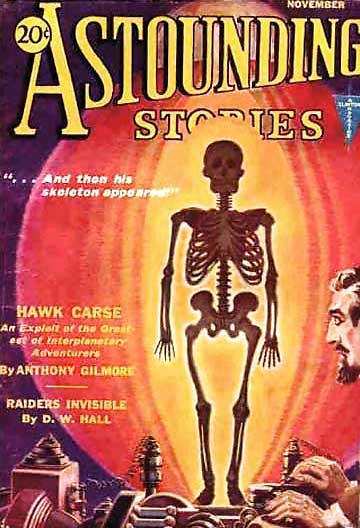
awk Carse's icy poise in times of emotional stress never failed to amaze friends and enemies alike. Most of them swore he had no nerves, and that in that way he was not human. This estimate, of course, is foolish; Carse was perhaps too human, as was proved by the all-consuming object of his life. It was rather, probably, an inward vanity that made him stand composed as a statue while death was gnawing near; that had, once, led him actually to file his nails when apparently trapped and hotly besieged, with the wicked hiss of ray-guns all around.
And so he stood within his suit now—calm, quite collected, his face graven, while the yellow tendrils carpeted the whole cabin, penetrated between the twin banks of instruments on each side and clouded the bow windows, visi-screen and positionals until the two living men aboard that ship of death were completely shut off from outside vision. Friday, his large white eyes never for a moment still, and waiting as the Hawk was waiting to find whether or not their suits, too, harbored the fungus, could quite easily have been scared into a state of panic; but the sight of the steely figure near him eased his nerves and brought a vague kind of reassurance.
Minutes went by. Presently the Hawk said softly into his microphone:
"We're safe, now, I think. You'd better go aft and see what state the ship's in. Come right back." And as Friday left, wading through the clinging growth, the trader went to the eye-piece of the electelscope.
He brushed the puffy covering of yellow silt away and adjusted the instrument's controls as best he could, centering it on where Judd's craft had last been. Then he peered through—and saw that which made him start.
The Star Devil was rolling round and round, like a ball!
arse looked out on a star-studded panorama that was sweeping crazily by. Now the cloudy globe of Iapetus, which had just before lain far behind, came swinging into view, sliding rapidly from the bottom of his field of view to the top, and so out of sight again, to quickly give place to the flaming, ringed sphere of Saturn, which in turn passed away and left the star-spangled blackness of space. Then Iapetus once more. He snapped the electelscope off abruptly, and turned from it to see Friday come clumping back.
"Swept everything clean, suh," the negro reported gloomily. "That fungus's thick; cain't even see the men's bodies, it's so deep. It's that way, all over."
"It's down in the gravity propulsion plates too," Carse said shortly. "Their adjustment's been ruined by it, and we're out of control, turning over and over. I couldn't possibly see Judd. Well, we've got to go down to the plates and try and clean them."
It was a weird scene that faced him in the engine room. The complex instruments and machinery were draped with straggling ferns of yellow; up above, a solid clump some ten feet thick hung on the platform where the engineer usually stood—a living tomb. The usual purr of the mechanisms was muffled and hushed. So fecund was the fungus that the path Friday had cleared in his passage aft was already filled, and Carse had to clear a new one. The growth was deep there, but still deeper in the next compartment.
It was practically a solid mass of yellow, for in it their invader had found food. It had fed well on the lockers of supplies and devoured all but the bones and clothing of the two men whom it had caught—radio-operator and cook. Carse fought on through this tough, clinging sea and came at last to the cargo hold, where, in the deck, was the man-hole that gave passage down to the 'tween-decks compartment where the rows of gravity propulsion plates were located.
riday raised the cover with a wrench: then, preceded by the rays of their hand-flashes, they climbed down and wormed forward as best they could in their hampering suits, to the plates. They found they had lost their customary glitter beneath powdery coatings of yellow, sufficient to disturb their faint electric currents and microscopically adjusted angles. On hands and knees—for the compartment, though as wide as the ship's inner shell, was only three feet in height—the Hawk stopped and said:
"We might be able to get some use out of these plates if we can keep the fungus brushed off. It's thin: let's try it."
But the yellow growth's vitality baulked them. Sweating from their awkward exertions inside the hot space-suits, they again and again brushed clean the plates with pieces of waste—only to see the feathery particles regather as quickly as they were cleared away. There wasn't more than an inch of the fungus, but that inch stuck. There was no removing it.
"No use, boss," gasped the negro, pausing breathless. "Cain't do it. Nothin' to do, I guess, but wait an' see what de Kite does. He'll sure want this ship and the horn."
"I know," his captain answered slowly. "He'll want this ship, for it's the fastest in space—but I can't understand how he'll board us. I'm going up and see what I can find out. You stay here. Try cleaning the plates again."
Up through the man-hole he went, and forward to the control cabin. And, as before, the electelscope's eye-piece held a surprise for him.
Somehow, the Star Devil's speed of wild tumbling had lessened. A moment later the reason appeared. As her bow dipped down and down, there slid across the field of view, about a mile away, the lighted ports of another ship; and, from this other ship's nose there winked a spot of green, the beginning of a ray-stream which stabbed across the gulf to impinge on the Star Devil's bow. Carse could feel his craft steady as it struck. It was a gravital ray, with strong magnetic properties, which Judd was using to stop her turnings so he and his men could board!
gain and again the beam flashed across the Hawk's field of view, and he knew it was raying its mark neatly each time her bow swung abeam, for soon she was hardly turning at all. Then Judd evidently was satisfied. The port-lights of his ship veered aside; drew to a position abreast of the other. The two cold gray eyes that watched saw the outer port-lock door of the pirate open, revealing six figures, clad in space-suits and connected by a rope, that stepped out, pushed, and came floating towards the Star Devil.
Swiftly Carse moved. For many reasons it was useless, he rapidly decided, to try and surprise them as they boarded; there was a better and surer way. And, as always, he attended to every little detail—details that to others might have seemed trivial—of this preferred way.
With quick, strong fingers he removed the fungus-choked body of Harkness from its space-suit, and threw the suit into a nearby locker. From another locker he selected a loop of yellow-encrusted rope. Holding this over one arm, he made his way back rapidly to the aft man-hole, closed it carefully behind him and crept forward to the anxious negro who was still futilely dusting the plates. He told what he had seen, but nothing else.
Friday noted the rope, and he twisted his whole body to get a sight of Carse's gray eyes, through the face-shield.
"What we do, then, suh?" he asked. "Try an surprise 'em?"
"Can't do that; we'd still be helpless, without a way to remove this fungus. They probably know how to do it, and we've got to give them a chance."
Puzzlement pricked the negro. "Then what you goin' to do with that rope?"
"You'll soon see," snapped Hawk Carse.
hey waited.
It was hot and stuffy down in the belly of the ship, and also utterly black, for the trader had flicked off his hand-flash. Friday was unhappily possessed of an active curiosity; he wanted terribly to go on with his questions and ask Carse what his plan was; but he did not dare, for he knew very well from past experience that the Hawk was impatient of detailing his schemes in advance. So he sat in silence, and sweated, and stared gloomily into the darkness, thinking uneasy thoughts.
True, he thought, Judd the Kite did not know that Carse and he were still alive; on the contrary, he was probably convinced that they were dead; but what good did that do? Surely it would have been better to have surprised the brigands when boarding, but Captain Carse was against that. And they were hopelessly outnumbered.
Friday remembered a tale told him once by a survivor of a trading ship Judd the Kite had destroyed. It wasn't a nice tale. The Kite, so the report ran, was diabolically ingenious with a long peeling knife, and could improvise with it for hours. Friday pursued the tack of thought, and then suddenly began to sweat in earnest. He recalled—horrible!—that Judd possessed a special dislike for colored gentlemen!...
"Oh, Lawd!" he groaned, unconsciously—to have a cold voice ring in his earphones.
"Quiet!" it snapped. "They're entering."
The negro threw a switch on his helmet so he could catch outside noises. His body tensed. From above, unmistakably, had come the hiss of the inner port-lock door opening. And again, moments later, the hiss echoed. Twice! The lock could hold three men at a time. That probably meant that all six had boarded. Friday turned in the darkness and peered at Carse.
The adventurer without warning flicked on his hand-flash. The beam fell on the parallel planes of the yellow-covered gravity plates. The negro, every nerve in him jumping from impatience and suspense, gazed at them, and suddenly straightened. The mold-like fungus which had prevented them from getting the ship into control was slowly melting away. It was dwindling into fine dust!
"Gas," came a soft whisper to him. "As I expected, Judd's cleaning it out with some sort of gas. But the plates won't work yet—not until they're polished bright." Unthinking, Friday raised his hand to his helmet fastenings. "Keep your face-shield shut!" he was ordered crisply. "The gas would be as fatal as the fungus."
ilence rested tensely over the two men, to be broken at last by the clump of feet proceeding aft on the deck above.
Carse switched off the light. His voice was but faintly audible.
"Coming down to clean off the dust. He'll have a flash. Hide behind the truss-work at your side, and when he gets here seize him by the neck. I'll be with you right away. I want no noise."
Friday saw a great light, and grinned in the confidence it brought him. Of course! That explained the rope. The plan was so simple it had escaped him. Already he felt cheerful. It was only mental worries, and never physical hazards, that unsettled him. He angled around the truss-work and shrank into as small a space as possible—which wasn't very small, as he still wore his bulky, clumsy suit.
The clump-clump of feet had died: now there came the sound of the man-hole aft being raised. A white beam pronged down into the darkness, felt around and flicked off. Boots clanged on the connecting ladder; reached the bottom. The light appeared again, lower now, and came slowly forward. Limned faintly against the reflected light was the outline of a crouching man's body.
He went to hands and knees and progressed carefully, his flash darting to left and right. Suddenly, in a certain light, the two who awaited his coming saw a swarthy, black-stubbled face in profile. He wore no space-suit! That meant, Friday reflected, that the brigands had cleared the ship of the gas in some way. It meant that they could get out of their own suits.
But they could not possibly do so at the moment. They heard the nearby pirate's breathing, a harsh oath as he stubbed a toe. The negro tightened his giant arms and held himself ready, his eyes steady on the black outline which signified his quarry. Then the pirate was close enough.
It was over in seconds. Rounding the truss, Friday caught the man in the armored crook of his arm. A startled croak preluded the thump of two bodies on the hull; there was the tinkle of a falling hand-flash and a slight squirming which was quickly stopped by a belting punch.
hen Carse was there in the darkness, looping his rope around the pirate's arms and legs—a difficult job when wearing a bulky space-suit in such cramped quarters. He used a bunch of waste for a gag and then hauled the captive to a girder farther forward and bound him sitting to it. By the time he had finished, Friday was out of his space-suit and asking:
"Shall I rub him out, suh? Best make sure of him."
"Never in cold blood," said the Hawk acidly. "You should know that well enough by now!
"Now, there should be five left above, and I think they'll send another down. We must get him, too. Get back where you were."
He took off his space-suit also: then, after minutes of silence, they heard voices upraised in argument coming from the control cabin. Once more came the sound of feet overhead; another flash bit down through the man-hole, and another man wriggled into the compartment. He was obviously uneasy and suspicious. He called:
"Jake! Hey, Jake! You there? Where the hell are you?"
Mumbling oaths, he advanced, his light ray weaving over every inch before him.
"What you doing, Jake? Where are you?"
Friday gathered his muscles, unhampered now by the restricting suit. But light must have been reflected by the round whites of his eyes, for the pirate suddenly stopped and called in sharp alarm:
"What's that? What's that there? You, Jake? Hey! I'll ray you—"
And that was all he said. Friday was too far away to reach him in time, but the Hawk was closer; he approached behind the brigand, crouched on silent cat's feet. Two powerful arms reached out and tightened in a strangle hold—and two minutes later the second man was bound and gagged.
Carse loosened his ray-gun in its holster.
"Now we attack," he whispered. "Four to two are fair odds, I think. You go aft and wait by the man-hole; wait till you hear me call. Don't be seen—wait. And when I call, come at once."
"Yes, suh. You goin' forward 'tween the hulls?"
A curt nod answered him.
"Then up through that—"
"Don't ask so many questions!" the Hawk rasped crisply.
They separated.
CHAPTER V
The Hawk and the Kite
n the deck of the control cabin, between a bank of instruments and the starboard wall, was another man-hole that gave entrance from the 'tween hulls compartment to the cabin.
Only two men besides Carse knew of its existence. The adventurer for good reasons of his own had it built in; and so cunningly was its cover fitted on that its outlines were not visible.
Beneath it, now, on the three-rung ladder that led up from the lower shell, Hawk Carse waited.
He could hear quite clearly the angry, snarling voice of Judd the Kite, haranguing his men.
"Rinker, you go down and see what's wrong. Just because Jake and Sako don't come back right away, you guys seem to think the ship's haunted! Haunted! By Betelguese! A sweet bunch of white-livered cowards I've got for a crew—"
"Ah, lay off!" growled a deep, sullen voice. "I ain't scared, but this looks fishy to me. Something's wrong down there 'tween the hulls—damn wrong, I tell you. We only found four skeletons, an' four, ain't the full crew for a ship like this. There oughta to be a couple more somewhere. Carse, blast him! he's got nine lives. How do we know he was one of the four?"
Another spoke up, as Rinker evidently hesitated. "I say we all go down and investigate together."
"Stow it!" thundered Judd. "They didn't get their space-suits out, did they? Why, they hadn't a chance to escape—none of 'em. They were killed, every one, quick! And four's plenty to work this ship. Carse is dead, see, dead! This was one trick he didn't know—one time he couldn't worm out. He was clever, all right, but he couldn't quite stack up against me. I swore I'd get him and I did. He's dead!"
"Judd," said a low, clear voice.
he Kite whirled around. He stared. The hand-flash he was holding dropped to the deck with a clang. His hands went limp, and his voice was suddenly weak and dazed.
"My God—Carse! Hawk Carse!"
"Yes," a whisper answered. "Hawk Carse. And not dead."
It was a scene that might have puzzled a newcomer to the frontiers of space. Certainly there seemed to be nothing menacing about the slender figure that stood by the now open man-hole, both arms hanging easily at his sides; the advantage, on the contrary, appeared to be all with the men whom he confronted. All but one was big, and each was fully armed with a brace of ray-guns and knives.
But, though there were four guns to one, they made no attempt to draw. For it was the Hawk they faced, the fastest, most accurate shot in all those millions of leagues of space, and in his two icy eyes was a menace that filled the control cabin with fine-drawn silence.
At last Judd the Kite opened his lips and wetted them.
"Where did you come from?" he stammered.
"No matter," came the answer from the thinly smiling mouth. "Friday!"
"Yes, suh!" boomed the big black's distant voice.
Judd's three men turned their heads and saw Carse's famous satellite step into the control cabin, a ray-gun in each capacious hand. He was all flashing white teeth, so wide was his grin.
"Well, well!" he chuckled. "Ain't this the pleasure! Certainly am pleased to meet old friends like this—yes, suh! Jus' drop in?"
But the Kite's head had not turned; he seemed not to hear Friday's words; his eyes were held fascinated by Carse's. The attention of everyone came back to the two leaders.
"Ku Sui is in back of this?" asked the Hawk.
Judd licked his lips again. He had to spar for time: to divert for a while the vengeance he knew possessed the other's mind, so that he might find some chance, some loop-hole.
"That's right," he began eagerly, "it was Ku Sui. I had to do this, Carse: I hadn't any choice. He's got something on me: I had to go through with it. Had to!"
he Hawk's eyes were glacial; the ghost of a smile hovered once more around the corners of his lips.
"Go on," he said. "What was that fungus?"
"I don't know. Ku Sui developed it in his laboratory. He just gave me a sealed cartridge of the spores with instructions to raid your ranch, as you saw, and plant them in a drilled-out phanti horn. There was a simple mechanism in the cartridge that allowed us to release the spores by a radio wave from our ship. When I wanted them to grow I simply—"
"I see. A clever scheme," Carse said. "Quite up to Ku Sui's standard. The idea of those three men running for the jungle when I came down on Iapetus was to insure my taking the horn cargo aboard, of course. The raid was only incidental to your scheme to get me. And Crane, the radio operator, was dead when I received that S.O.S. It was faked, to bring me quickly for your schedule."
Judd stared at him. "How in hell did you know that? Damn you, Carse, you're—"
"Where," interrupted the adventurer coldly, "is Ku Sui?"
The pirate's eyes shifted nervously. "I don't know," he muttered.
"Where," came the steady question again, "is Ku Sui?"
The other licked his lips. His fingers clenched, unclenched, gripped tight. "I don't know!" he protested. His eyes widened as he saw the Hawk's left hand stir slightly, and he started as he heard the whip-like word:
"Talk!"
"Carse. I swear it! No one knows where he is. When he wants to see me personally, he comes out of darkness—out of empty space. I don't know whether it's done by invisibility or the fourth dimension, but one moment his ship's not there; the next it is; I don't know where his base is; and if he knew I'd told you what I have, he'd—"
"How do you arrange your meetings, then?"
"They're always in a different place. The next is in seven days. I don't remember the figures: they're in the log of my ship."
Carse nodded. "All right. I believe you. And now—there are a few accounts to be settled."
uring the few minutes the Hawk had questioned Judd, the brigand crew in the cabin had stood silent, their breath bated, their eyes watching fascinated. But now they started, and shifted uneasily. They suspected what was coming. The inexorable, seemingly inhuman adventurer went on emotionlessly:
"Six of my men were killed on Iapetus, treacherously, without a chance. Four more were slaughtered by the fungus. That's ten. Back up to your men, Judd."
Judd knew all too well what that order portended. He could not move. His cunning eyes protruded with fear as they shifted down and riveted on the shabby holster that hung on Carse's left side. His breath came unevenly, in short, ragged gasps through parted lips.
"Back, Judd!"
The stinging, icy force of the voice jolted him back despite his will. One short retreating step after another he took, until at length he was standing with his three men against the side wall of the cabin, the dividing line between it and the engine room. Friday's guns were still covering the pirates.
"You goin' to shoot us down in cold blood?" one of them asked hoarsely.
The Hawk surveyed the speaker until the man shivered. Beneath their coldness, his gray eyes were faintly contemptuous.
"No—I leave that for yellow-streaked hi-jacking rats such as you. I'm going to give you a chance: more than a chance. Friday," he called.
"Yes, suh?"
"Do you want to come in on this?"
Without the slightest hesitation the negro answered, grinning:
"Yes, suh!"
"I thought you would. Come here alongside me, then sheathe your guns."
Friday did so. He stood in position beside his master, just in front of the opening that led below. The four brigands were some fifteen feet away. The two groups faced each other squarely.
"Good," whispered Carse.
hey stood there, four men to two, deadly enemies; yet not one hand moved toward a ray-gun. Again, an outsider would have marveled why Judd, the numbers on his side did not draw and fire; why he waited; why his face was pale, his eyes nervous. But he knew too well what the least sign of a draw on his part would entail; he preferred to wait, to receive the advantage of the cold vanity in Carse which demanded, in gun-play, that the odds of numbers be against him. Perhaps this time that vanity would lead the Hawk a little too far. Perhaps even yet a loop-hole for strategy might appear.
So the Kite waited, but fear was strong within him.
"A little earlier," the Hawk's frigid voice went on, "there was some counting. To the number five. Remember, Judd? Well, since you managed so poorly before, perhaps you'll count again."
"You mean to count to five?"
"Yes. And on the fifth count, we draw and fire."
Judd's eyes narrowed, shifted, while thoughts clashed and meshed in his brain. Hawk Carse smiled icily.
"Is that clear?" he asked.
Judd said after a while:
"All right."
Friday noted one of the pirates: a brawny, black-browed giant almost as large as himself, and decided to go for him when the time came. He whispered this to Carse; then, keeping his gaze on the man, he stood ready.
"Begin, I'm waiting," reminded Hawk Carse.
he Kite crouched, drew a deep breath—but before his lips could form the first count there was a quick, sharp stir of movement from the brigand to his right; Carse's left hand seemed to vanish; a hiss followed, a streak of wicked blue light. Friday grunted, not yet quite realizing what had happened; Judd, gaped at Carse's lowering weapon, then turned his eyes to the right—and choked out an oath.
The brawny giant by his side was standing, but his face was creased and puzzled. One hand was at a holster; the other grasped a gun—unfired. Accurate to an inch, between his eyebrows there had appeared is if by magic a neatly seared, round hole.
His knees crumpled. His gun clanged to the deck. His head bowed; he bent; he pitched forward, sprawled face downward. Then he quivered and lay still. A burnt odor was in the air....
"I'm still waiting, Judd," came an ironic whisper.
"My God!" stammered one of the pirate chief's two remaining men. "He's a devil. Fast as light!"
Judd's eyes had returned to the Hawk, and they still showed some of his reaction of surprise to what had happened, when a peculiar thing occurred. For a split second his gaze shot past Carse, took in something, then switched back again. And when he had done so his face showed a faint but unmistakable feeling of relief.
This was old stuff to the Hawk, but he could not afford to take chances. Instantly he rapped:
"Look behind. Friday! Quick!"
The negro jerked his head around. He was too late. He had a glimpse of a man standing in the man-hole behind—a glimpse of a short steel bar that flashed to Carse's head in a vicious arc, and again to his own. He was rocked by pain is blackness came across his vision; and together, white man and black crumpled to the deck....
CHAPTER VI
Back to Iapetus
n indefinite time later Carse awoke to a trip-hammer of pain thudding through his head. He groaned a little, and tried to turn over in an effort to ease it. He found he could not. Then his eyes opened and he blinked up.
He found himself lying on the deck of the control cabin, near the after wall, and bound hand and foot with tightly strapped rope. Over him, looking down, was Judd the Kite, hands on his hips, a gloating smile on his coarse lips, and in his eyes a look of taunting, exultant triumph. He drew back his foot and kicked the netted Hawk in the ribs. The trader made no sound; his pale face did not change, except to set a trifle more rigidly.
"Pretty easy the way my men got you, Carse," said Judd. "Seems to me you're just a damned fool with a big rep you don't deserve. You're too careless. You ought to know by now not to leave bound men in reach of high-powered cable. It cuts as good as an electric knife. Does your head hurt where you were hit?" Deliberately, still smiling, he rapped his foot brutally against Carse's head.
The trader said nothing. He glanced around, to get the situation clearly. Friday, he saw, was in the control cabin too, lying stretched out and bound as he was, but evidently still unconscious from the ugly, bloody welt on his head. One of Judd's men was at the ship's space-stick, another stood by her dials, occasionally glancing back at the prisoners and grinning; the two remaining pirates were apparently aft. The body of the one whom Carse had killed had been removed.
Through the port bow window, far out, he noticed a small spot, half black and half brilliant with the reflected light of Saturn: that would be the other space ship, the Kite's, on the same course as they. And ahead was the large-looming sphere of Iapetus. The pirate was returning, then, to the ranch, probably to pick up his three men, and perhaps to leave a small crew to work it.
"Yes. I'm afraid this is the end of the Sparrow Hawk!" Judd sneered the name and laughed harshly. "A lot of people will be glad to hear it. There'll be a big reward for me, too, from Ku Sui. Head still bad?" And again he swung his leg and drove its heavy shoe into his captive's head.
arse's lips compressed till they were colorless. He looked steadily at Judd's eyes and asked:
"What are you going to do with Friday and me?"
"Well," grinned the pirate, "I can't tell you definitely, but it's sure to be interesting. It'd suit me best if I could teach you a few little tricks with a peeling knife—the Venusians have some very neat ones, you know—and then perhaps burn you full of holes. Little holes, done with a mild needle-ray. But unfortunately I can't kill you personally, for Ku Sui will want to do that himself. You're worth a hell of a lot of money alive."
"I go to Ku Sui, then?"
"That's right. I'll hand you over when I have my rendezvous with him, seven days from now. Clever man, Ku Sui! Half Chinese, you know. He'll be tickled to get you alive."
A muscle in the Hawk's cheek quivered. Then he asked:
"And Friday?"
Judd laughed. "Oh, I don't much care; he's not worth anything. I'll throw him in with you for good measure, probably. How's the head?" Once more the foot swung.
Carse's gray eyes were as frigid as the snow caps of Mars. The left eyelid was twitching a little; otherwise his pale face was as if graven from stone.
"Judd," he whispered, so softly that his voice was almost inaudible. "I shall kill you very soon. I shall make it a point to. Very soon. Judd...."
The Kite stared at the pallid gray eyes. His lips parted slightly. And then he remembered that his captive was bound, helpless. He spat.
"Bah!" he snarled. "Just your old stuff, Carse. It's all over with you now. You'll be screaming to me to kill you when Ku Sui begins to touch you up!" He guffawed, again kicked the man at his feet, and turned away.
Hawk Carse watched him walk to the forward end of the cabin; and, after a little while, he sighed. He could be patient. He was still alive, and he would stay alive, he felt. A chance would come—he did not know how or when; it perhaps would not be soon; it might not come until he had been delivered to Ku Sui, but it would arrive. And then....
Then there would be a reckoning!
The deceptively mild gray eyes of the Hawk were veiled by their lids.
ight had settled over the ranch by the time the Star Devil and Judd's accompanying ship were in the satellite's atmosphere. It was the rare, deep, moonless night of Iapetus, when the only light came from the far, cold, distant stars that hung faintly twinkling in the great void above. Occasionally, the tiny world was lit clearly at night by the rays of Saturn, reflected from one of the eight other satellites; and occasionally, too, there was no night, the central sun of the solar universe sending its distance-weakened shafts of fire to light one side of the globe while ringed Saturn gilded the other.
But this season was the one of dark, full-bodied nights; and it was into the hush of their blackness that the Star Devil and her attendant brigand ship glided.
Below, on the surface of the Satellite, glowed the pin-prick of a camp-fire. When the ships were some fifteen thousand feet up, Judd's orders caused long light-rays to shaft out from the Star Devil and finger the ground. They rested on the ranch house and then passed on to douse with white the figures of three men standing by the fire. Through the electelscope the pirate chief saw them wave their arms in greeting.
Ten minutes later the two ships nestled down close together a hundred yards or more from the ranch clearing, and Judd said to his mate, standing next to him:
"We'll have a little celebration to-night. Break out a few cases of alkite and send three of the boys to the ranch's storeroom after meat for the cook to barbecue."
"What you goin' to do with them two?" the other asked.
"Carse and the nig? Keep them here in the control cabin; I'll detail a couple of men to guard them. I'm taking no chances: they must be in sight every minute. Carse is too damned dangerous." He peered back at the captives. The trader's eyes were shut; Friday still appeared unconscious from the brutal blow on his head. "Asleep. Well, they'd better sleep—while they have eyelid's to close!" Judd said mockingly, and his mate laughed in appreciation of his wit.
But neither the Hawk or Friday was asleep. Nor was the negro unconscious. Carse had ascertained this some time before by cautious signals.
A little stir had come within him when he heard Judd say there would be a celebration, for a celebration, to these men, meant a debauch and relaxed discipline, and relaxed discipline meant—a chance. First, however, there were the tight bonds of rope; they were expertly tied, and strong. But the Hawk was not particularly concerned about them.
He had dismissed them as a problem after a few minutes of consideration, and his mind ran farther ahead, planning coldly, mechanically, the payment of his blood debts....
ll in all, Judd was to blame for what happened that night on Iapetus. He was an old hand and a capable one, and certainly he should have known that extraordinary measures had to be adopted when Hawk Carse became his prisoner. By rights, he should have killed Friday immediately, and steered straight for his rendezvous with Ku Sui, keeping his eye on Carse all the time. He would have had to loaf on his way to the rendezvous, of course, for it needed but five days to get there, and he had seven; and he would also have had to pick up his three marooned men later. But that was what he should have done.
Yet, when one regards the personal angles, it is necessary to divide Judd's responsibility for succeeding events. He felt like having a celebration, and certainly he and his men had earned one. He had captured the man who had stood, more than anyone else, in his and in Ku Sui's way for years; the man who had quashed any number of their outlaw schemes, and who had given more trouble to them than all the forces of law and order on Earth and the patrol ships in space. More, he had captured him alive, and that meant a much fatter reward from Ku Sui. He possessed the valuable cargo of phanti horn; he had taken a brand new ship, alone worth millions, besides being the fastest in space. Judd was naturally elated; he had two nights and a day to spare; he felt expansive, and ordered a celebration.
Such decisions—trivial when seen from the eminence of a hundred years—have directed the tide of history more than once.
There were thirteen men left of Judd's crew, including the three posted on Iapetus; these three and the six who manned the pirate's own craft came running to the Star Devil and piled into her open port-lock. They milled around in the control cabin, shouting in high spirits, swearing, throwing clumsy jests at the two silent figures on the deck; and Judd joined with them. There was much loot to be split, and the Hawk was snared at last! Their chief stilled them for a moment and said:
"Well, I guess we deserve a little jamboree. I'm breaking out some alkite and meat; make a big fire outside and dig some barbecue pits. Go ahead—out of here! But wait: you, Sharkey, and you, Keyger."
These last two men, more husky and alert than most of their fellows, he detailed for guard duty ever Carse and Friday. They were much cast down at the job, but he premised them a larger slice of the loot for recompense, and then stalked out after the other men.
The two guards stuck a brace of ray-guns in their belts and looked over the captives. Angry at missing the carousal, the man called Keyger kicked Friday, whose eyelids did not budge and whose body did not quiver, and then, more gingerly, kicked Carse and swore at him—but he turned somewhat hastily when the mild gray eyes slowly opened and stared up into his.
Then the two guards pulled out chairs and placed them by the open port-lock, where they could command a view of the celebration. They drew one ray-gun each, laid them ready, close by, and sat down.
CHAPTER VII
Jamboree
wo hours later their eyes were taking in a fantastic, mad scene, one that in some ways might have occurred in the days when buccaneers roamed the Spanish Main of Earth.
A little over a hundred yards away, straight before them, was the corral of the phantis: far behind it encroached the shadowy fringe of the jungle: to their right, closer to the corral than to the space ships, was the ranch house, lonely now and silent. But these objects were only the background for what had grown in front of the corral wire.
It was the roaring mass of the monster fire that had been lit, a splash of fierce, leaping flames in the velvety cool of the night. Black shapes were clustered around it; bottles were raised and drained; and a frieze of shadows, staggered and jumped and danced around the ruddy pile of fire. The carousal was in full swing; a chorus of wild song rose noisily into the night; more cases were smashed open and more alkite drawn out. The carcases of three animals taken from the ranch's storehouse sizzled on the barbecue pits, to be ripped apart and the rich, dripping meat torn at, tooth and claw. Ever higher pierced the shrieks and oaths, till the calm night was distorted and crazy.
Other heavier sounds accompanied the bedlam of human noise: deep snortings and roarings and the scraping of scores of horn-shod feet. Behind their wired electric fence was clustered the herd of phantis, staring with their evil, red-shot little eyes at the flames and the shapes of the hated men. The big bulls were bellowing, bucking their heads angrily, churning up the soft soil with their strong, dagger-spurred feet: the welter of noise and the sight of so many men had wrought them up into a vicious and dangerous state.
Judd the Kite, a bottle in one hand and in the other a huge joint of meat which he was tearing at with his teeth, suddenly paused with mouth crammed full and stared over through the flickering light at the phanti corral. A cruel light gleamed in his eyes: he gulped down the meat and then turned to the shapes staggering around him. He yelled:
"Hey, there—let's get out the nigger! A little entertainment, fellows! Bring him out; but don't touch Carse: he's Ku Sui's. Douse him with water if he's unconscious."
hey yelled in drunken delight at his words, and half of them reeled off towards the Star Devil. Judd, lips up-curved in a smile, drew his ray-gun and set the lever over for the low-power, continuous ray-stream. These guns, unlike our present weapons, could shoot in two ways: they could spit about twenty high-power discharges, a fraction of a second each in duration and easily sufficient to burn a man's head through; or they could deliver a long-lasting low-power stream, just strong enough to sear and crisp a human skin. For the entertainment Judd had in mind he needed low power.
The men sent to the Star Devil shoved past the guards on watch near the port-lock and over to the prisoners. They found them lying, very close together near the after wall.
"Gonna have some fun with the black, Judd's orders," they explained to the guards. "Still unconscious?"
Certainly Friday looked unconscious, his eyes closed, his full lips slightly parted, showing the powerful white teeth.
"I'll give him a shot of the ray," another brigand cut in. "That'll bring him to. Be ready to grab him."
They got an unpleasant shock when the low-power stream flicked the negro's leg. With a gigantic bellow that rang throughout the ship, Friday resisted.
It was like seeing a dead man come to life, and it startled them. Bound as he was, Friday made things unhealthy for his would-be captors; he shunted his legs up and down and squirmed mightily, and once his gleaming teeth snapped into an arm, bringing a howl of pain and several minutes of cursing. The unexpected resistance, once the surprise was over, infuriated the rum-sodden men. One of them yelled: "Sock him; Shorty!" A ray-gun's butt was slapped down on Friday's head; the negro rolled over, stunned. Then he was picked up without resistance and borne out into the night, where fantastic figures cavorted around the towering fire.
"The black devil was faking all the time!" one of the guards said amazedly. "He wasn't unconscious. What in hell did he do that for?"
"Dunno," snarled the other, rubbing a bruised leg. "Must have suspected what he's gonna get. Wish we was over there."
"Well, we can watch from here," grumbled his companion, and returned to the seats by the port-lock.
They both sat down, their backs half turned to the figure still lying on the deck.
arse had said nothing, made no protest, had not even moved when Friday struggled in fierce resistance. He could have done much more, but it would have been useless. Long before, he had seen the negro's opening eyes and signaled him to feign unconsciousness thus deflecting attention and making him appear harmless. He had also broached his plan for escape to Friday. He had not, however, reckoned on Judd's desire to torture: he would, he now saw, have to act with his greatest speed to save his mate from as much pain as possible.
And he began to act.
The control cabin was streaked with patches of shadow and light, made vague by pools of darkness thrown by the banks of instruments. Only one lighting tube was dimly burning. In this indefinite half-light the Hawk set about stalking his prey.
With eyes narrowed and steady on the two guards who were completely absorbed in the happenings outside, he drew his hands from beneath him. They were no longer bound. The rope knotted around them had been gnawed through strand by strand—sliced by the strong white teeth of a negro....
Cautiously, without a whisper of sound, Carse reached towards the bonds on his legs. The lean fingers worked rapidly. Quickly the knots, yielded and the rope was unwound. The legs were free. For a moment Hawk Carse, ever with careful calculation of time, stretched his cramped muscles, limbering them for action.
A mutter came from the port-lock. He froze. But it was only:
"Look at 'im! This is goin' to be good! Judd gets some damn clever ideas!"
They were utterly wrapped up in the scene outside, and unconscious of the low blot that moved with steely purpose behind them.