
47
Perhaps it was the thin slash of early sunlight venturing across her bed that had aroused her; perhaps she had awakened early because she had retired early. Pleading weariness and an aching head, Joanna had stayed away from the Tetrarch’s lavish dinner, the preparation of which she had directed. She had felt certain that the banquet, safely hidden within the old palace’s thick walls from the prying, sanctimonious eyes of the priests, would turn into a drunken debauch, and the Feast of the Passover, she held strongly, was no occasion for such frivolity.
The drafty old palace and the grounds about it were quiet. With the exception of the servants, she surmised, there was likely to be no one astir in the Tetrarch’s household, particularly Herod Antipas himself. No doubt he would arise late, in time to bathe and dress for his ceremonious partaking of the Passover meal.
Joanna, who had come up from Tiberias with her husband Chuza and others of the Tetrarch’s staff, lay still and listened to the small sounds of early morning in old Jerusalem: birds twittering on the sill of her open window, cattle lowing in the stalls at the Temple, the rising hum of the densely packed city’s coming alive.
So, lying quiet and keenly awake now, she heard in the court below her window a babble of men’s voices and the uncadenced slap and shuffle of sandaled feet on paving stones. Quickly she slipped from the bed and crossed her chamber. Peering out from behind the draperies, she saw, hardly twenty paces from the palace wall, a motley throng that numbered several Temple priests resplendently robed, with their luxuriant beards fastidiously plaited and oiled. One of the elegant ones, she was surprised to discover, was the High Priest Joseph Caiaphas himself. But why, she wondered, would the High Priest and his Temple aristocracy be coming with such a nondescript mob as this into the palace courtyard?
She ventured to open wider the slit between the draperies and the window frame and lean further forward. Ahead, leading the strangely discordant procession, was a detachment of Roman soldiers, currently assigned, no doubt, as guardsmen in the Temple service, since they were in the vanguard of the High Priest and others of the Temple leadership.
Then, in the center of the marching soldiers, she saw the manacled prisoner. Bareheaded, he was half a head taller than his guards; his reddish-brown hair fell straight to curl at his shoulders. He held his head erect, but he seemed to be walking with labored stride to keep in step with his captors; his wide shoulders sloped as though pulled down by the weight of his long arms and the pinioned hands; his brown homespun robe, already sweat-stained, hung awry and loosely open at the neck.
Though his back was toward her, there was something vaguely familiar about the tall one, his carriage, manner of walking, the way he arched his back, weary though he must have been for a long while. Then he turned his head to look over his shoulder, and she saw the twin-spiked short beard and the curling earlocks.
“By the beard of the High Priest!” She had almost screamed it aloud, but she restrained herself. “The rabbi of Nazareth!” The man who had healed her son of the deadly fever, who had also cured the Centurion Cornelius’ Lucian, the good teacher whom many believed—and she, too!—to have in those fettered hands the veritable healing power of God Himself.
The procession stopped. A soldier stepped to the entrance way and spoke to the sentry on duty there. Now the sentry was talking with a manservant who had appeared at the portal. In another instant the servant disappeared inside.
“It’s the High Priest’s doing!” she said aloud. “He’s bringing the Nazarene here for the Tetrarch to condemn; he’s determined to destroy Jesus.”
She stepped back from the window and began quickly to dress. As she pulled on her clothes she tried desperately to evolve some plan that might thwart the High Priest’s evil scheme. Certainly Antipas, incredibly fearful of displeasing Caiaphas and his fellows in the Temple leadership, would be disposed to yield to the High Priest’s demands, even to beheading the Galilean. Had he not beheaded the Wilderness prophet? Had he not yielded then, against his better judgment, to Herodias? Herod would be more inclined to give way to Caiaphas than would the Procurator Pontius Pilate. But if Herodias would intervene....
The Tetrarchess indeed! Hurriedly Joanna finished dressing and rushed downstairs as quickly as she could without exciting undue attention, to find the palace servant with whom the sentry a moment ago had spoken.
“They have brought the Galilean wonder worker to the Tetrarch for trial,” the servant revealed. “The High Priest is charging him with many crimes, the soldier said. They took him first before the Procurator, but when Pilate discovered he was a Galilean, he ordered him delivered here for trial before Tetrarch Herod. Now they are in the judgment hall awaiting the Tetrarch’s arrival.” He smiled glumly. “Herod, I suppose, was fit to burst at being awakened so early.”
Next, Joanna went in search of Herodias. She found her in her apartment; the Tetrarchess had finished her bath and now Neaera was doing her hair. In a few words Joanna revealed that Pilate had just sent the Galilean teacher and miracle worker to the Tetrarch for trial and that the High Priest Caiaphas and other Sadducean leaders were awaiting Herod’s arrival in the judgment hall; they planned to present charges that Jesus was guilty of crimes deserving of death.
Herodias listened patiently. When Joanna finished her recital, the Tetrarchess shrugged. “But what do you wish me to do? How does this Galilean’s fate concern me? Just because he beguiled you and Chuza into believing that he drove out the fever and healed your son....” She broke off with a patronizing smile.
“He concerns you, Tetrarchess, in that the Tetrarch is greatly concerned, though he may not suspect it. The High Priest schemed this man’s arrest and carried him before the Procurator, who rules in Judaea. But Pilate, realizing that whatever judgment he might render, whether to release the prisoner or execute him, would cause a great outcry in the province and be reported to the rulers in Rome, has cleverly sought to evade his responsibility and put it upon the Tetrarch. Thus, the Tetrarch in trying the Galilean, will be the one to be judged both in Israel and in Rome.”
The smile on the face of the crafty Herodias had vanished, and her forehead wrinkled in sudden concern. “But the man is a Galilean, and Pilate in sending him before Antipas recognizes the Tetrarch’s authority and compliments him....”
“He professes to do that, but what he’s really doing is shifting the burden onto the Tetrarch. And when this commotion develops into a great storm in Rome, then the Tetrarch, too late, I’m afraid, will know he’s been tricked. Let him free this prisoner, and the High Priest will inform the Emperor that the Tetrarch has released someone who was plotting to overthrow Rome. On the other hand, let him execute the Galilean and the report will go by fastest ship to Rome that another prophet in the Wilderness....”
“No! No! Joanna, never mention that man!” Herodias cried out. But quickly she recovered her poise and smiled weakly. “You see, mere mention of that Wilderness fellow still frightens Antipas. When he began to get reports of this Nazarene’s appearance before throngs in Galilee and other places, Antipas was obsessed with the idea that this one was the Wilderness preacher returned to life. Lately he seems to have returned to his senses, but, as you know, he’s a very superstitious person. And frankly, Joanna, I myself don’t like to be reminded of the Wilderness prophet.” She relaxed somewhat. “You’re right about Pilate, I daresay. He probably does wish to evade trying the Galilean. Claudia, though, would want him to get himself involved in further difficulty; that would make it easier for her and Longinus.” She turned to speak to her maid. “Hurry, Neaera,” she ordered, “I’ve got to get out of here quickly. We can finish all this later. I must see the Tetrarch before he goes.” Then she spoke again to the wife of Herod’s steward. “Thank you, Joanna; you have done Antipas and me a great service.”
48
As the Temple guardsmen withdrew with their prisoner from the Praetorium, Pilate beckoned to one of the Antonia soldiers.
“I wish to proceed with the trials of the revolutionaries captured last week by Centurion Cornelius,” he announced. “If the centurion has returned with any other captives, have them brought in too.”
“He has not returned, sir,” the soldier said.
“Then we shall try the three we have.”
Bar Abbas and his two henchmen had already been brought up from their cells deep under Antonia; the witnesses who would testify against them, including several soldiers from Cornelius’ century, were waiting in an anteroom. In the group of witnesses were several Temple priests, elegantly robed, their beards elaborately braided and oiled, their plump fingers weighted with rings.
The prisoners, shackled at wrists and ankles, were led shuffling into the chamber to stand before the tribunal. After a week in the blackness of the dungeon, their eyes were unaccustomed to light; they stood blinking in the growing brightness of the chamber. Then from an anteroom on the other side of the courtroom another soldier escorted the witnesses to a position facing Pilate’s curule several paces across from the three bound men.
Quickly the prisoners were identified: one Bar Abbas, long sought chieftain of a Zealot band preying upon travelers in various sections of the province, particularly the boulder-bordered steep ascent of the Jericho road, and two others of his fellow revolutionaries, one Dysmas and one Gesmas, all three of Galilee.
“With what crimes are these men charged?” the Procurator asked. He made no reference to their being Galileans, nor did he question his jurisdiction over them, though he had just sent another Galilean to the Tetrarch.
The accusations were made. As members of a notoriously desperate Zealot gang of revolutionaries, they had pillaged caravans, waylaid tax collectors and robbed them of their revenues, descended from the hills upon merchants’ pack trains and looted them, even assailed detachments of Roman soldiers and slain some. Then the witnesses confronted them. One of the priests, accompanied by fellow priests of the Temple, was returning from Caesarea when the party was set upon and robbed. He identified the three as among his assailants; he declared he was positive the shackled men standing there were the culprits. Then another lavishly robed priest was called upon to give testimony.
“O Excellency,” he began, “it was on the Jericho road that these men, this Bar Abbas and these other two”—he pointed to each in turn—“came down from the rocks and seized me. I was bearing a large pouch of gold and silver, funds of the Temple I was taking to be put in its coffers, when this big fellow here....”
“He was coming from the Temple!” screamed Bar Abbas, interrupting the testimony, as he lifted his pinioned hands and shook them so that the chains rattled loudly. “He had stolen the money from its coffers! But we took it from him and gave it to feed the poor and those dispossessed by the traitorous publicans!”
“Silence!” commanded Pilate. “You will have your turn to speak.”
Next, two soldiers, one after the other, who had been coming to Jerusalem the past week as members of the century commanded by Centurion Cornelius, testified that the three were among the marauders who had swept down from the rocks beside the Jericho road to capture for a few minutes the detachment that was escorting Tetrarch Herod Antipas and his wife and to assail the near-by flanking columns put out by the centurion. In this assault, the witnesses testified, several of the Roman soldiers had been killed.
The three offered no evidence in rebuttal. The one called Dysmas, who looked both grave and resigned, seemed to be studying the pattern of the mosaic at his feet; Gesmas glared sullenly at the smirking priests who had witnessed against him; and Bar Abbas stood, as wide-legged as his chains would permit, with his sharp black eyes fixed in defiance on the round face of his judge and his lips above the tangle of his beard twisted in a sneer.
“I adjudge you guilty,” Pilate said, looking in turn toward each of the prisoners. He called to one of the soldiers on courtroom duty. “Go tell the commander to send me three centurions.”
When after a short wait the soldier returned with the three officers and they had reported to the Procurator, Pilate faced the convicted revolutionaries. “I sentence each of you to the lash and the cross. And may all such dastardly wicked enemies of Rome so perish!” He turned again to the tribunal attendant. “Prepare a titulus for each,” he commanded, “and write thus: robber-assassin-revolutionary.” He leaned forward. “Take them now into the courtyard and scourge them, and then conduct them outside the walls to the Hill of the Skull, and crucify them. Each of you centurions will choose a quaternion to assist, and each will have charge of the scourging and execution of one of the prisoners. And do not dally. I wish them on the crosses quickly, so that the Passover crowds may see what becomes of those who plot revolution against Rome. It should have a salutary effect.” He waved his arm imperiously. “Take them away!”
49
Hardly had the Procurator climbed the stairs to his apartment and ordered his long delayed breakfast to be brought in, when a soldier assigned to the Praetorium reported to him.
“Sir, the Galilean whom you sent to the Tetrarch Herod has been returned to you,” he announced. “The High Priest and his Temple associates, together with a throng of excited Jews, are down there awaiting your return to the Praetorium to resume trial of the prisoner.”
“By great Jove!” The Procurator’s scowl was heavy. Why had Herod sent him back? Surely the bumbling Tetrarch hadn’t been clever enough to comprehend Pilate’s scheme to evade responsibility.
He did not question the soldier, however, and a few moments later he mounted the tribunal again and sat down upon the curule. From the pavement before the Praetorium the captain of the Temple guards and his detachment, forming a square about the Galilean, advanced to the tribunal. Jesus, Pilate saw, was wearing a bedraggled, purple-bordered robe. One of the soldiers was carrying the folded brown homespun robe which the prisoner had been wearing before.
Pilate, color mounting, pointed to Jesus and glared at the officer. “What is the meaning of this?” he demanded. “Why is he wearing this emblem of authority? Speak up! Who is responsible for this mockery?”
“Not I, sir,” the captain hastened to declare. “The Tetrarch ordered one of his old robes to be placed upon the prisoner; he said he appreciated the Procurator’s raillery in calling the man the King of the Jews, and he ordered him arrayed in the purple in order to further your joking, sir.”
“Didn’t he examine the prisoner?”
“He questioned him, sir, and sought to have him work some tricks of magic, but the prisoner made no reply.”
Once again Pilate descended from the tribunal and went out upon the pavement before the Praetorium. At first sight of him the mob began to raise a clamor. “Bar Abbas!” a man toward the rear of the multitude screamed. “Bar Abbas! Give us Bar Abbas!” Others joined in the uproar. Pilate seemed not to understand them. “They want to see the revolutionaries’ leader,” he said to the soldier who had accompanied him. “They will see him as the condemned men start for the Hill of the Skull. But not until I have disposed of this Galilean. There is already too much commotion. Go into the courtyard, and tell the centurions not to start to the execution ground until I give the order.” He turned back to face Caiaphas and the priests and behind them the motley crowd. “You brought me this man and charged that he was a revolutionary, that he sought to overthrow the rule of Rome in this province, but I found no guilt in him, and when I sent him to the Tetrarch Herod, ruler of Galilee, he, too, found nothing worthy of death. So I shall discharge him. And now, disperse and let us have no more of this tumult.”
“No! No! O Procurator, crucify him! Bar Abbas! Bar Abbas!”
“Crucify the King of the Jews!” Pilate looked toward the High Priest as he said it, as though he were jesting, but he could not effectively conceal the scorn in his voice and on his face. “I must let him go free!”
His words provoked another storm of shouted entreaties and demands. “Bar Abbas! Bar Abbas! Give us Bar Abbas!”
“When I have disposed of this Jesus of Galilee, you shall get to see that revolutionary”—he smiled glumly—“as Bar Abbas goes to the cross.”
“The Passover release! It’s the long-established custom, O Procurator. Give us the Passover release!”
Pilate stared in surprise at the crowd shouting below him. Could it be, then, as he had first suspected, that this throng hated the Temple priests and especially Caiaphas and wanted the release of the Galilean? But he had found Jesus not guilty and technically had already released him. If, however, he should find him guilty of some minor crime, such as causing a great disturbance and commotion among the people, for example, and punish him for that, then he might logically release him as the Passover recipient of the Procurator’s pardon. At the same time he would dull considerably any report concerning this case that might find its way to Rome.
“I find no serious fault in this Galilean,” he declared, as he held up his hand to signal for silence, “but because of his indiscretions and his provocation of tumults and unrest and much bickering among the people, I shall have him scourged before I release him.”
He returned to the tribunal and gave the formal order for the scourging of Jesus. Then once again he climbed the stone stairway to his apartment and called for his breakfast. His food was placed on a small table by the window, for already the morning sun was warm and out beyond the smoldering Vale of Hinnom dark, thickening clouds had begun to form. But the Procurator was not permitted to relax calmly over his morning meal. The din below not only continued, but the shoutings grew increasingly loud. After awhile, Pilate pushed back his plate and stood up.
“I’ll abide this no longer!” he shouted to his orderly standing near the doorway. “The obstinate, cantankerous provincials! They’ll end this disgraceful tumult, or I’ll have the Antonia garrison on them with their swords!” He caught up his toga and started once more for the Praetorium.
“Bring out to the pavement the robber Bar Abbas and the Galilean miracle worker,” he commanded, when he arrived in his tribunal chamber.
“Bar Abbas! Bar Abbas! Bring forth Bar Abbas, O Procurator!” the multitude began to shout, as Pilate appeared on the mosaic in front of the Praetorium. “The Passover release! Give us Bar Abbas!” The Procurator, studying the vociferous throng, saw that the cries for the release of the robber chieftain seemed to be coming from a group of wild-eyed, fanatical-looking rough fellows bunched behind the High Priest and his clique. The thought came to him that they might be Zealots, even some of the escaped members of the Bar Abbas band broken up a week before by the Centurion Cornelius. But the supporters of the Galilean mystic, he reasoned, would outnumber these men screaming for the release of Bar Abbas.
The multitude calmed perceptibly as the scourged revolutionary appeared on the pavement before them and then, recovered somewhat from the shock the man’s sad state had caused, burst into a new clamoring for his release. Bar Abbas stared stonily ahead, as if indifferent to the screams and yelling of the people, no doubt still half dazed from the ordeal from which he had that moment been delivered. Although his coarse robe had been returned to him after the scourging and was thrown loosely about his shoulders, the milling crowd saw at once that the leather-thonged whip had stripped and torn the flesh of his shoulders and back; already the robe was reddening into a gory, clinging covering like that which a butcher might have worn to carry on his shoulder a freshly slaughtered lamb.
But Jesus, when he was led forth from the courtyard to the pavement before the Praetorium to stand near the robber chieftain, made an even more pitiable figure. The purple robe he had been wearing when he was brought back from Herod’s judgment hall was once again about his sagging shoulders, and it was soaked with blood. His long hair was matted with drying blood where it curled above his flayed and bruised shoulders, and his naked upper arms were crisscrossed with bleeding cuts and great reddened welts. But more shocking than the lacerations and the bleeding flesh, the blood-soaked purple robe, the mercilessly flayed, drooping shoulders burdened beyond human strength to endure, was the evidence he wore upon his head of a sadism past comprehending. Pressed down hard against his skull, so that the sharp points in some places actually had pierced the skin of his forehead and temples, was a circlet hastily fashioned from a long thin branch torn from a rhamnus thorn.
Pilate noticed it immediately. “Why the victor’s wreath?” he asked the soldier guarding the Galilean.
“It’s not a victor’s wreath,” he answered. “Sir, it’s the royal crown of the King of the Jews.” He ventured a smile. “The soldiers made it from a shrub growing near the scourging post and crowned him with it.”
“Indeed, the crown goes well with the Tetrarch’s purple.” Pilate smiled humorlessly. Then he held up his hand to command silence. “It must be well known to you that each year at the Feast of the Passover it is the custom of the Procurator to release a prisoner. Here before you are the revolutionary and murderer and robber, one Bar Abbas, who has been sentenced to the cross, and the prisoner brought by the High Priest, one Jesus of Galilee”—he paused and looking directly at the group of Temple priests, smiled appreciatively—“the King of the Jews....”
“We have no king!” shouted Joseph Caiaphas, and a chorus of angry voices supported him, “no king except Tiberius. This man is not our king; he is a blasphemer, an enemy of Israel’s God; he stirs up the people; he declares himself to be king in Israel; he calls himself the Son of God!” He paused, as if fearful at having uttered the ineffable name.
“Crucify him! Crucify him!” The mob renewed its angry demanding. “He claims to be the Son of God, the blasphemer! Crucify him!”
But Pilate paid them little heed. Turning his back upon the High Priest and the clamoring throng on the esplanade below, he withdrew into the Praetorium. “Bring him inside,” he said, motioning with his head as he looked back. And then he spoke to the soldier guarding Bar Abbas. “And remove that one from the sight of the multitude. But presently I shall call for him again.”
The Procurator had hardly mounted the tribunal when a soldier entered the chamber from the courtyard and handed a tablet to one of the attendants. The two whispered, heads together, for a moment. Then the attendant strode quickly to the tribunal, saluted, and presented Pilate the wax tablet. “A message, sir, from the Procurator’s wife,” he explained. “The messenger reported it was urgent.”
Hastily Pilate scanned the tablet. He scowled, then beckoned to the man. “Fetch me the soldier who brought this tablet.”
In another moment the soldier was standing stiffly before the tribunal. “Soldier,” Pilate inquired, “did you bring this message from the hand of the Lady Claudia?”
“No, sir,” he answered. “It was handed to me in the courtyard over there.”
“By whom?”
“The Centurion Longinus, sir; he had just come, I understood, from the Palace of the Herods.”
A quick frown darkened the Procurator’s countenance. “And where is the Centurion Longinus now?”
“Sir, I think he went up to his apartment in the fortress.”
Pilate nodded and waved the man aside; his face was heavy as once again he read his wife’s message:
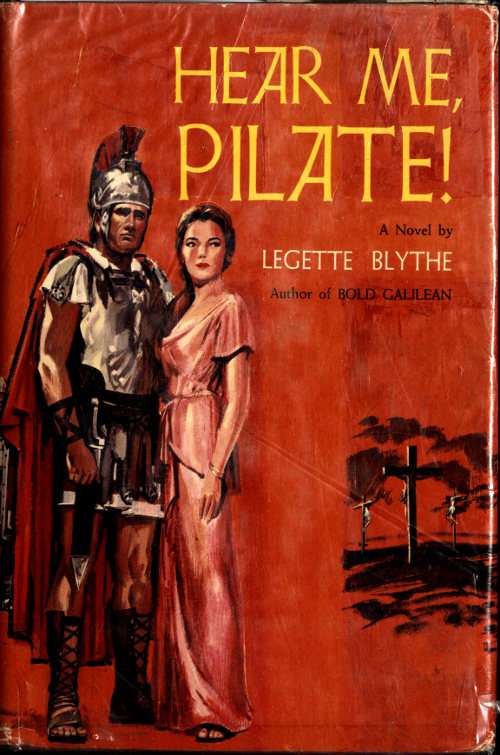
Hear me, Pilate:
Take no responsibility for that righteous man’s blood, for in the night I had a frightful dream concerning him.
What on earth, he wondered, could Claudia have dreamed about this Galilean fanatic? And how did she know that the man had been brought before the Procurator’s tribunal? Yes, and by all the gods, why had the message come from Longinus, and why, moreover, had Longinus not delivered it himself?
Still frowning, Pilate turned once again to question the prisoner standing calmly before the tribunal, his face streaked with drying sweat and blood, his robe turned deep crimson from the whip’s fearful wounds, his matted hair still crowned with the circlet of thorns. “They say you claim to be the son of their god,” he said. “What do they mean? Tell me, where do you come from?”
Jesus appeared lost in introspection. If he heard the Procurator’s question, he ignored it. An infinite sadness seemed to possess him.
But Pilate, still scowling, perhaps upset further because of his wife’s message and the manner in which it had been brought to him, revealed his impatience. “Will you answer me?” he asked testily. “Don’t you know that I have the power either to release you or to condemn you?”
Calmly, looking the Procurator in the eyes and with no tone of rancor, Jesus replied. “You would have no power over me were it not granted you from above. Therefore, he who delivered me to you”—he pointed toward the esplanade where the High Priest and his cohorts awaited—“has a greater guilt than you.”
Once again the Procurator stepped down from the tribunal and strode out to the pavement in front of the Praetorium. “Bring forth the prisoner,” he commanded. “And have Bar Abbas brought to me, too.”
“I shall release to you a Passover prisoner,” he announced to the multitude when the two scourged prisoners stood before him. “Here stand a robber and assassin”—he pointed toward Bar Abbas—“and”—he smiled grimly as he waved his hand toward the Galilean—“your King of the Jews. Which shall I release?”
“Bar Abbas! Bar Abbas!” the people howled, and Pilate could see the priests exhorting them to shout their demands. “Release Bar Abbas! Bar Abbas!”
“But what shall I do with the King of the Jews?”
“Crucify him! Crucify him!” they stormed. “Release unto us Bar Abbas!”
“He is not our king!” shouted Caiaphas. “We have no king but Caesar!”
Grudgingly, Pilate nodded to the robber chief’s guards. “Release him.” The Procurator had lost. He had been sure the Galilean’s followers would outnumber the vociferous Zealots. But Caiaphas had been the better schemer.
Quickly the soldiers freed the hulking Bar Abbas, and in another moment he disappeared with a tumultuously happy group of his supporters, probably members of his own band, in the mass of people thronging the Court of the Gentiles. But the High Priest and his hirelings kept their places on the pavement before the Praetorium. Now the Procurator, pointing toward the Galilean, spoke to them.
“What then shall I do with the King of the Jews?” His tone was sarcastic. “I find no fault in him. I shall release him, just as I have already released your robber.”
“No! No! Crucify him! He is not our king! He is a blasphemer who would destroy us!”
“Crucify your king?” A cold smile lifted the corners of the Procurator’s heavy lips. “Crucify the King of the Jews?”
“We have no king, O Procurator,” Caiaphas declared evenly, when he had lifted his hands to still the clamor, “no king but Caesar. And if you are a friend of Caesar, O Excellency, you will rid us of this one who not only seeks to destroy our religion but also to set himself upon the restored throne of King David. Should word get to Tiberius or Sejanus in Rome....” The High Priest shrugged and smiled suggestively.
Word would certainly reach the capital. And the story would be of the High Priest’s coloring. The Procurator Pontius Pilate, despite repeated warning and ample testimony establishing the guilt of the accused, it would be told, had released a dangerously clever revolutionary intent upon restoring the ancient kingdom of the Jews in Palestine with himself as king.
“But he declares that his kingdom is not of this world,” Pilate tried to protest. “He’s nothing but a harmless babbler, a religious fanatic whom too much reasoning has driven mad....”
“So he would have you think, O Procurator. The man is cunning, amazingly clever, captivating.” Caiaphas smiled indulgently. “Has he not already deceived even the wise and discerning Procurator?”
The High Priest Joseph Caiaphas had won. Already too many reports of the conduct of the Procurator’s office had gone to Rome; one more might be sufficient to arouse the wrath of the Prefect Sejanus. Nevertheless, since the High Priest had forced the verdict, the responsibility would rest on him. He clapped his hands and when a servant came running, called for a basin of water. A moment later, as the servant held the basin before him, the Procurator plunged his hands into the water and rubbed them together vigorously. “Let the people heed,” he said loudly and with ostentation, “that I wash my hands of the blood of this man. I am guiltless. His blood is not upon me.”
“Indeed, O Procurator”—the High Priest’s smile was scornful, his tone sneeringly derisive—“let his blood be upon us, yea, and our children!”
“Then take him, and crucify him.” Pilate glanced toward the prisoner, standing tall and calm and regal in the blood-drenched discarded purple. But when their eyes met, Pilate’s shifted in that same instant to the mosaic at the Galilean’s feet, so that momentarily the judge’s head was bowed to the prisoner. Then, in a voice that was scarcely more than a whisper, Pilate spoke to the guard who held the fetter binding Jesus’ wrists. “Lead him into the courtyard.”
As they were going out he summoned an attendant. “Fetch a tablet that I may prepare the titulus.” His eyes fell upon the wax tablet that his wife had sent him. “Wait,” he said. “This one will suffice. There’s space enough on it for what I have in mind.” The soldier picked up the tablet with the attached stylus. “Write this,” Pilate commanded, “and when you have written it, take the tablet into the courtyard and have the words inscribed on the headboard in Latin, Greek, and Hebrew.” He paused, reflecting. “Write what I say: This is Jesus of Nazareth, the King of the Jews.”
Joseph Caiaphas had heard. “No, O Procurator! Write that he says he is King of the Jews!”
Pontius Pilate stared in stony silence at the furious High Priest. “What I have written,” he said after a moment, “I have written.” He turned to the soldier. “Go prepare the titulus board.” Then, without a glance toward the High Priest and his group, he returned to the Praetorium and mounted the tribunal. Only the few soldiers in attendance remained in the vaulted great chamber. Pilate sat down upon the curule; his eyes, unseeing, were fixed on the pattern of the mosaic at the foot of the tribunal steps.
... Great Rome’s vaunted justice. But must not justice yield sometimes to expediency, the expediency of the greater good for the greater number? Will not his death end a developing tumult in Palestine that might have brought even bloodshed and death for many Jews and perhaps even Roman soldiers? And now no report will go to Sejanus from Joseph Caiaphas.
... The Galilean. A dreamer, a devotee of the Jewish religion, a visionary ... a righteous man, Claudia said. “Take no responsibility for that righteous man’s blood.” Claudia’s dream, bah. Superstition, astrology maybe, foolishness. Calpurnia had a dream, and Caesar laughed at her warning. Caesar laughed, and Caesar died.
... But no report will go to Rome of the Procurator’s releasing a dangerous revolutionary who was planning to establish himself on the restored throne of ancient Israel. Joseph Caiaphas has been silenced....
Suddenly a cold, numbing fear clutched Pontius Pilate. “By great Jove!” But he had not exclaimed aloud. No report would go to Rome from the High Priest, no fawning spies would tell how the Procurator had freed a cunning revolutionary, but Claudia had warned him not to judge the Galilean. Could his wife, by all the gods, be a secret follower of this mystic? Didn’t many high-placed women of Rome become devotees of this strange Jewish one-god religion? Could the Emperor’s stepdaughter, by great Jove, have become, of all persons, interested in religion, in any religion? Could Claudia really feel strongly about this Nazarene fellow?
... And Longinus had fetched her message. Longinus, yes, by all the gods....
The soldier who had led Jesus forth from the pavement into the courtyard had returned to the Praetorium. “Sir, the titulus board is complete. They are ready to proceed with the crucifixions, except....”
“Then start at once with the three prisoners to the Hill of the Skull.” He paused. “Except? What were you going to say?”
“You have assigned no centurion, sir, to have charge of the crucifixion of this fellow whom you have just condemned. Do you wish Porcius, who was to have crucified Bar Abbas....”
“No.” Then, in a flash came an idea. Pilate maintained a sternly impassive countenance, but inwardly he exulted in the suddenly revealed manner of solving his dilemma. Now no one would be sending stories to Rome, for certainly nobody would be foolish enough to reveal to Sejanus the execution of an innocent Jew if he himself had participated with the Procurator in that Jew’s crucifixion. “I wish Porcius for another duty today.” He pointed upward. “Go at once to the apartment of the Centurion Longinus and inform him that the Procurator assigns him to take charge of the quaternion and orders him to proceed immediately with the crucifixion of the Galilean.”
50
Beside a cluster of gnarled olive trees along the Bethany road Centurion Cornelius halted his weary cavalcade. They had attained the summit of the Mount of Olives. Steady climbing from the Jericho plain had lathered the laboring horses, and the dust-grimed faces of the men were streaked with perspiration. Since the passing of midday the heat had grown increasingly oppressive; now, as they approached Jerusalem in the eerie half-darkness, it weighed upon them like a heavy blanket.
The dark cloud over the city that hardly two hours ago they had seen from the narrow defile between the boulders had grown to envelop them, and as they came over the rise and looked across toward the walled density of flat-roofed stone structures, they could scarcely make out the usually dominating mass of the Temple. Ordinarily on an early afternoon in April the sun would have been reflected brilliantly in the gold plates of the Temple’s roof, but today it was barely able to penetrate the overcast. In the strangely thickening gloom the resplendent plates had taken on a dull coating of bilious green. Faintly discernible to the right were the darker masses of the Fortress Antonia towers upthrust in the cloaking shadows; but westward, beyond Antonia, the great Palace of the Herods and the other splendid abodes of the privileged were completely shrouded; Mount Zion and the Ophel shared equally in oblivion.
“What is it, Centurion?” Decius shook his head perplexedly. “I’ve been out here a long time, but I’ve never seen anything like it. This strange darkness, this stillness, and the peculiar blue-green cast. Centurion, this isn’t just another storm coming up, another thunderstorm following excessive heat. It’s got a queer, ghastly look, as if the gods might be angry ...”
“The gods, Decius?”
The soldier laughed uneasily. “I use the term broadly, for want of one more accurate.” He waved an arm in the direction of the darkened city. “But it does have a sort of supernatural look, doesn’t it, Centurion?”—he smiled—“though of course I have little belief in the supernatural.” He shrugged. “How do you explain it?”
“It does have a strange, unearthly look,” Cornelius agreed. “But I don’t believe it’s a manifestation of the gods’ anger, though I’ve never seen one before like this. Could it be a heavy mass of sand borne in from the desert? If that’s it, then maybe the sun shining through the concentration of sand accounts for this strange greenish color.”
“That’s probably it,” Decius agreed. “But then, where is the wind?”
“It may be the lull before the wind. This unseasonable heat is bound to bring on a storm. Look!” He pointed. “The sun.”
High above the city, beyond its southern wall and past the ever smoldering refuse heaps in the Vale of Hinnom, the sun rode like a pale copper disk behind a thinning portion of the veiling cloud. In the same instant its rays found a rift in the mantle covering the city and shot a pinpoint of light to bathe in sudden brilliance a small eminence just beyond and slightly to the right of the Fortress Antonia.
“By all the gods! Bar Abbas and the two henchmen we captured last week!”
On the summit of the little hill stood three crosses, and stretched upon each cross was the body of a man. A staring throng of spectators stood scattered about below.
Then suddenly the rift in the covering cloud was healed; darkness swallowed the burdened crosses.
“Poor devils,” Cornelius said. “That’s an assignment I’m glad I didn’t get. Being late returning may have saved me.” He looked up again toward the lowering sky. “But we’d better be getting on to Antonia. This storm may break at any moment, and when it does, I don’t want to be in it.”
Quickly the cavalcade moved down the slope toward the Garden of Gethsemane and the Brook Kidron beyond. Entering the walled city by Dung Gate, it went through Ophel and ascended the slope westward to move along the lower level of Mount Zion and cross the bridge spanning the Tyropoeon Valley. At the eastern end of the bridge the procession turned northward and marched along the way paralleling the Temple’s wall to the entrance gate of the Antonia.
When Cornelius had dismissed his men, he went up at once to his apartment in the officers’ quarters on the south side of the fortress. He had been looking forward eagerly to a refreshing bath and a short nap before dressing in fresh clothing for the evening meal. But as he was about to enter his quarters he encountered a centurion coming into the corridor from the apartment next to his.
“By Hercules, Cornelius!”
“Porcius!” He clapped a hand on the other’s shoulder. “I didn’t know you were quartered here.”
“I’ve come since you left, Cornelius. I heard you were out pursuing a gang of those Zealots. Did you overtake any of them?”
“Yes, and killed several. But we didn’t capture any.”
“This morning they crucified two of the ones you captured last week.”
“Three, you mean, don’t you? Bar Abbas and two of his company.”
“But Pilate released Bar Abbas.”
“Released him? Bar Abbas?”
“Yes, released him. It’s amazing, isn’t it? But the mob demanded his release as the Passover prisoner—you know, don’t you, that the Procurator each year, in accordance with tradition, releases one prisoner at Passover time?”
Cornelius nodded. “But weren’t there three men crucified?”
“Yes. I was supposed to have had charge of the crucifixion of Bar Abbas. Pilate had already condemned him to the cross when the demand for his release was made. So he released him, and I was relieved of a most unpleasant task.”
“You were fortunate, Porcius. But if three men were crucified, who was the third? I didn’t know another revolutionary had been captured.”
“He was no revolutionary, Cornelius. Pilate knew he wasn’t and wanted to free him. But the High Priest insisted that the fellow was a troublemaker who planned to attempt to set himself up as King of Israel. So, rather than run the risk of having the Temple leaders report him to Rome as protector of the Emperor’s enemies, Pilate yielded and sent the fellow to the cross. And luckily for me, he assigned Centurion Longinus the task of conducting the man’s execution.”
“Longinus! By all the gods, Porcius, who was the fellow?”
“A Galilean. A religious fanatic, I judged him to be, but entirely harmless. His name, if I recall it correctly, was Jesus, I think, one Jesus from a place in Galilee called Nazareth, they said.”
“Jesus! Oh, by all the gods, when....”
“But do you know the man, Centurion?”
“When did they lead him to the Hill of the Skull?” Cornelius ignored the centurion’s question. “How long...?”
“It was in mid-morning. He’s been on the cross for several hours now. And he was unmercifully scourged before they started with him to the crucifixion ground.” He stared at his companion’s suddenly ashen face. “But, Cornelius, why...?”
“Jesus! Oh, great Jove!” Anger, utter amazement and pain were written in swift succession on his still sweating, dust-covered face. “O God of Israel! O his God! O my God, Jesus!”
Turning, he raced along the corridor toward the steps that a moment ago he had ascended, stone stairs that went down to the ground-floor open area just inside the great western entrance to the fortress.
51
Cornelius had reached the gate in the north wall when the storm broke with sudden fury. He darted beneath the flimsy awning of a fish stall to wait out the blast.
“Here, let me help,” he said to the frantic shopkeeper as he caught a side of the filthy cloth with which the squat Jew was trying desperately to cover his malodorous fish to protect them from the dust and powdered dung swirling along the cobblestones. “You’re lucky your market has the protection of the wall, or everything would be blown away. This is one of the worst storms I’ve ever.... By all the gods!” The ground had begun to tremble.
“An earthquake!” the shopkeeper shouted. “Wind and torrents of rain, and now the earth shakes!” His eyes were round and frightened. But in another moment the tremors subsided, and the man regained his calm. “I’m not surprised, soldier,” he observed, lifting his hands, palms up, and shaking his head solemnly. “And it makes no difference, I’m thinking, that my stall sits in the lee of the great wall. By the beard of the High Priest, it, too, will be leveled to the ground!”
“What do you mean? Hasn’t this wall survived many an earthquake before this one?”
“Indeed, soldier. But we’ve never had anything like that before.” He indicated with a quick nod of his head the hill beyond the gate’s square. “Never him on a cross.” He looked the centurion in the eyes, and Cornelius fancied he saw a sudden hostility. “Soldier, have you been up there?”
“No, I’ve just come from the Fortress Antonia, and only an hour ago I arrived in Jerusalem. What do you mean?”
“I mean that one up there, soldier, on the middle cross.” He pointed. “It’s that rabbi from Galilee. Your Pilate tried him this morning and sent him to the cross, and unjustly, too, it’s my opinion. And I heard it said that the Galilean told how he would cause the Temple to be destroyed and in three days raise it up again.” He dabbed a greasy forefinger against the centurion’s soiled toga. “And I’m of the opinion, soldier, he’s got the power to do it. Didn’t he raise that fellow over at Bethany from the dead? This storm and this earthquake”—he paused and on his countenance was an expression of understanding suddenly gained—“soldier, maybe he’s doing it now! Nor could I blame him.” He shook his head slowly. “I’d hate to be in Pilate’s sandals, or those soldiers’ up there!”
Almost as quickly as it had burst upon them, the storm was ended. The rain ceased with the blowing away of the clouds, the winds quieted, and the great blazing disk of the sun, still high in the sky toward the Great Sea, shone down bright and searing. The shopkeeper rolled back the grimy cloth, crumpled it into a heap, and with it dabbed lightly at several fish it had failed to protect; then he hurled it into a corner and turned to wait upon pilgrims in the vanguard of a procession Cornelius saw coming down the slope of the Hill of the Skull.