
“The Antonia garrison is just as busy,” Pilate interrupted, “and many of our soldiers are leaving Jerusalem. Maybe, though, I can arrange yet again to humor the High Priest.” He beckoned to an aide. “Summon the fortress commander.”
“Are there any centurions available for a special assignment beginning at once and continuing into tomorrow?” he asked, when a few moments later the officer appeared.
“Centurion Longinus, sir, is....”
“No, by all the gods!”
“The only other one not assigned at the present is Centurion Cornelius. He’s preparing to return his....”
“Then call Cornelius in and instruct him to select from his century a sufficient detail and mount a guard at the tomb of the Galilean”—he paused and looked unsmiling toward the High Priest—“rather, the ‘King of the Jews,’ to see that it is not disturbed.”
Caiaphas smiled grimly but made no comment.
“Now, O High Priest, you will have your guard, though I consider a guard unnecessary. Once again your will has prevailed.” He bowed, and his smile was cold. “I trust your sleep tonight will be peaceful.”
56
It was within two hours of midnight after the Jewish Sabbath, which by Hebrew reckoning ended at sundown, when Longinus came to the Palace of the Herods. Claudia was already in her nightdress and prepared for bed. “Aren’t you going to spend the night?” she asked eagerly, after he loosened her from their warm embrace.
“With your permission,” he said, grinning wryly. “I have your husband’s, remember.”
“Please, let’s not talk of him.” Her expression sobered. “Did I speak too frankly yesterday, Longinus? Did I reveal too much to him ... about us, I mean? Is that why you didn’t come last night? You were annoyed with me?”
“You really spoke your feelings, didn’t you? But I wasn’t annoyed with you,” he said. “In fact, I’m glad you spoke up. And I suspect he was not surprised at what you told him, only that you would say it, and with such fury.” She had sat down on the side of her bed. He seated himself beside her and bent over to unfasten his sandals. Then he straightened and faced her. “Claudia, I was too depressed last night to be good company.” He shook his head slowly. “I’ve never been in lower spirits.”
“Because of the Galilean?”
“Yes. Because of what I had done. It felt like a crushing load on my back. I couldn’t get out from under it.” He stood up, and laid his tunic across a chair. “After I left you and Pilate, I went back out to the crosses and helped get him down, taking care to see that in pulling the nails out we didn’t tear or further bruise the flesh”—he paused in his narration, and his low laugh was hollow, mirthless—“after I had seen the nails driven through the living flesh and had plunged my lance into his side. Then we put him in the rich Jew’s tomb; they had bound the body the way the Jews prepare their dead for burial, although they didn’t have time to anoint it with aromatic spices as they customarily do....”
“They are going to do that tomorrow,” Claudia interrupted him. “Tullia has gone out to Bethany to go with Mary of Magdala and Chuza’s wife Joanna and some other followers of the Galilean early in the morning to the tomb to finish the burial rites.” She paused. “But I interrupted your story. What did you do when you had finished out there?”
“I came back to Antonia and sat for a long time on the balcony looking out over the Temple courts. Then I went to bed and tried to get some sleep, but I couldn’t, no matter how I tried. Every time I closed my eyes I saw that man ... the death march out to the hill, nailing him down, lifting him to the upright....” He cupped his palm across his eyes. “By the gods, Claudia, it was terrible, frightening. And his crying out to his god to forgive us.” His hand dropped listlessly to his side. “Well, I finally gave up and walked out along the balcony again, and then I went to see Cornelius. He was troubled, too. He hadn’t gone to bed. We sat and talked, mostly about that man, until daylight.”
“Did you come to any conclusion ... about him, I mean?”
“Well, no, I suppose not, except that it was a monstrous crime to crucify such a man, though Cornelius still held to the idea that the Galilean probably was a god of some sort, that he had supernatural powers, even the ability to heal people—he insisted that he had healed his little Lucian—maybe to raise dead people to life. Cornelius even said he thought it was possible that the Galilean might come to life himself, as some of his followers say he will, and walk out of that tomb.” He was silent for a moment. “If he does,” he added after awhile, “he’ll have to move a tremendous stone from the mouth of the tomb ... and from the inside.” He sat down again beside her. “And under the noses of the guards, too.”
“The guards?”
“Yes. At the insistence of the High Priest, Pilate has set a guard at the tomb to prevent the Galilean’s followers from stealing the body and claiming that he actually did come to life. The Procurator put Cornelius in charge, and I went out there with him; in fact, I’ve just come from there. Cornelius is going to stay until daylight.”
“Then Pilate is still trying to appease the High Priest, even after all I said to him yesterday?”
“Evidently. The Procurator isn’t likely to change his ways.”
“Maybe I was rash yesterday in losing my temper and speaking with such boldness, but I’ve come to have such contempt for him, to loathe him so. Oh, Longinus”—she clutched his arm in both hands and clung to him—“how can I stay with him longer in this dreary land? Please take me with you to Rome. Hasn’t the time come...?”
“That’s why I’m here, Claudia.” Then his serious expression softened, and his eyes teased. “And because it’s my last night.”
“Must you be leaving tomorrow?”
“Yes. I’m going with Cornelius as far as Tiberias. From there I’ll go across to Ptolemaïs and get a ship for Rome. Cornelius is providing me an escort to the coast. I’ll have to get the first ship leaving that port for the capital. But I had to see you before I left. Claudia”—in the subdued light of the bedchamber the gentle flame of the wall lamp was mirrored in his eyes as he looked deeply into hers—“it may be that a way of escape is about to open for us. By all the gods, it’s strange, and distressing, too, but the death of the Galilean may actually save us.”
“You mean that Pilate in condemning the Galilean may have condemned himself?”
“I believe he has ... in one way or another. And I think he has given you a means of freeing yourself.” He paused. “You’re sure no one can hear us?”
She nodded. But he went to the door anyway, listened with his ear to the panel, and tried the bolt.
“This is dangerous, Claudia,” he said, as he sat down again. “You mustn’t breathe a word of it to anybody, not even Tullia. It could get us both killed.” He lowered his voice. “That message I had yesterday. It brought startling news. I purposely showed it to Pilate, but of course he had no idea what it was saying. But I did. That ‘matter of utmost concern’ was the Prefect’s way of notifying me that now he’s finally ready to proceed with his scheme and wants me in Rome when he makes his move.”
“But this new scheme? What...?”
“It’s not a new one, Claudia. He gave me a broad hint concerning his plans the last time I was home; he said that when I got a message so worded it would mean he was ready to proceed with the final step.” He leaned close to her. “Claudia, Sejanus is plotting to have the Emperor assassinated; he is bidding for the throne.”
“But surely”—her face had paled—“he doesn’t mean for you to ...”
“Oh, no, not that. Some palace servant out at Capri will probably attend to that. But he wants me in Rome when it’s done so that I can help rally his supporters at the crucial moment and make him Emperor.”
“But even if Sejanus should become Emperor, how would that help us?”
“I would be much closer to him than I am now, one of his advisors,” the centurion replied. “I’m sure I could poison him against Pilate, and justly. This case of the Galilean will be just one more example of his unfitness to administer Roman government. His failure to conciliate, his forever keeping Judaea in a stir....”
“But, Longinus”—her face revealed sudden apprehension, fear—“what if the Emperor’s supporters should discover the Prefect’s plotting and kill him before he could have the Emperor killed?”
“Then I would have been on the Emperor’s side.” Longinus smiled reassuringly and patted the back of her hand on his arm. “Don’t worry about me; I’ll not let myself get trapped. And soon now, either way the dice fall, we’ll be the winners.” He stood up and quickly lifted her to her feet. Leaning over, he pulled down the light coverlet. “But for now, my dearest,” he said, as he gently pushed her down and lifted her legs to the bed, “let’s forget them all; let’s make what’s left of it our night.”
57
Once more she felt herself floating upward in a dark morass of confused and tangled dreaming. Then as she seemed to burst through the heavy waters to the surface and a sudden effulgent light, she sat up, eyes blinking and sleep drained from her.
The knocking and calling were restrained but insistent from Tullia’s side of the door. “Mistress! Oh, Mistress! Mistress!”
She sprang from the bed. “Just a moment, little one, until I can draw back the bolt.” The movement and her exclamation awakened Longinus; precipitately he sat up in bed. “Tullia’s returned,” she explained to him, as he blinked sleepily. She opened the door. “Bona Dea, you’re breathless,” she said to the girl. “What’s happened, by great Ceres?”
“I’ve run all the way from the Hasmonean Palace where I left Joanna....” She paused, breathing hard. “Mistress”—her face flamed with new excitement—“Jesus is alive! He’s come from the tomb alive! He did it, Mistress! He really did it!”
“Sit down, Tullia,” she said calmly. “You’re excited, little one. Calm yourself. Longinus told me that the Galilean was not in a trance; he said he knew he was dead; he said....”
“He was dead, Mistress, I know. But now he’s alive again! He’s alive, Mistress, alive!”
Claudia shook her head dubiously. “I don’t doubt that you think so, but when a man’s dead....” She paused. “And you’ve been under such tension, so troubled....”
“But I’m no longer troubled, Mistress,” Tullia said calmly. “Nor have I lost my reason. He is alive. Mary of Magdala talked with him at the tomb. We’ve just come from there, Mistress.”
“But where were Cornelius and his soldiers? Surely they didn’t all go to sleep and let the Galilean’s friends....”
“They had gone,” the maid answered. “But nobody stole the body, Mistress. Jesus walked away. He told Mary to tell those of his company that he would meet them down in Galilee.”
“Then Cornelius and his guards weren’t at the tomb when the Galilean walked from it, Tullia?” Longinus, adjusting his tunic, came through the doorway.
“Oh, no, Centurion, I meant they were gone when we got there. But they had left only a few minutes before. In fact, we met them coming in through the city gate as we were going out. I recognized Centurion Cornelius, although I don’t think he noticed me. He seemed greatly disturbed.”
“Then, by the gods, Claudia, I must go find him. This is amazing. Tullia, by great Jupiter, do you know what you’re saying? Do you realize that you are saying a dead man....?”
His question was interrupted by a knocking on the corridor door. Quickly Tullia opened it. A palace servant announced that Centurion Cornelius was trying to find Centurion Longinus.
“Tell him to come in,” Claudia had overheard. “The Centurion Longinus is here.”
“I’ve been trying since daylight to locate you, Longinus,” he reported. “I went to your quarters, but I should have known....” He didn’t finish the observation. “Something very strange has happened. The Galilean disappeared from his tomb.”
“So Tullia has just told us,” Longinus said. “She contends that he came to life and simply walked out.” His eyes narrowed. “By the gods, Cornelius, did your guards go to sleep and allow his friends to slip in and...?”
“No, Longinus, we weren’t asleep.” He shook his head slowly. “Nobody was asleep. I can’t understand it. I had stationed my men so that no one could slip past us to get to the tomb. And that heavy stone ... Longinus, it had to be rolled uphill on its track, and that requires the hard work of at least two or three strong men.” His forehead wrinkled in a puzzled frown.
“Well, then,” Longinus pursued, “what did happen?”
“That’s what I don’t know. Nothing happened. At least, I saw and heard nothing. I asked the men later if any of them had, and they all insisted, to a man, that they hadn’t heard a sound or seen anything the least bit unusual. Only a moment before I had checked the tomb’s mouth. The seal hadn’t been disturbed. And there was a dim light from a little fire we had kindled earlier to keep off the night chill; it had burned down, but there was still a light on the stone at the mouth. In fact, that’s how we noticed....”
“The Galilean?”
“Oh, no, we didn’t see him. But one moment the stone was in place, and the next ... well, I looked over there, and it had been rolled up the track and the mouth was wide-open.”
“What did you do then?”
“I lighted a torch from the smoldering fire and investigated. The Galilean was gone, disappeared. The linen strips with which the body had been wrapped were lying there, still in folds but collapsed, just as though the body they had been enfolding had melted away.” He shook his head, gestured with palms up. “Longinus, I can’t figure it any other way.”
“You mean you actually believe he returned to life?”
“What else can I believe?”
“But what about the stone? How could he have rolled it back?”
“If he had the power to call back his life,” Cornelius said, “rolling away the stone would surely have been no problem.”
“But, Cornelius,” Claudia interposed, “Tullia, too, has just come from the tomb. She was there with Mary of Magdala and Joanna and some other followers of the Galilean.”
“I didn’t see them....”
“They got there just after you left. They saw you at the city gate as you were coming away, she said. But Mary of Magdala saw the Galilean and talked with him.” She shrugged. “Or at any rate that’s what she told Tullia.”
The centurion’s amazement was not feigned. “Then where did he go? Where is he now?”
“According to Tullia, he told Mary that he was going down to Galilee. He said he would meet his band there.”
“Then we may come upon him somewhere, beside the sea with the fishermen or maybe in Capernaum.”
“But, Cornelius”—Claudia’s expression betrayed a sudden apprehension—“how would he receive Longinus?”
“In a spirit of forgiveness, I hope ... and believe. It was really not Longinus who did it. The guilt was Herod’s and Pilate’s ... and, of course, even more, the High Priest’s.”
“Cornelius, does Pilate know ... about the empty tomb, I mean?”
“Yes, Claudia. I reported to him first, before I started to look for Longinus. He was still in his bedchamber.”
“What did he say? How did he act?”
“At first he was angry; he charged that the guards had gone to sleep, said the High Priest would be greatly agitated, and threatened to punish us severely. But when I stood my ground and insisted that no one had stolen the body, he began to show concern, and when I left him he was thoroughly frightened.” He turned to Longinus. “That’s why I want to get started as quickly as possible for Tiberias, before Pilate orders my century to remain in Jerusalem to help protect him from the Galilean. Can you be ready to start by midday?”
Longinus nodded. “Yes. I’m already packed. All I have to do is pick up my bags at Antonia.”
58
When Cornelius left the Palace of the Herods, Claudia and Longinus walked out into the garden and sat on the stone bench before the fountain. Already the sun was high in the cloudless heavens and the air was growing warm. Birds chattered in the trees and shrubs, and as they watched the spurting water, two small conies skittered across a circle of sunlight to dark safety beneath a heavily leaved fig bush.
“A glorious day.”
“Yes.” He tossed a twig toward the fountain. “You know, Claudia”—he was looking, she saw, at some invisible point beyond the trembling column of water—“a hundred years from now the world may still remember this day, if....”
“If the Galilean really has come to life?” she finished softly. “What do you think about it, Longinus? Cornelius and Tullia seemed so certain he has.”
The centurion shook his head slowly, his eyes still on the lifting and falling water. “I don’t know what to think. But”—he turned to face her, and his forehead was furrowed in concentration—“how else can you explain it? The guards awake, the heavy stone sealing the tomb. By all the gods....”
“Are you afraid then?”
For a long moment he was silent. “No,” he answered finally, “I’m not afraid. But I’m ... I’m ashamed, Claudia; I’m ashamed for myself, Pilate, Herod, the contemptible High Priest, my quaternion, everybody who had anything at all to do with this terrible thing. If indeed he did come back to life, I hope I may see him in Galilee and beg his forgiveness.”
“But what about Pilate? Do you think the Galilean will seek vengeance on him? And on the High Priest, and even Antipas?”
“Up there on the hill as we were nailing him to the crossbeam, that man prayed to his god to forgive us ... to forgive us, Claudia. Didn’t he mean all his enemies?” Longinus stood up and walked to the fountain; he held his palm against the upshooting column. “A few days ago I was scoffing at him and even at the very idea of gods, any god, or spirit being, or whatever you may call it”—he smiled glumly—“and so were you, my dear. But since day before yesterday”—he shrugged—“and this morning, well, I’m ... I’m changed. You know, I’ve been thinking about what Cornelius’ old Greek tutor taught and how it might fit in with the Jews’ notion of their Yahweh. And now, if the Galilean really has taken on life again—and I know he was dead when we took him down—it may be that he really was ... is ... a physical, tangible manifestation of this all-wise and all-powerful spirit....” Abruptly he broke off. “Oh, I don’t know, Claudia, it’s too deep for me. But I do know”—his smile was warm—“if there’s ever another testing, I’ll be on his side then.”
He strode over to the bench and helped her to her feet, and they returned to her apartment where no other eyes could invade the privacy of their last moments together.
“Has this morning changed things for us, beloved?” she asked, as they sat on her couch. “Your plans, in Rome, I mean, do you still intend to do what you were telling me last night?”
“Of course, my dearest. And it won’t be long before we’ll have a new Emperor or a new Prefect. And in either case there’ll be a new Procurator in Judaea and”—he smiled playfully—“a new husband for the present Procurator’s wife. It’s even possible,” he added with a studied air, “that the present Procurator’s wife will be the wife of the new Procurator.”
“But, Longinus, you wouldn’t want to be Procurator in this dreary province....”
“No,” he broke in, “but if the present Procurator’s wife went with the assignment”—he shrugged—“I believe I could endure it.” Then he was serious. “Before the summer is ended, Claudia, I firmly believe that Tiberius or Sejanus will be dead—and little I care which—or both of them even, and there’ll be a new regime at Rome. By then, and maybe earlier, Pilate will have been banished to Gaul or Britannia or some other remote province, and you and I will be together ... maybe living out at Baiae.”
“Oh, Longinus, I hope so, I do hope so.” She clung to him tightly, for in a few minutes, she knew, he would be leaving her to join Cornelius for the journey down into Galilee. “Already it has been so long, and I am utterly weary of waiting. May the beneficent gods grant you swift sailing and an early safe return.”
With an arm about her waist he lifted her to her toes. “But there are no gods, remember?” Teasingly, he pushed her chin until her eager lips parted, and then hungrily he bent once again to savor them.
59
Longinus and the orderly carrying his luggage had almost reached the foot of the Antonia stairway when a soldier came hurrying down the steps behind them. The Procurator Pontius Pilate, the soldier announced, wished to speak immediately with the centurion.
“Take the bags to the pack train,” Longinus instructed his man, “and tell Centurion Cornelius I’ll be there as quickly as the Procurator dismisses me.” Then he went at once to the Procurator’s chamber.
Pontius Pilate was standing before the window, staring in the direction of the forlorn and frightful Hill of the Skull. When he heard the centurion, he turned quickly and advanced toward the center of the chamber. “Have a seat, Centurion,” he said, as he pointed to a chair across the desk from his own. “I’ll detain you only a moment.” His round face lighted with an unctuous smile as he sat down heavily. “You’ll soon be leaving Jerusalem, no doubt?”
“Yes, Excellency. I was on my way, in fact, when your aide overtook me.”
“It occurred to me, though I haven’t seen her since we three were here two days ago, that Lady Claudia might like to ride with you as far as Caesarea. She is weary of Jerusalem, I know, but I’ll not be able to leave here for several days. And at Caesarea you two could enjoy one another’s company until your ship sails for Rome.”
“But I’m not going to Caesarea, Excellency. I’m going to accompany Centurion Cornelius down into Galilee, and from there I’ll cross to Ptolemaïs and get a vessel for Rome.”
“Oh. Well, then, yes.” Pilate’s honeyed smile vanished, and he licked his lips. “I thought you two would welcome an opportunity....” But he did not pursue the thought further. He leaned forward, elbows on desk. “Centurion, this ‘matter of utmost concern’ that takes you to Rome, I wonder if....”
“You read the Prefect’s message,” Longinus said, when the Procurator paused. “And of course, Excellency, I’ve had no further communication from him.”
“The Prefect must be calling you to Rome to discuss the situation out here, Longinus. It would hardly be anything in Rome that he’s concerned about, because you wouldn’t be familiar with affairs there. I’ve been trying to think what it could be that commands his attention here.” Pilate’s expression was grim now, his shallow suavity gone. “It must be that he’s dissatisfied with my governing, or even”—he swallowed, and his face was somber—“that he’s planning to remove me as Procurator and extend Herod’s domain to include Judaea, with that incompetent weasel as king over the entire realm his father ruled.” He paused, his expression questioning. “Herodias’ scheming, I’ll wager.”
“I can’t say, Excellency”—Longinus shook his head—“what the Prefect may be planning for any of us.”
“Us? By all the gods, Longinus, I hadn’t thought that his plans might concern you, too!” His expression suddenly brightened. “Why, that’s it, great Jupiter, that would solve the dilemma!”
“But, Excellency, I don’t....”
“I beg you then, Centurion, in your report to the Prefect to deal charitably....”
“But, what....?”
“Petition him to transfer me, with comparable position and emoluments, to some other post, Gaul, Spain, Alexandria maybe, even Rome, and name you Procurator of Judaea, Longinus.” The unctuous smile, patently contrived, momentarily relieved his grimness. “And then, though the Prefect and the Emperor might not permit Lady Claudia to go with me to a new post, particularly if it should be at Rome or near the capital, I’m sure they would permit her to divorce me and marry you.”
“But the day the Galilean died”—the discipline of long training kept Longinus’ tone level, even though his fist ached to be smashed against the stupidly grinning round face—“you appeared to be most anxious to retain your post here.”
The mere mention of the Galilean made violence unnecessary; the Procurator’s mask of laughter was instantly ripped away, and the terror beneath it now lay exposed. “Yes, Centurion,” he began, “but since then I ... I....” He threw out both hands as if in desperation. “I’ve had no peace! It’s these insufferable Jews, Centurion. And the arrogant, demanding, conniving High Priest, may the great Pluto grill him to cinders! I must get away from these Jews before they drive me mad, Longinus.” He stood up and glanced toward the window, then shuddered and quickly turned away. “That Galilean, the one you crucified....”
“The one you condemned to the cross, Excellency.”
“Yes, the one I condemned.” Pilate seemed suddenly very weary. “I thought I’d purchase immunity by involving you. But I was thinking of the High Priest on the one hand and the Prefect on the other. I never thought of him. And now, now I can’t get away from him. I can’t sleep, Centurion. He’s always there between me and sleep, his calm face confronting me, his dark eyes studying me. It’s as though he were trying me! I ... I can’t get away from him, Longinus. He’ll haunt me as long as I remain in this abominable province.” He leaned on the desk with fists clenched. “Nor will they let him lie in his tomb and be forgotten. Have you heard the foolish rumor”—his eyes narrowed as he hesitated, and then he leaned nearer the centurion—“that the Galilean has walked from his tomb and is on his way to Galilee?”
“Yes, Excellency, Cornelius told me the man had disappeared under the noses of his guardsmen.”
“So he told me. But of course the guards were asleep. And since Cornelius reported the man’s disappearance, I’ve been told some of the guards were bribed by Caiaphas—Pluto take him—to say that they permitted certain of his followers to steal the body to make it appear that he had come to life, as they claimed he would.” He shook his forefinger to emphasize his venom. “That arrogant Jew never relents in his efforts to embarrass me and undermine my administration of Judaea’s government.”
“But, Excellency, the body wasn’t stolen. Cornelius assured me they were all wide-awake. And there was that heavy stone sealing the mouth....”
“By great Jupiter, Longinus”—Pilate sank to his chair, and his eyes were incredulous—“surely you don’t believe he had supernatural power to restore himself to life and roll back the stone?” He sat back; his eyes were fixed unseeing, it seemed, on the wall beyond and above the centurion’s head. “He said that his kingdom was not of this world. He said that were he to command it, a host of his followers”—he paused, and his eyes, intent and fearful, sought the centurion’s—“unearthly followers, Longinus, spirits, demons....” Quickly he leaned forward. “Could he have been in a trance after all? Could you have failed to take his life?”
“He was dead, Procurator; I assure you he was dead when we put him in the tomb.” Longinus leaned nearer his questioner. “But we didn’t take his life. When he was ready to die, he surrendered it.”
“Centurion, do you realize what you’re saying?” A sickly smile played at the corners of his mouth, and his usually florid face was the shade of ashes. He braced his hands, palms down, on the desk’s gleaming surface. “By great Jupiter, Longinus, do you believe the Galilean really did return to life, that he’s alive now?”
“Excellency”—Longinus looked the Procurator straight in the eyes—“what other explanation could I offer?”
Pilate opened his mouth, but no answer came. Instead, with the tip of his thick tongue he circled his dry lips, and a heavy sigh stirred his ponderous frame. “I should have had the courage to resist the High Priest and release the man,” he observed, more to himself than to the centurion across the desk from him. “But I condemned him. Then I tried to cleanse these hands”—he turned them over and, palms up, studied them—“of his guiltless blood. I could have freed him.” He glanced toward the window but quickly turned back to face Longinus. “Centurion, do you suppose”—perspiration was beading on the Procurator’s plainly frightened face—“he will be coming back soon from Galilee ... to Jerusalem, the Temple, to Antonia? By great Jupiter, Longinus”—he did not pause for the centurion’s reply—“help me escape him! Urge the Prefect to transfer me, send me to some post across the world from this frightful Judaea, to Gaul, Germania, even, by the gods, to Britannia!” His eyes were wild, his hands on the desk were shaking, and he clenched them into white-knuckled fists. “Tell him to give you Claudia; she’s been yours anyway all along.” He attempted a feeble smile. “But I ... I mustn’t keep you. Centurion Cornelius will be awaiting you, Longinus. Go, and the gods give you good winds.” His voice had calmed. “And I beg you, Centurion, say a good word to the Prefect.”
Longinus nodded and quietly left the chamber. As the door closed gently behind him, Pilate sat motionless, frozen in his chair. But some moments later, hearing the commotion in the courtyard below, he went to the window and watched the century, with Cornelius and Longinus leading the column and the pack animals at the rear, until it disappeared around the bend of the narrow street. Then as he raised his eyes from the cobblestones to the huddled houses beyond the Damascus Gate, a sudden sharp glint of sunshine was reflected to them from a white-painted titulus board nailed to a heavy timber thrusting upward from a forlorn scarred mound on the other side of the city wall.
“No! No!” Pilate whirled about hands before his eyes as though the flash of sunlight had blinded him. “Flavius! Flavius!”
The startled attendant rushed in. “Yes, Excellency?” he asked.
“Go find the commander of Antonia and tell him I want every cross upright out there on the Hill of the Skull pulled down, and by great Jupiter, I want it done now!” Breathing heavily, Pilate sat again at his desk. “Wait. Before you go, draw those draperies. I’m sick of the sight.” Flavius went to the window and busied himself with the curtains, but when he had pulled one, he discovered that he could not draw the other all the way until the bronze stand and wine-colored vase on it had been moved. Quickly he shifted them to the western window a few paces away and almost directly behind the Procurator.
As he did so he saw that the sun shining through the vase shot straight outward from the delicate glass a band of red light that crossed the floor, climbed the back of Pilate’s chair, and went obliquely over his shoulder to split evenly the polished surface of the desk. Flavius turned back to the first window and pulled the curtains together, so that not even a sliver of sunshine came through. Then he came around in front of the Procurator. But Pilate said nothing, and Flavius withdrew quietly, closing the door behind him.
The Procurator leaned back in his chair; his arms were folded across his middle, and his eyes appeared fixed upon a spot above the door. But Pilate was not seeing the ornate panels; his eyes were being held instead in the calm and untroubled gaze of another pair of eyes....
Suddenly he shook his head, vigorously, as though to rid himself of this haunting vision. “What’s this?” he said aloud. “The man’s dead. Of course the guards dozed. Gods-come-to-earth, spirits, demons. Woman dreaming. Jewish fanaticism. Bah! Cornelius and Longinus wished to confuse and frighten me.”
... Even if he did walk from the tomb, he can cross no seas to haunt me with pitying sad eyes. In Gaul or Germania, anywhere but in this despicable land, I’ll be free of him. I’ll have escaped him. By great Jupiter, I, afraid of a Galilean carpenter. Imagine, I, a Roman soldier, I, by the gods, Procurator of Judaea....
“I’ll have an end to this foolishness, this child’s business,” he said loudly. He sat up straight. “The other day I washed my hands of that man’s death. Today, this moment, I wash them of him, his circlet of thorns, his slashed back, his searching eyes, his blood, by the gods of Rome. I’m free of him, do you hear?”
... And I’m not afraid to look through that window at his hill of death....
“Flavius!” he shouted. “Come draw aside the draperies. I want to see outside.”
He lifted his hands to the desk and, leaning forward, began to rise.
... By great Jupiter, I’ll go look out the window now. I’ve purged myself of the Galilean; I’ve washed my hands of that man....
He glanced downward.
Flavius, entering the chamber in response to Pilate’s summons, halted abruptly. Procurator Pontius Pilate, ruler of Judaea, his eyes wide with terror, stood rigid in his tracks, staring at his hands.
From wrists to fingertips, in the fiery beam from the window, they flamed a gory crimson.
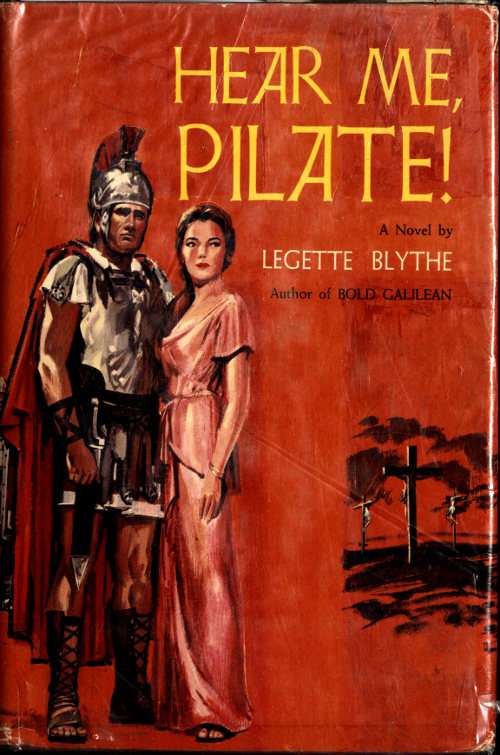
Ever since the publication of his best-selling novels, Bold Galilean and The Tree of Judas, the name of LeGette Blythe has been synonymous with the finest in historical fiction. Hear Me, Pilate! demonstrates once again his amazing ability to recreate scenes from the past with drama and authenticity. Mr. Blythe is a graduate of the University of North Carolina at Chapel Hill, is married, and has three children.
Transcriber’s Notes
- Copyright notice provided as in the original—this e-text is public domain in the country of publication.
- Silently corrected palpable typos; left non-standard spellings and dialect unchanged.
- In the text versions, delimited italicized text by _underscores_.