
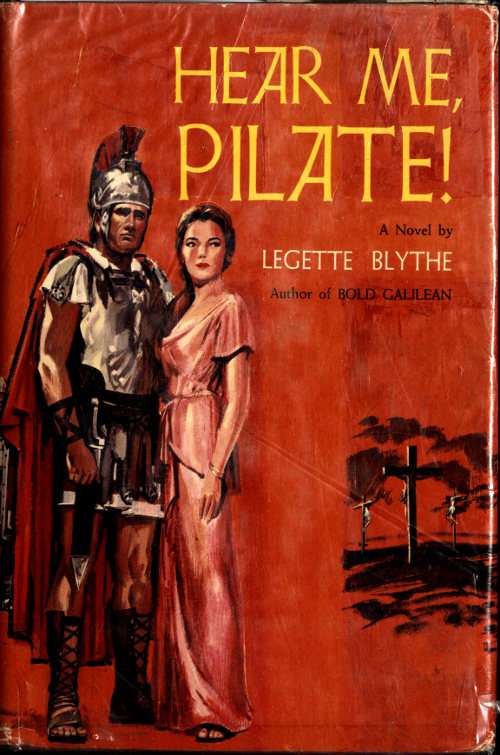
“By the great and little gods, Claudia, it’s not the senator you’re marrying, remember? I’m the one,” he said, thumping his chest with stiffened thumb. “Me, understand?”
“Of course, silly man.” She sat up again and fluffed the pillow behind her. “But the senator might object, Longinus. He’s a proud man, proud of his name, his lineage. He’s not going to like the idea of his son’s marrying a bastard and a divorcee, even though she may be the granddaughter of the Emperor Augustus.”
“He won’t object, Claudia; I’m sure of it. But even if he should, I’d marry you anyway, despite him, despite Sejanus, despite even old Tiberius himself.” He adjusted his tunic, then came over to stand by the bed. “Remember that, Claudia.”
“Even in spite of last night?” She was smiling up at him, and she said it capriciously, but he thought he detected a note of seriousness in her voice. “You don’t think I’m terribly wanton, Longinus?”
“Last night makes me all the more determined.” He studied her for a long moment; her expression was coy, but radiant too, a little wistful and warmly affectionate, he saw. “Wanton? Of course not, my dear.” A mischievous grin slowly crossed his face. “Wanting, maybe. And wanted certainly, wanted by me. The most desirable woman I’ve ever known, the most wanted.” He bent down to her, his eyes aflame, and gently he pushed the outthrust chin to separate slightly the rouge-smudged lips raised hungrily to his. Greedily their lips met and held, and then as the girl lifted a hand to the back of his head to crush his face against hers, he grasped the protecting sheet from her fingers and flung it toward the foot of the bed.
“Oh, you beast!” she shrieked. “By all the silly little gods!”
Roaring, he darted for the peristylium. As he fled past the long mirror near the doorway, he caught in it a glimpse of the laughing Claudia struggling wildly to cover herself with the twisted sheet.
4
The magnificent villa of the Prefect Lucius Aelius Sejanus clung precariously to the precipitous slope high above the blue waters of the bay. The greater part of the mansion had been built some hundred years before in the days of Lucius Licinius Lucullus by one of the general’s fellow patricians. This man’s family had suffered the misfortune of having had the villa confiscated after the pater familias had been beheaded for making the wrong choice in a civil war of that era.
Sejanus had acquired the property—many Romans wondered how, but they were too discreet to inquire—and had added to it extensively, including a spacious peristylium with a great fountain that spouted water piped from higher on the slope and palms and flowers and oriental plants. But most interesting of his improvements was the spreading terrace pushed outward from the peristylium to the very edge of the precipice, paved in ornate mosaic with slabs of marble transported in government barges from quarries far distant—gray and red from Egypt, yellow in various shades and black from Numidia, green cipolin from Euboea—and bordered by a protecting balustrade of white Carrara.
This morning the Prefect and his guest, Pontius Pilate, a cohort commander lately returned from a campaign in Germania, sat on this terrace before a round bronze table whose legs were molded in the size and likeness of a lion’s foreleg. On the table were a pitcher and matching goblets. Pilate, large, broad-framed, with a round head and hair closely cropped, a heavy man and, in his early forties, perhaps a score of years younger than the Prefect, was eying the unusual pitcher. Sejanus motioned to it.
“You may be interested in glassware,” he said, as he reached over and with a fingernail tapped one of the delicate blue, blown goblets. “These pieces came from Phoenicia. No doubt you will have the opportunity while you’re in Judaea to visit the glassworks where they were blown. It’s situated near Tyre, up the coast from Caesarea and not far from Mount Carmel. One of Senator Piso’s enterprises.” He fastened his unblinking small eyes on Pilate’s florid face. “But of course you won’t be concerned with this operation. It’s not in Judaea anyway, and its affairs—so far as Rome is concerned—are being supervised from Rome.”
Pilate nodded. “I understand, sir.”
“Good. It’s important that you do understand fully. There should be no area, for example, in which your duties and responsibilities overlap those of Tetrarch Herod Antipas. I trust that you’ll always bear that in mind.”
“You can depend upon my doing so, sir.”
“Then is there anything else not entirely clear to you concerning your duties, powers, and functions as I’ve outlined them? Do you fully understand that as Procurator you will be required to keep the Jews in your province as quiet and contented as possible—and they are a cantankerous, fanatical, troublesome race, I warn you—even though you will be draining them of their revenues to the limit of their capacities?” He held up an admonishing forefinger. “And do you also understand that it is tremendously important for you, as Procurator of Judaea, to avoid becoming embroiled in any of the turmoils arising out of their foolish but zealously defended one-god system of religion?” Sejanus curled his lower lip to cover the upper and slowly pushed them both out into a rounded tight pucker; his eyes remained firmly fixed on the cohort commander’s face. “It is a difficult post, being Procurator in Judaea, Pilate.”
“It is a difficult assignment, sir, but it’s one that I’ve been hoping to obtain, and I appreciate the appointment. I understand what is required, and I shall make every effort to administer Judaea to the best of my ability and in accordance with your instructions.”
“Then you may consider yourself Procurator, Pilate. When the Emperor gives you your audience tomorrow, he will approve what I have actually already done.” A sly smile overspread the Prefect’s weasel face. “But there is one thing further that you must agree to do, Pilate, if you wish to become Procurator of Judaea.” He stood, and Pilate arose, remaining stiffly erect. Sejanus walked to the marble balustrade and looked down at the blue water far below. “But first, come here. I want to show you something.”
The cohort commander strode quickly to the Prefect’s side. Sejanus pointed toward the north. “Look,” he said, “Misenum there, and just beyond is Baiae. Over there”—he swept his arm in an arc—“is Puteoli. And in this half-moon of shore line fronting on the bay between here and Puteoli’s harbor, in those mansions scrambling up the slopes”—he drew a half circle in the air that ended with his forefinger pointing straight south—“in this lower district of Campania from here to Puteoli and Neapolis and around the rugged rim of the gulf, past Vesuvius and Herculaneum, Pompeii and Surrentum out to the end of Capri is embraced the very cream of the Empire’s aristocracy and wealth.” He turned to face north again. “There. That is the villa for which Lucullus paid ten million sesterces. You can see parts of the roof among the trees and flowering plants. They say that some of the cherry trees he introduced from Pontus are still bearing. Yes, they rightly call this the playground of the Empire. Look down there,” he said, pointing toward the gaily colored barges idling along the shore between Baiae and Puteoli. “There you will find beautiful women, Pilate, gorgeous creatures who are completely uninhibited, delightfully immoral. Beautiful Baiae, where husbands able to afford it can find happy respite from monogamy. Ah, Ovid, how you would sing of Baiae today!”
Silently for a moment now the Prefect contemplated the villa-filled slopes, the pleasure barges, the lazily lifting sulphurous fumes above Lake Avernus in the crater of an extinct volcano to the north, and the sleeping cone of Vesuvius looming magnificently in the west. Then he turned again to face Pilate, and a sly, malevolent smile crossed his narrow face. “You, too, Commander, some day can live in luxury out there on the slope above Baiae ... if you manage affairs in Judaea properly,” he paused, for emphasis, “by following explicitly the instructions you have received and will continue to receive from me.”
“I am ambitious, sir,” Pilate answered, “and I would take great pleasure some day in joining the equestrian class here. But whether I am able to achieve a villa at Baiae or not, I am determined to follow explicitly the Prefect’s instructions and desires.” His hand on the marble balustrade, Pilate studied the movement in the bay. Then he faced the Prefect. “But you said a moment ago, sir, that there was still one more provision?”
“Yes, Pilate.” Sejanus pointed to the chairs beside the lion-legged table. “But let’s sit down and have some more of the Falernian.”
As they took their seats, a slave who all the while had been hovering attentively near-by came forward quickly and filled the goblets. Sejanus sipped slowly. “Surely you have guessed that the Emperor and I confer at times on matters of particular intimacy, such as the problems of his household, even the affairs of members of his own Imperial family?”
“I can see, sir, how the Emperor would wish the Prefect’s counsel in matters of every kind.”
“That is true.” Sejanus toyed with the wine glass, then abruptly set it down. “This is the provision, Pilate, and I think it not unreasonable. In fact, I might explain that it was at my suggestion that Tiberius has included it. And were I in your position, Pilate”—his eyes brightened, and he flattened his lips against his teeth—“I would be delighted that such a provision had been made. She is a beautiful woman, young, possessed of every feminine appeal, and a woman to be earnestly desired and sought, at least in the opinion of one old man who”—he smiled—“can still look, appreciate, and imagine.”
“A woman?”
“Yes, Pilate. The Emperor expects you to marry his stepdaughter.”
“Claudia!” Pilate said in amazement. “The granddaughter of Augustus?”
“Indeed.” Sejanus was eying him intently. “And of Antony, too, and Cleopatra, I’ve always understood.” A sly smile again crossed his face. “And, if I’m a capable judge, a woman possessed of everything Cleopatra had.”
Pilate seemed oblivious to the Prefect’s description. “But why should he want me, the son of a Spanish...?”
“But you will be Procurator of Judaea,” Sejanus interrupted. “Look, Pilate,” he went on, his face all seriousness now, “I’m sure you’ve heard the story of Claudia’s mother, the wife of Tiberius. Augustus was forced to banish her when her adulteries became notorious. It’s one of those paradoxes, Pilate, of Imperial life. The Emperor may indulge in any of the ordinarily forbidden delights, adultery, pederasty”—he smiled again, but this time his smile was a scarcely concealed sneer—“but his stepdaughter may not. Or she may not publicly, at any rate. And now that Claudia is divorced from Aemilius and has no husband to point to in the event that....” He paused and laid his hand on Pilate’s arm. “I dislike putting the matter so bluntly, Pilate, but there is no other way to explain the situation. The Emperor wishes to forestall any scandal. The best way to do so, he thinks, is to have his stepdaughter married and sent as far away as possible from Rome.”
“But, sir, doesn’t custom forbid the wives of generals and legates and procurators from journeying with them to their provincial posts?”
“Custom, yes. But custom is not always followed. Agrippina, for example, accompanied Germanicus on his campaign in the north. Caligula was born while she was away with the general.” He was watching Pilate closely. “But you have not said whether you accept the Emperor’s final provision.”
“Sir, I would be greatly honored and highly pleased to be the husband of the granddaughter of the great Augustus.”
Sejanus beamed. “Then, Pilate, you may consider yourself the Procurator of Judaea.”
“But....”
The Prefect held up his hand to interrupt. “The Emperor will speak to you about the necessity of your keeping your wife under firm authority. But I would like to emphasize something more important, Commander, and that is this: keep her happy, and keep her satisfied, in Judaea. I want no reports coming to me that the Emperor’s stepdaughter is being kept virtually a prisoner, that she is suffering banishment from Rome.” His eyes flamed again, and he licked his sensuous lips. “Do you understand, Pilate? Claudia is a modern woman. She’s accustomed to the ways of Rome’s equestrians. Keep her contented, Pilate; do nothing to add to her burden of living in a land that to her, no doubt, will be dull and even loathsome. If sometimes she strays into indiscretions, overlook them. Don’t attempt to make of her a Caesar’s wife.” His stern expression relaxed into a grin. “Besides, I believe it’s too late for anyone to accomplish that.” Then as quickly as it had come, the levity was gone. “But I interrupted you. You were going to ask something?”
“Yes.” Pilate stared thoughtfully at his hands. “I was wondering, sir, if Claudia has been apprised of the Emperor’s and your wishes. What has she to say about all this?”
“Say?” Sejanus smiled and rubbed his palms together. “My dear Procurator, Claudia has nothing to say in matters such as this. Tiberius speaks for his stepdaughter. And I speak for Tiberius.”
5
The next morning one of the fastest triremes of the Roman navy carried the Prefect Sejanus and Pontius Pilate from the harbor below the Prefect’s villa straight southward across the gulf toward the island of Capri.
When Sejanus finished discussing certain other matters of business with the Emperor, he had his aide summon Pilate into the Imperial chamber. The cohort commander was nervous as he entered the great hall. It was his first sight of Tiberius since the Emperor had allowed his crafty minister to bring all nine of the Praetorian Guard’s cohorts into the camp near the Viminal Gate, from which, on a moment’s notice, they could sally forth to enforce the Prefect’s will, even to giving orders to the Senate itself. A year ago the Emperor, melancholy, embittered, tired of rule, had left Rome and journeyed southward to Capri to seek on that island the privacy he had long craved. Since then, with the exception of the wily Prefect and a few others—the Emperor’s young girls and, according to Roman gossip, his powdered, painted, and perfumed young boys and the growing circle of poets and philosophers—Tiberius Claudius Nero Caesar had seen few visitors. Gradually he had relinquished affairs of state to the scheming Prefect Sejanus.
But now Pilate saw confronting him a man vastly changed from the tall, powerful, and thoroughly able general he had known earlier. The Emperor was noticeably stooped; his once broad forehead and now almost naked pate seemed to have shriveled into a narrowing expanse of wrinkled skull. Acne had inflamed and pocked his face, and the skin lay in folds around the stem of his neck like that of a vulture’s.
Tiberius greeted Pilate perfunctorily. “The Prefect tells me you’re petitioning us for appointment to the post of Procurator in Judaea. Is that true?”
“Sire, if it is the will of the Emperor that I serve in that capacity, I shall be happy to undertake the assignment and serve the Emperor and the Empire to the full extent of my ability.”
“That I would expect and demand,” Tiberius harshly replied. “It is a difficult post. The Jews are a stubborn and intractable people. They are fanatically religious, and they resent bitterly and will oppose even to the sacrifice of their lives all actions they consider offensive to their strange one-god religion. Their priests are diabolically clever, and they are determined to rule the people in accordance with the ancient religious laws and traditions of the land.” His cold eyes fastened upon the cohort commander’s countenance. “Pilate, I shall expect you to govern in that province. Foremost among your functions of office, in addition to maintaining at all times Roman law and order, will be the levying and collecting of ample taxes. That, in itself, will be a burdensome duty. In addition, I charge you to see to it that Rome is not embroiled in any great difficulty with these Jews. I warn you, it will be difficult. Do you think you are equal to such a task?”
“I am bold enough, Sire, to think so. Certainly I shall do everything within my power to demonstrate to the Emperor and his Prefect that I am.”
“We shall see.” The Emperor’s cold eyes bored into those of the officer standing before him. Suddenly his grimness relaxed into a thin smile. “Sejanus tells me also that you have ambitions to marry my stepdaughter Claudia.”
“To marry your stepdaughter, Sire, should it be the Emperor’s will, would bestow on me the highest honor and afford me the greatest happiness.”
“Evidently he knows little about her,” Tiberius observed wryly to Sejanus, “else he would not consider himself so fortunate.” But quickly his eyes were on Pilate again, and the malevolent smile was gone. “I grant my permission, Pilate. The dowry will be arranged, and I assure you it will be adequate. Sejanus will settle the details. Unfortunately I shall not be able to attend the festivities of the wedding.” Now he twisted his head to face the Prefect. “If there is nothing further, Sejanus?” He did not wait for an answer but arose. The Prefect and Pontius Pilate, bowing, were backing toward the doorway when Tiberius suddenly stopped them. “Wait. I wish to tell Pilate a story.
“Once a traveler stopped to aid a man lying wounded beside the road,” he began. “He started to brush away the flies clustered about the wound, when the injured man spoke out. ‘No, don’t drive away the flies,’ he said. ‘They have fed on me until now they are satisfied and no longer hurt me. But if you brush these off, then other, more hungry ones will come and feed on me until I am sucked dry of blood.’” A mirthless smile crinkled the corners of his mouth. “Pilate, I want no new thirsty fly settling after Valerius Gratus upon the Jews in Judaea. Nevertheless, from them I must be sent a sufficiency of blood. Do you understand?”
Pilate swallowed. “Sire, I understand.” He licked his heavy red lips.
As they were at the door, Tiberius raised his hand to stop them again. A sly grin, leering and sadistic, spread across his face. “Take Claudia with you to Judaea, Procurator. And rule her, man! Rule her!”
6
Languidly the Princess Herodias of the Maccabean branch of the Herod dynasty lay back in the warm, scented water so that only her head, framed in black hair held dry by a finely woven silk net, was exposed.
“More hot water, Neaera,” she commanded. “But be careful. I don’t want to look cooked for the Tetrarch.”
Quickly the slave maid turned the tap, and steaming water gushed from the ornate eagle’s-head faucet.
“That’s enough!” shouted Herodias after a minute. “By the gods, shut it off!” She sat upright in the tiled tub, and the water ran down from her neck and shoulders, leaving little islands of suds clinging to her glistening white body. “Now hand me the mirror.”
She extended a dripping arm and accepted the polished bronze. For a long moment she studied her image. “Neaera, tell me truthfully, am I showing my age too dreadfully?”
“But, Mistress, you are not old,” the maid protested.
“You’re a flatterer, Neaera. Salome, remember, is fourteen.”
“But you were married very young, Mistress.”
“And I was married a long time ago, too.” She peered again into the mirror. “Look. Already I can see tiny crow’s-foot lines around my eyes.”
“But unguents and a little eye shadowing....”
“More flattery.” Herodias shook a wet finger at the young woman’s nose. “But I love it; so don’t ever stop. But now”—she grasped the sides of the tub—“help me out. I mustn’t lie in this hot water any longer, or I’ll be as pink as a roast by the time the Tetrarch comes.” She grasped the maid’s arm to steady herself as she stepped from the tub to the tufted mat, and Neaera began to rub her down with a heavy towel. When the slave maid had finished drying her, Herodias turned to face the full-length minor, her body flushed and glowing from the brisk robbing. Palms on hips, she studied her own straight, still lithe frame. “Really, Neaera,” she asked, “how do I look?” With fingers spread she caressed the gently rounded smooth plane of her stomach and then lifted cupped palms to her firm, finely shaped breasts. “I haven’t lost my figure too badly, have I?”
“You haven’t lost it at all, Mistress,” the maid assured her, as she picked up a filmy undergarment from the bench. “It’s still youthful and still beautiful.” Herodias braced herself as the girl bent low to assist her into the black silk garment. Neaera leaned back and studied the older woman again. “You have the figure of a young woman, indeed, Mistress,” she said, “though fully matured and....”
“And what, Neaera? What were you going to say?”
“Well, Mistress, a figure to me more beautiful because of maturity, and more interesting.”
“And more alluring, more seductive, maybe?” Her smile was lightly wanton. “To the Tetrarch, perhaps? But the Herods, Neaera, and old Tiberius, too, I hear, like their women very young.” Her expression sobered. “I’m almost afraid he’ll be having eyes for Salome rather than for me. The child has matured remarkably, you know, in the last year.”
“I should think, though, Mistress, that the Tetrarch....”
A sharp knocking on the door interrupted her.
“By the gods, Neaera, it must be the Tetrarch, and I’m not ready. Tell Strabo to seat him in the peristylium and pour him wine and say that I shall be ready soon.”
But the visitor was not the Tetrarch of Galilee. Strabo announced that the Emperor’s stepdaughter was in the atrium.
“Claudia! How wonderful! Show her into the solarium, and tell her I’ll join her in a minute. Neaera, hurry and fetch me my robe. We can sit and talk while you do my hair.”
“I can’t stay for more than a few minutes,” the Emperor’s stepdaughter announced when, a moment later, Herodias greeted her in the solarium. “Longinus is going to take me out to the chariot races, and he may be waiting for me right now. But I wanted to tell you, Herodias....” She paused, her expression suddenly questioning. “Bona Dea, I’ll bet that the Tetrarch is taking you there, too, and I’ve caught you in the middle of getting dressed.”
“Yes, you’re right, but there’s no hurry, Claudia. I can finish quickly. And if I’m not ready when he comes, he can wait.”
“So,” Claudia laughed, “you already have the Tetrarch so entranced that he will wait patiently while you dress.”
“Not patiently, perhaps, but he’ll wait ... without protesting.”
“Then it won’t be long before you’ll be marrying him and leaving for Palestine.” She said it teasingly, but immediately her expression changed to reveal concern. “But, Herodias, when you do, what will his present wife say; how will she take it? And his subjects in Galilee? Doesn’t the Jewish religion forbid a man’s having more than one living wife?”
“The daughter of King Aretas will resent his bringing another wife to Tiberias, no doubt”—Herodias smiled coyly—“if I do marry him. And as for the religion of the Jews, well, my dear, you must know that neither Antipas nor I follow its tenets too closely.”
“Of course. But I wasn’t thinking of you or the Tetrarch as much as I was of how his present wife would react. And the people of Galilee, too, how will they feel about his having two living wives, one of whom is his niece. Won’t it offend them?”
“Yes, if we marry, it will offend a great many of them. But my grandfather, old King Herod, father of Philip and Antipas, had ten wives, remember, nine of them at the same time. The Jews didn’t like that, but what could they do? No, we aren’t too concerned about what the Jews will think. But Aretas’ daughter probably will try to cause trouble. Not because Antipas will be having a new bedfellow, but because she won’t any longer be Tetrarchess. Being replaced will make her furious. She cares not a fig for the Tetrarch’s bedding with other women; she even gave him a harem of Arabian women, Antipas told me.” She paused, smiling. “Claudia, you remember that black-haired woman at the banquet the other night, the one called Mary of Magdala?” Claudia nodded. “Well, Antipas told me that his wife not only knew that Mary was coming with him to Rome but actually suggested that he bring her. He said his wife and Mary were good friends even though the Tetrarchess knew quite well what the relationship was between him and Mary.”
“Maybe the Tetrarchess sent this Mary with Antipas to keep his eyes from straying to other women, like you, for example.”
“Keeping his eyes from straying would be an impossible task.”
“Do you think Mary is jealous of you now?”
“That woman!” Herodias tossed her head. “Of course not. Nor am I jealous of her. I really don’t care if he spends an occasional night in her bed. All I want is to be Tetrarchess. If he marries me, I shall insist, though, that he divorce that Arabian woman. No, our concern, Claudia”—she lowered her voice and glanced cautiously around the room, but Neaera had left the solarium—“is not what the Jews in Galilee, or his present wife, or this woman from Magdala will think, but rather what the Prefect himself will think. Sejanus could cause us much trouble. But now everything seems to be all right. Antipas assures me that we needn’t worry about it any longer. He says that he and Sejanus have reached an understanding.”
“And I have a good idea of what that understanding is based upon,” Claudia said. “But what about your husband, Herodias? What will Philip think?”
“Philip! Hah!” She sneered. “What Philip thinks is of no concern. I’ve never really cared for him anyway. It’s a little hard to feel romantic toward a man who’s your half uncle, you know.”
“But Antipas, too, is your half uncle, isn’t he? And he’s Philip’s half brother as well. Hmm.” She smiled mischievously. “That makes him both Salome’s half uncle and half great-uncle, doesn’t it? That is, if Philip’s her father.”
“Well, yes,” Herodias admitted. “I suppose he’s her father. Anyway, he thinks so. But he’s also an old man, a generation older than I.” She said it with evident sarcasm. “Antipas is old too, of course, but remember, my dear, he’s the Tetrarch of Galilee, while Philip is only a tiresome, fast aging, disowned son of a dead king, dependent for his very existence on the favor of a crotchety Emperor and a conniving Prefect. Antipas is old and fat, Claudia, but he has power and an opulence far in excess of Philip’s, and a title, too. And some day, perhaps not too far away, with my pushing him, who knows, he may be a king like his father was.” She shrugged. “As for romance, the world’s filled with younger men.”
Claudia studied the face of her Idumaean friend. “Herodias, you worship power, don’t you?”
“Why shouldn’t I?” Herodias replied tartly. “Power and wealth, you forget, are rightfully mine. I am the granddaughter of Mariamne, King Herod’s royal wife, daughter of the Maccabeans, while Philip’s mother was only a high priest’s daughter and the mother of Antipas was a Samaritan woman. I am descended from the true royalty in Israel.” Her irritation faded as quickly as it had come. “You say I worship power. What else, pray, is there for one to worship? Your pale, anemic Roman gods? Bah! You don’t worship them yourself. Why then should I? I’m not even a Roman. Silly superstition, your Roman gods, and well you know it, Claudia. And the gods of the Greeks are no better. Nor the Egyptians. If I had to embrace the superstition of any religion I would be inclined to worship the Yahweh of the Jews. He’s the only god who makes any sense at all to me, but even he is too fire-breathing and vindictive for my liking. But I’m not a Jew, Claudia, even though I am descended on one side from the royal Maccabeans. I’m a Herod, and the Herods are Idumaeans. The Jews call them pagans, and by the Jews’ standards, pagans we are.” For a moment she was thoughtful, and Claudia said nothing to break the silence. “But I suppose you’re right, Claudia,” she said at last. “If I have any god at all, he’s the two-headed god of power and money. And if the Tetrarch were your Longinus, well, my god would have a third head, pleasure. I envy you, Claudia! By the way,” she added, as she poured wine for her guest and herself, “may I be so bold, my dear, as to inquire how things between you and the centurion stand just now?”
“That’s why I came to see you, Herodias. I wanted to thank you for a most enjoyable evening too, but mainly I wanted to tell you that Longinus and I have—how did you express it—reached an understanding.”
“Wonderful!” Herodias beamed. “Are you going to marry him, Claudia, or are you...?” She hesitated, grinning.
“Am I going to marry him, or will we just continue as we are without the formality of marriage vows?” She laughed. “Yes, I’m planning to marry him. But this is what I wanted to tell you, Herodias. I’m going out with him to Palestine. He’s being sent there on some sort of special mission by the Prefect Sejanus.”
“By all the gods, that is wonderful, Claudia! Then we’ll be able to see each other out there. Where will you be stationed? At Caesarea? Jerusalem? Maybe even Tiberias?”
“He hasn’t received his detailed orders yet. But I’ll be able to visit you at the palace anyway. I hear it’s a magnificent place.”
“It must be. I’m anxious to see it myself; you know, I haven’t been near the place since it was finished. And it will be wonderful to have you and Longinus to visit us.” But suddenly her expression sobered. “Claudia, has the Emperor given his permission for you to marry Longinus? And does the Prefect approve?”
“Neither of them knows about it yet. But I’m sure they’ll both be glad to see me married and away from Rome. Longinus is going to speak to Sejanus about us.”
They heard voices in the atrium. Claudia stood up quickly. “That must be the Tetrarch. By Bona Dea, I didn’t realize I was staying this long; I must be going. Longinus will be waiting for me. Herodias, surely we’ll see one another again before either of us sails for Palestine?”
“Yes, we must. And when we do, we’ll both know more about our plans.”
Neaera entered. “Has the Tetrarch come?” Herodias asked.
“No, Mistress, it’s a soldier sent by the Prefect. He seeks the Lady Claudia. He awaits her in the atrium.”
The soldier, one of the Praetorian Guardsmen, announced that the Prefect Sejanus was at that moment waiting for Claudia in her own apartment at the Imperial Palace. He added that he hoped they might start immediately; he feared the Prefect might be getting impatient.
But when they reached her house and she entered the atrium to greet the Prefect of the Praetorian Guard, Sejanus bowed low and smiled reassuringly. “I come from an audience with your beloved stepfather, the Emperor, at Capri,” he said. “He commanded me to bear to you his esteem and fatherly love and to offer his congratulations upon the most excellent plans he has projected—with my warm approval, let me hasten to assure you—for your forthcoming marriage.”
“For my marriage? But, Prefect Sejanus....” Claudia paused, striving to maintain outward composure.
“I know it comes as quite a surprise to you. But the arrangements have been completed, and I’ve come here to tell you immediately on my return from Capri. You and your future husband are the only ones who are being informed now of the Emperor’s plans. But you will be married soon, even before you and your husband leave for his tour of duty in Palestine.”
“In Palestine!”
How could the Emperor have known about Longinus and me? The Prefect? Of course, that’s how. Sejanus knew that Longinus was with me at the banquet Antipas gave for Herodias; he knew that Longinus was at my house later that evening when he sent Cornelius out to fetch him, or he learned of it when they came afterward to his palace. Old Sejanus must not be so bad, after all. Nor is the Emperor, either. Perhaps I have been too severe in judging them. Perhaps they both have their good moments, their generous impulses....
“Yes, to Palestine.” The Prefect was speaking. “He has promised your hand in marriage to a Roman army officer who, if he follows my orders implicitly and remains completely loyal to me, may shortly be not only a man of wealth but also a leader of influence in the affairs of the Empire.”
Claudia was about to express her thanks to the Emperor and his most excellent Prefect and to ask when the wedding would be held. But some instinctive vein of caution restrained her from mentioning Longinus’ name. Now the Prefect was speaking again.
“Needless to say, I join the Emperor in praying the gods that you and the Procurator Pontius Pilate lead long lives and find great happiness with each other.”
“The Procurator Pontius Pilate! Then....” But again caution stopped her just in time.
Sejanus smiled. “You are surprised, my dear Claudia? And whom did you think the Emperor had chosen to be your husband?”
“But I ... I don’t even know this Pontius Pilate.” Claudia ignored the Prefect’s question. “He is to be Procurator in Palestine, succeeding Valerius Gratus?”
“Procurator of Judaea, with headquarters at Caesarea, yes.” His grin was sardonically beguiling. “But what were you about to say?”
“I was going to observe that then I would be spending the rest of my life away from Rome, living in a distant provincial army post,” she lied, not too convincingly, she suspected.
But Sejanus did not pursue his questioning. “Not if the Procurator conducts the affairs of his post in the manner that I have outlined to him.”
“Has he been informed of the Emperor’s plans for ... for us?”
“Yes. And he is tremendously happy and excited, as what man wouldn’t be, my dear Claudia?” His lips flattened bloodless across his teeth, and his little eyes flamed. “Even I, with my youth long fled, envy him!”
7
Claudia, striving to be courteously casual, walked with the Prefect to the doorway where two Praetorian Guardsmen awaited him. As they went out she closed the pivoted double doors behind them, but after a moment she cautiously drew one back and peered through the narrow slit.
The Prefect’s bearers and the guards who had remained outside were standing stiffly at attention, the bearers at the sedan-chair handles; one of the guards stepped forward quickly to open the door. Sejanus paused an instant and spoke to the man; then he stepped into the chair and, as the guard closed the door, pulled together the shielding curtains. The guard raised his hand, and the bearers moved off smartly.
Claudia saw, however, that the bodyguard did not march off with the Prefect’s procession; instead, he peered about furtively, cast a hurried glance toward her doorway, and then merged into the traffic pushing along the narrow, cobbled way. Momentarily she lost him but in the next instant discovered him idling in front of a shop diagonally across from her entrance. But not for long did he study the wares of the merchant; she saw that he had faced about and was staring intently at her own doorway.
“I thought so,” she observed to Tullia, who had retreated into the shadowed narrow corridor as Sejanus was leaving. “The Prefect left one of his bodyguards to watch the house. He either wishes to know where I’ll be going or who will be coming here, perhaps both. I don’t know what he is scheming, Tullia”—the maid had come forward and secured the doors—“but whatever it is, I don’t like it. Longinus may endanger himself by coming. We must warn him. But how, Tullia? He is likely to be arriving any moment; he must have been delayed at Castra Praetoria, or he would have been here already.”
Quickly she told the maid the startling news the Prefect had brought.
“Anyone who leaves this house through these doors, Mistress, then is sure to be followed. But I could go out through the servant’s entrance on some contrived mission and perhaps be able to warn him.”
“Good, Tullia. You can be taking something to Senator Piso’s house and carry a message to Longinus. Talk with him if he is there and tell him what has happened, but say that I’ll arrange to meet him later, perhaps at the house of Herodias.”
“Or maybe, Mistress, at the shop of Stephanos.”
“Yes. Maybe the goldsmith’s would be better. But if the Prefect’s men should follow and ask you questions, Tullia, what will you say?”
“I could be bearing a small gift to Philo, Senator Piso’s old Greek slave who tutored his children. He’s quite ill and....”
“Wonderful! Tullia, you are indeed my treasure. Take the old man a jar of that honey from Samos; he would like that. And some wheat cakes and a bottle of the Falernian.” She was silent a moment, thoughtful. “By the Bountiful Mother! Tullia, I’ll help you get away by leading that soldier myself on a false chase. Fetch me my cloak and scarf. I’ll pretend to be disguising myself in order to slip away. Then he’ll follow me. Now find the things to take to old Philo, and get yourself ready. And do hurry.”
In a few minutes Tullia returned with the cloak and scarf. “The basket of food is ready,” she said. She helped her mistress put on the cloak and tie the scarf so that much of her face was concealed. “Leave the door ajar as I go out,” Claudia instructed her, “and when you see the soldier following me, close the door and slip away yourself through the servants’ entrance. And return the same way, as quickly as you can.”
“Yes, Mistress.”
“And, Tullia, say to Longinus that I instructed you to tell him that what has happened changes nothing, that as far as I am concerned everything is just as it was with him and me. But say as little as you can to anyone else, Tullia, and nothing concerning the Prefect’s visit.”
Claudia walked to the entrance doors and turned to face her maid again. “You go out and look around furtively as though you were seeing that the way was clear for me. That will likely warn the guardsman that something is afoot, that we suspect someone may be watching the house. Then I’ll go out, and because I will not have my bearers summoned, he’ll surmise that I am trying to leave unnoticed.”
Then she puckered her rouged lips into a thoughtful bud. “But why is old Sejanus having us watched? Did he think that I would slip out to tell Longinus? Does he want me to tell the centurion and perhaps deliberately prejudice him against Pilate?” She shook her head slowly. “But how can he know about Longinus and me?”
“Perhaps, Mistress, he only suspects,” Tullia answered. “It may be that he is trying to find out just what your relationship is.”
“Maybe so. But little he’ll discover now, by the gods!” She opened the door and peered out. “Now.”
Tullia slipped through the doorway, looked up and down the narrow street, then stepped back into the atrium.
“Now I’ll go,” Claudia said. “Be careful, Tullia. And do guard your tongue.” Outside she readjusted her scarf and pulled her cloak more closely about her. Then she stepped into the cobble-stoned way and walked rapidly along it.
Tullia, peeping through the slit in the doorway, saw the Prefect’s man emerge from the shadows of a shop entrance and move off quickly to follow her. When the two had disappeared around the turn, Tullia closed the doors and hurriedly recrossed the atrium. A moment later she slipped out through the servants’ entrance. A freshly starched napkin covered the food in the basket she carried.
8
An unexpected assignment, fortunately, had delayed Longinus’ departure from Castra Praetoria, and he had just reached home when Tullia arrived at Senator Piso’s. Quickly she told him of the Prefect’s visit to her mistress.
He listened attentively, outwardly calm but inwardly with rage mounting as her story progressed. “Go back to your mistress, Tullia,” he said, when she finished, “and tell her that with me, too, nothing is changed. But warn her to make no attempt, until I tell her, to communicate with me. The Prefect is diabolically clever; he may suspect that we will try to thwart his plans. I don’t understand just what he’s scheming; we must be careful. But assure her that I will find some way of getting a message to her.”
“Centurion Longinus, if I may suggest, sir, should you send the message, or bear it yourself, to the shop of Stephanos in the Vicus Margaritarius....”
“I know that shop, Tullia, and the goldsmith, too.”
“Then, sir, from there I could take your message verbally to my mistress. Stephanos is the son of my father’s brother. He can be trusted, you may be assured, sir.”
“That’s a good arrangement, Tullia. And should your mistress wish to send me a message, you can leave it with the goldsmith. But do warn her to be careful. The Prefect may be setting a trap for us.”
The goldsmith Stephanos was, like his cousin Tullia, a Greek-speaking Jew who had been reared in the Jewish colony in Rome. Although a young man, he had already established a profitable business in the capital, and his customers numbered many of the equestrian class, including members of Senator Piso’s family. Consequently, Longinus, were he being watched, could go to the goldsmith’s shop without arousing suspicion.
Longinus discovered how fortunate they had been in taking such precautions when, a week after Tullia’s visit to him, he was again summoned to the palace of the Prefect.
Sejanus gave little time to the formalities of greeting the Senator’s son. “I am now prepared to hand you your orders, Centurion Longinus,” he said. “But before I do so I must ask you if you have any reservations whatsoever concerning this mission I propose to send you on.” The Prefect’s cold little eyes were studying him, Longinus realized, and he was determined that he would reveal neither fear nor surprise.
“None, sir. I’m a soldier, and I await the Prefect’s orders.”
But Sejanus was not satisfied. “When last I talked with you, you said that you were hardly acquainted with Pontius Pilate, that you were in no sense an intimate friend. But I ask you now, do you have any hostility toward him?” He leaned forward, and his eyes bored into the centurion’s bland countenance. “Has anything happened since then that would cause you to change your feeling toward him?”
“I know nothing that he has done, sir, that would cause me to feel hostility toward him. Has he, sir?”
The question seemed to surprise Sejanus. He leaned back against his chair. “He has done nothing. But something has been done that may have caused you to feel bitter toward him.” He was studying the centurion intently. “Bitterness toward the Procurator would render you unfit for the assignment I am proposing for you, just as close friendship for him would do the same.” He smiled, changing his stern tone to one of fatherly interest. “Frankly, Longinus, I had expected to find you bitter toward Pilate, the Emperor, and me.”
“But why, sir, should I be bitter?”
“I had thought that perhaps you would be jealous of him, resent his....”
“Jealous of Pilate?” Boldly Longinus ventured to interrupt. “But why, sir?”
“Pilate is going to marry the Emperor’s stepdaughter and take her out to Judaea when he goes there to begin his duties as Procurator. I had thought that you yourself might be planning to marry Claudia.”
“I, sir?” Longinus affected sudden surprise. “May I respectfully ask why you thought that?”
“You have been seeing her since your return from Germania. She accompanied you to the banquet Antipas gave for his brother’s wife.” Sejanus shrugged. “That suggested it to me.” His lips thinned into a feline grin. “Since I made known to her the Emperor’s plans I have had you both watched; if you have met or communicated with one another, it has escaped my men’s sharp eyes.” His piggish eyes brightened. “I want you to understand, Longinus, that I am not the protector of either Claudia or Pilate. I am not the least concerned with their private lives so long as what they do doesn’t harm me or the Empire. And let me add”—his eyes were dancing now—“I’m not concerned with your private life either. I am determined, however, that nothing be done to interfere with our plans for Pilate and Claudia. But if after they are married and gone out to Judaea, some evening in Caesarea or Jerusalem you should find yourself in Pilate’s bed when Pilate is away, that will be no concern of mine, nor shall I care one green fig’s worth.” Suddenly the lascivious gleam was gone from his eyes, and his countenance was grave. He raised a stern hand and leaned forward again. “But I’ll require of you a true and unbiased report on Pontius Pilate, Longinus. If you think you may be prejudiced against the man because he will have taken Claudia away from you, then I charge you to tell me now and I shall give you some other assignment.”
“I assure you, sir, that I have no hostility toward him. But I do wonder why Claudia is being required to marry him and be virtually exiled from Rome.”
Sejanus studied the senator’s son a long moment. “Longinus, I shall be entirely frank with you, as I shall require you to be with me,” he replied, lowering his voice, though there were no other ears to hear. “The Emperor and I want Claudia exiled, though we would never employ so harsh a word for her being sent away from Rome. Claudia’s the granddaughter of Augustus, remember, and also—it’s generally believed, at any rate—the granddaughter of Mark Antony and the Egyptian Cleopatra. She’s in direct descent from strong-willed, able—and in their day tremendously popular—forebears. Tiberius, on the other hand, is not. Nor does he have any strong following. As you know, Longinus”—he paused, and his small black eyes for an instant weighed the centurion’s expression—“in everything but name, I am the Emperor.”
“Indeed, sir, but were Rome to overthrow the Emperor, the gods forbid, would the people enthrone a woman? Surely, sir, they would never....”
“Of course not. It’s not likely, under any circumstances. But you don’t understand, Longinus.” The Prefect’s grim countenance relaxed a bit, but he kept his voice low as he sat back against his chair. “Claudia is no longer married. While she was married to that fop Aemilius there was no cause for concern. But now she’s divorced and in a position to marry again.” He smiled, and the wanton flame lighted once more. “And beautiful. Gods, what a figure!” He rolled his eyes. “If I were young again, with her I could be Emperor of Rome!” He was silent a moment. “But I am Emperor of Rome—in all but title.” Now Sejanus was suddenly grave, and old, and the flame was only of an innate cunning. He leaned toward the centurion. “Longinus, any man in Rome, any man, would be happy to marry Claudia. She’s beautiful, rich, highly intelligent, and the granddaughter of Rome’s greatest Emperor. Being that, she remains a threat to us as long as she is in Rome. What if some strong, ambitious general or senator, for example, should marry her and undertake to displace Tiberius?” He sat back and gestured with outspread palms. “Don’t you see, Centurion? And displacement of Tiberius—and me—would be disastrous for your father, of course, and for you. You and I must work together just as your father and I have been doing. So I shall look forward not only to your frequent reports of a military and administrative nature, particularly with respect to the collection of revenue, but now that Claudia is going out there, to tidbits of information concerning her and Pilate.” His sensual lips thinned across his teeth. “Claudia must be kept away from Rome, Longinus, but she must be kept happily away, too. So if you can help make her stay in Judaea pleasant, if you can help Pilate keep her satisfied, or if you can keep her satisfied,” he added with a leer, “you will be serving the Emperor and me, your father, and yourself. And I don’t care how you do it. Be careful to avoid scandal, though, that might reach Rome.” He grinned again. “I think you need have little fear of Pilate.” His lips were twisted in an evil smile. “Now have I answered your question, Longinus? Do I make myself entirely clear?”
“You do, sir.” Longinus’ countenance was impassive, he hoped, but his palm itched to be doubled into a fist that would smash the leer off the Prefect’s face.
“Then these are your orders. Three days hence the ‘Palmyra’ sails for Palestine. Aboard will be a maniple of troops to relieve two centuries of the Second Italian Cohort. You will command a century that will be stationed at Caesarea under Sergius Paulus. Centurion Cornelius will command the other. Also aboard will be Tetrarch Herod Antipas. You and your century will go ashore at Caesarea, but Cornelius and his will accompany Herod to Joppa. There they will land, and Cornelius will escort the Tetrarch to Jerusalem. Ostensibly Herod will be going up to the Temple to worship, but he will be bearing a message from me to old Annas, the former high priest.” He paused but did not explain further. “From Jerusalem,” he went on, “Cornelius will escort Herod to Tiberias, where the century will be stationed, with a garrison post at Capernaum supporting it. And now, to get back to you, Longinus, I have dispatched orders to Sergius Paulus that although you will command a century, you must be allowed leave any time you request it to undertake special missions. I indicated to him that these missions would be concerned primarily with the government’s interest in the operations of your father’s factories in Phoenicia. This work understandably could take you to the plants in Phoenicia and also to Tiberias, Jerusalem, and other regions in Palestine. The cohort commander must never suspect, nor anyone else, including Claudia, remember, that you are keeping sharp eyes and ears on Pilate and Herod Antipas. I’m sending you ahead on the ‘Palmyra,’ Longinus, so that you will be in Caesarea when Pilate and Claudia arrive there.” He studied the centurion. “Is everything understood, Centurion?”
“Yes, sir, I understand.” His forehead creased into small wrinkles. “When you talked with me before, sir, you said that I would be expected to keep watch on the activities of three persons, Pilate, Antipas, and....”
“Claudia, of course, was the third.” He twisted his vulture-like head to scan the large chamber, a habit developed during long years of caution. “Watch her, too. Know what she is doing, what she is thinking even, if you can.” He lowered his voice. “Be careful, Centurion. She’s a clever woman, with brains worthy of old Augustus. I am not concerned, as I said, with her morals, or Pilate’s, or yours. But be careful.” His little eyes fired again, and a wry grin twisted his face. “Don’t let Pilate catch you in bed with her. Such carelessness might destroy your effectiveness.”
Sejanus stood up, a signal that his business with the centurion was finished. Longinus arose quickly to stand at attention, concerned that even yet he might reveal in the Prefect’s presence the revulsion mounting within him.
“Send me reports as often and as regularly as you have valuable information to give, Longinus. Use great care to see that your messages are well-sealed and not likely to go astray. Watch those three. Let nothing of significance escape your notice, and let nothing be omitted from your reports. Keep Claudia under surveillance, but don’t get so occupied with her that you aren’t fully alive to everything that is happening. Watch her, regardless of what else you two may be doing!”