
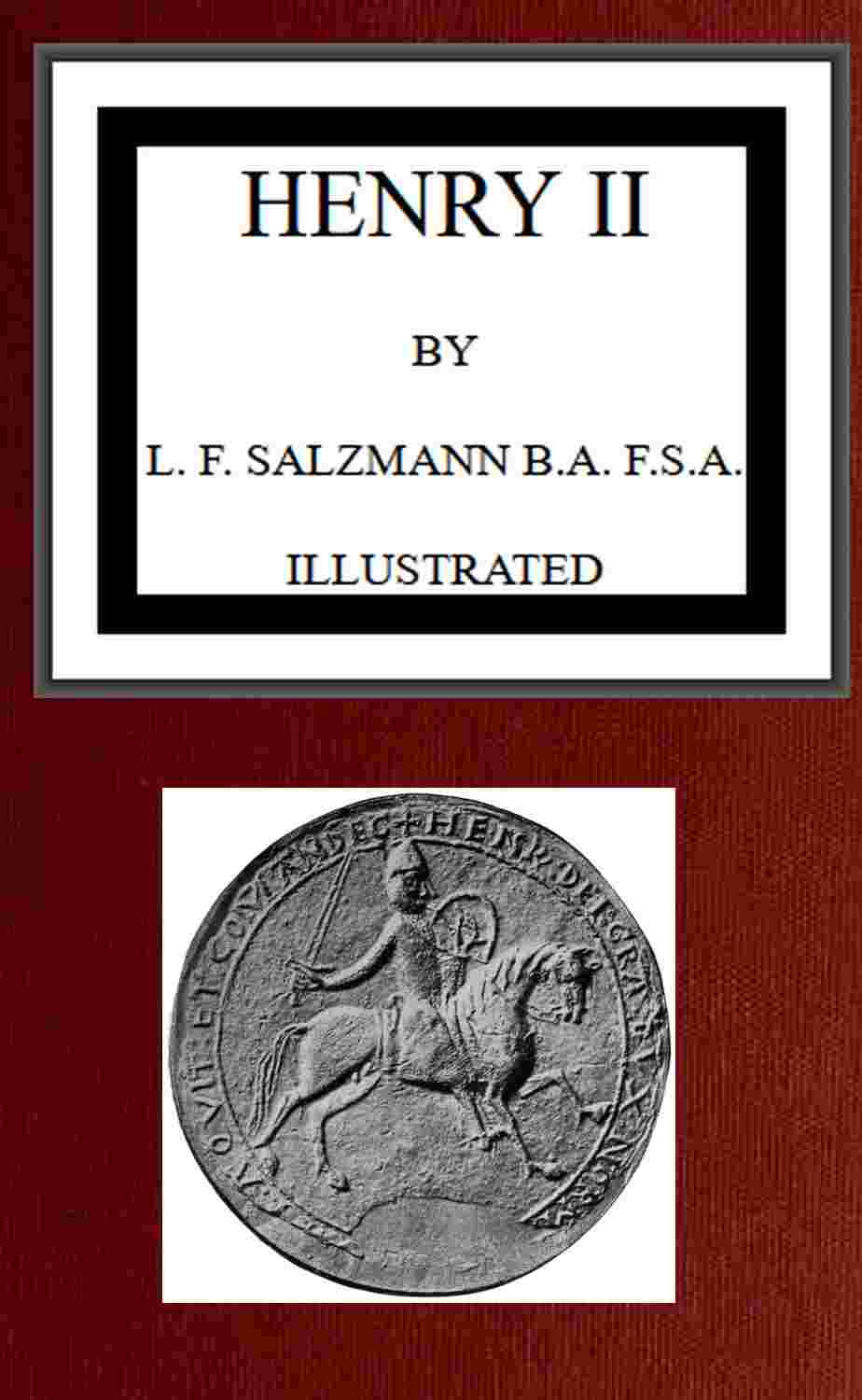
The Project Gutenberg eBook of Henry II
Title: Henry II
Author: L. F. Salzman
Release date: December 8, 2025 [eBook #77429]
Language: English
Original publication: Boston: Houghton Mifflin, 1914
Credits: Chuck Greif, MWS and the Online Distributed Proofreading Team at https://www.pgdp.net (This file was produced from images generously made available by The Internet Archive/American Libraries.)
CONTENTS
ILLUSTRATIONS
BIBLIOGRAPHY
APPENDIX: ITINERARY OF HENRY II
INDEX
FOOTNOTES
Kings and Queens of England
EDITED BY
ROBERT S. RAIT M.A. AND WILLIAM PAGE F.S.A.
H E N R Y I I
HENRY II
BY
L. F. SALZMANN B.A. F.S.A.
ILLUSTRATED
BOSTON AND NEW YORK
HOUGHTON MIFFLIN COMPANY
1914
Printed by Ballantyne, Hanson & Co.
at the Ballantyne Press, Edinburgh
CONTENTS
ILLUSTRATIONS
HENRY II
CHAPTER I
HENRY FITZ-EMPRESS
When the White Ship went down on 25th November 1120, carrying with her the only legitimate son of Henry I., the succession to the English throne became a question of great moment. Henry’s daughter, Maud, had been married to Henry V., Emperor of Germany, in 1114; it was clearly impossible for England and Normandy to be ruled in conjunction with the Empire, and Maud had no children to whom her father’s crown might pass. The king’s unruly brother, Robert of Normandy, was still alive, but a prisoner in England; and his son William, the most formidable candidate for the throne, was destined to die in Flanders in 1128. But before death had removed this dangerous and unpopular competitor, a fresh solution of the difficulty had become possible. Maud’s husband, the emperor, had died in 1125, [1]and on 1st January 1127, King Henry declared Maud his heir, and caused the peers to swear to accept her as his successor in England and in Normandy. There was no precedent for female sovereignty in either country, and it was probably not anticipated that she should reign alone, but rather that she should by marriage bestow the crown upon some fitting partner. The important matter of this marriage Henry had virtually undertaken to submit to the decision of his barons, but at the end of May 1127 he betrothed her, with an absence of preparation that amounted almost to secrecy, to Geoffrey, son of Count Fulk of Anjou, a boy of fourteen, eleven years the junior of his bride. The marriage, as Henry had foreseen, was unpopular, though the addition of the neighbouring provinces of Anjou and Maine to Normandy made the King of England the most powerful of all the feudatories of France.
The marriage of Geoffrey, now Count of Anjou, and Maud took place in June 1129, but within a few weeks the quick-tempered count and his haughty bride had quarrelled and separated, and it was not until the autumn of 1131 that they came together again. Their reunion was made by Henry the occasion for causing his barons to renew their oath of allegiance to Maud as his successor, thereby quashing any objection that might have been made to the previous oath as invalidated by her marriage. The king was now more than sixty years old, and his anxiety for the future of his country and his dynasty must have been greatly relieved by the birth of a son to Geoffrey and Maud on the 25th March 1133. The boy was called Henry, after his grandfather, and it is significant of the predominance attaching to his mother, as heiress of England and Normandy, that the title by which he was most commonly known to his contemporaries was that of Henry Fitz-Empress.
The death of Henry I., on 1st December 1135, seems to have taken the empress and her partisans by surprise. She went almost at once into Normandy to press her claims, half-heartedly and with little success; but in the meanwhile her cousin, Stephen of Blois, nephew of the late king, had crossed into England, and, with the assistance of his brother, Henry, Bishop of Winchester, had caused himself to be crowned king on 22nd December. The Norman barons accepted Stephen, and the final blow was given to Maud’s cause by the Pope’s declaration in favour of her rival. Her half-brother, however, Earl Robert of Gloucester, was not long in forming a party to support the claims of Maud and her son in England, and in 1139 Maud herself crossed the Channel with a small body of troops. With the varying fortunes of the long-continued war between the empress and Stephen we are not concerned, but it was when Maud’s cause was almost at its worst, in the winter of 1142, that her young son Henry, then in his tenth year, came over in charge of his uncle, Earl Robert, and was settled at Bristol. There he remained for four years under the tuition of a certain Master Matthew, who cultivated in him that love for learning which made him in later days the most literary prince of his time and a worthy successor of his scholarly grandfather.
During those four years Henry’s father, Geoffrey of Anjou, had been strengthening his position on the Continent, though apparently making no effort to assist his wife in her struggle with Stephen. By the end of 1143 he had secured control of the greater part of Normandy, and early in 1144 Rouen surrendered and Geoffrey was recognised as Duke of Normandy. Having established himself securely he now sent for his son to join him, and accordingly, late in 1146, or at the beginning of the next year, Earl Robert of Gloucester escorted young Henry to Wareham and there bade farewell to him. Uncle and nephew were destined to meet no more, for on 31st October 1147 Earl Robert died. Immediately the earl’s death was known, Earl Gilbert of Pembroke, whose castle of Pevensey was then undergoing a siege, urged Henry’s return. He considered that the only hope for the empress’s cause, now that its mainstay had departed, lay in the presence of Henry in England. The boy—he was only fourteen—hurriedly crossed with a few companions, landed at one of the western ports, and made feeble attacks on Cricklade and Bourton, in Gloucestershire, from which he was easily driven off. His forces dwindled rather than increased, and his scanty supply of money soon came to an end. An application to his mother for further funds proved ineffectual, as she was in the same straits herself. He then turned to the Earl of Gloucester for assistance; but Earl William was very different from his father; he cared little for war, had no enthusiasm for the cause of his cousin, and saw no reason why he should waste his treasure on a desperate and hopeless enterprise. Unable for lack of funds either to continue his injudicious venture or to leave the country, the humiliated prince had to apply for help to the rival whom he had so rashly attacked. Stephen, always chivalrous and good-natured even to weakness, in spite of the opposition and remonstrances of his advisers, at once supplied Henry with the necessary means of returning to his father’s court, where, in the early spring of 1148, he was joined by his mother, the empress.[2]
Geoffrey, now that he was firmly established in Normandy, seems to have begun to plan the aggrandisement of his son, in whose right he had obtained the duchy. And so, in April 1149, Henry was sent to England to receive the honour of knighthood from King David of Scotland, his mother’s uncle. Landing, probably, at Wareham, he made a brief stay at Devizes, where we find in his company Roger, Earl of Hereford, Patrick, Earl of Salisbury, William Beauchamp, John St. John, Roger Berkeley, Hubert de Vaux, Henry Hussey, Manser Bisset and others.[3] Thence he passed peacefully northwards, the whole of western England being in the hands of magnates, such as the Earls of Leicester and Warwick, who were friendly to his cause or at least hostile to that of Stephen. To Carlisle he was brought by Earl Ralph of Chester, and there he was received by King David and his son Henry, Earl of Northumberland, and on Whitsunday, 22nd May, was duly invested with the insignia of knighthood. Henry and his ally of Scotland now persuaded the powerful Earl of Chester to join forces with them against Stephen, but before this scheme could be carried out King Stephen had outbid his rivals and bought the support of the earl by a bestowal of fiefs so lavish as to render him almost king of northern England.
Returning to his father in January 1150, Henry was invested with the dukedom of Normandy. But a little more than a year later Stephen’s son, Eustace, persuaded King Louis of France, with whom Geoffrey
had quarrelled, to assist him in regaining Normandy. The allies advanced as far as Arques, where they were opposed by the forces under the young duke. Henry here exhibited that scrupulous respect for his feudal overlord, the King of France, which he displayed so conspicuously in later years, and acted on the defensive, refusing to attack his suzerain. Eustace was a man of warlike spirit, but King Louis, who, though not averse to war, seems to have had a profound distaste for fighting, did not care to risk a battle and retired for the time. Later in the year he despatched another force to operate against Mantes, but Geoffrey now came to terms and agreed to surrender the Vexin, the borderland between France and Normandy, on condition that Louis should confirm Henry in the possession of the rest of the Norman duchy, and these terms the French king gladly accepted.
Henry had now established his claim to half of his grandfather’s dominions, and began to plan the recovery of the remainder by an invasion of England. His plans, however, were interfered with by the sudden death of his father on 7th September 1151. The recovery of England was postponed, but a great accession of territory was obtained by Henry in the following spring. Louis VII. had married Eleanor, the heiress of Aquitaine, in 1137, but relations between the able and energetic queen and her feeble husband had gradually become strained to breaking, and at last, early in 1152, they discovered that they ought never to have married, being related to one another, distantly but within the degrees theoretically prohibited by the Church.[4] A divorce was granted on 18th March, and Eleanor, avoiding the too pressing attentions of Count Theobald of Blois and Geoffrey of Anjou, Henry’s younger brother, intimated her willingness to bestow her hand and great possessions upon the Duke of Normandy. Henry, now nineteen, but with a reputation that many an older man might have envied, hastened at once to meet Eleanor at Poitiers, and they were married in May. By this marriage Henry became master of Aquitaine and Poitou, in addition to Anjou, Maine, and Normandy, and his rule reached from the Channel to the Pyrenees.
He now once more prepared for the invasion of England, and was assembling his forces at Barfleur in June when he found himself called upon to face the combined forces of Eleanor’s late husband, King Louis, and her disappointed suitors, Count Theobald and Geoffrey of Anjou. Henry displayed the energy and rapidity of movement which in later years made the French king declare that he must be able to fly, dashed down to Pacey and prepared to attack the French forces, but Louis, with his usual discretion, retired at once. Henry promptly turned north to crush the rebellious Richer of L’Aigle and destroy his robbers’ castle of Bonmoulins. The Norman frontier had been secured before the end of August, and the duke was free to turn his hand against his brother Geoffrey, which he did very effectually, reducing Montsoreau and compelling Geoffrey to sue for peace. A truce patched up between Henry and Louis was speedily renounced by the latter, but Henry, estimating his adversary’s military abilities at a low rate, continued his preparations for the invasion of England, and eventually crossed about the second week in January 1153, with a fleet of thirty-six ships.
It was probably at Wareham that Henry landed with his hundred and forty men-at-arms and three thousand infantry, and he would seem to have gone straight to Bristol, where he was joined by those magnates who had supported his cause in the past, or who considered that it would be to their advantage to do so in the future. Operations were at once begun against Malmesbury Castle, and the outer works were speedily carried, but the massive keep was too strong to be stormed and could only be reduced by starvation. Meanwhile Stephen had collected his forces and was marching to the rescue; after halting for the night at Cirencester he advanced to the relief of Malmesbury, but found the little Avon swollen and impassable, while a bitter wind and blinding rain and sleet, driving in the faces of his men, made it impossible for him to advance or to retain his position. Abandoning his enterprise, the king marched back to London, and the castellan Jordan had no choice but to surrender. Enheartened by the capture of Malmesbury, Henry now directed his energies to the particular business which had brought him over—the relief of Wallingford. During the past five or six years, although the country as a whole had been at peace, some of the more restless spirits had carried on a sort of war on their own account, and of these one of the most prominent had been Brian Fitz-Count of Wallingford. In 1152 he had managed to destroy the castles set up at Brightwell and Reading to keep him in check, and Stephen had been obliged to besiege Wallingford Castle and blockade it by the erection of counter-works at Crowmarsh. Finding themselves in difficulties, the garrison had sent over to Henry for assistance, and he now came to the rescue and invested Crowmarsh. An outlying portion of the royalist siege works on Wallingford Bridge had already fallen into his hands, when Stephen once more offered fight. Henry, for his part, was very willing to give battle and drew out his forces, but the desire of the prelates to avoid further bloodshed, and the fear of the barons that a decisive victory might destroy the balance of power between the two parties and so render their own services less marketable, resulted in secret negotiations, and compelled the rivals to agree to a truce for five days, though suggestions for a more permanent cessation of hostilities, made at a private interview between Henry and Stephen, came to nothing. The terms of the truce were highly favourable to Henry, the king being obliged to withdraw his garrison from Crowmarsh and allow the fortifications to be dismantled.
Wallingford having been relieved, and the royalists under William Cheyney and Richard de Lucy having been defeated in a cavalry action near Oxford, Henry seems to have recruited his forces in the western counties, visiting Evesham and Warwick, where the Countess Gundreda handed over to him the castle, from which she had ejected Stephen’s garrison. Then, turning eastwards, he besieged and captured Stamford Castle about the same time that Stephen reduced Ipswich. The duke next plundered Nottingham, but did not attempt to take the castle. By this time the peace party were beginning to gain the upper hand, and the efforts of Archbishop Theobald and Bishop Henry of Winchester gained strength by the removal of their chief opponent, the king’s son, Eustace of Boulogne. That bellicose ruffian, enraged at the tame conclusion of the Wallingford affair, had gone off on a ravaging expedition in the eastern counties. After plundering Cambridgeshire he paid a similar attention to the lands of Bury St. Edmunds, rashly pillaging the monastic lands on St. Laurence’s Day (10th August). The offended saints were not slow to avenge the outrage, and within a week Eustace lay dead. With his death died Stephen’s hopes of founding a dynasty, for his younger son, William, had borne no part in the civil war and possessed neither the desire nor the ability to contest the crown with Henry.
After some weeks of negotiation a compromise was at last arrived at by which Stephen was to retain the crown for life on condition of acknowledging Henry as his heir, and on 6th November 1153 this agreement was ratified by the peers in council at Winchester; the rivals were reconciled and the barons of both parties did homage to the king and his successor. From Winchester the double court moved to London, where the news of the termination of the long and ruinous struggle was received with the greatest enthusiasm; and after Christmas king and duke met once more, at Oxford, on 13th January 1154, just a year since Henry had landed in England. A little later, when they met again, at Dunstable, Henry reproached Stephen for not having fulfilled one of the conditions of the treaty of peace, which was that the castles built since the death of Henry I. should be destroyed. The task was no small one, as these so-called adulterine castles had sprung up all over the country and were estimated by Robert of Torigny, usually an accurate authority, to number eleven hundred and fifteen. Stephen resented the charge of ill-faith, but the quarrel, if it deserve the name, was soon made up, and the two princes went down to Dover together in February to meet the Count and Countess of Flanders. While there it is said that Stephen’s Flemish mercenaries, without his knowledge but with the connivance of his son William, planned to murder Henry. Whether a rumour of the plot reached his ears or whether he considered that affairs in Normandy required his presence, Henry soon afterwards parted from the king and returned to Normandy, where he spent the next five months strengthening his position. With King Louis he was now on good terms; and he was actually engaged in a military expedition on that king’s behalf when the throne of England fell to him by the death of Stephen on 25th October 1154.
CHAPTER II
HENRY II., KING OF ENGLAND
Henry ascended the throne of England in singularly favourable circumstances. Still young, his character had been formed and his reputation had been established on the battle-fields of England and Normandy. Far inferior to his predecessor in personal character, he was as far his superior in kingcraft, possessing just those talents necessary for his position which the chivalrous, kindly, and erratic Stephen lacked. Something of this, which was to be demonstrated by the history of his reign, was already obvious, and the bulk of his English subjects were strongly prepossessed in his favour. The Church was on his side; the greater barons cared little who was king so long as their titles and their revenues were assured to them; the lesser lords and the peasantry, exhausted and impoverished by the twenty years of anarchy, welcomed a ruler strong enough to curb the lawless feuds of semi-independent chieftains, while, above all, there was no other claimant to the throne, the only possible rival, Stephen’s son, William, Earl of Warenne and Surrey, being, fortunately for himself, quite unambitious of regal honours. Possessing great powers of physical endurance, Henry was as active
in mind as in body, a well-read scholar and an accomplished linguist; short, sturdy, with coarse hands and freckled face, unkempt and careless in his dress, he overcame the disadvantages of an unattractive appearance by his courtesy and the charm of his manner, which made him formidable in diplomacy or love. Although inheriting the volcanic temper of his Angevin forefathers and liable to outbursts of diabolic rage, he ruled his hot blood with a cool head, practically never allowing his feelings to dictate his policy and but rarely indulging in acts of cruelty or revenge. He was non-religious rather than irreligious, non-moral rather than immoral; though he made no attempt to bridle his lust, there is no reason to suppose that any of his numerous mistresses were unwilling victims; and though his irreverence and contempt of the Church’s sacraments shocked his contemporaries, he admired and chose for his friends such men as St. Hugh of Lincoln. Clear-sighted and self-centred, Henry was emphatically a strong man; and it is the irony of fate that the weak spot which was to prove his ruin lay in his most unselfish and amiable trait, his affection for his family.
Not the least of Henry’s qualifications for the kingship was his ability to select the right men for his ministers. It is possible that Archbishop Theobald may have had some influence in the appointment of the brilliant young Archdeacon of Canterbury, Thomas Becket, to the high office of Chancellor, but the king may be given the credit for choosing Robert, Earl of Leicester, and Richard of Lucy as Justiciars. All three appointments proved to have been well made, and the first two were probably made before the coronation.[5] At this ceremony, on 19th December, besides the Archbishop of Canterbury, to whose see belonged the privilege of crowning the king, there were present the Archbishops of York and of Rouen, fourteen English bishops and the bishops of Bayeux, Lisieux, and Avranches, numbers of foreign noblemen, including Dietrich, Count of Flanders, and a multitude of English and Norman lords. There were the king’s two brothers—Geoffrey, with whom he was shortly to be at war for the second time, and William, for whose benefit he was no doubt already planning the conquest of Ireland; there were the royal officers Henry of Essex, Constable of England, Richard de Humet, Constable of Normandy, Warin Fitz-Gerald, the Chamberlain, and Hugh, Earl of Norfolk, hereditary High Steward; and there amongst the brilliant crowd would be such great lords as Reynold, Earl of Cornwall, son of King Henry I., and William, Earl of Arundel, the confirmation of whose privileges and estates was one of the new king’s first acts. Abbots, royal chaplains, clerks of the Chancery and Exchequer, wealthy merchants and burgesses, and the ladies of the court with their attendants, whose gay robes formed but the highest tone in an assembly blazing with colour, complete the picture. Yet of all those in whose presence Henry swore to follow in the footsteps of his grandfather, to maintain the good laws of the realm and to abate the bad, very few were English and few even spoke the English tongue. The governing classes in Church and State were Norman by lineage, language, and sympathy, and at a time when an Englishman sat in St. Peter’s chair[6] scarce any of his compatriots held offices of trust in their native country. The fusion of English and Norman, which had already spread so far in the lower ranks of society, only began to affect the higher ranks in the course of the reign of Henry, who, by the ultimate failure of his life-long policy, was to give the English nation its individuality.
The affairs of the kingdom could not be neglected for coronation festivities, and at his Christmas court, held at Bermondsey, Henry took the first step for ensuring peace by the expulsion of the lawless Flemish mercenaries. Their leader, William of Ipres, was allowed to retain the large revenues from lands in Kent granted to him by Stephen and well earned by his loyalty and skill, and some few of his followers were sent to join the colony of Flemings established on the borders of Wales, but the bulk of the “Flemish wolves” were packed off to satisfy their appetite for war and plunder on the Continent. Having thus disposed of these alien robbers, the king had next to deal with those of his own subjects who had abused their own powers and the weakness of the central government during the anarchy to extend their possessions at the expense of the royal demesnes and to strengthen their position by the erection of castles. The destruction of the “adulterine” castles, erected without royal licence, had been promised, and to some extent performed, by Stephen in the last months of his reign,[7] but Henry now determined to complete the work and at the same time to revoke the grants of royal demesne whether made by King Stephen or by the empress.
In thus recovering the Crown lands the king was no doubt partly influenced by the desire to increase the very scanty royal revenues, and partly by his deliberate anti-feudal policy. It did not require the acute intelligence which Henry possessed to learn from the events of the last twenty years that it would be wise to clip the wings of the great barons, who threatened to overshadow the throne itself, and to play for popular support. It was clearly to his interest that the people should be prosperous, contented, and loyal, and he was not slow to adopt measures which would render the nobles less able alike to oppose the Crown and to oppress the people. Throughout his reign he acted on these anti-feudal principles. Although Henry had a distinct appreciation of justice, it may be doubted if the legal reforms, which were in many ways the most important features of his reign, would ever have seen the light had they not tended towards the elevation of the smaller men and the consequent depression of the greater. With a few exceptions it will be found that when Henry required, as he usually did, to increase his revenues by means of doubtful legality, he preferred to extort large sums from the wealthy rather than an equivalent multitude of small amounts from the poorer classes. So also the frequent substitution of money payments for military service helped to discourage the maintenance of large bands of armed retainers, kept nominally for the king’s service but liable to be used for the furthering of their lord’s ambition. Yet in all cases Henry acted with a wise moderation, which, leaving the great lords in possession of their titles and estates, left them in the position of having more to lose than gain by rebellion.
The king’s orders were as a whole acquiesced in with little resistance, the estates wrested from the Crown were restored, the castles demolished, life and property were once more secure, commerce revived, the merchants came forth to find customers and the Jews to seek their debtors. But William of Aumâle, Earl of Yorkshire, who, under Stephen, had enjoyed a semi-regal independence, hesitated to conform to the new state of affairs, and prepared to offer armed resistance to the king’s demands. Henry left Oxford, whither he had gone at the beginning of the new year, 1155, and moved slowly northwards, halting apparently at Northampton to re-create Hugh Bigot, Earl of Norfolk, his charter taking the form of a re-creation rather than a confirmation, possibly as a hint to the shifty earl that his dignities were not secure beyond all risk. By the time that the king reached York Earl William, finding himself unsupported, had reconsidered his position and wisely submitted to the royal demands, surrendering his fortress of Scarborough. A precipitous bluff projecting into the sea, whose waves washed it on three sides, joined to the mainland only on the west by a narrow neck, the rock of Scarborough presented an ideal spot for the rearing of a castle, and here accordingly the earl had set his great stronghold, surrounding the spacious plateau on the top of the cliff with a wall, digging a well, and building a keep four-square upon the narrow neck by which alone access was possible. Nestling against the western base of the rock lay the little town of Scarborough, itself surrounded with a wall and thus forming an outwork of the castle. The position was too formidable to be left in the hands of a subject, and King Henry took care to retain it for the remainder of his reign; and when in the course of a few years the earl’s keep fell into decay, it was rebuilt and enlarged at a cost equivalent to some £10,000 of modern money, the work beginning in 1159 and spreading over the next three years.[8]
On his way either to or from York Henry appears to have visited Lincoln, the priory of Spalding, and the great abbeys of Peterborough, Thorney, and Ramsey. The news of the king’s approach to Nottingham so stirred the guilty conscience of William Peverel, burdened with the murder of the Earl of Chester, that he sought to save body and soul at the expense of his possessions by becoming a monk in a priory of which he was himself patron at Lenton. It was no doubt while in the neighbourhood of Nottingham that the king received information of the birth of his second son, Henry, on 28th February, and shortly afterwards he returned to London, where he held a council at the end of March. During the previous three months Roger, Earl of Hereford, had been contemplating resistance to the king’s demands for the surrender of his castles, but the arguments of his kinsman, Gilbert Foliot, Bishop of Hereford, supported by the success of Henry’s expedition into Yorkshire, brought him to a wiser mind, and he placed the castles of Hereford and Gloucester in the king’s hands. Hugh de Mortimer, however, the great lord of the Welsh Marches, who had been the chief instigator of Earl Roger’s disaffection, maintained his attitude of opposition and fortified his castles of Cleobury, Wigmore, and Bridgnorth. Henry accordingly moved west, halting at Wallingford, where on 10th April he held a council at which the nobles swore allegiance to his elder son William, or in the event of his death, which occurred the following year, to the infant Henry. Mortimer’s strongholds were invested and, after some resistance, reduced, he himself making his peace with the king at Bridgnorth early in July.
With the collapse of Mortimer’s rebellion all active opposition to the king ceased. Henry, Bishop of Winchester, brother of the late King Stephen, having possibly displayed his sympathy with the defeated party too prominently, deemed it prudent to retire to the Continent, leaving his castles to share the fate of other private fortresses. Peace being thus ensured in England, King Henry was at liberty to look abroad, and at a council held in Winchester at Michaelmas he broached the subject of the conquest of Ireland, proposing to subdue that turbulent and uncivilised country and place it under the rule of his brother William. To strengthen his position and justify his action he sent John of Salisbury to represent to the pope the urgent need for reform, ecclesiastical and political, in Ireland. The pope at this time, Adrian IV., was an Englishman, his father being a poor clerk of Langley, who entered the monastery of St. Albans shortly after his son’s birth: the young Nicholas Brakespere, endeavouring to follow his father’s example, was rejected by the authorities at St. Albans and went out of England to Provence, where he rose to be abbot of St. Ruphus; his monks, regretting their election of a foreigner, appealed to the pope to depose him, and he again prospered by rejection, as he was at once promoted to the bishopric of Albano and made papal legate to Scandinavia, where his success was so great that, upon the death of Pope Eugenius III., in December 1154, he was elected to the papacy, taking the title of Adrian IV. Pope Adrian heartily approved of Henry’s project, and sent back John of Salisbury with a letter commending the proposed crusade and an emerald ring symbolic of the sovereignty of Ireland, with which he invested Henry by virtue of the alleged supremacy of the popes over all islands.[10] Feeling in England, however, does not seem to have been in favour of the expedition, and the empress, doubtless foreseeing that William would find the Irish throne an insecure position of little glory and less profit, strongly opposed the project. Her influence with her son was sufficient to cause him to abandon the idea, or at least to postpone it until a more favourable opportunity.
Henry kept Christmas at Westminster, and early in January 1156 sailed from Dover for Normandy, his last act before leaving being to re-create Aubrey de Vere, who the previous year had paid 500 marks to be High Chamberlain of England,[11] Earl of Oxford. At the beginning of the next month he met Louis VII. on the borders of France and Normandy and did homage to him for all his continental possessions, including Anjou and Maine, which his brother Geoffrey claimed under his father’s will. Geoffrey, persisting in his claims and refusing Henry’s offers of compensation, garrisoned his castles of Loudun, Chinon, and Mirabeau. By the beginning of July the two latter were in the king’s hands, and Geoffrey had agreed to be content with retaining Loudun and a money pension. Shortly afterwards the people of Nantes and Lower Brittany expelled their ruler, Count Hoel, and elected Geoffrey in his place. Henry gladly assented to the election, and upon Geoffrey’s death in 1158 successfully enforced his own claims, as heir to his brother, against Conan, Earl of Richmond and Count of Upper Brittany.
The king’s first daughter, Maud, had been born at London early in the summer, and towards the end of August Queen Eleanor crossed from England and joined her husband in Anjou. The court returned to England in April 1157, and a short tour was made through the eastern counties, the king wearing his crown in state at Bury St. Edmunds on 19th May and staying the following week at Colchester. In continuation of his former policy he now caused William de Warenne, Earl of Surrey, to surrender the castles of Norwich and Pevensey, which he had hitherto retained, apparently compensating him by further additions to his great estates in Norfolk.[12] Earl Hugh of Norfolk was also deprived of his castles, and in Essex one of Earl Geoffrey’s strongholds was destroyed.
Henry was now so firmly established on the throne that he could insist upon a far more important resumption of territory, and accordingly he demanded from the young King Malcolm of Scotland the cession of Northumberland, Westmoreland, and Cumberland. Malcolm, unable to offer any effective resistance to his demands, travelled south through Yorkshire and Lincolnshire to the castle of the Peak. Meanwhile Henry, after holding a council on 17th July at Northampton, where he left the queen, was moving westwards. The two kings met at the Peak and passed on together to Chester, where Malcolm formally restored the northern counties, receiving in exchange the earldom of Huntingdon, for which he did homage to Henry. The Scottish king then returned to his own country to repress the rebellion raised by his nobles in indignation at his surrender to the English demands, while Henry completed his arrangements for the invasion of North Wales.
CHAPTER III
THE WELSH WARS
The Welsh, who had been brought into at least nominal subjection by the strong hand of Henry I., were not slow to avail themselves of England’s weakness under Stephen to regain their liberty. Unfortunately the chief result of the removal of foreign control was the increase of those internal disputes which had always formed so large a part of the nation’s history.[13] Prince warred with prince, brother against brother, and cousin against cousin; treachery was met with treachery, and in the end the inevitable appeal of a disappointed claimant for foreign assistance against his successful rival brought an English army into Welsh soil once more. Owain Gwynedd, king of North Wales, had exiled his brother Cadwalader and seized his possessions, and it was on the pretext of restoring Cadwalader that Henry assembled his forces at Chester and prepared for the invasion of Wales in the summer of 1157.
The task was formidable alike from the nature of the country and the inhabitants. Wales was divided into three parts—North Wales or Venedotia, South Wales or Demetia, and Powys, but, save that the lance was the weapon of the northern Welsh and the bow of the southern, the divisions were arbitrary and artificial, and unconnected with any differences in the character of the population. With the exception of the Brabantine mercenaries, a race apart, a tribe of professional Ishmaelites, ready to turn their hands against any man for pay, no nation was so thoroughly permeated by the martial spirit as the Welsh. With the English and Normans war was the business of the gentry, but throughout Wales the young men of all classes, gentle and peasant alike, devoted their leisure to the practice of military exercises and strove to perfect themselves in the art of war. Possessing a country whose woods and mountains, intersected by torrents and marshy valleys, were admirably adapted for the ambuscade and other tricks of guerilla warfare, the Welsh had cultivated those qualities which enabled them to make best use of these natural advantages. Simple in their requirements for food or dress, they were hardy, active, and endowed with wonderful powers of endurance. Of defensive armour they made practically no use, yet they did not hesitate to encounter any foe, however well equipped; their first attack, delivered to an accompaniment of yells and braying trumpets, was furious, but, as is inevitable when light armed troops engage with heavy, if it did not prove immediately successful, they soon broke and fled, always ready, however, to resume the fight if opportunity offered. They did not disdain to strengthen their position with fortifications, and the whole land bristled with castles,[14] hardly a year passing without record of the erection, capture, recapture, or destruction of one or more castles in the course of the incessant wars waged either between local chieftains or with the Norman barons of the Marches; yet it was emphatically in the strategical use which they made of the natural advantages of their country that the Welsh were pre-eminent.
It is possible that the straightforward pitched battle between troops contending stubbornly under the open sky tends to promote the honourable traditions of chivalry, while the ambush, surprise, and night attack foster treachery and deceit. Certain it is that the Welsh were notorious amongst their contemporaries as liars and perjurers, men to whom the most solemn oaths were not binding; and their Norman neighbours, the lords Marchers, were not slow to follow their example, so that the history of the border warfare is constantly stained with treachery and broken oaths. The corollary to “Taffy was a Welshman” that “Taffy was a thief” was already recognised as an axiom at the time of the Domesday Survey, when the customs of the Herefordshire Welsh contained provisions for correcting this reprehensible propensity. Yet in spite of this tendency to enrich themselves at the expense of their neighbours the Welsh were open-handed and generous; none need beg for a meal, nor need the wayfarer fear to lack a resting-place. Hospitality was not so much a duty as a commonplace of life amongst this people, and exercised without hesitation. The food was simple, for though orgies of gluttony and drunkenness were only too common after a successful plundering raid, yet the habitual excess prevalent in England was here unknown; but this simplicity was more than atoned for by the charms of female society and the delights of music. In music the Welsh surpassed even the Irish; in every house a harp was to be found, and it is noteworthy that they shared with the men of Yorkshire the peculiarity of singing not in unison but in parts. In their rhythmical chanted songs the nation’s exceptional powers of rhetoric found their highest form of expression, and their bards were held in such honour that in 1157, when Morgan, son of King Owain Gwynedd, was murdered, it is expressly noted that with him was slain Gwrgant ap Rhys, “the best poet.” Thus with music and eloquent conversation were passed the restful hours of the day, the remainder of which would be devoted to military exercise, hunting, the tending of flocks and herds, or, more rarely, agriculture, for which the poor soil and the inclinations of the people were alike unsuited. They were thus perilously dependent upon England for much of their food supply and therefore liable to be starved into surrender in the event of war.
The antagonism existing between the peoples of England and Wales found some echo in the relations between the two branches of the Church. The Welsh Church, possessing a far longer continuous history than that of England, was less completely under the influence of Rome, and retained many primitive customs which were strange and even abhorrent to the more orthodox. Their clergy continued to marry, with the result that many benefices had become hereditary, descending from father to son like secular property. But if the marriage of the clergy was a primitive condition no longer canonical, the marriage customs of the laity were still more shocking to the orthodox, being in many cases not merely uncanonical but clearly survivals from pagan times, indefensible on any grounds except those of crude common-sense. The English Church, having control of the four sees of St. David’s, Llandaff, Bangor, and St. Asaph, should have been able to execute the necessary reforms, but unfortunately Norman prejudice forbade the appointment of a Welshman to any post of authority in Wales, and the sees were consequently occupied by foreigners who, for the most part, could not speak the language of their flocks, and only too frequently used their power to increase their slender revenues at the expense of their clergy. Despised by the Norman clergy as corrupt and by the nobles as barbarous, it is possible that the Welsh appeared to Henry less formidable opponents than they really were. Moreover, he disregarded the advice of the lords of the Marches, whose whole lives were spent in fighting their Welsh neighbours, and determined to conduct his expedition on the most approved continental lines. Owain had entrenched himself at Basingwerk, and Henry accordingly advanced along the coast for some distance, and then, meditating a flanking movement, led a detachment of his forces through the woods of Consillt. This gave the Welsh the opportunity for which they had been waiting, and no sooner were the Normans entangled in the woods than the forces under Owain’s sons, David and Cynan, fell upon them, inflicting heavy losses. Caught at a disadvantage the invaders were thrown into confusion; two of their leaders, Eustace Fitz-John and Robert de Courcy, were slain, and a cry was raised that the king had been killed. Panic ensued, and it was afterwards said that Henry of Essex, the Constable of England, had thrown down the royal standard and fled. If the Constable really displayed cowardice on this occasion the fact must have been hushed up, for nothing is heard of it for six years, until in 1163 Robert de Montfort made it the subject of a formal accusation. Such an accusation could have only one outcome, and accordingly a duel was fought between the two parties at Reading in the king’s presence, when Henry of Essex, rashly abandoning a successful defence for the offensive, was defeated and left for dead on the ground, but being nursed back to life by the monks of Reading, joined their community and spent the remainder of his days in their abbey. It is noteworthy that the challenger, Robert de Montfort, was a connection of his opponent’s and not improbably a rival claimant to the constableship, which Henry had inherited through the heiress of Hugh de Montfort.[15] On the whole it would seem more probable that Robert should have made his accusation as a taunt based on some flying rumour and that the result of the duel was unjust, than that King Henry should have condoned the Constable’s cowardice and allowed him to continue in honour at his court.
However Henry of Essex may have behaved, it is clear that the Normans had suffered a severe defeat, and Henry in a furious rage drew off his troops and rejoined the main body of his army, with which he advanced unopposed to Rhuddlan, Owain having withdrawn from Basingwerk to Conway. Meanwhile the fleet, which was acting in unison with the land forces, had been despatched to Anglesea, to ravage that fertile island, the granary of North Wales. But here bad discipline was the cause of a severe check; the attractions of looting churches and monasteries proved too great for the royal forces and delivered them into the hands of the ever vigilant natives. The sailors lost their commander, William Trenchemer, and most of their officers, while amongst the men of note who fell was Henry, the king’s half-uncle, son of Henry I. by the famous Welsh princess Nest. In spite of these two initial successes Owain felt himself in a position of danger, and preferring to make terms rather than to have them forced upon him, made peace and gave hostages to Henry. Cadwalader was restored to his possessions, and homage was done by Owain to the English king, and the English frontier was once more pushed as far forward as Rhuddlan, where, as also at Basingwerk, Henry restored the castle. The campaign, therefore, might be regarded as fairly successful, although the only two engagements recorded had been disastrous.
Although Owain Gwynedd and the other princes had come to terms with King Henry, the redoubtable Rhys, son of Gruffudd of South Wales, proposed to continue the war. Finding, however, that he would receive no support from any other native princes, he was persuaded to make his peace with the king, who in return promised to grant him a complete cantref of land. The spirit of the agreement was broken by the grant of the land in scattered portions instead of in a continuous block, but Rhys accepted the gift and remained quiet until he found that the king would not do him justice against Walter Clifford, when he took the law into his own hands and made a series of successful attacks upon the strongholds of the Norman barons in Cardigan. About the same time, in 1158, Yvor the Little, a noble of Glamorgan, being deprived of his lands by Earl William of Gloucester, made a daring night attack upon the castle of Cardiff, and in spite of its strength and the imposing numbers of its garrison, said to have numbered 120 men-at-arms, besides archers and others, carried off the earl with his countess and their son, who were only released after more than full restitution had been made to Yvor. Meanwhile Rhys, encouraged by his successes in Cardigan, attacked Caermarthen, and Henry, who was preparing for a great expedition into the south of France, was obliged to send a force under the Earls of Cornwall, Gloucester, and Clare to relieve the castle. This they did, and they were also successful in bringing Rhys to accept terms of peace.
Peace, so far as it ever existed on the Welsh borders, continued for a short time, but when Henry returned to England in 1163, he found the country in so disturbed a state that he was obliged to lead an army against Rhys. The latter offered little or no active opposition, and the expedition took the form of a military progress through Glamorgan and Gower towards Caermarthen and as far as Pencader, returning by the mountains of Plinlimmon to Radnor. It is said that during this progress the invading host came to a stream called Nant Pencarn, where the natives anxiously waited to see whether Henry would fulfil in his own person a traditional prophecy that the crossing of the ancient ford by a brave man with a freckled face should foreshadow the defeat of the Welsh. When they saw the king ride past the old ford and set his horse to cross by one newer and better known, the Welsh set up such a blare of horns and trumpets that his horse took fright, and the king, turning round, made for the older ford and dashed across, this time without any orchestral welcome.
As a result of this campaign Rhys, with Owain of North Wales and other princes, attended Henry’s court at Woodstock and did homage to him there in July 1163. The king, apparently meditating the confiscation of his estates or possibly the extortion of a ransom, sent a knight to visit Dynevor, the capital of South Wales, and to report upon the nature of the country; the priest, however, who acted as guide, while professing to go by the best route, took the unsuspecting knight by all the worst and most impassable tracks, and so contrived to impress him with the utter poverty of the land and the inhabitants that the king, on the strength of his report, abandoned his first intention and released Rhys, only taking from him hostages for his good behaviour. Hardly had Rhys returned than he renewed the struggle, recapturing the whole district of Cardigan, invading Pembrokeshire and despoiling the Norman and Flemish settlers. His example was speedily followed by Owain Gwynedd and his sons, who ravaged the district round Rhuddlan. In October 1164 Henry had issued orders for a force to be raised against Rhys, and on his return to England in the following May, he found this force ready and with it pushed hastily forward to Rhuddlan. Having relieved pressure in this district for the time being he returned to England to collect a larger army, furiously vowing to destroy the whole nation of Welsh. The border fortresses were set in order from Abergavenny, Grosmont, Llantilis, and Skenfrith in the south to Montgomery, Shrawardine, and Chirk in the north; foreign mercenaries were brought over and provided with arms, Ernald the armourer providing 300 bucklers for their use; lances and arrows were bought in Oxford and elsewhere and despatched to the frontier; and, above all, large sums of money were extorted from the cities, prelates, and nobles for the conduct of the war.[16] Operations on a small scale seem to have been carried on from Abergavenny, but the king, with the main part of his imposing army, advanced from Shrewsbury to Oswestry and so into Powys. For once the Welsh were united; Rhys of South Wales, Owain Gwynedd and Cadwalader his brother, the former ally of the English, the two sons of Madog of Powys, lesser princes such as Owain Cyveliog and Jorwerth the Red, all with their whole following were assembled to oppose the invader.
Henry advanced down the valley of the Ceiriog and, mindful of former disaster, endeavoured to protect his flanks by cutting down the woods. Indecisive skirmishing took place, resulting in heavy losses to both sides, but the Welsh avoided a pitched battle and retired before the royal forces until the latter had penetrated as far as the mountains of Berwyn in Merionethshire. Here they encamped, ravaging the country round and plundering the churches, to the intense anger of the Welsh, who always scrupulously observed the sanctity of churches. Punishment speedily overtook the impious host: tremendous storms of rain, exceptionally vehement even for Wales, coupled with a shortage of provisions, drove the English back in a disorderly and disastrous retreat to Chester, where Henry waited for the arrival of a fleet from Ireland. When the ships came they proved to be insufficient for the conduct of further operations against the Welsh. The king, furious at his ill-success, took a mean revenge by barbarously mutilating the sons of Rhys and Owain and a score of other hostages in his power.[17]
Hardly had the English army retired from Wales when Rhys stormed the castle of Cardigan and captured its lord, Robert Fitz-Stephen. Next year, in 1165, the Normans and Flemings of Pembroke made two unsuccessful attempts to retake Cardigan, while in the north Owain Gwynedd destroyed Basingwerk. Internal dissensions led to the ejection from their lands of Jorwerth the Red and Owain Cyveliog,[18] and the latter, in 1166, assisted the Normans to gain a small success in the capture of the castle of Caereinion, but this was more than counterbalanced by the action of Rhys and Owain Gwynedd, who, after a three months’ siege, captured the castles of Rhuddlan and Prestatyn. The development of Irish affairs now made friendly relations with Wales important, the main route to Ireland being by way of South Wales and the ports of Pembrokeshire. Accordingly we find Henry becoming reconciled to Rhys in 1171, and from henceforth treating him with an honourable courtesy which the Welsh prince reciprocated. Peace, therefore, varied with occasional border skirmishes, continued between England and Wales until the end of Henry’s reign, and the Welsh, deprived of the pleasure of molesting the foreigner, turned with the greater zest to the task of cutting one another’s throats.
The invariable failure of Henry’s military policy in Wales was due to his persistent disregard of the local lords of the marches and reliance upon men famous in continental warfare but totally ignorant of the very different conditions prevailing in the mountains and forests of Wales. Such a man as Gerald de Barri could have given the king far more useful advice in the conduct of a Welsh campaign than any of his great Norman barons. That acute historian afterwards set out at length the measures necessary for the conquest of his native country. No expedition should be undertaken hastily, but careful preparations should be made, allies secured, and internal divisions carefully fostered; castles should be built along the frontier, trade with England, especially in provisions, stopped, and the coasts blockaded. This would, as a rule, be sufficient to bring them to terms, but if military operations were needful then an advance should be made in the early spring before the trees came into leaf; the troops should be light armed, and preferably men of the border used to the country rather than Flemish or Brabantines, good as the latter were on their own ground. The operations should be conducted by counsel of the lords marchers, and heavy losses must be expected and borne with equanimity, for while mercenaries are easily replaced the Welsh could not replace their men. Once subdued the natives should be treated with justice and kindness so long as they remain quiet, but their rulers should be ever watchful and should punish rebellion with severity. To diminish the chance of revolt the intervals of peace ought to be used for the building of roads and of castles, and at the same time the English border towns along the Severn might well have special privileges granted them to facilitate their growth, and in return they should be bound to maintain a fitting provision of arms and horses and to practise universal military training. “Yet for all this the nation shall not perish utterly, and at the last great Day of Judgment this little spot of land shall be answered for by the Welsh race, still speaking in their ancient tongue.”