
s winter slowly wore away, little Nelly's health began to fail. She
seemed weary and languid, and poor little Benny was at his wits' end to
know what to get her to eat. After spending more than he could really
afford in something that he thought would tempt her appetite, he was
grieved beyond measure when she would turn away her head and say,
"I's very sorry for yer, Benny, but I canna eat it; I would if I could."
And he would be compelled reluctantly to eat it himself, though he would not mind going without food altogether if only "little Nell" could eat. But he comforted himself with the thought that she would get better when the spring-time came, and the streets were dry and warm. He might get her into the parks, too, and she would be sure, he thought, to get an appetite then. And so he kept up his spirits, and hoped for the best.
"She's ripenin' for the kingdom," was Joe Wrag's reflection, as he watched her pale face becoming thinner, and her great round eyes becoming larger and more luminous day by day. "She belongs to the elect, there ken be no doubt, an' the Lord don't intend for her little bare feet to walk the cold, dirty streets o' Liverpool much longer. I reckon she'll soon be walking the golden streets o' the shinin' city, where there's no more cold, nor hunger, nor pain. I shall be main sorry to lose her, bless her little heart, for I'm feared there's no chance of me ever seein' her agin' when she's gone. I wonder if the Lord would permit me to look at her through the bars o' the gate just for a minit if I wur to ax Him very hard? 'T will be nice, anyhow, to think o' her bein' comforted while I'm tormented. But it comes 'ard 'pon such as us as don't belong to the elect, whichever way we looks at it."
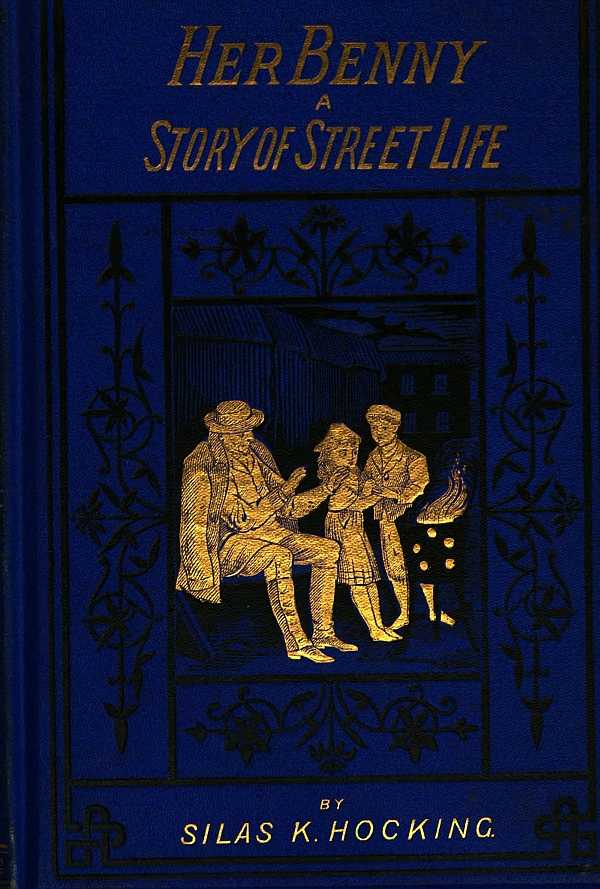
Sometimes Joe would leave his home earlier in the afternoon than usual, and getting a nice bunch of grapes, he would make his way towards Nelly's stand as the short winter's day was fading in the west. He would rarely have much difficulty in finding his little pet, and taking her up in his great strong arms, he would carry her off through bye-streets to his hut. And wrapping her in his great warm overcoat, and placing her on a low seat that he had contrived for her, he would leave her to enjoy her grapes, while he went out to light the fire and see that the lamps were properly set for the night.
With a dreamy look in her eyes, Nelly would watch her old friend kindling his fire and putting things "ship-shape," as he termed it, and would think how well she had been cared for of late.
By-and-bye, when the fire crackled and glowed in the grate, Joe would come into the hut and take her upon his knee, and she would lean her head against his shoulder with a heart more full of thankfulness than words of hers could utter. And at such times, at her request, Joe would tell her of the mercy that was infinite, and of the love that was stronger than death. She had only been twice to the chapel, for when she and Benny went the following week they discovered that there was no service, and so disappointed were they that they had not gone again; for the chapel was a long distance from Tempest Court, and she was tired when the day's work was done, and to go such a long distance and find the doors closed was anything but inviting. So they had not ventured again. But Nelly had heard enough from granny and while at the chapel to make her thirst for more. And so Joe became her teacher, and evening by evening, whenever opportunity presented, he unfolded to her the "old, old story of Jesus and His love."
It made his heart ache, though, to talk of the "good tidings of great joy," and think they were not for him. If the truth must be told, this was the reason why he kept away from church and chapel. He had adopted in early life the Calvinistic creed, and had come to the conclusion, when about thirty years of age, that he belonged to the "eternally reprobate." Hence, to go to church to listen to promises that were not for him, to hear offers of salvation that he could not accept, to be told of a heaven that he could never enter, and of a hell that he could not shun, was more than his sensitive nature could bear.
And yet, as he repeated to Nelly the wonderful promises of the Gospel, they seemed sometimes to widen out, until they embraced the whole world, including even him, and for a moment his heart would throb with joy and hope. Then again the bossy front of his creed would loom up before him like an iron wall, hiding the light, shutting out the sunshine, and leaving him still in "outer darkness."
One day Nelly rather startled him by saying, in her sweet childish way,
"I does like that word who-so-ever!"
"Do you?" said Joe.
"Oh, yes, very much; don't you?"
"Well, I 'ardly knows what to make on it."
"How is that, Joe?" said Nelly, looking up with a wondering expression on her face.
"Well, 'cause it seems to mean what it don't mean," said Joe, jerking out the words with an effort.
"Oh, no, Joe; how can that be?"
"Well, that's jist where I'm floored, Nelly. But it seem to be the fact, anyhow."
"Oh, Joe! And would the Saviour you've been a-tellin' me of say what He didna mean?" And a startled expression came over the child's face, as if the ground was slipping from beneath her.
"No, no, Nelly, He could not say that; but the pinch is about what the word do mean."
"Oh, the man in the chapel said it meaned everybody, an' I reckon he knows, 'cause he looked as if he wur sartin."
"Did he, Nelly? Then perhaps he wur right."
"Oh, yes, it's everybody, Joe. I feels as if it wur so inside."
"Purty little hangel!" said Joe, in an undertone. "But there are somethin' in the Book about 'out of the mouths of babes an' sucklings.' I'll read it again when I gets home."
That night, as Joe Wrag sat in his hut alone, while the silence of the slumbering town was unbroken, save for the echoing footfall of the policeman on his beat, he seemed to see the iron wall of his creed melt and vanish, till not a shred remained, and beyond where it stood stretched endless plains of light and glory. And arching the sky from horizon to horizon, a rainbow glowed of every colour and hue, and in the rainbow a promise was written in letters of fire, and as he gazed the letters burst forth into brighter flame, and the promise was this, "Whosoever cometh unto me, I will in no wise cast them out." And over the distant hills a great multitude appeared in sight—so many, indeed, that he could not number them. But he noticed this, that none of them were sick, or feeble, or old. No touch of pain was on any face, no line of care on any brow, and nearer and yet nearer they came, till he could hear the regular tramp, tramp of their feet, and catch the words they were chanting as if with one voice. How thankful he was that the great town was hushed and still, so that he could not mistake the words. "And the Spirit and the Bride say, Come. And let him that heareth say, Come. And let him that is athirst come. And whosoever will, let him take the water of life freely." And still nearer their echoing footfalls came, when suddenly the glowing arch of fire in his grate fell together, and a policeman passing his hut with measured tread, shouted,—
"Good night, Joe. We shall have a storm, I reckon; the wind has got up terrible during the last hour."
"Ay, ay," responded Joe, rubbing his eyes and wondering for a moment what had come over him.
"You seem hardly awake, Joe," laughed the policeman.
"Believe I 'ave nodded a bit," said Joe. "But, bless me, how the wind do howl!"
"Yes, it'll be rough outside the 'bar,' I reckon. I hope we shall have no wrecks. Good night."
"Good night," said Joe, as he staggered out of his hut to mend the fire, which done, he sat down to reflect.
"Wur it a vision," he soliloquized, "or wur it a dream, or wur it 'magination? Wur it given to teach or to mislead me? But, lor', how bright that promise did shine! I ken see it now. It are in the Bible, too, that's the queerest part on it. An' how beautiful they did sing, an' how they did shout out that part, 'Whosoever will.' Lor' bless us! I can't get it out o' my noddle; nor I dunno that I want to, it's so amazin' comfortin', and much more nearer my idear of what God ought to be, 'cause as how there is no limit to it."
And Joe scratched his head vigorously, which was a sure sign that some new idea had struck him.
"Well, bang me!" he ejaculated, "if I ain't floored again. Ain't God infinite, an' if that be the case He must be infinite 'all round.' An' that bein' so, then His power's infinite, and His marcy's infinite, an' His love's infinite, an' He's all infinite. No limit to nothin'. An' if that be so, it don't square nohow with His love an' marcy stoppin' just at the point where the elect leaves off an' the reprobate begins."
And Joe took a long iron rod and stirred up the fire until it roared again, muttering to himself the while. "Well, if I ain't completely banged. I'll ax little Nell. I b'lieve she knows more about it now than I do, by a long chalk."
By this time slates and chimneypots began to drop around him in a decidedly dangerous fashion, and he had again to seek the shelter of his hut. But even there he did not feel quite safe, for the little wooden house rocked and creaked in the might of the storm, and threatened to topple over altogether.
There was no longer any chance of meditation, so he had to content himself listening to the roar of the storm. Sometimes he heard its voice moaning away in the distant streets, and he wondered where it had gone to. Then he heard it coming up behind his hut again, at first quietly, as if meditating what to do; then it would gather strength and speed, and he would listen as it came nearer and nearer, till it would rush shrieking past his hut, making it creak and shiver, and once more there would be a momentary lull.
And so Joe waited and listened through the wild solemn night, and longed as he had rarely done for the light of the morning to appear.
CHAPTER IX.
Tempted.
Where the watching, waiting angels
Lead them from the shadow dim,
To the brightness of His presence
Who has called them unto Him,—
Little hearts for ever stainless,
Little hands as pure as they,
Little feet by angels guided,
Never a forbidden way.
owards the close of February Nelly caught a very severe cold, which
kept her indoors for several days. One night her cough had been so bad
that she had scarcely slept at all, and when she got up in the morning,
with flushed cheeks and hollow eyes, unrested and unrefreshed, granny
insisted that she was not fit to go out, and that she must stay indoors
and keep herself warm.
Benny was very sorry to lose her earnings, for, alas! it had been a hard struggle for the children to find the necessary coppers day by day to purchase food and pay for their lodgings; and had it not been for Joe Wrag's kindness, they would often have fared much worse. Nelly knew this very well, and hence it was a great trial to her to stay indoors doing nothing, while her Benny was out fighting the world alone.
"How will yer manage, Benny?" she said, with an anxious look in her eyes, the first morning that he went out alone.
"Oh, never fear, Nell, I'll 'cumulate the coppers somehow," was the response.
"What's 'cumulate, Benny?" for it was the first time he had ventured to use that word in her hearing.
"Well, I might a-knowed," he said, putting on a knowing look, "that you would not hundercumstand sich words, 'cause as how you don't seem to care for larnin' like me."
"Well, you 'ave not told me now, Benny."
"Oh, it means as how I'm bound to get the coppers somehow."
"How somehow, Benny? You'll only get 'em the right way, will yer, now?"
"Never fear, Nell; I's not goin' to steal 'em."
"But if you dunna get enough, Benny?"
"Oh, I'll go hungry for a day or two; 't won't be fust time I's done it."
"Poor Benny!" and she placed her wasted hand on his shoulder. "But I 'ope it will be true, what Joe told me t'other night."
"What did he tell yer?"
"Well, he said the good Lord was sure to provide; that is, you know, Benny, He willna let us starve."
"I dunno much about Him, Nell."
"Oh, but Joe 'as told me lots an' lots about Him; an' He never says what He doesna mean; an' if He says He'll provide, He will, Benny."
"Anyhow, I shall be glad to see it," was Benny's observation, as he walked away, leaving Nelly standing at the door.
He found the days very long without a sight of his sister's face from morn till eve. But he bore up bravely, and hurried home as early as he possibly could when the day's toil was over. Nobody knew how much "little Nell" was to him: she had been the only comfort of his cheerless life, and when the world seemed more rough and unfriendly than usual, it was Nelly who stood by his side like a ministering angel, encouraging him still to persevere.
The sight of her sweet patient face in the evening was like a benediction to him, and after the frugal meal they would sit on the floor with their arms around each other before granny's fire. And Benny would tell his sister all the experiences of the day; making light, however, of the difficulties and disappointments, and magnifying every little pleasure that had fallen to his lot.
It was wonderful how thoughtful he was of his sister, and how he anticipated her every want. He would not give her a moment's pain on any consideration if he could possibly help it. Yet Nelly always knew when he was in trouble, though he said nothing about it; for experience had made her quick to detect his every mood.
One afternoon, as Benny was passing along a narrow and not very frequented street, he paused before a small hosier's shop. A great many things had been hung outside the door to catch the eye of the passer-by. But one article especially attracted his attention, and that was a woollen "cross-over."
"Golly!" he said to himself, "if Nelly only had that, she'd be better in no time."
Nelly had been much better that morning, and but for the keen east wind that had been blowing for several days, she would have again ventured into the streets. And as Benny looked again and again at the cross-over, he thought how nice she would look with it crossed over her chest, and how nice and snug and warm it would make her feel. No cold, he was sure, could come through a thing like that; and it was the cold, granny said, that made her cough so much.
But he knew he could not purchase it, so with a sigh he turned away. Yet in less than half an hour he was standing before the shop again.
"They would never miss it," he muttered to himself, "an' Nelly needs it so much."
Then a voice within him whispered, "Don't steal, Benny," and again he walked away. But the tempter followed and gave him no rest.
"I could cut the string as easy as that," he said to himself, snapping his fingers. "And it ain't for myself that I wants it, and I dunna think it can be so very wrong to take it for little Nell, when she's so ill."
While he was musing thus, he was startled by a voice near him,
"Hullo, Ben, are 'e goin' to a funeral, yer look so glum?"
Looking up a narrow entry, he saw a lad that went by the name of "Perks," engaged in trying on a pair of shoes, that were evidently new, though they had been well plastered with mud.
Perks was not so big as Benny, though he was two or three years older. He was a strange-looking lad. A great shock of fiery red hair made hat or cap totally unnecessary. His face was plain, looked at under any circumstances, but a look of low cunning made it at times appear almost repulsive.
Perks was no friend of Benny's, who rarely took the trouble to reply when addressed by him. Benny knew that he was not honest. He never sold matches, and rarely carried parcels, and yet he had generally plenty of coppers at his disposal, and wore better clothes than any of the street lads. But to-day Benny was in a different humour to what he was generally. He had permitted an evil spirit to take possession of him, and so was not so particular about his company.
So he walked up the entry close to where Perks sat, and pointing to the shoes, said in a whisper,
"Where'd yer get them?"
"Walked 'em," was the response.
"That is, stole 'em, ain't it?"
"Gem'men of our per-fession don't say stole, it ain't perlite," said Perks, trying to look important.
"It means that, though," said Benny.
"Well, I admit I took 'em without leave, as I takes most things; it's most conwenient."
"How did yer manage?" said Benny.
"So yer wants to take up the per-fession, does yer?" And there was a cunning leer in his eye as he spoke.
"No, I don't," said Benny, colouring up.
"What yer ax me for 'ow I did it, then?"
"For fun."
"No doubt. But, I'll tell yer, nothin' is easier. Folks hang things outside on purpose to be stole. I took up the per-fession 'cause I couldn't 'elp it. Shop-keepers put things right under my nose, an' made me take 'em against my will at fust. Now I's no feelin' 'bout it at all."
"'T ain't right, though, nohow," said Benny.
Perks was about to sneer at this remark, but thought better of it, and answered, after a pause,
"Well, if it ain't, I's not to blame. Folks just put things in my way; an' a chap's not to blame for eatin' butter when it's put in his mouth."
To this Benny ventured no remark. And Perks having fastened on the shoes to his satisfaction, said, "Come with me a minute," and together they walked off into a more crowded thoroughfare.
Poor Benny! in such a state of mind as he was, he could not have fallen into worse hands. He was fast getting into the toils of the tempter; and who should deliver him?
For awhile Benny and Perks walked on in silence, when suddenly Perks clutched his arm and whispered in his ear,
"Look alive, an' I'll show yer a bit of nice play."
"What yer mean?" said Benny.
"Yer see that man afore us, with a bit o' his hankecher peepin' out o' his pocket?"
"Ay."
"Well, there's another chap walking alongside o' him, an' comin' down the street is three or four more; don't 'e see as how they'll all meet by that lamp-post? Well, ther'll be a bit o' crush, an' I'll just pop in atween 'em at the same time onexpected, an' for a moment we'll be sixes an' sevens, an' then the thing is done."
And off Perks darted like the wind. Benny did not wait to see how he succeeded in his undertaking. The poisonous seed had taken root in the soil that had been prepared for its reception, and Benny hurried away to the hosier's shop, alas! already a thief in heart, if not in action, for he had made up his mind to take the cross-over if anything like a favourable opportunity presented itself.
"I's not to blame for takin' things," he said, using Perks's words, "if people puts 'em right in one's way."
It was getting dusk, and in this narrow street it was darker than in the street he had just left.
Yes, there was the cross-over. And, after looking at all the windows in the neighbourhood, to see that no one was watching him, he glided stealthily up to the door. The shopkeeper was busy inside. "So much the better," he thought. "Now's the time," and he stretched out his hand to grasp the coveted article, when a hand was laid upon his arm with a firm grip, and, turning, he saw a face that made the perspiration ooze from him at every pore.
Leaving Benny for a moment to recover his fright, we will go back to Tempest Court, and have a look at Nelly. She had been restless and ill at ease all the day—a sign, granny said, that she was getting better; and, indeed, she felt much better in body, though she was uneasy in mind, and, as the day kept fine and got much warmer as the hours wore on, she determined she would go out and see how Benny was getting on, for she had a vague presentiment that all was not right.
On reaching the landing-stage she looked anxiously around, but Benny was nowhere visible. This did not trouble her much, but after loitering around for a good part of an hour, and he did not come, she began to feel alarmed; still she waited around, till, unable longer to bear the burden of suspense, she started off to search for him. Up one street and down another she went, looking here and there and everywhere, but without avail.
Just before four o'clock she made her way to the old trysting-place by St. George's Church, in the hope that Benny might do the same; but, alas! she was doomed to disappointment, for he did not come; and when she saw the daylight begin to fade, she got frightened, feeling sure that some evil had befallen "her Benny."
Evil, alas! had befallen him, though not of the nature that she had feared.
At length she saw some one turn up a narrow street that looked like Benny. She could not be certain, but she would follow and see; so with beating heart she hurried up the street.
Yes, it was Benny; she was near enough to recognize him now. But when she saw—as she did at a glance—what he was about to do, her heart stood still for a moment; the next moment she hurried forward with the fleetness of the wind, and laid her hand upon his arm, unable to speak a word.
For two or three seconds the children looked at each other in silence, then Nelly took her brother by the hand and led him away. She uttered no word of reproach, she only said, "My poor Benny!" and her great round eyes filled with tears, which rolled silently down her wasted cheeks.
"It was for you, Nelly. I thought 't would warm yer. I wouldna 'ave done it for myself."
And again came the words, in a choking voice, "My poor Benny!"
"I didna think it wur so very wicked, seein' as you is so ill, Nelly. Is you very mad at me, Nell?"
"I's not mad, Benny, but I's sorry—oh, so sorry! I did not think——"
But here she broke off abruptly: she would utter no word of reproach, for she knew it was all out of love for her.
That evening she could eat no supper. Benny knew the reason and did not press her, but her silent grief nearly broke his heart. He would rather suffer anything himself than see his sister suffer. And yet now he had given her keener pain than words could tell.
In the middle of the night he awoke and found her sobbing by his side as though her little heart would break, and he knew that he was the cause of her grief.
"Don't take on so, Nell," he said, in a voice that had the sound of tears in it. And he drew her tear-stained face towards him and kissed her affectionately.
But she only sobbed the more.
"Do forgive me, Nell," he said. "I's very sorry."
"I 'as nothin' to forgive you for, Benny; you's always been good to me. Ax the dear Lord to forgive yer."
"I knows nowt about Him, Nell."
"But He knows about you, Benny—Joe says so; and He sees everything we does. Ax Him."
"Could He hear if I wur to ax Him?"
"Yes, Joe says as He hears everything."
"Then I'll try Him," said Benny, and, sitting up in bed, he commenced,—
"If you plaise, Mr. God, I's very sorry I tried to stole; but if you'll be a trump an' not split on a poor little chap, I'll be mighty 'bliged to yer. An' I promise 'e I won't do nowt o' the sort agin'."
"There, will that do, Nell?"
"Say Amen."
"Amen," said Benny, and he lay down to listen for the answer.
But after waiting a long time and no voice broke the stillness of the night, and Nelly having fallen asleep, our hero concluded that she had received the answer, as she seemed so much comforted; so he thought that he might go to sleep also, which he accordingly did, and did not awake till late in the morning, when he saw his sister bending over him with a calm face, from which all trace of pain had fled, and a beautiful light shining in her eyes.
This satisfied him that his prayer had been answered, and once more his heart was at peace.
CHAPTER X.
In the Woods.
I roam the woods that crown
The upland, where the mingled splendours glow,
Where the gay company of trees look down
On the green fields below.
Let in through all the trees
Come the strange rays; the forest depths are bright,
Their sunny-coloured foliage in the breeze
Twinkles like beams of light.
—Bryant.
erks was very much annoyed that Benny had not stayed to see him perform
the feat of picking a gentleman's pocket, nevertheless, he was very
anxious to cultivate our hero's acquaintance, especially as Benny had
generally treated him with unmistakable contempt; so on the following
morning he sought out Benny, and tried his very best to make himself
agreeable. But Benny was in a decidedly unfriendly mood, and threw cold
water on all Perks' advances. But, nothing daunted, Perks kept near him
most of the day, and even offered to treat him to what he called "a
feed." But it was of no use. Benny had learned a lesson he would not
easily forget, and he knew that his safety lay in having as little to do
with Perks and his class as possible. So as evening came on and Perks
still hung around him, he lost all patience, and, doubling his fist in
an unmistakable manner, he said, with a gymnastic flourish,
"Look 'ere, Perks, if yer don't walk yer pegs in double-quick time, you'll wish yer had, that's all."
"Oh, that's yer game, is it?" said Perks, in a defiant tone, and squaring up in front of Benny.
"It are," was the reply; "an' if yer don't want to see fire, you'd better be off like greased lightnin'."
"I shall go when I likes, and not afore," said Perks; "an' if yer thinks yer's goin' to bully this little chap, you's got the wrong pig by the ear."
"I wants to bully nobody," said Benny, in a milder tone; "but I won't have yer a hangin' about me all day."
"I 'spose yer wants to crib somethin' without my knowin' it," said Perks, with a sneer.
"It's a lie," said Benny, colouring painfully, as the event of the previous day crossed his mind.
"'T ain't a lie, neither," was the response, "or you'd not get so red over it."
"D' yer think I's a thief, then?" said Benny.
"No," said Perks scornfully, "but I knows it."
"An' yer shall know some'at else afore yer a minit older," said Benny, springing upon him, and dealing him a blow between the eyes that made him stagger; and, before he could recover himself, a second blow sent him reeling against a wall.
For a moment Perks glared at his antagonist with flaming eyes, but he saw that he was no match for Benny, so he turned on his heel and walked away. He had not gone many steps, however, before he came back again.
"Look 'ere, Ben Bates," he said, "you's licked me now, but I'll get my revenge, an' I'll a'most plague the life out o' yer," and once more he walked away.
Perks kept his word; from that day he became the greatest plague of Benny's life. He stole his matches, picked his pocket, tripped him up in the street, and annoyed him in every possible way that he could imagine, always mindful, however, to keep out of the reach of Benny's arm; and, being fleet-footed, that was not difficult.
Benny, however, said that he could "'ford to bide his time," so he quietly went on his way, feeling that nothing could trouble him very much now that "little Nell" was getting better again.
And as the summer advanced she did seem to get very much better. The cough became less troublesome, her appetite improved, her cheerfulness came back, and altogether she seemed to be taking, as Joe Wrag put it, "a new lease of her life."
And yet a close observer would have noticed that the improvement was more in appearance than in reality. The pink spot still burned on either cheek, and her great round eyes shone with an unnatural lustre, and her strength, which had been failing for months, did not seem to come back; and though she went out with Benny in the morning and came back with him in the evening, yet each evening she seemed more tired and worn than on the previous one. She made no complaint, however; but, on the contrary, always declared that she was getting ever so much better.
For several weeks Joe Wrag had been planning to give the children a treat; and one fine morning in June he put in an appearance at Tempest Court before they had left, much to their surprise and delight.
Nelly was the first to see him coming up the court, and ran to meet him, her eyes beaming with pleasure. "Oh, Joe," she exclaimed, "I's so pleased to see you!"
"Is you, my purty?" said Joe fondly; and, stooping down, he took her up in his arms, and carried her into the house.
Granny looked up in surprise, and Benny stared in bewilderment, fearing there was mischief in the wind.
"Yer don't get much heavier," said Joe, sitting down with Nelly on his knee. "We'll have to feed yer up a bit somehow."
"Oh, I's very well, Joe," said Nelly, nestling closer to her old friend.
"Dunno 'bout that," said Joe reflectively; "but what d' yer say 'bout havin' holiday to-day?"
"Oh, Methusaler!" said Benny, brightening up in a moment, "that's the game, are it?" and he went out in the doorway and stood on his head—a sure sign that he was more than usually delighted.
Nelly looked up in Joe's face with a beautiful light in her eyes. "D' yer mean it, Joe?" she said, simply.
"Ay, my bonny, that I do," responded Joe.
"Oh, then, won't it be jist—jist—"
"Profusely," said Benny, coming to her rescue with one of his grand words, of which he had been laying in a stock of late.
"Now, then," said Joe, "get on yer best togs, and let's be off."
Poor children! they had not much of best or worst in the way of attire, but, such as it was, it was clean and neatly mended. Granny did her very best to turn them out respectable, and certainly they did her no discredit.
"Where is we going?" said Nelly, as she stepped along by Joe's side, her eyes sparkling with delight.
"Into the woods somewhere on t' other side o' the water," said Joe, looking fondly down into the child's beaming eyes.
Benny had nearly stood on his head again when he heard that; but thought better of it, and contented himself with a shrill whistle expressive of delight.
"Better an' better," he thought, flinging his cap into the air and catching it on his toe; "won't I enjoy myself, just, that's all?"
By ten o'clock they were on the landing-stage, and soon after they were gliding up the river towards Eastham. Oh, how the wavelets sparkled in the summer's sunshine, and how the paddle-wheels tossed the water into foam! How happy everything seemed to-day! The ferries were crowded with passengers, all of whom seemed in the best of spirits; and the rush of water and the beat of the engine seemed to Nelly the happiest sounds she had ever heard.
Benny was rushing here and there and everywhere, and asking Joe questions about everything. But Nelly sat still. Her thoughts were too big for utterance, and her little heart was full to overflowing.
At length they reach New Ferry, where several passengers get off and several others get on; then on they glide again. The river here seems like a sheet of glass, so broad and smooth. Now they are nearing the river's bank, and Nelly is delighted to watch the trees gliding past. How wonderful everything seems! Surely her dreams are becoming a reality at last.
For awhile after they land they sit on the river's bank in the shade of the trees, and Nelly rubs her eyes and pinches herself, to be certain that she is not asleep. How grandly the mile-wide river at their feet flows downward to the sea! And what a beautiful background to the picture the wooded landscape makes that stretches away beyond Garston and Aigburth! And Nelly wonders to herself if it is possible that heaven can be more beautiful than this.
But Benny soon gets impatient to be off into the wood, and, humouring his wish, they set off up the narrow path, between banks of ferns and primroses and wild flowers of almost every hue. The tall trees wave their branches above them, and the birds whistle out their happy hearts. Here and there the grasshoppers chirp among the undergrowth, and myriads of insects make the air vocal with their ceaseless hum.
They had scarcely got into the heart of the wood ere they found that Benny was missing; but they were neither surprised nor alarmed at this, for the lad was fairly brimming over with delight, and could not stay for five minutes in the same place if he were to be crowned.
Nelly was as much delighted as her brother; perhaps more so, but she had a different way of expressing it. She felt as she sat on a mossy bank, holding Joe's rough and horny hand within both her own, and looked away up the long avenues between the trees, and watched the dancing sunlight that was sifted down in golden patches, and listened to the dreamy murmur of the summer's wind through the leafy trees, mingling with the song of birds and the lowing of the cattle in the distant fields, as if she could have cried for very joy. It was all so solemn, and yet so delightful, so awe-inspiring and yet so gladsome, that she hardly knew whether to laugh outright, or hide her face on Joe's shoulder and have a good cry.
Benny, however, decided the matter for her. He had been wandering no one knew whither, and Joe was beginning to think that it was time to go off in search of him, when they heard him shouting at the top of his voice,—
"Joe, Joe! Golly! Make haste—quick, d' ye hear? Thunder!"
Judging by the tone of his voice, as well as by his words, that he was in a difficulty of some kind, Joe and Nelly started off in the direction from whence the sound came. They had not gone far, however, before they espied our hero, and at sight of him Joe stood stock-still and held his sides. For there was Benny suspended by his nether garment to the branch of a tree, and striking out with his hands and feet like a huge octopus in a frantic and vain endeavour to recover a horizontal position.
He had gone out on this branch, which was not more than six feet from the ground, for some unknown purpose, and, missing his hold, he slipped, and would have fallen to the ground but for the friendly stump that held him suspended in mid-air.
"Joe! Oh, do come! Murder and turf! D' ye hear? What's yer larfin at? Are 'e moon-struck? Oh—h—!" he shrieked out at the top of his voice, still going through most unheard-of gymnastic exercises, and vainly trying to raise his head to the level of his heels.
To make the matter worse, a young gentleman passing at the time inquired of Benny, with a very grave face, "Whether his was a new method of learning to swim on dry land? If so, he thought he had got the action nearly perfect, the only thing required was to keep his head just a trifle higher."
By this time, however, Joe had come to his relief, and easily lifted him down without further mishap.
The young gentleman tried to poke some more fun at Benny, but he would not reply, and soon after set off with Joe and Nelly to get some dinner. After dinner they took a ramble across the fields, in the direction of Raby Mere. Benny's adventure had rather sobered him, so he did not object to assist his sister in gathering wild flowers, while Joe artistically arranged them into what seemed to the children to be a magnificent bouquet.
Fleet-footed indeed were the hours of that long summer's afternoon. Benny wished a thousand times that the day could last for ever; and Nelly, though she was getting tired, watched with a look of pain in her eyes the sun getting farther and farther down in the western sky.
As they were returning across the fields Benny was strongly tempted to leap a ditch that he had noticed at the beginning of their ramble—so strongly tempted indeed that he could not resist it. So off he set at a swinging trot as soon as they got into the field. Joe guessed what he was after, and called him back; but it was of no use, he either did not hear or would not heed, for he went faster and faster as he neared the ditch. Joe saw him fling up his hands, take a flying leap, and then disappear. After waiting a few moments, and he did not appear on the opposite bank, Joe and Nelly hurried after him. On reaching the ditch they found that he was stuck fast in the mud about two feet from the opposite side, and the more he tried to get out the deeper he sank.
"Oh, quick, Joe!" he shouted, "or I'll be out o' sight in another minit."
"Sarve you right!" said Joe, laughing; "you had no business to get in there."
"I can't stay to argify," retorted Benny; "don't yer see there's scarce anything of me left?"
"Ay, I see plain enough," said Joe, going to the other side, and pulling him out, though not without an effort. "I wonder what mischief you'll be into next?"
"Dunno," said Benny, regarding his legs with a look of dismay. Then, after a long pause, "I say, Joe, how's I to get this mud off?"
"Scrape off what yer can," said Joe, "and let the rest dry, and it'll rub off as clean as a new pin."
Benny was rather ashamed of his appearance, however, when he got into the wood again, and found himself in the midst of two or three hundred Sunday-school children and their teachers, all nicely dressed, who had come out for a picnic. But when he saw them each with a small bun loaf and a cup of milk, he could not help drawing near, notwithstanding the rather disgraceful state of his legs. Nelly was also anxious to have a nearer view of all those happy-looking children.
Fortunately for Benny, the superintendent of the school was the gentleman that had invited him into the chapel months before. Benny felt sure he knew them again, but whether he did or not he invited all three to sit down with the rest, and gave them each a bun and a cup of milk.
Joe was as delighted as the children with the kindness shown, and was soon quite at his ease.
After lunch the children ran races for prizes, and Benny was invited to compete with the rest. This suited him exactly, and very soon after, with about a dozen others, he was bounding up a broad avenue between the trees, in a well-matched and most exciting race.
For the first half of the distance Benny dropped into the rear, then he began gradually to gain upon the others. Now was his time, so putting on a spurt, for which he had saved his breath, he went bounding ahead of all the others, and amid loud hurrahs came first into the goal.
Benny never felt so proud in his life before as when that first prize—a brand new sixpence—was put into his hand. His success, however, disqualified him from competing again, so he had to content himself with watching the others run.
But the most delightful circumstance of all to Nelly was when all the children stood up in a large circle, and sang in their pure young voices the following hymn:—
"Land ahead! Its fruits are waving
O'er the fields of fadeless green;
And the living waters laving
Shores where heavenly forms are seen.
"There let go the anchor. Riding
On this calm and silvery bay,
Seaward fast the tide is gliding,
Shores in sunlight stretch away.
"Now we're safe from all temptation,
All the storms of life are past;
Praise the Rock of our salvation,
We are safely home at last."
Nelly never forgot that little hymn to her dying day; and when that evening they glided down the placid river towards home, she repeated to herself over and over again—
"Seaward fast the tide is gliding,
Shores in sunlight stretch away."
And when in her little corner she lay down to sleep, it was only to dream of the sunlit shores on the banks of the far Jordan river.
Heaven seemed nearer and dearer to her ever after that day, and she sometimes almost longed for the sunny slopes of that far-off country where there should be no more weariness nor pain.
CHAPTER XI.
Benny prays.
Prayer is the burden of a sigh,
The falling of a tear,
The upward glancing of the eye
When none but God is near.
Prayer is the simplest form of speech
That infant lips can try;
Prayer the sublimest strains that reach
The Majesty on high.
—Montgomery.