
In vino veritas—and, after three or four hours of constant tippling, there was that about this man's face which it was not good to see. The "ape-and-tiger" qualities within him, which for over ten years his way of life had fostered and developed, never very far beneath the surface, were rampant now, and stared from his bloodshot angry eyes, and showed themselves again in his rolling walk, his hot clenched hands, and swollen, sullen mouth. Had Clare Cavan's nature held aught of the womanly she would have shrunk from the notion of handing even an enemy over to the tender mercies of such a man as this.
But Clare Gavan had no pity for the girl who had supplanted her in her aunt's favour and in the love of so rich and handsome a suitor as Lorin Armstrong; and, although she was annoyed at the stupefied condition in which she had found the man of her search, she was by no means minded to put off her interview with him.
Stopping her cab, she sprang out and seized Wallace by the arm.
At first he stared at her stupidly, then, with a laugh and an oath, he tried to shake her off.
"Mr. Armstrong, don't you know me?" she hissed in his ear. "I am Clare Cavan, niece to Mrs. Vandeleur. We had a talk yesterday—about your cousin and that Miss Lina Grahame he is engaged to. Don't you remember?"
"Curse them both!"
He was swaying heavily in his walk, and hardly seemed capable of understanding her words; but Clare was not inclined to lose a moment.
"Jump into this cab with me!" she urged, holding tight to his arm, in part to sustain his halting footsteps and in part to impress the importance of her mission upon him. "People are staring at us. We can't talk here; and I have something I must tell you."
His spirit-laden breath made her faint and sick with disgust; but spite was stronger in Clare at that moment than any other feeling, and she waited quietly while Wallace hurled his massive form into the seat by her side, and with tipsy hilarity flung his arm about her waist.
"I remember you now," he hiccoughed—"the wicked little red-haired girl, whom I kissed yesterday afternoon over the tea-table when I went to the little witch's house to see what Lorin's girl was like! I hate that girl! I dreamed of her scornful face and disdainful eyes; and she 'cottons' to my precious cousin, and is down on me just because I am poor and out of favour. It's the way of the world—the way of the world——"
"Should you like," broke in Miss Cavan, impatient of his maudlin prolixity—"should you like an opportunity of punishing this girl for her insulting conduct towards you, and of paying out your cousin at the same time for having stolen your place in your uncle's favour?"
"Should I like? Give me the chance!"
"What would you give," Clare asked slowly and distinctly, "to have that girl in your power, to know that you were her master, and that she could not escape from you, while Lorin, whose wife she was to have become, gnashed his teeth and tore his hair with jealousy and rage?"
"What would I give? I think I would give my soul—if any one would take it!"
"I have come to you to-night," pursued Clare, her eyes glittering like emeralds under sunlight, "to tell you that this girl, Lina Grahame, is your lost wife, Laline Garth!"
"Laline! By——! I half guessed it!"
The shock of the news sobered him. For some seconds he sat by her side, perfectly quiet, staring in front of him and pulling at his heavy moustache. Then, suddenly turning upon her, he asked, in an altered tone—
"How did you find all this out? Mind, I know it's true; I don't require proofs. Jove! How she brazened it out to-day, trying to stare me in the eyes while I held her hands! She's a confoundedly good actress! But all you women are good at lying and deceiving. What possessed her, though, to confide in you?"
"She didn't confide in me. She has no idea that I have discovered her secret. She doesn't mean that any one shall know. Your half recognising her must have frightened her, though. She has been talking of breaking off her engagement to Lorin and of going off somewhere by herself."
"Her engagement to Lorin! My wife's engagement!"
He burst into a coarse laugh of enjoyment—a long laugh, during the course of which Clare watched him impatiently.
"Well, what do you mean to do?" she asked at length. "Do you mean to stand quietly by and see your model cousin take not only your inheritance but actually your wife from under your nose?"
"No, by——, I don't! Laline shall come with me. I'll break her spirit and tame her pride for her! She always gave promise of being pretty, but she's a real beauty now! So that's the reason of her black looks and scornful words—eh? Husband number one had turned up to spoil sport just as husband number two was fairly hooked. Upon my soul, the impudence of it beats me! And this slim, Christian-martyr-like saint, who looks almost too pure for things of this earth, was coolly planning bigamy all the time, and would have carried it through but for the chance of your finding her out! Hang the hussy! She has cost me a pretty penny already. Her father ruined me, when I married her to get him out of a hole, and she bolted on our wedding-day——"
"On your wedding-day? I thought you had been married a month!"
"How should I know? It all happened years ago. Anyhow, there shan't be any doubt that she's my wife now."
"I wouldn't claim her to-night if I were you," purred Clare. "I wouldn't come to the house and make a scene so late. I would wait until the morning. Lorin is coming in the morning at about twelve, so you will know when to time your visit. But you must take her by surprise and appeal to her sense of duty, otherwise I know her quite well enough to be sure she will give you the slip again. For you know she doesn't like you."
"I know she hates me," he returned coolly, stopping the cab as he spoke. "Here we are in the High Street, and I'll stroll back home and think things over. My head aches a bit. I know Laline hates me, but, by Jove, she doesn't hate me as you hate her! I could almost find it in me to be sorry for the poor wretch now that you've got your knife so deeply into her," he concluded, as Clare bent out over the hansom and gave him her hand in parting. "You are delighted with this night's work," he said roughly, "because you think you have handed over a girl you hate to a drunken brute who will ill-treat her."
"I am glad," she said, with a narrow smile that showed her white teeth, "to have found for Laline a husband of whom any girl might be proud. Good-night, Mr. Armstrong."
He could have struck her sneering red lips and forced the lie back into her throat. He hardly knew which of the two he hated the most at that moment—himself or her. He stood staring after the hansom for some seconds after it had driven away, and threw an oath or two after it before resuming his stumbling walk Strandwards.
"There goes my match," he said to himself.
He was perfectly clear in his thoughts by this time, though still unsteady on his feet. All through his moral turpitude, his treachery, ingratitude, and bitter sneers at his betters he never for one moment deceived himself, as so many better and worse men have done, by believing himself a fine and noble character labouring under undeserved persecution.
Right down in his heart he knew that Laline was infinitely too good for him, and that, if her love was given to Lorin, it was the man and not his money that she prized. Her treatment of himself he resented bitterly, but he knew full well that she, of all people, had good reason for despising him. Years ago he had learned that the true reason of his bride's flight lay in the fact that she had overheard the interview between her father and himself immediately after the ceremony in the registry-office, and had thus been rudely thrust from her fool's paradise of childish gratitude and affection.
At the time her flight had angered him, as it had rendered the task of propitiating his uncle and extracting money from him more difficult; but for the girl herself he had had few regrets that an extra glass of cognac could not effectually drown. She had been only a pretty ungainly child then; but now it was very different.
Staggering along the snow-covered streets, he laughed aloud as he thought of the blow he was about to direct against both his cousin and Laline.
"Lorin's fond of unselfishness," he reflected, sardonically. "He's always had a mania for giving up things to me—I wonder how he will like giving me up my wife? The joke of it is that, whatever I may do, she must certainly be in the wrong in the eyes of everybody, for the simple reason that I am her husband—husband to one of the prettiest women in London, and I didn't know my own luck till half an hour ago. Lorin will be hard hit; but I'll make him a present of the red-haired one, and she'll keep his hands full looking after her. My doddering old uncle will be delighted. He'll bless us and weep over us and set us up in the Homestead; and, by Jove, I'll invite Lorin to dinner and bully Laline before him! I knew her eyes in a moment—I remember how that innocent stare of hers used to make me uncomfortable years ago. For every scornful word, for every scornful look, I'll pay her back a hundredfold. While she was Lorin's sweetheart there were leagues before us, and nothing I could say or do could touch her; but, now that she is my wife, I think I can punish her, and her hatred will give a wonderful zest and excitement to our future life together."
It was very necessary, however, that she should not be frightened away prematurely. Wallace forgot even to drink as he walked on, his brain becoming clearer at every step. He must have an interview with Laline on the following morning, and he would not come too early—a very early visit will start her fears, and she might refuse to see him—but about midday. Then, with a flush of excitement, he recollected that his cousin was to call at St. Mary's Crescent at twelve.
"She is certain to see him," he reflected, with a grin; "and when they are comfortably tête-à-tête, and he is well into the swing of his wooing, urging her to marry him at once, and she coyly deprecating and kissing—no doubt they will be kissing—I will tip the servant to show me right into the room where they are. Tableau! It will be the finest moment of my life!"
Having settled his plans for the morrow with elaborate cunning, Wallace reeled off to finish the evening among his favourite tavern acquaintances, to drink a farewell to his bachelor-existence, as he put it in his own mind, although he knew quite well he should encounter from Laline a desperate resistance against his wish to take her back again.
"But my will is stronger than hers," he reflected. "I remember frightening her once by telling her some stuff I invented about the lines of her hand. My will should dominate hers, and our fates should be bound up the one in the other, or some such nonsense. But it had a bit of truth in it all the same."
Not one word concerning Laline did he breathe to his cousin when they met at the bank on the following morning. Lorin, as he observed, looked pale and worried and anxious. At half-past eleven the younger Armstrong left the building, and Wallace quickly followed him. Lorin hailed a hansom, his cousin followed in another, which he stopped opposite the narrow turning into St. Mary's Crescent.
Wallace, from across the road, saw his cousin admitted into Mrs. Vandeleur's house, whither he was bent on following him. Meantime he walked up and down on the opposite side of the way, smoking and watching the narrow opening to the Crescent, the while he revelled in the joys of vengeful anticipation.
"Just a quarter of an hour, and I will darken your horizons!" he said, and chuckled to himself.
But very much may happen where emotions are concerned in fifteen minutes by the clock, and, long before then, Lorin Armstrong had found himself alone in the presence of Laline.
Mrs. Vandeleur had said so far not one word of last night's discovery to Laline. She had sent for her at an unusually early hour in the morning, and had kept her fully employed, on one pretext or another, until Lorin's arrival. Then, when Susan announced his name, Laline sprang from her seat and would have left the room, but Mrs. Vandeleur detained her.
"You must see him!" she exclaimed imperatively, laying her hand on the girl's arm. "And you must tell him the truth—the whole truth. It is the only course fair alike to him and to you."
Then, before the girl could speak, the little sibyl had glided from the room, giving place to Lorin, and the door had closed behind him.
"Lina, my darling—at last!" he had cried, stretching his arms towards her. But she, with a white, terrified face, had held up her hands to ward off his caress.
"Don't!" she called out in a strangled voice. "Lorin, we must not love each other! And I have deceived you, for I am a married woman!"
CHAPTER XXIX.
"You can't know what you are saying," Lorin said, gently, after a pause. "You forget what has passed between us—you forget that you have again and again sworn that I am the first man you have ever loved, that my kisses are the first ever laid on your lips; and now you tell me, without any warning, that you are another man's wife——"
"No, Lorin—I never said so! It would not be true. Just four years and a half ago I went through a ceremony at a registry-office. Remember I was only just sixteen and very unhappy at home, and I had no idea of the real value of my action. I had only known this man for three weeks, and had seen hardly anything of him. He was my father's friend, and—my father is dead, Lorin; but he was not a very good man. The two arranged the whole thing. It was a bargain, for a certain sum of money depended upon an immediate marriage; and this sum they agreed to divide between them. Of all this I knew nothing; but we were very poor and in debt, and I was very lonely after my dear mother's death, and had to do rough servant's work. And when this man came and bought me sweets and pretty things to wear, and took me and all my childish friends out for treats and excursions, he seemed a sort of fairy prince, and I was quite proud of the idea of getting married and coming away to England, where I had been so happy with my mother as a child. But, within an hour of the marriage, I heard them quarrelling—my father and this man; and he—my husband—spoke of me already as a drag and a bore to him. I was to be made to lie and cheat if I did not help him in his schemes to get money, and to be subjected to ill-treatment if I did not obey him. And, as I listened to all this, I suddenly changed, and from a child grew into a woman. Escape was the one and only thought in my mind. By myself I came away to England, to the house of an old school-fellow of my mother's, who kept a school at Norwood. I taught there until she left for Australia to get married; and then I answered Mrs. Vandeleur's advertisement and became her companion. There—now you know all my life, and I am not deceiving you any more!"
Her voice broke as she finished speaking, and she sank on a chair by the window, gazing out, with tear-laden eyes that saw not, upon the dreary snow-covered square. Every line of her figure looked drooping and forlorn, and Lorin's heart ached with pity as he beheld her.
"Dear," he whispered, gently, "was it quite fair to wait until now to tell me all this?"
"You don't understand," she returned, looking at him in a helpless, frightened manner. "When I first knew you, I thought I would not speak one word of this until after—after we were married."
"After we were married? Laline, you can't know what you are saying! If your husband is alive, our marriage would not be legal."
"I can never make you understand," she said, leaning her elbows on a little table before the window and burying her face in her hands. "I was dense enough, mad enough, to believe you were my husband! That is why I loved you so readily—that is why I let my heart go out to you—that is why I encouraged you to make love to me! Oh, I have been a fool! But you would try to forgive me, I know, if I could tell you what I am suffering now."
"You—thought—I—was your husband?" he repeated, slowly, feeling utterly bewildered. "Laline, what can you mean?"
"It was the same name!" she sobbed, weakly, breaking down altogether. "And, when you were shown into this room that evening, I had no idea that there could be another Wallace Armstrong——"
"Good heavens!" he cried. "You cannot mean——It would be too horrible!"
"It is true all the same," she said, raising a white tear-washed face to his. "I am Laline, your cousin Wallace's wife."
"Am I dreaming?" he asked, staring down at her with dilated eyes. "I saw his wife's grave—Wallace and her uncle showed it me——"
"It was all an invention," she said, wearily, "to account for my disappearance. Captain Garth was not my uncle, but my father. I was married to your cousin not a month, but an hour, when I disappeared. They altered the date of the certificate. Oh, you can prove that what I say is true by making inquiries at Boulogne! And now I have confessed; no more lies stand between us and we can just say 'Good-bye!'"
He stood silent for a few moments, looking at her.
"Why should we say 'Good-bye'?" he asked, in a low, unsteady voice. "Does Wallace know of this?"
She shook her head.
"No. And until he came last Sunday, and I, thinking it was you, rushed into his arms, I believed—on my honour I believed, Lorin—that you were my husband. Oh, I cannot tell you how happy the thought made me! I used to whisper to myself, 'I am Laline Armstrong and his wife already.' But I dared not tell you, partly because we were so happy together that I feared to spoil things, and partly because I had heard you speak so harshly of that poor Laline. So I waited, and you never hinted at the existence of a cousin and a namesake; nor did your uncle either——"
"We were ashamed of him," Lorin said, curtly. "He had not long been out of prison, and I feared to displease you. But go on."
"There is nothing more to tell," she said, in the same tired way. "When I found the horrible mistake I had made, I felt as if I should go mad. For the first glance at your cousin's face and the first sound of his voice told me that it was he I had known at Boulogne and whom I had married!"
"And you could believe," he exclaimed, in reproachful astonishment, "that I could have married you as a child for money, and could have threatened to ill-treat you if you did not lie and cheat for me?"
"Lorin," she said, suddenly, "when once I knew you it didn't matter what I remembered against you; for I loved you instantly, and I forgot—deliberately forgot—all that I thought I knew against you! At every word you uttered during our first meeting my thoughts grew gentler about you. When you left the house I watched you, as you know. I dreamed about you all that night; and from that moment the idea of you never left my mind. You see," she added, breaking down again, "I thought I was growing to love my own husband."
"And I remembered you," he said, wonderingly. "I had seen at Boulogne a portrait of you, with loose hair about your shoulders, as a child. But are you really sure that Wallace does not recognise you?"
"I half feared he would yesterday. Oh, Lorin, I can't bear even to talk of him! The very sight of him turns me sick and cold with dislike! Lorin"—seeing that he stood aloof from her, looking stern and pale—"you are not going to tell me to go back to him?"
In an instant he was kneeling by the side of her chair with his arms wrapped about her.
"Go back to him!" he repeated in horror. "Heaven forbid! Lina, you don't know the man—you can't understand his nature. The very thought of his claiming you is sacrilege! That marriage of yours is all an ugly dream which you must forget. It is not as if he wanted you, or as if he even knew of your existence. I want you, darling! My whole nature cries out for you! I cannot live another day without you. Listen to me, my dear one! I don't believe your story—you have no proofs of it. You have, on the contrary, my cousin's word, Captain Garth's letters, and the Boulogne certificate against you—and the testimony of my own eyes too, for I saw Laline's grave. You are not she. You are 'Lina Grahame;' and by this time to-morrow you shall be 'Lina Armstrong.' All that you told me was pure fancy. You are weak and hysterical and over-wrought, and living in the unwholesome, over-strained mental atmosphere of this ghost-ridden and witchcraft-haunted house has turned your brain a little. There is only one real and true thing in life, only one thing worth reckoning with—our love for each other. The rest are shadows and fancies. Clasp your dear hands round my neck, my queen, my wife, and forget everything but that I love you and you love me!"
He was holding her passionately to him, raining quick hot kisses upon her lips and eyes. The fear of losing her worked in him like madness, and he felt that he must clasp her close and fast against the world.
And she? For a few brief seconds she yielded to the dear delight of his embrace, and clung to him, still sobbing like a penitent child. But, even while her lips met his, it seemed as though the spectre of Duty rose impalpably between them, and she turned her face abruptly away from his kisses and drooped her cheek upon his shoulder.
"We must part, all the same," she whispered. "Think, Lorin. I am your cousin's wife—I have sworn to keep faith with him. How could I meet him and your uncle and all the world and know that I was a cheat and a fraud?"
"I tell you those are mere fancies!" he exclaimed, almost angrily. "But you need never meet these people. I have quite sufficient income for us to live abroad. We should not mind where we went, so long as we were together—should we, dear?"
"No," she cried, rousing herself by a supreme effort and walking away from him, with her hands pressed to her eyes—"no, Lorin; I must not listen, and you must not urge me! You know in your heart that what I said is true, and you know that we must say 'Good-bye.' To-night I shall leave London——"
"Where will you go?"
"I don't know yet. I have to begin a new life alone."
"That you shall never do. Your life belongs to me, as mine to you. Even if all that fancied tale were true, of what value is the promise wrung by fraud from an ignorant child beside the vow made with all her heart by a loving woman? You have given me your word, and you cannot take it back. I will not release you; and wherever you go, Lina, I will follow you!"
He had sprung after her and caught her in his arms, holding her so closely that his grasp hurt her. Laline trembled and cried; but, with all her heart and soul yearning for his caress, she felt powerless to resist him. So they stood a moment, she with her pale cheek pillowed on his breast, while, bending his head, he spoke rapidly and passionately in her ear.
"Does nature count for nothing?" he whispered. "Does it mean nothing that your whole soul asks for me as mine does for you? Does it mean nothing that our ears are dull and dead to other voices, and our nerves unresponsive to other touches, but that when we speak to each other, when my lips meet yours—like this—a very heaven opens to us both? We never meant to love each other, darling, but, as soon as we met, love came! I knew that you must be mine. And, even if your story were true and not an idle dream, what should stand between us? Our love, our life's happiness, on the one side; on the other, a childish promise to a man who does not want you, who does not love you, who is not even aware of your existence. There is no hesitation possible, Lina. Your heart, throbbing with love for me, has answered for you."
She reddened and paled by turns as she listened to his words, and a very intoxication of bliss seemed to rise to her brain as he put the temptation before her. Yet that it was a temptation she knew; and, with only the thought of religion and of her dead mother's teaching to support her, she meant to fight against it. She could not love Lorin the less for wishing to persuade himself that a lie was truth; but the consciousness of her power to make him faithless to his ideals, and his power to make her perjured and foresworn, filled her with something like terror. Inwardly she called on a Higher Power for aid in her weakness; and, as they stood together thus, moved by a very whirlwind of passion, doubt, hope, and despair, neither Laline nor Lorin heard the door softly open to admit a third actor into the scene.
The new-comer was Wallace Armstrong.
No contrition, but a malicious joy filled his mind as he beheld the two standing together in lover-like attitude—Lorin with his arm round Laline's waist, and she with her head on his shoulder. The sight of their pale, agitated faces amused him hugely. He had already taken the edge off any finer sensations he might possess by more than one brandy-and-soda, and for the space of several seconds he stood watching, with a kind of ogre-like geniality, the endearments of the pair whom he was about to separate forever.
From the inner room where he stood their figures were clearly revealed against the window; but they, for their part, had no suspicion of his presence until Laline broke again away from Lorin.
"Ah, what is the use of talking?" she cried. "I am another man's wife; no words can alter that, even if he has forgotten me!"
"But he has not forgotten you, Laline!"
Then they both turned and faced him, knowing that the worst had happened and Wallace had come to claim his own; and, as Lorin gazed from his cousin's face to that of the woman he loved, a dumb rage seized him.
He understood Wallace better than any man living, and, although he invariably took his part and bore with him as no one else had ever done, in his heart he could not refrain from loathing the man's vices even while he tried to make allowances for him to others. Grief had rendered Laline's appearance even more fragile and spiritual than it was normally; the despair in her soft eyes was like the voiceless agony of a dying animal. Lorin felt that his self-control would give way if he looked at her, or if his eyes sought that companion-picture of the man, brutalised and degraded by drink and dissipation, whom the law had made her master. Turning abruptly away, he walked to the window and stood there a few seconds with his back to the other occupants of the room.
"I am afraid," Wallace observed sardonically, after a short pause, "that neither of you are particularly glad to see me. I am really sorry to disturb your charming little matrimonial plans; but, as I happen to be the lady's husband——"
"Understand," exclaimed Lorin, turning round upon him fiercely—"I will have no cowardly sneers at the expense of this lady! If she has indeed the misfortune to be your wife, I pity her with all my heart and soul!"
"Pity is akin to love, they say."
"And I love her and honour her and reverence her, and would give my life to serve her! Lina, you know that, do you not?"
"Yes," she said, softly—"I know it, Lorin. But we must say 'Good-bye,' for I am going away!"
"Not without me!" put in Wallace, advancing farther into the room. "Why, Laline, now that I have found you, do you think I shall let you give me the slip again? Look at my cousin there and look at me. Which of us looks as though he wanted a woman's helping, saving hand—he or I? He has his money-making, his friends, his amusements, his afternoon-parties and balls, his painting and dabbling in art. But what have I? I am shunned and despised because I went off the rails long ago and contracted bad habits which no one has ever cared for me sufficiently to break me of. If you had stuck by me all these years and had had a little patience with me, I should not have been the worthless wreck I have become."
She looked at him doubtfully, a woman's gentle pity struggling with her instinctive aversion against him.
"I could not have helped you!" she murmured. "And, when I had heard the truth, I could not stay."
"The truth!" he repeated, in what sounded like accents of genuine passion. "What do you call the truth? You heard an angry altercation between two men, neither of them wholly sober and each trying to provoke the other. I have never been one to wear my heart upon my sleeve, and, had I told your father I wanted to marry you because I loved you, and because I believed that you could make another man of me, he would have been the first to disbelieve me. Remember, though he was your father it was he who first ruined me, he who first introduced me to bad company, and taught me cynicism and taught me fraud. Oh, I was an apt enough pupil, I dare say! It is always easier to learn evil than good. But, Laline, with all my heart, bad as I may have been, I pitied you for the hardness of your life at Boulogne, and I meant to make you happy. In your pure eyes I read my last hope of salvation; and, though I won you by a trick, I never meant you to regret your bargain. I meant to reform—I should have reformed, but your desertion maddened me; and, since you left me, I have gone from bad to worse. Listen, Laline—I am your husband, but I renounce a husband's right to your obedience! I want your helping hand to save my life, such as it is, as a drowning man wants a rope to save him. Will you refuse to hold it out to me?"
His voice seemed to ring with sincerity and fervour. Laline began nervously clasping and unclasping her hands. Her eyes sought those of Lorin; but he, very pale, with features sternly set, stood a little apart from the other two, as though he knew that his part was played, and that he could now be only a spectator in their life-drama of life. Already he guessed how it would end, for he knew that his cousin would move Laline to pity and remorse, both of which would be causeless and undeserved.
For Lorin understood that his cousin was but acting the penitent to gain his own ends, as he had often acted it before and afterwards mocked at his own performance. In this case the prize for which he played was no longer the loosening of a credulous old man's purse-strings, but the life and soul of a woman, the woman Lorin loved.
Yet his tongue was tied. He would not even raise his eyes to her face lest he should influence her decision. And, as he waited in the silence that followed Wallace's appeal, Lorin felt himself growing old with pain.
Had he only known, it was his presence which swayed Laline far more than that of her husband. Her heart was torn between regrets for lost opportunities and neglected duties, pity for the man before her, and an instinctive, intense dislike against him; but, stronger than all these, there surged up in her heart a flood of passionate love for Lorin, a love so strong and unreasoning that she herself was terrified by its force. That she should feel thus now in the very presence of the man who had a legal right to claim her and whom she had sworn to cherish seemed to Laline a sting both horrible and sinful. Once she turned to Lorin appealingly; but his eyes were averted and he steadily avoided her gaze. The full daylight showed her her husband's face, worn and old before its time, his stooping form and prematurely silvered hair, and the look of eager humble longing he knew well how to assume.
Only by one act could she save herself and Lorin too, and it seemed to Laline that her mother's voice sounded in her ears, telling her of the duty which lay straight before her.
With a dry sob in her throat she spoke to Wallace.
"I am your wife," she said, "and I will come to you. Now please go—and leave me quite alone!"
CHAPTER XXX.
Exactly a fortnight later Laline stood for the last time within the little room in which she had slept during her stay in Mrs. Vandeleur's house. Within an hour she would have turned her back on St. Mary's Crescent forever. Now, as she gazed for the last time round the simply-furnished room, it seemed as though she had lived, not a few weeks only, but a whole lifetime within the four walls of the old house in Kensington. Love, joy, and hope, terror, hatred, and dumb despair, were mere names to her until she became an inmate of Mrs. Vandeleur's household, and the first three of these she was leaving behind her as it seemed forever.
She moved mechanically about, putting the finishing touches to her packing. Clare's help she had declined, for Clare's malevolent satisfaction at the turn things had taken was more than Laline could bear. Of Lorin she had seen nothing since that interview which Wallace had interrupted; but she knew that he had left London. Old Mr. Wallace had told her that when he had come to visit her, ready and willing to forgive all Wallace's past lies and deception, and to welcome Wallace's wife with open arms. He had distracted her with questions, and striven hard to induce her to alter her determination to leave England with her husband immediately, but to no purpose.
"I cannot stay in England," she had said; "but, if you can find your nephew an opening abroad, I will go with him, and will do my best to make him happy and to help him to lead a new life amid fresh surroundings."
As to Wallace, he was tired of London, so he declared, and perfectly willing to leave it. Once away from his uncle's and his cousin's eyes, he could dispense with all make-believe of working, and settle down comfortably to spend the liberal allowance which old Alexander would settle upon the wife of his favourite nephew. In a few years' time, so the old man stipulated, the young couple must return—if not for good, at least for a long visit.
"I must have my children about me when I die!" he had pleaded.
And to this Laline had agreed. She would have agreed to anything only to put the sea between her and the man she loved, but of whom she would not even let herself think now.
She had sent him back his ring without a word; and now, within a few hours of leaving London for Liverpool on her way to Canada, a letter from Lorin had arrived with the postmark "Rome."
She would not open it at first, but held it in her hand as she walked about the room. She had reached a passive stage of grief, a point at which all feeling seemed to have left her, and she could look forward without either interest, curiosity, or even dread to her future existence.
By a succession of cablegrams Alexander Wallace had secured for his ne'er-do-weel nephew an opening in Toronto in the office of an old friend and client. Mr. and Mrs. Armstrong were to travel from London that evening, and sail from Liverpool for New York early on the following day.
And now, just as Laline had reached the stage of dull, feelingless acquiescence which usually follows a storm of emotion, the sight of Lorin's handwriting on the envelope made her heart quiver and ache, awakening to pain again.
Yet his words, when she could summon up courage to read them, were few and restrained.
"I received the ring," he wrote, "and I am sorry you did not care to keep it. My uncle writes that you are going to Canada. I hope with all my heart that you will be happy there—happy and prosperous. You will no doubt be writing sometimes to my uncle, so that I shall be able to hear about you. I shall be in Italy some weeks, or I may cross to Spain. I do not very much care where I go, but I may have to cut my wanderings short for Uncle Alec's sake. He is used to me and may be lonely. I shall not be writing again; but you will remember—will you not?—that at any time, while we both live, if there is anything in the world you wish me to do it shall be done.
"Wallace Lorin Armstrong."
She read the letter with hot dry eyes. Then she sat down and learned it by heart—every word. That done, she tore it into little pieces and burned them one by one in the candle she lit for the purpose. Not one tear did she shed during the work, and her eyes were still tearless when she descended to the study to take leave of Mrs. Vandeleur.
To all appearance that lady was far more agitated than she.
"You are really going to him!" she exclaimed, rising hurriedly and coming over to where Laline stood, white as death, in her travelling-costume. "To the last I thought you would escape. Lina, you don't know what it is to live with a wholly uncongenial nature. You and your husband were born under opposing stars; he is wholly animal, you are as wholly spiritual. My poor dear child, my heart bleeds for you, and I feel as though I had brought all this upon you!"
The little lady had indeed bitterly reproached herself for having permitted her treacherous niece to be present on the occasion when Laline, under the influence of hypnotism, had confessed her marriage.
"You have always been very kind to me," Laline said, in dull steady tones. "I ought to have confided in you fully from the first; but it is useless to speak of that now."
"You seem so strangely resigned," the little lady exclaimed, peering at her curiously—"almost as though you did not realise what you are doing! It is a terrible thing to give your whole life into the keeping of a man you can neither love nor respect; but perhaps your feelings towards him have changed."
A shiver ran through Laline's frame. For a moment her dry lips refused to speak. Then at last she answered in unnaturally low level tones—
"Love is not everything! I want to do my duty!"
"It is so difficult to say what is one's duty," the elder woman said. "We owe duty to ourselves first of all. We may starve our own souls while fulfilling what we imagine to be our duty towards others. Is your mind quite made up?"
"Quite!"
"Take this, then, as a parting gift."
With a little key which hung at her watch-chain Mrs. Vandeleur unlocked a glass-covered table in which she kept some of the more valuable of her amulets and charms. Drawing out a slender gold chain of Eastern workmanship, from which a five-pointed star in beaten gold open-work depended, she flung it round the girl's neck. On the star some words were inscribed in Oriental letters.
"It is a charm," she whispered—"a charm which will preserve its wearer against the wickedness of evil minds. Wear it for my sake. Good-bye, my poor child! Remember, if you find the life impossible, you have always a home with me."
"Good-bye," Laline said, with a pale smile—"and thank you! But I shall not come back."
Her mind was resolutely fixed upon the line in life which she must follow, nor would she allow any room in it for regrets over the past or dread of the future. She had seen a good deal of Wallace during the past few days when he had called at St. Mary's Crescent. By Laline's request Mrs. Vandeleur had generally been present on these interviews, and Wallace had always been on his best behaviour, assiduously acting the part of a man of good and kindly impulse, whom weakness and neglect had caused to deviate from the straight path.
Yet, school himself though he might, here and there a look, a chance phrase, betrayed his real nature—selfish, cynical, and callous—and struck a chill fear into Laline's heart. That good existed in him she could not doubt, nor did he lack appreciation of goodness in others. And in yet another fact there lay hope for his future—he was unmistakably in love with his wife. Possibly his love, strong as it was, was of its nature ephemeral, too fitful and violent to last; but it was none the less certain that Wallace loved Laline, after his own fashion, with a jealous and exacting passion, stronger than he had ever yet felt for any woman.
Yet his love was very far from bringing happiness along with it. So far in life he had accustomed himself to despising the entire female sex, and the conviction that this woman, who was by law his property, was immeasurably above him, that only her religion and duty constrained her to tolerate him, that he might kill her pride and break her spirit, but that never could he hope to win the love she had so freely lavished upon his cousin, irritated him at times almost to madness.
He was her husband; she would follow him through the world, link her life to his broken fortunes, bear with his furious temper, his drunkenness, and his brutality, be proudly silent under his ill-usage, and remain throughout her whole existence faithful to him in word and deed, and yet he knew already that of her mind and heart he would never be master, that she would be kind to him, pitiful, and patient, but that her love he might not hope to gain.
Sometimes, after leaving Mrs. Vandeleur's little oak-panelled sitting-room, in the scented air and amid the weird accessories of which he felt strangely out of place, he would give way to a furious access of rage against his wife as he recalled her image, sitting there in her low chair by the fire facing Mrs. Vandeleur, and looking at him with those soft, searching dark eyes of hers. She was always kind to him; she listened to him with a great effort to appear interested in the unfolding of his plans for their future; but it was very difficult to lie to her, and sometimes an impotent rage against her kept him silent, lest he should break into curses against her cold quiet purity and aloofness from such a man as he.
His nerves were broken by the life he had led, and now and then he absolutely dreaded lest the mingled love and hate with which she inspired him might move him to strike the light out of that beautiful pale face of hers. Through all her gentleness he fancied he could read her dislike of him and the strain his presence inflicted upon her, and the thought stung his pride and self-love intolerably.
Thus the time had passed with him until the very day fixed for their departure from London. It had been arranged that Laline should call in a cab at her husband's rooms, and that they should proceed together to the station to catch the train for Liverpool. The arrangement was Laline's. She especially wished that Wallace should not come for her to St. Mary's Crescent. Between him and Clare there appeared always to be a kind of secret understanding, which puzzled and distressed Laline, who had no suspicion of the part Clare had played in the recent events of her life. Unpunctuality was one of Wallace's distinguishing characteristics, and, to guard against this, it had been arranged that Mrs. Wallace Armstrong should call with her luggage on the cab at nine o'clock, as the train for Liverpool left Euston Station at ten.
On the stroke of nine, therefore, a four-wheeled cab drew up at the door of Wallace's rooms in the dreary side street off the Strand. The elderly landlady opened the door so promptly that it was plain she had been on the watch, and her manner to Laline was very different from what it had been towards Clare Cavan on the occasion of that young lady's flying visit a fortnight before.
"Mr. Armstrong's things are all packed, ma'am, according to his orders. But Mr. Armstrong is not in just now. I expect him every minute. He went out about ten this morning and hasn't yet returned. But he expects you, ma'am. Please step inside and let me give you a cup of tea."
As she spoke she opened the door of a sitting-room on the ground-floor, a room furnished in the depressing fashion peculiar to London lodgings. Something in the untidy and neglected air of it, in the odour of stale spirits and tobacco, and the quantity of newspapers strewn around, took Laline's thoughts back instantly to the old Boulogne life with her father. There was plenty of time yet, and her head throbbed with a dull incessant pain. She therefore accepted the landlady's offer of tea and sat down in a shiny black horsehair arm-chair, with her eyes fixed on the clock, to wait for her husband.
The minutes ticked by. Tea was brought in. Laline drank it and dismissed the sympathetic but inquisitive landlady, who opined that "gentlemen do get detained like when they meet a friend in the Strand—especially gentlemen that are going abroad. It's 'Good luck to you!' and a glass here and a glass there, until many a gentleman doesn't rightly know the time of day or whether he's on his head or his heels."
Still the minutes ticked by. The half-hour struck, the quarter, and finally the hour. The train which was to take them on the first stage of their journey towards that new life in the West had left the station by this time, Laline knew. Motionless she sat, watching the hands of the clock, while the cab waited outside with her luggage, until the full pain and humiliation of her position suddenly burst upon her with overwhelming force.
Wallace was spending the day drinking, and had probably forgotten all about the appointment. The landlady outside, peeping curiously at her every now and then through the chink in the folding-doors leading to the adjoining room, knew it, and pitied her. She could not go back to Mrs. Vandeleur's—she had burned her ships. By this time every one believed that she and her husband had left London. This was the beginning of the ordeal she must go through, and, coming after a long period of intense strain and suffering, it seemed more than Laline could bear.
Suddenly slipping on her knees before the chair on which she had been sitting, she stretched up her arms in a despairing prayer to Heaven.
"Help me! Help me! I cannot bear it! My heart will break!"
She did not hear the folding-doors open; she did not see the shambling figure standing in the aperture with haggard eyes fixed upon her. She never guessed that Wallace had come home after a day spent in wild excess, and that, hearing of her presence, he had crept first into the bedroom and endeavoured, by plunging his head in cold water, to make himself presentable to his wife. He had forgotten the time fixed for the train, but he retained an uneasy sense of a last chance lost. The cold water partly sobered him, but right through his dull blurred senses Laline's heart-breaking cry pierced to his very soul.
He had spoiled his own life, and no new one was possible. He knew in his secret heart that he should go on in the old way again and drag her life down in the misery of his. She had come to him to save him, and already her heart was breaking. Lorin, too, who had been his friend through everything, was breaking his heart away from his home and his love. He turned back into the room and looked at himself in a strip of glass affixed to the wardrobe. Gray-haired, pallid, with shaking hands and bloodshot eyes, was he worth the sacrifice this girl was making for him?
Every nerve in his body thundered "No!" And, moved by the first unselfish impulse of his life, he crept out into the darkness and slippery rain of the thaw outside.
"'Found drowned,' that's what they'll call it. And she need never know."
So his horrid stumbling footsteps led him down to the embankment, and the turbid waters closed that night over one more wasted life.
One year later Laline Armstrong, a widow but never a wife, was married very quietly to Lorin in the presence of his uncle and Mrs. Vandeleur. Clare Cavan was not present. She had not indeed been invited, but was consoled about that time by an offer of marriage from an elderly and wealthy stock-broker, which she at once accepted. Rumour has it that it has proved a miserable union, and that Clare's husband's jealousy is beyond parallel. But, at least, her toilettes are much admired.
As to Lorin and Laline, we may leave them with a quiet mind, sure that for them—
"Life will just hold out the proving both their powers, alone and blended;
And then, come next life quickly! This world's use will have been ended."
THE END.
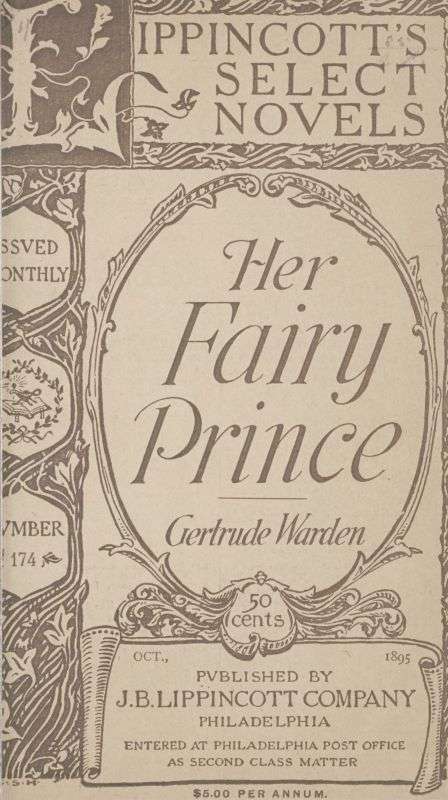
Lippincott's Series of Select Novels
Issued Monthly. In Paper, 50 cents; Cloth, $1.00.
YEARLY SUBSCRIPTION, TWELVE ISSUES, $5.00.
MAY BE COMMENCED IN ANY NUMBER.
THE SEPTEMBER NUMBER CONTAINS
"A SPOILT GIRL,"
By FLORENCE WARDEN.
"Her latest story, 'A Spoilt Girl,' is her best."
PREVIOUS POPULAR ISSUES:
A Magnificent Young Man. By John Strange Winter.
Too Late Repented. By Mrs. Forrester.
The Prince of Balkistan. By Allen Upward.
The Mystery of the Patrician Club. By Albert D. Vandam.
They Call It Love. By Frank Frankfort Moore.
The Banishment of Jessop Blythe. By Joseph Hatton.
Gallia. By Menie Muriel Dowie.
In Market Overt. By James Payne.
The Spell of Ursula. By Effie Adelaide Rowlands.
Mr. Jervis. By B.M. Croker.
Matthew Austin. By W.E. Norris.
Peter's Wife. By the "Duchess."
Every Inch a Soldier. By John Strange Winter.
The Light of Other Days. By Mrs. Forrester.
Found Wanting. By Mrs. Alexander.
Queen of Love. By S. Baring-Gould.
A Man of To-Day. By Helen Mathers.
Burgo's Romance. By T.W. Speight.
A Tragic Blunder. By Mrs. H.L. Cameron.
Paynton Jacks, Gentleman. By Marian Bower.
My Child and I. By Florence Warden.
A Third Person. By B.M. Croker.
The Sign of Four. By A. Conan Doyle.
"To Let." By B.M. Croker.
Aunt Johnnie. By John Strange Winter.
The Hoyden. By the "Duchess."
Barbara Dering. By Amélie Rives.
Broken Chords. By Mrs. McClellan.
Was He the Other? By Isobel Fitzroy.
But Men Must Work. By Rosa N. Carey.
A North-Country Comedy. By M. Betham-Edwards.
One of the Bevans. By Mrs. Robert Jocelyn.
A Family Likeness. By B.M. Croker.
A Sister's Sin. By Mrs. H. Lovett Cameron.
Sir Godfrey's Grand-Daughters. By Rosa N. Carey.
A Big Stake. By Mrs. Robert Jocelyn.
For His Sake. By Mrs. Alexander.
A Daughter's Heart. By Mrs. H. Lovett Cameron.
Lady Patty. By the "Duchess."
Old Dacres' Darling. By Annie Thomas.
A Covenant with the Dead. By Clara Lemore.
Corinthia Marazion. By Cecil Griffith.
Only Human; or, Justice. By John Strange Winter.
The New Mistress. By George Manville Fenn.
A Divided Duty. By Ida Lemon.
Drawn Blank. By Mrs. Robert Jocelyn.
My Land of Beulah. By Mrs. Leith Adams.
Interference. By B.M. Croker.
Just Impediment. By Richard Price.
Mary St. John. By Rosa N. Carey.
Quita. By Cecil Dunstan.
A Little Irish Girl. By the "Duchess."
Two English Girls. By Mabel Hart.
A Draught of Lethe. By Roy Tellet.
The Plunger. By Hawley Smart.
The Other Man's Wife. By John Strange Winter.
A Homburg Beauty. By Mrs. Edward Kennard.
Jack's Secret. By Mrs. H. Lovett Cameron.
Heriot's Choice. By Rosa N. Carey.
Two Matters. By B.M. Croker.
Disenchantment. By F. Mabel Robinson.
Pearl Powder. By Annie Edwardes.
The Jewel in the Lotos. By Mary Agnes Tincker.
Syrlin. By "Ouida."
A Study in Scarlet. By A. Conan Doyle.
A Last Love. By Georges Ohnet.
The Rajah's Heir.
A NEW POSTER SUPPLIED UPON APPLICATION.
Authors and Their Works.
Captain Charles King, U.S.A.
Under Fire. Illustrated. Cloth, $1.25.
The Colonel's Daughter. Illustrated. Cloth, $1.25.
Marian's Faith. Illustrated. Cloth, $1.25.
Captain Blake. Illustrated. Cloth, $1.25.
Foes in Ambush. Cloth, $1.25.
Kitty's Conquest. Cloth, $1.00.
Starlight Ranch, and Other Stories. Cloth, $1.00.
Laramie; or, The Queen of Bedlam. Cloth, $1.00.
The Deserter, and From the Ranks. Cloth, $1.00.
Two Soldiers, and Dunraven Ranch. Cloth, $1.00.
A Soldier's Secret, and An Army Portia. Cloth, $1.00.
Waring's Peril. Cloth, $1.00.
Trials of a Staff Officer. Cloth, $1.00.
Captain Close, and Sergeant Crœsus. Cloth, $1.00.
EDITOR OF
The Colonel's Christmas Dinner, and Other Stories. Cloth, $1.25.
An Initial Experience, and Other Stories. Cloth, $1.00; Paper, 50 cents.
Captain Dreams, and Other Stories. Cloth, $1.00; Paper, 50 cents.
From the lowest soldier to the highest officer, from the servant to the master, there is not a character in any of Captain King's novels that is not wholly in keeping with expressed sentiments. There is not a movement made on the field, not a break from the ranks, not an offence against the military code of discipline, and hardly a heart-beat that escapes his watchfulness.—Boston Herald.
J.B. LIPPINCOTT COMPANY, PHILADELPHIA.
ANNE H. WHARTON.
Through Colonial Doorways.
With A Number of Colonial Illustrations from Drawings specially made for the Work.
12mo. Cloth, $1.25.
"It is a pleasant retrospect of fashionable New York and Philadelphia society during and immediately following the Revolution; for there was a Four Hundred even in these days, and some of them were Whigs and some were Tories, but all enjoyed feasting and dancing, of which there seemed to be no limit. And this little book tells us about the belles of the Philadelphia meschianza, who they were, how they dressed, and how they flirted with Major André and other officers in Sir William Howe's wicked employ."—Philadelphia Record.
Colonial Days and Dames.
With Numerous Illustrations.
12mo. Cloth. $1.25.
"In less skilful hands than those of Anne Hollingsworth Wharton's, these scraps of reminiscences from diaries and letters would prove but dry bones. But she has made them so charming that it is as if she had taken dried roses from an old album and freshened them into bloom and perfume. Each slight paragraph from a letter is framed in historical sketches of local affairs or with some account of the people who knew the letter writers, or were at least of their date, and there are pretty suggestions as to how and why such letters were written, with hints of love affairs, which lend a rose-colored veil to what were probably everyday matters in colonial families."—Pittsburg Bulletin.
The Colonial Library.
Through Colonial Doorways and Colonial Days and Dames.
Two volumes in a box. 12mo. Cloth, $2.50.
J.B. Lippincott Company, Philadelphia.
JUST PUBLISHED.
A New Novel
By FLORENCE WARDEN,
Author of "The House on the Marsh," "My Child and I," etc.,
A SPOILT GIRL.
12mo. Paper, 50 cents; Cloth, $1.00.
"It is rather a fascinating tale, which holds the interest of the reader."—Brooklyn Eagle.
"Miss Warden's novels are always interesting. Readers of 'House on the Marsh' will welcome a new work from the pen of this charming author."—National Tribune.
"'A Spoilt Girl' is a kind of retelling of the old story of Ingomar, with the characters reversed. There is plenty of stirring adventure in it, and Miss Warden's latest venture can be pronounced a good one."—Philadelphia Evening Telegraph.
"'A Spoilt Girl,' by Florence Warden, has a charm which is quite irresistible. There is not a dull page in the book, the dialogues are vivacious and witty, and the chief character is capitally managed."—Philadelphia Press.
"The story is somewhat different from others by this author, for there is no mystery about it, but it is decidedly novel and readable. Those who like Miss Warden's stories, and the number is constantly increasing, will gladly add this to the books to be read at once."—Boston Times.
"'The House on the Marsh,' by Florence Warden, published some two years or more ago, brought this author into favorable notice, and later stories of hers increased the favorable estimate of her works. Her latest story, 'A Spoilt Girl,' is her best. The 'Brancepeths' are a new type, and their portrayal shows great originality. As a love-story the book is delightful."—Boston Daily Advertiser.
For sale by all Booksellers, or will be sent, post-paid, upon receipt of price by the Publishers,
J.B. LIPPINCOTT COMPANY,
715 and 717 Market Street, Philadelphia
SOME FICTION ANNOUNCEMENTS
Ready this Autumn.
A Colonial Wooing.
A Novel. By Dr. Charles Conrad Abbott, author of "The Birds About Us," "Travels in a Tree-Top," etc. 12mo. Cloth, $1.00.
Much interest has been excited in this new venture of Dr. Abbott's, by the fact that it chronicles the doings and adventures of some of his own ancestors: He has, furthermore, so successfully reproduced the atmosphere of that most interesting period—the days of our great-great-grandfathers—that those who wish may realize the life which they lived.
A Wedding, and Other Stories.
By Julien Gordon, author of "A Diplomat's Diary," "Poppæa," etc. Tall 12mo, Buckram, $1.00.
A collection of the shorter works of this popular author, none of which have previously appeared in book form. They comprise some of the strongest work she has done.
The Story of a Marriage.
By Mrs. Alfred Baldwin. Volume I. of a new illustrated series of novels, Published in connection with J.M. Dent & Co. Six illustrations, 12mo. Cloth, $1.50.
"The Story of a Marriage" is a story of mistaken intentions, thwarted plans for the amelioration of the world, and hopeless ideals, brought at last to a happy conclusion by letting the heart lead the head. Mrs. Baldwin has produced a novel of rare charm, which carries with it a lesson of deep importance in this day of shifting faith and broken ideals.
The Black Lamb.
By Anna Robeson Brown, author of "Alain of Halfdene," etc. 12mo, Cloth, ornamental, $1.25
This is a story of New York life, and the adventures of a pair of young Americans, whose education and environment has been uncommon. Circumstances entangle them with two equally unconventional Englishmen, and with a rather unusual fraud.
The Track of a Storm.
By Owen Hall. 12mo. Cloth, $1.25.
Although this is the author's first attempt in writing a long novel, he has succeeded in fashioning a story of adventure which compares favorably with the best work of Weyman or even Dumas.
The Secret of the Court.
A Tale of Adventure. By Frank Frankfort Moore, author of "They Call It Love," "A Grey Eye or So," "I Forbid the Banns," "Daireen," etc. 12mo. Cloth, illustrated, $1.25.
Mr. Frank Frankfort Moore, whose recent novels "They Call It Love" and "A Grey Eye or So" have brought his name into unusual prominence, now comes forward with a romance in an entirely new vein, which will enhance a reputation already wide on both sides of the Atlantic.
For Sale by all Booksellers, or will be sent, post-paid, upon receipt of price by the Publishers.
J.B. LIPPINCOTT COMPANY,
715 and 717 Market Street, Philadelphia.