
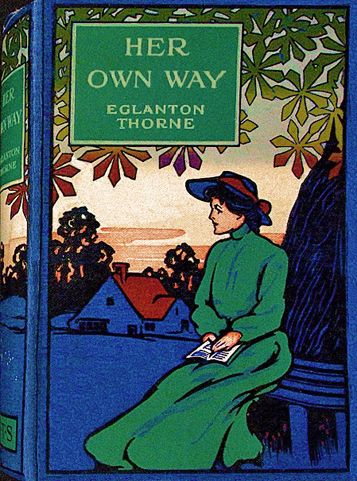
"I do not think so," said Hannah; "Juliet is by no means fond of Dora. I heard her call her a sneak only yesterday. No, if you ask me, I should say that most probably Juliet has been taking tea with her friend, Flossie Chalcombe."
"Oh no, Hannah," said Mrs. Tracy quickly; "Juliet would not go there."
Hannah made no reply, but smiled in a peculiar and exasperating manner. The subject was allowed to drop, but all three were feeling intensely curious as to how Juliet had passed the afternoon. That young lady did not appear to satisfy their curiosity.
As soon as tea was over, Salome went upstairs to get ready to go out. There was a committee meeting at the vestry that evening which she had promised to attend. On the first landing she paused, and, after a moment's hesitation, tapped on the closed door of the room Juliet shared with her mother.
"Come in!" rang out Juliet's voice, and Salome entered.
Juliet was seated on her little bed. She had not removed her hat, but it was thrust far back from the flossy curly mass of sunny hair above her forehead. Dusty shoes still covered the little feet, which she was swinging to and fro in undesirable proximity to the spotless counterpane.
Salome felt the natural irritation of an immaculate housewife who had recently sustained the burdens of a spring cleaning.
"Juliet, I wish you would not sit on your bed. It impossible to keep the counterpane clean if you do so."
"Oh, did you only come to say that?" Juliet's accents were provokingly cool.
Salome looked with angry disapproval at her flushed, excited face and saucy eyes.
"Of course not. How could I know that you were sitting on the bed till I opened the door? I came to ask if you really would have nothing to eat. There are some nice fresh scones downstairs."
"No, thank you, I am not hungry."
Juliet's tone expressed no gratitude. Already she divined that Salome had come mainly from a desire to find out how she had spent the afternoon.
"Where did you have tea?" asked Salome.
"With a friend," replied Juliet laconically, still retaining her position on the bed, and swinging her feet faster than before.
"Of course," replied Salome, with mild sarcasm; "I did not suppose it was with an enemy. That is no answer to my question."
"It is near enough," said Juliet. "I do not see that it matters to you with whom I took tea."
"Really, Juliet, it is hard if a sister cannot ask so simple a thing as that!"
"You may ask, of course,—as many questions as you like,—but I do not feel bound to answer them."
"I must say, Juliet, you are very polite."
"And I must say you are very inquisitive."
"Pray do not let us quarrel about such a thing," said Salome coldly. "You are welcome to make a mystery of it, if you please, only I must say it does not look well that you are ashamed to say with whom you have been taking tea."
And Salome quitted the room.
"I am not ashamed!" exclaimed Juliet, suddenly springing from the bed and darting after her. "And you know it is not my way to make mysteries of things. Since you are so consumed by curiosity, I will inform you that I went home with Flossie Chalcombe and had tea with her. There, now; are you satisfied?" And Juliet went back to her room flushed and triumphant.
A few minutes later, Salome, in her close-fitting, deaconess-like bonnet, with her waterproof cloak neatly folded on her arm, one or two dark clouds being apparent in the evening sky, came into the room where Hannah and her mother were sitting. Her face was rather more highly coloured than usual; but it was in a quiet, composed manner that she said—
"You were right about Juliet, Hannah. She has been taking tea with the Chalcombes."
"You do not mean that?" exclaimed Hannah. "But I am not surprised," she added the next moment.
Mrs. Tracy turned round with a startled air.
"Are you sure of what you are saying, Salome?" she asked, with unusual incisiveness.
"Quite sure, mother. Juliet told me so herself."
"She was perhaps joking," suggested Mrs. Tracy.
"Oh no; I am sure she was not joking," said Salome demurely. "But I must go now, or I shall be late." She passed quickly from the room, and the next moment they heard the hall door close behind her.
At the same instant, Mr. Ainger might have been seen crossing the road from his lodgings on the opposite side.
There was silence in the room for some minutes after she had gone. Mrs. Tracy was feeling intensely hurt and mortified.
"I should think, mother," Hannah said at last, "you must now see that it is desirable Juliet should take a situation as soon as she leaves school."
"Not at a distance," replied Mrs. Tracy, in quick, agitated tones. "I will not have my child sent away from me."
"It would be a very good thing for her to leave home for a time," said Hannah quietly. "It seems the only way of withdrawing her from undesirable connections."
"I will never give my consent to it!" said Mrs. Tracy, in an excited manner. And she rose and went hurriedly from the room, as if resolved not to listen further to Hannah's views on the subject.
Juliet was standing before the dressing-table when her mother entered their bedroom. She had removed her hat, and was engaged in arranging, somewhat fastidiously, her golden locks; but, careless as was her attitude, she was not so much at ease as she appeared. For the last ten minutes she had been hearing with the ears of her imagination the discussion of her conduct that was probably taking place below. Her reflections on the consequences of her confession to Salome were not agreeable.
"Juliet," said Mrs. Tracy, when she had closed the door, "I think you will break my heart."
Juliet had been hardening herself in anticipation of reproof, but she had not expected such words as these. As she heard her mother's faltering tones, and saw that there were tears in her eyes, her own face fell, and she said in tones that expressed unfeigned regret—
"Oh, mother! I am so sorry. I did not think you would mind so very much."
"My dear, after what I said to you only the other day, you must have known that I should very much dislike the idea of your entering the Chalcombes' house."
"Well, yes, I suppose I did know it," Juliet acknowledged ruefully; "but Flossie persuaded me so, and she taunted me with being afraid of Hannah. I could not stand that. But I am sorry if you are vexed with me. Oh dear! I am always doing the wrong thing."
"It is because you are so thoughtless, dear. You always act upon impulse. If only you would give yourself time to reflect."
"Oh, mother, don't preach to me!" exclaimed Juliet impatiently. "It is done now; and, after all, I am not entirely sorry, for, do you know, I was singing to Flossie, and Mr. Chalcombe heard me—"
"Oh, did you see him?" interrupted Mrs. Tracy, in a tone of vexation.
"Yes, he came into the room when I was singing. He is a vulgar little man, mother; but he knows about things, and he said my voice was beautiful, and that if it were properly trained I should be a great success as a public singer, and earn lots of money. Only think, mother, how much better that would be than teaching brats, as Hannah wants me to do!"
"I don't agree with you, dear. The idea is not at all to my mind."
"But, mother, would you not like to have a daughter who could sing like Antoinette Sterling? Fancy, he said I might earn thirty guineas a night! Only think! We should soon be as rich as Crœsus!"
"I daresay," said Mrs. Tracy, with a faint smile; "but you are a long way from that at present, my child. I expect he only said it to flatter you. You must not dream of being a public singer, Juliet. I hate the idea of a public career for a woman. The quieter and simpler her life, the happier she is, as a rule."
"I don't think so," said Juliet, vexed that her mother did not share her elation. "I know I am sick to death of the quietness and simplicity of my life. Oh! what is the matter, mother?"
Her mother had sunk on to a chair, and was pressing both hands to her temples. Her face was very pale.
"My head!" she moaned. "It has been aching all day, but now the pain has grown almost unendurable. I believe I shall have to go to bed."
"Oh dear it is all my fault!" exclaimed Juliet, greatly distressed. "You must go to bed, mother dear, and I will bathe your head with toilet vinegar, and give you the medicine which always sends you to sleep."
And, contrite and remorseful, Juliet waited on her mother in the deftest and tenderest manner. When, some time later, she lay down in her own little bed, her mind was still so uneasy that sleep did not come readily. She turned from side to side, though cautiously, that she might not disturb her mother, many times ere she fell asleep.
Mrs. Tracy, when once her dose began to take effect, slept soundly. She woke in the early morning to find that Juliet was already up and kneeling in her nightdress by the fender, engaged in some mysterious operation.
"What are you doing, dear?" her mother asked.
"I am getting you a cup of tea," Juliet replied, as she anxiously watched the little kettle she had placed to boil on a spirit-lamp; "it will soon be ready now."
"You are very good, darling," Mrs. Tracy said, as Juliet brought the cup of fragrant tea to her bedside. She liked the refreshment of an early cup of tea, though it was an indulgence she rarely allowed herself, since Salome regarded it as an extravagance, and Hannah condemned the habit as pernicious.
"How did you manage to get all the things?" Mrs. Tracy asked, with pleased curiosity.
"I brought them up last night," Juliet said exultantly.
"I do believe you love me a little, Juliet," her mother said.
"A little, mother! I love you a very great deal."
"Then, darling," said her mother, eager to embrace the favourable opportunity, "you will not mind giving me a promise that will be a great comfort to me."
"What is it?" Juliet asked reluctantly.
"Promise me you will not enter the Chalcombes' house again."
Juliet was silent for a few moments, and her colour deepened. She was not one to give a promise lightly, and she did not want to bind herself thus. But when she met her mother's tender, pleading glance, and noted how white and weary-looking was the face which pressed the pillow, it seemed impossible to refuse.
"I promise, mother," she said, in a low voice; and then her mother drew the girl's face down to hers, and kissed her with passionate warmth.
After all, the mother told herself with a throbbing heart, she was a good and loving child, this wayward, spoilt Juliet.
CHAPTER V
A DISAGREEABLE PROSPECT
"AT last I have heard of the very thing for Juliet," said Hannah, in tones of extreme satisfaction.
Mrs. Tracy looked up quickly from her needlework, her face expressing some anxiety. Hannah had just returned from an afternoon visit to the high school. It was a busy time with the teachers, for the school year was drawing to its close and the examinations were being held.
Already the beauty of the summer was past in London. The suburban trees looked dim and dusty; the grass was baked brown; the air was oppressively close and the sun's heat torrid. Everyone was talking or thinking of the seaside.
"Miss Tucker invited me into her room for a little talk," continued Hannah, in response to her mother's questioning glance. "She said she had heard of a situation which she thought Juliet might take. It is at Hampstead—just to teach two little girls. The elder, I believe, is only eight. Miss Tucker thinks Juliet might do well there if she chose."
"If she chose!" The proviso was an important one. Mrs. Tracy felt its significance.
"Miss Tucker says that she would have no hesitation in recommending Juliet for the situation. She thinks she might teach such little ones very nicely; but she is not fit to undertake older ones, for she is not taking at all a high place in the examinations."
Mrs. Tracy's countenance fell.
"Oh dear!" she said, with a sigh. "I am sorry to hear that."
"It is the result of idleness rather than lack of ability," said Hannah severely. "If Juliet were really stupid, one could forgive her. She trifles away her time with that horrid Chalcombe girl instead of working. I don't know whether you are aware, mother, that they are constantly together."
"Yes," said Salome, looking up from the accounts she was carefully auditing. "I asked Frances Hayes yesterday why she never came to see us now, and she said she fancied that Juliet had ceased to care for her visits since she had been so taken up with her new friend. Frances would have nothing to say to such a girl. Her mother is too careful of her."
Mrs. Tracy's colour rose. She looked annoyed—rather, it is to be feared, with her elder daughters than with the culprit they denounced.
"Perhaps Mrs. Hayes has cause to be distrustful of her daughter," she said proudly. "I am not afraid for Juliet. She is kind to that Chalcombe girl because she knows her to be lonely and friendless in the school. The intimacy will naturally cease when Juliet leaves school."
"I hope it will," said Hannah. "It is on that account that I am anxious to lose no time in getting an engagement for Juliet. This lady will want her from ten till five every day, which will leave her little time to herself."
"I wonder what Juliet will say to it!" said Mrs. Tracy, thinking aloud.
"It does not much natter what she says," returned Hannah decisively. "She must be shown what is her duty. The salary will be forty pounds. We cannot afford to throw away such a chance. It is time Juliet helped to maintain herself. Her clothes cost a good deal."
"Not very much," said Mrs. Tracy deprecatingly, "since I make most of her things myself. Of course I see that it is a good chance; but it will be hard for the dear child to get into harness at once. She has been counting on a little extra leisure, and meant to practise up her music. I had almost promised her that she should have singing lessons."
"Surely, mother, you are not going to encourage, Juliet in her absurd notion of becoming a public singer!" Salome exclaimed.
"By no means, dear; but the child has certainly a beautiful voice, and it is a pity that it should not be cultivated."
"Of course, if you have money to throw away on such lessons, there is no reason why you should not indulge her whim," said Hannah coldly.
Mrs. Tracy flushed. The words stung her, coming as they did from the one who contributed most largely to the support of the household. But ere she could defend herself against the insinuation they conveyed, the door opened, and Juliet walked into the room.
Mrs. Tracy made a quick movement, which expressed to her elder daughters her wish that no more should be said on the subject at present. But Juliet saw the signal, and she noted, too, her mother's flushed face and the excited air worn by all three. Little escaped the keen observation of that young lady. She felt sure that she had been under discussion when her entrance broke off the conversation.
"Dear me! How very warm you all look!" she remarked with the utmost sang-froid. "What agitating topic has excited you so? You should really, from sanitary considerations, avoid such discussions when the thermometer stands at eighty degrees in the shade. I am not surprised at you, mother darling; but I do wonder to find Hannah and Salome showing so little good sense."
"I suppose you think that is clever," said Salome, who could never endure Juliet's raillery.
"Oh, very; do not you?" said Juliet, with superb indifference in the glance of her violet eyes.
Salome turned away discomfited. She was not quick at repartee, and she knew that Juliet always got the better of her in a battle of words.
Juliet carried a large fan open in her hand. She now drew her mother's form back more comfortably into her chair and began to fan her. Hannah cast an expressive glance at Salome, and quitted the room Salome soon followed, wishing doubtless to talk over the situation with her sister.
"Well, mother," said Juliet, when they were alone, "what are the latest tactics of the enemy?"
"You should not speak of your sisters so, Juliet. They are not your enemies."
"No?" Juliet lifted her eyebrows comically. "Well, then, what is Hannah's latest plan—'for my good'?"
Her mother could not help smiling at the manner in which Juliet uttered the last words. Mrs. Tracy sometimes feared that she was guilty of encouraging the child in her naughtiness. But the little puss had such pretty, fascinating ways, and the eyes looking mischievously into hers were so full of charm.
Mrs. Tracy's face grew quickly grave again, and she sighed ere she replied to Juliet's question.
"It is rather Miss Tucker's plan," she said, with fine tact. She knew that Juliet, in common with most of the schoolgirls, held the headmistress in high esteem. "She has heard of a daily engagement for which she thinks you are suited," continued Mrs. Tracy, "and has very kindly promised to recommend you for it."
Juliet's countenance fell. She threw down the fan she had been using and walked to the window, where she stood looking out with a moody expression on her young face.
"I hate it!" she said at last. "I hate the thought of teaching a lot of little brats!"
"There are only two," said her mother.
"It's all the same," said Juliet; "I am not a bit fitted for it. But I suppose you want me to take the situation?"
"I think, dear, it is time you began to earn money for yourself," said her mother gently. "Your sisters have a right to expect it. They work so hard, and Hannah contributes so much—"
"Oh, don't tell me of Hannah's exemplary conduct," broke in Juliet impatiently, "I am sick of it. It is horrid to be so poor. If only—oh, mother, if only my voice could be trained, think what I should earn! How much better off we should be!"
"You would probably only be disappointed, dear. You think of the few women who succeed; but you forget the many who fail. I hear people say that all the professions are overstocked. It must be so with music too."
"Of course there are too many stupid, talentless performers," said Juliet, "but you know there is always room at the top."
"Well, dear, there is no reason why you should not practise your music, if you take this engagement," said her mother. "Hannah thinks the salary would be forty pounds, so perhaps you might afford to give yourself lessons. You will go and see the lady, Juliet, if she wishes for an interview?"
"Oh yes, I will go and see her," said Juliet, a mischievous gleam coming into her eyes. "Perhaps when she sees me she will not want to engage me."
Two days later, Juliet was sitting with her friend, Flossie Chalcombe, on the public green near which stood the home of the latter. Juliet had kept the promise she had given to her mother. She had not again entered the Chalcombes' house, in spite of many persuasions to do so. The green had become instead the rendezvous of the friends. Here they would linger for a talk when they had walked together from the schoolhouse, and here Juliet would occasionally seek her friend on the fair summer evenings.
Not infrequently it happened that Algernon Chalcombe strolled across from the house with his dogs and lingered by Juliet's side for a talk. Juliet felt very shy of him when first he came, but she soon grew used to seeing him, and came to look forward to her talks with him. It was pleasant to perceive his admiration, which betrayed itself in so subtle a way that her pride could not take offence. From him and his sister she received ample sympathy in her longings after an artistic life. They fed her vanity continually by pictures of the glorious future from which, as they described it, she seemed to be separated only by a few steps.
Juliet and Flossie were alone on this warm summer evening, and their talk consisted largely of lamentation, for Juliet was the bearer of disagreeable intelligence.
"Is it not horrid, Flossie?" she said, as soon as they met. "Hannah is going to take me to Hampstead to-morrow to see that lady."
"You don't mean it? How disgusting!" returned her friend.
"Is it not? I hate the idea of going there to be inspected; but—" and a laughing look came into Juliet's eyes—"it shall not be my fault if the lady engages me. I mean to do my utmost to make a bad impression on her."
"Oh, Juliet! How lovely! What a capital idea!" said Flossie, laughing heartily. "Algernon says it is shameful of anyone to think of making a governess of you. He says your people don't deserve to have you. He is just mad about it. You should hear how he goes on."
"The lady will not want me till the autumn, happily," said Juliet. "She wishes to engage someone before she goes to the seaside. Are you going to the sea, Flossie?"
"Yes, we are going to Margate," said Flossie. "I like Margate, don't you? Where will you go, Juliet?"
"Oh, I don't know. Mother and I will perhaps get a fortnight at Herne Bay together. Hannah is going to Cambridge, and Salome is to accompany the Hayeses to a religious convention in the North. It will be nice to get rid of them for a while; but I don't care much for anything with this hanging over me."
As the girls talked together there came across the green, from one of the houses opposite, a young clergyman accompanied by a little boy. As he approached the bench on which they were seated, he paused and exclaimed in a tone of vexation, "There! I've forgotten the packet I promised to post. Run back for it, Archie, there's a dear boy. You'll see it on the hall table."
"You will wait for me, Uncle Arthur?" the little fellow stipulated ere he sped away.
"Of course I shall wait for you. See, I will sit here till you come back." And he seated himself on the farther end of the bench.
The girls glanced at him with some curiosity and then continued their talk, Juliet instinctively lowering her tones and Flossie as characteristically raising hers. She was one who never lost an opportunity of showing herself off, and cherished the delusion that her words and bearing could not fail to please everyone.
"Really, Juliet," she exclaimed flightily, "it is very odd to think of your becoming a governess. Everyone will be calling you Miss Tracy."
"Indeed, I hope they will not address me in that prim way," said Juliet; "I shall hate it."
"But they will. Governesses are always addressed in that manner. 'Miss Tracy, I hope that your pupils give you satisfaction,'" said Flossie, mimicking the air of a grand lady.
"Do be quiet, Flossie," said Juliet, with some irritation, caused rather by her companion's loudness than by her words. She glanced towards the clergyman.
To her surprise, he was regarding her with an air of interest. He seemed about to speak, then hesitated; finally, with heightened colour, he bent towards her, lifting his hat and speaking very courteously.
"Excuse me if I seem intrusive,—I would not willingly be impertinent,—but I could not help hearing your name. Now it happens that a gentleman with whom I have recently travelled from Australia is anxious to find some relatives of that name in London. Can it be that you are one of those he is seeking?"
"I do not think so," said Juliet, much surprised; "I believe I have no relative of the name of Tracy. There are just my mother and I. My father, who was an officer in the army, died many years ago."
"Strange!" exclaimed the clergyman. "This gentleman spoke of having had a brother in the army. I wonder if you would mind letting me have your address, on the chance of its being of service to him? He is not one whom you need fear would make any undesirable use of it."
"Oh, I do not mind in the least," said Juliet, and she hastened to tell him where she lived.
He thanked her cordially; then, as his little nephew came running to him, he lifted his hat and walked away.
"Well, that's a funny thing!" exclaimed Flossie. "To think of his catching up your name like that! Can it be that he has met with any relative of yours?"
"I do not think so," said Juliet; "I never heard of our having anyone in Australia belonging to us. But mother will know."
"Suppose it should be a rich uncle turned up to make you his heiress," said Flossie. "Would not that be lovely? You would not have to be a governess then."
"No, indeed. Oh, it would be lovely!" exclaimed Juliet, her imagination elated by the idea. "But it is not in the least likely! Such a thing would never happen to me."
"I don't know about that. It seems to me that you are just the one to whom nice things should happen. I can fancy you becoming anything—a prima donna, a duchess, a queen!" said Flossie, who set no limits to her flattering speech.
Juliet laughed, and shook her head.
"A poor little drudge of a daily governess is what you may fancy me, Flossie," she said. But she was not ill-pleased by the tribute paid to her vanity. "I wonder who that gentleman is," she said, glancing back at the clergyman's retreating form. "Do you not think he has a nice face?"
"No, indeed. I thought him remarkably ugly," replied Flossie; "but I admit he is rather distinguished-looking. A gentleman, no doubt."
"I like his face," said Juliet; "it looks so good and strong."
"Really, Juliet, I did not know you were so fond of good people!" said Flossie, laughing.
"I do not admire people who think themselves good, and want to put everyone else right," said Juliet, "but I do like people who are really good. I wish—"
Juliet suddenly checked herself, with an instinctive sense that Flossie would not understand her wish. How could she express the emotion with which, in spite of her perversity and self-will, her heart would often swell as she thought of all that is good, and true and beautiful in human life?
Juliet did not mean her life to be just like the lives of the people about her. She was impatient when others sought to control her. She wanted to take her own way, but she never meant that it should be an ignoble way. She had her ideals, though they were all too vague and visionary. She hated selfishness and meanness, and felt a keen sense of injustice whenever her sisters pronounced her selfish. But they could only judge her actions by their shrewd, matter-of-fact observation; they had not the imagination to conceive how different they might appear seen from her point of view.
CHAPTER VI
JULIET IS INSPECTED
"MOTHER, do you think it can be anyone belonging to us?" asked Juliet eagerly, when she had told of her meeting with the unknown clergyman that afternoon, and the question he had put to her.
"Oh no, dear! Tracy is not an uncommon name. And yet—it is very strange—your father had a brother who went to Australia; but he has been dead for years—at least, it was always believed that he was dead."
"But it was a mistake—it was a mistake, and he has come back to claim us as his next of kin!" cried Juliet excitedly. "Oh, that's so, I am sure! Of course he is rich, and I shall not need to be a governess—"
"My dear child, how you talk! You quite bewilder me! You forget what a big place Australia is. There may be hundreds of Tracys there. And your father always believed his brother to be dead. To be sure, he went off in a huff, and perhaps wished his relatives to think him dead. His name was Ralph. There were only the two children—your father and he. They were early left orphans, and were brought up by their grandfather. I believe there was some jealousy between them. At any rate, there was a quarrel, and Ralph took himself off; but I never heard the particulars. Your father did not care to speak about it."
"Oh, mother, I can't help thinking that it is my uncle who has returned! How I wish he would make haste and look us up! I could snap my fingers at Hannah and Salome if I had a rich uncle to defend me."
"Juliet! What a way to speak! You really are a very naughty girl."
"Just so. Quite incorrigible. I shall consider it my duty to inform Mrs. Campbell that I shall not make an exemplary instructor of youth."
Mrs. Tracy glanced quickly at Juliet. She caught a gleam of mischief in her eyes that caused her some misgivings. How would the child behave on the morrow? But she took no notice of Juliet's words. She wished to avoid all reference to the interview arranged for the morrow. She was fearful lest anything should be said that might throw Juliet into an intractable mood. So she did not attempt to check the girl, when she presently launched out into glowing descriptions of what their life might become on the advent of the rich uncle. Castle-building is undeniably an amusing diversion, and we learn soon enough the unsubstantial nature of the airy structures we rear.
Juliet's mood had changed by the next morning. She had no longer any hope of something wonderful happening to brighten the horizon of her future. Her spirit rebelled more than ever at the thought of the hated inspection to which she was to be subjected in the afternoon. She was petulant and irritable in her speech, looked at times very cross, and at others exhibited a mischievous glee accompanied by that wicked gleam in the violet eyes which had already caused her mother uneasiness.
"You will be careful to dress yourself neatly," said Salome to her, when she was about to prepare for her visit. "So much depends upon the first impression."
"You need not be afraid," returned Juliet, with sparkling eyes, "I mean to be very careful as to the impression I make."
There was little fault to be found with her appearance when she came down a few minutes later. To her mother's eyes she had never looked prettier. Salome scrutinised her carefully from head to foot; but gloves, boots, gown, all were neat. Salome's disapproving glance fell on the unruly locks which showed in soft, flossy confusion beneath the wide Leghorn hat which so charmingly became the fair, young face.
"Can't you make your hair a little tidier?" she asked. "It seems frizzier than ever to-day."
"No, I can't," said Juliet, giving her head a shake which made the wayward golden curls stand out farther from her brow than before. "My hair is just part of myself, and I cannot alter it. Most people find my golden locks admirable."
"There, you look very nice, dear!" said her mother fondly. "Run away now; you must not keep Hannah waiting, or you will miss the train."
Mrs. Tracy and Salome stood side by side at the window and watched Hannah and Juliet as they walked to the gate.
"She does not look much fit to be a governess, does she?" remarked Salome.
"No, indeed, poor dear!" responded Mrs. Tracy, with feeling. "You look much more suited for it," she added, not without a touch of satire.
But Salome was unconscious of the satire. She received her mother's words as complimentary. She prided herself on the extreme simplicity of her dress, and the contrast it presented to the general mode. She liked to think that she was not as other women. To her the word fashionable appeared quite synonymous with sinful. She believed the attitude she maintained towards the world and its fashions to be indicative of a superior mind and character. It cost her no self-denial to refrain from wearing pretty things, for she had little taste for these; nor did it pain her to be considered odd. She had her reward in many a glow of self-esteem, many a proud, complacent reflection upon her own heroic, martyr-like fortitude.
Juliet had little to say, as she and her sister walked to the railway station. She responded so briefly to the remarks made by Hannah that the latter concluded she was "sulky."
As soon as they had taken their places in the train, Hannah, who had a horror of wasting time, unrolled a copy of the "Educational Times," with which she had provided herself for this opportunity, and read intently till the train stopped at Hampstead station. Once or twice she glanced at Juliet, who had seated herself at the farther end of the compartment, which they had to themselves. Juliet appeared to be absorbed in contemplating her gloves. Hannah was shortsighted, and she failed to see that Juliet's right hand held a tiny penknife, with which she was carefully opening the seams of the glove on her other hand just at the tips of the fingers. Nor did she observe that Juliet afterwards gave some attention to her boots.
The house for which they were bound was at some little distance from the station, and Hannah experienced difficulty in finding the way. She was anxious to be punctual to the hour Mrs. Campbell had named, and as she hurried along, she gave little heed to Juliet; but she was aware that whilst she was growing worried and impatient, Juliet's mood had taken the reverse change. Her sulkiness had vanished. She took an amiable interest in her sister's perplexities, spoke brightly, and even made humorous observations on the persons and places they passed—a sure sign she was in a good humour. Hannah marvelled, but congratulated herself on the transition.
They reached the house very little behind time. As she stood on the doorstep and rang the bell, Hannah turned to make a critical survey of Juliet.
"Why, Juliet," she exclaimed, in a tone of dismay, "there's a button gone from the front of your frock! How very careless of you to come out like that!"
"So there is!" said Juliet. "And it has not been off long," she added, raising her hands to the spot where the loose threads hung, and examining it with an air of scientific interest. The action brought her gloves full into Hannah's view, and she exclaimed in horror as she saw their condition—
"Juliet, how could you put on such gloves? I declare there is every finger showing! They are perfectly disgraceful."
"Now you mention it, they do look rather bad," said Juliet, as though the idea would not have occurred to her unprompted.
"Bad!" The opening of the door cut short Hannah's indignant utterance. There was no help for it; retreat was impossible now. Hannah had to compose herself as best she could, ask for Mrs. Campbell, and follow the neat parlour-maid across the hall to the drawing-room, with a mortifying conviction that the coming interview must prove a failure. What had her mother and Salome been about, not to see that Juliet started properly equipped?
"My dear Juliet, do sit with your back to the light, and keep your hands out of sight as much as possible," Hannah admonished her when the servant had left them to themselves.
"Really, Hannah, I don't think that would be fair to Mrs. Campbell," Juliet replied, with provoking, gravity. "I came here that she might inspect me, and she has a right to see me in the best light."
She seated herself as she spoke opposite to a window with her feet well exposed to view. With fresh consternation, Hannah perceived that two buttons were missing from her left boot.
"Dear me," said Juliet, as Hannah pointed it out, "it is strange how buttons will sometimes come off!"
Before Hannah could say another word, Mrs. Campbell entered the room. No woman could bear herself with more dignity and self-possession than Hannah was wont to display; but now her usual self-possession deserted her. Her sense of shame at the appearance Juliet presented made her nervous and almost shy. She half suspected that Juliet had deliberately planned to discomfort her thus, and she was in absolute dread as to how her young sister might comport herself during the interview. What could she venture to say, whilst Juliet sat by with that mischievous light in her eyes, and that innocent—all too innocent—expression of the rosy mouth, the meaning of which Hannah knew but too well? Never had she felt herself in a more uneasy position.
Mrs. Campbell was a graceful little woman with pleasant manners. Her blue eyes had a very keen, alert expression, and Hannah felt sure that she took in at the first glance the glaring defects of Juliet's attire.
"I could have sunk through the floor with shame," she said afterwards, when describing her sensations to Salome.
Mrs. Campbell's glance softened as it rested on Juliet's pretty, childish face.
"This is surely not the sister of whom Miss Tucker wrote to me," she said, turning to Hannah. "She looks far too young to be a governess."
"She is neatly twenty," replied Hannah.
"Indeed! I should hardly have thought you were seventeen," she said, looking with a smile at Juliet. "Are you fond of children?"
"No, I am not," said Juliet frankly. "To be sure, I never have had much to do with them, for I am the youngest at home; but I do not think I should like them."
"That is unfortunate," said Mrs. Campbell, looking puzzled; "then what made you think you would like to teach?"
"I don't think it," replied Juliet; "I must tell you candidly that I hate the idea, and I do not think that I am in the least fitted to be a teacher. It is my sisters who wish me to be a governess. They think I ought to earn money."
Hannah flushed crimson. "Juliet," she protested, "you are not fair to us in putting the case so. We are anxious that Juliet should find something to do," she explained, "because we are sure she would be happier if she had regular occupation. Of course I do not mean you to understand that it is not of importance to us that she should help to maintain herself, but I am sure our main desire is for her good."
"Certainly, certainly. You are quite right. It is well for girls to have something definite to do," said Mrs. Campbell. She could sympathise with the elder sister in her embarrassment, but Juliet had still more of her sympathy. She was charmed by the girl's prettiness and amused at her audacity; but, as a governess, she put her out of the question at once. "Still, I think it a mistake to try to force inclination," she continued. "If your sister has no fancy for teaching, would it not be better for her to try something else? I am strongly of opinion that no one should attempt to teach who does not feel a true vocation for it. Now I must own that my little girls are so high-spirited and so little disposed to learn, that I should feel afraid to entrust them to one who did not truly love children, and feel some enthusiasm in teaching them."
"Of course; I can quite understand that after what has passed you could not feel otherwise," said Hannah, rising to go.
But at that moment a servant entered with tea, and Mrs. Campbell gently insisted that her visitors must take some ere they went away. Each would gladly have gone at once. Juliet's momentary sense of triumph was past, and she was feeling ashamed of the part she had played. She felt that she had acted meanly by Hannah. Moreover, her self-respect was sorely wounded, and her cheeks burned with shame as she was obliged to display her very untidy gloves, whilst Mrs. Campbell, with charming courtesy, waited on her and supplied her with tea and cake. For Juliet had the instincts of a lady, although she had chosen to act in defiance of them that afternoon.
Hannah said nothing for some minutes after they had left Mrs. Campbell's house. She was feeling so indignant that she hardly dared trust herself to speak.
"You need not fear, Juliet, that I shall ever come on such an expedition with you again," she said at last, bitterly. "This is the first, and it shall also be the last."
"So much the better," replied Juliet, with affected cheerfulness.
"You might have told me," continued Hannah, "that you meant to make it impossible for Mrs. Campbell to engage you. You need not have placed me in such a humiliating position."
"I said nothing but what you knew perfectly well before," returned Juliet. "I thought it right to be candid."
"I never knew before that you disliked children," said Hannah. "I have seen you play with the little Hayeses as if you were quite fond of them. You have thrown away an excellent chance. I believe Mrs. Campbell was inclined to like you."
"So are most people, except you, Hannah."
"You have no right to speak so, Juliet. I am sure there is nothing I would not do for you; but you must remember that if people wish to be loved they should be loving. When do you try to please me or Salome? You simply delight in vexing us."
"Then I must be a happy mortal, for it seems very easy to vex you," said Juliet.
Hannah attempted no retort to this shaft of satire, and for the rest of the way home they maintained silence. Though she held her head high and affected the utmost indifference, Juliet was feeling rather out of spirits as they came in sight of The Poplars. To her surprise she saw a hansom cab standing at the gate.
"Who can have come?" she asked. Then, clasping her hands in sudden glee, "Oh, if it should be my rich uncle!" she cried, and hurried into the house.
Salome met her in the hall with an air of mild excitement.
"Gently, Juliet," she said; "there is a gentleman in the drawing-room with mother. See, this is his card. I suppose he is some relative."
Juliet glanced at the card and uttered a little cry of ecstasy.
"Mr. Ralph Tracy! It is he! It is my rich uncle!" she cried, and tearing off her gloves and throwing them from her, she hurried to the drawing-room door.
"Stay, Juliet!" exclaimed Salome, as soon as she was aware of her intention. "You must not go in unless mother sends for you."
But she spoke in vain, for Juliet had already opened the door.
CHAPTER VII
THE RICH UNCLE COMES
JULIET walked impetuously into the drawing-room, and gazed with frank curiosity at the stranger who sat there talking earnestly with her mother.
He was not at all the big, florid, prosperous-looking man she had expected to see. He was of slight build, and so thin as to be almost cadaverous. His head was bald, save for a fringe of iron-grey hair at the back; he had sharp features, and keen though rather sunken eyes. He spoke hoarsely; his clothes were good, but of a precise, old-fashioned cut. He was seated with his back to the door, and Juliet, as she approached, had time to notice these details ere her mother uttered her name and the stranger rose.
"So this is Juliet?" he said, looking at her with evident admiration. "I am happy to make your acquaintance, my dear;" and as he took the hand she offered him, he bowed over it with old-fashioned courtesy.
"Juliet," said Mrs. Tracy, who was looking much pleased and excited, "this is your uncle, your father's only brother, whom everyone thought was dead."
"How delightful!" exclaimed Juliet, in clear, ringing tones. "I am very glad that everyone was wrong. How delightful to have an uncle!"
"It is very pleasant to hear you say so," said her uncle, looking intensely gratified; "and, for my part, I am ready to say, 'How delightful to have such a niece!'"
His face had a very agreeable expression as he spoke. His eyes, if keen, were kindly, and had a humorous twinkle. Juliet looked at him, and felt that she should like him.
"It is but lately I have learned that I might claim so precious a possession," continued Mr. Tracy. "Strange to say, I never heard of my brother's marriage nor of his death till quite recently, chance brought to my remote Australian dwelling a gentleman who had formerly been in your father's regiment. He told me that he believed my brother's widow and child were living somewhere in London. I pondered the news for some little time ere I made up my mind to come home. I had grown weary of a lonely life; the reasons which had led me to cut myself adrift from all who had known me in the Old World no longer existed. Perhaps I was wrong in acting as I did, but I thought myself justified at the time. However, there is no need to dwell upon that now."
Mrs. Tracy manifested no indiscreet curiosity. She judged it best the past should remain in obscurity. An attempt on her part to explore its mysteries might result in bringing to light facts concerning her husband, Captain Tracy, which it would be painful to learn.
Juliet, too, had no desire to learn more of her uncle's history than he was disposed to tell. She was interested in him for various reasons, but not at all in his past. It was not strange that he should display considerable interest in her; that seemed to her only what was to be expected. She received his flattering attention in the most unabashed manner, wondering that he was so old-looking, and so unlike the portraits of her father she had seen.
"You are not married, I think?" Mrs. Tracy said to him presently.
"I have been married, but my wife is dead," was his reply. "I had a little daughter, too, but she died."
He spoke with an effort; evidently it was painful to him to speak of himself. He was one who shunned rather than sought sympathy, but he was very ready to ask questions concerning his sister-in-law and her child. Juliet was soon chatting away to him, and giving him abundant information concerning herself in her usual outspoken way.
"This is a happy ending to a very horrid afternoon," she remarked.
He inquired wherein the horridness of the afternoon consisted, and Juliet proceeded to give him an amusing description of her interview with Mrs. Campbell. He could not help laughing as she told the story. Even Mrs. Tracy had difficulty in keeping a grave countenance—a fact which robbed of all effectiveness the reproofs she felt bound to deliver.
"I am afraid she would not make a model governess," said Mr. Tracy to her mother, as he wiped away the tears that laughter had induced.
"I am afraid not," said Juliet, with a resigned air; "but a governess I shall be, if Hannah and Salome have their way."
"And who are Hannah and Salome?" he asked.
Mrs. Tracy, with some embarrassment, explained the existence of her two elder daughters.
He listened, and looked at Juliet with new interest. Was this pretty young creature, then, in the position of a Cinderella, tyrannised over by elder sisters, whose hearts were as ugly as their persons? Well, he would see if he could not act a part similar to that of the fairy godmother. A little later he rose to go, and was not to be persuaded to remain longer in order to make the acquaintance of Hannah and Salome.
"Another day I shall hope to have that pleasure," he said. "Now I must be getting back to my hotel. The truth is, I am somewhat of an invalid, and have to diet myself very carefully, so that I am obliged to decline all hospitable invitations."
"I am sorry to hear that," said Mrs. Tracy. "Are you thinking of consulting any of our London physicians while you are in town?"
"By no means," was the reply, given with more energy than he had as yet displayed. "I have no opinion of modern physicians. If by the time he is forty, a man has not learned to understand his own constitution better than anyone else, it is a pity. Health is mainly a matter of diet; the flesh-consuming propensities of humanity are a fertile source of disease."
"Then you are a vegetarian?" said Mrs. Tracy.
"Well, yes—I suppose I am," he said, and then, with his usual aversion to discussing himself, abruptly changed the subject.
"Take care of that pretty child of yours," he said, lowering his voice; "and don't let there be any more talk of making her a governess: she is far too young for that. I will see that she has what she wants. I am not a rich man, but I can so provide for her that there shall be no need for her to earn money."
"You are very kind, I am sure. It is too good of you!" exclaimed Mrs. Tracy, with a flush of surprise and pleasure.
But to be thanked was apparently even more alarming to Ralph Tracy than personal talk, and Mrs. Tracy's thanks caused him to hurry from the house with all speed.
Mrs. Tracy half hoped that Juliet had not heard her uncle's parting words, but her quick ears had caught their purport, in spite of his lowered tones.
As his cab drove away she rushed into the dining-room and pirouetted wildly round the table in her delight.
Hannah looked up from her book with a clouded brow.
"Hurrah! Hurrah!" shouted Juliet. "My rich uncle has come, and there is to be no more talk of my being a governess. He said so himself; I heard him. Mrs. Campbell may get me now if she can!"
"You forget," said Hannah, "that Mrs. Campbell very distinctly declined to engage your services."
"Thereby showing herself a sensible woman," said Juliet. "Oh, I am so glad! I feel just crazy with delight!"
"And you act as if you were crazy," said Salome, as she stitched vehemently at a garment she was finishing for the Dorcas Society.
"Well," said Juliet, with a sigh of intense satisfaction, "there is some chance of my getting a little of my own way now."
"As if you had not taken your own way all your life long!" said Salome.
"Who would have thought of such a thing?" said Mrs. Tracy, as she entered the room, her face radiant with happy excitement. "My husband's brother! And I hardly knew that he had a brother! Indeed, when first he mentioned him to me, he told me he felt sure that he was dead. It is most strange!" And sitting down, she described very vividly the interview with Mr. Ralph Tracy, and repeated all he had said.
It did not strike her that her elder daughters listened with little interest. She was too thrilled and elated herself by what had happened to mark how it affected these others; but Hannah and Salome were painfully conscious of being out of it all.
The event of the afternoon was nothing to them; it was not their uncle who had presented himself in this remarkable manner, and Hannah felt bitterly that Juliet, who deserved to be severely reprimanded for her conduct at Mrs. Campbell's, would now escape without even a reproof. She had no right to the wild delight she was exhibiting. Hannah's common-sense withheld her from introducing the subject of Juliet's misdoings at this moment. She knew that her mother was in no mood for discussing them, and it would be wisest to pass them over in silence.
But none the less, Hannah resented the light-heartedness Juliet was displaying. Would it always be thus? Would the girl never be made to feel the consequences of her flagrant wilfulness? It seemed so. It appeared as if life were to be made exceptionally smooth and easy for Juliet's feet. There was to be no further thought of her being a governess or earning her own living in any way. And Hannah, who had worked very hard all her life, first as a schoolgirl, ambitious of distinction, and later as a painstaking, conscientious teacher, unconsciously felt aggrieved at the contrast which the lot of her young sister seemed to present to her own.
"Juliet will get her own way in everything now, you will see," she remarked to Salome that night, as they were going to bed.
"She has had it pretty much already, I think," said Salome. "Do you mean that she will gain her desire of becoming a public singer?"
"I was not thinking of that especially," said Hannah, startled by the suggestion. "I devoutly hope that may not be the result; but nothing would surprise me. It is possible, however, that her uncle might object to such a career for his niece."
"I wonder if he is very rich," said Salome.
"He said he was not a rich man," replied Hannah; "but since he volunteered to provide for Juliet, I presume that his means are not straitened."
"Well, I hope this may prove for Juliet's good," said Salome, with a dubious air, "but I cannot help thinking it would be better for her to have to work."
"Indeed it would. She is far too idle and frivolous as it is. I don't know what she will become when she has nothing to do but to please herself."
"I would not change places with her," said Salome. "Idleness is a great temptation. I am more than content with my life of hard work."
"And so am I," said Hannah.
But, in spite of their wise words, perhaps neither of the sisters was absolutely free from envy, as they contemplated the good fortune that had befallen that spoilt child Juliet.
CHAPTER VIII
FORTUNE SMILES ON JULIET
IN the days that followed, Hannah's prophecy respecting Juliet seemed to find its fulfilment. She certainly did win her own way in everything, and with as little effort as possible. If her uncle were not a rich man he was a very generous one.
Juliet had but to express a fancy for anything, and, if it were in his power to obtain it, he got it for her directly. He literally showered gifts upon her. Juliet had charmed him at the moment of their first meeting, and the fascination increased as he saw more of her. It was delightful to think that she was his nearest relative, and that he had a better right to care for her and protect her than anyone else except her mother. Naturally a man of warm and affectionate disposition, his years of solitary, self-centred life had left him with a heart still so tender that it found exquisite delight in ministering to the pleasure of "the child," as he constantly called her, forgetting, as so many did in regard to Juliet, that in years she was no longer a child.
Mr. Tracy had named so liberal a sum as the extent of his provision for the child's frocks and personal expenses; that Juliet could now indulge freely her taste for pretty dress. She spent most of the early days of her freedom as a young lady who had "left school" in visits to the West End shops, accompanied by her mother, to whom the business of choosing gowns, millinery, and various of the latest dainty trifles designed for girls' summer wear, afforded scarcely less pleasure than to Juliet. It gratified Mrs. Tracy intensely to see how pretty her darling looked when arrayed in these; but Salome's face was very grave when she saw the parcels opened and the dainty clothes displayed. Such an outlay on finery appeared to her most extravagant, whilst it must tend to foster Juliet's vanity. Mrs. Tracy was driven to defend herself, in response to the accusation she read in her daughter's looks.
"There is surely no sin in wearing pretty clothes, Salome?" she said. "At Juliet's age it is but natural to take delight in them. One can be young but once. You might sympathise with her a little."
"I can't help seeing what these things may lead to," said Salome. "Don't ask me to encourage her vanity."
Juliet's shopping was by no means entirely for self. She was anxious to purchase for her mother more things than she was willing to accept. One day a charming little bibbed apron struck her as just the thing for Salome to wear when engaged in domestic duties, and she bought it for her.
But when she gave it to her, Salome looked doubtfully at the cream lace and crimson bows, and said, after a moment's hesitation, "It is very kind of you, I am sure, Juliet, but—I should not know myself in that be-ribboned thing. You had better give it to mother."
And Juliet, sorely stung, vowed that she would never give Salome a present again.
On the following Sunday morning, Juliet stood at the dining-room window waiting till her mother was ready to accompany her to church. Hannah and Salome had already started. It was the first Sunday in August, and oppressively hot. On Tuesday, Salome was to travel north with the Hayeses; Hannah would start for Cambridge on the following day, and Juliet and her mother hoped to leave for North Devon two days later. Through Mr. Tracy's liberality they were to have a more enjoyable change than they had anticipated. He was taking the greatest interest in their plans, and even talked of joining them at Lynton a little later.
Juliet had arrayed herself all in white, and was looking delightfully fresh and cool. She was enjoying the inward satisfaction produced by her consciousness that every adjunct of her attire was in faultless taste. It is to be feared she was not indifferent as to the effect her appearance was likely to have on those who saw her in church. As she stood at the window, she observed with some curiosity the church-goers who were passing.
"Mother," she said, as Mrs. Tracy came into the room, slowly putting on her gloves, "come and look at Dora Felgate. She has a new pink gown. It is very smart, and it suits her because she is so dark. She and her sister have done their hair in the new way. I don't think it suits Dora; but she always likes to be in the latest fashion. Ah! There is Mr. Ainger coming out of his house and hurrying to overtake them. Yes, now he is speaking to them. Oh, how he is smiling at Dora! Ha! Ha! How foolish it is of Salome to think she can attract him by dressing in that dowdy fashion! He does not admire plain gowns and deaconess bonnets. He likes girls who dress à la mode."
"You naughty child! You shall not talk in that way," protested Mrs. Tracy. "Salome does not dress to attract Mr. Ainger."
"Oh, does she not?" said Juliet, with mischief in her eyes. "Then I should like to know why she persistently makes such a guy of herself."
"It is not fair to call Salome a guy," said her mother; "those small, close-fitting bonnets are very becoming, I think. And you know that your sister spends as little as possible on dress, in order that she may have more to give away."
"And yet when I offered her an apron for nothing she would not take it," said Juliet.
"It was too smart for her taste."
"Too smart for her lack of taste, you mean!" retorted Juliet.
And her mother allowed her to have the last word on the subject.
Among those who cast admiring glances at Juliet's pretty, fresh attire as she followed her mother up the aisle of the church was Flossie Chalcombe. She had come to church indeed chiefly for the sake of seeing Juliet. They had hardly met since their school term ended. There had just been one brief opportunity, of which Juliet had availed herself to tell Flossie the wonderful news that the rich uncle had indeed appeared, and her life was delightfully changed in consequence.
Flossie was longing to know more. Now, as she observed Juliet's graceful, distinguished appearance, she noted that new clothes were among the agreeable results of the uncle's coming. There was envy as well as admiration in Flossie's eyes as she scanned every detail of Juliet's neat, perfectly fitting costume. Flossie's own gown was far gayer, but, as she knew well, it was not in such good style as Juliet's. Flossie loved fine clothes. She regarded with absolute reverence everything that could be described by her favourite adjective, stylish. She could seldom gratify as she would her own taste in this respect. Her father was at once lavish and mean. Money was often scarce in their extravagant, ill-ordered household.
Flossie had no regular allowance for dress, but had to coax and cajole her father into giving her money as she wanted it. If he were in a good humour, he would perhaps give her more than she expected; but more often, he gave her less than she wanted, so that she was driven to run up bills unknown to him, reckless of the storm she must face when they had to be settled. As she had no idea how to lay out money to the best advantage, and generally bought the first thing that struck her fancy, her wardrobe was full of sharp contrasts, and her appearance seldom presented a harmonious whole. The effect of a good gown would be marred by shabby boots, or that of a fashionable and expensive hat by a cheap and ill-cut jacket. In spite of all her efforts, poor Flossie did not, as Juliet's sisters were so keenly aware, look like a lady. There were times when she was dimly conscious of this herself. Such a twinge of painful consciousness visited her now, as she watched Juliet looking so cool and at her ease in the gown which became her so well.
"Enter not into judgment with Thy servant, O Lord." The voice of the clergyman, who was commencing the service, broke in upon her thoughts. Oh, if God were to judge us according to the vain imaginings, the petty cares we suffer to absorb our minds when we profess to worship Him, where should we stand?
At the close of the service, Flossie watched for her opportunity, and as Juliet stood alone at a little distance from the church waiting for her mother, who had lingered to speak to an acquaintance, she approached her.
"How awfully nice you look to-day, Juliet! I never saw you in a more becoming frock. If Algernon could see you now, all in white, he might well call you an angel."
Juliet started, coloured, and looked round in some alarm, for Flossie had not thought it necessary to lower her voice.
"Hush, Flossie! I wish you would not speak in that way. I am not an angel, or anything like one."
"Now you need not be cross. I meant no harm. You do look charming, and I think a poor unlucky creature like me might be allowed to admire the way in which you act the role of the rich heiress."
"Heiress indeed! What nonsense you are talking! I am no more an heiress that I am an angel."
"Rubbish, Juliet! You need not try that on with me. Of course your uncle means to leave you all his money."
"If he does, I am quite unaware of his intention; nor has such an idea even occurred to me before," said Juliet disdainfully, whilst the colour deepened in her cheek.
Flossie saw she had made a mistake.
"Well, I am sure your friends would be only too glad if he did. Algernon was saying yesterday how fitted you were to grace any position. He says he is glad for your sake; but he can't help feeling that he shall never see you now. You will forget your old friends."
"You do not know me, Flossie, if you say that," replied Juliet, with flashing eyes; "I never forget friends—I am faithful, whatever else I may be."
"Of course you are. That is what I told him. You are a darling, Juliet. There is no one like you. You are not to be tried by ordinary rules."
Juliet felt impatient of this flow of adulation. She looked back, and saw her mother coming alone.
"I must go back and meet mother," she said; "I cannot let her walk home alone. Good-bye, Flossie; I shall see you again, I hope, when we return from North Devon."
So they parted. On the opposite side of the road Hannah and Salome were walking with Mrs. Hayes. Juliet met them as she turned back. Her eyes flashed defiance at her sisters. Mrs. Hayes looked at the girl with hard scrutiny as she bowed to her. She was of opinion that Juliet was not a nice girl.
The following Sunday found Mrs. Tracy and Juliet at Ilfracombe, delighting in the grandeur of that rocky coast and the magnificent sea that beats against it. They had not had such a holiday together for years, and they enjoyed it most thoroughly. Mrs. Tracy was still young at heart; she was, in many respects indeed, far younger than either Hannah or Salome, and she quite enjoyed the novelty of wandering about, taking irregular alfresco repasts, driving in a donkey-carriage when the distance was beyond her walking powers, and almost living out of doors during the glorious August weather. From Ilfracombe they went to Lynton, and there Juliet's uncle joined them.
In spite of his thin, cadaverous appearance Mr. Tracy seemed strong and wiry. He was ready to accompany them on any excursion they liked to plan. He had no objection to picnics, as long as he was not urged to forsake his own regimen. When Juliet and her mother ate sandwiches with the relish imparted by strong, pure air, he would allow himself only the refreshment of two Abernethy biscuits and an acid drop, the latter item being, as he would gravely assure Juliet, safer and better as a thirst-quencher than a draught of water, when one could not be sure that that was absolutely uncontaminated.
Juliet was greatly amused by his fads, which happily he did not try to persuade her to follow. But Mrs. Tracy was rendered quite uneasy by them.
"I cannot think how he sustains life on so little," she would say. "He need be thin. It is a wonder he is as well as he is. What a profit they must make out of him at the hotel!"
Juliet was content to leave her uncle's health to his own care. He must please himself. But she liked him exceedingly, since he showed himself more and more charmed by her pretty ways, and more and more desirous of gratifying her every fancy. With him, she was never wayward and petulant, but only sweet and winsome and mischievous. Instinctively she showed him the best side of her character; and, as her sisters were wont to remark, Juliet could be very nice to people when she chose.
One lovely evening, the three were walking along the romantic cliff path at Lynton, which commands such a glorious view of sea and sky, and terminates at the Castle Rock. Juliet's quick steps had carried her a little in advance of the others. She was singing little snatches of song to herself, and was only half conscious of the beauty about her, for her mind was busy weaving golden visions of the future, when round a bend of the narrow path, she came face to face with a stranger so suddenly that she started and uttered a nervous cry.
"Oh, I am so sorry I frightened you!" said the gentleman in concern; and he put forth a hand to steady her, for the cliff was very precipitous at that point, and she seemed perilously near the edge.
"Oh, it was silly of me; I was not thinking," Juliet explained confusedly.
Then as she looked at the grave, kind face bent upon her she had a puzzling sense of recognition. Where had she seen before that broad, overhanging brow, those deep-set grey eyes,—gleaming now with a kind of pleased surprise, as if he too saw a face not unknown,—and those strong, rugged features?
Her uncle's voice gave her enlightenment. "Why, Mainprice!" he exclaimed, hurrying forward. "Who would have thought of seeing you here?"
Of course. This was Mr. Mainprice, the curate, who through his chance meeting with her on the green near Flossie's home had been able to direct her uncle where to seek her. She had often heard Mr. Tracy speak of him since, and knew that he held this young clergyman in high esteem.
"I might reply in similar fashion," said Mr. Mainprice, as they shook hands. "I have come down from town on my bicycle. I like touring in that fashion, as you know."
"To be sure. Well, it is healthy exercise. But now let me introduce you to Mrs. Tracy and my niece, whom you were the means of my finding. We feel that we owe you a debt of gratitude for that, do we not, Juliet?"
"I most certainly do," said Juliet gravely.
"Oh, I do not feel that I deserve any gratitude. You would have found each other sooner or later in any case."
"I am very glad it was not later," said Juliet significantly.
"Then I am happy that I was the cause of your meeting when you did," he said with a smile, which Juliet decided made him look quite handsome.
Mr. Mainprice was easily persuaded to turn back with them, and they all walked on together towards the Castle Rock. Juliet did not talk much at first. She was occupied in observing Mr. Mainprice and listening to what he said. She liked the frank, easy manner in which he talked and the sound of his deep, strong voice.
"I am going to the top of the rock," cried Juliet, as they approached the tall, rugged mass of rock, which like a castle surmounts the crag and fronts the sea.