
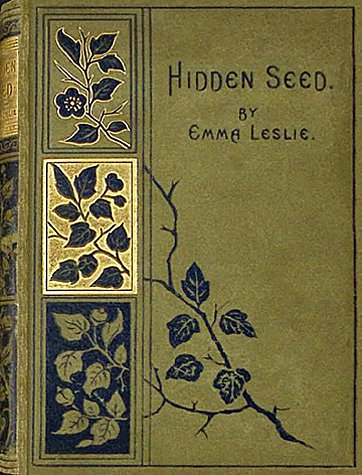
The Project Gutenberg eBook of Hidden seed
Title: Hidden seed
or A year in a girl's life
Author: Emma Leslie
Release date: August 17, 2025 [eBook #76694]
Language: English
Original publication: London: Blackie & Son, Limited, 1886
Transcriber's note: Unusual and inconsistent spelling is as printed.
THE NEW DRESS HAD A LARGE INK STAIN ON IT.
HIDDEN SEED:
OR
A YEAR IN A GIRL'S LIFE.
BY
EMMA LESLIE
Author of "Gytha's Message;" "Glacia the Greek Slave;"
"Tom Watkin's Mistake;" &c.
ILLUSTRATED.
Lucem Libris Disseminamus.
LONDON
BLACKIE & SON, LIMITED, 50 OLD BAILEY, E.C.
GLASGOW AND DUBLIN
CONTENTS.
————
CHAP.
HIDDEN SEED:
OR, A YEAR IN A GIRL'S LIFE.
——————
CHAPTER I.
A RESOLUTION.
"I AM fifteen to-day—fifteen," and the speaker rose from her seat near the table and walked to the window that opened upon a pleasant old-fashioned garden. "Mr. Rose said on Sunday that we ought early to form a plan for our life work, and I have formed mine—I mean to be a missionary to the heathen."
At this point she was interrupted by a knock at the door, and the next minute the housemaid appeared.
"If you please, Miss Mabel, your mamma wishes you to begin your music practice now."
"Oh, very well, I'm coming, Ann," said the young lady petulantly. But she turned to the window again and went on talking to herself. "How very tiresome it is of mamma to want me to keep on with these lessons! I am almost a woman now, and of what use will music and German be to me by and by? I don't mean to live a frivolous fashionable life. I mean to be of some use in the world, and I must tell mamma to-day that I have promised to help Mrs. Rose with the work among the poor."
But now there came another interruption, and her sister Mary, a lively girl about twelve years old, bounced into the room, without the ceremony of knocking at the door.
"Now, Mary, go out; this is my room. You know mamma gave it to me to be my own, and you are only to come in when you are invited."
"Humph!" exclaimed Mary, standing still and surveying the whole. "I should call it a den, or an old curiosity shop, or a lumber-room."
In truth, the furniture had, for the most part, been rescued from the lumber-room, and either repaired or their defects cleverly hidden with chintz draperies. Many a happy hour had Mabel and her mother spent in making this little garden-room, as it was called, habitable and pleasant—a place where Mabel could prepare her lessons, free from the distraction of the children or the interruption of callers. This had been Mrs. Randolph's object in giving her elder daughter a room to herself on her fifteenth birthday. But while Mabel tacitly agreed to this, she was thinking that the time for lessons was almost over, and the garden-room would be a place where she could shut herself up and follow her own devices, apart from the rest of the family.
"Now, Mary, do go!" exclaimed Mabel, who was determined to put a stop to these incursions from her sister.
"But mamma sent me," retorted Mary, inquisitively lifting the cover of a cosy-looking chair. "I thought so," she added the next minute, "mamma's old rocking-chair."
"Now, Mary, will you go?" repeated Mabel.
"But mamma sent me to fetch you to practise."
"I told Ann I was coming, and that was sufficient," replied Mabel haughtily. And she walked towards the door, but took care that Mary should go out first.
"Mamma, I do think you might let me have an hour to myself in my own room and on my birthday, too," exclaimed Mabel in an aggrieved tone, as she entered the dining-room where Mrs. Randolph was sitting busy at work.
"My dear Mabel, do you know the time? It is a quarter to twelve, and you have been undisturbed in your room since breakfast-time. Have you finished that German exercise, dear?" she added.
"No, mamma. I have been thinking it is mere waste of time for me to go on learning German. I don't mean to be a frivolous, fashionable young lady."
"I hope not, indeed, Mabel," said her mother quietly.
"Then what is the use of my spending so much time over the music now? I can play pretty well, and that is enough, I think."
"But your father is fond of music, dear, and is particularly anxious that you and Mary should both be good German scholars. It may be useful to you by and by, he thinks."
"Not to me, mamma," said Mabel decidedly. "If it was Chinese, or some other heathen language, it might be. For I have quite made up my mind to be a missionary."
Mrs. Randolph smiled.
"My dear, the question of your being a missionary can be left for the present, I think. The duty lying nearest to us is the one God asks us to perform, and—"
"Yes, mamma, I have been thinking of that too," said Mabel impetuously. "I have been thinking it all over this morning sitting in my dear little room. And as I have promised Mrs. Rose to help her in her work among the poor in that new district near the church, I might as well begin at once with the work that is nearest."
"But, my dear, is that work the nearest?" asked her mother seriously.
"What! Having a tract district, and teaching a Sunday-school class, and helping at the Dorcas meeting close to my own home? Surely, mamma, that work lies nearest, and will be a good preparation for a missionary life?"
"But what of the duties at home? I have been thinking, Mabel, that, now you are fifteen, you might take some share in the housekeeping. You might go to cook for an hour's instruction every morning. It is not every one I could trust you to learn under, but cook is an old and faithful servant, and could teach you as well as I could."
But Mabel did not look at all pleased at this proposal.
"What with kitchen work and German, I should not have a minute to myself," she said. "Oh, mamma, I really do want to serve God now!" she said earnestly, her eyes filling with tears.
"My dear, you seem to think that everyday duties lie altogether outside the service of God. But it is in the spirit in which these are done, much more than in the quantity of other work, that the service of God consists. But, of course, if you have promised to help Mrs. Rose you must do so, only do not undertake too much."
At this point Mrs. Randolph was called away, and Mabel went to practise her much-despised music lesson. She got through it as quickly as she could, and then, without waiting to see her mother again, hurried out to keep her appointment with Mrs. Rose.
The minister's wife had too often to deplore the unwillingness of young ladies to employ their leisure in any useful occupation, not to receive with readiness Mabel's proffered help. And so before she returned home, she had engaged to take a junior class in the Sunday-school, visit a poor district and distribute tracts, and work for the Dorcas society, although it was with the greatest difficulty her mother could induce her to help with the needlework at home. In truth, Mrs. Randolph did not look very pleased when she heard how much her daughter had undertaken, but she only said quietly:
"My dear Mabel, I hope you will remember that your father wishes you to continue your lessons for the present."
"I shall not forget, mamma. You shall not have to complain that I neglect my home duties," said Mabel stiffly.
In spite of what her mother had said in the morning, she expected her news would have been received with the warmest approval, and she was hurt and disappointed that her mother looked so coldly upon her scheme of usefulness. She retired to her own room feeling very much ill-used, and talked to herself about home persecution until she was summoned to tea.
After tea, a few friends came to spend the evening with her. But altogether it was a disappointing birthday, and she had looked forward to it with so much eagerness. For she had determined that it should be the beginning of a new life to her, and here she was thwarted and hindered at the very outset, just where she expected to receive the most help, too.
These were Mabel's thoughts when she awoke the next morning, but she resolved to persevere. She would not be disheartened by the first difficulty. She would commence her district work that very day. And when her mother saw that she was thoroughly in earnest, she would no longer disapprove of her plans.
Mabel had her own views about district visiting, as she had about most other things, and after breakfast, instead of going to her own sitting-room, she turned out an old dress from her wardrobe that had not seen the light of day for nearly a year. It was a gray that had not worn well as to colour, for it was faded to a yellow in some places and a dull green in others. But Mabel had decided the previous day that this was just the dress for visiting among the poor. And although she looked rather rueful at its creased and tumbled appearance, she would not give it up. An old jacket of another colour, and her garden hat, completed her costume. And Mabel thought, with pride, that no one could accuse her of a love of finery, or that she taught her poor people to dress above their station.
Armed with a bundle of tracts and a note-book, Mabel set forth. And nurse, catching a glimpse of her at the back as she left the door, thought the laundress had sent a message about the washing.
"It was not Miss Mabel I saw," she remarked when the housemaid told her that no message had come from the laundress, but that Miss Mabel had gone out.
At dinner-time, however, Mr. Randolph asked rather sharply where Mabel had gone to in that masquerade dress, for he had caught a glimpse of her going through the town, and it annoyed him exceedingly.
"It will set everybody talking about us, and discussing our affairs, and I begged you to do nothing that could bring our name before the public," he said to his wife in a tone of anger.
He was worried and anxious about business matters, or he would not have spoken so irritably, or have fancied that such a trifle could awaken people's attention to their concerns.
Mabel, too, came in cross and out of humour. The people in Fisher's Rents had not overwhelmed her with gratitude, and some had even refused to look at her tracts. And so when her father scolded her for disgracing him by walking through the town like a beggar girl, she felt she was greatly ill-used and misunderstood.
Poor Mabel! She was to be pitied, for she had done it all with the best of motives, and had only received angry looks and hard words for her pains. Her mother sympathized with her in spite of the vexation she felt, and after dinner said a few comforting words to her, at the same time pointing out that she must not wear the obnoxious dress again, and that she was afraid she had undertaken too much work for her strength.
"Go and rest in your own room for half an hour, and then come and practise the duet with Mary," said Mrs. Randolph as she left her.
And Mabel went to her room to recall again the vexatious events of the morning, until she was summoned by Mary to take her place at the piano.
"It really is very tiresome that mamma should fix upon this duet," she said in a complaining tone. But recalling her promise and resolution that none of her home duties should be neglected, she went with her sister without further grumbling.
But as the weeks went on, she forgot her promise about these home duties, shut herself up more and more in her own room, or went out to visit her district, but never had time to help the children with their lessons, sew on a button, or mend a glove when she was asked. Her temper too had not improved. She had grown sharp and querulous under the strain, and at last she began to see this herself, and had resolved to alter it.
She woke up one morning with the full determination of being less snappish to everybody, and went to the nursery to warm her hands before going down-stairs full of amiable feelings.
But unfortunately the nursery fire had not burned up, and Mabel made some remark about this.
Turning sharply round, nurse said, "Don't come here finding fault, Miss Mabel. If you worry your poor mamma to death, you shall not worry me, so please leave the nursery."
"I shall not leave the nursery. What do you mean, nurse, by saying I worry mamma?" she angrily demanded.
"Because I see my poor mistress fretted and worried and ill for want of a little help that you could and ought to give her. And yet you go out day after day seeking your own pleasure, when you ought to be at home."
"I am not seeking my own pleasure, nurse. You know that, and mamma knows it too," retorted Mabel.
"I don't know. You go to please yourself. I know that for I heard your mamma ask you yesterday to stay and help Miss Mary with her music, but you would persist in going out."
"I was obliged to go," she said. But she would not condescend to make any further explanations, but walked angrily down-stairs.
"Mamma, what do you mean by saying I worry you to death?" she said as she entered the breakfast-room.
Her father had come in behind her, just in time to hear the question. And without giving Mrs. Randolph time to reply, he ordered Mabel to leave the room for speaking to her mother in such a disrespectful manner.
In truth Mabel was heartily ashamed of herself the moment the words were spoken, and she burst into tears and went to her room crying bitterly.
"Was there ever such a miserable girl!" she sobbed, sitting down at the table and coveting her face with her hands.
In a few minutes, her breakfast was brought by the housemaid, but Mabel did not want any this morning. She pushed the tray aside as soon as the servant had gone, and once more buried her face in her hands.
"What am I to do?" she sobbed. "I do want to serve God, and make sure that I am a Christian indeed, and not in name only. I am sure I am in earnest, and yet nothing but trouble seems to follow what I do. And then the work is not so pleasant as I expected to find it. The girls in my Sunday class are often tiresome and disobedient, and people take my tracts as though they did not care whether they had them or not. And I never did like needlework, so that the sewing class and the Dorcas garments I bring home to finish are often a real trouble to me. I think I shall have to give it all up."
And then Mabel lifted her head, and the fragrance of the coffee proved too strong a temptation to be resisted any longer, and to her own vexation she found that she could eat her breakfast after all.
——————
CHAPTER II.
THE INVITATION.
AFTER breakfast Mabel sat down and wrote a letter to Mrs. Rose, saying she must give up all the work she had undertaken, for she was not fit to do it. But before the letter was finished, her mother came into the room, and Mabel instantly handed it to her.
Mrs. Randolph smiled as she read it.
"Impulsive as usual, Mabel," she said. "But I do not think Mrs. Rose ought to be made the victim of it to this extent, my dear."
"What do you mean, mamma? I thought you wished me to give up all outside work," exclaimed Mabel.
"I did not wish you to undertake it, my dear, but having done so, you cannot throw it up for a mere whim, a mere caprice. Go and see Mrs. Rose, and tell her you have undertaken too much, and ask her to relieve you of the visiting and the Dorcas work, but continue your Sunday-school class for the present."
Mabel did not look very pleased.
"I thought you wanted me to devote my time to helping you, mamma," she said rather crossly.
"My dear, I do wish you to help me, for I am anxious to lessen the household expenses as much as I can." And Mrs. Randolph spoke very earnestly.
"Mamma, what is it? What is the matter?" asked Mabel, noticing the change in her mother's voice.
"Perhaps it is better you should know it," said Mrs. Randolph with a sigh, "but I do not wish to burden you with care and anxiety. Only, if you understand exactly how things are, Mabel, you will be the more ready to help—the more willing to do whatever your father thinks will be best for the future."
"But, mother, what is it?" asked Mabel in alarm, instantly jumping to the conclusion that they were on the verge of ruin. "Are—are we ruined?" she gasped.
Mrs. Randolph could not help laughing at her impulsive daughter.
"Not quite so bad as that, Mabel," she said. "But business is not improving—it is growing less and less every year, while our household expenses are increasing."
"Then, mamma, what are we to do?" said Mabel.
"That is the question your father and I often ask each other—How are the children to be educated, and household expenses curtailed? And it cannot be done without your help, Mabel."
"Oh, mamma, how can I do anything?" asked Mabel earnestly.
"Well, dear, at present I am afraid you can only help us by being as diligent as you can with your own lessons, that you may be able to teach Mary and the others by and by, so as to save us the expense of a governess and masters," said Mrs. Randolph.
Mabel looked greatly disappointed.
"Only teach Mary and the children!" she said.
"My dear, it will be a great help to us—a great relief to me, when you can take this work off my hands. You might begin with some of the easy lessons now, if you wish. But I do not want to burden you while you are still learning yourself." But as she said it, Mrs. Randolph looked wistfully at her daughter, hoping she would offer to hear the children some of their lessons.
But Mabel was in no hurry to undertake the post of governess to her little sisters. She craved some greater work than this, and she said:
"Mamma, couldn't I do something else?"
"Something else, Mabel!" repeated Mrs. Randolph. "What could a girl of fifteen do? But I must not stay talking any longer," she hastily added, "for Mary and the children will be waiting for me."
Again she cast a wistful, lingering look at Mabel, hoping she would offer to take the children's lessons this morning.
But Mabel was feeling too vexed and disappointed to look at her mother, but sat toying with the pen she had been using until her mother left the room. Then she leaned her head down and burst into tears.
"It is hard," she sobbed. "I do want to be useful, and yet it seems that I am not to do anything except learn lessons."
She tore up the letter she had written to Mrs. Rose, and then wrote another, saying she must give up all her work but the Sunday-school class. For, truth to tell, she shrank from going to see either the rector or his wife just now, as her mother had suggested.
When the letter was written, she took out a German exercise and sat down to study it, but soon fell to thinking over what her mother had told her concerning her father's business, and from this she began wishing she could have the assistance of first-class masters like her cousin Isabel had. But then there was all the difference in their circumstances, for while her uncle was every year growing richer, it seemed that they were only getting poorer as time went on. And yet it did seem hard. The more she thought of it, the harder it seemed. For while her cousin had all these educational advantages, she would never need to use them as Mabel herself would, for she had always heard that her aunt was a fashionable, fine lady, without a thought beyond her dress and her dinners and the furnishing of her house, and so Isabel's proficiency in music and languages would be no more than an extra adornment of no real service to herself or anybody else. And Mabel heaved a sigh of envy as she turned to her book again.
"It is such awful drudgery doing this alone. Mamma thinks because I had a year or two of it at school, I ought to be able to read both French and German fluently," she grumbled.
But help in this work was nearer than she thought—nearer, perhaps, than she altogether desired. The next evening when Mr. Randolph came home, he brought with him a letter which he had that day received from his brother, Isabel's father, proposing that Mabel should come and share Isabel's lessons for a year, by way of finishing her education.
"What do you think of it?" he asked eagerly as Mrs. Randolph handed back the letter.
It was evident that he was pleased with his brother's proposal, and expected his wife would be the same. "It will be a capital thing for her, I think. For if the worst should come to the worst, and she should have to go out as a governess by and by, she will find it very useful."
Mrs. Randolph looked anxiously at her husband as she said, "I hope this will not be necessary, John."
"Well, I hope not, and I do not think it will. But still, we agreed the other day that Mabel should teach Mary and the little ones, and for this she will need some further instruction herself, and so Henry's offer is really most opportune."
"And you think we ought to accept it for Mabel," said Mrs. Randolph, wondering whether it would be wise to send Mabel to a home where wealth and luxury reigned—whether this would be a wise arrangement for such a girl as Mabel.
Before deciding the matter in her own mind, she resolved to talk to Mabel about it. And so after the children had gone to bed, and while Mr. Randolph was busy over some accounts, she went to Mabel's room and told her of the offer made by her uncle.
"But you will not let me go, mamma?" said Mabel quickly.
"I scarcely know what to do under existing circumstances," said her mother with a sigh.
"But aunt is a gay, fashionable lady, and I should grow worldly too, if—"
"My dear, you may grow worldly in any society. Do not think that worldliness is confined to the frivolous and fashionable people. Certainly if I thought by allowing you to go to your aunt's, it would foster this tendency in you, I would not let you go for all the educational advantages in the world. But there is no necessity for this if you watch and pray against it, and that is what I want to talk to you about, my dear. It will be a great advantage to you to have a year's teaching under good masters, and no one can tell what you may need by and by, and so your father, I know, is very anxious that you should go."
"But aunt is a mere fine lady, I have heard father say," objected Mabel.
"That is probably the fault of her education, and can be no excuse for you. Indeed, Mabel, you will never have the opportunity of being a mere fine lady, so there is some comfort in being poor," concluded Mrs. Randolph with a slight smile.
But Mabel did not smile.
"Mamma, I am afraid I should like it," she said seriously.
"Like to be a fine lady! Well, perhaps you would—I am afraid you would, if the temptation ever came in your way. But it is never likely to come, my dear. The world will claim work at your hands as the price of your right to live in it."
"But I might grow worldly and frivolous."
"Yes, under any circumstances, in any society, you might become worldly; and a worldly woman is the saddest sight under heaven. But now let us understand what this word means. For as I understand it, the poorest as well as the richest may fall into this, and it is by no means confined to the gay fashionable world, as so many imagine. Shorn of its outward surroundings, worldliness is just another name for selfishness. Our own advantage, a pushing of our own claims, a desire and effort to outshine our neighbours and friends, are all so many forms of worldliness and selfishness; and these may be indulged, and often are, I am sorry to say, by religious people and even in religious work."
"Oh, mamma!" exclaimed Mabel.
"I know it by experience, Mabel. I once wanted to reprove a young friend for her love of dress, and so I had my winter bonnet made as dowdy as I well could. And, oh, how proud I was of that bonnet! What hard, uncharitable thoughts I indulged concerning those who wore a bit of bright ribbon! And I thought I ought to be noticed and held up as a pattern. I don't think I ever was so worldly before or since as I was while I wore that exemplary bonnet. And this spirit of worldliness may be carried into anything, spoiling the divinest service. While, if it is one's duty to mix in fashionable society, it may be done—it is done—without contracting a taint of worldliness. For there are those for whom our Master's prayer is constantly being fulfilled, and they are kept 'unspotted from the world.' So you see, my dear, it is the spirit we cultivate in ourselves that determines whether we are worldly or unworldly, and not the outward circumstances of our life."
"But, mamma, outward circumstances do make some difference," said Mabel.
"If we allow them to conquer us, Mabel, it will make all the difference. But we are not sent here to be the slave of circumstances, but to struggle and grow stronger for the fight. Now about your visit, dear. You will have to make up your mind before you go, to strive against yielding to the envious and perhaps covetous feelings that are pretty sure to arise in your heart, if they are not fought against and overcome. This is the form of worldliness you will be specially tempted to yield to, and not that of gay, fashionable society. For you and Isabel will spend most of your time in the school-room, I expect."
"Then you think, mamma, I ought to go?" said Mabel.
"Your father does, my dear, and—and if you were a little less impulsive, a little more willing to yield your own will and your own way, I should think it would be a splendid opportunity for you," said her mother.
"Then you are afraid of me, mother?" said Mabel in a half-offended tone.
"Mabel, dear, I don't want to speak harshly. I know you are full of good intentions, and I believe you desire, above all things, to make your life a useful one, but still I am afraid for you—afraid of the wilfulness and impulsiveness lest they should lead you into irreparable mischief."
Mabel sat with downcast eyes, twisting the corner of her apron.
"Oh, mamma!" she gasped. "I have been trying ever since my birthday to be of some use in the world."
"I know you have, dear, only you have made a mistake as to which part of the world you ought to begin at. Be sure of this, dear, that our duty lies in the work that is nearest to us. When we have done that, if we have time and opportunity for more, then we may do it. But home duties should have our first care and attention under any circumstances."
"And yet, mamma, you think I ought to go away from home?" exclaimed Mabel.
"Yes, dear, as it will fit you for greater usefulness at home. And who can tell what duty may lie before you with your cousins? Try to think that God may have some work for you to do there besides learning lessons and improving yourself."
"But it won't be pleasant, mamma, to go there as a poor relation. If I could have plenty of new dresses and money and other things, I should like to go, but—but—"
And Mabel burst into tears and went out of the room, leaving her mother greatly disconcerted and perplexed. She went back to the dining-room, where she found her husband had so far settled the matter that he had written a letter accepting his brother's offer concerning Mabel, which he handed to his wife, remarking, as he did so, that Mabel had better have some new dresses made before she went away.
He was by no means inclined to take his daughter's wishes into consideration in the matter. The offer was too good to be declined, and so Mabel must accept it whether she liked it or not. This was her father's way of looking at it, and Mrs. Randolph found that she was expected to acquiesce in the arrangement. It was as well, perhaps, that it was so, for secretly Mabel scarcely knew her own mind upon the matter. But when her father talked about the new dresses the next morning, and advised that she should go with her mother to choose them, the last of Mabel's opposition faded, and she was as eager to go on the shopping expedition as she had been to commence district visiting.
The dresses were chosen, and a dressmaker engaged to come and help make them up, and Mabel's study was turned into a workroom for the time being.
"Now, Mabel, you had better take your lessons and do them with Mary, for fear the ink should be spilled on the work," said her mother, as she opened some of the parcels and pushed Mabel's writing aside.
"Oh, mamma, be turned out of my own room!" gasped Mabel.
"Not at all, my dear. I hope you will get your lessons done as quickly as you can, and come and help with the work. There is plenty to do, I can assure you."
Mabel took the pens and ink out of the way, but she secretly determined to clear a little corner of the table for herself the next day, where she could write her exercise without interfering with the work. The dressmaker would be there, but she would not mind. And Mabel carried out her intention, risking the spotting of her new dresses with ink rather than peril her dignity by sitting down to lessons with her younger sisters.
She managed to get through her work without spilling a drop of ink. But just as she had finished, she was called away. And the dressmaker wanting the room occupied by her exercise-book, put it aside with the pen, but did not see the bottle of ink, and forgot to look for it. And when Mabel came back, she thought no more of it than the dressmaker did.
——————
CHAPTER III.
THE INKED DRESS.
MABEL was willing enough to take her share of the home duties now, even to sitting down to sow under the direction of the dressmaker. But as she was turning over the things on the crowded table that afternoon in search of her thimble, she came upon the overturned ink-bottle, and exclaimed, "Who has done this? Who has had the ink here?"
"You had it yourself, Miss Mabel," said the dressmaker. "No one else has used ink in this room."
"But—but I put it away," she said, trying to remember whether she had done so.
"I don't know, I'm sure, miss. I moved the book and pen because they were in my way, but I don't remember seeing the ink."
While they were talking, Mabel was looking under the pile of work to see whether any mischief had been done, and now she saw with consternation, that her new claret merino dress had a large ink stain upon it.
"Oh dear, what shall I do?" she said in affright, unfolding the roll of merino, and seeing that the large ink stain had soaked through fold after fold.
The dressmaker looked scarcely less concerned. "What will your mamma say?" she exclaimed. "The dress is quite spoiled; it can never be made up as it is."
Mabel burst into tears as she looked at her ruined dress. "Can nothing be done with it?" she said. "The ink is not quite dry. Don't you think we might get it out somehow?"
But the dressmaker shook her head.
And at this moment Mrs. Randolph herself came into the room.
"What is the matter?" she asked, seeing Mabel in tears. But the next minute she saw the ink stains on the bright-coloured merino lying in her lap. "Oh dear, who has done that?" she exclaimed.
"Well, it has just been lying on the table, ma'am," said the dressmaker, anxious to spare Mabel as much as she could.
But both knew well enough how it had been done.
And Mabel said through her tears, "I have been writing here, and must have left the ink on the table, and it got covered over with some of the things and upset."
"Dear, dear me! I told you, Mabel, to do your lessons with the others, and not to use the ink in this room while the work was about. What can we do with it, Miss Simpson? The ink has gone through every fold."
"Well, ma'am, I've been thinking if I took it at once to the dyer's, he might be able to get it out, as it is not quite dry, or dye it a colour that will not show the stain."
"I am afraid it is the only thing we can do with it," said Mrs. Randolph, still examining the merino. "Will you put your bonnet on at once and take it? Ask him to keep it the same colour if possible," added the lady.
"Oh, yes, I sha'n't like any other colour," said Mabel, wiping her eyes when she saw there might be a way out of the dilemma.
"You can scarcely have any choice in this, I am afraid," said her mother severely. "The stuff must be dyed any colour it will take, so as best to erase the ink stains. You should have thought of this, if you did not of my wishes, before you sat down to your lessons."
When Miss Simpson came back, it was with the message that the only colour it could be dyed, after the ink stains had been partially removed, so as to hide all marks of these, was brown.
"Oh, I don't want another brown dress!" exclaimed Mabel. "You are making one, Miss Simpson."
"Just what I told them, but the dyer said it would be impossible to make it look nice in any other colour than a very dark brown."
"Then it must be done," said Mrs. Randolph with a sigh. "It's of no use grumbling, Mabel. You will have to wear two brown dresses now instead of having a change of colour."
But although she spoke severely, reminding her daughter that it was entirely owing to her own wilfulness that the accident had occurred, she nevertheless so far pitied Mabel that she gave her a light silk dress of her own to be cleaned, turned, and altered. For the spoiling of the merino would reduce her outfit to great monotony of colour, and they could not justly afford to lay out more than they were doing on her wardrobe just now.
The making, altering, and preparing Mabel's dresses occupied some little time, and so it was decided that she should not go to Glenavon until after Christmas, when her father would be able to take her on his way to see a gentleman on important business, whom he was anxious to consult.
Mabel wore one of her unfortunate brown dresses to travel in. It was a perpetual reminder of her own self-will and disobedience, but I am afraid it rather vexed and annoyed her than led her to resolve upon any severe struggle with it for the future. And this vexation increased when she arrived at her uncle's house, and saw how much larger and finer it was than even she had ever supposed.
The carriage had been sent to meet them at the station. And as they drove up, she thought how much she should enjoy all this luxury. But on arriving at her uncle's house, the thought of the other brown dress in her box made her feel uncomfortable at once, and she wondered how she would look going up and down that broad staircase, perpetually wearing brown dresses.
The thought that she "might" be treated as a poor relation made her draw herself up and assume an air of haughtiness, so that her aunt was not altogether to blame for the coolness of the welcome she received. It was not in the elder Mrs. Randolph's nature to be affectionate, even to her own children. She was proud of her elder daughter, and just now fully occupied in efforts to secure her an entrance into the best society in the county, and make her a social success.
By and by, when Isabel was old enough, she would be quite as willing to do the same for her younger daughter, but meanwhile Isabel was left very much to her own devices and the care of the various masters who had taken the place of a governess in directing her studies. That she could want more than this—facilities for following her sister's example in making herself an ornament to society—never entered her mother's head.
"Isabel's turn will come by and by," she said sometimes when reminded of her younger daughter's wants or wishes.
And so it was scarcely to be expected that she would accord a very warm welcome to a niece she had scarcely seen before.
Isabel was too shy and Mabel's manner much too haughty for their greeting to be very warm. But Isabel had heard from her father about her aunt and cousin, and how eager Mabel was to make her life useful instead of merely ornamental—how she had tried to help the poor by visiting them, and teaching in a Sunday-school, all which news had given gentle, timid Isabel a very exalted idea of her cousin. And so far from resenting her rather haughty demeanour, she wished she could behave with such coolness and dignity, and not feel such a strong wish to throw her arms round everybody's neck who was at all kind to her.
She took her cousin to her room, which was near her own.
And Mabel instantly saw that loving hands had prepared a welcome for her here, although her reception had been so cold down-stairs. A bright little fire was burning in the grate, a cosy low chair was drawn up to it, with a table on which stood a vase of choice flowers.
"Oh, how sweet!" exclaimed Mabel, bending over them, and forgetting all her dignified stiffness.
"You like flowers. I am glad of that," said Isabel timidly.
"You prepared this sweet surprise for me," said Mabel, turning to Isabel. "Oh, thank you, thank you, dear." And the tears stood in Mabel's eyes as she stooped and kissed her cousin. "It is foolish, you will think," said Mabel, hastily brushing the tears aside, "but this has made me think of mamma; it is just the sort of thing she would have done. I shall always love this room now, and think of your welcome to me here."
"I want you to tell me about your mother by and by. Papa says she is such a noble woman," said Isabel.
"Well, this room is like her. I could almost fancy she had been here getting it ready for me," said Mabel.
But Isabel shook her head. "I got it ready," she said, "all but lighting the fire, and the housemaid did that."
"Yes, dear, I know none but loving hands could have made everything look so nice. Do you think we might have a cup of tea together here, instead of going down-stairs?" she ventured to ask.
"We will have it in the next room. See, this is our sitting-room," and she led the way through an opposite door into a larger room beyond. "My bed-room is on the opposite side, and opens into this, the same as yours. Julia used to have your room. But since she has grown up, and goes to so many parties and balls, and don't learn lessons, she has a room near mamma, with a dressing-room to herself."
"And this is where we shall learn our lessons," said Mabel, gazing round the handsomely-furnished room, almost equal to their drawing-room at home, with its pictures and piano, and vases of fresh-cut flowers.
"Do you like lessons?" asked Isabel.
Mabel was a little puzzled how to answer the question. At length she said, "I don't think I do—at least, not now, for I want to be of some use in the world. I want to go abroad and be a missionary by and by, and I sha'n't want any fine learning to teach the heathen to read the Bible."
"No, I suppose not," said Isabel, with a little gasping sigh, and looking at Mabel with something like awe, as she thought of her exalted aims. "I am afraid I have never thought about the heathen," she added. "Perhaps you will tell me about them by and by."
But Mabel was busy examining a watercolour sketch on the wall, and did not notice her cousin's question. "This is very pretty," she said—"I am so fond of drawing and painting. Is it yours?"
"No, that is one of Julia's. Nothing of mine will ever be worth framing, I am afraid, for I like music best, and care very little for sketching. But I am glad you like it, for it will give Mr. Gibson so much pleasure to teach you."
"Oh, shall I really have lessons in painting too?" exclaimed Mabel.
And then she seated herself in a low luxurious chair by the fire, and gave herself up to the enjoyment of her surroundings, while Isabel went to ask that tea might be brought up to their own room.
While they were at tea, the two girls chatted over their plans for the future, during which Mabel learned that her uncle filled a large share of his younger daughter's heart. That it was for "papa" that Isabel took so much pains with her music, because to hear her play often soothed him when he came home tired of an evening, and his wife and elder daughter were out.
"It rests him more than anything when he is very much worried," said Isabel; "and sometimes when I play, as I often do, in a minor key, it helps him to go to sleep."
Mabel looked as though she thought this a very poor compliment—a very questionable aim to study music for. And she began to think her cousin must be a poor insignificant little thing to be satisfied with such a result. "I don't think that would quite please me," she said aloud.
"But if it was the only thing you could do for your father, you would not think so," said Isabel quickly. "You see, I don't know anything about being useful. Cook knows just what he likes for dinner, so I cannot help that way, and the upper housemaid sews on all the buttons neater than I could, so there is nothing else left for me to do."
"No, I suppose not," said Mabel in a pitying tone, "but still I think we ought to have an aim in life, and to aim high."
"I am afraid I have not thought much about such things," said Isabel with something of a sigh, "but papa said you would be able to help me in many ways, and so you must tell me what I ought to do."
But at this moment there came an interruption. A servant came to summon Mabel down-stairs, for her father was going, as he wanted to reach the end of his journey that night. And when she came back again, there was the work of unpacking to be done. Mabel learned that there was a young servant whose special work it was to wait upon them, and do anything they might require, and she was not slow in availing herself of this help, although Isabel eagerly pressed to be allowed to assist.
"No, no, dear. Ann can help me just as well. She can reach the pegs in the wardrobe even better than you, I think."
For Isabel was not only slight and frail-looking, but short for her age too. Another but unconfessed reason was that it was a new and altogether unexpected pleasure to Mabel to have a maid at her own disposal, and she was not slow to avail herself of the full benefit of her service. When the unpacking was done, and the boxes carried away, Mabel sat down by the fire and bade Ann brush out her hair and plait it up afresh, before she put on another dress in readiness to go down-stairs.
Isabel had changed hers, putting on a pretty dark silk, and Mabel felt that she must put on the light silk that had been intended for state occasions. So the companion brown merino that had been laid out on the bed in readiness was put away and the other donned in its stead. And Mabel felt and looked quite radiant in her pale blue glace, trimmed with white lace.
When they entered the dining-room together, a displeased frown crossed Mrs. Randolph's face. And Julia stared at her cousin as though she was not quite sure of her identity. But her uncle made some kindly inquiries as to how she felt after her long journey.
But it was an intense relief to Mabel when dinner was over and they were free to retire to the drawing-room.
But it soon became evident that something had displeased both Mrs. Randolph and Julia. And Mabel surmised that she must have displeased them, for they never spoke a word to her the whole evening, but allowed her to sit and turn over an album of photographic views without taking the slightest notice of her.
Now the fact was, she had raised a storm of anger and suspicion in her aunt's mind by wearing such a pretty dress. To the jealous watchful mother, this seemed like an attempt to put herself on a level with Julia at once, and she resolved to thwart it. So she told her daughter to take no notice of her cousin, while Isabel slipped away to spend the evening with her father in his study, leaving, as she thought, her cousin and sister to become mutually acquainted with each other.
Poor Mabel! She felt ready to cry with mortification before the evening was half over, for there sat her aunt toying with a piece of fancy work, but never speaking a word, while Julia reclined in a low chair reading a novel, and utterly ignoring her presence. How dreary that grand drawing-room looked to Mabel in spite of its splendid satin furniture and luxurious lounges, and costly and elegant trifles that everywhere abounded! She grew tired of looking at photographic views very soon, and then took to looking round the room. Then she ventured to cross over and look at her aunt's work, and timidly put a question about it, but Mrs. Randolph gave a short answer and at once folded up her work and took a book that was lying near.
Thus repulsed, Mabel could only return to her seat and yawn through the next hour, until Isabel came from the study to announce that it was time to go to bed, and bid her mother and sister good-night.
It was an unutterable relief to Mabel to escape from the presence of her aunt, and yet she somehow resented the idea of being sent up to bed in this summary fashion. She felt hurt and angry, too, at the treatment she had received. And so her farewell to Isabel before she went to her own room was not so warm and cordial as they otherwise would have been. And gentle, sensitive Isabel was sent to bed with an aching heart and a dim foreboding that her cousin would not love her after all.
——————
CHAPTER IV.
THE SOWER AND THE SEED.
THE next day Mrs. Randolph announced that the "young ladies," meaning Isabel and Mabel, would dine in the middle of the day, and do their lessons in their own room in the evening instead of coming down to the drawing-room. Now, although Mabel's experience of an evening in the drawing-room was anything but a pleasant one, she was by no means pleased at such an escape being provided for her.
"Why should the usual arrangements be altered on my account?" she asked Isabel somewhat resentfully.
But Isabel could only shake her head, for she was inwardly wondering why this change had been made.
"Perhaps mamma thinks you would like it better," she said.
But Mabel gave her head an indignant shake of denial.
"No, no; it is not for that reason. But I can guess why it is done." And Mabel drew herself up and put on her haughtiest airs, as she reflected that she was to be treated as a poor relation.
"Never mind, dear; we can be very happy here—happier, I think, than we should be in the drawing-room. I should like it better, I am sure, if—if—" And then Isabel hesitated, and the tears slowly filled her eyes.
"Yes, I know," said Mabel indignantly.
Isabel looked at her cousin through her tears. "Perhaps papa will come up here to us sometimes," she said.
Mabel looked as though she did not understand. "Uncle come up here!" she said.
"Why should he come?"
"Because we are not to go down. It is the only thing I care for. I shall scarcely see papa all day else. For it is not often we have an evening in the library like we did last night."
Mabel made no reply, but she felt a little ashamed of her anger, and she likewise hoped that her uncle would interfere and prevent this plan being carried out, as it would grieve Isabel so much.
They were not to commence lessons for a few days, and so Isabel proposed that they should go and see her old nurse, who lived in a pretty cottage in the village. And when they were dressed for their walk, Isabel noticed for the first time that her cousin was always dressed in brown.
"That is your favourite colour, I suppose," she said, looking rather deprecatingly at her own bright blue dress.
"No, I hate it now." And she told Isabel of the unfortunate accident that had compelled her to wear two brown dresses. "I shall have nothing but these all the winter," she concluded, "and I hate them already."
"Oh! But you need not do that, for they look very nice, I think." And as she spoke, Isabel formed a little plan in her own mind to reconcile her cousin to her dull-coloured dresses.
The visit to nurse's cottage was always a pleasant one to Isabel, and now the old woman had some news to impart and gladly welcomed her young lady.
"I'm going to have a lodger, my dear," she said, when Isabel had been duly presented and the usual inquiries had been made.
"Oh, nurse, a lodger!" exclaimed Isabel.
"Yes, my dear. She is a distant sort of cousin and an old woman like myself, and so it will be a bit of company for me. Now, my deary, take care and wrap yourself up well when you come out. You see, Miss Mabel, your cousin is delicate. How is your cough now, deary?"
"Oh, just about the same, nurse," said Isabel, looking up from her attentions to the cat who sat purring on her lap.
"Well, dear, mind you tell your mamma if it gets the least bit worse," said nurse, with a deep-drawn sigh as she looked tenderly down into the pale face.
There was a little more friendly gossip, and then the girls took their departure, Mabel feeling somewhat displeased over their visit, for it was by no means the sort of visiting among the poor that she contemplated.
"Isabel, you ought to have some tracts," she said somewhat severely, as soon as they were outside the house.
"Some tracts!" repeated Isabel. "Oh, but I could not give nurse a tract. I wonder what she would say if I was to try?" And the idea seemed altogether so funny that Isabel broke into a merry laugh at the thought of it.
"But, Isabel, you ought to do something to make your life of some use," said Mabel in a half-offended tone.
"But of what use would it be to give tracts to nursey—dear old nursey, who is the wisest old woman in the parish. I am sure it would be more fit for her to come and bring them to Julia and me. How is it, Mabel, that people think if they are a little better off than others that they are fit to teach them at once?"
Isabel asked the question quite innocently and in all good faith, but Mabel chose to think it was done to rebuke her, and she answered shortly:
"I am sure I had no wish to teach your nurse."
"No, no, dear, of course not, for I am sure you could not do it. But still I have heard of such things, but—but I forgot, dear, you are so much wiser than I am, that I daresay you could teach some people older than yourself, although I should be afraid even to try. You see, Mabel, I can only hope to be just a little ornamental, for I am afraid that what mamma says is true, and I shall never be 'an ornament to society' like Julia, and I cannot be useful like you."
If Mr. Randolph had been asked, however, he would probably have given a different opinion, for he called his youngest daughter his "home sunshine," and various other pet names, indicative of how her gentle love and influence brightened all his life. Useful! Why, no one else could render the loving service to him that Isabel did. And when he heard of the change that had been made for the girls, he asked his wife angrily what could have induced her to make such an alteration.
"It is for their good, my dear," said the lady suavely. "Mabel has come here to complete her education, and she ought to have her evenings for study and to prepare her lessons in readiness for the next day."
"Very well, you know best about such things, only I must have Bella when you are out."
"Well, Isabel could come, of course. She is not very strong, and cannot apply herself to her books like her cousin—indeed, there is no occasion for it. But if Mabel is here for self-improvement, she ought to make the best use of her time," concluded the lady.
This was all so reasonable and so plausible that Mr. Randolph could not dispute it. But to be deprived of the society of his youngest daughter was out of the question, and so when dinner was over, a servant was despatched to summon Isabel to the drawing-room.
"Only Miss Isabel," concluded the servant when she had delivered the message.
The two girls looked up from their books to each other, and Mabel's face grew hot and angry.
"Are you sure mamma did not send for both of us?" said Isabel.
"I shall not come down to-night even if aunt sends for me. I want to write a letter to mamma," said Mabel quickly, and without giving the servant time to reply.
"Then you won't mind me leaving you alone a little while," said Isabel.
"Mind! Of course not. I tell you I shall be busy writing."
But although Mabel hastened to get her desk and take out her writing materials, when Isabel was gone she seemed in no hurry to begin her letter.
"I won't stay," she said half aloud as soon as the door had closed upon Isabel. "I am not going to be treated as a poor relation. Why should the dinner hour be altered because I am here, and why should I not go down to the drawing-room in the evening? No, no, I won't put up with it, and I'll write and tell mamma so at once." And then Mabel drew her desk towards her and began her home letter.
She wrote on, covering page after page, sometimes stopping to shed a few tears, for she really was feeling home-sick as well as hurt and disappointed. And these interruptions so hindered her that Isabel came back before she had quite finished her letter.
"Oh, Mabel, you are feeling dull I am afraid," said Isabel, slipping her arm round her cousin's neck, as she noticed the traces of tears on her face.
"Oh, it don't matter," said Mabel hastily. "You see I have only just finished my letter," she added, pointing to the table.
Should she tell her cousin what she had told her mother—that she could not stay here in this fine house where everything was so different from her own home. While she hesitated, however, Isabel said:
"We will go shopping to-morrow, Mabel. Mamma says we can have the carriage in the morning, and papa has given me a cheque to go and buy a new dress."
"Another new dress," said Mabel, who thought her cousin already possessed an extensive wardrobe.
"Yes, dear, I am going to have one just like yours; I think I like brown now," concluded Isabel critically. "You look like a robin redbreast in your brown dress and red bonnet strings—so cosy and comfortable. I wonder whether I shall look as nice."
"To be sure you will, dear," said Mabel, greatly mollified by her cousin's delicate flattery. And she picked up her letter and put it into the desk, resolving to finish and send it off the next day.
But the next day, after a pleasant drive to the town and the excitement of a shopping expedition, during which her opinion was always allowed full sway, Mabel did not feel quite so eager to return home, and in truth she felt a little ashamed of the complaints it contained.
"It would vex mamma, I know," she said to herself as she took the letter out of her desk and re-read it.
She could smile at its dolefulness to-day. And she threw it into the fire and sat down and wrote another that caused her mother almost as much anxiety as the first would have done, for Mabel could talk of nothing but the comfort and luxury of her new home. And her mother feared that the best educational advantages, amid such surroundings, could scarcely compensate for the effect it would have on the character of such a girl as Mabel. She pictured her throwing herself into a life of luxury and frivolity, without thought or care for that future she was sent to prepare herself for. And from that time, Mabel had a larger share than ever in her mother's prayers.
Whether Mrs. Randolph's fears for her daughter would not have been realized, if the supposed danger had really existed, it is hard to say. But in a few days, lessons began for Mabel in earnest, and she had little time to think of anything else. Music, drawing, painting, German and French exercises left her small time to brood over fancied slights. And Isabel's fondness for her brown dress, so that they were usually dressed alike, reconciled her more than anything to her own sombre appearance.
Occasionally she spent the evening in the drawing-room, but this was when her aunt and elder cousin were out, and Isabel and her father had it to themselves.
At other times Mabel spent her evenings in the school-room or their own sitting-room, with her books alone, for Mr. Randolph had strictly interdicted too much study for Isabel. Her persistent cough and general delicate health was sufficient excuse for his claiming all her evenings. And he also insisted that whenever the weather was fine, the two girls should go out together during the day, either for a drive or a walk.
Isabel's favourite walk was to go and see her old nurse, but as the village was some distance from her home, this was not often possible. When at length an opportunity occurred, Mabel was determined to turn the visit to some account, and before they started she said:
"Your old nurse has got her lodger now, I suppose, so I shall take my Bible and read a chapter to her as I used to do to my poor people at home."
Isabel looked a little awe-stricken at the proposal. "Do—do you think she would like it?" she said. "Don't you think we had better ask first?"
But Mabel laughed at the idea of treating the poor as though they were personal friends, on an equality with themselves.
"You leave me to manage it," she said. "I shall be glad of this opportunity of making myself useful."
When they reached the cottage they heard, to Isabel's disappointment, but Mabel's relief, that nurse herself was out—had gone to the town to make some necessary purchases, and would not be back for some time.
"But walk in, young ladies," said the stranger courteously. "You must not go back until you have rested yourselves." And she led the way into a cosy little parlour and placed chairs for them near the fire.
"I will read a chapter to you while we rest," said Mabel, drawing forth her Bible as she spoke. And without waiting for her hostess to assent or dissent to her proposal, she turned to the parable of the sower and read it.
When she closed the book, and before she could begin her little commonplace comments upon what she had read, the old lady said rather abruptly:
"I am afraid we none of us think as much as we ought to do about this seed, which is the very Word of God planted in our hearts."
And then she reached her own well-worn Bible, and turned over the leaves to the first chapter of John, and read, "'In the beginning was the Word, and the Word was with God, and the Word was God.' This was what the Lord Jesus Christ meant by the seed in the parable," she said. "It is the Spirit or Life of God, 'the true Light that lighteth every man that cometh into the world.'
"You see in the parable the seed is the same, but the difference is in the soil, and so the life of God—the spiritual life in us—will grow and flourish, or dwindle and pine, as we remove the weeds of worldliness and selfishness, or suffer them to grow unchecked. This little flower of grace is a delicate plant, and the hot sun of pleasure, or fame, or applause will soon wither it, or the weeds of pride, and envy, and selfishness choke it, if these are allowed to grow unchecked."
"Yes, but if we try to make our life a useful one?" said Mabel as soon as she could recover from her astonishment.
"If the usefulness springs from the root of grace, then it is a beautiful flower. But I have heard of such things as artificial flowers—very pretty, very natural looking, but having no root—they are simply imitations. I am an old woman, my dear, and have been about the world a good deal, and I have known people who, as you say, have tried to make their lives useful, but never thought of pulling up the weeds of selfishness from their own hearts. In the world, they have been known as most useful people—Sunday-school teachers, perhaps—while at home their friends could tell you that they were peevish and exacting, or proud and overbearing, or envious and jealous.
"What can be thought of the beautiful flowers of usefulness, then, when we hear that this delicate plant of God's Word is being choked by such worldliness? We know that the root and the delicate green blade are pining and withering, and therefore these flowers can only be poor imitations of what the real ones would be. But now, my dear young ladies, having had our little talk, you will let me get you a glass of milk and a biscuit." And the old lady bustled about in spite of their assurances that they did not need anything.
Mabel sat silently wondering over the strange turn her patronizing of the poor had suddenly taken. But the old woman's words—her new reading of the parable of the sower—had likewise made a deep impression upon her mind. It had been presented to her in a new aspect. It was not simply the written word that might be listened to and forgotten, and listened to again, but the very Life of God—the Word—the Light which lighteth every man—the Christ-life in the heart that was meant. And this, like a tender blade of corn, was likely to be choked by giving way to the very thoughts, and feelings, and passions that had ruled her life lately.
Very quietly she sat and pondered over these things while she ate her biscuit and sipped her milk, while Isabel chatted with their hostess. Then arose the question,—Had this seed of grace ever been planted in her heart? And then she repeated the well-known lines:
"'Tis a point I long to know—
Oft it causes anxious thought—
Do I love the Lord or no?
Am I his, or am I not?"
But she found no answer to her question.
——————