
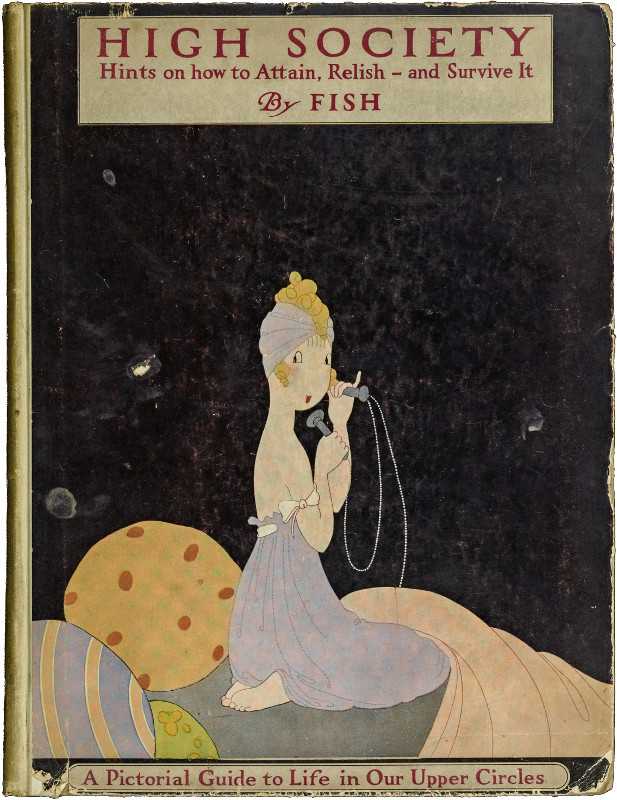
HIGH SOCIETY
Advice as to Social Campaigning,
and Hints on the Management of
Dowagers, Dinners, Debutantes, Dances,
and the Thousand and One Diversions of
Persons of Quality
The Drawings by
FISH
The Prose Precepts by
DOROTHY PARKER
GEORGE S. CHAPPELL
and
FRANK CROWNINSHIELD
G. P. PUTNAM’S SONS · NEW YORK and LONDON
The Knickerbocker Press
A HINT TO HIGHWAYMEN
Copyright, 1915, 1916, 1917, 1918, 1919, 1920, by the
VANITY FAIR PUBLISHING COMPANY, INC.
Copyright, 1920, by G. P. PUTNAM’S SONS
Fish, And Her Work
When, in the summer of 1914, certain remarkable drawings of social life, by a new hand, began to appear, in Vanity Fair in New York, and in The Tatler in London, people all over the world stared at them, amazed, amused, admiring. Then they stared at each other, demanding, with one voice: “Who, under the sun, is Fish?”
Meantime, a tall, slender young girl of twenty-two was drawing the pictures that were helping to keep laughter alive during those dark days—and troubling very little indeed as to whether Fame’s wandering searchlight would ever find her out.
That girl was “Fish,” deemed to-day, by many critics, the most distinguished of satirical black-and-white illustrators.
Miss Fish has created, on that miraculous drawing-board of hers, a complete human society, as original and amusing as the worlds of George Du Maurier and Charles Dana Gibson. It is a world populated by young-old matrons, astoundingly mature young girls, Victorian lady remnants, resplendent captains of industry, pussy-footing English butlers, amourous nursemaids, race touts, yearning young lovers, swanking soldiers, blank and vapid bores, bridge-playing parsons, and middle-class millionaires. But, for all its sophistication, it is a world of innocence. The creatures in it are of a touching simplicity, an incredible naïveté. Fish is one of the only caricaturists who has ever done this sort of satire without malice—who has ever treated the poor, misguided children of this world as if they were really children.
But there is beauty in her extraordinary gallery, as well as caricature. The patterns on her flappers’ gowns are like laces and hangings by Beardsley; a Pomeranian lying on a rug, becomes a patch of elegant scrollery, like a detail in a Japanese print. There is no trace at all, in her drawings, of the hackneyed conventions of illustration: everything in them is presented through the medium of an original feeling for form. Even her profiteering millionaires become designs made up of deft and satisfying curves. Her sketches are creations not only of a clever and sophisticated intelligence, but of a true artist.
Photograph by Malcolm Arbuthnot
“FISH”
In depicting fashionable society Miss Fish is perhaps at her best, for the reason that the spectacle which seems to interest her most is that pageant of “smart” types that race, as if by magic, to her drawing-board, from every haunt of social life—from opera boxes, ballrooms, race-meets, cabarets, smart supper parties, dinners of state, musicales, and the thousand and one happy backgrounds against which the contemporary beau monde is wont to pose and posture.
In the pages of this book the reader will meet only with Miss Fish’s social creations: the double-decked dowagers, the amateur vampires, the horsey horsemen, the diabolically clever little débutantes, the tango addicts, the incurable bridge-players, the worn-out week-end hostesses, and the myriad types of human beings that seem perpetually to haunt the portals of our most exalted society.
For six years, Miss Fish’s sketches have appeared, in America, only in Vanity Fair. For the past two years the British public has only seen her work in Vogue (the British edition), and in The Patrician,—the English edition of Vanity Fair. All the drawings in this book appear here with the permission of Condé Nast, the publisher of Vogue, Vanity Fair, and The Patrician.
The Editor.
List Of Contents
In Which the Scenes and the Principal Characters Are Revealed
- PAGE
- The Opening of the Social Season
- How the Members of the Beau Monde will Spend what is Left of their War-time Incomes 2
- The Opera, in Full Blast
- Showing that Things are Sounding Much as Usual at the Opera this Year 4
- Keeping on with the Dance
- You Will Certainly be Considered a Social Pariah if you don’t Dance the Night Out 6
- Getting On, in Smart Society
- If, at First, You Don’t Succeed, Dine ’em and Dine ’em Again 8
- Hints on Honeymoons—for the Very Rich
- How to Make a Smart Honeymoon—Comparatively Speaking—Agreeable 10
- The Poets that Bloom in the Spring
- A Popular New Pastime in Smart Society—the Matinée Poétique 12
- The Art Exhibition: Opening Day
- After All, There is Nothing Like Modern Sculpture to Stimulate the Imagination 13
- A Week-End with the Recently Rich
- Showing that a Profiteer is Without Honour in his Own Country 14
- On the Trail of the Concert Lovers
- “Among Those Present”—at all the Smart Concert Halls 16
- The Trials of the Newly Poor
- A Heart-Rending Picture of Life as it is Lived Behind Aristocratic Doors 18
- The Prize Fight Finally Gets into Society
- The Smartest Diversion is now the Science of the Swat and the Slam 20
- Dreadful Moments in Society
- Embarrassing Little Episodes which Might Happen to Even the Best of Us 22
- On the Trail of a Wife
- Détours on the Road to Matrimony 24
- Divorce: A Great Indoor Sport
- It is Beginning to Rank First among our Fashionable and Popular Pastimes 26
- Wild Bores We Have Met
- Question! Who—in Society—is the Unadulterated, 100 Per Cent Bore? 28
- The Throes of First Love, in Society
- A Few Fashionable Little Variations on the Oldest Theme in the World 30
- A Calendar of Popular Outdoor Sports
- As Practised among Persons of Breeding and Quality 32
- The Seven Deadly Temperaments
- As Frequently Met With in the Ladies 34
- Six Brands of Week-End Hostesses
- It’s a Lusty Life, if You Don’t Week-End 36
- After-the-War Servant Problems
- How the Great Conflict Ended the Golden Days of Service in the Houses of the Elect 38
- Advice to the Lovelorn
- What Every Girl Should Know, Before Choosing a Husband 40
- The Open Season for Strikes
- If you Don’t See What you Want, Strike for It 42
- The Art of Fashionable Portraiture
- You Can’t be Quite “It,” Without the Aid of a Modernist Artist 44
- Social Superstitions
- With Very Special Obeisances to Cupid 46
- Who’s Who—in the Audience
- Showing that the Smart Playgoer, Not the Smart Play, is Really the Thing 48
- The Horrors of the Week-End
- From the Tortured Hostess’s Point of View 50
- When Marriage Is a Failure—Cherchez La Femme
- Have You a Little Failure in Your Home? 52
- Opening of the Opera Season
- The Opera Opened—To Crowded Boxes—With the Usual Performance of “Aïda” 54
- Blighters at Bridge
- A Terrifying Triumvirate of Familiar Lady Auction Pests 55
- The Way to Succeed on the Stage
- A Lady, Once a Creature of Fashion, and Now a Famous Actress, Tells of Her Success 56
- Sports for the Summer
- The Increasingly Feminine Tone of Our Outdoor Diversions 58
- Sea Bathing has become the King of All the Dry Sports
- Fashionable Debutantes Who Sojourn by the Sea 59
- The Strategy and Finesse of Proposing
- Advance Leaves from the 1921 Handbook of Courtship. 60
- Palmy Days at the Seaside
- Sights at the Bathing Resorts When the Season for Salt Water is Declared On 62
- An Interview with a Great Dancer
- Privileged Peeps into the Soul of Mlle. Angeline, of Paris 64
HIGH SOCIETY
THE HORSE SHOW
Here we see the horse show in full blast. Here you will see everybody happy, everybody occupied, scandals energetically and effectually discussed, meetings arranged in whispers, society reporters calling everybody by their wrong names, and everybody paying the strictest attention to everything about them—except the horses.
THE RESTAURANTS
The season in the restaurants has opened strong. And the worst of it is that the ladies will spend all their time in these blessed robbers’ dens. Tell a woman that her place is in the home and—but you wouldn’t do anything as rude as that, would you? There are two other discouraging things about women in a restaurant: first, that they won’t ever go home, and second, that they won’t ever sit down. Here we see a tragedy illustrating both of these points. Muriel, who long ago finished her luncheon simply will not join the gentleman in the hallway (the one who looks a little like President Wilson), although the poor creature has been waiting for twenty minutes. And her charming little vis a vis, Esmé by name (the one with the lap dog that looks like a three-leaved clover), has, on her side, been keeping her fiancé standing at attention for a similar period of time—and, all because the two dears have such thrilling and wonderful things to talk about.
The Opening of the
Social Season
How the Members of the Beau Monde
Will Spend What Is Left of
Their War-time Incomes
THE ART SHOWS
Below we see the opening of the Vorticist Sculpture Salon, a debauch in marble that always brings out a full quota of the artistic cognoscenti of the town. Bohemia always appears in goodly numbers at these charming little revels in stone. The extraordinary thing about much of the new sculpture is that it looks like illustrations for those wonderful books on hygiene, in which ladies’ are taking their matutinal exercises—by correspondence, of course. Take, for instance, the case of the delicate little gem entitled “Love” in this illustration. Captain De Pluyster who is viewing it in company with his fiancée, Miss Corinna Walpole, is listening to her: “Oh, that’s an easy one. I do that twenty times, every morning, just before my bath.”
THE FASHION FÊTES
Perhaps the most delightful social occasion of all—at least as far as married men are concerned—is the winter Fashion Fête at Luciline’s select little dressmaking establishment. In the picture, you will observe a married gentleman, accompanied by his gross tonnage. The poor man is not at all listening to Mme. Luciline; no, he is gazing wistfully and, with eyes aflame, toward the wholly divine young ladies who, every season, do so much toward making the happy modes and unmaking the unhappy marriages. “How different would have been my life,” he reflects, “had I met one of those limp and sinuous sirens before I took up with my Henrietta.”
The Opera, in Full Blast
Showing That Things Are Sounding Much
as Usual At the Opera This Year
AN OPERATIC DUET
For upward of a generation, now, operatic and musical matters have gone along much as usual at our opera house. It’s always dangerous to be different, or original, or diverting. Literally, the only novel thing that has happened at the opera this season is that the director’s box, which has always been empty, was, at one performance last week, tenanted by a young gentleman in our best society, along with a tiny little friend of his. To see this usually dim, untenanted cave so decoratively occupied was a welcome change in the monotony of a somewhat uneventful season.
HOME, SWEET HOME
Below, you will behold a little scene in Pneumonia Alley otherwise known as the lobby of the opera. It is here that all of our best people gather, after the opera, and wait for hours for their flunkeys and limousines. Fashionable personages are really much cleverer than mere people are wont to suppose. After twenty years of hard study, they have finally devised a system by which—after the opera—they can wait around in the lobby for their motors and reach their houses only an hour later than they would if they left by the main door and picked up a passing taxi.
HEARTS AND FLOWERS
One of the great tragedies of life is that men and women have a way of saying pleasant things to your face, and truthful things behind it. Nowhere is this practice more prevalent than in grand opera. Above, for instance, you will observe a portrait of Signor Enrico Scottinelli, buttering with fair words the bewitching soprano. Nothing could exceed the sweetness of his remarks to her, during the opera. You know the remarks we mean: “Your eyes are radiant arrows in my soul. Your lips are torments to my heart. Look at me, and an eagle lifts my feet; kiss me, and pansies blossom in my breast.” It’s all very operatic and charming, but, back of the scenes—oh my!—what a difference!—“You call yourself an artist! You, who paid a press agent for every line you ever got in a newspaper! You who were hissed at Monte Carlo. You, who are only kept on here at the opera in order to save storage charges on your body at the warehouse! A singer! Ha! ha! ha! Why don’t you go back to washing? An artist! Corpo di Bacco! Why don’t you go back to scrubbing floors? You, who stand there dressed up like Marguerite! Where is your fur, where are your claws, where are your shiny yellow eyes, cat that you are!” All of this, disheartening and saddening as it is, only proves that social amenities at the opera are very much as they are with us all in real life.
THE SPELL OF MUSIC
Why is it, we wonder, that the people in the first tier boxes at the opera always seem like human beings. Even their tiaras, feathers, and red Indian facial accoutrements, fail wholly to remove them from the category of living creatures. But the inhabitants of the second tier boxes are, somehow, a race apart. Their faces, figures, fans, hair, and bodily habiliments all somehow take on a strange, wild note. “Are they human?” we ask ourselves, “or are they merely some wax figures which we, as children were wont to admire?” In the sketch we see a group of these second-tier creatures suffering intensely under the spell of the director’s baton.
LES TROIS CORYPHÉES
Above is pictured a bright moment from the Ballet of the Rosebud—one of the lighter, sweeter forms of ballet. The plot concerns the love of the Rosebud for the South Wind—the sex interest is always developed early in these little dramas—and it shows how he subsequently leaves her ruthlessly—as it’s against the rules for any ballet to end happily. This scene shows a Trio of Spring Flowers, in action.
THE EIGHT HOUR NIGHT
Below is an intimate glimpse of any gathering any evening, anywhere in the, broadly speaking, civilized world. Now that the war is really over, something had to be found to keep all the men interested,—so the dance habit has come back more strongly than ever. If he can only have seven or eight hours of fox-trotting every evening, a young man will get so that he hardly misses his bayonet practise at all.
Keeping on With the Dance
You Will Certainly Be Considered a Social Pariah if You Don’t Dance the Night Out
In spite of sporadic outbursts of protest from non-dancing editors of hearth-side magazines, the dance craze is still going strong. In fact, it’s more violent than it ever was; it is no longer a mere craze—it has reached the point of frenzy. Any kind of dance goes (whether in Rome, Madrid, New York, Paris or London) from the intricacies of the Russian ballet on the stage of the opera, to the simple little fox trot in the privacy of your own home. Joy has never been so completely unconfined as it is this season; everybody is going on—and on—with the dance. You simply can’t get away from it. No matter where you go, some form of dancing is sure to come into your life, someone is certain to appear suddenly and dance with, beside, in front, or all over you.
MORNING—IN THE PARK
Somebody once got all worked up about dancing and called it the poetry of motion; if you want to go right along with the idea, you might speak of barefoot dancing as the vers libre of motion. No one is quite certain of what it’s all about. The lady in this sketch, a disciple of the art, has left home to run wild in the park at dawn, in a little dance called “The Birth of the Crocus.”
A LEGEND OF RUSSIA
A quiet corner of the Ballet Russe—one of the calmest moments in the company’s entire repertory. Both the lady and gentleman are, of course, stars of the Imperial Ballet of Moscow—they always are. Any male dancer wearing trick red boots, and any female dancer whose costumes are designed by Bakst, instantly becomes a star of the Imperial Theatre of Moscow. This is a scene from “The Golden Vodka,” a drama all about the love of the Princess Soviet for Nikailovitch, the handsome samovar.
THE SOCIETY DERVISHES
This is what some euphemist has delicately called “ballroom dancing.” It occurs at least once in the course of every musical comedy and variety show. The male half of the cast seems forever looking for an opportunity to toss his partner out into the orchestra. Perhaps it’s the element of uncertainty about this sort of dancing that makes it so popular with the public; you never know at just what moment it’s going to prove too much of a strain for the male member of the team, or when the lady in the case is going to land, with a pretty informality, in your lap.
THE DAUGHTER OF HERODIAS
The Dance of Salome seems never to lose its popularity—perhaps the secret of its appeal is the sweet, wholesome joyousness of it all. It requires very few properties. All a girl needs, to give her own version of Salome’s famous specialty, is a plated silver platter, a papier maché head, and the usual lack of costume.
Getting On, in Smart Society
If, at First, You Don’t Succeed, Dine ’em and Dine ’em Again
IN THE INTELLECTUAL SET
The T. Pennypacker Higgingbothams reached the metropolis, a short while ago, from the social ooze of the Texas oil fields. They wanted to break into society, but, alas, a fondness for eating and a fortune of twenty millions were all that they had to do it with. These pictures mirror their progress in the frigid marble-and-gold society of our inhospitable city. They are here shown at their first important dinner—a little repast of eight—at their palace, a palace which, architecturally considered, is a cross between the Temple of Karnak and Charing Cross Station. They are wisely beginning their social climb among the intellectual set. Brains are the best things to climb on until you got fairly high up, when you can safely discard them.
Reading from left to right, T. Pennypacker Higgingbotham; Marietta Pillsbury Powyss, author of “The Fear of Love,” “More Than Kisses”; Frederick von Nippelzow, Professor of Czech, and the Slav and Bulgar languages at Oxford; Miss Sophronisba Ottway, Japanese lacquer worker, Etruscan embosser, designer of Indian art-jewelry; Guido Bruno Pfaff, lecturer on Malthusianism, Mendelism and sea worms; Babette La Rue, smock designer, garden-stick maker, flower-pot varnisher, book-end painter, art stenciler and jig-saw artist; Bliss Merriweather Gow, play-reader, author of nine Shakespearean masques, creator of a ballet entitled “The Birth of Passion”; and, finally, the dazed Hostess, about to go down for the third time.
HEARTS AND DIAMONDS
The Higgingbothams were told that they could do nothing without a social secretary. They accordingly engaged Miss Audrey De Vere, a young lady of lineage. Audrey smokes, drinks, and plays “poker”: she also knows how to get first-night tickets at the theatres and an outside table at a cabaret. She can mix eleven different kinds of cocktails with only one bottle of gin, one lemon, two bottles of Vermouth and a single olive. She is engaged to a war hero—her vis-a-vis at this table. The dinner has been cleared away and Audrey and her friends have just finished a little session with the cards. Net result: the T. Pennypacker Higgingbothams are minus the value of one small Texas oil well.
THE RECEPTION COMMITTEE
Front elevation of Mr. and Mrs. H. at the head of the grand stairway leading to the gold organ room in their palace. Mr. and Mrs. H. are expecting forty more or less strangers to dine with them. Gold favors will be found under the napkins. Twenty pairs of footmen’s calves, in wood, have just been successfully adjusted by the H’s footmen, in the magenta and gold dining room, brought, at some expense, from Verocchio’s palace in Venice.
THE ATTACK ON BOHEMIA
The Higgingbothams have not, on the whole, been very successful in their attacks on the smart set, so they are at present engaged in entertaining Bohemia. Here you see a section of it let loose in the Verocchio dining-room. Reading from left to right: Mr. H., somewhat at a loss to know how to manage the bright young thing on his left; Miss Tessie Truefitt, artists’ model, understudy to a barefoot dancer, poses for Jo Davidson; Le Roy Eastman, socialist, drawing room anarchist, author of “The Red Flag in Spain,” lectures on Government Ownership of Women; Theda B. Small, film vampire, the worst woman in the city, rolls her own cigarettes, never wears stockings; Archibald Witherspoon Troutt, fashion artist, introduced the hoop in men’s evening coats, is suing Lady Duff Gordon for stealing his ideas (note the Byron collar and the Hero tie); Polly Pym, keeps a restaurant in the Apache region—paper napkins, waiters in red shirts, pipe smoking allowed, eau de quinine served from straw bottles, choral singing and recitations; Aristede Le Blanc, French Impressionist, paints with a palette knife; and, finally, poor Mrs. H., speechless at the wild and wanton scene around.
SUCCESS AT LAST
The Higgingbothams have had bad luck with their dinners and have now decided to try nothing but little suppers after the opera. Here we behold them with Mr. and Mrs. Lestranges, who compose the thickest part of the social cream. The Higgingbothams have at last arrived. They have a loge at the opera and know so many great people that they can perfectly well afford to discard all their intellectuals, social secretaries and Bohemians—all of them now unnecessary and de trop. The Lestranges have already refused three courses at supper and are now engaged in inspecting the little Escargots, à la Melba.
HE’S A JOLLY GOOD FELLOW
Mr. Higgingbotham has at last been permitted to join an ancient social club. He is here enjoying a bottle or two of his famous private stock, Veuve Clicquot, 1883, gray label, silver foil: only two cases in the world—and Mr. Higgingbotham owns them both.
Hints on Honeymoons—For the Very Rich
How to Make a Smart Honeymoon—Comparatively Speaking—Agreeable
PEACE HATH HER VICTORIES
A type of honeymoon which is not seen very much now is the War Brand. The lady mooner in the sketch below (she is the one leaning against the tree) is Colonel of the First Daffodils, and, of course, the flower of the regiment. The gentleman mooner is the Captain of the 7th Scotch Sodas. They are taking their honeymoon in little slices, between drills, as it were; not a bad system, as it prevents the happy young warriors from becoming fed up with the sweetness of love.
THE COTTAGE OF DREAMS
Oh, honeymooners, do you remember the little creeper-covered cottage to which You and She planned to fly immediately after the Voice had breathed o’er Eden? It was millions of miles from home, that little rose-colored paradise, and there wasn’t to be any telephone, and letters were not to be forwarded, and mother couldn’t annoy you, and you were going to pick heartsease in the garden,—and then you found you couldn’t afford it, and so you settled in a suburban villa in solitary exile.
ALONE, AT LAST
The moment in the honeymoon, which is pictured below, is technically known as the enfin seuls. The parents have been banished, the best man is still in wine; the bridemaids are at the photographer’s, the footmen have gone to chase up the entrée, and the lovers are at last alone with their J-HOY. What a blissful moment! Six months later a moment like this is a bit of a bore. Any third person then, even a dun from the tailor, would be welcome, for love, alas, is like caviare; a little indigestible—unless consumed in very small portions.
WATER, WATER, EVERYWHERE
The yachting honeymoon is always a mistake. If anybody offers you a yacht for your honeymoon don’t accept it. The trouble with the ocean, for social purposes, is that it has no kind of taxi service. Take the case of Mr. and Mrs. Boodle-Beauty, who would have died of loneliness if it hadn’t been for bridge. Fortunately, a cook and a sailor knew their way about the card deck. Hearts would come into the bridegroom’s hand, but, with the bride, everything was diamonds.
THE EXPRESS TO EDEN
Showing the bride and groom at the station just before the departure of the Eden express. Note the almost amorous gentleness with which the sentimental porters are caring for the slippered luggage. Good luck to you, happy newlyweds, before you pass into the Beatific Blue! Good luck, and here’s hoping that the train is a limited express, with no “stop-overs” in Nevada.
AMOUR DE VOYAGE
Of course, most honeymoons take place at hotels. Such wonderful food, and such dim, religious corners in the corridors. And it makes letters home so ridiculously easy. “Dear Mamma, and all: Arthur and I arrived last night. So, so happy. We are very comfortable. Arthur tries to be very cruel, but, so far, I have had no trouble in sitting on him.”
The Poets That Bloom in the Spring
A Popular New Pastime in Smart Society—the Matinée Poétique
New York, and other American cities, have lately had a visiting procession of foreign poets. Robert Nichols, W. B. Yeats, Siegfried Sasson, John Drinkwater and Lord Dunsany have given ringing poetry recitals, and added greatly to their laurels. Here we have the latest arrival from English shores, Lonsdale Thornditch, the young poet, who finds compensation for the indifference of the British public by reciting his verse to the appreciative audience of America. With the present rate of exchange, and everything, Mr. Thornditch feels very well compensated. He is here seen in the futuristic salon of Mrs. Updike Jones, in New York, reading from his still-unpublished volume, “Skeletons in Scarlet.” His poems are most effective when read aloud, as may be judged from observing the prostrate illuminati about him. We cannot see why this pretty idea of lending literati to other lands should not be taken up by America. Why not redeem America’s literary debt and introduce the people of England to the joys—and even horrors—of the imported poetry recital.
The Art Exhibition: Opening Day
After All, There Is Nothing Like Modern Sculpture to Stimulate the Imagination
There was a time when one visited the Natural History Museums to observe Nature’s latest vagaries in the shape of undeveloped amoebæ in bowls, rudimentary horns on recently unearthed amphibians, and models of funny little puffins, and green lizards, who had gone wrong while still in a pre-natal state.
Now one may see all these little jokes of Mother Nature at any fashionable exhibition of ultra modernist sculpture. The city is full of them. You are probably familiar with them. Here, for instance, are a few, which have been named by their creators as follows—reading from left to right—along the very top row: “The Birth of Love,” “Portrait of My Wife,” “Study of a lady,” “Fruitage,” “Inhibited Motherhood” and, finally, “The Death of Libido.”
A Week-End With
the Recently Rich
Showing That a Profiteer Is Without
Honour in His Own Country
OUR HERO
Mr. John R. Blivvins, of America, one of the leading figures in that noble band of munitions factory owners who did such yeoman service—for themselves—all through the great conflict. However, even though peace is here, there is still work to be done,—Mr. Blivvins is about to crash in on British Society. By way of a start in the right direction, he has purchased—at 10 per cent discount for cash—an ancestral estate equipped with all the modern conveniences, including built-in butlers, hot and cold running footmen at all hours, and a resident bishop. Everything goes with the estate but the title, and Mr. Blivvins looks to his attractive daughter, Angelica, to furnish that, by marrying one.
A HORRIBLE MOMENT
Up to this moment, everything has gone along beautifully. Angelica has worked up a visiting Duke to the proposal point, and Mr. Blivvins has behaved so conservatively that the dinner guests are on the verge of accepting him. And then he had to wreck the entire works. Led away by too conscientious attention to the products of the ancestral wine-cellar, Mr. B. is, with unfortunate geniality, insisting that the footman try one of his best cigars. The Duke might overlook this, but the footman—never.
THE COMMITTEE OF WELCOME
This moment marks the dawn of a new life for the Blivvins family. Their future seems to be practically assured. Angelica, the one and only daughter, has got in some deadly work on one of the local Dukes, who has been pressed into coming down for the week-end. To make it all delightfully homelike, the Duke has brought along his sister, one of the most unmarried noble-women in the entire United Kingdom. This charming little domestic scene shows the arrival of the guests, just at tea time. Angelica is going strong with the Duke (his is the third figure from the right—the clean-cut, red-blooded lad of barely seventy summers). Mr. Blivvins is welcoming the bishop to the little circle—a bishop is always so ornamental when draped gracefully around a tea-table.
THE EROTIC MOTIVE
This picture does not show the great moment in any one of our popular farces,—it is far more tragic than that. It shows how Mr. Blivvins—always an artist at that sort of thing—has managed to get himself disliked. In an absent-minded moment—all life’s bitter tragedies happen in such moments—our hero has mistaken a door, and walked into the room where the Duke’s sister has retired to her chaste repose. The noble vestal is defending her honor at the point of a curling-iron, shrieking, “Stop, villain, or I fire.”
THE GRAND TOUR
The snappy little evening’s entertainment—Mr. Blivvins takes his guests on a personally conducted tour of the picture galleries, proudly pointing out all of his ancestral portraits—that came with the house, when he bought it. Of course, a little of that sort of thing is perfectly ripping, but, after the first eight miles, picture galleries seem to pall a bit. The Duke’s sister is plainly bored.