
THE UNSEEN HOSTESS
The self effacing hostess is a very popular brand. If it weren’t for her week-end parties, society never could catch up with its correspondence. She isn’t in the least entertaining—and she mercifully doesn’t try to be. She thoughtfully effaces herself, and leaves you in your room after supplying each guest with crested paper, assorted pens, and unused stamps. Spending a week-end at her house is much the same thing as spending it in the writing room of the Ritz.
THE BISHOP’S MOVE
The absent-minded hostess has ruined many a promising young week-end by her unfortunate affliction. She can never quite remember just what people she has asked for the week-end and she will go and ask a bishop, at the last moment. Of course, bishops are a splendid institution and you really couldn’t want anything nicer around a cathedral, but, at a week-end party, when all the tired guests are having their relaxation, a bishop is about as welcome as an outbreak of beri-beri.
THE MUSICAL HOSTESS
The hostess who is so musical is one of those blessings that we could all get along without. She is always exploring among the fauna of Bohemia and capturing some particularly wild specimen. Her guests spend the week-end, like Daniel, in a lion’s den. There is no let-up to the atrocities. The guests sit in horror, thinking of the things they might be doing in the city, while a hairy conscientious objector does unmentionable things to a piano.
THE WELL MEANING HOSTESS
The well-meaning hostess is one of the lowest forms. She insists upon everybody’s getting together and having a jolly time. She can’t call it a week-end till each of her guests has committed at least one parlor trick. She is here portrayed in her favorite pursuit of dragging an inoffensive guest to the piano, insisting that she just knows he sings. People spend exactly one week-end at her place; after that, “Very important business keeps me away. So sorry.”
THE VANISHING HOSTESS
The perfect, or disappearing, hostess is rare. She always invites the One Person you want to spend the week-end with, and then lets nature take its course. She has a perfectly bearable house surrounded by really wonderful grounds. This hostess appears occasionally at dinner, but at all other times she vanishes completely, leaving things to the careful supervision of the faithful family gardener, who has probably seen more biological history in the making than any man in the county.
PALM SUNDAY
The gilded hostess has one of those rustic cottages, where her guests rough it over Sunday surrounded by vintage champagne, Swiss butlers, liveried footmen. The sketch—from life—shows a guest’s retreat to the city, after a week-end’s bridge; note how effectively the footmen decorate the sketch with palms.
After-the-War
Servant
Problems
How the Great Conflict ended
the Golden Days of Service
in the Houses of the Elect
GILDING THE LILY
In the good old ante-bellum days, scenes like this were every-day occurrences in the life of Mr. J. Wallingford Smith,—inventor and sole owner of Smith’s Slenderizing Stays—They Lace on the Side. Mr. Smith simply could not call it a day unless at least five male menials were involved in the process of getting him dressed. All his puttings on and takings off were personally attended to by these motherly creatures. And then, just as everything was going nicely, the world had to get mixed up in that dreadful war, so that poor Mr. Smith now has to adjust his jewelry without a corps of specially trained liveried attendants.
TWEEDLEDUM AND TWEEDLEDEE
Portrait impression—from memory—of Mr. and Mrs. J. Wallingford Smith, motoring in their third-best Rolls-Royce, just about two weeks before the Kaiser turned on the war. Note the attendant chauffeur and footman—Mr. and Mrs. Smith wouldn’t dream of going out without two men on the box. But things aren’t what they used to be. The chauffeur and footman now own their own motors—after two years in the provision business.
WHY BOYS LEAVE HOME
This scene, almost too terrible to look upon, is absolutely true—it’s not one of those faked war pictures at all. It reveals the hideous, dreadful privations, that the war brought upon some of us. It shows the bitter anguish of the J. Wallingford Smiths as they watched a battalion of their footmen, chauffeurs, butlers, valets gardeners, coachmen, grooms, house detectives, and resident photographers departing for the Saar Valley. How silent and lonely the house has seemed, the past year, without these brave youths!
TIGER! TIGER!
Conscription was the mother of invention—Mrs. Smith recently conceived the brilliant idea of engaging a mere stripling to understudy for the footman who was removed by the war. Someone simply has to carry the family ermines around—you can’t expect a lone lady to do it all by herself. The accompanying picture graphically portrays the new footman in action—playing the part of a movable human coat-room.
THE ULTIMATE STRAW
And now, even Mrs. Smith’s maid has gone and done it—she decided to remain permanently in the Woman’s Motor Corps. The uniform is so much more becoming than those trying maid’s costumes. She is pictured with her latest and very best Young Man.
CASUALS OF THE AVENUE
Fate seems to be against the unhappy Smiths—it’s not even on speaking terms with them. Even that good idea of Mrs. Smith’s about engaging a child footman didn’t work out. The boy wonder was really too immature—he couldn’t overhear even the simplest stories without blushing—so Mrs. Smith had to resort to a maid to accompany her around the city. But, judging from her expression, she is a trifle dismayed by the number and ardor of Mrs. Smith’s casual acquaintances.
Advice to the Lovelorn
What Every Girl Should
Know, Before Choosing
a Husband
Advice to the Lovelorn
What Every Girl Should
Know, Before Choosing
a Husband
Advice to the Lovelorn
What Every Girl Should
Know, Before Choosing
a Husband
LE PREMIER PAS
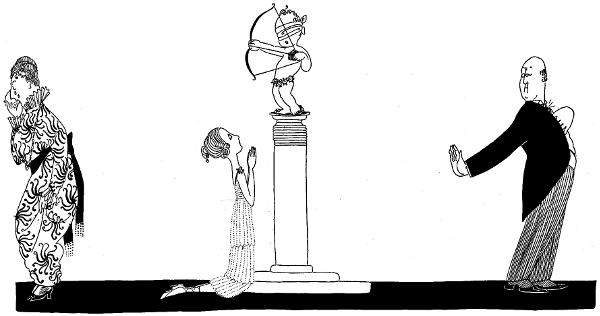
The love interest really must come into the life of every young girl. There’s no use talking, she simply can’t get along without it. Her mother may weep, and her father may become dramatic about it, but a girl should remember in choosing a husband, that it’s the first step that counts in matrimony. After a girl has once been married, a second, third or even a fourth husband are simple matters. It’s the first one that’s tricky. Getting a husband is rather like getting the olives out of a bottle—after you get the first one, the rest come easily.
BEWARE THE SOCIETY FAVORITE
Every girl is likely to be dazzled by the radiance of the Social Light. He shines in ball-rooms, and in the frontline trenches of tea-fights; he fox-trots with passionate abandon, he is the life and soul of every dinner party, but, around the house he is, unfortunately, something else again. The trouble with these Social Lights is that they simply can’t live without a group of admiring females about them.
BEWARE THE MODERNIST POET
There is a time in every girl’s life—usually around Spring—when she falls in love with the Professional Poet. He wears his hair in the manner made popular by Irene Castle, and he believes in free speech, and free verse, and free love, and free everything. His favorite game is reading from his own works—such selections as his “Lines to an Un-moral Tulip.” This type of poet does not go in very strongly for marriage—it cramps his style—with the other ladies.
THE FUTURIST—WITH A PAST
Then there is the Futurist Artist. He is really a great factor in a girl’s education: he can show her how, at a glance, to tell the difference between a Matisse painting and a Spanish omelette, and he knows just what the vorticists are trying to prove. He dresses like the property artist in musical comedies and he is simply ripping at designing costumes—he tells you how Lucile is battling to engage him if he would only descend to commercialism. Avoid them, girls, avoid them! They always have a past!
WITH THIS RING
There is unquestionably much to be said on the side of the Munitions Millionaire, as a husband. The course of true love certainly does run much more smoothly if it’s travelled in a Rolls-Royce. Such trifles as diamond tiaras, Russian sables, chintz-lined limousines, and ropes of pearls help Love’s young dream along considerably. The only trouble with a Munitions Millionaire is that his neck is a little too much inclined to bulge over the back of his collar.
THE RIGHT MAN—AT LAST
But, after all, there’s no use in advising a girl what to do and what not to do, in choosing a husband. The safest way is just to let Nature take its course. She needn’t worry about the thing at all,—she is sure to know the Leading Man, the moment he makes his entrance. He doesn’t even have to be near her—if she just knows he’s back from patrol duty in a distant land, and on the telephone, the cosmic urge will make her break all existing running broad jump records, in order to get to the telephone.
HERE ARE YOUR JEWELS
It’s getting so that the members of the widely advertised working classes get up in the morning, look out of the window, and say, “This looks like a nice, warm day—let’s strike for something.” This little habit of going on strike is like the cosmic urge, or the wanderlust, or the young man’s fancy, or any of those things; it gets under way at any time of year, and there’s simply no stopping it. Here is a harrowing scene, one of the fearful tragedies incident to the strike of the nursemaids. The nurse, just called out by her union, is returning her charges to mother, a lady with whom they have but the merest bowing acquaintance, thus utterly spoiling the lady’s afternoon.
The Open Season for Strikes
If You Don’t See What You Want, Strike for It
THE HUSBANDS’ REVOLT
It’s only a question of time before the down-trodden husbands form a union and strike for freedom. They have come to realize that bitter truth of married life—it’s always the man who pays, and pays, and pays. Street-cleaners, ship-builders, riveters, gasfitters, and all other laborers claim the right to a forty-four hour week and every evening and Sunday off, with no questions asked—why not husbands? Here is one of the agitators of the Industrial Husbands of the World, shown in the act of uprising.
WHAT ARE THE WILD WAVES SAYING?
Even the hairdressers are getting into the spirit of the times, and pledging themselves to strike while the curling-iron is hot. They have found that there is really very little in this silly idea of a life on a Marcel wave. Observe this terrible catastrophe—the striker is throwing down his badge of labor and going out, leaving his unfortunate client with half her hair as art intended it to be, and half of it in the unfinished state in which nature left it.
THE WIVES’ UNION
A strike of wives may be called at any time; many wives have been threatening to walk out for months. The thing is likely to prove rather embarrassing. Here, for instance, is the case of a member of the wives’ union, whose husband has just returned from five years’ service in the East. In the midst of her enthusiastic welcome, she has been called out by three quite unfeeling delegates of her union.
THE WAYS OF A MAID
The maids are at last coming around to the modern way of thinking—that in unions there is strength. Here is an intimate glimpse of what will happen if they ever start striking. The maid is obeying the first law of all agitators,—-be sure to strike at the most inconvenient time. She is leaving her employer, so to speak, sunk—just on the point of throwing up the sponge and going down for the third and last time.
THE ULTIMATE HORROR
There are many terrible things in this world, as someone has so cleverly said, but the worst of all would be a strike of footmen. Why, all social life would be completely paralyzed by it. Just see what a cruel thing it would be. The footmen in this case are striking for shorter hours, higher wages, and looser liveries; they have walked out in the middle of the caviarre, leaving the guests face to face with starvation—and, what is worse, face to face with each other.
THE PORTRAITS OF OLD
Having your portrait painted, in the good old days, used to be a comparatively simple matter. It was as much a part of a woman’s social duties as going to the opera, or having her hair marcelled. All you needed was a black evening gown, a lap-dog, a cheque for $10,000, and an appointment at the studio of Mr. John Sargent.
The Art of Fashionable Portraiture
You Can’t Quite Be “It,” Without the Aid of a Modernist Artist
GO TO THE AUNT
It used to be considered awfully radical and just the least bit Bohemian, to have your portrait done by a bearded foreigner like Monsieur Chartran,—local talent was simply nowhere. It was always obligatory, while posing for the portrait, to bring along a trained aunt, to keep off draughts and gentlemen callers. When the canvas was done, you could almost always tell, in six guesses, who the portrait was intended to be.
THE OVAL-SHAPED LADY
But having one’s portrait merely painted isn’t being done any more. The thing to do now is to lease a sculptor, and have him do a simple little portrait in marble, and call it “Mrs. ...—a Mood.” Prospective sitters for modernist busts should remember never to show surprise at the finished product. Never behave like the lady in the sketch; remember that only novices faint on seeing the completed masterpiece. The thing to do is to clasp the hands, gaze yearningly at the ceiling and murmur in passionate undertones, “It is wonderful—but wonderful! The feeling, the soul, the ego—how could you know?”
THE HUMAN EGG
If you want to go that far, you can have your portrait done by one of the cubist sculptors, who are causing such a furor—among themselves. Just ask the first sculptor you meet at dinner if he won’t do a bust of you; he is sure to be a cubist. He will only be too glad to oblige with a charming trifle, looking rather like an egg after a hard Easter, and to name it “Arrangement: Mrs. B.”
THE NUDE SOUL
But the sculpture of the young Roumanian refugee artiste, now so plentifully in our midst, is the very farthest one can get in modern portraiture. The gifted sculptress specializes in soul portraits. Naturally, every woman loves to have a little statue of her soul, somewhere around the house. The completed statue, always in the nude, bears the title “My Soul, in Passing: Nocturne.”
In case you haven’t decided just which school you want to employ in creating your portrait, here is a cross-section of our artistic Bohemia. It is a most representative group of sculptors at their recent notable dinner. The noble spirit, at the extreme right is Henri Pryzmytioff, the Post-Futurist Sculptor delivering a long and most impassioned talk on “The Sculpture of Day After To-morrow—and Why.”
Social Superstitions
With Very Special Obeisances to Cupid
THE SHEEP—AND THE GOAT
Everyone has a pet superstition, and pretty Madeleine Templeton’s is that if a girl sleeps on her love-letters she is sure to dream of him who is to be her true, true love. Unfortunately, Madeleine has so many tender missives from so many true loves that she is positively uncomfortable and can not sleep at all. She has tried counting her fingers, counting her sheep and counting her admirers, but all is in vain. She is now desperately wondering if she ought to try the modern society method of marrying her true loves, one by one, until the right husband finally turns up.
THE SUIT AND THE SUITOR
Helen de Peyster’s favorite fear complex is the fatal number Thirteen! And yet, what is she to do when, having rejected a dozen proposals, along comes handsome Harry Radcliffe, with wealth, position and a personality that causes her heart to miss like a faulty motor. And now the Fates have spoken, indicating plainly that hearts are trumps and that she should undoubtedly follow her partner’s lead. “Am I doomed?” asks Helen, “Simply because Harry is the thirteenth man to propose to me? That’s what I want to know—am I doomed?”
SALT AND BATTERY
Because Clarice Vanderhoff almost fainted when her fiancé, Teddy Ashhurst, spilled the salt, Ted naturally placated the Unknown Gods by throwing a handful of the offending seasoning over his left shoulder with his right hand. This is undoubtedly very pleasing to the Fates and Goddesses of Chance, but hardly as agreeable to the charming Mrs. Drexel-Drexel who, quite naturally, objects to being salted, like an almond—particularly in public.
THE WORST IS YET TO COME
It is an established fact, in the mind of Annabelle Armitage, who is shown on our left, that she will wed the first man who meets her gaze on St. Valentine’s morn. She has not yet looked down, nor has Tony Galati, who does the Armitage roses, looked up, but Fate is plainly staging another of those elopements in high society with a stirring last act in which the pleasant news is broken to the present Signora Galati, in Calabria, and the seven little Galatis.
THE CROIX DE COUTEAUX
It is certainly hard on a hostess to have her dinner party spoiled by a social contretemps, yet that is what happened at Mrs. Aspinwall’s when her imported and important authoress, Patience Bitgood, fainted dead away in mid-sweetbread, at the sight of crossed knives beside her plate. This is one of the worst omens of a relentless Nemesis, and foretells a solid year of hard luck.
DANGEROUS DIANA
The new moon is a lovely sight, but, of course, it is absolutely fatal to look at it through glass, a fact well known by Eric Appledorn, who, we may say, is not as simple as he looks. “Come into the garden, Maud,” he murmurs, “and let us go out through the dining room so that we may be sure to gaze on Luna over your lovely right shoulder!” Something in Maud’s eyes tells us that she will follow the red line of romance to its usual and pleasant destination.
Who’s Who—in the
Audience
Showing That the Smart Playgoer, Not
the Smart Play, Is Really the Thing
IT’S ALL IN THE LINES
Musical comedy audiences are always notable for the rapt attention they pay to the evening’s entertainment. The male students of the drama, in particular, seem to be ever on the lookout for good lines—especially those of the ladies of the chorus. Above is shown a loge-ful at that standing-room-only success, “The Girl on the Nightboat.”
CINEMA LOVERS
This is a scene from that realm of outer darkness—the moving picture theatre. The audiences are the thing that make moving pictures move. Observe how intent they are upon the thrilling scenes reeling out before their very eyes. The stirring picture now on the screen shows the inhabitants of Nova Scotia tinning salmon. Only two people—in the back row—fail to register interest in the scenes before them,—those two are, nevertheless, true devotees of the cinema theatres.
CAN YOU GUESS WHO’S ON THE STAGE?
You can always tell, by looking at the audience, just who is holding the center of the stage. When the masculine half of the audience occupies itself in reading the corset advertisements in the programmes or in looking restlessly about while the feminine half strains to catch every word—then you can be sure that the marcelled hero, in the jet-buttoned evening clothes, with the velvet collar, is standing in the spotlight and singing, or talking, rhapsodically about the age-old passion of LOVE.
DOUBLE ENTENDRES
The war was really responsible for a great many unfortunate occurrences, as so many observant people have already pointed out. Here, for instance, is the case of two returned Lieutenants who, in their year’s stay in Germany, have managed to pick up a good working knowledge of the French language. By way of celebrating their home-coming, they have been invited to see the latest imported French farce—and find that they can understand every word of it. In the future, they will only patronize domestic products.
FOR THE CHILDREN’S SAKE
This is one of those delightful little occasions where the children are given their annual holiday treat. All their existing ancestors, in a body, take them to the Hippodrome. For weeks before the eventful evening, their parents, grandparents, aunts, and uncles go about suffering intensely saying what a fearful bore it is going to be and how they dread it, but they really must go through with it—it means so much to the kiddies. Here is the party, shown in action,—observe the deadly boredom of the grown people and the hysterical hilarity of the little guests of honor.
CAN YOU GUESS WHO’S ON THE STAGE, NOW?
As we explained just a few minutes ago, a glance at the audience will show you what’s going on, on the stage. When the ladies are reading the notes in the programme, or in studying the components of the complexion of the woman in the stage box, while the attention of the gentlemen is riveted on the stage—then you know that the chorus girls have undulated on.
SPEEDING THE PARTING GUESTS
Of course, you were thrilled when they—your week-end guests—accepted your invitation; and you were tremendously glad to see them when they arrived; and you enjoyed every minute of their stay,—but, oh, Lady, Lady,—wasn’t the most exquisite moment of all that when you and your consort waved a fond farewell to them and the back axle of their Rolls-Royce? Week-ends are wonderful, but, wasn’t Tennyson clever when he said that parting is such sweet sorrow!
The Horrors of the Week End
From the Tortured Hostess’s Point of View
WHY DINNER WAS LATE
The chief horror of every week-end is the lady guest who comes without a maid, borrows the hostess’s, monopolizes her wholly and leaves the hostess marooned in her boudoir, unnerved, unnoticed, and unhooked. This migratory blight always wears a gown out of which she can only escape with the aid of Harry Houdini. In the meantime, below stairs, the pommes-soufflés have collapsed and—which is a great deal more important—the cook is getting ready to do likewise.
VISITORS-IN-LAW
There is something about family relationships that always wrecks the entente-cordiale which should exist between guest and host. For instance, there is your wife’s brother, who, warmed by heavy inroads on your vintage Scotch, invariably tells you how little he thought of you when he first met you, and how broken up his family were over the wedding. Only the sacred rites of hospitality stand between this repulsive and misguided being and the honors of a sudden death.
THE LADY BURGLAR
The statement that “old friends are best” was never made by a lady who has endured the highwayman methods adopted by her old school-chum, or knew-you-as-a-child type of visitor. Reverting to habits, this little house-breaker rifles her hostess’s bureau and chiffonier with the avowed intention of wearing each garment which the hostess has not had the foresight to put on.
THE HOOT-OWL
In this picture, we have a fiendish friend who, after boring you all day with his silence and devastating dullness, suddenly wakes up, about 11.30 P.M., and begins to tell you about his salmon-fishing trip. After the details of what his camp outfit consisted of, we see him, as the clock strikes two, beginning to play his second salmon, and still going fairly strong.
RUDENESS REPAID
Have you ever lived, for a dozen odd years, next to some utterly impossible neighbors whom you have carefully snubbed, avoided and ignored only to have a well-meaning idiot, who happens to be your guest over Sunday, lead them joyously into your home with an air of triumphant discovery, as if he had done you the greatest sort of favour.
When Marriage Is a Failure—Cherchez
la Femme
Have You a Little Failure In Your Home?
A CATALOGUE OF WIVES
There are only six kinds of wives. They are all shown on these two pages, but only one of them can be—on a crossed heart—warmly recommended. Fortunately marriage—which is at best but a primitive substitute for friendship—is becoming less and less fashionable, so that every year fewer of our young society leaders are sacrificed on the wedding pyre. This is especially true among clever people. And now, reader, here is our first exhibit in wives, a very terrible kind, to be sure. She is known as the DEVOTED wife. She loves—and watches out for—her husband, especially in the early morning hours. Note the restraint exercised by our artist in refusing to introduce a cuckoo clock, a device usually inevitable in pictures of this kind.
THE LAPLAND MODEL
Here we see a living embodiment of Model No. 2—the BIJOU DOLL. She is often a blonde, but always a deceiver. Despite persistent complaints—by husbands—against wives of this model, the demand for them continues to be brisk. She always has a serious grievance against Fate! Why is it that her husband is so groundlessly jealous? Is it her fault if his men friends pester her and bother the life out of her? Was it her plan to share a chair with Mr. Reginald Stuart? And how absurd her husband is to carry on in that ridiculous way, just because, being tired, she had to sit somewhere, and, as there was nothing else to sit on, the thought suddenly flashed on her: Why not sit on Mr. Stuart?
THE SECRET SOLVED
And here we see the only perfect wife, the model known as the “LET YOU ALONE.” She is positively the final word—the dernier cri—in wives. Have you ever tried one? No! Ah, then you can’t imagine what married happiness really is. She is guaranteed never to ask any of the four, fatal questions, namely: Why? Where? Who? and When? Hers is an incomparable model that robs marriage of many of its horrors. Give her a cigarette, a glass of chartreuse, on improving little French novel, a pet dog or two and she won’t ask for another thing during an entire afternoon—until the gentlemen callers begin to arrive. More and more sociologists are realizing that married life can be made one grand, sweet song, if the two combatants will only let each other alone.
THE SENSITIVE WIFE
This is the SENSITIVE wife. A familiar and, alas, incurable type. She always makes the mistake of marrying a Fiend Incarnate while still an Innocent and Trusting child. She then spends the remainder of her life in “telling all,” to a strictly limited circle of female friends. Yes, she has children, twin boys—for the Brute has left nothing undone to spoil her life. (N.B. The little boys are shown, in décolleté at the lower left-hand corner). She is fond of “giving away” the fiend to her circle of devoted harpies, furies, and bloodhounds. The Brute does not understand her—and never has, since she was a little, sensitive, misunderstood girl. Her mother should have warned her! Told her what Life really was: explained the grim horror and hateful meaning of it all.
THE “DRESSY” WIFE
An inordinate reader of Vogue; spends her mornings at Lucile’s; Paris is her Heaven; would sell her child for a Callot lace teagown; has to be torn, nightly, from shop windows; wears openwork stockings for breakfast. Our artist shows her in one of her frequent bruised moments. Her husband simply can’t understand how Poiret’s bill can be so much for a single week. But then he never understands anything. He is just a business man. No heart! No soul! No inspired moments! She is married to a “ledger,” a man who is nothing but a glorified adding machine. Her “jailer” has, with the characteristic brutality of a Hun, just refused to sign a blank check which she has made payable to Lanvin. He is trying to squirm out of it by saying that he is overdrawn at the bank—which statement she has just branded as a wilful, malicious and palpable LIE. She knows what he is up to. He wants to HURT her!
THE HUMAN BANK ACCOUNT
And here is the last portrait in our gallery—the rich or MONEYED wife. We would like entirely to discontinue the manufacture of this model and substitute for it, on all future occasions, the old-fashioned, penniless, demure, rosy-cheeked, Oh Alfred, all-for-love, type of wife, but, alas, business is business, and rents, and club dues, and golf balls, and servants wages, are all going up, so why not recognize the fact that a rich wife is a good thing to begin on; something to hang on to until you get up a little free action in the direction of True Love? The only trouble with marrying a rich wife is that, when you sign up for life, you are handed a leather leash along with the wedding certificate. Put a metal collar on your neck and a little red velvet blanket around your middle and you might just as well be Yami, or Sing Hi, or Chihuahua, the only three things in the world that your female meal-ticket really seems to love. Observe the prisoner’s heart-breaking, backward glance! The cry of anguish: the caged spirit, sending out an S.O.S. to two lovely nymphs.
Opening of the Opera Season
The opera opened—to crowded boxes—with the usual performance of “Aïda.” Such of the fashionable people who came an act late, left an act early, slept during the second act, and talked in between times, passed an unusually pleasant evening.
THE POOR, INNOCENT VICTIM
What type of bridge player is the most spirit-blighting? Some favor the talking player; some the cheat—but we must vote, on every ballot, for the three girlies mirrored on this page. First, there is the creature shown above, who, after losing five rubbers, suddenly registers horror with the orbs, and exclaims in dismay: “Heavens! are we playing for money? I never dreamed of such a thing! I never play for anything!” Note the indifference of the other participants—intensified by financial anguish.
Blighters at Bridge
A Terrifying Triumvirate of Familiar
Lady Auction Pests
THE BLIGHTER, PAR EXCELLENCE
The supreme Blighter is undoubtedly that moon-faced Medusa who, after each and every hand, lays it out, and delivers herself of a lengthy post-mortem, the object of which is to prove that there must be something mentally wrong with her partner and that he ought to be put under observation, at once, by a first class alienist. She usually passes for a lady, so that violent reprisals, however desirable, are not always possible.
THE HOODOO-ED DOWAGER
Explain, if you can, why luck always seems to run the wrong way with Certain Sensitive Dowagers, just as the game is at its tensest? It does, you know,—with the result that the poor Persecuted One insists upon holding up the rubber while she does a majestic Marathon round and round her little gilt chair. Such childish overtures to Chance may be employed by ladies in many trifling matters, such as Love, Marriage, and Divorce, but, Georgiana, dear! try to remember, this is BRIDGE!