
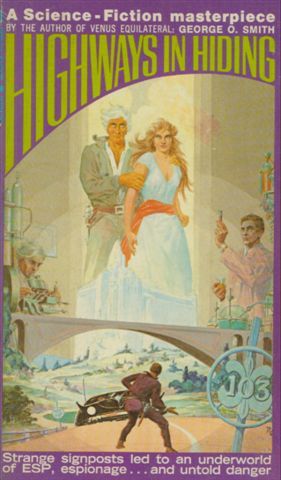
Steve: I just drove along that road in the right side of the picture. It reminded me of yours, so I'm writing because I want to know how you are making out. I'll be at the Med-Center in a couple of weeks, you can write me there.
Jim Thorndyke.
I turned the postcard over and eyed it critically. Then I got it. Along the roadside was a tall ornamental standard of wrought iron. The same design as the road signs along that fatal highway of mine.
I sat there with a magnifying glass on the roadsign; its stereo image standing up alongside the road in full color and solidity. It took me back to that moment when Catherine had wriggled against my side, thrilling me with her warmth and eagerness.
That put me down a few days, too.
Another month passed. I'd come out of my shell quite a bit in the meantime. I now felt that I could walk in a bar and have a drink without wondering whether all the other people in the place were pointing at me. I'd cut myself off from all my previous friends, and I'd made no new friends in the weeks gone by. But I was getting more and more lonely and consequently more and more inclined to speak to people and want friends.
The accident had paled from its original horror; the vital scene returned only infrequently. Catherine was assuming the position of a lost love rather than a sweetheart expected to return soon. I remembered the warmth of her arms and the eagerness of her kiss in a nostalgic way and my mind, especially when in a doze, would play me tricks. I would recall Catherine, but when she came into my arms, I'd be holding Marian, brown and tawny, with her electric blue eyes and her vibrant nature.
But I did nothing about it. I knew that once I had asked Marian Harrison for a date I would be emotionally involved. And then if—no, when—Catherine turned up I would be torn between desires.
I would wake up and call myself all sorts of a fool. I had seen Marian for a total of perhaps fifteen minutes—in the company of her brother.
But eventually dreaming loses its sting just as futile waiting and searching does, and I awoke one morning in a long and involved debate between my id and my conscience. I decided at that moment that I would take that highway out and pay a visit to the Harrison farm. I was salving my slightly rusty conscience by telling myself that it was because I had never paid my respects to Father Harrison, but not too deep inside I knew that if Father were missing and Daughter were present I'd enjoy my visit to the farm with more relish.
But my id took a licking because the doorbell rang about nine o'clock that morning and when I dug the doorstep I came up with two gentlemen wearing gold badges in leather folders in their jacket pockets.
I opened the door because I couldn't have played absent to a team consisting of one esper and one telepath. They both knew I was home.
"Mr. Cornell, we'll waste no time. We want to know how well you know Doctor James Thorndyke."
I didn't blink at the bluntness of it. It is standard technique when an esper-telepath team go investigating. The telepath knew all about me, including the fact that I'd dug their wallets and identification cards, badges and the serial numbers of the nasty little automatics they carried. The idea was to drive the important question hard and first; it being impossible to not-think the several quick answers that pop through your mind. What I knew about Thorndyke was sketchy enough but they got it all because I didn't have any reason for covering up. I let them know that, too.
Finally, #That's about all,# I thought. #Now—why?#
The telepath half of the team answered. "Normally we wouldn't answer, Mr. Cornell, unless you said it aloud. But we don't mind letting you know which of us is the telepath this time. To answer, you are the last person to have received any message from Thorndyke."
"I—what?"
"That postcard. It was the last contact Thorndyke made with anyone. He has disappeared."
"But—"
"Thorndyke was due to arrive at The Medical Research Center in Marion, Indiana, three weeks ago. We've been tracking him ever since he failed to turn up. We've been able to retrace his meanderings very well up to a certain point in Yellowstone. There the trail stops. He had a telephoned reservation to a small hotel; there he dropped out of sight. Now, Mr. Cornell, may I see that postcard?"
"Certainly." I got it for them. The esper took it over to the window and eyed it in the light, and as he did that I went over to stand beside him and together we espered that postcard until I thought the edges would start to curl. But if there were any codes, concealed writings or any other form of hidden meaning or message in or on that card, I didn't dig any.
I gave up. I'm no trained investigator. But I knew that Thorndyke was fairly well acquainted with the depth of my perceptive sense, and he would not have concealed anything too deep for me.
Then the esper shook his head. He handed me the card. "Not a trace."
The telepath nodded. He looked at me and smiled sort of thin and strained. "We're naturally interested in you, Mr. Cornell. This seems to be the second disappearance. And you know nothing about either."
"I know," I said slowly. The puzzle began to go around and around in my head again, all the way back to that gleaming road and the crack-up.
"We'll probably be back, Mr. Cornell. You don't mind?"
"Look," I told them rather firmly, "if this puzzle can be unwound, I'll be one of the happiest men on the planet. If I can do anything to help, just say the word."
They left after that and so did I. I was still going to pay my visit to the Harrison farm. Another wild goose chase, but somewhere along this cockeyed row there was an angle. Honest people who are healthy and fairly happy with good prospects ahead of them do not just drop out of sight without a trace.
A couple of hours later I was making a good pace along the highway again. It was getting familiar to me.
I could not avoid letting my perceptive sense rest on the sign as I drove past. Not long enough to put me in danger, but long enough to discover to my surprise that someone had taken the trouble to repair the broken spoke. Someone must have been a perfectionist. The break was so slight that it seemed like calling in a mechanic because the ashtray in the car is full.
Then I noticed other changes that time had caused.
The burned scar was fading in a growth of tall weeds. The limb of the tree that hung out over the scene, from which block and tackle had hung, was beginning to lose its smoke-blackened appearance. The block was gone from the limb.
Give us a year, I thought, and the only remaining scar will be the one on my mind, and even that will be fading.
I turned into the drive, wound around the homestead road, and pulled up in front of the big, rambling house.
It looked bleak. The front lawn was a bit shaggy and there were some wisps of paper on the front porch. The venetian blinds were down and slatted shut behind closed windows. Since it was summer by now, the closed windows and the tight door, neither of which had flyscreens installed, quickly gave the fact away. The Harrisons were gone.
Another disappearance?
I turned quickly and drove to the nearest town and went to the post office.
"I'm looking for the Harrison family," I told the man behind the wicket.
"Why, they moved several weeks ago."
"Moved?" I asked with a blank-sounding voice.
The clerk nodded. Then he leaned forward and said in a confidential whisper, "Heard a rumor that the girl got a touch of that spacemen's disease."
"Mekstrom's?" I blurted.
The clerk looked at me as if I'd shouted a dirty word. "She was a fine girl," he said softly. "It's a shame."
I nodded and he went into the back files. I tried to dig alone behind him, but the files were in a small dead area in the rear of the building. I swore under my breath although I'd expected to find files in dead areas. Just as Rhine Institute was opened, the Government combed the countryside for dead or cloudy areas for their secret and confidential files. There had been one mad claim-staking rush with the Government about six feet ahead of the rest of the general public, business and the underworld.
He came back with a sorrowful look. "They left a concealed address," he said.
I felt like flashing a twenty at him like a private eye did in the old tough-books, but I knew it wouldn't work. Rhine also made it impossible for a public official to take a bribe. So instead, I tried to look distressed.
"This is extremely important. I'd say it was a matter of life and death."
"I'm sorry. A concealed forwarding address is still concealed. If you must get in touch with them, you might drop them a letter to be forwarded. Then if they care to answer, they'll reply to your home."
"Later," I told him. "I'll probably be back to mail it direct from here."
He waved at the writing desk. I nodded and left.
I drove back to the ex-Harrison Farm slowly, thinking it over. Wondering. People did not just go around catching Mekstrom's Disease, from what little I knew of it. And somehow the idea of Marian Harrison withering away or becoming a basket case, or maybe taking the painless way out was a thought that my mind kept avoiding except for occasional flashes of horror.
I drove in toward the farmhouse again and parked in front of the verandah. I was not sure of why I was there except that I wanted to wander through it to see what I could find before I went back to the post-office to write that card or letter.
The back of the house was locked with an old-fashioned slide bolt that was turned with what they used to call an "E" key. I shrugged, oiled my conscience and found a bit of bent wire. Probing a lock like that would have been easy for a total blank; with esper I lifted the simple keepers and slid back the bolt almost as swiftly as if I had used a proper key.
This was no case of disappearance. In every one of the fourteen rooms were the unmistakable signs of a deliberate removal. Discarded stuff was mixed with the odds and ends of packing case materials, a scattered collection of temporary nails, a half-finished but never used box filled with old clothing.
I pawed through this but found nothing, even though I separated it from the rest to help my esper dig it without interference.
I roamed the house slowly letting my perception wander from point to point. I tried to time-dig the place but that was futile. I didn't have enough perception.
I caught only one response. It was in one of the upper bedrooms. But then as I stopped in the room where Marian had slept, I began again to doubt my senses. It could have been esper, but it was more likely that I'd caught the dying traces of perfume.
Then I suddenly realized that the entire premises were clear to me!
An esper map of the world looked sort of like a mottled sky, with bright places and cloudy patches strewn in disorder across it. A mottled sky, except that the psi-pattern usually does not change. But this house had been in a murky area, if not dead. Now it was clear.
I left the house and went to the big combination barn and garage. It was as unsatisfying as the house had been. Phillip Harrison, or someone, had had a workshop out there. I found the bench and a small table where bolt-holes, oil marks, and other traces said that there had been one of those big combination woodworking machines there, the kind that combines circular saw, drill, lathe, planer, router, dado, and does everything. There had been some metal-working stuff there, too, but nothing as elaborate as the woodshop. Mostly things like hacksaws and an electric drill, and a circular scar where a blowtorch had been sitting.
I don't know why I kept on standing there esping the abandoned set-up. Maybe it was because my esper dug the fact that there was something there that I should know about, but which was so minute or remote that the impression did not come through. I stood there puzzled at my own reluctance to leave until something satisfied that almost imperceptible impression.
Idly I leaned down and picked up a bit of metal from the floor and fumbled it in my hand nervously. I looked around the place with my eyes and saw nothing. I gave the whole garage a thorough scanning with my esper and got zero for my trouble.
Finally I snarled at myself for being an imbecile, and left.
Everyone has done what I did, time and time again. I do not recall anything of my walk back to the car, lost in a whirl of thoughts, ideas, plans and questions. I would probably have driven all the way back to my apartment with my mind in that whirligig, driving by habit and training, but I was shaken out of it because I could not start my car by poking that bit of metal in the lock. It did not fit.
I laughed, a bit ashamed of my preoccupation, and flung the bit of metal into the grass, poked my key in the lock—
And then I was out pawing the grass for that piece of metal.
For the small piece of metal I had found on the floor of the abandoned workshop was the spoke of that road sign that had been missing when Catherine and I cracked up!
I drove out along the highway and stopped near one of the standards. I esped the sign, compared my impression against my eyesight. I made sure.
That bit of metal, a half inch long and a bit under a quarter inch in diameter, with both ends faintly broken-ragged, was identical in size and shape to the unbroken spokes in the sign!
Then I noticed something else. The trefoil ornament in the middle did not look the same as I recalled them. I took Thorndyke's card out of my pocket and looked at the stereo. I compared the picture against the real thing before me and I knew that I was right.
The trefoil gizmo was a take-off on the fleur-de-lis or the Boy Scout Tenderfoot badge, or the design they use to signify North on a compass. But the lower flare of the leaves was wider than any of the more familiar emblems; almost as wide as the top. It took a comparison to tell the difference between one of them right-side-up and another one upside-down. One assumes for this design that the larger foils are supposed to be up. If that were so, then the ones along that road out there in or near Yellowstone were right-side-up, while the ones along my familiar highway were upside-down.
I goaded myself. #Memory, have these things been turned or were they always upside-down?#
The last thing I did as I turned off the highway was to stop and let my esper dig that design once more. I covered the design itself, let my perception roam along the spokes, and then around the circlet that supported the spokes that held the trefoil emblem.
Oh, it was not obvious. It was designed in, so to speak. If I were asked even today for my professional opinion I would have to admit that the way the circlet snapped into the rest of the ornamental scrollwork was a matter of good assembly design, and not a design deliberately created so that the emblem could be turned upside down.
In fact, if it had not been for that tiny, broken spoke I found on the floor of the Harrison garage, never in a million years would I have considered these road signs significant.
At the post office I wrote a letter to Phillip Harrison:
Dear Phil:
I was by your old place today and was sorry to find that you had moved. I'd like to get in touch with you again. If I may ask, please send me your forwarding address. I'll keep it concealed if you like, or I'll reply through the post office, concealed forward.
As an item of interest, did you know that your house has lost its deadness? A medium-equipped esper can dig it with ease. Have you ever heard of the psi-pattern changing before?
Ah, and another item, that road sign with the busted spoke has been replaced. You must be a bum shot, not to hit that curlicue in the middle. I found the spoke you hit on the floor of your garage, if you'd like it for a souvenir of one close miss.
Please write and let me know how things are going. Rumor has it that Marian contracted Mekstrom's and if you will pardon my mentioning a delicate subject, I am doing so because I really want to help if I am able. After all, no matter how lightly you hold it, I still owe you my life. This is a debt I do not intend to forget.
Sincerely,
Steve Cornell.
V
I did not go to the police.
They were sick of my face and already considering me a candidate for the paranoid ward. All I would have to do is go roaring into the station to tell them that I had uncovered some deep plot where the underground was using ornamental road signs to conceal their own network of roads and directions, and that the disappearance of Catherine Lewis, Dr. Thorndyke and the removal of the Harrisons were all tied together.
Instead, I closed my apartment and told everyone that I was going to take a long, rambling tourist jaunt to settle my nerves; that I thought getting away from the scene might finish the job that time and rest had started.
Then I started to drive. I drove for several days, not attempting to pace off miles, but covering a lot of aimless-direction territory. I was just as likely to spend four hours going North on one highway, and then take the next four coming back South on a parallel highway, and sometimes I even came back to the original starting place. After a week I had come no farther West than across that sliver of West Virginia into Eastern Ohio. And in Eastern Ohio I saw some more of the now familiar and suspicious road signs.
The emblem was right side up, and the signs looked as though they had not been up long.
I followed that road for seventy-five miles, and as I went the signs kept getting newer and newer until I finally came to a truck loaded with pipe, hardware, and ornamental ironwork. Leading the truck was one of those iron mole things.
I watched the automatic gear hoist one of the old pipe and white and black enamel roadsigns up by its roots, and place it on a truck full of discards. I watched the mole drive a corkscrew blade into the ground with a roaring of engine and bucking of the truck. It paused, pulled upward to bring out the screw and its load of dirt, stones and gravel. The crew placed one of the new signs in the cradle and I watched the machine set the sign upright, pour the concrete, tamp down the earth, and then move along down the road.
There was little point in asking questions of the crew, so I just took off and drove to Columbus as hard as I could make it.
Shined, cleaned, polished, and very conservatively dressed, I presented myself to the State Commissioner of Roads and Highways. I toyed briefly with the idea of representing myself as a minor official from some distant state like Alaska or the Virgin Islands, inquiring about these signs for official reasons. But then I knew that if I bumped into a hot telepath I'd be in the soup. On the other hand, mere curiosity on the part of a citizen, well oiled with compliments, would get me at the very least a polite answer.
The Commissioner's fifth-under-secretary bucked me down the hall; another office bucked me upstairs. A third buck-around brought me to the Department of Highways Marking and Road Maps.
A sub-secretary finally admitted that he might be able to help me. His name was Houghton. But whether he was telepath or esper did not matter because the Commission building was constructed right in the middle of a dead area.
I still played it straight. I told him I was a citizen of New York, interested in the new road signs, Ohio was to be commended, et cetera.
"I'm glad you feel that way," he said beaming.
"I presume these signs cost quite a bit more than the stark, black and white enamel jobs?"
"On the contrary," he said with pride. "They might, but mass-production methods brought the cost down. You see, the enamel jobs, while we buy several thousand of the plates for any highway, must be set up, stamped out, enamelled, and so on. The new signs are all made in one plant as they are needed; I don't suppose you know, but the highway number and any other information is put on the plate from loose, snap-in letters. That means we can buy so many thousand of this or that letter or number, and the necessary base plates and put them together as needed. They admitted that they were still running at a loss, but if they could get enough states interested, they'd eventually come out even, and maybe they could reduce the cost. Why, they even have a contingent-clause in the contract stating that if the cost were lowered, they would make a rebate to cover it. That's so the first users will not bide their time instead of buying now."
He went on and on and on like any bureaucrat. I was glad we were in a dead area because he'd have thrown me out of his office for what I was thinking.
Eventually Mr. Houghton ran down and I left.
I toyed around with the idea of barging in on the main office of the company but I figured that might be too much like poking my head into a hornet's nest.
I pocketed the card he gave me from the company, and I studied the ink-fresh road map, which he had proudly supplied. It pointed out in a replica panel of the fancy signs, that the State of Ohio was beautifying their highways with these new signs at no increased cost to the taxpayer, and that the dates in green on the various highways here and there gave the dates when the new signs would be installed. The bottom of the panel gave the Road Commissioner's name in boldface with Houghton's name below in slightly smaller print.
I smiled. Usually I get mad at signs that proclaim that such and such a tunnel is being created by Mayor So-and-so, as if the good mayor were out there with a shovel and hoe digging the tunnel. But this sort of thing would have been a worthy cause if it hadn't been for the sinister side.
I selected a highway that had been completed toward Cincinnati and made my way there with no waste of time.
The road was new and it was another beaut. The signs led me on, mile after mile and sign after sign.
I did not know what I was following, and I was not sure I knew what I was looking for. But I was on the trail of something and a bit of activity, both mental and physical, after weeks of blank-wall frustration made my spirits rise and my mental equipment sharper. The radio in the car was yangling with hillbilly songs, the only thing you can pick up in Ohio, but I didn't care. I was looking for something significant.
I found it late in the afternoon about half-way between Dayton and Cincinnati. One of the spokes was missing.
Fifty yards ahead was a crossroad.
I hauled in with a whine of rubber and brakes, and sat there trying to reason out my next move by logic. Do I turn with the missing spoke, or do I turn with the one that is not missing?
Memory came to my aid. The "ten o'clock" spoke had been missing back there near the Harrison farm. The Harrisons had lived on the left side of the highway. One follows the missing spoke. Here the "two o'clock" spoke was missing, so I turned to the right along the crossroad until I came to another sign that was complete.
Then, wondering, I U-turned and drove back across the main highway and drove for about five miles watching the signs as I went. The ones on my right had that trefoil emblem upside down. The ones on my left were right side up. The difference was so small that only someone who knew the significance would distinguish one from the other. So far as I could reason out, it meant that what I sought was in the other direction. When the emblem was upside down I was going away from, and when right side up, I was going toward.
Away from or toward what?
I U-turned again and started following the signs.
Twenty miles beyond the main highway where I'd seen the sign that announced the turn, I came upon another missing spoke. This indicated a turn to the left, and so I slowed down until I came upon a homestead road leading off toward a farmhouse.
I turned, determined to make like a man lost and hoping that I'd not bump into a telepath.
A few hundred yards in from the main road I came upon a girl who was walking briskly toward me. I stopped. She looked at me with a quizzical smile and asked me if she could be of any help.
Brashly, I nodded. "I'm looking for some old friends of mine," I said. "Haven't seen them for years. Named Harrison."
She smiled up at me. "I don't know of any Harrison around here." Her voice had the Ohio twang.
"No?"
"Just where do they live?"
I eyed her carefully, hoping my glance did not look like a wolf eyeing a lamb. "Well, they gave me some crude directions. Said I was to turn at the main highway onto this road and come about twenty miles and stop on the left side when I came upon one of those new road signs where someone had shot one of the spokes out."
"Spokes? Left side—" She mumbled the words and was apparently mulling the idea around in her mind. She was not more than about seventeen, sun-tanned and animal-alive from living in the open. I wondered about her. As far as I was concerned, she was part and parcel of this whole mysterious affair. No matter what she said or did, it was an obvious fact that the hidden road sign directions pointed to this farm. And since no one at seventeen can be kept in complete ignorance of the business of the parents, she must be aware of some of the ramifications.
After some thought she said, "No, I don't know of any Harrisons."
I grunted. I was really making the least of this, now that I'd arrived.
"Your folks at home?" I asked.
"Yes," she replied.
"I think I'll drop in and ask them, too."
She shrugged. "Go ahead," she said with the noncommittal attitude of youth. "You didn't happen to notice whether the mailbox flag was up, did you?"
I hadn't, but I espied back quickly and said, "No, it isn't."
"Then the mailman hasn't been to deliver," she said. "Mind if I ride back to the house with you, mister?"
"Hop in."
She smiled brightly and got in quickly. I took off down the road toward the house at an easy pace. She seemed interested in the car, and finally said, "I've never been in a car like this before. New?"
"Few weeks," I responded.
"Fast?"
"If you want to make it go fast. She'll take this rocky road at fifty, if anyone wants to be so foolish."
"Let's see."
I laughed. "Nobody but an idiot would tackle a road like this at fifty."
"I like to go fast. My brother takes it at sixty."
That, so far as I was concerned, was youthful exaggeration. I was busy telling her all the perils of fast driving when a rabbit came barrelling out of the bushes along one side and streaked across in front of me.
I twitched the wheel. The car went out of the narrow road and up on the shoulder, tilting quite a bit. Beyond the rabbit I swung back into the road, but not before the youngster had grabbed my arm to keep from being tossed all over the front seat.
Her grip was like a hydraulic vise. My arm went numb and my fingers went limp on the wheel. I struggled with my left hand to spin the wheel to keep on the narrow, winding road and my foot hit the brake to bring the car down, but fast.
Taking a deep breath as we stopped, I shook my right hand by holding it in my left at the wrist. I was a mass of tingling pins and needles because she had grabbed me just above the elbow. It felt as though it would have taken only a trifle more to pinch my arm off and leave me with a bloody stump.
"Sorry, mister," she said breathlessly, her eyes wide open. Her face was white around the corners of the mouth and at the edges of her nose. The whiteness of the flesh under the deep tan gave her a completely frightened look, far more than the shake-up could have produced.
I reached over and took her hand. "That's a mighty powerful grip you—"
The flesh of her hand was hard and solid. Not the meaty solidity of good tone, fine training and excellent health. It was the solidity of a—all I could think of at the time was a green cucumber. I squeezed a bit and the flesh gave way only a trifle. I rubbed my thumb over her palm and found it solid-hard instead of soft and yielding.
I wondered.
I had never seen a case of Mekstrom's Disease—before.
I looked down at the hand and said, "Young lady, do you realize that you have an advanced case of Mekstrom's Disease?"
She eyed me coldly. "Now," she said in a hard voice. "I know you'll come in."
Something in my make-up objects violently to being ordered around by a slip of a girl. I balance off at about one-sixty. I guessed her at about two-thirds of that, say one-ten or thereabouts—
"One-eight," she said levelly.
#A telepath!#
"Yes," she replied calmly. "And I don't mind letting you know it, so you'll not try anything stupid."
#I'm getting the heck out of here!#
"No, you're not. You are coming in with me."
"Like heck!" I exploded.
"Don't be silly. You'll come in. Or shall I lay one along your jaw and carry you?"
I had to try something, anything, to get free. Yet—
"Now you're being un-bright," she told me insolently. "You should know that you can't plan any surprise move with a telepath. And if you try a frontal attack I'll belt you so cold they'll have to put you in the oven for a week."
I just let her ramble for a few seconds because when she was rattling this way she couldn't put her entire mental attention on my thoughts. So while she was yaking it off, I had an idea that felt as though it might work.
She shut up like a clam when she realized that her mouthing had given me a chance to think, and I went into high gear with my perception:
#Not bad—for a kid. Growing up fast. Been playing hookey from momma, leaving off your panties like the big girls do. I can tell by the elastic cord marks you had 'em on not long ago.#
Seventeeners have a lot more modesty than they like to admit. She was stunned by my cold-blooded catalog of her body just long enough for me to make a quick lunge across her lap to the door handle on her side.
I flipped it over and gave her a shove at the same time. She went bottom over appetite in a sprawl that would have jarred the teeth loose in a normal body and might have cracked a few bones. But she landed on the back of her neck, rolled and came to her feet like a cat.
I didn't wait to close the door. I just tromped on the go-pedal and the car leaped forward with a jerk that slammed the door for me. I roared forward and left her just as she was making another grab.
How I hoped to get out of there I did not know. All I wanted was momentary freedom to think. I turned this way and that to follow the road until I came to the house. I left the road, circled the house with the turbine screaming like a banshee and the car taking the corners on the outside wheels. I skidded into a turn like a racing driver and ironed my wheels out flat on the takeaway, rounded another corner and turned back into the road again going the other way.
She was standing there waiting for me as I pelted past at a good sixty, and she reached out one girder-strong arm, latched onto the frame of the open window on my side, and swung onto the half-inch trim along the bottom of the car-body like a switchman hooking a freight car.
She reached for the steering wheel with her free hand.
I knew what was to happen next. She'd casually haul and I'd go off the road into a tree or pile up in a ditch, and while the smoke was clearing out of my mind, she'd be untangling me from the wreck and carting me over her shoulder, without a scratch to show for her adventure.
I yanked the wheel—whip! whap!—cutting an arc. I slammed past a tree, missing it by half an inch. I wiped her off the side of the car like a mailbag is clipped from the fast express by the catch-hook.
I heard a cry of "Whoof!" as her body hit the trunk of the tree. But as I regained the road and went racing on to safety, I saw in the rear view mirror that she had bounced off the tree, sprawled a bit, caught her balance, and was standing in the middle of the road, shaking her small but very dangerous fist at my tail license plate.
I didn't stop driving at one-ten until I was above Dayton again. Then I paused along the road to take stock.
Stock? What the hell did I know, really?
I'd uncovered and confirmed the fact that there was some secret organization that had a program that included their own highway system, concealed within the confines of the United States. I was almost certain by this time that they had been the prime movers in the disappearance of Catherine and Dr. Thorndyke. They—
I suddenly re-lived the big crack-up.
Willingly now, no longer rejecting the memory, I followed my recollection as Catherine and I went along that highway at a happy pace. With care I recalled every detail of Catherine, watching the road through my mind and eyes, how she'd mentioned the case of the missing spoke, and how I'd projected back to perceive that which I had not been conscious of.
Reminding myself that it was past, I went through it again, deliberately. The fallen limb that blocked the road, my own horror as the wheels hit it. The struggle to regain control of the careening car.
As a man watching a motion picture, I watched the sky and the earth turn over and over, and I heard my voice mouthing wordless shouts of fear. Catherine's cry of pain and fright came, and I listened as my mind reconstructed it this time without wincing. Then the final crash, the horrid wave of pain and the sear of the flash-fire. I went through my own horror and self condemnation, and my concern over Catherine. I didn't shut if off. I waded through it.
Now I remembered something else.
Something that any normal, sensible mind would reject as an hallucination. Beyond any shadow of a doubt there had been no time for a man to rig a block and tackle on a tree above a burning automobile in time to get the trapped victims out alive. And even more certain it was that no normal man of fifty would have had enough strength to lift a car by its front bumper while his son made a rush into the flames.
That tackle had been rigged and burned afterward. But who would reject a block and tackle in favor of an impossibly strong man? No, with the tackle in sight, the recollection of a man lifting that overturned automobile like a weight lifter pressing up a bar bell would be buried in any mind as a rank hallucination. Then one more item came driving home hard. So hard that I almost jumped when the idea crossed my mind.
Both Catherine and Dr. Thorndyke had been telepaths.
A telepath close to any member of his underground outfit would divine their purpose, come to know their organization, and begin to grasp the fundamentals of their program. Such a person would be dangerous.
On the other hand, an esper such as myself could be turned aside with bland remarks and a convincing attitude. I knew that I had no way of telling lie from truth and that made my problem a lot more difficult.
From the facts that I did have, something smelled of overripe seafood. Government and charities were pouring scads of dough into a joint called the Medical Research Center. To hear the scholars of medicine tell it, Mekstrom's Disease was about the last human frailty that hadn't been licked to a standstill. They boasted that if a victim of practically anything had enough life left in him to crawl to a telephone and use it, his life could be saved. They grafted well. I'd heard tales of things like fingers, and I know they were experimenting on hands, arms and legs with some success. But when it came to Mekstrom's they were stopped cold. Therefore the Medical Research Center received a walloping batch of money for that alone; all the money that used to go to the various heart, lung, spine and cancer funds. It added up well.
But the Medical Research Center seemed unaware that some group had solved their basic problem.
From the books I've read I am well aware of one of the fundamental principles of running an underground: Keep it underground! The Commie menace in these United States might have won out in the middle of the century if they'd been able to stay a secret organization. So the Highways in Hiding could stay underground and be an efficient organization only until someone smoked them out.
That one was going to be me.
But I needed an aide-de-camp. Especially and specifically I needed a trained telepath, one who would listen to my tale and not instantly howl for the nut-hatch attendants. The F.B.I. were all trained investigators and they used esper-telepath teams all the time. One dug the joint while the other dug the inhabitant, which covered the situation to a faretheewell.
It would take time to come up with a possible helper. So I spent the next hour driving toward Chicago, and by the time I'd crossed the Ohio-Indiana line and hit Richmond, I had a plan laid out. I placed a call to New York and within a few minutes I was talking to Nurse Farrow.
I'll not go into detail because there was a lot of mish-mash that is not particularly interesting and a lot more that covered my tracks since I'd parted company with her on the steps of the hospital. I did not, of course, mention my real purpose over the telephone and Miss Farrow could not read my mind from New York.
The upshot of the deal was that I felt that I needed a nurse for a while, not that I was ill, but that I felt a bit woozy now and then because I hadn't learned to slow down. I worked too fast and too long and my condition was not up to it yet. This Miss Farrow allowed as being quite possible. I repeated my offer to pay her at the going prices for registered nurses with a one-month guarantee, paid in advance. That softened her quite a bit. Then I added that I'd videograph her a check large enough to cover the works plus a round trip ticket. She should come out and have a look, and if she weren't satisfied, she could return without digging into her own pocket. All she'd lose was one day, and it might be a bit of a vacation if she enjoyed flying in a jetliner at sixty thousand feet.
The accumulation of offers finally sold her and she agreed to arrange a leave of absence. She'd meet me in the morning of the day-after-tomorrow, at Central Airport in Chicago.
I videographed the check and then took off again, confident that I'd be able to sell her on the idea of being the telepath half of my amateur investigation team.
Then because I needed some direct information, I turned West and crossed the line into Indiana, heading toward Marion. So far I had a lot of well-placed suspicions, but until I was certain, I could do no more than postulate ideas. I had to know definitely how to identify Mekstrom's Disease, or at least the infected flesh. I have a fairly good recall; all I needed now was to have someone point to a Case and say flatly that this was a case of Mekstrom's Disease. Then I'd know whether what I'd seen in Ohio was actually one hundred percent Mekstrom.
VI
I walked into the front office with a lot of self-assurance. The Medical Center was a big, rambling place with a lot of spread-out one- and two-story buildings that looked so much like "Hospital" that no one in the world would have mistaken them for anything else. The main building was by the road, the rest spread out behind as far as I could see; beyond my esper range even though the whole business was set in one of the clearest psi areas that I'd even been in.
I was only mildly worried about telepaths. In the first place, the only thing I had to hide was my conviction about a secret organization and how part of it functioned. In the second place, the chances were good that few, if any, telepaths were working there, if the case of Dr. Thorndyke carried any weight. That there were some telepaths, I did not doubt, but these would not be among the high-powered help.
So I sailed in and faced the receptionist, who was a good-looking chemical-type blonde with a pale skin, lovely complexion and figure to match. She greeted me with a glacial calm and asked my business.
Brazenly I lied. "I'm a freelance writer and I'm looking for material."
"Have you an assignment?" she asked without a trace of interest in the answer.
"Not this time. I'm strictly freelance. I like it better this way because I can write whatever I like."
Her glacial air melted a bit at the inference that my writing had not been in vain. "Where have you been published?" she asked.
I made a fast stab in the dark, aiming in a direction that looked safe. "Last article was one on the latest archeological findings in Assyria. Got my source material direct from the Oriental Institute in Chicago."
"Too bad I missed it," she said, looking regretful. I had to grin, I'd carefully avoided giving the name of the publication and the supposed date. She went on, "I suppose you would not be happy with the usual press release?"
"Handouts contain material, all right, but they're so confounded trite and impersonal. People prefer to read anecdotes about the people rather than a listing of facts and figures."
She nodded at that. "Just a moment," she said. Then she addressed her telephone in a voice that I couldn't hear. When she finished, she smiled in a warmish-type manner as if to indicate that she'd gone all out in my behalf and that I'd be a heel to forget it. I nodded back and tried to match the tooth-paste-ad smile. Then the door opened and a man came in briskly.
He was a tall man, as straight as a ramrod, with a firm jaw and a close-clipped moustache. He had an air like a thin-man's Captain Bligh. When he spoke, his voice was as clipped and precise as his moustache; in fact it was so precise that it seemed almost mechanical.
"I am Dr. Lyon Sprague," he clipped. "What may I do for you?"
"I'm Steve Cornell," I said. "I'm here after source material for a magazine article about Mekstrom's Disease. I'd prefer not to take my material from a handout."
"Do you hope to get more?" he demanded.
"I usually do. I've seen your handouts; I could get as much by taking last year's medical encyclopedia. Far too dry, too uninteresting, too impersonal."
"Just exactly what do you have in mind?"
I eyed him with speculation. Here was not a man who would take kindly to imaginative conjecture. So Dr. Lyon Sprague was not the man I'd like to talk to. With an inward smile, I said, "I have a rather new idea about Mekstrom's that I'd like to discuss with the right party."
He looked down at me, although our eyes were on the same level. "I doubt that any layman could possibly come up with an idea that has not been most thoroughly discussed here among the research staff."
"In cold words you feel that no untrained lunk has a right to have an idea."
He froze. "I did not say that."
"You implied, at least, that suggestions from outsiders were not welcome. I begin to understand why the Medical Center has failed to get anywhere with Mekstrom's in the past twenty years."
"What do you mean?" he snapped.
"Merely that it is the duty of all scientists to listen to every suggestion and to discard it only after it has been shown wrong."
"Such as—?" he said coldly, with a curl of his eyebrows.
"Well, just for instance, suppose some way were found to keep a victim alive during the vital period, so that he would end up a complete Mekstrom Human."
"The idea is utterly fantastic. We have no time for such idle speculation. There is too much foggy thinking in the world already. Why, only last week we had a Velikovsky Adherent tell us that Mekstrom's had been predicted in the Bible. There are still people reporting flying saucers, you know. We have no time for foolish notions or utter nonsense."
"May I quote you?"
"Of course not," he snapped stiffly. "I'm merely pointing out that non-medical persons cannot have the grasp—"
The door opened again and a second man entered. The new arrival had pleasant blue eyes, a van dyke beard, and a good-natured air of self-confidence and competence. "May I cut in?" he said to Dr. Sprague.
"Certainly. Mr. Cornell, this is Scholar Phelps, Director of the Center. Scholar Phelps, this is Mr. Steve Cornell, a gentleman of the press," he added in a tone of voice that made the identification a sort of nasty name. "Mr. Cornell has an odd theory about Mekstrom's Disease that he intends to publish unless we can convince him that it is not possible."
"Odd theory?" asked Scholar Phelps with some interest. "Well, if Mr. Cornell can come up with something new, I'll be most happy to hear him out."
Dr. Lyon Sprague decamped with alacrity. Scholar Phelps smiled after him, then turned to me and said, "Dr. Sprague is a diligent worker, businesslike and well-informed, but he lacks the imagination and the sense of humor that makes a man brilliant in research. Unfortunately, Dr. Sprague cannot abide anything that is not laid out as neat as an interlocking tile floor. Now, Mr. Cornell, how about this theory of yours?"
"First," I replied, "I'd like to know how come you turn up in the nick of time."
He laughed good-naturedly. "We always send Dr. Sprague out to interview visitors. If the visitor can be turned away easily, all is well and quiet. Dr. Sprague can do the job with ease. But if the visitor, like yourself, Mr. Cornell, proposes something that distresses the good Dr. Sprague and will not be loftily dismissed, Dr. Sprague's blood pressure goes up. We all keep a bit of esper on his nervous system and when the fuse begins to blow, we come out and effect a double rescue."
I laughed with him. Apparently the Medical Center staff enjoyed needling Dr. Sprague. "Scholar Phelps, before I get into my theory, I'd like to know more about Mekstrom's Disease. I may not be able to use it in my article, but any background material works well with writers of fact articles."
"You're quite right. What would you like to know?"
"I've heard, too many times, that no one knows anything at all about Mekstrom's. This is unbelievable, considering that you folks have been working on it for some twenty years."
He nodded. "We have some, but it's precious little."
"It seems to me that you could analyze the flesh—"
He smiled. "We have. The state of analytical chemistry is well advanced. We could, I think, take a dry scraping out of the cauldron used by MacBeth's witches, and determine whether Shakespeare had reported the formula correctly. Now, young man, if you think that something is added to the human flesh to make it Mekstrom's Flesh, you are wrong. Standard analysis shows that the flesh is composed of exactly the same chemicals that normal flesh contains, in the same proportion. Nothing is added, as, for instance, in the case of calcification."
"Then what is the difference?"
"The difference lies in the structure. By X-ray crystallographic method, we have determined that Mekstrom's Flesh is a micro-crystalline formation, interlocked tightly." Scholar Phelps looked at me thoughtfully. "Do you know much about crystallography?"
As a mechanical engineer I did, but as a writer of magazine articles I felt I should profess some ignorance, so I merely said that I knew a little about the subject.
"Well, Mr. Cornell, you may know that in the field of solid geometry there are only five possible regular polyhedrons. Like the laws of topology that state that no more than four colors need be used to print a map on a flat surface, or that no more than seven colors are required to print separate patches on a toroid, the laws of solid geometry prove that no more than five regular polyhedrons are possible. Now in crystallography there are only thirty-two possible classes of crystal lattice construction. Of these only thirty have ever been discovered in nature. Yet we know how the other two would appear if they did emerge in natural formation."
I knew it all right but I made scribblings in my notebooks as if the idea were of interest. Scholar Phelps waited patiently until I'd made the notation.
"Now, Mr. Cornell, here comes the shock. Mekstrom's Flesh is one of the other two classes."
This was news to me and I blinked.
Then his face faded into a solemn expression. "Unfortunately," he said in a low voice, "knowing how a crystal should form does not help us much in forming one to that class. We have no real control over the arrangement of atoms in a crystal lattice. We can prevent the crystal formation, we can control the size of the crystal as it forms. But we cannot change the crystal into some other class."
"I suppose it's sort of like baking a cake. Once the ingredients are mixed, the cake can be big or small or shaped to fit the pan, or you can spoil it complete. But if you mix devil's food, it either comes out devil's food or nothing."
"An amusing analogy and rather correct. However I prefer the one used years ago by Dr. Willy Ley, who observed that analysis is fine, but you can't learn how a locomotive is built by melting it down and analyzing the mess."
Then he went on again. "To get back to Mekstrom's Disease and what we know about it. We know that the crawl goes at about a sixty-fourth of an inch per hour. If, for instance, you turned up here with a trace on your right middle finger, the entire first joint would be Mekstrom's Flesh in approximately three days. Within two weeks your entire middle finger would be solid. Without anesthesia we could take a saw and cut off a bit for our research."
"No feeling?"
"None whatever. The joints knit together, the arteries become as hard as steel tubing and the heart cannot function properly—not that the heart cares about minor conditions such as the arteries in the extremities, but as the Mekstrom infection crawls up the arm toward the shoulder the larger arteries become solid and then the heart cannot drive the blood through them in its accustomed fashion. It gets like an advanced case of arteriosclerosis. Eventually the infection reaches and immobilizes the shoulder; this takes about ninety days. By this time, the other extremities have also become infected and the crawl is coming up all four limbs."
He looked at me very solemnly at that. "The rest is not pretty. Death comes shortly after that. I can almost say that he is blessed who catches Mekstrom's in the left hand for them the infection reaches the heart before it reaches other parts. Those whose initial infection is in the toes are particularly cursed, because the infection reaches the lower parts of the body. I believe you can imagine the result, elimination is prevented because of the stoppage of peristalsis. Death comes of autointoxication, which is slow and painful."
I shuddered at the idea. The thought of death has always bothered me. The idea of looking at a hand and knowing that I was going to die by the calendar seemed particularly horrible.
Taking the bit between my teeth, I said, "Scholar Phelps, I've been wondering whether you and your Center have ever considered treating Mekstrom's by helping it?"
"Helping it?" he asked.
"Sure. Consider what a man might be if he were Mekstrom's all the way through."
He nodded. "You would have a physical superman," he said. "Steel-strong muscles driving steel-hard flesh covered by a near impenetrable skin. Perhaps such a man would be free of all minor pains and ills. Imagine a normal bacterium trying to bore into flesh as hard as concrete. Mekstrom Flesh tends to be acid-resistant as well as tough physically. It is not beyond the imagination to believe that your Mekstrom Superman might live three times our frail four-score and ten. But—"
Here he paused.
"Not to pull down your house of cards, this idea is not a new one. Some years ago we invited a brilliant young doctor here to study for his scholarate. The unfortunate fellow arrived with the first traces of Mekstrom's in his right middle toe. We placed about a hundred of our most brilliant researchers under his guidance, and he decided to take this particular angle of study. He failed; for all his efforts, he did not stay his death by a single hour. From that time to the present we have maintained one group on this part of the problem."
It occurred to me at that moment that if I turned up with a trace of Mekstrom's I'd be seeking out the Highways in Hiding rather than the Medical Center. That fast thought brought a second: Suppose that Dr. Thorndyke learned that he had a trace, or rather, the Highways found it out. What better way to augment their medical staff than to approach the victim with a proposition: You help us, work with us, and we will save your life.
That, of course, led to the next idea: That if the Highways in Hiding had any honest motive, they'd not be hidden in the first place and they'd have taken their cure to the Medical Center in the second. Well, I had a bit of something listed against them, so I decided to let my bombshell drop.
"Scholar Phelps," I said quietly, "one of the reasons I am here is that I have fairly good evidence that the cure for Mekstrom's Disease does exist, and that it produces people of ultrahard bodies and superhuman strength."
He smiled at me with the same tolerant air that father uses on the offspring who comes up with one of the standard juvenile plans for perpetual motion.
"What do you consider good evidence?"
"Suppose I claimed to have seen it myself."
"Then I would say that you had misinterpreted your evidence," he replied calmly. "The flying saucer enthusiasts still insist that the things they see are piloted by little green men from Venus, even though we have been there and found Venus to be absolutely uninhabited by anything higher than slugs, grubs, and little globby animals like Tellurian leeches."
"But—"
"This, too, is an old story," he told me with a whimsical smile. "It goes with the standard routine about a secret organization that is intending to take over the Earth. The outline has been popular ever since Charles Fort. Now—er—just tell me what you saw."
I concocted a tale that was about thirty-three percent true and the rest partly distorted. It covered my hitting a girl in Ohio with my car, hard enough to clobber her. But when I stopped to help her, she got up and ran away unhurt. She hadn't left a trace of blood although the front fender of the car was badly smashed.
He nodded solemnly. "Such things happen," he said. "The human body is really quite durable; now and then comes the lucky happenstance when the fearful accident does no more than raise a slight bruise. I've read the story of the man whose parachute did not open and who lived to return it to the factory in person, according to the old joke. But now, Mr. Cornell, have you ever considered the utter impossibility of running any sort of secret organization in this world of today. Even before Rhine it was difficult. You'll be adding to your tale next—some sort of secret sign, maybe a form of fraternity grip, or perhaps even a world-wide system of local clubs and hangouts, all aimed at some dire purpose."
I squirmed nervously for a bit. Scholar Phelps was too close to the truth to make me like it, because he was scoffing. He went right on making me nervous.
"Now before we get too deep, I only want to ask about the probable motives of such an organization. You grant them superhuman strength, perhaps extreme longevity. If they wanted to take over the Earth, couldn't they do it by a show of force? Or are they mild-mannered supermen, only quietly interested in overrunning the human race and waiting out the inevitable decline of normal homo sapiens? You're not endowing them with extraterrestrial origin, are you?"
I shook my head unhappily.
"Good. That shows some logic, Mr. Cornell. After all, we know now that while we could live on Mars or Venus with a lot of home-sent aid, we'd be most uncomfortable there. We could not live a minute on any planet of our solar system without artificial help."
"I might point out that our hypothetical superman might be able to stand a lot of rough treatment," I blurted.
"Oh, this I'll grant if your tale held any water at all. But let's forget this fruitless conjecture and take a look at the utter impossibility of running such an organization. Even planting all of their secret hangouts in dead areas and never going into urban centers, they'd still find some telepath or esper on their trail. Perhaps a team. Let's go back a step and consider, even without psi training, how long such an outfit could function. It would run until the first specimen had an automobile accident on, say Times Square; or until one of them walked—or ran—out of the fire following a jetliner crash."
He then spared me with a cold eye. "Write it as fiction, Mr. Cornell. But leave my name out of it. I thought you were after facts."
"I am. But the better fact articles always use a bit of speculation to liven it up."
"Well," he grunted, "one such fanciful suggestion is the possibility of such an underground outfit being able to develop a 'cure' while we cannot. We, who have had the best of brains and money for twenty years."
I nodded, and while I did not agree with Phelps, I knew that to insist was to insult him to his face, and get myself tossed out.
"You do seem to have quite a set-up here," I said, off-hand.
At this point Phelps offered to show me around the place, and I accepted. Medical Center was far larger than I had believed at first; it spread beyond my esper range into the hills beyond the main plant. The buildings were arranged in a haphazard-looking pattern out in the back section; I say "looking" because only a psi-trained person can dig a pattern. The wide-open psi area did not extend for miles. Behind the main buildings it closed down into the usual mottled pattern and the medical buildings had been placed in the open areas. Dwellings and dormitories were in the dark places. A nice set-up.
I did not meet any of the patients, but Phelps let me stand in the corridor outside a couple of rooms and use my esper on the flesh. It was both distressing and instructive.
He explained, "The usual thing after someone visits this way, is that the visitor goes out itching. In medical circles this is a form of what we call 'Sophomore's Syndrome.' Ever heard of it?"
I nodded. "That's during the first years at pre-med. Knowing all too little of medicine, every disease they study produces the same symptoms that the student finds in himself. Until tomorrow, when they study the next. Then the symptoms in the student change."
"Right. So in order to prevent 'Sophomore's Syndrome' among visitors we usually let them study the real thing. Also," he added seriously, "we'd like to have as many people as possible recognize the real thing as early as possible. Even though we can't do anything for them at the present time, someday we will."
He stopped before a closed door. "In here is a girl of eighteen, doomed to die in a month." His voice trailed off as he tapped on the door of the room.
I froze. A few beads of cold sweat ran down my spine, and I fought myself into a state of nervous calmness. I put the observation away, buried it as deep as I could, tried to think around it, and so far as I knew, succeeded.
The tap of Scholar Phelps' finger against the door panel was the rap-rap-rap sound characteristic of hard-tanned leather tapping wood.
Scholar Phelps was a Mekstrom!
I paid only surface attention to the rest of my visit. I thanked my personal gods that esper training had also given me the ability to dissemble. It was impossible to not think of something but it is possible to keep the mind so busy with surface thoughts that the underlying idea does not come through the interference.
Eventually I managed to leave the Medical Center without exciting anyone, and when I left I took off like a skyrocket for Chicago.