
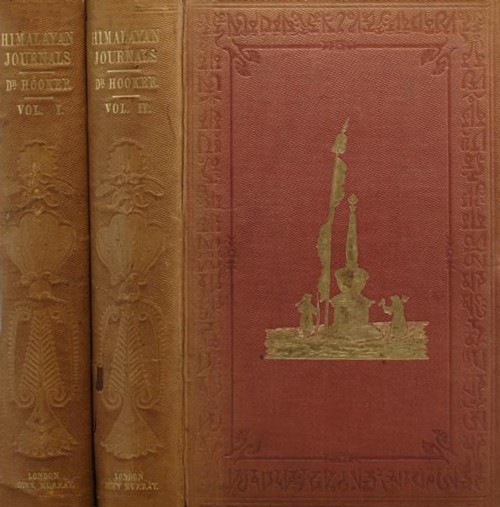
The Project Gutenberg eBook of Himalayan Journals — Complete
Title: Himalayan Journals — Complete
Author: Joseph Dalton Hooker
Release date: September 1, 2004 [eBook #6478]
Most recently updated: March 8, 2020
Language: English
Credits: Scanned by Derek Thompson
Himalayan Journals
OR,
NOTES OF A NATURALIST
IN BENGAL, THE SIKKIM AND NEPAL HIMALAYAS,
THE KHASIA MOUNTAINS, &C.
by J.D. Hooker,
K.C.S.I., C.B., M.D., D.C.L., F.R.S.
1891
Contents
Sunderbunds vegetation—Calcutta Botanic Garden—Leave for Burdwan—Rajah’s gardens and menagerie—Coal-beds, geology, and plants of—Lac insect and plant—Camels—Kunker—Cowage—Effloresced soda on soil—Glass, manufacture of—Atmospheric vapours—Temperature, etc.—Mahowa oil and spirits—Maddaobund—Jains—Ascent of Paras-nath—Vegetation of that mountain.
Doomree—Vegetation of table-land—Lieutenant Beadle—Birds—Hot springs of Soorujkoond—Plants near them—Shells in them—Cholera-tree—Olibanum—Palms, form of—Dunwah pass—Trees, native and planted —Wild peacock—Poppy fields—Geography and geology of Behar and Central India—Toddy-palm—Ground, temperature of—Baroon—Temperature of plants—Lizard—Cross the Soane—Sand, ripple-marks on—Kymore hills—Ground, temperature of—Limestone—Rotas fort and palace—Nitrate of lime—Change of climate—Lime stalagmites, enclosing leaves—Fall of Soane—Spiders, etc.—Scenery and natural history of upper Soane valley—Hardwickia binata—Bhel fruit—Dust-storm—Alligator—Catechu—Cochlospermum—Leaf-bellows—Scorpions—Tortoises—Florican—Limestone spheres—Coles—Tiger-hunt—Robbery.
Ek-powa Ghat—Sandstones—Shahgunj—Table-land, elevation, etc.—Gum-arabic—Mango—Fair—Aquatic plants—Rujubbund—Storm—False sunset and sunrise—Bind hills—Mirzapore—Manufactures, imports, etc.—Climate—Thuggee—Chunar—Benares—Mosque—Observatory—Sar-nath—Ghazeepore—Rose-gardens—Manufactory of attar—Lord Cornwallis’ tomb—Ganges, scenery and natural history of—Pelicans—Vegetation—Insects—Dinapore—Patna—Opium godowns and manufacture—Mudar, white and purple—Monghyr islets—Hot springs of Seetakoond—Alluvium of Ganges—Rocks of Sultun-gunj—Bhaugulpore—Temples of Mt. Manden—Coles and native tribes—Bhaugulpore rangers—Horticultural gardens.
Leave Bhaugulpore—Kunker—Colgong—Himalaya, distant view of—Cosi, mouth of—Difficult navigation—Sand-storms—Caragola-Ghat—Purnea—Ortolans—Mahanuddy, transport of pebbles, etc.—Betel-pepper, cultivation of—Titalya—Siligoree—View of outer Himalaya—Terai—Mechis—Punkabaree—Foot of mountains—Ascent to Dorjiling—Cicadas—Leeches—Animals—Kursiong, spring vegetation of—Pacheem—Arrive at Dorjiling—Dorjiling, origin and settlement of—Grant of land from Rajah—Dr. Campbell appointed superintendent—Dewan, late and present—Aggressive conduct of the latter—Increase of the station—Trade—Titalya fair—Healthy climate for Europeans and children—Invalids, diseases prejudicial to.
View from Mr. Hodgson’s of range of snowy mountains—Their extent and elevation—Delusive appearance of elevation—Sinchul, view from and vegetation of—Chumulari—Magnolias, white and purple—Rhododendron Dalhousiæ, arboreum and argentium—Natives of Dorjiling—Lepchas, origin, tradition of flood, morals, dress, arms, ornaments, diet—Cups, origin and value—Marriages—Diseases—Burial—Worship and religion—Bijooas—Kumpa Rong, or Arrat—Limboos, origin, habits, language, etc.—Moormis—Magras—Mechis—Comparison of customs with those of the natives of Assam, Khasia, etc.
Excursion from Dorjiling to Great Rungeet—Zones of vegetation—Tree-ferns—Palms, upper limit of—Leebong, tea plantations—Ging—Boodhist remains—Tropical vegetation—Pines—Lepcha clearances—Forest fires—Boodhist monuments—Fig—Cane-bridge and raft over Rungeet—Sago-palm—India-rubber—Yel Pote—Butterflies and other insects—Snakes—Camp—Temperature and humidity of atmosphere—Junction of Teesta and Rungeet—Return to Dorjiling—Tonglo, excursion to—Bamboo, flowering—Oaks—Gordonia—Maize, hermaphrodite flowered—Figs—Nettles—Peepsa—Simonbong, cultivation at—European fruits at Dorjiling—Plains of India.
Continue the ascent of Tonglo—Trees—Lepcha construction of hut—Simsibong—Climbing-trees—Frogs—Magnolias, etc.—Ticks—Leeches—Cattle, murrain amongst—Summit of Tonglo—Rhododendrons—Skimmia—Yew—Rose—Aconite—Bikh poison—English genera of plants—Ascent of tropical orders—Comparison with south temperate zone—Heavy rain—Temperature, etc.—Descent—Simonbong temple—Furniture therein—Praying-cylinder—Thigh-bone trumpet—Morning orisons—Present of Murwa beer, etc.
Difficulty in procuring leave to enter Sikkim—Obtain permission to travel in East Nepal—Arrangements—Coolies—Stores—Servants—Personal equipment—Mode of travelling—Leave Dorjiling—Goong ridge—Behaviour of Bhotan coolies—Nepal frontier—Myong valley—Ilam—Sikkim massacre—Cultivation—Nettles—Camp at Nanki on Tonglo—Bhotan coolies run away—View of Chumulari—Nepal peaks to west—Sakkiazong—Buceros—Road to Wallanchoon—Oaks—Scarcity of water—Singular view of mountain-valleys—Encampment—My tent and its furniture—Evening occupations—Dunkotah-Cross ridge of Sakkiazong—Yews—Silver-firs-View of Tambur valley—Pemmi river—Pebbly terraces—Geology—Holy springs—Enormous trees—Luculia gratissima—Khawa river, rocks of—Arrive at Tambur—Shingle and gravel terraces—Natives, indolence of—Canoe ferry—Votive offerings—Bad road—Temperature, etc.—Chingtam village, view from—Mywa river and Guola—House—Boulders—Chain-bridge—Meepo, arrival of—Fevers.
Leave Mywa—Suspension bridge—Landslips—Vegetation—Slope of river-bed—Bees’ nests—Glacial phenomena—Tibetans, clothing, ornaments, amulets, salutation, children, dogs—Last Limboo village, Taptiatok—Beautiful scenery—Tibet village of Lelyp—Opuntia—Edgeworthia—Crab-apple—Chameleon and porcupine—Praying-machine—Abies Brunoniana—European plants—Grand scenery—Arrive at Wallanchoon—Scenery around—Trees—Tibet houses—Manis and Mendongs—Tibet household—Food—Tea-soup—Hospitality—Yaks and Zobo, uses and habits of—Bhoteeas—Yak-hair tents—Guobah of Walloong—Jatamansi—Obstacles to proceeding—Climate and weather—Proceed—Rhododendrons, etc.—Lichens—Poa annua and Shepherd’s purse—Tibet camp—Tuquoroma—Scenery of pass—Glaciers and snow—Summit—Plants, woolly, etc.
Return from Wallanchoon pass—Procure a bazaar at village—Dance of Lamas—Blackening face, Tibetan custom of—Temple and convent—Leave for Kanglachem pass—Send part of party back to Dorjiling—Yangma Guola—Drunken Tibetans—Guobah of Wallanchoon—Camp at foot of Great Moraine—View from top—Geological speculations—Height of moraines—Cross dry lake-bed—Glaciers—More moraines—Terraces—Yangma temples—Jos, books and furniture—Peak of Nango—Lake—Arrive at village—Cultivation—Scenery—Potatos—State of my provisions—Pass through village—Gigantic boulders—Terraces—Wild sheep—Lake-beds—Sun’s power—Piles of gravel and detritus—Glaciers and moraines—Pabuk, elevation of—Moonlight scene—Return to Yangma—Temperature, etc.—Geological causes of phenomena in valley—Scenery of valley on descent.
Ascend to Nango mountain—Moraines—Glaciers—Vegetation—Rhododendron Hodgsoni—Rocks—Honey-combed surface of snow—Perpetual snow—Top of pass—View—Elevation—Geology—Distance of sound—Plants—Temperature—Scenery—Cliffs of granite and hurled boulders—Camp—Descent—Pheasants—Larch—Himalayan pines—Distribution of Deodar, note on—Tassichooding temples—Kambachen village—Cultivation—Moraines in valley, distribution of—Picturesque lake-beds, and their vegetation—Tibetan sheep and goats—Cryptogramma crispa—Ascent to Choonjerma pass—View of Junnoo—Rocks of its summit—Misty ocean—Nepal peaks—Top of pass—Temperature, and observations—Gorgeous sunset—Descent to Yalloong valley—Loose path—Night scenes—Musk deer.
Yalloong valley—Find Kanglanamo pass closed—Change route for the southward—Picrorhiza—View of Kubra—Rhododendron Falconeri—Yalloong river—Junction of gneiss and clay-slate—Cross Yalloong range—View—Descent—Yew—Vegetation—Misty weather—Tongdam village—Khabang—Tropical vegetation—Sidingbah mountain—View of Kinchinjunga—Yangyading village—Slopes of hills, and courses of rivers—Khabili valley—Ghorkha Havildar’s bad conduct—Ascend Singalelah—Plague of ticks—Short commons—Cross Islumbo pass—Boundary of Sikkim—Kulhait valley—Lingcham—Reception by Kajee—Hear of Dr. Campbell’s going to meet Rajah—Views in valley—Leave for Teesta river—Tipsy Kajee—Hospitality—Murwa beer—Temples—Acorus Calamus—Long Mendong—Burning of dead—Superstitions—Cross Great Rungeet—Boulders, origin of—Purchase of a dog—Marshes—Lamas—Dismiss Ghorkhas—Bhoteea house—Murwa beer.
Raklang pass—Uses of nettles—Edible plants—Lepcha war—Do-mani stone—Neongong—Teesta valley—Pony, saddle, etc.—Meet Campbell—Vegetation and scenery—Presents—Visit of Dewan—Characters of Rajah and Dewan—Accounts of Tibet—Lhassa—Siling—Tricks of Dewan—Walk up Teesta—Audience of Rajah—Lamas—Kajees—Tchebu Lama, his character and position—Effects of interview—Heir-apparent—Dewan’s house—Guitar—Weather—Fall of river—Tibet officers—Gigantic trees—Neongong lake—Mainom, ascent of—Vegetation—Camp on snow—Silver-firs—View from top—Kinchin, etc.—Geology—Vapours—Sunset effect—Elevation—Temperature, etc.—Lamas of Neongong—Temples—Religious festival Bamboo, flowering—Recross pass of Raklang—Numerous temples, villages, etc.—Domestic animals—Descent to Great Rungeet.
Tassiding, view of and from—Funereal cypress—Camp at Sunnook—Hot vapours—Lama’s house—Temples, decorations, altars, idols, general effect—Chaits—Date of erection—Plundered by Ghorkas—Cross Ratong—Ascend to Pemiongehi—Relation of river-beds to strike of rocks—Slopes of ravines—Pemiongehi, view of—Vegetation—Elevation—Temple, decorations, etc.—Former capital of Sikkim—History of Sikkim—Nightingales—Campbell departs—Tchonpong—Edgeworthia—Cross Rungbee and Ratong—Hoar-frost on plantains—Yoksun—Walnuts—View—Funereal cypresses—Doobdi—Gigantic cypresses—Temples—Snow-fall—Sikkim, etc.—Toys.
Leave Yoksun for Kinchinjunga—Ascend Ratong valley—Salt-smuggling over Ratong—Landslips—Plants—Buckeem—Blocks of gneiss—Mon Lepcha—View—Weather—View from Gubroo—Kinchinjunga, tops of—Pundimcliff—Nursing—Vegetation of Himalaya—Coup d’œil of Jongri—Route to Yalloong—Arduous route of salt-traders from Tibet—Kinchin, ascent of—Lichens—Surfaces sculptured by snow and ice—Weather at Jongri—Snow—Shades for eyes.
Ratong river below Mon Lepcha—Ferns—Vegetation of Yoksun, tropical—Araliaceæ, fodder for cattle—Rice-paper plant—Geology of Yoksun—Lake—Old temples—Funereal cypresses—Gigantic chart—Altars—Songboom—Weather—Catsuperri—Velocity of Ratong—Worship at Catsuperri lake—Scenery—Willow—Lamas and ecclesiastical establishments of Sikkim—Tengling—Changachelling temples and monks—Portrait of myself on walls—Block of mica-schist—Lingcham Kajee asks for spectacles—Hee-hill—Arrive at Little Rungeet—At Dorjiling—Its deserted and wintry appearance.
Dispatch collections—Acorns—Heat—Punkabaree—Bees—Vegetation—Haze—Titalya—Earthquake—Proceed to Nepal frontier—Terai, geology of—Physical features of Himalayan valleys—Elephants, purchase of, etc.—River-beds—Mechi river—Return to Titalya—Leave for Teesta—Climate of plains—Jeelpigoree—Cooches—Alteration in the appearance of country by fires, etc.—Grasses—Bamboos—Cottages—Rajah of Cooch Behar—Condition of people—Hooli festival—Ascend Teesta—Canoes—Cranes—Forest—Baikant-pore—Rummai—Religion—Plants at foot of mountains—Exit of Teesta—Canoe voyage down to Rangamally—English genera of plants—Birds—Beautiful scenery—Botanizing on elephants—Willow—Siligoree—Cross Terai—Geology—Iron—Lohar-ghur—Coal and sandstone beds—Mechi fisherman—Hailstorm—Ascent to Kursiong—To Dorjiling—Vegetation—Geology—Folded quartz-beds—Spheres of feldspar—Lime deposits.
Arrangements for second journey into Sikkim—Opposition of Dewan—Lassoo Kajee—Tendong—Legend of flood—Lama of Silok-foke—Namtchi—Tchebu Lama—Top of Tendong—Gigantic oak—Plants—Teesta valley—Commencement of rains—Bhomsong—Ascent to Lathiang—View—Bad road—Orchids—Gorh—Opposition of Lama—Arrival of Meepo—Cross Teesta—Difficulties of travelling—Lepchas swimming—Moxa for sprains—Singtam—Grandeur of view of Kinchinjunga—Wild men—Singtam Soubah—Landslips—Bees’ nests and honey-seekers—Leeches, etc.—Chakoong—Vegetation—Gravel terraces—Unpleasant effects of wormwood—Choongtam, scenery and vegetation of—Inhabitants—Tibetan salute—Lamas—Difficulty of procuring food—Contrast of vegetation of inner and outer Himalaya—Rhododendrons—Yew—Abies Brunoniana—Venomous snakes—Hornets and other insects—Choongtam temple—Pictures of Lhassa—Minerals—Scenery.
Routes from Choongtam to Tibet frontier—Choice of that by the Lachen river—Arrival of supplies—Departure—Features of the valley—Eatable Polygonum—Tumlong—Cross Taktoong river—Pines, larches, and other trees—Chateng pool—Water-plants and insects—Tukcham mountain—Lamteng village—Inhabitants—Alpine monkey—Botany of temperate Himalaya—European and American fauna—Japanese and Malayan genera—Superstitious objections to shooting—Customs of people—Rain—Run short of provisions—Altered position of Tibet frontier—Zemu Samdong—Imposition—Vegetation—Uses of pines—Ascent to Thlonok river—Balanophora wood for making cups—Snow-beds—Eatable mushrooms and Smilacina—Asarabacca—View of Kinchinjunga—Arum-roots, preparation of for food—Liklo mountain—Behaviour of my party—Bridge constructed over Zemu—Cross river—Alarm of my party—Camp on Zemu river.
Camp on Zemu river—Scenery—Falling rocks—Tukcham mountain—Height of glaciers—Botany—Gigantic rhubarb—Insects—Storm—Temperature of rivers—Behaviour of Lachen Phipun—Hostile conduct of Bhoteeas—View from mountains above camp—Descend to Zemu Samdong—Vegetation—Letters from Dorjiling—Arrival of Singtam Soubah—Presents from Rajah—Parties collecting arum-roots—Insects—Ascend Lachen river—Thakya-zong—Tallum Samdong village—Cottages—Mountains—Plants—Entomology—Weather—Halo—Diseases—Conduct of Singtam Soubah—His character and illness—Agrees to take me to Kongra Lama—Tungu—Appearance of country—Houses—Poisoning by aram-roots—Yaks and calves—Tibet ponies—Journey to Kongra Lama—Tibetan tents—Butter, curds, and churns—Hospitality—Kinchinjhow and Chomiomo—Magnificent scenery—Reach Kongra Lama pass.
Top of Kongra Lama—Tibet frontier—Elevation—View—Vegetation—Descent to Tungu—Tungu-choo—Ponies—Kinchinjhow and Chango-khang mountains—Palung plains—Tibetans—Dogs—Dingcham province of Tibet—Inhabitants—Dresses—Women’s ornaments—Blackening faces—Coral—Tents—Elevation of Palung—Lama—Shawl-wool goats—Shearing—Siberian plants—Height of glaciers, and perpetual snow—Geology—Plants, and wild animals—Marmots—Insects—Birds—Choongtam Lama—Religious exercises—Tibetan hospitality—Delphinium—Perpetual snow—Temperature at Tungu—Return to Tallum Samdong—To Lamteng—Houses—Fall of barometer—Cicadas—Lime deposits—Landslips—Arrival at Choongtam—Cobra—Rageu—Heat of climate—Velocity and volume of rivers measured—Leave for Lachoong valley—Keadom—General features of valley—Lachoong village—Tunkra mountain—Moraines—Cultivation—Lachoong Phipun—Lama ceremonies beside a sick-bed.
Leave Lachoong for Tunkra pass—Moraines and their vegetation—Pines of great dimensions—Wild currants—Glaciers—Summit of pass—Elevation—Views—Plants—Winds—Choombi district—Lacheepia rock—Extreme cold—Kinchinjunga—Himalayan grouse—Meteorological observations—Return to Lachoong—Oaks—Ascend to Yeumtong—Flats and debacles—Buried pine-trunks—Perpetual snow—Hot springs—Behaviour of Singtam Soubah—Leave for Momay Samdong—Upper limit of trees—Distribution of plants—Glacial terraces, etc.—Forked Donkia—Moutonneed rocks—Ascent to Donkia pass—Vegetation—Scenery—Lakes—Tibet—Bhomtso—Arun river—Kiang-lah mountains—Yaru-Tsampu river—Appearance of Tibet—Kambajong—Jigatzi—Kinchinjhow, and Kinchinjunga—Chola range—Deceptive appearance of distant landscape—Perpetual snow—Granite—Temperatures—Pulses—Plants—Tripe de roche—Return to Momay—Dogs and yaks—Birds—Insects—Quadrupeds—Hot springs—Marmots—Kinchinjhow glacier.
Donkia glaciers—Moraines—Dome of ice—Honey-combed surface—Rocks of Donkia—Metamorphic action of granite veins—Accident to instruments—Sebolah pass—Bees and May-flies—View—Temperature—Pulses of party—Lamas and travellers at Momay—Weather and climate—Dr. Campbell leaves Dorjiling for Sikkim—Leave Momay—Yeumtong—Lachoong—Retardation of vegetation at low elevations—Choongtam—Landslips and debacle—Meet Dr. Campbell—Motives for his journey—Second visit to Lachen valley—Autumnal tints—Red currants—Lachen Phipun—Tungu—Scenery—Animals—Poisonous rhododendrons—Fire-wood—Palung—Elevations—Sitong—Kongra Lama—Tibetans—Enter Tibet—Desolate scenery—Plants—Animals—Geology—Cholamoo lakes—Antelopes—Return to Yeumtso—Dr. Campbell lost—Extreme cold—Headaches—Tibetan Dingpun and guard—Arms and accoutrements—Temperature of Yeumtso—Migratory birds—Visit of Dingpun—Yeumtso lakes.
Ascent of Bhomtso—View of snowy mountains—Chumulari—Arun river—Kiang-lah mountains—Jigatzi—Lhassa—Dingcham province of Tibet—Misapplication of term “Plain of Tibet”—Sheep, flocks of—Crops—Probable elevation of Jigatzi—Yaru-Tsampu river—Tame elephants—Wild horses—Dryness of air—Sunset beams—Rocks of Kinchinjhow—Cholamoo lakes—Limestone—Dip and strike of rocks—Effects of great elevation on party—Ascent of Donkia—Moving piles of debris—Cross Donkia pass—Second visit to Momay Samdong—Hot springs—Descent to Yeumtong—Lachoong—Retardation of vegetation again noticed—Jerked meat—Fish—Lose a thermometer—Lepcha lad sleeps in hot spring—Keadom—Bucklandia—Arrive at Choongtam—Mendicant—Meepo—Lachen-Lachoong river—Wild grape—View from Singtam of Kinchinjunga—Virulent nettle.
Journey to the Rajah’s residence at Tumloong—Ryott valley—Rajah’s house—Tupgain Lama—Lagong nunnery—Phadong Goompa—Phenzong ditto—Lepcha sepoys—Proceedings at Tumloong—Refused admittance to Rajah—Women’s dresses—Meepo’s and Tchebu Lama’s families—Chapel—Leave for Chola pass—Ryott river—Rungpo, view from—Deputation of Kajees, etc.—Conference—Laghep—Eatable fruit of Decaisnea—Cathcartia—Rhododendrons—Phieung-goong—Pines—Rutto river—Barfonchen—Curling of rhododendron leaf—Woodcock—Chola pass—Small lakes—Tibet guard and sepoys—Dingpun—Arrival of Sikkim sepoys—Their conduct—Meet Singtam Soubah—Chumanako—We are seized by the Soubah’s party—Soubah’s conduct—Dingpun Tinli—Treatment of Dr. Campbell—Bound and guarded—Separated from Campbell—Marched to Tumloong—Motives for such conduct—Arrive at Rungpo—At Phadong—Presents from Rajah—Visits of Lama—Of Singtam Soubah—I am cross-questioned by Amlah—Confined with Campbell—Seizure of my Coolies—Threats of attacking Dorjiling.
Dr. Campbell is ordered to appear at Durbar—Lamas called to council—Threats—Scarcity of food—Arrival of Dewan—Our jailer, Thoba-sing—Temperature, etc., at Tumloong—Services of Goompas—Lepcha girl—Jews’-harp—Terror of servants—Ilam-sing’s family—Interview with Dewan—Remonstrances—Dewan feigns sickness—Lord Dalhousie’s letter to Rajah—Treatment of Indo-Chinese—Concourse of Lamas—Visit of Tchebu Lama—Close confinement—Dr. Campbell’s illness—Conference with Amlah—Relaxation of confinement—Pemiongchi Lama’s intercession—Escape of Nimbo—Presents from Rajah, Ranee, and people—Protestations of friendship—Mr. Lushington sent to Dorjiling—Leave Tumloong—Cordial farewell—Dewan’s merchandize—Gangtok Kajee—Dewan’s pomp—Governor-General’s letter—Dikkeeling—Suspicion of poison—Dinner and pills—Tobacco—Bhotanese colony—Katong-ghat on Teesta—Wild lemons—Sepoys’ insolence—Dewan alarmed—View of Dorjiling—Threats of a rescue—Fears of our escape—Tibet flutes—Negotiate our release—Arrival at Dorjiling—Dr. Thomson joins me—Movement of troops at Dorjiling—Seizure of Rajah’s Terai property.
Leave Dorjiling for Calcutta—Jung Bahadoor—Dr. Falconer—Improvements in Botanic Gardens—Palmetum—Victoria—Amherstia—Orchids spread by seed—Banyan—Cycas—Importation of American plants in ice—Return to Dorjiling—Leave with Dr. Thomson for the Khasia mountains—Mahanuddy river—Vegetation of banks—Maldah—Alligators—Rampore-Bauleah—Climate of Ganges—Pubna—Jummul river—Altered course of Burrampooter and Megna—Dacca—Conch shells—Saws—Cotton muslins—Fruit—Vegetation—Elevation—Rose of Bengal—Burrampooter—Delta of Soormah river—Jheels—Soil—Vegetation—Navigation—Mosquitos—Atmospheric pressure—Effects of geological changes—Imbedding of plants—Teelas or islets—Chattuc—Salubrious climate—Rains—Canoes—Pundua—Mr. Harry Inglis—Terrya Ghat—Ascent to Churra—Scenery and vegetation at foot of mountains—Cascades.
Churra, English station of—Khasia people—Garrow people—Houses—Habits—Dress—Arms—Dialects—Marriages—Food—Funerals—Superstitions—Flat of Churra—Scenery—Lime and coal—Mamloo—Cliffs—Cascades—Chamærops palm—Jasper-rocks—Flora of Churra—Orchids—Rhododendrons—Pine—Climate—Extraordinary rain-fall—Its effects—Gardens of Lieuts. Raban and Cave—Leave Churra to cross the mountain range—Coal, shale, and under-clay—Kala-panee river—Lailangkot—Luculia Pinceana—Conglomerate—Surureem wood—Boga-panee river—View of Himalaya—Greenstone—Age of pine-cones—Moflong plants—Coix—Chillong mountain—Extensive view—Road to Syong—Broad valleys—Geology—Plants—Myrung—Granite blocks—Kollong rock—Pine-woods—Features of country—Orchids—Iron forges.
View of Himalaya from the Khasia—Great masses of snow—Chumulari—Donkia—Grasses—Nunklow—Assam valley and Burrampooter—Tropical forest—Bor-panee—Rhododendrons—Wild elephants—Blocks of Syenite—Return to Churra—Coal—August temperature—Leave for Chela—Jasper hill—Birds—Arundina—Habits of leaf-insects—Curious village—Houses—Canoes—Boga-panee river—Jheels—Chattuc—Churra—Leave for Jyntea hills—Trading parties—Dried fish—Cherries—Cinnamon—Fraud—Pea-violet—Nonkreem—Sandstone—Pines—Granite boulders—Iron washing—Forges—Tanks—Siberian Nymphæa—Barren country—Pomrang—Podostemon—Patchouli plant—Mooshye—Enormous stone slabs—Pitcher-plant—Joowye—Cultivation and vegetation—Hydropeltis—Sulky hostess—Nurtiung—Hamamelis chinensis—Bor-panee river—Sacred grove and gigantic stone structures—Altars—Pyramids, etc.—Origin of names—Yandaca cœrulea—Collections—November vegetation—Geology of Khasia—Sandstone—Coal—Lime—Gneiss—Greenstone—Tidal action—Strike of rocks—Comparison with Rajmahal hills and the Himalaya.
Best voyage to Silhet—River—Palms—Teelas—Botany—Fish weirs—Forests of Cachar—Sandal-wood, etc.—Porpoises—Alligators—Silchar—Tigers—Rice crops—Cookies—Munniporees—Hockey—Varnish—Dance—Nagas—Excursion to Munnipore frontier—Elephant bogged—Bamboos—Cardiopteris—Climate, etc., of Cachar—Mosquitos—Fall of banks—Silhet—Oaks—Stylidium—Tree-ferns—Chattuc—Megna—Meteorology—Palms—Noa-colly—Salt- smuggling—Delta of Ganges and Megna—Westward progress of Megna—Peat—Tide—Waves—Earthquakes—Dangerous navigation—Moonlight scenes—Mud island—Chittagong—Mug tribes—Views—Trees—Churs—Flagstaff hill—Coffee—Pepper—Tea, etc.—Excursions from Chittagong—Dipterocarpi or Gurjun oil trees—Earthquake—Birds—Papaw—Bleeding of stems—Poppy and Sun fields—Seetakoond—Bungalow and hill—Perpetual flame—Falconeria—Cycas—Climate—Leave for Calcutta—Hattiah island—Plants—Sunderbunds—Steamer—Tides—Nipa fruticans—Fishing—Otters—Crocodiles—Phœnix paludosa—Departure from India.
LIST OF ILLUSTRATIONS
LITHOGRAPHIC VIEWS
| Plate I. The Dhak, Butea frondosa, and Cochlospermum gossypium, with the Kymore Hills in the background. |
| Plate II. View of Kinchinjunga from Mr. Hodgson’s bungalow at Dorjiling, from a sketch by W. Tayler, Esq., B.C.S. |
| Plate III. From Chingtam, looking up the Tambur Valley. |
| Plate IV. Nango mountain, from the summit of the great moraine in Yangma Valley, looking eastward. |
| Plate V. Junnoo mountain from the Choonjerma Pass. |
| Plate VI. View of Kinchinjunga from Singtam, looking north-westward. |
| Plate VII. Kinchinjunga from the Thlonok river, with rhododendrons in flower. |
| Plate VIII. Tibet and Cholamoo lake from the summit of the Donkia pass, looking north-west. |
| Plate IX. Kinchinjhow, Donkia, and Cholamoo lake, from the summit of Bhomtso, looking south; the summit of Chumulari is introduced in the extreme left of the view. |
| Plate X. The table-land and station of Churra, with the Jheels, course of the Soormah river, and Tipperah hills in the extreme distance, looking south. |
| Plate XI. The Bhotan Himalaya, Assam valley, and Burrampooter river, from Nunklow, looking north. |
| Plate XII. Seetakoond hill. |
WOOD ENGRAVINGS
| Fig. 1. Old tamarind trees. |
| Fig. 2. Crossing the Soane River above Tura, with the Kymore Hills in the background. |
| Fig. 3. Equatorial sun-dial, Benares Observatory. |
| Fig. 4. Equinoctial sun-dial, Benares Observatory. |
| Fig. 5. Azimuth circle, Benares Observatory. |
| Fig. 6. Monghyr on the Ganges. |
| Fig. 7. Punkabaree, Sikkim Terai, and Balasun River. The trees in the foreground are Araliaceæ. |
| Fig. 8. Lepcha girl and Boodhist priest. From a sketch by Miss Colvile. |
| Fig. 9. Pinus longifolia, in the great Rungeet Valley. |
| Fig. 10. Construction of a cane suspension-bridge. |
| Fig. 11. Lepcha boy carrying a bamboo water-vessel. From a sketch by Miss Colvile. |
| Fig. 12. Amulet usually worn by Lepchas. |
| Fig. 13. Trunk-like root of Wightia gigantea, ascending a tree, which its stout rootlets clasp. |
| Fig. 14. Interior of Boodhist temple at Simonbong. |
| Fig. 15. Trumpet made of a human thigh-bone. |
| Fig. 16. Tibetan amulet set with turquoises. |
| Fig. 17. Head of Tibet Mastiff. From a sketch taken in the zoological gardens by C. Jenyns, Esq. |
| Fig. 18. View on the Tambur River, with Ambies brunoniana. |
| Fig. 19. Wallanchoon village, East Nepal. |
| Fig. 20. Head of a Tibetan demon. From a model in the possession of Captain H. Strachey. |
| Fig. 21. Ancient moraines surrounding the lower lake-bed in the Yangma valley (looking west). |
| Fig. 22. Second lake-bed in the Yangma valley, with Nango mountain, (looking east). |
| Fig. 23. Diagram of the terraces and glacial boulders, etc., at the fork of the Yangma valley (looking north-west up the valley). The terraces are represented as much too level and angular, and the boulders too large, the woodcut being intended as a diagram rather than as a view. |
| Fig. 24. View of the head of the Yangma valley, and ancient moraines of debris, which rise in confused hills several hundred feet above the floor of the valley below the Kanglachem pass (elevation 16,000 feet). |
| Fig. 25. Skulls of Ovis ammon. Sketched by J. E. Winterbottom, Esq. |
| Fig. 26. Ancient moraines, in which small lake-beds occur, in the Kambachen valley (elevation 11,400 feet). |
| Fig. 27. Brass box to contain amulets, from Tibet. |
| Fig. 28. Pemiongchi goompa (or temple) with Chaits in the foreground. |
| Fig. 29. Costumes of Sikkim lamas and monks, with the bell, mani, dobje, and trident. |
| Fig. 30. The Do-mani stone, with gigantic Tibetan characters. |
| Fig. 31. Implements of worship in the Sikkim temples. |
| Fig. 32. Chaits at Tassiding, with decayed funereal cypresses. |
| Fig. 33. Vestibule of temple at Tassiding. |
| Fig. 34. Southern temple, at Tassiding. |
| Fig. 35. Middle temple, at Tassiding, with mounted yaks. |
| Fig. 36. Chair, altar, and images in the great temple at Tassiding. |
| Fig. 37. Ground-plan of southern temple at Tassiding. |
| Fig. 38. Interior of temple at Pemiongchi, the walls covered with allegorical paintings. |
| Fig. 39. Doobdi temple, with young and old funereal cypress. |
| Fig. 40. Summit of Kinchinjunga, with Pundim on the right; its black cliff traversed by white granite veins. |
| Fig. 41. Image of Maitrya, the coming Boodh. |
| Fig. 42. Stone altar, and erection for burning juniper ashes. |
| Fig. 43. Facsimile of the vermilion seal of the Dhurma Rajah of Bhotan, head of the Dookpa sect of Boodhists. |
| Fig. 44. A Mech, native of the Sikkim Terai. Sketched by Miss Colvile. |
| Fig. 45. Mech pocket-comb (of wood). |
| Fig. 46. Pandanus in the Teesta valley. |
| Fig. 47. Cane-bridge over the Lachen-Lachoong river, below Choongtam. Tukcham mountain is brought into the view, as seen from a higher elevation. |
| Fig. 48. Juniperus recurva, the weeping juniper. |
| Fig. 49. Lamteng village, with Tukcham in the distance. |
| Fig. 50. Black juniper and young larch. |
| Fig. 51. Tungu village, with yaks in the foreground. |
| Fig. 52. Women’s head-dresses—the two outer, Lepcha girls; the two inner, Tibetan women. |
| Fig. 53. Tibet marmot. Sketched by J. E. Winterbottom, Esq. |
| Fig. 54. Lachoong valley (looking south), larch tree in the foreground. |
| Fig. 55. Conical ancient moraines in the Lachoong valley, with Abies brunoniana and smithiana. |
| Fig. 56. Head and legs of Tibet marmot. Sketched by J. E. Winterbottom, Esq. |
| Fig. 57. Block of gneiss with granite bands, on the Kinchinjhow glacier. |
| Fig. 58. Summit of forked Donkia mountain, with Goa antelopes in the foreground; from 17,500 feet elevation. |
| Fig. 59. View of the eastern top of Kinchinjhow, and Tibet in the distance, with wild sheep in the foreground; from an elevation of 18,000 feet. |
| Fig. 60. Head of Chiru antelope, the unicorn of Tibet. From a sketch by Lieut. H. Maxwell. |
| Fig. 61. A Phud, or Tibetan mendicant. Sketched at Dorjiling by Miss Colvile. |
| Fig. 62. Tea (brick of), tea-pot, wooden cup, etc. |
| Fig. 63. Portrait of Aden Tchebu Lama. Sketched by Lieut. H. Maxwell. |
| Fig. 64. Silver chain and hooks, ornamented with turquoises, used to fasten women’s cloaks. |
| Fig. 65. Horns of the Showa stag of Tibet (Cervus wallichii). Sketched by Lieut. H. Maxwell. |
| Fig. 66. Rajah’s house at Tumloong, in the foreground the cottage in which Dr. Campbell was confined, with the Dewan’s retinue passing. This is partly executed from memory. |
| Fig. 67. Tibetan tobacco-pipe and tinder-pouch, with steel attached. |
| Fig. 68. Lepcha sepoys, the right hand figures, and Tibetan ones on the left. |
| Fig. 69. Dr. Falconer’s residence, Calcutta Botanic Gardens; from Sir L. Peel’s grounds, looking across the Hoogly. |
| Fig. 70. View in the Jheels of Bengal, with Khasia mountains in the distance. |
| Fig. 71. Living bridge, formed of the aerial roots of figs. |
| Fig. 72. Dewan’s ear-ring of pearl and turquoises. |
| Fig. 73. Waterfalls at Mamloo, with fan-palms. |
| Fig. 74. Kollong rock. |
| Fig. 75. Chela, on the Boga-panee river. |
| Fig. 76. Nonkreem village, with boulders of denudation. |
| Fig. 77. Bellows of iron smelters in the Khasia mountains. |
| Fig. 78. Old bridge at Amwee. |
| Fig. 79. Stones at Nurtiung. |
| Fig. 80. Dipterocarpus turbinatus, gurjun or wood-oil tree. |