
The Project Gutenberg eBook of His Most Gracious Majesty King Edward VII
Title: His Most Gracious Majesty King Edward VII
Author: Marie Belloc Lowndes
Release date: June 4, 2016 [eBook #52237]
Most recently updated: October 23, 2024
Language: English
Credits: Produced by Suzanne Shell and the Online Distributed
Proofreading Team at http://www.pgdp.net (This file was
produced from images generously made available by The
Internet Archive/American Libraries.)
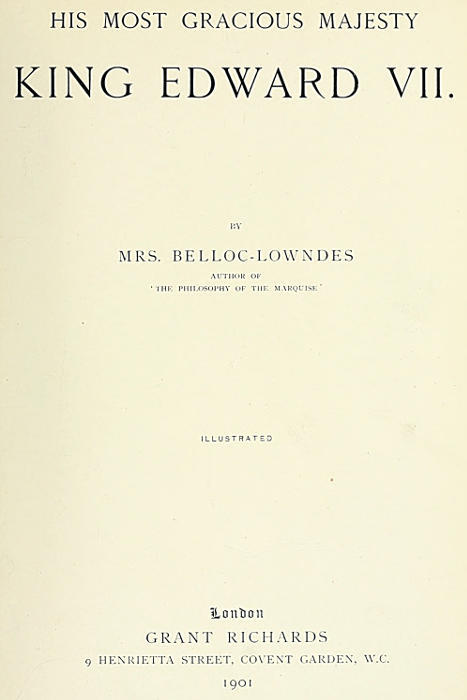
HIS MOST GRACIOUS MAJESTY KING EDWARD VII.
The King
From the Painting by Archibald Stuart Wortley, published by Henry Graves and Co.
HIS MOST GRACIOUS MAJESTY
KING EDWARD VII.
BY
MRS. BELLOC-LOWNDES
AUTHOR OF
‘THE PHILOSOPHY OF THE MARQUISE’
ILLUSTRATED
London
GRANT RICHARDS
9 HENRIETTA STREET, COVENT GARDEN, W.C.
1901
PREFACE
This book, originally published as a Life of the Prince of Wales, has now been much enlarged and brought up to the latest date, including His Majesty’s Accession and the events which followed. Fresh illustrations have also been added. It is believed that no previous attempt has been made to present a connected account of the Kings life, although isolated portions of His Majesty’s manifold activities have been treated of by various writers. Thus the author of the present work acknowledges considerable indebtedness to the Honble. Mrs. Grey’s “Journal of a Visit to Egypt, Constantinople, the Crimea, Greece, etc., in the Suite of the Prince and Princess of Wales”; to Sir W. H. Russell’s delightful volumes on their Majesties’ tour in the East and the King’s tour in India (from which two illustrations are reproduced); and to Sir H. C. Burdett’s “Prince, Princess, and People,” which deals mainly with the philanthropic work of the King and Queen. A large number of memoirs have also been consulted, including those of the Prince Consort, the Duchess of Teck, Baron Stockmar, Archbishop Magee, Archbishop Benson, Dean Stanley, and Canon Kingsley.
CONTENTS
| PAGE | |
| CHAPTER I | |
| An Appreciation | 1 |
| CHAPTER II | |
| Birth and Early Years | 5 |
| CHAPTER III | |
| The King’s Boyhood | 22 |
| CHAPTER IV | |
| Oxford, Cambridge, and the Curragh | 34 |
| CHAPTER V | |
| The King’s Visit to Canada and the United States | 43 |
| CHAPTER VI | |
| Death of the Prince Consort—Tour in the East | 55 |
| CHAPTER VII | |
| The Wedding of King Edward and Queen Alexandra | 63 |
| CHAPTER VIII | |
| Early Married Life | 83 |
| CHAPTER IX | |
| Their Majesties’ Tour in Egypt and the Mediterranean | 103 |
| CHAPTER X | |
| The Franco-Prussian War—The King’s Illness | 125 |
| CHAPTER XI | |
| 1873-1875 | 136 |
| CHAPTER XII | |
| The King’s Tour in India | 143 |
| CHAPTER XIII | |
| Quiet Years of Public Work, 1876-1887—Visit to Ireland—Queen Victoria’s Golden Jubilee | 159 |
| CHAPTER XIV | |
| Silver Wedding of King Edward and Queen Alexandra—Engagement and Marriage of Princess Louise | 171 |
| CHAPTER XV | |
| The Baccarat Case—Birth of Lady Alexandra Duff—The King’s Fiftieth Birthday—Illness of Prince George | 179 |
| CHAPTER XVI | |
| The Duke of Clarence and Avondale | 184 |
| CHAPTER XVII | |
| The Housing of the Working Classes—Marriage of Prince George—The Diamond Jubilee—Death of the Duchess of Teck | 200 |
| CHAPTER XVIII | |
| Later Years—A Serious Accident to the King—Gradual Recovery—The Attempt on the King’s Life | 220 |
| CHAPTER XIX | |
| The King as a Country Squire | 235 |
| CHAPTER XX | |
| The King in London | 251 |
| CHAPTER XXI | |
| The King and State Policy | 262 |
| CHAPTER XXII | |
| The King and the Services | 268 |
| CHAPTER XXIII | |
| The King and Freemasonry | 279 |
| CHAPTER XXIV | |
| The King as a Philanthropist | 287 |
| CHAPTER XXV | |
| The King as a Sportsman | 296 |
| CHAPTER XXVI | |
| The Death of Queen Victoria—The King’s Accession | 310 |
LIST OF ILLUSTRATIONS
| PAGE | |
| The King. From the Painting by Mr. A. Stuart Wortley | Frontispiece |
| The King at Homburg | xvi |
| The Christening of King Edward VII. | 9 |
| Queen Victoria, the Empress Frederick, and King Edward VII. | 11 |
| King Edward VII. | 13 |
| King Edward VII. at the Age of Three | 15 |
| The King in 1847 | 17 |
| The Landing of Queen Victoria, Prince Albert, and their Children at Aberdeen | 19 |
| The King and the Empress Frederick as Children | 21 |
| The Rev. Henry Mildred Birch, the King’s First Tutor | 25 |
| Queen Victoria, Prince Albert, and their Children | 27 |
| The King at the Age of Eight, and the Duke of Saxe-Coburg and Gotha at the Age of Five | 29 |
| Sketching at Loch Laggan—Queen Victoria with King Edward and the Empress Frederick | 31 |
| Queen Victoria and King Edward VII. | 32 |
| The King in 1859 | 35 |
| Christ Church, Oxford | 38 |
| Trinity College, Cambridge | 39 |
| The King in 1861 | 41 |
| The Tour in Canada and the United States, 1860 | 43 |
| The Fifth Duke of Newcastle, K.G. | 44 |
| The King’s Landing at Montreal | 46 |
| The King laying the Last Stone of the Victoria Bridge over the St. Lawrence | 47 |
| The Grand Ball given at the Academy of Music, New York | 52 |
| Dean Stanley | 58 |
| The King’s Reception by Said Pacha, Viceroy of Egypt, at Cairo | 59 |
| The King about the Time of his Marriage | 62 |
| Queen Alexandra | 65 |
| The King on Coming of Age | 67 |
| Queen Alexandra in 1863 | 69 |
| Queen Alexandra | 71 |
| The Marriage of the King and Queen | 75 |
| A Contemporary Design for the Royal Wedding | 78 |
| On the Wedding Day | 81 |
| Queen Alexandra at the Time of her Marriage | 82 |
| Queen Alexandra in 1863 | 86 |
| Queen Alexandra in 1864 | 89 |
| Queen Alexandra with the Baby Prince Albert Victor | 91 |
| King Edward, Queen Alexandra, and Prince Albert Victor | 93 |
| Queen Victoria with Prince Albert Victor | 95 |
| King Edward at the Age of Twenty-Three | 99 |
| Queen Victoria, Queen Alexandra, and Princess Christian | 101 |
| Queen Alexandra about the Year 1865 | 102 |
| Thanksgiving Day, 1872: The Scene at Temple Bar | 132 |
| Thanksgiving Day, 1872: The Procession up Ludgate Hill | 134 |
| Queen Alexandra and her Sister, the Empress Alexander of Russia, in 1873 | 137 |
| Queen Victoria, with the Princes Albert Victor and George, and their sister, Princess Victoria | 139 |
| The King’s Indian Tour, 1875 | 143 |
| Embarkation on Board the Serapis at Brindisi | 147 |
| The King’s Visit to the Cawnpore Memorial | 153 |
| The King in 1876 | 157 |
| The King in 1879 | 161 |
| The King in 1882 | 164 |
| Queen Alexandra in her Robes as Doctor of Music | 169 |
| The Duchess of Fife, Princess Victoria, and Princess Charles of Denmark | 175 |
| The Duke of Fife | 177 |
| The Duke of Clarence and Avondale | 185 |
| Queen Alexandra | 193 |
| King Edward and Queen Alexandra, with the Duchess of Fife and Lady Alexandra Duff | 201 |
| Queen Victoria and the Duke and Duchess of Cornwall and York | 205 |
| The King in the Undress Uniform of an Admiral of the Fleet | 210 |
| The King as Grand Master of the Knights-Hospitallers of Malta, at the Duchess of Devonshire’s Ball | 213 |
| The Duke of Cornwall and York in his Robes as a Knight of St. Patrick | 215 |
| The Duchess of Cornwall and York | 217 |
| The Duke of Connaught, the late Duke of Saxe-Coburg, the German Emperor, King Edward VII., Queen Victoria, and the Empress Frederick | 223 |
| The King with the Ladies Duff | 229 |
| Sandringham from the Grounds | 235 |
| The Norwich Gate at Sandringham | 238 |
| The East Front, Sandringham | 239 |
| Queen Alexandra’s Dairy at Sandringham | 241 |
| Queen Alexandra at Sandringham | 245 |
| The Kennels, Sandringham | 248 |
| Queen Alexandra with her Favourite Dogs | 250 |
| Marlborough House from the South-West | 252 |
| Marlborough House: the Drawing-Room | 254 |
| Garden Party at Marlborough House, July 1881 | 257 |
| Marlborough House: the Salon | 259 |
| The King as Admiral of the Fleet | 269 |
| The King as Colonel of the 10th Hussars | 273 |
| The King and the Duke of Connaught | 277 |
| Sir Francis Knollys | 292 |
| Mr. John Porter and Mr. Richard Marsh, the King’s Past and Present Trainers, and John Watts, his Jockey | 296 |
| The Egerton House Training Stables, Newmarket | 297 |
| The King’s Derby, 1896 | 299 |
| The King as a Sportsman in 1876 | 305 |
| The Britannia | 307 |
| The King as a Yachtsman | 308 |
The King
From a Photograph by T. H. Voigt, Hamburg v.d.H.
CHAPTER I
AN APPRECIATION
On the Sunday following that eventful 9th of November on which His Most Gracious Majesty King Edward VII. first saw the light, the Rev. Sydney Smith preached at St. Paul’s, and made the following interesting addition to the Bidding Prayer:—
“We pray also for that infant of the Royal race whom in Thy good providence Thou hast given us for our future King. We beseech Thee so to mould his heart and fashion his spirit that he may be a blessing and not an evil to the land of his birth. May he grow in favour with man by leaving to its own force and direction the energy of a free people. May he grow in favour with God by holding the faith in Christ fervently and feelingly, without feebleness, without fanaticism, without folly. As he will be the first man in these realms, so may he be the best, disdaining to hide bad actions by high station, and endeavouring always by the example of a strict and moral life to repay those gifts which a loyal people are so willing to spare from their own necessities to a good King.”
It must be remembered that this prayer was uttered in 1841, and some of the phrases which the great wit used reflect rather the Holland House view of the monarchy entertained at that time. Nevertheless, the prayer is noteworthy because in spirit, if not in the letter, it has been so completely answered. The manner of King Edward’s accession exhibits to a contemplative mind the eternal contrast between East and West. In an Oriental State a new Sovereign is as a rule unknown even in his outward appearance to his subjects, and is generally tossed up on to the throne by the angry waves of some palace intrigue of which he himself knows nothing. But it is the peculiar happiness of the British people that, in the midst of their bitter grief at the loss of Queen Victoria, there came to them the swift thought that one whom they had known and approved from his youth up was her successor, and would assuredly walk in her footsteps.
The accession of a Prince so universally beloved to the throne of his ancestors amid the deeply-felt joy of a great and free people is an inspiring spectacle. Perhaps, however, it is not fully realised how much King Edward, in the years of his public life as Prince of Wales, shared in the duties of the British Crown. The following pages will, it is hoped, show how completely His Majesty and his lamented mother agreed in their conception of the position of ruler of the British Empire. It is known that the death of the Prince Consort drew even closer the ties of affection which subsisted between the late Sovereign and her eldest son, and it would seem as if King Edward from that day forward had set both his parents before himself as exemplars, and had endeavoured to approve himself to his future subjects as a worthy son, not only of Victoria the Wise but also of Albert the Good. It is certainly significant how many of the qualities of both his parents His Majesty possesses.
In those admirable messages to his people, and to India and the Colonies, as well as to his Navy and Army, the King wrote absolutely as his mother would have wished him to write. There is in these documents the same keen personal sympathy, the same human touch, so notable in all Her late Majesty’s letters to her people, the same unerring perception, the same insight which demonstrated how completely the heart of the monarch was beating in unison with that of his people.
Although the British people realised and appreciated the Prince Consort’s great qualities some time before his death, it is, nevertheless, true to say that they never came to regard him with quite the same feeling of affection as that in which other members of the Royal Family were held. This was in no sense the fault of Prince Albert, but is rather attributable to that national prejudice against everything and everybody not originally and completely British which was especially strong in the middle years of the nineteenth century. Certainly we have become more cosmopolitan since those days; we have come to see that the manners and customs of foreign nations are not perhaps always so absurd as our forefathers, at any rate, supposed, and may even in some few respects be worthy of adoption and imitation.
In this salutary process of national illumination King Edward VII. undoubtedly played a considerable part. From the beginning of his public career he endeared himself to his future subjects by his natural bonhomie, his tact, and a certain indefinable touch of human sympathy which characterised all his actions and speeches. He was therefore able to carry on and to develop with extraordinary success his father’s work in promoting, not only the higher pursuits of science and art, but also the more immediately practical application of scientific principles to industries and manufactures. Few people realise how much England’s industrial prosperity was advanced both by the father and the son, and how much greater that prosperity would have been if Prince Albert’s foresight had been better understood and appreciated by his contemporaries.
Prince Albert will also ever be remembered with gratitude by the British people for the unremitting care which he devoted to the education of all his children, and especially to that of his eldest son. Of course the seed must be sown in good ground, and we know that the ground was good; the effect of that early education is seen in the admirable tact with which King Edward filled a most difficult and delicate position for many years. This position was rendered additionally onerous by the sometimes ridiculous, sometimes malevolent, stories which used to be circulated about his private affairs. It is one of the great penalties of Royalty that practically no reply can be made to the voice of calumny and detraction. The increase of the means of communication, and the growth of the newspaper press, have tended to heighten the glare of publicity in which Royalty is compelled to live. But this bright light of publicity does not at all resemble that dry light of reason which Bacon regarded as so essential to the investigations of science; its rays are refracted and distorted by ignorance and clumsiness, if not by actual malevolence. Mr. Balfour’s quiet announcement in the House of Commons soon after the King’s Accession, that on the resettlement of the Civil List no question of debts will arise for consideration—as was the case, for instance, on the Accession of George IV.—is an impressive reply to rumours regrettably current of late years.
It must have required no common discipline and self-control to bear such penalties as those, inflicted by the tongue of scandal, and at the same time to exercise that invariable discretion in reference to the great interests of State which we all admired so much in His Majesty when he was Prince of Wales. We should all regard as extraordinary, were it not that we have become so used to it, the way in which His Majesty contrived over so many years to be in politics and yet not of them; to educate himself in State affairs, while preserving that rigorous impartiality which our constitutional monarchy demands from the Heir to the throne. The sentiments with which he takes up his great task as King, not only of the United Kingdom but also of our vast Colonial Empire beyond the seas, added to the great dependency of India, is significantly shown in a sentence which His Majesty uttered in a speech long ago—that his great wish was that every man born in the Colonies should feel himself as English as if he had been born in Kent or Sussex.
CHAPTER II
BIRTH AND EARLY YEARS
King Edward VII. was born on 9th November 1841, at Buckingham Palace. The Duke of Wellington, who was in the Palace at the time, is said to have asked the nurse, Mrs. Lily, “Is it a boy?” “It’s a Prince, your Grace,” answered the justly offended woman.
The news was received with great enthusiasm throughout the country, and Queen Victoria and Prince Albert had thousands of letters and telegrams of congratulation not only through official sources at home and abroad but from many of Her Majesty’s humblest subjects all over the world. Punch celebrated the event in some verses beginning—
At the moment of his birth the eldest son of the Sovereign became Duke of Cornwall. This dukedom was the first created in England. It was created by King Edward III. by charter, wherein his son, Edward the Black Prince, was declared Duke of Cornwall, to hold to himself and his heirs, Kings of England, and to their first-born sons; and it is in virtue of that charter that the eldest son of the Sovereign is by law acknowledged Duke of Cornwall the instant he is born.
At the same time King Edward III. granted by patent certain provision for the support of the dukedom, including the Stannaries, in Cornwall, together with the coinage of tin, and various lands, manors, and tenements, some of which lay outside the county of Cornwall, but were nevertheless deemed to be part of the duchy. From these rents and royalties King Edward VII. derived, when he was Duke of Cornwall, a revenue of about £60,000 a year.
The little prince also became at his birth Duke of Rothesay, Earl of Carrick, Baron of Renfrew, Lord of the Isles, and Great Steward of Scotland (by act of the Scottish Parliament in 1469), but he was not born Prince of Wales. King George IV. was only a week old when he was created Prince of Wales and Earl of Chester by letters patent, but King Edward VII. had to wait nearly a month—till 4th December 1841—for these dignities.
The picturesque origin of the title of Prince of Wales is well known—how King Edward I. promised the turbulent Welsh barons to appoint them a prince of their own, one who was born in Wales and could not speak a word of English, and on whose life and conversation there was no stain at all. Having engaged the consent of the barons beforehand, he showed them his infant son, Prince Edward, who had been born in Carnarvon Castle but a few days before, and who was thereupon acclaimed as the first Prince of Wales. The dignity thus became established as personal, not hereditary, which could be granted or withheld at the pleasure of the Sovereign.
The Earldom of Chester was an early creation which was annexed to the Crown for ever by letters patent in the thirty-first year of King Henry III., when Prince Edward, his eldest son, was immediately granted the dignity. Edward the Black Prince received the Earldom of Chester when he was only three years old, before he was created Duke of Cornwall.
Queen Victoria’s recovery was rapid, as will be seen from the following entry in Her Majesty’s Journal on 21st November, the birthday of the Empress Frederick (Princess Royal of England):—
“Albert brought in dearest little Pussy [the Princess Royal] in such a smart white merino dress trimmed with blue, which Mama [the Duchess of Kent] had given her, and a pretty cap, and placed her on my bed, seating himself next to her, and she was very dear and good. And as my precious, invaluable Albert sat there, and our little Love between us, I felt quite moved with happiness and gratitude to God.”
A little less than a month after the birth of her eldest son, Queen Victoria wrote to her uncle, Leopold I., King of the Belgians:—
“I wonder very much who my little boy will be like. You will understand how fervent are my prayers, and I am sure everybody’s must be, to see him resemble his Father in every, every respect, both in body and mind.”
Christmas with its Christmas tree brought a new fund of delight to the Royal parents. “To think,” wrote the Queen in her Journal, “that we have two children now, and one who enjoys the sight already, is like a dream!” Prince Albert also wrote to his father:—“To-day I have two children of my own to give presents to, who, they know not why, are full of happy wonder at the German Christmas tree and its radiant candles.”
The christening of the Prince of Wales took place on 25th January 1842, in St. George’s Chapel, Windsor, for although Royal baptisms had hitherto been celebrated within the Palace, both the Queen and Prince Albert felt it to be more in harmony with the religious sentiments of the country that the future King should be christened within a consecrated building.
As can be easily understood, the choice of sponsors for the Prince of Wales was a matter of considerable delicacy. Finally the King of Prussia was asked to undertake the office, and Baron Stockmar gives the following interesting account of how His Majesty brushed aside the intrigues which were immediately set on foot:—
“Politicians, as their habit is, attached an exaggerated political importance to the affair. The King, who foresaw this, wrote to Metternich, and in a manner asked for his advice. The answer was evasive; and on this the King determined not to give himself any concern about the political intrigues which were set on foot against the journey. Certain it is, that the Russians, Austrians, and even the French, in the person of Bresson (their Ambassador at Berlin) manœuvred against it. They were backed up by a Court party, who were persuaded that the King would avail himself of the opportunity to promote, along with Bunsen and the Archbishop of Canterbury, his pet idea of Anglicanizing the Prussian Church. When the King’s decision to go became known, Bresson begged that he would at least go through France, and give the Royal Family a meeting; but this was declined.”
The King of Prussia arrived on the 22nd, and was met by Prince Albert at Greenwich and conducted to Windsor.
King Edward’s other sponsors were his step-grandmother, the Duchess of Saxe-Coburg, represented by the Duchess of Kent; the Duke of Cambridge; the young Duchess of Saxe-Coburg (Queen Victoria’s sister-in-law), represented by the Duchess of Cambridge; Princess Sophia, represented by the Princess Augusta of Cambridge; and Prince Ferdinand of Saxe-Coburg.
Nothing was omitted to make the Prince of Wales’s christening a magnificent and impressive ceremony. There was a full choral service, and a special anthem had been composed by Mr. (afterwards Sir) George Elvey for the occasion. When Prince Albert was told of this, and asked when it should be sung, he answered, “Not at all. No anthem. If the service ends by an anthem, we shall all go out criticising the music. We will have something we all know—something in which we can all join—something devotional. The Hallelujah Chorus; we shall all join in that, with our hearts.” The Hallelujah Chorus ended the ceremony accordingly.