
WeRead Powered by ReaderPub
History and criticism of the labor theory of value in English political economy cover

History and criticism of the labor theory of value in English political economy

Chapter 1: 2 HISTORY AND CRITICISM OF THE LABOR THEORY OF VALUE
Open in WeRead

Explore more books like this:

About This Book

A systematic history and critique of the labor theory of value in English political economy, tracing its evolution from varied early accounts through Adam Smith’s multiple formulations to Ricardo’s cost-of-production thesis and subsequent refinements. The study contrasts philosophical and empirical approaches to value, examines difficulties raised by skilled and indirect labor, and analyzes how the introduction of capital, interest, and the organic composition of capital complicated a simple labor measure. Chapters survey responses from nineteenth-century writers and show how sustained criticism and theoretical adjustments ultimately displaced a pure labor-based account of value.

2

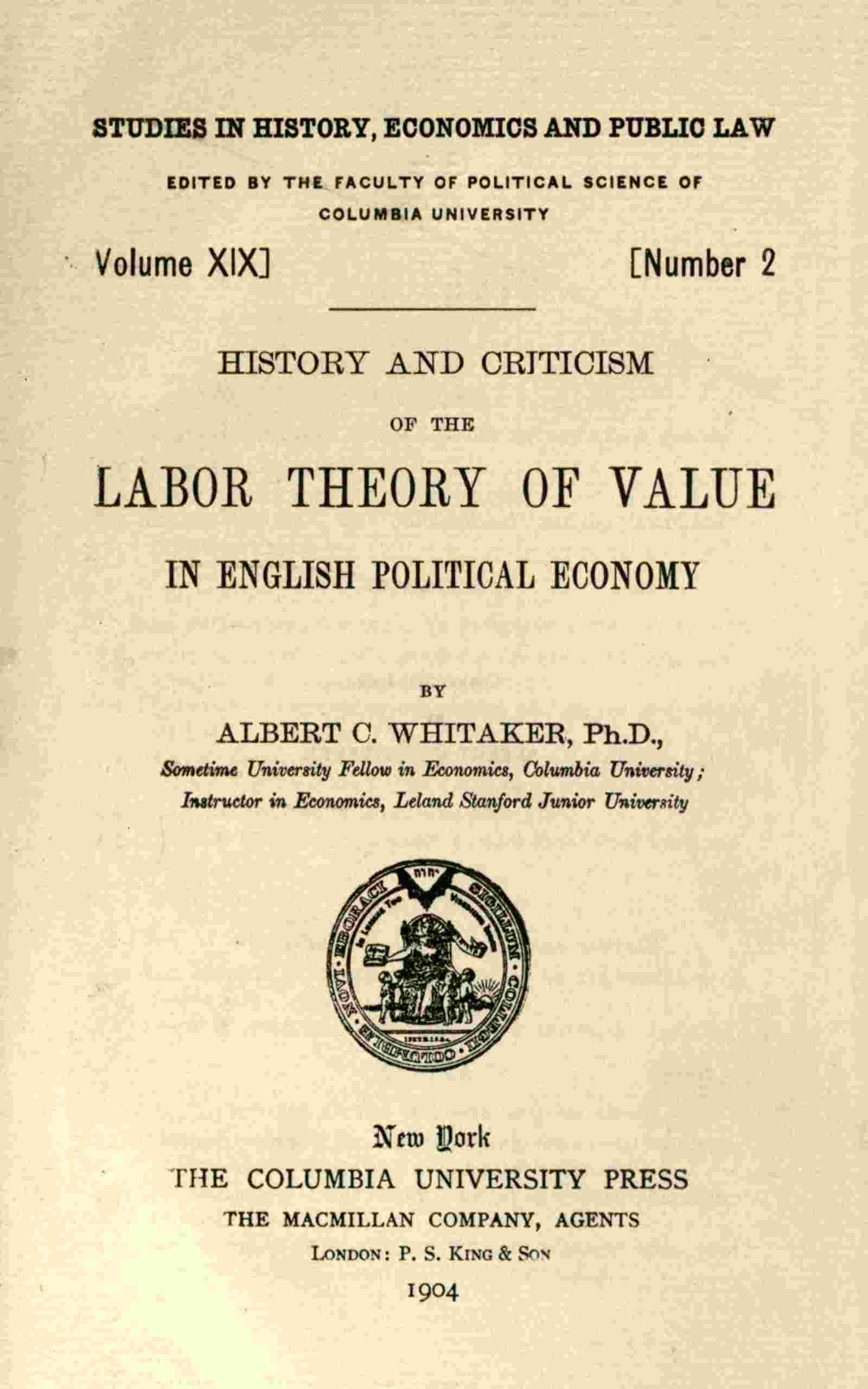
HISTORY AND CRITICISM OF THE
LABOR THEORY OF VALUE

STUDIES IN HISTORY, ECONOMICS AND PUBLIC LAW

EDITED BY THE FACULTY OF POLITICAL SCIENCE OF
COLUMBIA UNIVERSITY

Volume XIX] [Number 2

HISTORY AND CRITICISM
OF THE

LABOR THEORY OF VALUE
IN ENGLISH POLITICAL ECONOMY

BY
ALBERT C. WHITAKER, Ph.D.,
Sometime University Fellow in Economics, Columbia University;
Instructor in Economics, Leland Stanford Junior University

New York
THE COLUMBIA UNIVERSITY PRESS
THE MACMILLAN COMPANY, AGENTS
London: P. S. King & Son
1904

Copyright, 1904,
BY
ALBERT C. WHITAKER