
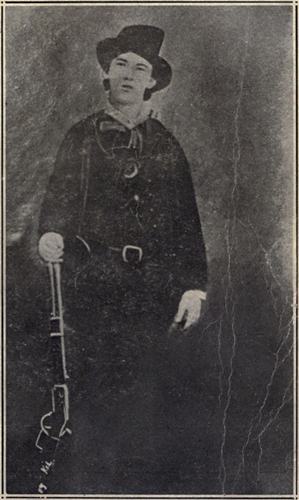
One night a lawyer named Chapman, who had been sent from Las Vegas to settle up the McSween estate, was in the saloon, when Campbell shot at his feet to make him dance. The lawyer protested indignantly and was shot dead by Campbell.
Jimmie Dolan and J. B. Mathews, being present, were later arrested, along with Campbell, for this killing.
Dolan and Mathews came clear at the preliminary trial, and Campbell was bound over to the Grand Jury. He was taken to Fort Stanton and placed in jail. There he made his escape and has never been heard of in that part of the country since.
Now “Billy the Kid” and Tom O’Phalliard rode back to Fort Sumner, but soon returned to Lincoln, where they were arrested by Sheriff Kimbrall and his deputies—merely as a matter of performing their duty, but with no intention of disgracing them. They were turned over to Deputy Sheriff T. B. Longworth and guarded in the home of Don Juan Patron, where they were wined and dined.
On the 21st day of March, 1879, Deputy Sheriff Longworth received orders to place his two prisoners in the town jail—a filthy hole.
Arriving at the jail door, the “Kid” told Mr. Longworth that he had been in this jail once before, and he swore he would never go into it again, but to avoid making trouble, he would go back on his pledge.
On a pine door to one of the cells, the “Kid” wrote with his pencil: “William Bonney was incarcerated first time, December 22nd, 1878—Second time, March 21st, 1879, and hope I will never be again. W. H. Bonney.”
This inscription showed on the old jail door for many years after it was written.
The first time the “Kid” was put in this jail he walked right out, and this second time, he broke down the door when he got ready to go.
After breaking out of the jail, the “Kid” and O’Phalliard spent a couple of weeks in Lincoln, carrying their rifles whenever they walked through the street, in plain view of the sheriff.
In April, they returned to Fort Sumner and were joined by Charlie Bowdre and Skurlock. Jesse Evans had left for the lower Pecos, where he was later killed, according to reports.
The summer was spent by the “Kid” and his followers stealing cattle and horses.
In October they went to Roswell and stole 118 head of John Chisum’s fattest steers, and later sold them to Colorado beef buyers. The “Kid” claimed that Chisum owed him for fighting his battles during the Lincoln County war, and he was using this method to get his pay.
From now on, for the next year, the “Kid” and gang did a wholesale business in stealing cattle. Tom Cooper and his gang had joined issues with the “Kid” and party, and they established headquarters at the Portales Lake—a salty body of water at the foot of the Staked Plains, about seventy-five miles east of Fort Sumner.
Here a permanent camp was pitched against a cliff of rock, at a fresh water spring, and it afterward became noted as “Billy the Kid’s” cave. A rock wall had been built against the cliff to take in the spring, and afforded protection as a fort in case of a surprise from Indians or law-officers.
They had the whole country to themselves, as there were no inhabitants—only drifting bands of buffalo hunters.
Raids were made into the Texas Panhandle, the western line being a few miles east of their camp, and fat steers stolen from the “LX” and “LIT” cattle ranges on the Canadian river.
These herds of stolen steers were driven to Tularosa, in Dona Ana County, New Mexico, and turned over to Pat Cohglin, the “King of Tularosa,” who had a contract to furnish beef to the U. S. soldiers at Ft. Stanton. Cohglin had made a deal with “Billy the Kid” to buy all the steers he could steal in the Texas Panhandle, and deliver to him in Tularosa.
In January, 1880, the “Kid” added another notch on the handle of his pistol as a mankiller. He and a crowd of the Chisum cowboys were celebrating in Bob Hargroves’ saloon in Fort Sumner. A bad-man from Texas, by the name of Joe Grant, was filling his hide full of “Kill-me-quick” whiskey, in the Hargroves’ saloon.
Grant pulled a fine, ivory-handled Colt’s pistol from the scabbard of Cowboy Finan, putting his own pistol in place of it.
Here the “Kid” asked Grant to let him look at this beautiful, ivory-handled pistol. The request was granted. Then the “Kid” revolved the cylinder and saw there were two empty chambers. He let the hammer down so that the first two attempts to shoot would be failures.
Now the pretty pistol was handed back to Grant and he stuck it in his scabbard.
A little later Grant stepped behind the bar, so as to face the crowd, and jerking his pistol, he began knocking glasses off the bar with it. Eyeing “Billy the Kid,” he remarked: “Pard, I’ll kill a man quicker than you will, for the whiskey.”
The “Kid” accepted the challenge. Grant fired at the “Kid,” but the hammer struck on an empty chamber. Now the “Kid” planted a ball between Grant’s eyes and he fell over dead.
At the Bosque Grande, on the Pecos river, the three Dedrick boys, Sam, Dan, and Mose, owned a ranch, which became quite a rendezvous for the “Kid’s” and Tom Cooper’s gangs. From here the herds of stolen Panhandle, Texas, cattle were started across the waterless desert to the foot of the Capitan mountains, a distance of about one hundred miles.
Here Dave Rudabaugh, who had the previous fall killed the jailer in Las Vegas in trying to liberate his friend, Webb, joined “Billy the Kid’s” gang. Also Billy Wilson and Tom Pickett joined the party, and their time was spent stealing cattle and horses.
CHAPTER VIII.
“BILLY THE KID” ADDS ONE MORE NOTCH TO HIS GUN AS A KILLER. TRAPPED AT LAST BY PAT GARRETT AND POSSE. TWO OF HIS GANG KILLED. IN JAIL AT SANTA FE.
In the year 1879, rich gold ore had been struck on Baxter mountain, three
miles from White Oaks Spring, about thirty miles north of Lincoln, and the
new town of White Oaks was established, with a population of about one
thousand souls.
The “Kid” had many friends in this hurrah mining camp. He had shot up the town, and was wanted by the law officers.
On the 23rd day of November, 1880, the “Kid” celebrated his birthday in White Oaks, under cover, among friends.
On riding out of town with his gang after dark, he took one friendly shot at Deputy Sheriff Jim Woodland, who was standing in front of the Pioneer Saloon. The chances are he had no intention of shooting Woodland, as he was a warm friend to his chum, Tom O’Phalliard, who was riding by his side. O’Phalliard and Jim Woodland had come to New Mexico from Texas together, a few years previous. Woodland is still a resident of Lincoln County, with a permanent home on the large Block cattle ranch.
This shot woke up Deputy Sheriffs Jim Carlyle and J. N. Bell, who fired parting shots at the gang, as they galloped out of town.
The next day a posse was made up of leading citizens of White Oaks with Deputy Sheriff Will Hudgens and Jim Carlyle in command. They followed the trail of the outlaw gang to Coyote Spring, where they came onto the gang in camp. Shots were exchanged. “Billy the Kid” had sprung onto his horse, which was shot from under him.
When the “Kid’s” gang fired on the posse, Johnny Hudgens’ mount fell over dead, shot in the head.
The weather was bitter cold and snow lay on the ground. Without overcoat or gloves, “Billy the Kid” rushed for the hills, afoot, after his horse fell. The rest of the gang had become separated, and each one looked out for himself.
In the outlaws’ camp the posse found a good supply of grub and plunder.
Jim Carlyle appropriated the “Kid’s” gloves and put them on his hands. No doubt they were the real cause of his death later.
With “Billy the Kid’s” saddle, overcoat and the other plunder found in the outlaws’ camp, the posse returned to White Oaks, arriving there about dark.
It would seem from all accounts that “Billy the Kid” trailed the posse into White Oaks, where he found shelter at the Dedrick and West Livery Stable. He was seen on the street during the night.
On November 27th, a posse of White Oaks citizens under command of Jim Carlyle and Will Hudgens, rode to the Jim Greathouse road-ranch, about forty miles north, arriving there before daylight. Their horses were secreted, and they made breastworks of logs and brush, so as to cover the ranch house, which was known to be a rendezvous of the “Kid’s” gang.
After daylight the cook came out of the house with a nosebag and ropes to hunt the horses which had been hobbled the evening before.
This cook, Steck, was captured by the posse behind the breastworks. He confessed that the “Kid” and his gang were in the house.
Now Steck was sent to the house with a note to the “Kid” demanding his surrender. The reply he sent back by Steck read: “You can only take me a corpse.”
The proprietor of the ranch, Jim Greathouse, accompanied Steck back to the posse behind the logs.
Jimmie Carlyle suggested that he go to the house unarmed and have a talk with the “Kid.” Will Hudgens wouldn’t agree to this until after Greathouse said he would remain to guarantee Carlyle’s safe return. That if the “Kid” should kill Carlyle, they could take his life.
A time limit was set for Carlyle’s return, or Greathouse would be killed. This was written on a note and sent by Steck to the “Kid.”
When Carlyle entered the saloon, in the front part of the log building, the “Kid” greeted him in a friendly manner, but seeing his gloves sticking out of Carlyle’s coat pocket, he grabbed them, saying: “What in the h—l are you doing with my gloves?” Of course this brought back the misery he had endured without gloves after the posse raided their camp at Coyote Spring.
Here he invited Carlyle up to the bar to take his last drink on earth—as he said he intended to kill him when the whiskey was down.
After Carlyle had drained his glass the “Kid” pulled his pistol and told him to say his prayers before he fired.
With a laugh the “Kid” put up his pistol, saying, “Why, Jimmie, I wouldn’t kill you. Let’s all take another friendly drink.”
Now the time was spent singing and dancing. Every time the gang took a drink, Carlyle had to join them in a social glass.
The “Kid” afterwards told friends that he had no intention of killing Carlyle, that he just wanted to detain him till after dark, so they could make a dash for liberty.
The time had just expired when the posse were to kill Jim Greathouse, if Carlyle was not back. At that moment a man behind the breastworks fired a shot at the house. Carlyle supposed this shot had killed Greathouse, which would result in his own death. He leaped for the glass window, taking sash and all with him. The “Kid” fired a bullet into him. When he struck the ground he began crawling away on his hands and knees, as he was badly wounded. Now the “Kid” finished him with a well aimed shot from his pistol.
The men behind the logs were witnesses to this murder,—as they could see Carlyle crawling away from the window. Now they opened fire with a vengeance on the building. The gang had previously piled sacks of grain and flour against the doors, to keep out the bullets.
In the excitement, Jim Greathouse slipped away from the posse and ran through the woods. Finding one of his own hobbled ponies, he mounted him and rode away. He was later shot by desperado Joe Fowler, with a double-barrel shot gun, as he lay in bed asleep. This murder took place on Joe Fowler’s cattle ranch west of Socorro, New Mexico.
After dark the posse concluded to return to White Oaks, as they were cold and hungry. They had brought no grub with them, and they dared not build a fire to keep warm, for fear of being shot by the gang.
A few hours later the “Kid” and gang made a break for liberty, intending to fight the posse to a finish, they not knowing that the officers had departed.
All night the gang waded through the deep snow, afoot. They arrived at Mr. Spence’s ranch at daylight, and ate a hearty breakfast. Then continued their journey towards Anton Chico on the Pecos river.
About daylight that morning, Will Hudgens, Johnny Hurley, and Jim Brent made up a large posse and started to the Greathouse road-ranch. Arriving there, they found the place vacated. The buildings were set afire, then the journey continued on the gang’s trail, in the deep snow.
A highly respected citizen, by the name of Spence, had established a road-ranch on a cut-off road between White Oaks and Las Vegas. The gang’s trail led up to this ranch, and Mr. Spence acknowledged cooking breakfast for them.
Now Mr. Spence was dragged to a tree with a rope around his neck to hang him. Many of the posse protested against the hanging of Spence, and his life was spared, but revenge was taken by burning up his buildings.
The “Kid’s” trail was now followed into a rough, hilly country and there abandoned. Then the posse returned to White Oaks.
In Anton Chico, the “Kid” and his party stole horses and saddles, and rode down the Pecos river.
A few days later, Pat Garrett, the sheriff of Lincoln County, arrived in Anton Chico from Fort Sumner, to make up a posse to run down the “Kid” and his gang.
At this time the writer and Bob Roberson had arrived in Anton Chico from Tascosa, Texas, with a crew of fighting cowboys, to help run down the “Kid,” and put a stop to the stealing of Panhandle, Texas, cattle.
The author had charge of five “warriors,” Jas. H. East, Cal Polk, Lee Hall, Frank Clifford (Big-Foot Wallace), and Lon Chambers. We were armed to the teeth, and had four large mules to draw the mess-wagon, driven by the Mexican cook, Francisco.
Bob Roberson was in charge of five riders and a mess-wagon.
At our camp, west of Anton Chico, Pat Garrett met us, and we agreed to loan him a few of our “warriors.” The writer turned over to him three men, Jim East, Lon Chambers and Lee Hall. Bob Roberson turned over to him three cowboys, Tom Emmory, Bob Williams, and Louis Bozeman.
We then continued our journey to White Oaks in a raging snow storm.
Pat Garrett started down the Pecos river with his crew, consisting of our six cowboys, his brother-in-law, Barney Mason, and Frank Stewart, who had been acting as detective for the Panhandle cattlemen’s association.
At Fort Sumner, Pat Garrett deputized Charlie Rudolph and a few Mexican friends, to join the crowd which now numbered about thirteen men.
Finding that the “Kid” and party had been in Fort Sumner, and made the old abandoned United States Hospital building, where lived Charlie Bowdre and his half-breed Mexican wife, their headquarters, Pat Garrett concluded to camp there. He figured that the outlaws would return and visit Mrs. Charlie Bowdre, whose husband was one of the outlaw band.
In order to get a true record of the capture of “Billy the Kid” and gang, the author wrote to James H. East, of Douglas, Arizona, for the facts. Jim East is the only known living participant in that tragic event. His reputation for honesty and truthfulness is above par wherever he is known. He served eight years as sheriff of Oldham County, Texas, at Tascosa, and was city marshal for several years in Douglas, Arizona.
Herewith his letter to the writer is printed in full:
“Douglas, Arizona,
May 1st, 1920.
Dear Charlie:
Yours of the 29th received, and contents noted. I will try to answer your questions, but you know after a lapse of forty years, one’s memory may slip a cog. First: We were quartered in the old Government Hospital building in Ft. Sumner, the night of the first fight. Lon Chambers was on guard. Our horses were in Pete Maxwell’s stable. Sheriff Pat Garrett, Tom Emory, Bob Williams, and Barney Mason were playing poker on a blanket on the floor.
I had just laid down on my blanket in the corner, when Chambers ran in and told us that the ‘Kid’ and his gang were coming. It was about eleven o’clock at night. We all grabbed our guns and stepped out in the yard.
Just then the ‘Kid’s’ men came around the corner of the old hospital building, in front of the room occupied by Charlie Bowdre’s woman and her mother. Tom O’Phalliard was riding in the lead. Garrett yelled out: ‘Throw up your hands!’ But O’Phalliard jerked his pistol. Then the shooting commenced. It being dark, the shooting was at random.
Tom O’Phalliard was shot through the body, near the heart, and lost control of his horse. ‘Kid’ and the rest of his men whirled their horses and ran up the road.
O’Phalliard’s horse came up near us, and Tom said: ‘Don’t shoot any more, I am dying.’ We helped him off his horse and took him in, and laid him down on my blanket. Pat and the other boys then went back to playing poker.
I got Tom some water. He then cussed Garrett and died, in about thirty minutes after being shot.
The horse that Dave Rudabaugh was riding was shot, but not killed instantly. We found the dead horse the next day on the trail, about one mile or so east of Ft. Sumner.
After Dave’s horse fell down from loss of blood, he got up behind Billy Wilson, and they all went to Wilcox’s ranch that night.
The next morning a big snow storm set in and put out their trail, so we laid over in Sumner and buried Tom O’Phalliard.
The next night, after the fight, it cleared off and about midnight, Mr. Wilcox rode in and reported to us that the “Kid,” Dave Rudabaugh, Billy Wilson, Tom Pickett, and Charlie Bowdre, had eaten supper at his ranch about dark, then pulled out for the little rock house at Stinking Spring. So we saddled up and started about one o’clock in the morning.
We got to the rock house just before daylight. Our horses were left with Frank Stewart and some of the other boys under guard, while Garrett took Lee Hall, Tom Emory and myself with him. We crawled up the arroyo to within about thirty feet of the door, where we lay down in the snow.
There was no window in this house, and only one door, which we would cover with our guns.
The “Kid” had taken his race mare into the house, but the other three horses were standing near the door, hitched by ropes to the vega poles.
Just as day began to show, Charlie Bowdre came out to feed his horse, I suppose, for he had a moral in one hand. Garrett told him to throw up his hands, but he grabbed at his six-shooter. Then Garrett and Lee Hall both shot him in the breast. Emory and I didn’t shoot, for there was no use to waste ammunition then.
Charlie turned and went into the house, and we heard the ‘Kid’ say to him: ‘Charlie, you are done for. Go out and see if you can’t get one of the s—of—b’s before you die.’
Charlie then walked out with his hand on his pistol, but was unable to shoot. We didn’t shoot, for we could see he was about dead. He stumbled and fell on Lee Hall. He started to speak, but the words died with him.
Now Garrett, Lee, Tom and I, fired several shots at the ropes which held the horses, and cut them loose—all but one horse which was half way in the door. Garrett shot him down, and that blocked the door, so the ‘Kid’ could not make a wolf dart on his mare.
We then held a medicine talk with the Kid, but of course couldn’t see him. Garrett asked him to give up, Billy answered: ‘Go to h—l, you long-legged s— of a b!’
Garrett then told Tom Emory and I to go around to the other side of the house, as we could hear them trying to pick out a port-hole. Then we took it, time about, guarding the house all that day. When nearly sundown, we saw a white handkerchief on a stick, poked out of the chimney. Some of us crawled up the arroyo near enough to talk to ‘Billy.’ He said they had no show to get away, and wanted to surrender, if we would give our word not to fire into them, when they came out. We gave the promise, and they came out with their hands up, but that traitor, Barney Mason, raised his gun to shoot the ‘Kid,’ when Lee Hall and I covered Barney and told him to drop his gun, which he did.
Now we took the prisoners and the body of Charlie Bowdre to the Wilcox ranch, where we stayed until next day. Then to Ft. Sumner, where we delivered the body of Bowdre to his wife. Garrett asked Louis Bousman and I to take Bowdre in the house to his wife. As we started in with him, she struck me over the head with a branding iron, and I had to drop Charlie at her feet. The poor woman was crazy with grief. I always regretted the death of Charlie Bowdre, for he was a brave man, and true to his friends to the last.
Before we left Ft. Sumner with the prisoners for Santa Fe, the ‘Kid’ asked Garrett to let Tom Emory and I go along as guards, which, as you know, he did.
The ‘Kid’ made me a present of his Winchester rifle, but old Beaver Smith made such a roar about an account he said ‘Billy’ owed him, that at the request of ‘Billy,’ I gave old Beaver the gun. I wish now I had kept it.
On the road to Santa Fe, the ‘Kid’ told Garrett this: That those who live by the sword, die by the sword. Part of that prophecy has come true. Pat Garrett got his, but I am still alive.
I must close. You may use any quotations from my letters, for they are true. Good luck to you. Mrs. East joins me in best wishes.
Sincerely yours,
JAS. H. EAST.”
The author had previously written to Jim East about “Billy the Kid’s” sweetheart, Miss Dulcinea del Toboso. Here is a quotation from his answer, of April 26th, 1920: “Your recollection of Dulcinea del Toboso, about tallies with the way I remember her. She was rather stout, built like her mother, but not so dark.
“After we captured ‘Billy the Kid’ at Arroyo Tivan, we took him, Dave Rudabaugh, Billy Wilson, and Tom Pickett—also the dead body of Charlie Bowdre—to Fort Sumner.
“After dinner Mrs. Toboso sent over an old Navajo woman to ask Pat Garrett to let ‘Billy’ come over to the house and see them before taking him to Santa Fe. So Garrett told Lee Hall and I to guard ‘Billy’ and Dave Rudebough over to Toboso’s, Dave and ‘Billy’ being shackled together. As we went over the lock on Dave’s leg came loose, and ‘Billy’ being very superstitious, said: ‘That is a bad sign. I will die, and Dave will go free,’ which, as you know, proved true.
“When we went in the house only Mrs. Toboso, Dulcinea, and the old Navajo woman were there.
“Mrs. Toboso asked Hall and I to let ‘Billy’ and Dulcinea go into another room and talk awhile, but we did not do so, for it was only a stall of ‘Billy’s’ to make a run for liberty, and the old lady and the girl were willing to further the scheme. The lovers embraced, and she gave ‘Billy’ one of those soul kisses the novelists tell us about, till it being time to hit the trail for Vegas, we had to pull them apart, much against our wishes, for you know all the world loves a lover.”
It was December 23rd, 1880, when the “Kid” and gang, Dave Rudebaugh, Tom Pickett and Billy Wilson—were captured, and Charlie Bowdre killed.
The prisoners were taken to the nearest railroad, at Las Vegas, where a mob tried to take them away from the posse, to string them up.
They were placed in the County jail at Santa Fe, the capital of the Territory of New Mexico, as the penitentiary was not yet completed.
Dave Rudebaugh was tried and sentenced to death for the killing of the jailer in Las Vegas. Later he made his escape and has never been heard of since.
CHAPTER IX.
“BILLY THE KID” IS SENTENCED TO HANG. HE KILLS HIS TWO GUARDS AND MAKES GOOD HIS ESCAPE.
In the latter part of February, 1881, “Billy the Kid” was taken to Mesilla
to be tried for the murder of Roberts at Blazer’s saw mill. Judge Bristol
presided over the District Court, and assigned Ira E. Leonard to defend
the “Kid.” He was acquitted for the murder of Roberts.
In the same term of court, the “Kid” was put on trial for the murder of Sheriff Wm. Brady, in April, 1878. This time he was convicted, and sentenced to hang on the 13th day of May, 1881, in the Court House yard in Lincoln.
Deputy United States Marshall, Robert Ollinger, and Deputy Sheriff David Wood, drove the “Kid” in a covered back to Fort Stanton, and turned him over to Sheriff Pat Garrett.
As Lincoln had no suitable jail, an upstairs room in the large adobe Court House was selected as the “Kid’s” last home on earth—as the officers supposed, but fate decided otherwise.
Bob Ollinger and J. W. Bell were selected to guard “Billy the Kid” until the time came for shutting off his wind with a rope.
The room selected for the “Kid’s” home was large, and in the northeast corner of the building, upstairs. There were two windows in it, one on the east side and the other on the north, fronting the main street.
In order to get out of this room one had to pass through a hall into another room, where a back stairs led down to the rear yard.
In a room in the southwest corner of the building, the surplus firearms were kept, in a closet, or armory. One room was assigned as the Sheriff’s private office.
The “Kid’s” furniture consisted of a pair of steel hand-cuffs, steel shackles for his legs, a stool, and a cot.
Bob Ollinger, the chief guard, was a large, powerful middle-aged man, with a mean disposition. He and the “Kid” were bitter enemies on account of having killed warm friends of each other during the bloody Lincoln County war. It is said that Ollinger shot one of the “Kid’s” friends to death while holding his right hand with his, Ollinger’s, left hand. After this local war had ended, the fellow stepped up to Ollinger to shake hands and to bury the hatchet of former hatred. Ollinger extended his left hand, and grabbed the man’s right, holding it fast until he had shot him to death. Of course this cowardly act left a scar on “Billy the Kid’s” heart, which only death could heal.
J. W. Bell was a tall, slender man of middle age, with a large knife scar across one cheek. He had come from San Antonio, Texas. He held a grudge against the “Kid” for the killing of his friend, Jimmie Carlyle, otherwise there was no enmity between them.
In the latter part of April, Cowboy Charlie Wall had four Mexicans helping him irrigate an alfalfa field, above the Mexican village of Tularosa, on Tularosa river.
A large band of Tularosa Mexicans appeared on the scene one morning, to prevent young Wall from using water for his thirsty alfalfa.
When the smoke of battle cleared away, four Tularosa Mexicans lay dead on the ground and Charlie Wall had two bullet wounds in his body, though they were not dangerous wounds.
Now, to prevent being mobbed by the angry citizens of Tularosa, which was just over the line in Dona Ana County, Wall and his helpers made a run, on horseback, for Lincoln, to surrender to Sheriff Pat Garrett.
The Sheriff allowed them to wear their pistols and to sleep in the old jail. At meal times they accompanied either Bob Ollinger or J. W. Bell, to the Ellis Hotel across the main street, which ran east and west through town.
Charlie Wall did his loafing while recovering from his bullet wounds, in the room where the “Kid” was kept.
On the morning of April 28th, 1881, Sheriff Garrett prepared to leave for White Oaks, thirty-five miles north, to have a scaffold made to hang the “Kid” on. Before starting, he went into the room where the “Kid” sat on his stool, guarded by Ollinger, who was having a friendly chat with Charlie Wall—the man who gave the writer the full details of the affair. J. W. Bell was also present in the room.
Garrett remarked to the two guards: “Say, boys, you must keep a close watch on the ‘Kid,’ as he has only a few more days to live, and might make a break for liberty.”
Bob Ollinger answered: “Don’t worry, Pat, we will watch him like a goat.”
Now Ollinger stepped into the other room and got his double-barrel shot gun. With the gun in his hand, and looking towards the “Kid,” he said: “There are eighteen buckshot in each barrel, and I reckon the man who gets them will feel it.”
With a smile, “Billy the Kid” remarked: “You may be the one to get them yourself.”
Now Ollinger put the gun back in the armory, locking the door, putting the key in his pocket. Then Garrett left for White Oaks.
About five o’clock in the evening, Bob Ollinger took Charlie Wall and the other four armed prisoners to the Ellis Hotel, across the street, for supper. Bell was left to guard the “Kid.”
According to the story “Billy the Kid” told Mrs. Charlie Bowdre, and other friends, after his escape, he had been starving himself so that he could slip his left hand out of the steel cuff. The guards thought he had lost his appetite from worry over his approaching death.
J. W. Bell sat on a chair, facing the “Kid,” several paces away. He was reading a newspaper. The “Kid” slipped his left hand out of the cuff and made a spring for the guard, striking him over the head with the steel cuff. Bell threw up both hands to shield his head from another blow. Then the “Kid” jerked Bell’s pistol out of its scabbard. Now Bell ran out of the door and received a bullet from his own pistol. The body of Bell tumbled down the back stairs, falling on the jailer, a German by the name of Geiss, who was sitting at the foot of the stairs.
Of course Geiss stampeded. He flew out of the gate towards the Ellis Hotel.
On hearing the shot, Bob Ollinger and the five armed prisoners, got up from the supper table and ran to the street. Charlie Wall and the four Mexicans stopped on the sidewalk, while Ollinger continued to run towards the court house.
After killing Bell, the “Kid” broke in the door to the armory and secured Ollinger’s shot-gun. Then he hobbled to the open window facing the hotel.
When in the middle of the street, Ollinger met the stampeded jailer, and as he passed, he said: “Bell has killed the “Kid.” This caused Ollinger to quit running. He walked the balance of the way.
When directly under the window, the “Kid” stuck his head out, saying: “Hello, Bob!”
Ollinger looked up and saw his own shotgun pointed at him. He said, in a voice loud enough to be heard by Wall and the other prisoners across the street: “Yes, he has killed me, too!”
These words were hardly out of the guard’s mouth when the “Kid” fired a charge of buckshot into his heart.
Now “Billy the Kid” hobbled back to the armory and buckled around his waist two belts of cartridges and two Colt’s pistols. Then taking a Winchester rifle in his hand, he hobbled back to the shot gun, which he picked up. He then went out on the small porch in front of the building. Reaching over the ballisters with the shotgun, he fired the other charge into Ollinger’s body. Then breaking the shotgun in two, across the ballisters, he threw the pieces at the corpse, saying: “Take that, you s— of a b—, you will never follow me with that gun again.”
Now the “Kid” hailed the jailer, old man Geiss, and told him to throw up a file, which he did. Then the chain holding his feet close together was filed in two.
When his legs were free, the “Kid” danced a jig on the little front porch, where many people, who had run out to the sidewalk across the street, on hearing the shots, were witnesses to this free show, which couldn’t be beat for money.
Geiss was hailed again and told to saddle up Billy Burt’s, the Deputy County Clerk’s, black pony and bring him out on the street. This black pony had formerly belonged to the “Kid.”
When the pony stood on the street, ready for the last act, the “Kid” went down the back stairs, stepping over the dead body of Bell, and started to mount. Being encumbered with the weight of two pistols, two belts full of ammunition, and the rifle, the “Kid” was thrown to the ground, when the pony began bucking, before he had got into the saddle.
Now the “Kid” faced the crowd across the street, holding the rifle ready for action.
Charlie Wall told the writer that he could have killed him with his pistol, but that he wanted to see him escape. Many other men in the crowd felt the same way, no doubt.
When the pony was brought back the “Kid” gave Geiss his rifle to hold, while he mounted. The rifle being handed back to him when he was securely seated in the saddle, then he dug the pony in the sides with his heels, and galloped west. At the edge of town he waved his hat over his head, yelling: “Three cheers for Billy the Kid!” Now the curtain went down, for the time being.
CHAPTER X.
“BILLY THE KID” GOES BACK TO HIS SWEETHEART IN FORT SUMNER. SHOT THROUGH THE HEART BY SHERIFF PAT GARRET, AND BURIED BY THE SIDE OF HIS CHUM, TOM O’PHALLIARD.
A few days after the “Kid’s” escape, Billy Burt’s black pony returned to
Lincoln dragging a rope. He had either escaped or been turned loose by the
“Kid.”
The next we hear of the “Kid” he visited friends in Las Tablas, and stole a horse from Andy Richardson. From there he headed for Fort Sumner to see his sweetheart, Miss Dulcinea del Toboso. It was said he tried to persuade her to run away with him, and go to old Mexico to live in happiness ever afterward. But that sweet little Dulce refused to leave mamma.
The “Kid” found shelter and concealment in the home of Mrs. Charlie Bowdre and her mother. One night a few weeks after his escape, the writer was within whispering distance of “Billy the Kid.”
Myself and a crowd of cowboys had attended a Mexican dance. Mrs. Charlie Bowdre was there, dressed like a young princess. She captured the heart of the author, so that he danced with her often, and escorted her to the midnight supper.
About three o’clock in the morning the dance broke up and the writer escorted the pretty young widow, Mrs. Charlie Bowdre, to her adobe home. At the front door, I almost got down on my knees pleading for her to let me go into the house and talk awhile, but no use, she insisted that her mother would object.
Now a wine-soaked young cowboy with jingling spurs on his high-heel boots, staggered into camp and “piled” into bed, spread on the ground under a cottonwood tree, to dream of Mexican “Fandangos,” where the girls have no choice of partners. Without an introduction the man walks up to the girl of his choice and leads her out on the floor to dance to his heart’s content.
About six months later, in the fall of 1881, after the “Kid” had been killed, the writer was in Fort Sumner again, and attended a dance with Mrs. Charlie Bowdre. Now she explained the reason for not letting me enter the house. She said at that time, “Billy the Kid,” who was in hiding at her home, was on the inside of the door listening to our conversation. That he recognized my voice.
Here Mrs. Bowdre told me the facts in the case, of how “Billy the Kid” met his death, bare-headed and bare-footed, with a butcher knife in his hand.
While in hiding in Fort Sumner the “Kid” stole a saddle horse from Mr. Montgomery Bell, who had ridden into town from his ranch fifty miles above, on the Rio Pecos.
Bell supposed the horse had been ridden off by a common Mexican thief. He hired Barney Mason and a Mr. Curington to go with him to hunt the animal. They started down the stream, Bell keeping on one side of the river, while Mason and Curington headed for a sheep camp in the foot hills.
Riding up to the tent in the sheep camp, the “Kid” stepped out with his Winchester rifle, and hailed them.
Barney Mason was armed to the teeth, and was on a swift horse. He had on a new pair of spurs and nearly wore them out making his get-away.
Mr. Curington rode up to his friend, “Billy the Kid,” and had a friendly chat.
The “Kid” told Mr. Curington to tell Montgomery Bell that he would return his horse, or pay for him.
When Curington reported the matter to Mr. Bell, he was satisfied and searched no more for the animal.
After the “Kid’s” escape from Lincoln, Sheriff Pat Garrett “laid low,” and tried to find out the “Kid’s” whereabouts through his friends and associates.
In March, 1881, a Deputy United States Marshal by the name of John W. Poe arrived in the booming mining camp of White Oaks. He had been sent to New Mexico by the Cattlemen’s Association of the Texas Panhandle. Cattle King Charlie Goodnight, being the president of the association, had selected Mr. Poe as the proper man to put a stop to the stealing of Panhandle cattle by “Billy the Kid” and gang.
After the “Kid’s” escape, Pat Garrett went to White Oaks and deputized John W. Poe to assist him in rounding up the “Kid.”
From now on Mr. Poe made trips out in the mountains trying to locate the young outlaw. The “Kid’s” best friends argued that he was “nobody’s fool,” and would not remain in the United States, when the Old Mexico border was so near. They didn’t realize that little Cupid was shooting his tender young heart full of love-darts, straight from the heart of pretty little Miss Dulcinea del Toboso, of Fort Sumner.
Early in July, Pat Garrett received a letter from an acquaintance by the name of Brazil, in Fort Sumner, advising him that the “Kid” was hanging around there. Garrett at once wrote Brazil to meet him about dark on the night of July 13th at the mouth of the Taiban arroyo, below Fort Sumner.
Now the sheriff took his trusted deputy, John W. Poe, and rode to Roswell, on the Rio Pecos. There they were joined by one of Mr. Garret’s fearless cowboy deputies, “Kip” McKinnie, who had been raised near Uvalde, Texas.
Together the three law officers rode up the river towards Fort Sumner, a distance of eighty miles. They arrived at the mouth of Taiban arroyo an hour after dark on July 13th, but Brazil was not there to meet them. The night was spent sleeping on their saddle blankets.
The next morning Garrett sent Mr. Poe, who was a stranger in the country, and for that reason would not be suspicioned, into Fort Sumner, five miles north, to find out what he could on the sly, about the “Kid’s” presence. From Fort Sumner he was to go to Sunny Side, six miles north, to interview a merchant by the name of Mr. Rudolph. Then when the moon was rising, to meet Garrett and McKinnie at La Punta de la Glorietta, about four miles north of Fort Sumner.
Failing to find out anything of importance about the “Kid,” John W. Poe met his two companions at the appointed place, and they rode into Fort Sumner.
It was about eleven o’clock, and the moon was shining brightly, when the officers rode into an old orchard and concealed their horses. Now the three continued afoot to the home of Pete Maxwell, a wealthy stockman, who was a friend to both Garrett and the “Kid.” He lived in a long, one-story adobe building, which had been the U. S. officers’ quarters when the soldiers were stationed there. The house fronted south, and had a wide covered porch in front. The grassy front yard was surrounded by a picket fence.
As Pat Garrett had courted his wife and married her in this town, he knew every foot of the ground, even to Pete Maxwell’s private bed room.
On reaching the picket gate, near the corner room, which Pete Maxwell always occupied, Garrett told his two deputies to wait there until after he had a talk with half-breed Pete Maxwell.
The night being hot, Pete Maxwell’s door stood wide open, and Garrett walked in.
A short time previous, “Billy the Kid” had arrived from a sheep camp out in the hills. Back of the Maxwell home lived a Mexican servant, who was a warm friend to the “Kid.” Here “Billy the Kid” always found late newspapers, placed there by loving hands, for his special benefit.
This old servant had gone to bed. The “Kid” lit a lamp, then pulled off his coat and boots. Now he glanced over the papers to see if his name was mentioned. Finding nothing of interest in the newspapers, he asked the old servant to get up and cook him some supper, as he was very hungry.
Getting up, the servant told him there was no meat in the house. The “Kid” remarked that he would go and get some from Pete Maxwell.
Now he picked up a butcher knife from the table to cut the meat with, and started, bare-footed and bare-headed.
The “Kid” passed within a few feet of the end of the porch where sat John W. Poe and Kip McKinnie. The latter had raised up, when his spur rattled, which attracted the “Kid’s” attention. At the same moment Mr. Poe stood up in the small open gateway leading from the street to the end of the porch. They supposed the man coming towards them, only partly dressed, was a servant, or possibly Pete Maxwell.
The “Kid” had pulled his pistol, and so had John Poe, who by that time was almost within arm’s reach of the “Kid.”
With pistol pointing at Poe, at the same time asking in Spanish: “Quien es?” (Who is that?), he backed into Pete Maxwell’s room. He had repeated the above question several times.
On entering the room, “Billy the Kid” walked up to within a few feet of Pat Garrett, who was sitting on Maxwell’s bed, and asked: “Who are they, Pete?”
Now discovering that a man sat on Pete’s bed, the “Kid” with raised pistol pointing towards the bed, began backing across the room.
Pete Maxwell whispered to the sheriff: “That’s him, Pat.” By this time the “Kid” had backed to a streak of moonlight coming through the south window, asking: “Quien Es?” (Who’s that?)
Garrett raised his pistol and fired. Then cocked the pistol again and it went off accidentally, putting a hole in the ceiling, or wall.
Now the sheriff sprang out of the door onto the porch, where stood his two deputies with drawn pistols.
Soon after, Pete Maxwell ran out, and came very near getting a ball from Poe’s pistol. Garrett struck the pistol upward, saying: “Don’t shoot Maxwell!”
A lighted candle was secured from the mother of Pete Maxwell, who occupied a nearby room, and the dead body of “Billy the Kid” was found stretched out on his back with a bullet wound in his breast, just above the heart. At the right hand lay a Colt’s 41 calibre pistol, and at his left a butcher knife.
Now the native people began to collect,—many of them being warm friends of the “Kid’s.” Garrett allowed them to take the body across the street to a carpenter shop, where it was laid out on a bench. Then lighted candles were placed around the remains of what was once the bravest, and coolest young outlaw who ever trod the face of the earth.
The next day, this, once mother’s darling, was buried by the side of his chum, Tom O’Phalliard, in the old military cemetery.
He was killed at midnight, July 14th, 1881, being just twenty-one years, seven months and twenty-one days of age, and had killed twenty-one men, not including Indians, which he said didn’t count as human beings.
A few months after the killing of the “Kid,” a man was coining money, showing “Billy the Kid’s” trigger finger, preserved in alcohol. Seeing sensational accounts of it in the newspapers, Sheriff Garrett had the body dug up, but found his trigger-finger was still attached to the right hand.
During the following spring in the town of Lincoln, the sheriff auctioned off the “Kid’s” saddle, and the blue-barrel, rubber-handled, double action Colt’s 41 calibre pistol, which the “Kid” held in his hand when killed.
There were only two bidders for the pistol, the writer and the deputy county clerk, Billy Burt, who got it for $13.50. Its actual value was about $12.00.
Since then many pistols have been prized as keepsakes from the supposed idea that the “Kid” had held each one of them in his hand when he fell. Many were presented to friends with a sincere thought that they were genuine.
As an illustration we will quote a few lines from a friendly letter, dated May 10th, 1920, written by the present game warden, Mr. J. L. DeHart of the state of Montana: “Later in March, 1895, I was ushered into office as sheriff of Sweet Grass County, Montana, and a former resident of New Mexico, and an acquaintance of ‘Billy the Kid,’ later a resident of Livingston, Montana, by the name of William Dawson, upon this momentous occasion, presented me with a splendid Colt’s six-shooter, forty-five calibre, seven inch barrel, and ivory handle, said to have been the property of the notorious “Billy the Kid,” when killed by Sheriff Pat Garrett, at the Maxwell ranch house. I have always considered this piece of artillery a valuable relic, and with much trouble have retained it. Most of my diligent watch, however, upon this gun, was brought about as a result of being named as state game warden in 1913, by His Excellency, Governor S. V. Stewart.”
“Where ignorance is bliss, it is folly to be wise,” is a true saying.
No doubt Mr. DeHart has felt proud over the ownership of the pistol “Billy the Kid” was supposed to have in his hand at the time of his death.
This is not the only “Billy the Kid” pistol in existence. It would be a safe gamble to bet that there are a wagon load of them scattered over the United States.
The Winchester rifle taken from the “Kid” at the time of his capture at Stinking Spring, was raffled off in the spring of 1881, and the writer won it. He put it up again in a game of “freeze out” poker. As one of my cowboys, Tom Emory, was an expert poker player, I induced him to play my hand. I then went to bed. On going down to the Pioneer Saloon, in White Oaks, early next morning, the night barkeeper told me a secret, under promise that I keep it to myself. He said he was stretched out on the bar trying to take a nap. The poker game was going on near him. When he lay down all had been “freezed out” but Tom Emory and Johnny Hudgens. Just before daylight, Emory won all the chips, in a big show down, and I was the owner of “Billy the Kid’s” rifle for the second time, but only for a moment, as Johnny Hudgens gave Tom Emory $20.00 for the gun, under the pretense that Hudgens had won it. Emory almost shed tears when he told me of losing the rifle in what he thought was a winning hand. Of course I didn’t dispute it, as I had given a promise to keep silent.
“Billy the Kid” came very near having a stone monument placed on his grave for the benefit of posterity—so that the curious among the unborn generations would know the exact spot where this “Claude Duval” of the southwest was planted.
One day, on the Plaza in the city of Santa Fe, in about the year 1916, the writer met Mrs. Gertrude Dills, wife of Lucius Dills, the Surveyor General of New Mexico, a daughter of Judge Frank Lea of White Oaks, and a niece to that whole-souled prince among men, the father of the city of Roswell, Captain J. C. Lea. She suggested that the writer get up a subscription to place a lasting monument on the grave of “Billy the Kid,” so that future generations would know where he was buried. As a little girl, Mrs. Dills was once tempted to crawl under the bed, when “Billy the Kid” and gang shot up the town of White Oaks.
I at once went to the monument establishment of Mr. Louis Napoleon, and selected a fine marble monument, with the understanding that the inscription not be cut on it until after I had located the grave.
Many years ago, Will E. Griffin, who is still a resident of Santa Fe, moved all the bodies of the soldiers buried in the old military cemetery, at Fort Sumner, to the National Cemetery at Santa Fe. He says, when the work was finished, the only graves left in the grave-yard, were those of “Billy the Kid” and his chum, Tom O’Phalliard. On these two graves, close together, still remained the badly rotted wooden head boards.
Since then the old cemetery has been turned into an alfalfa field, and the chances are, all signs of this noted young outlaw’s resting place have been obliterated.
Soon after selecting the monument, I happened to be in the town of Tularosa, and brought up the subject to my old cowboy friend, John P. Meadows. He at once subscribed five dollars towards the erection of the monument. He said “Billy the Kid” had befriended him in 1879, when he needed a friend, and for that reason he would like to perpetuate his memory. He thought it would be no trouble to raise the desired amount in Tularosa, but the first man he struck for a subscription, Mr. Charlie Miller, former state engineer, discouraged him. Mr. Miller went straight up in the air with indignation at the idea of placing a monument at the grave of a blood-thirsty outlaw. Soon after this, Mr. Miller was murdered, when Pancho Villa made his bloody raid on Columbus, New Mexico.
This is as far as the grave of “Billy the Kid” came to being marked, as the writer has been too busy on other matters, to visit Fort Sumner and try to locate his last resting place.
In closing, I wish to state that with all his faults, “Billy the Kid” had many noble traits. In White Oaks, during the winter of 1881, the writer talked with a man who actually shed tears in telling of how he lay almost at the point of death, with smallpox, in an old abandoned shack in Fort Sumner, when the “Kid” found him. A good supply of money was given by the “Kid,” and a wagon and team hired to haul him to Las Vegas, where medical attention could be secured.
Since the killing of the “Kid,” Kip McKinney has died with his boots off, while Pat Garrett died with them on, being shot and killed on the road between Tularosa and Las Cruces, New Mexico. Hence the only man now living who saw the curtain go down on the last act of “Billy the Kid’s” eventful life, is John W. Poe, at the present writing a wealthy banker in the beautiful little city of Roswell, New Mexico. He has served one term as sheriff of Lincoln County, and has helped to change that blood-spattered county from an outlaw’s paradise, to a land of happy, peaceful homes.
Peace to William H. Bonney’s ashes, is the author’s prayer.
THE END.