
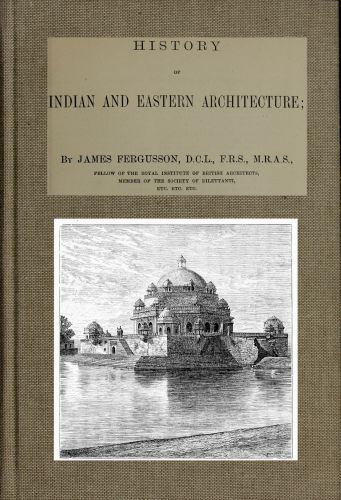
On the exterior, the terrace on which it stands is ornamented by bold octagonal pavilions in the angles, which support appropriately the central dome, and the little bracketed kiosks between them break pleasingly the outline. In the same manner the octagonal kiosks that cluster round the drum of the dome, and the dome itself, relieve the monotony of the composition without detracting from its solidity or apparent solemnity. Altogether, as a royal tomb of the second class, there are few that surpass it in India, either for beauty of outline or appropriateness of detail. Originally it was connected with the mainland by a bridge, which fortunately was broken down before the grand trunk road passed near. But for this, it would probably have been utilised before now.
The mosques of the Pathans bore the same aspect as their tombs. The so-called Kala Musjid in the present city of Delhi, and finished, according to an inscription on its walls, in A.D. 1389, is in a style not unlike the tomb (Woodcut No. 286), but more massive, and even less ornamented. This severe simplicity seems to have been the characteristic of the latter part of the 14th century, and may have been a protest of the more puritanical Moslem spirit against the Hindu exuberance which characterised both the 13th and the 15th centuries. A reaction, however, took place, and the late Pathan style of Delhi was hardly less rich, and certainly far more appropriate for the purposes to which it was devoted than the first style, as exhibited in the buildings at the Kutub.
This, however, was principally owing to the exceptional splendour of the reign of Shere Shah, who, however, is so mixed up both in date and in association with the earlier Moguls, that it is difficult to discriminate between them. Though Baber practically conquered India in A.D. 1494, his successor, Humayun, was defeated and driven from the throne by Shere Shah in A.D. 1540, and it was only in A.D. 1554 that the Mogul dynasty was finally and securely established at Delhi. The style consequently of the first half of the 16th century may be considered as the last expiring effort of the Pathans, or the first dawn of that of the great Moguls, and it was well worthy of either.
At this age the façades of these mosques became far more ornamental, and more frequently encrusted with marbles, and always adorned with sculpture of a rich and beautiful character; the angles of the buildings were also relieved by little kiosks, supported by four richly bracketed pillars, but never with minarets, which, so far as I know, were not attached to mosques during the Pathan period. The call to prayer was made from the roof; and, except the first rude attempt at Ajmir, I do not know a single instance of a minaret built for such a purpose, though they were, as we know, universal in Egypt and elsewhere long before this time, and were considered nearly indispensable in the buildings of the Moguls very shortly afterwards. The Pathans seem to have regarded the minar as the Italians viewed the Campanile, more as a symbol of power and of victory than as an adjunct to a house of worship.
The body of the mosque became generally an oblong hall, with a central dome flanked by two others of the same horizontal dimensions, but not so lofty, and separated from it by a broad bold arch, the mouldings and decorations of which formed one of the principal ornaments of the building.
The pendentives were even more remarkable than the arches for elaborateness of detail. Their forms are so various that it is impossible to classify or describe them; perhaps the most usual is that represented in Woodcut No. 289, where the angle is filled up with a number of small imitations of arches, bracketing out one beyond the other. It was this form that was afterwards converted into the honeycomb work of the Arabs in Spain.
If it were not that the buildings of the Pathans are so completely eclipsed by the greater splendour of those of the Mogul dynasty, which succeeded them in their own capitals, their style would have attracted more attention than has hitherto been bestowed upon it; and its monograph would be as interesting as any that the Indian-Saracenic affords. In its first period the style was characterised by all the richness which Hindu elaboration could bestow; in the second by a stern simplicity and grandeur much more appropriate, according to our ideas, to the spirit of the people; and during the latter part of its existence, by a return to the elaborateness of the past; but at this period every detail was fitted to its place and its purpose. We forget the Hindu except in his delicacy, and we recognise in this last development one of the completed architectural styles of the world.
CHAPTER IV.
JAUNPORE.
CONTENTS.
Mosques of Jumma Musjid and Lall Durwaza.
CHRONOLOGY.
| Khoja Jehan assumes independence at Jaunpore | A.D. 1397 |
| Mubarick, his son | 1400 |
| Shems ud-dîn—Ibrahim Shah | 1401 |
| Mahmúd | 1441 |
| Husain Shah | 1451 |
| —— deposed and seeks refuge at Gaur | 1478 |
It was just two centuries after the conquest of India by the Moslems that Khoja Jehan, the Soubahdar or governor of the province in which Jaunpore is situated, assumed independence, and established a dynasty which maintained itself for nearly a century, from A.D. 1397 to about 1478, and though then reconquered by the sovereign of Delhi, still retained a sort of semi-independence till finally incorporated in the Mogul empire by the great Akbar. During this period Jaunpore was adorned by several large mosques, three of which still remain tolerably entire, and a considerable number of tombs, palaces, and other buildings, besides a fort and bridge, all of which are as remarkable specimens of their class of architecture as are to be found anywhere in India.
Although so long after the time when under Ala ud-dîn and Tugluck Shah the architecture of the capital had assumed something like completeness, it is curious to observe how imperfect the amalgamation was in the provinces at the time when the principal buildings at Jaunpore were erected. The principal parts of the mosques, such as the gateways, the great halls, and the western parts generally, are in a complete arcuate style. Wherever indeed wide openings and large internal spaces were wanted, arches and domes and radiating vaults were employed, and there is little in those parts to distinguish this architecture from that of the capitals. But in the cloisters that surround the courts, and in the galleries in the interior, short square pillars are as generally employed, with bracket capitals, horizontal architraves, and roofs formed of flat slabs, as was invariably the case in Hindu and Jaina temples. Instead of being fused together, as they afterwards became, the arcuate style of the Moslems stands here, though in juxtaposition, in such marked contrast to the trabeate style of the Hindus, that some authors have been led to suppose that the pillared parts belonged to ancient Jaina or Buddhist monuments, which had been appropriated by the Mahomedans and converted to their purposes.[509] The truth of the matter appears to be, that the greater part of the Mahomedans in the province at the time the mosques were built were Hindus converted to that religion, and who still clung to their native forms when these did not clash with their new faith; and the masons were almost certainly those whose traditions and whose taste inclined them much more to the old trabeate forms than to the newly-introduced arched style.
As we shall presently see at Gaur, on the one hand, the arched style prevailed from the first, because the builders had no other material than brick, and large openings were then impossible without arches. At Ahmedabad, on the other hand, in an essentially Jaina country, and where stone was abundant, the pillared forms were not only as commonly employed, as at Jaunpore, but were used for so long a time, that before the country was absorbed in the Mogul empire, the amalgamation between the trabeate and arcuate forms was complete.
The oldest mosque at Jaunpore is that in the fort, which we learn from an inscription on it, was completed in A.D. 1398. It is not large—barely 100 ft. north and south—and consists of a central block of masonry, with a large archway, of the usual style of the Mahomedan architecture of the period, and five openings between pillars on either hand. The front rows of these pillars are richly sculptured, and were evidently taken from some temple that existed there, or in the neighbourhood, before the Moslem occupation, but they seem to have exhausted the stock, as no other such are found in any of the mosques built subsequently.[510]
There are three great mosques still standing in the city; of these the grandest is the Jumma Musjid (Woodcuts Nos. 290, 291), or Friday
290. Plan of Western Half of Courtyard of Jumma Musjid, Jaunpore. (From a Plan by the Author.) Scale 100 ft. to 1 in.
Mosque, which was commenced by Shah Ibrahim, A.D. 1419, but not completed till the reign of Husain, A.D. 1451-1478. It consists of a courtyard 220 ft. by 214 ft., on the western side of which is situated a range of buildings, the central one covered by a dome 40 ft. in diameter,
in front of which stands a gate pyramid or propylon,[511] of almost Egyptian mass and outline, rising to the height of 86 ft. This gate pyramid by its elevation supplied the place of a minaret, which is a feature as little known at Jaunpore, as it was, at the same age, in the capital city of Delhi. On each side of the dome is a compartment divided into two storeys by a stone floor supported on pillars; and beyond this, on each side, is an apartment 40 ft. by 50 ft., covered by a bold pointed vault with ribs, so constructed that its upper surface forms the external roof of the building, which in Gothic vaults is scarcely ever the case. The three sides of the courtyard were surrounded by double colonnades, two storeys in height internally, but with three on the exterior, the floor of the courtyard being raised to the height of the lower storey. On each face was a handsome gateway; one of which is represented in Woodcut No. 291, which gives a fair idea of the style: the greater part of the eastern side of the court has been taken down and removed by the English to repair station-roads and bridges, for which in their estimation these pillars are admirably adapted.
The smallest of the mosques in the city is the Lall Durwaza or Red Gate. It is in the same style as the others; and its propylon—represented in Woodcut No. 292—displays not only the bold massiveness with which these mosques were erected, but shows also that strange admixture of Hindu and Mahomedan architecture which pervaded the style during the whole period of its continuance.
Of all the mosques remaining at Jaunpore, the Atala Musjid is the most ornate and the most beautiful. The colonnades surrounding its court are four aisles in depth, the outer columns, as well as those next the court, being double square pillars. The three intermediate rows are single square columns, supporting a flat roof of slabs, arranged as in Jaina temples. Externally, too, it is two storeys in height, the lower storey being occupied by a series of cells opening outwardly. All this is so like a Hindu arrangement that one might almost at first sight be tempted, like Baron Hügel, to fancy it was originally a Buddhist monastery. He failed to remark, however, that both here and in the Jumma Musjid the cells open outwardly, and are below the level of the courtyard of the mosque—an arrangement common enough in Mahomedan, but never found in Buddhist buildings. Its gateways, however, which are the principal ornaments of the outer court, are purely Saracenic, and the western face is adorned by three propylons similar to that represented in the last woodcut, but richer and more beautiful, while its interior domes and roofs are superior to any other specimen of Mahomedan art I am acquainted with of so early an age. They are, too, perhaps, more striking here, because, though in juxtaposition with the quasi-Hinduism of the court, they exhibit the arched style of the Saracenic architects in as great a degree of completeness as it exhibited at any subsequent period.
The other buildings hardly require particular mention, though, as transition specimens between the two styles, these Jaunpore examples are well worthy of illustration, and in themselves possess a simplicity and grandeur not often met with in this style. An appearance of strength, moreover, is imparted to them by their sloping walls, which is foreign to our general conception of Saracenic art, though at Tugluckabad and elsewhere it is carried even further than at Jaunpore. Among the Pathans of India the expression of strength is as characteristic of the style as massiveness is of that of the Normans in England. In India it is found conjoined with a degree of refinement seldom met with elsewhere, and totally free from the coarseness which in other countries usually besets vigour and boldness of design.
The peculiarities of this style are by no means confined to the capital; they prevail at Gazeepore, and as far north as Canouge, while at Benares the examples are frequent. In the suburbs of that city, at a place called the Bakaraya Kund,[512] there is a group of tombs, as mentioned above, and other buildings belonging to the Moslems, which are singularly pleasing specimens of the Jaunpore style, and certainly belong to the same age as those just described.
The kingdom of Jaunpore is also rich in little tombs and shrines in which the Moslems have used up Hindu and Jaina pillars, merely rearranging them after their own fashion. These, of course, will not bear criticism as architectural designs, but there is always something so indescribably picturesque about them as fairly to extort admiration. The principal example of this compound style is a mosque at Canouge, known popularly as “Sita ka Rasui,” “Sita’s kitchen.” It is a Jaina temple, rearranged as a mosque, in the manner described at pp. 263-4. It measures externally 133 ft. by 120 ft. The mosque itself has four rows of fifteen columns each, and three domes. The cloisters surrounding the court are only two rows in depth, and had originally sixty-eight pillars, smaller than those of the mosque. Externally it has no great beauty, but its pillared court is very picturesque and pleasing. According to an inscription over its principal gateway, its conversion was effected by Ibrahim Shah, of Jaunpore, A.D. 1406.[513]
At a later age, and even after it had lost its independence, several important buildings were erected in the capital and in other towns of the kingdom in the style of the day; but none of these, so far as is now known, are of sufficient importance to require notice in such a work as the present.
CHAPTER V.
GUJERAT.
CONTENTS.
Jumma Musjid and other Mosques at Ahmedabad—Tombs and Mosques at Sirkej and Butwa—Buildings in the Provinces.
CHRONOLOGY.
| Muzaffar Shah, a Rajput, appointed Viceroy | A.D. 1391 |
| Ahmed Shah, his grandson, founds Ahmedabad | 1411 |
| Mohammed Shah the Merciful | 1443 |
| Kutub Shah; war with Rana Khumbo | 1454 |
| Mahmúd Shah Begurra | 1459 |
| Muzaffar Shah II. | 1511 |
| Bahadur Shah murdered by Portuguese | 1526 |
| Muzaffar Shah III. | 1561 |
| Gujerat becomes a province of Akbar’s kingdom | 1583 |
Of the various forms which the Saracenic architecture assumed in India, that of Ahmedabad may probably be considered as the most elegant, as it certainly is the most characteristic of all. No other form is so essentially Indian, and no one tells its tale with the same unmistakable distinctness.
As mentioned above, the Mahomedans, in the first century of the Hejira, made a brilliant attempt to conquer Scinde and Gujerat, and apparently succeeded; but the country was so populous, and its civilization so great, that the invaders were absorbed, and soon disappeared from the scene.
Mahmúd of Ghazni next overran the province, but left no permanent mark; and even after the fall of Delhi (A.D. 1196) Gujerat maintained the struggle for independence for nearly two centuries longer, till Feroze Tugluck, in A.D. 1391, appointed Muzaffar, a converted Rajput, of the Tak clan, to be his viceroy. This, however, was only on the eve of the troubles caused by the invasion of Tamerlane, and, mutato domino, Gujerat remained as independent as before.
The next two centuries—during which the Ahmed Shahi dynasty occupied the throne—were spent in continual wars and struggles with their refractory vassals and the neighbouring chiefs. On the whole, however, their power may be said to have been gradually on the increase till the death of Bahadur, A.D. 1536, but they never wholly subdued the rebellious spirit of their subjects, and certainly never converted the bulk of them to their faith. As a consequence of this, the principal buildings with which this chapter is concerned are to be found in the capital and its immediate proximity. Beyond that the Hindus followed their old faith and built temples as before; though in such large cities as Cambay or Baroach the Mahomedans, of course, possessed places of worship, some of them of considerable importance, and generally made up from pillars borrowed from Hindu buildings.
In Ahmedabad itself, however, the Hindu influence continued to be felt throughout. Even the mosques are Hindu, or rather Jaina, in every detail; only here and there an arch is inserted, not because it was wanted constructively, but because it was a symbol of the faith, while in their tombs and palaces even this is generally wanting. The truth of the matter is, the Mahomedans had forced themselves upon the most civilized and most essentially building race at that time in India, and the Chalukyas conquered their conquerors, and forced them to adopt forms and ornaments which were superior to any the invaders knew or could have introduced. The result is a style which combines all the elegance and finish of Jaina or Chalukyan art, with a certain largeness of conception which the Hindu never quite attained, but which is characteristic of the people who at this time were subjecting all India to their sway.
The first seat of the Mahomedan power was Anhilwarra, the old capital of the Rajputs, and which, at the time it fell into their power, must have been one of the most splendid cities of the East. Little now remains of all its magnificence, if we may trust what is said by recent travellers who have visited its deserted palaces. Ahmed, the second king, removed the seat of power to a town called Kurnawutti, afterwards known as Ahmedabad, from the name of its second founder, and which, with characteristic activity, he set about adorning with splendid edifices. Of these the principal was the Jumma Musjid, which, though not remarkable for its size, is one of the most beautiful mosques in the East. Its arrangement will be understood from the next plan (Woodcut No. 293). Its dimensions are 382 ft. by 258 ft. over all externally; the mosque itself being 210 ft. by 95 ft., covering consequently about 20,000 sq. ft. Within the mosque itself are 260 pillars, supporting fifteen domes arranged symmetrically, the centre three alone being somewhat larger and considerably higher than the others. If the plan is compared with that of the temple at Sadri (Woodcut No. 133), which was being erected at the same time by Khumbo Rana within 160 miles of Ahmedabad, it will afford a fair means of comparison between the Jaina and Mahomedan arrangements of that day. The form of the pillars and the details generally are practically the same in both buildings, the Hindu being somewhat richer and more elaborate. In plan, the mosque looks monotonous as compared with the temple; but this is redeemed, to some extent, by the different heights of the domes, as shown in the elevation (Woodcut No. 294), and by the elevation of each division being studiously varied. My own feeling is in favour of the poetry of the temple, but there is a sobriety about the plan of the mosque which, after all, may be in better taste. Both plans, it need hardly be remarked, are infinitely superior to the monotony of the southern halls of 1000 pillars. The latter are remarkable for their size and the amount of labour bestowed upon them, but it requires more than this to constitute good architecture.
The general character of the elevation will be understood from the woodcut No. 294, but unfortunately its minarets are gone. When Forbes[514] drew it, they were still standing, and were celebrated in Eastern story as the shaking minarets of Ahmedabad; an earthquake in A.D. 1818 shook them too much, but there are several others still standing in the city from which their form can easily be restored.
The plan and lateral extension of the Jumma Musjid are exceptional. The usual form taken by the mosques at Ahmedabad was that of the Queen’s Mosque at Mirzapore, and consists of three domes standing on twelve pillars each, with the central part so raised as to admit light to the interior. The mode in which this was effected will be understood from the annexed diagram (Woodcut No. 297). The pillars which support the central domes are twice as high as those of the side domes, and two rows of dwarf columns stand on the roof to make up the height. In front of these internally is a solid balustrade, which is generally most richly ornamented by carving. Thus arranged, it will be perceived that the necessary amount of light is introduced, as in the drum of a Byzantine dome, but in a more artistic manner. The sun’s rays can never fall on the floor, or even so low as the head of any one standing there. The light is reflected from the external roof into the dome, and perfect ventilation is obtained, with the most pleasing effect of illumination without glare. In order further to guard against the last dreaded contingency, in most of these mosques a screen of perforated stonework was introduced between the outer dwarf columns. These screens were frequently of the most exquisite beauty, and in consequence have very generally been removed.
There are three or four mosques at Ahmedabad, built on the same pattern as that last described, but as the style progressed it became more and more Indian. The arches in front were frequently omitted, and only a screen of columns appeared, supported by two minarets, one at each angle. This system was carried to its greatest extent at Sirkej, about five miles from the city. Mohammed Shah, in A.D. 1445, commenced erecting a tomb (A on Woodcut No. 298) here, in honour of Ahmed Gunj Buksh, the friend and adviser of his father. The style of these buildings may be judged of from the woodcut (No. 299, page 532), representing the pavilion of sixteen pillars in front of this tomb (I in Woodcut No. 298). They are of the usual simple outline of the style—a tall, square base; the shafts square, and with no ornament except a countersinking on the angles, and crowned with a moderately projecting bracket-capital. The building is roofed with nine small domes, insignificant in themselves, but both internally and externally forming as pleasing a mode of roofing as ever was applied to such a small detached building of this class. The mosque (D) was completed in A.D. 1451, and Mahmúd Begurra added afterwards a tomb for himself (B) and one for his wife Rajbaie (C). With their accompanying palaces and tombs these make up one of the most important groups in the neighbourhood. The whole are constructed without a single arch; all the pillars have the usual bracket capitals of the Hindus, and all the domes are on the horizontal principle. In the large tomb an attempt has been made to get a larger dome than the usual octagonal arrangement would admit of, but not quite successfully. The octagon does not accord with the substructure, and either wider spaces ought to have been introduced or a polygon of a greater number of sides employed. The mosque is the perfection of elegant simplicity, and is an improvement on the plan of the Jumma Musjid. There are five domes in a line, as there, but they are placed nearer to one another, and though of greater diameter the width of the whole is less, and they are only two ranges in depth. Except the
| REFERENCES. |
|
A. Tomb of Gunj Buksh. B. Tomb of Mahmúd Begurra and his Sons. C. Tomb of Beebee Rájbaie, his Queen. D. The Mosque. E. Covered Gateway. F. Covered Hall overlooking the Tank. G. Well and Fountain. H. Portico leading to Terrace and Steps down to the Tank. I. Pavilion. J. Portions of the Steps surrounding the Tank. |
Mootee Musjid at Agra, to be described hereafter, there is no mosque in India more remarkable for simple elegance than this.
Besides these larger mosques there are several smaller ones of great beauty, of which two—those of Mooháfiz Khan and the Rani Sîpri—are pre-eminent. The elevation of the first is by no means happy, but its details are exquisite, and it retains its minarets, which is too seldom the case. As will be seen from the woodcut, as well as from those of the Jumma and Queen’s Mosques (Nos. 294, 296), the lower part of the minarets is of pure Hindu architecture; all the bases at Ahmedabad are neither more nor less than the perpendicular parts of the basement of Hindu or Jaina temples elongated. Every form and every detail may be found at Chandravati or Abu, except in one particular—on the angles of all Hindu temples are niches containing images. This the Moslem could not tolerate, so he filled them with tracery. We can follow the progress of the development of this form, from the first rude attempt in the Jumma Musjid, through all its stages to the exquisite patterns of the Queen’s Mosque at Mirzapore. After a century’s experience they produced forms which as architectural ornaments will, in their own class, stand comparison with any employed in any age or in any part of the world; and in doing this they invented a class of window-tracery in which they were also unrivalled. The specimen below (Woodcut No. 301), from a window in a desecrated mosque in the palace (the Bhudder) will convey an idea of its elaborateness and grace. It would be difficult to excel the skill with which the vegetable forms are conventionalised just to the extent required for the purpose. The equal spacing also of the subject by the three ordinary trees and four palms, takes it out of the category of direct imitation of nature, and renders it sufficiently structural for its situation; but perhaps the greatest skill is shown in the even manner in which the pattern is spread over the whole surface. There are some exquisite specimens of tracery in precious marbles at Agra and Delhi, but none quite equal to this.
Above the roof of the mosques the minarets are always round towers slightly tapering, as in the mosque of Mooháfiz Khan (Woodcut No. 300), relieved by galleries displaying great richness in the brackets which support them as well as in the balustrades which protect them. The tower always terminates in a conical top relieved by various disks. They are, so far as I know, the only minarets belonging to mosques which surpass those of Cairo in beauty of outline or richness of detail, excepting those of the Rani Sîpri mosque, which are still more beautiful. Indeed, that mosque is the most exquisite gem at Ahmedabad, both in plan and detail. It is without arches, and every part is such as only a Hindu queen could order, and only Hindu artists could carve.[515]
Tombs.
Knowing the style, it would not be difficult to predicate the form of the tombs. The simplest would be that of Abu Touráb; an octagonal dome supported on twelve pillars, and this extended on every side, but always remaining a square, and the entrances being in the centre of the faces. The difference between this and the Jaina arrangement is that the latter is diagonal (Woodcut No. 119), while these are square. The superiority of the Hindu mode is apparent at a glance. Not, it is true, in so small an arrangement as that last quoted, but in the tombs at Sirkej (Woodcut No. 298), the effect is so monotonous as almost to become unpleasing. With the Jains this never is the case, however numerous the pillars may be.
Besides the monotony of the square plan, it was felt at Sirkej—as already pointed out—that the octagonal dome fitted awkwardly on to its supports. This was remedied, to a great extent, in the tomb of Syad Osmán, built in A.D. 460 by Mahmúd Begurra. In this instance the base of the dome is a dodecagon, and a very considerable amount of variety is obtained by grouping the pillars in twos and fours, and by the different spacing. In elevation the dome looks heavy for the substructure, but not so in perspective; and when the screens were added to inclose the central square, it was altogether the most successful sepulchral design carried out in the pillared style at Ahmedabad.
Towards the end of their career, the architects of Ahmedabad evinced a strong tendency to revert to the arched forms generally used by their brethren in other countries. Mahmúd Begurra built himself a tomb near Kaira, which is wholly in the arched style, and remains one of the most splendid sepulchres in India.[516] He also erected at Butwa, near Ahmedabad, a tomb over the grave of a saint, which is in every respect in the same style. So little, however, were the builders accustomed to arched forms, that, though the plan is judiciously disposed by placing smaller arches outside the larger, so as to abut them, still all those of the outer range have fallen down, and the whole is very much crippled, while the tomb without arches, that stands within a few yards of it, remains entire. The scale of the two, however (Plan No. 305), reveals the secret of the preference accorded to the arch as a constructive expedient. The larger piers, the wider spacing, the whole dimensions, were on a grander scale than could be attained with beams only, as the Hindus used them. As the Greeks and Romans employed these features, any dimensions that were feasible with arches could be attained by pillars; but the Hindus worked to a smaller modulus, and do not seem to have known how to increase it. It must, however, be remarked that they generally used pillars only in courts, where there was nothing to compare them with but the spectator’s own height; and there the forms employed by them were large enough. It was only when the Moslems came to use them externally, and in conjunction with arches and other larger features, that their diminutive scale became apparent.
It is perhaps the evidence of a declining age to find size becoming the principal aim. But it is certainly one great and important ingredient in architectural design, and so thought the later architects of Ahmedabad. In their later mosques and buildings they attained greater dimensions, but it was at the expense of all that renders their earlier style so beautiful and so interesting.[517]
Besides the buildings of the classes above enumerated, there are several smaller objects of art at Ahmedabad which are of extraordinary beauty. Among these are several bowlees, or deep wells, with broad flights of steps leading down to them, and ornamented with pillars and galleries to as great an extent as some of the largest buildings above ground. It requires a personal experience of the grateful coolness of a subterranean apartment in a hot climate to appreciate such a class of buildings, and in the rainy West we hardly know how valuable water may become.
Another object of architectural beauty is found in the inflow and outflow sluices of the great tanks which abound everywhere around the city. Nowhere did the inhabitants of Ahmedabad show how essentially they were an architectural people, as in these utilitarian works. It was a necessity of their nature that every object should be made ornamental, and their success was as great in these as in their mosques or palaces.
Buildings in the Provinces.
In addition to the numerous edifices that adorn the capital, there are, as hinted above, several in the provincial capitals that are well worthy of notice. Among these the Jumma Musjid at Cambay is perhaps the most splendid. It was erected in A.D. 1325, in the time of Mohammed Shah Gori, and is only inferior to that of the capital in size. It measures over all 200 ft. by 210 ft., and its internal court 120 ft. by 135 ft. Except being somewhat smaller in scale, its plan and arrangements are almost identical with those of the Altumsh Mosque (Woodcut No. 283) at Ajmir: but, when it is looked into, it would be difficult to conceive two buildings more essentially different than these two are. The screen of arches at Cambay, only three in number, are plain even to baldness, and low, in order to fit the dimensions of the Jaina pillars of the interior. These latter are all borrowed from desecrated temples, and in this instance certainly rearranged without much attention to congruity or architectural effect. Still the effect is picturesque, and the parts being employed for the purposes for which they were designed, there is no offensive incongruity anywhere.
One of the most remarkable features in this mosque is the tomb, which its founder, Imrar ben Ahmed Kajerani erected for himself. It is wholly composed of Hindu remains, and is two storeys in height, and was crowned with a dome 28 ft. in diameter. The parts, however—borrowed, apparently, from different buildings—were so badly fitted together that, after standing some three centuries, it fell in, and has since remained a ruin, singularly picturesque in form and exquisite in detail, but a monument of the folly of employing building materials for any purpose but that for which they were designed.[518]
There is another mosque at Baroach, not unlike this one in design but smaller, being only 135 ft. over all north and south, and it has—now, at least—no courtyard; but some of its details, borrowed from Hindu temples, are very beautiful.
There are also two very beautiful mosques at Dolka, a city twenty-two miles south-west from Ahmedabad, almost identical in size and plan, being each of them squares of about 150 ft., and the mosque-front covered with five domes and the screen-wall with three arches each.[519]
The most beautiful, however, of these provincial examples is the tomb at Mahmúdabad, of its class one of the most beautiful in India (Woodcut No. 306). It was erected by the same Mahmúd Begurra, A.D. 1484, who erected the tomb of Kutub-ul-Alum at Butwa, described above (Woodcut No. 304), and is said to have been designed by the same architect. This is, however, a far more successful example, and though small—it is only 94 ft. square, exclusive of the porch—there is a simplicity about its plan, a solidity and balance of parts in the design, which is not always found in these tombs, and has rarely, if ever, been surpassed in any tomb in India. The details, too, are all elegant and appropriate, so that it only wants somewhat increased dimensions to rank among the very first of its class. Its constructive arrangements, too, are so perfect that no alterations in them would be required, if the scale had been very much increased.
The tomb itself is surrounded by a screen of perforated stonework, of the very finest tracery, and with its double verandah aids in giving the sepulchral chamber that seclusion and repose so indispensable in a mausoleum.[520]
CHAPTER VI.
MALWA.
CONTENTS.
The Great Mosque at Mandu.
CHRONOLOGY.
| Sultan Dilawar Ghori | A.D. 1401 |
| Sultan Hoshang Ghori | 1405 |
| Ghazni Khan | 1432 |
| Mahmúd Khan, cotemp. Rana Khumbo of Chittore | 1435 |
| Sultan Ghias ud-dîn | 1469 |
| Sultan Mahmúd II | 1512 |
| Malwa incorporated with Gujerat | 1534 |
| —— annexed by Akbar | 1568 |
The Ghori dynasty of Mandu attained independence about the same time as the Sharkis of Jaunpore—Sultan Dilawar, who governed the province from A.D. 1387, having assumed the title of Shah in A.D. 1401. It is, however, to his successor Hoshang, that Mandu owes its greatness and all the finest of its buildings. The state continued to prosper as one of the independent Moslem principalities till A.D. 1534, when it was incorporated with Gujerat, and was finally annexed to Akbar’s dominion in A.D. 1568.
The original capital of the state was Dhar, an old Hindu city, twenty miles northward of Mandu, to which the seat of government was transferred after it became independent. Though an old and venerated city of the Hindus, Dhar contains no evidence of its former greatness, except two mosques erected wholly of Jaina remains. The principal of these, the Jumma Musjid, has a courtyard measuring 102 ft. north and south, by 131 ft. in the other direction. The mosque itself is 119 ft. by 40 ft. 6 in., and its roof is supported by sixty-four pillars of Jaina architecture, 12 ft. 6 in. in height, and all of them more or less richly carved, and the three domes that adorn it are also of purely Hindu form. The court is surrounded by an arcade containing forty-four columns, 10 ft. in height, but equally rich in carving. There is here no screen of arches, as at the Kutub or at Ajmir. Internally nothing is visible but Hindu pillars, and, except for their disposition and the prayer-niches that adorn the western wall, it might be taken for a Hindu building. In this instance, however, there seems no doubt that there is nothing in situ. The pillars have been brought from desecrated temples in the town, and arranged here by the Mahomedans as we now find them, probably before the transference of the capital to Mandu.
The other mosque is similar to this one, and only slightly smaller. It has long, however, ceased to be used as a place of prayer, and is sadly out of repair. It is called the Lât Musjid, from an iron pillar now lying half-buried in front of its gateway. This is generally supposed to have been a pillar of victory, like that at the Kutub; but this can hardly be the case. If it were intended for an ornamental purpose, it would have been either round or octagonal, and had some ornamental form. As it is, it is only a square bar of iron, some 20 ft. or 25 ft. in height, and 9 in. section, without any ornamental form whatever. My impression is, that it was used for some useful constructive purpose, like those which supported the false roof in the Pagoda at Kanaruc (ante, page 428). There are some holes through it, which tend further to make this view of its origin probable. But, be this as it may, it is another curious proof of the employment of large masses of wrought-iron by the Hindus at a time when they were supposed to be incapable of any such mechanical exertion. Its date is probably that of the pillars of the mosques where it is found, and from their style they probably belong to the 10th or 11th centuries.
The site on which the city of Mandu is placed is one of the noblest occupied by any capital in India. It is an extensive plateau, detached from the mainland of Malwa by a deep ravine about 300 to 400 yards across, where narrowest, and nowhere less than 200 ft. in depth. This is crossed by a noble causeway, defended by three gateways, and flanked by tombs on either hand. The plateau is surrounded by walls erected on the brink of the cliff—it is said 28 miles in extent. This, however, conveys a very erroneous idea of the size of the place, unless qualified by the information that the walls follow the sinuosities of the ravines wherever they occur, and many of these cut into the hill a mile or two, and are only half a mile across. The plateau may be four or five miles east and west, and three miles north and south, most pleasingly diversified in surface, abounding in water, and fertile in the highest degree, as is too plainly evidenced by the rank vegetation, which is tearing the buildings of the city to pieces or obscuring them so that they can hardly be seen.
The finest building in the city is the Jumma Musjid, commenced and nearly completed by Hoshang, the second king, who reigned from A.D. 1405 to A.D. 1432, which, though not very large, is so simple and grand in outline and details, that it ranks high among the monuments of its class. Its dimensions are externally 290 ft. by 275 ft., exclusive of the porch.
Internally, the courtyard is almost an exact square of 162 ft., and would be quite so, were it not that two of the piers on the east and west faces are doubled. In other respects the four sides of the court are exactly similar, each being ornamented by eleven great arches of precisely the same dimensions and height, supported by piers or pillars, each of one single block of red sandstone. The only variety attempted is, that the east side has two arcades in depth, the north and south three: while the west side, or that facing Mecca, has five, besides being ornamented by three great domes, each 42 ft. in diameter.
As will be seen on the plan (Woodcut No. 308), these large domes are supported each by twelve pillars. The pillars are all equally spaced, the architect having omitted, for the sake of uniformity, to widen the central avenues on the intersection of which the domes stand. It follows from this that the four sides of the octagon supporting the dome, which are parallel to the sides of the court, are shorter than the four diagonal sides. Internally, this produces a very awkward appearance; but it could not have been avoided except by running into another difficulty—that of having oblong spaces at the intersections of the wider aisles with the narrower, to which the smaller domes must have been fitted. Perhaps, on the whole, the architect took the less inconvenient course of the two.