
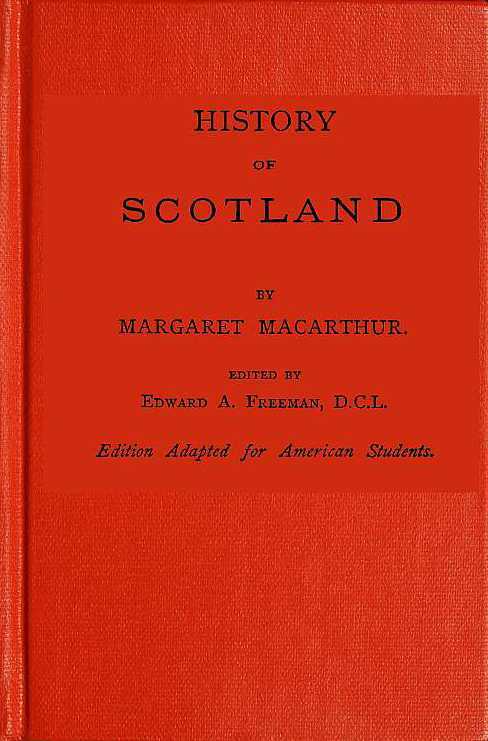
The Project Gutenberg eBook of History of Scotland
Title: History of Scotland
Author: Margaret MacArthur
Editor: Edward A. Freeman
Release date: November 7, 2013 [eBook #44121]
Most recently updated: October 23, 2024
Language: English
Credits: Produced by Paul Marshall, Greg Bergquist and the Online
Distributed Proofreading Team at http://www.pgdp.net (This
file was produced from images generously made available
by The Internet Archive/American Libraries.)
FREEMAN'S HISTORICAL COURSE FOR SCHOOLS.
HISTORY
OF
SCOTLAND
BY
MARGARET MACARTHUR.
EDITED BY
Edward A. Freeman, D.C.L.
Edition Adapted for American Students.
NEW YORK
HENRY HOLT AND COMPANY
1874
Entered according to Act of Congress, in the Year 1874, by
HENRY HOLT,
In the Office of the Librarian of Congress, at Washington.
CONTENTS.
| PAGE. | |
| CHAPTER I. | |
| THE GAELIC PERIOD | 1 |
CHAPTER II. |
|
| THE ENGLISH PERIOD | 19 |
CHAPTER III. |
|
| THE STRUGGLE FOR INDEPENDENCE | 35 |
CHAPTER IV. |
|
| THE INDEPENDENT KINGDOM | 52 |
CHAPTER V. |
|
| THE JAMESES | 67 |
CHAPTER VI. |
|
| THE REFORMATION | 96 |
CHAPTER VII. |
|
| THE UNION OF THE CROWNS | 125 |
CHAPTER VIII. |
|
| AFTER THE UNION | 167 |
CHRONOLOGICAL TABLE.
HISTORY OF SCOTLAND.
CHAPTER I.
THE GAELIC PERIOD.
The country (1)—the people (2)—Roman occupation (3)—English invasion (4)—the Scots (5)—introduction of Christianity (6)—conversion of the Picts (7)—conversion of the English (8)—English conquests (9)—union of Picts and Scots (10)—the Northmen (11)—the Commendation (12)—annexation of Strathclyde (13)—acquisition of Lothian (14)—Cnut's invasion (15)—Macbeth (16)—English immigration (17)—William's invasion (18)—Margaret's reforms (19)—disputed succession (20)—Gaelic period ends (21)—summary (22).
1. The Country.—The northern part of Great Britain is now called Scotland, but it was not called so till the Scots, a Celtic people, came over from Ireland and gave their name to it. The Romans who first mention it in history speak of it as Caledonia. There are two points in which the history of this country and of the people who live in it is unlike the history of most of the other countries and nations of Europe. Firstly, it never was taken into the great Roman Empire; and secondly in it we find a Celtic people who, instead of disappearing before the Teutons, held their ground against them so well that in the end the Teutons were called by the name of the Celtic people, were ruled by the Celtic kings, and fought for the independence of the Celtic kingdom as fiercely as if they had themselves been of the Celtic race. But the whole of the country is not of the same nature. The northern part is so nearly cut off from the rest of Britain by the two great Firths of Forth and Clyde as to form almost a separate island, and this peninsula is again divided into Highlands and Lowlands. Speaking roughly, we may say that all the west is Highland and the east Lowland. A range of mountains sweeping in a semicircle from the Firth of Clyde to the mouth of the Dee, known as Drumalbyn or the Mount, may be taken as the line of separation, though the Lowlands extend still further north along the eastern coast. The marked differences between these two districts have had a very decided influence on the character of the inhabitants, and consequently on the national development. The Lowlands are well watered and fertile, and the people who lived there were peaceable and industrious, and both on the seaboard and inland there is early notice of the existence of populous and thriving towns. The Highlands, on the contrary, are made up of lakes, moors, and barren hills, whose rocky summits are well-nigh inaccessible, and whose heath-clad sides are of little use even as pasture. Even in the glens between the mountains, where alone any arable land is to be found, the crops are poor, the harvest late and uncertain, and vegetation of any kind very scanty. The western coast is cut up into numberless islets, and the coast-line is constantly broken by steep jagged promontories jutting out seaward, or cut by long lochs, up which the sea runs far into the land between hills rising almost as bare and straight as walls on either side. In the Highlands even in the present day there are no towns of any importance, for the difficulty of access by land and the dangers of the coast have made commerce well-nigh impossible. The Highlanders, who were discouraged by the barrenness of their native mountains, where even untiring industry could only secure a bare maintenance, and tempted by the sight of prosperity so near them, found it a lighter task to lift the crops and cattle of their neighbour than to rear their own, and have at all times been much given to pillaging the more fortunate Lowlanders, of whom they were the justly dreaded scourge.
2. The People.—As the country is thus naturally divided into two parts distinctly opposite in character, so the people are made up of two distinct branches of the great Aryan family, the Celtic and the Teutonic. The Celts were the first comers, and were in possession when the country became historically known; that is, at the first invasion of the Romans. In later times we find three Celtic peoples in North Britain; to wit, the Picts, the Scots, and the Welsh. The Picts were those Celts who dwelt north of the Firths in Alba or Alban, as the earliest traditions call it; and if we judge from the names of places and contemporary accounts and notices, there is every reason to believe that they were more akin to the Gaelic than to the British branch of the Celtic race. The Scots, the other Gaelic people, were, when we first hear of them, settled in Ireland, from whence at different times bands of them came over to the western coast of Britain. They were friends and allies of the Picts, and are early mentioned as fighting on their side against the Romans. After a time, when many more Scots had settled in Alba, their name became common to all the Celts north of the Firths, and from them the whole country was called Scotland. The Celts south of the Firths were partly Christianized and civilized by the Romans, and thus became very different from the rest. They got their name of Welsh from the Teutonic tribes who came from the land between the Elbe and the Eyder, and, settling along the eastern coast, finally took possession of a great tract of country, and called the Celts whom they displaced Welshmen or foreigners. The Celts called all these new comers Saxons, though this was really only the name of one of the first tribes that came over; and as they gradually spread over the Lowlands, the word Saxon came to mean simply Lowlander. In course of time the original proportions of these two races have been nearly reversed, so that the modern Scottish nation, though it keeps its Celtic name, instead of being made up of three Celts to one Saxon, is much more nearly three Saxons to one Celt.
3. Roman Occupation.—The Romans, who had already made themselves masters of South Britain, were led into the northern part of the island by Julius Agricola, a.d. 80. But the Celts whom they found there, and whom they called Caledonians, were so well able to defend themselves among their mountains that the Romans, though they defeated them in a great battle on the Highland border, gave up the idea of conquering the country, and retreated again south of the Firths of Forth and Clyde. Across the isthmus between the two, which is about thirty miles wide, they built a line of forts, joined by a rampart of earth. This rampart was intended to serve as a defence to their colonists, and as a boundary to mark the limit of their empire; though, as many Roman remains have been found north of the isthmus, they must have had settlements without as well as within the fortifications. But the Caledonians, who were too high-spirited to look on quietly and see their country thus taken possession of, harassed the colonists by getting over the wall and seizing or destroying everything they could lay their hands on. At length (a.d. 120) the Roman Emperor Hadrian built a second rampart across the lower isthmus, between the rivers Tyne and Solway, leaving the district between the two pretty much at the mercy of the fierce Picts, as the Romans now began to call the Caledonians. Twenty years later, in the reign of the Emperor Antoninus Pius, one of his generals, Lollius Urbicus, again drove them back beyond the first wall, and repaired and strengthened the defences of Agricola. But, before half a century had passed, the Picts again burst the barrier, and killed the Roman commander. In 208 the Emperor Severus cut his way through Caledonia with a large army. He reached the northern coast, but had no chance of fighting a battle, and lost many of his men. He repaired and strengthened the rampart of Hadrian. In time the Picts got over the second rampart too, and came south as far as Kent, where, in the latter part of the fourth century, Theodosius the Roman general, father of the famous Emperor of the same name, had to fight his way to London through their plundering hordes. Theodosius drove them back with great vigour, restored the Empire to its former boundary, and made the district between the walls into a Roman province, which he called Valentia, in honour of Valentinian, who was then Emperor. It was probably about this time that the great stone wall was built across the lower isthmus. The dangers which threatened the capital of the Empire in the beginning of the next century forced the Romans to forsake this as well as all their other provinces in Britain, and the withdrawal of their troops left the Romanized Britons of Valentia a helpless prey to their merciless enemies the Picts. At the end of the three centuries of Roman occupation, the Britons south of the Firths had so little in common with the wild Picts, who in Alba and in Galloway still maintained their independence, that they were like people of a different race. The one sect, though still savage and heathen, were as brave and fierce as ever; the other, though Christianized and civilized, were so degenerated from the vigour of the original stock that they were powerless to resist their more warlike kinsmen.
4. English Invasion.—In the sixth century the Angles came in great force and settled on the eastern coast of Valentia, and drove the Britons, or as they called them Welshmen, back to the Westland Hills. This district then between the Roman walls was thus divided between two kingdoms. The English kingdom of Northumberland, founded by Ida in 547, took in all the eastern part of the country south of the Forth; while the Welsh kingdom, called Strathclyde from the river that watered it, stretched from the Firth of Clyde southwards towards the Dee.
5. The Scots.—About the same time that the English were pouring in on the east, the Scots were settling all along the western coast. As the strait which separates Britain from Ireland is only twelve miles broad, the Scots could easily come over from Scotia, as Ireland was formerly called, to seek their fortune in the larger island. It is impossible to fix the date of their first coming, but it was not till the beginning of the sixth century that there came over a swarm numerous and united enough to found a separate state. This is one of the few Celtic migrations on record from west to east, and forms an exception to the general displacement that was going on, by which the Celts were being driven further and further west before the Teutons. The leaders of the Scots were Fergus MacErc, and Lorn, of the family of the Dalriads, the ruling dynasty in the north of Ireland, and from them this new state founded on the western coast of what is now called Argyle got the name of Dalriada.
6. Introduction of Christianity.—These Scots were not pagans like the Picts of Alba, for Ireland had already been Christianized. The new comers brought the new faith to their adopted country, and through them it spread among the Picts, and also among the English of Northumberland. The great apostle of the Scots was Columba. He was Abbot of Durrow in Ireland, but was obliged to leave his own country, because he had been engaged in a feud with some of his kinsfolk, in which his side was worsted. He came over to the new colony on the coast of Alba, and Conal, who was then King of the Dalriads, welcomed him, and gave him I, or Iona, an islet about a mile and a half long and a mile broad, lying west of the large island of Mull. Here Columba settled with the twelve monks who had come with him, and here they built for the service of God a little wooden church after their simple fashion, and for their own dwelling a few rude huts of wattle, which in after-times was called a monastery, where they passed their days in prayer and study. But their missionary zeal was as great as their piety, and from their head-quarters on Iona they went cruising about among the adjacent islands, extending their circuit to the Orkneys, and even, it is said, as far as Iceland.
7. Conversion of the Picts.—Columba himself undertook the conversion of the Picts. About two years after his arrival at Iona he set out on this important mission, crossed Drumalbyn, sought the court of Brud, the Pictish king, converted him, and founded religious communities on the same plan as that on Iona, on lands granted to him by the king or his dependent chiefs. The Church thus set up was perfectly independent of the Bishop of Rome or of any other See, but it inherited all the peculiarities of the Church of the Irish Scots. The monks had a way of their own of reckoning the time for keeping Easter and of shaving their heads, trifles which were considered important enough to become the subject of a very long quarrel, and it was not till 716 that they agreed to yield to the Roman custom in both matters. According to their system of Church government, the abbots of the monasteries were the chief dignitaries, and had all the power which in the rest of Christendom was held to belong to bishops, while the bishops were held of no account except for ordaining priests, for which purpose there was one at least attached to each monastery. Columba, who was himself of the royal race, had so much influence among the Dalriads that his authority was called in to settle a dispute about the succession to the throne. The abbots of Iona after him continued supreme in all the ecclesiastical affairs of Alba till the middle of the ninth century, while the well-earned reputation for piety and learning enjoyed by the monks of his foundation was widely spread in continental Europe. About this time Kentigern revived among the Welshmen of Strathclyde the dying Christianity which had been planted there in the time of the Roman occupation.
8. Conversion of the English.—The English of Northumberland were still heathens, and, as they were ever fighting with and growing greater at the expense of their neighbours, their state bade fair to become the most powerful in Britain. In the beginning of the seventh century their king Eadwine was supreme over all Britain south of the Forth. But though Eadwine was converted by the preaching of Paullinus, the first Bishop of York, the new doctrine does not seem to have spread much among his people; for one of his successors, Oswald, who in his youth had been an exile at the court of his kinsman the Pictish king, prayed the monks of Iona to send him one of their number to help to make his people Christian. Conan, the first missionary who went, was so much disgusted with the manners of the English that he very soon came back to his brethren. Then Aidan, another of their number, devoted his life to the task which Conan had found so distasteful. He taught and toiled among them with a zeal that was seconded by Oswald, the king, who himself acted as interpreter, making the sermons of the monk intelligible to his English hearers. From Lindisfarne, where the little church of Aidan was founded, like that of Iona, on an islet, Christianity spread to the neighbouring state of Mercia, and many monasteries and schools were founded after the Columban model.
9. English Conquests.—Oswald and his successor Oswiu extended their dominions beyond the Firths, and it is said that they made the Scots and Picts pay tribute to them. The next king, Ecgfrith, marched north and crossed the Tay with a mighty host, but he was routed and slain in a great battle at a place called Nectansmere, the exact position of which is uncertain. From that time the English seem to have kept more to the country south of the Forth, and the Picts were more independent of them. This is about the only event of moment that we know of in the history of that people, of whom no records remain, except a long list of their kings down to 843, at which date they became united with the Scots under one king.
10. Union of Picts and Scots.—This union took place under Kenneth MacAlpin, who was king of the Scots. That he was king of the Picts also is certain: how he came to be so can only be guessed. It is more probable that it was by inheritance than by conquest, though he and the kings after him kept his original title of King of Scots. Over how much land he reigned, and what degree of power he had over his subjects, is not known. It is thought that among the Celts the king was only the head of the dominant tribe among many other tribes or clans, each of which was bound to follow its own chief, and the king's control over those chiefs seems to have been more in name than in fact. The northern districts seem to have been ruled by powerful chiefs called Maers or Mormaers. These chiefs, who it has been supposed were nominally subject to the King of Scots, acted as if they were quite independent of him. They were indeed his most troublesome enemies, and several of the kings lost their lives in battle against them. Moray was the greatest of the Mormaerships. It lay north of the Spey and of the mountains of Argyle, and stretched across the country from the Moray Firth to the opposite ocean.
11. Coming of the Northmen.—Kenneth was followed in turn by Donald, his brother, and Constantine, his son. Their reigns were mainly taken up in fighting with the Northmen, a heathen people of Teutonic race, who infested the seas and plundered the seaboard. From the eighth century downwards they were the scourge alike of English and Celtic Britain, swooping down on the coasts, harrying the lands, and making off with their booty; or, at other times, seizing and settling on great tracts of country. Three countries of modern Europe—Denmark, Norway, and Sweden were peopled by the Northmen. But while it was those from Denmark who chiefly harassed and finally conquered the English, the Norwegians seem to have looked upon Scotland as their own especial prey, attracted doubtless by the likeness between its many isles and inlets and the jagged outline of the larger Scandinavian peninsula. The long narrow lochs of the western coast, like the fiords of Norway, proved convenient harbours for the ships of these pirates. It is towards the close of the eighth century that we first hear of the descents of the Northmen on the Pictish kingdom. It is told how they ravaged all the coast, destroyed the Pictish capital, and haunted the Irish Sea. Their fury was specially directed against churches and religious communities, and Iona did not escape. Again and again it was wasted by fire and sword, its churches plundered, the brethren slain, till at length the abbot was compelled to seek on the mainland a refuge for himself and the relics of the saintly founder. Under Kenneth MacAlpin the supremacy over the Scottish Church was transferred to the monastery of Dunkeld. Under Kenneth's son, Constantine I., a fresh spirit was given to these invasions by the formation of the kingdom of Norway by Harold Harfagra. The petty chiefs displaced by him, who were called Vikings or dwellers on the bays, sought a settlement elsewhere. Several of them founded settlements in Ireland, whence they went to plunder the western shores of Britain. Others took up their quarters in the Orkneys, and the Sudereys or Southern Isles, as the Northmen called those isles that are now known as the Hebrides. Those in the Orkneys were subdued by Harold, who made the islands into an Earldom and gave it to Sigurd, one of his allies. Thorstein, Sigurd's successor, proved a formidable foe to the King of Scots, made himself master of all the north country, pretty nearly answering to the modern counties of Caithness and Sutherland, to which last the Northmen gave its name because it lay south of their island possessions. On Thorstein's death his great earldom fell to pieces. About this time one Cyric or Grig, who is supposed to have been one of the Northern chiefs, seized on the throne and reigned about eighteen years, leaving his name on record as the liberator of the Scottish Church.
12. The Commendation.—Constantine II. (900-943), grandson of Kenneth, who came after Grig, commended himself and his kingdom to Eadward, king of the English, in 924. Constantine chose him as "father and lord," that is, he placed himself under his protection, and acknowledged Eadward as mightier than himself. On this compact were based the subsequent claims of the English to the over-lordship of the Scots. This commendation was renewed to Æthelstan, Eadward's successor. But Constantine soon repented of his submission, and a few years later he and the Welshmen of Strathclyde joined the Danes in their attempt to get back Northumberland, from which Æthelstan had expelled them. The allies were utterly routed in the great battle of Brunanburh, in which Constantine's son was slain, in 937. Six years later Constantine exchanged civil for spiritual rule, and retired as abbot to the Monastery of St. Andrews.
13. Annexation of Strathclyde.—Malcolm I. (943-954) succeeded Constantine, though not his son, but his kinsman, for the Scots did not adhere strictly to the order of succession which is now customary: though they kept to the royal family, they generally preferred the brother to the son of the last king. The great event of this reign was the annexation of Strathclyde, which had been conquered by the English king Eadmund, and was now granted by him to Malcolm as a territorial fief, held on condition of doing military service by land and sea whenever it should be required. Thus Strathclyde became an appanage of the heir apparent to the Scottish crown. Of the six kings after Malcolm, Induff, Duff, Colin, Kenneth II., Constantine III., and Kenneth III., little is known. They passed their lives and met their deaths in struggles with the Welsh or with their own northern subjects. Under Induff the Scots got Edinburgh, which had been founded by Eadwine of Northumberland.
14. Acquisition of Lothian.—Malcolm II., grandson of the first of the name, was the last of the direct line of Kenneth MacAlpin. His reign, which lasted thirty years, is notable from the fact that he managed to get hold of Lothian, the northern part of Northumberland. One of Malcolm's first acts was an invasion of this earldom. Waltheof, the earl, being old and feeble, shut himself up in his castle of Bamborough and let Malcolm advance unresisted. He got as far as Durham, but there he was met and defeated by Uhtred, the vigorous son of the old Earl. Some years later, when his old enemy Uhtred was dead, Malcolm made a second invasion, and took ample revenge for his defeat at Durham in the brilliant victory at Carham, on the banks of the Tweed, in 1018. After this victory the Scots were in possession of Lothian, which Eadulf Cutel, now Earl of Northumberland, was not strong enough to take from them. It has been said that Lothian had been already granted by Eadgar of England to Kenneth III., who petitioned for it on plea of ancient hereditary right. If so, the Scots must have lost it again; but after the victory of Carham they had it and kept it, though their king held it as an English earldom, and did homage for it to the king of the English.
15. Cnut's Invasion.—In 1031 Cnut, the mighty Dane who reigned over Denmark, Norway, and England, came north, and Malcolm met him, acknowledged him as his over-lord, and renewed the agreement which had been made between Constantine and Eadward. Three years after his submission to Cnut, Malcolm died, leaving as his heir Duncan, the son of one of his daughters who had married Crinan, Abbot of Dunkeld. There is a tradition that, to secure Duncan's succession, Malcolm had caused the grandson of Kenneth III. to be murdered. If he did so, this crime defeated its own end, for Gruach, sister of the murdered man, was now the wife of Macbeth, the Mormaer of Moray, one of the most powerful chiefs. Duncan came north to make war on some of these turbulent Maers, and Macbeth seized the opportunity thus offered by the presence of the king in his province, attacked and defeated him in battle, and afterwards slew him in a place called Bothgowan, which it is thought means a smith's hut.
16. Macbeth, 1040-1057.—Macbeth must not be looked on as an usurper and murderer. He was the natural supporter of the claims of his wife and Lulach, her son by a former marriage, who, according to the received rule of Gaelic succession, had a better right to the throne than Duncan himself; and no doubt he justified the murder of the young king as lawful revenge for that of his wife's brother. At all events, after he had got the kingdom, he ruled it well and wisely, so that his reign was a time of great national plenty and prosperity, and he and his wife were benefactors of the Church and of the poor, not only at home, but abroad, for it stands on record that they sent alms to the poor at Rome. But he was not left long in peaceable possession, for the father of Duncan, Crinan, Abbot of Dunkeld, got up a rising in favour of his two grandsons, Malcolm and Donald. About the same time Siward, Earl of Northumberland, brought an army against Macbeth, and drove him from the throne, though he got it back as soon as Siward went away. Some years later Siward, whose kinswoman Duncan had married, again took up the cause of his cousin Malcolm, invaded the kingdom and defeated the king in a great battle; and though Macbeth held out for four years longer, he was at last slain at Lumphanan in Aberdeen. Lulach, son of Gruach, died soon after; and though he left a son, called Malsnecte, whose claim was brought up again long afterwards, there was no attempt made at that time to prolong the struggle.
17. English Immigration. Malcolm III., 1057-1093.—The reign of this Malcolm, surnamed Canmore or the great head, is a turning-point in Scottish history, which henceforth ceases to be essentially Scottish; the Celtic manners, language, laws, and customs being changed by the strong English influence brought to bear on them in this and the following reigns. This change was in great measure due to the conquest of England in 1066 by the Normans under William the Conqueror. The Scottish court was the nearest and most natural refuge for those Englishmen who would not yield to the strangers. Thither they flocked in great numbers, and there they found a hearty welcome. Among these exiles came Eadgar the Ætheling, the representative of the West-Saxon kings, and with him his mother and his two sisters Margaret and Christina. Malcolm received them very kindly, and they stayed with him all the winter. In the beginning of his reign Malcolm had invaded England, where Edward the Confessor was then king, and had wasted the shires of York and Northumberland, while Tostig the earl was gone on a pilgrimage to Rome. He now made a second raid of the same sort, although, when William held his court at York two years before, he had sent in his nominal homage to him by the Bishop of Durham. This time he went on behalf of the Ætheling, and harried the districts of Cleveland and Durham, which had already been wasted by William. His progress was marked by every species of cruelty, neither churches nor children were spared, and the Scots brought back so many captives that English slaves were to be found even in the very poorest households. Meanwhile Eadgar, who had taken part in two or three risings in England, again sought the protection of the Scottish court, and shortly after Malcolm succeeded in persuading Margaret to become his wife. He had before this been married to Ingebiorg, widow of Earl Thorfin of Orkney, and had one son, Duncan.
18. William's Invasion.—In 1072 William came north with a fleet and an army to avenge Malcolm's raid. He went as far as Abernethy on the Tay, the former Pictish capital, and there Malcolm met him and acknowledged William as overlord, by becoming his man or vassal, giving hostages, among whom was his own son Duncan, as warrants for his good faith. But some years later Malcolm took advantage of William's absence in Normandy to harry his kingdom again as far as the Tyne, bringing back both spoil and captives. The Conqueror's eldest son, Robert, came north to avenge this invasion, but happily he and Malcolm came to terms without any more bloodshed. This peace was not broken till 1092, when Malcolm again invaded England. The excuse for this was that his brother-in-law, the Ætheling, had been turned out of the retreat in Normandy granted to him by the Conqueror. William Rufus, who now sat on his father's throne, marched into Lothian, where peace was again made by the mediation of Robert and Eadgar. Malcolm renewed his homage, and William renewed the grant made by his father of certain manors and a yearly payment of twelve marks. But William did not keep to the terms of the treaty, and when Malcolm complained of this breach of good faith he was summoned to appear before the English court at Gloucester. He went, but soon came away again, justly incensed at the insulting way in which he was treated by being put on the same level as the Norman barons. For the fifth time Malcolm entered England at the head of an army, but from this expedition there was no triumphant return, for the king and his son were slain on the banks of the Alne, and the host that had followed them fled in great confusion.
19. Margaret's Reforms.—The disaster did not end with the death of the king, for the good Queen Margaret, who was then at Edinburgh, died of grief almost immediately after hearing the sad tidings. This good woman, whose many merits have won for her the title of saint, was the chief worker in the revolution which was being silently wrought in the manners of the court, and of the people, and in the government of the Church and of the State. The influence which her piety and learning gave her over her husband and his people was used to soften their fierceness, and to win them from their own half-savage ways to the customs of more civilized countries. She is said to have introduced silver plate at court, and many other luxuries of which the Scots had hitherto been ignorant; she encouraged literature and commerce, but she chiefly busied herself in reviving the state of religion, which had sunk to a very low ebb. The Church had fallen from its ancient purity and zeal, and had become a prey to many singular abuses. The abbotships were hereditary in the great families, and were often held by laymen, and the religious foundations were in the hands of a body of irregular clergy called Culdees, from two Latin words meaning 'servants of God.' Margaret called a council of the clergy and spoke to them herself, her husband acting as her interpreter, and did her best to make them give up their peculiarities and give in to the usages of the rest of Christendom. She rebuilt the church of Iona, which had suffered so terribly at the hands of the Northmen, and founded a new church at Dunfermline, in which she and her husband were buried.
20. Disputed Succession. Donald, 1093-1097.—The death of the King and of his son Eadward, who had been recognized as heir-apparent, threw the kingdom into confusion; and the Gaelic party, who had looked on with disgust and jealousy at the changes of the last reign and at the displacement of the Gaelic chiefs by the English immigrants, elected Donald Bane, Malcolm's brother, to the vacant throne. Meanwhile Duncan, the son of Malcolm and Ingebiorg, his first wife, prayed William of England to aid him in recovering his father's kingdom, which he promised to hold as an English fief. His suit was granted, and with the help of an English and Norman army he drove out his uncle and reigned a few months. But Donald, with the help of Eadmund, the eldest surviving son of Malcolm and Margaret, once more got the upper hand, murdered Duncan, exiled the rest of the family, and kept possession of the throne for three years. At the end of that time Eadgar the Ætheling was sent north with an English army, and placed his nephew Eadgar on the throne on the same terms as those which had been granted to Duncan. Donald Bane was taken, and, after the cruel custom of the time, his eyes were put out before he was cast into prison. Eadmund died a penitent in an English monastery.
21. End of the Gaelic Period.—With Donald ends the Gaelic or Celtic period. The sons of Margaret carried out the reforms begun by their mother, and the Celtic customs gave way more and more to the Saxon influence both in the court and in the country. The King identified himself with his new nobles and with his English earldom, so that Lothian, as it was the richest, became the most prominent part of his dominions, and the true Scots of the North came to be looked on as savages and aliens, the natural enemies and perpetual disturbers of all peace and prosperity. The records of this period are so very scanty that any ideas of the state of the country or of the habits of the people are extremely misty, and are chiefly drawn from incidental notices of Scottish matters in the chronicles of other lands. The chief architectural fragments which remain to bear witness to its Christianity are the round bell-towers in the Irish style at Brechin and at Abernethy. The church at Brechin was founded by Kenneth the Third.
22. Summary.—The most noteworthy events in this the first period of Scottish history are the repulses which the Romans met with from the Picts; the coming of the Scots from Ireland; their union with the Picts under Kenneth MacAlpin; the introduction of Christianity by Columba; the conversion of the Picts and of the English, and the joining on of Strathclyde and Lothian to the Scottish Crown. We must also notice the strong feeling of hereditary right which kept the succession for so long in one family, and the remarkable revolution brought about by the English exiles, which completely turned the current of the national life, and led to much strife and bitterness between the two races of which the nation was made up.
CHAPTER II.
THE ENGLISH PERIOD.
Eadgar; invasion of Magnus (1)—English marriage (2)—Alexander I.; rising in Moray (3)—Church reforms (4)—David I. (5)—English war (6)—Battle of the Standard (7)—peace with England (8)—internal improvements (9)—Malcolm IV. (10)—subjection of Galloway (11)—William the Lion (12)—Convention of Falaise (13)—homage at Lincoln (14)—independence of the Church (15)—internal troubles (16)—social progress (17)—Alexander II. (18)—settling of the border line (19)—state of the North (20)—Alexander III. (21)—his marriage and homage to England (22)—last invasion of the Northmen (23)—literature and architecture (24)—state of the kingdom (25).
1. Eadgar, 1097-1107. Invasion of Magnus.—In the beginning of this reign, Magnus Barefoot, King of Norway, made good his right to the Orkneys and the Scandinavian Earldom on the mainland. He seized the two earls, and placed his own son Sigurd in their stead. He then sailed for the Sudereys, at that time dependencies of the Kingdom of Man, wasted them with fire and sword, marked his claim by sailing round each island, and, by way of proving his right to Kintyre, is said to have had himself dragged across the isthmus that joins it to the mainland in his ship, with his hand on the tiller. On his death the islands fell back into the hands of the former owners, and their descendants, the Lords of the Isles, were afterwards wont to declare themselves vassals of Norway, whenever it suited their convenience. In one respect only did this expedition differ from the former piratical descents of the Northmen. This time the sacred island of Iona was respected, and the church, so lately rebuilt, was left uninjured by the special order of the King.
2. English Marriage.—The friendly relations with England were maintained and strengthened by the marriage of Eadgar's sister Eadgyth, who took the name of Matilda, with Henry the First, the youngest son of William the Conqueror. She proved nearly as great a blessing to the English as her English mother had been to the Scots, for she taught the King to "love his folk," and was affectionately remembered by them as "Maud the good Queen." On his death-bed Eadgar separated Strathclyde from the rest of the kingdom, and conferred it on his brother David as a return for the wise counsel with which that brother had helped him through his very uneventful reign.
3. Alexander I., 1107-1124. Northern Rising.—This King, unlike his easy-tempered brother, had a strong will and unyielding spirit. His reign was consequently a troubled one, as always happened when the Scots King tried to rule instead of being ruled by his turbulent subjects. His first difficulties were of course in the north. The men of Merne and Moray came forth secretly and swiftly, hoping to surprise and murder him; but their tactics, which had proved fatal to Duncan, were upset by Alexander's discovery of the plot and rapid march to meet them. They were thus forced to fight, and thoroughly beaten on the northern shore of the Moray Firth, and the signal vengeance taken by the King after his victory, won for him the title of "the Fierce." To commemorate his success he founded the monastery of Scone.
4. Church Reforms.—Alexander deserves to be remembered for the spirit and wisdom with which he upheld the independence of the national church. Anxious to carry out in the same spirit the reforms already begun by his mother, he appointed her confessor Turgot, Prior of Durham, to the See of St. Andrews, and asked the Archbishop of York to consecrate him. The Archbishop on this claimed the canonical obedience of all the Scottish bishops, declaring that the whole country was in his province. This demand was clearly unjust; for, though Lothian was undoubtedly so, the Scottish Church was older than his own, and had never been dependent on any foreign See. This difficulty was got over by the consecration of the new bishop by the Bishop of London, and Turgot was installed as head of the Church from which his own priory of Durham had originally branched off. Instead of identifying himself with the interests of his new charge, he did all he could to bring the Scottish Church under the authority of the Archbishop of York, so that he and the King soon quarrelled; and as the King refused to let the Bishop go to Rome to lay his case before the Pope, he resigned, and went back to Durham, where he shortly afterwards died. To evade the claims of York, the King resolved that his next bishop should be chosen from the southern province. Eadmer, a monk of Canterbury, the friend and biographer of Anselm the Archbishop, accepted the bishopric. But he proved no better than Turgot, for he persisted in considering himself and his bishopric as dependent on Canterbury; and as the King would on no account agree to this, he too resigned and went away. Though he afterwards repented, and proposed to return, it was then too late, for Robert, Prior of Scone, had been appointed in his stead. As Alexander left no children, his brother David succeeded him, so that Strathclyde or Cumbria was re-united to the kingdom.
5. David I., 1124-1153. Rising in Moray.—The usual rising in Moray took place in the early part of this reign. The Moray men seized the opportunity for revolt afforded them by David's absence in England, whither he had gone on some business connected with the Honour of Huntingdon, an English fief which he had got by his marriage with Matilda, daughter and heiress of Waltheof, Earl of Northhumberland, who had been put to death by William the Conqueror. Angus and Malcolm, the representatives of the old Moray Mormaers, were descended in the female line from Lulach, the son of Gruach, and the northern party wished to place one of them on the throne. The Constable of the kingdom, the first on record, defeated them; but as the rebellion still continued, David in alarm asked and obtained the aid of the barons of the north of England. He was preparing for his northern march, when the Celts took fright, and gave up their chief, who was imprisoned in Roxburgh Castle. The district of Moray was declared forfeited, and was divided among the Norman knights whom David had drawn round him when Prince of Strathclyde.
6. English War.—In 1135 Henry the First of England died, and David, who had been among the first to swear fealty, for the lands he held in England, to his own niece Matilda, daughter and heiress of Henry, was now the first to take up arms in defence of her right against Stephen. David at once marched into England, received the homage of the northern barons, and took possession of all the northern strongholds, except Bamborough, in Matilda's name. Stephen came north, but peace was made between them; for though David would not break his oath to Matilda by himself holding any fiefs of Stephen, this difficulty was got rid of by investing David's son Henry with the Honour of Huntingdon, which had been hitherto held by David. Carlisle and Doncaster were also conferred on Henry; and though his request to be put in possession of his mother's inheritance of Northumberland was not granted, Stephen promised to take his claim to it into consideration. Henry went south with Stephen, at whose court he took precedence of the English barons. This roused their jealousy, and they straightway left the court in a body. David, highly indignant at this insult, recalled his son, and the next year prepared to invade England again, nor would he agree to any terms of peace, unless Henry were put in immediate possession of Northumberland. In 1138 his army ravaged the northern counties, reduced to ashes the castle of Norham, and routed a body of the men of Lancashire who had mustered to resist the invaders at Clitheroe on the Ribble. After this success, the victors committed greater outrages than ever.
7. Battle of the Standard.—But their excesses, and the fear that David, as the representative of the English line, was trying to win the English crown for himself, at length roused the chivalry of northern England, who, forgetting party feeling, made common cause against the common foe, and assembled round the banner raised by Walter Espec, a doughty and gigantic warrior. A few years before they had prepared to help David in suppressing those very Celts whom he was now leading against themselves. Against such men, inspired by such righteous indignation, the mixed multitude of Scots, Picts of Galloway, Welshmen from Strathclyde, Northmen from the Orkneys, and English from the Lothians, who with a body of Norman knights made up the so-called Scottish host, had but small chance of success. This chance was made still smaller by what proved fatal to the cause of Scotland in many an after fight, the inevitable squabbles between the rival races. The Celts were jealous of the Norman strangers, and clamoured so loudly for their right of leading the van, that David at last gave in to them. His own better judgment would have led him to give the task of breaking the hostile ranks to his well-armed, well-mounted horsemen, leaving it to the infantry to follow up their advantage. The two armies met on a moor, near Northallerton, where the English were drawn up round their Standard, which was so singular that from it the battle took its name. It was the consecrated wafer hoisted on a ship's mast, with the banners of St. Peter of York, St. John of Beverley, and St. Wilfrith of Ripon, floating round it. Before the battle commenced, a last attempt for peace was made by two Norman barons, whose descendants afterwards played a great part in Scottish history. These were Robert de Brus and Bernard de Bailleul. They were friends of David and held lands from him, and they begged him not to fight with the old friends who had formerly stood by him. As he was unmoved by all their entreaties, they renounced their allegiance, and the battle began. The Galloway men made a fierce onslaught on the English, but were driven back and beaten down by the English arrows. They fled, and by their flight spread confusion through the army. The panic was made greater by a cry that the King was slain; and though David did all he could to rally the fugitives round his banner, the ancient dragon of Wessex, he was forced to retire upon Carlisle, where his son Henry joined him a few days after. But this defeat did not drive the Scots out of England. David still continued the siege of Werk, a strong castle, which at last surrendered.
8. Peace with England.—Next year, peace was made at Durham. Earl Henry was invested with the earldom of Northumberland, though Stephen kept Bamborough and Newcastle, and David continued to administer the affairs of the northern counties till his death. Two years after this peace he again took up arms in favour of Matilda, and narrowly escaped being taken prisoner when her forces were routed at Winchester; and it was by David at his court at Carlisle that her son Henry of Anjou was knighted. The close of David's life was embittered by the death of his only son Henry, a just man and a brave soldier, whose loss was universally lamented. He had married Ada de Warenne, daughter of the Earl of Surrey, and left three sons, Malcolm, William, and David, the two eldest of whom reigned in succession. His eldest daughter Ada married Florence Count of Holland, and got the promise of Ross, a great tract of the Highlands, as her dowry. After the death of his son David sent his eldest grandson through the provinces to be acknowledged as his successor, and within a few months he died at Carlisle, and was buried beside his parents at Dunfermline.
9. Internal Improvements.—David was both a good man and a great king. He upheld the honour of his kingdom abroad, and did so much for the welfare of his people at home, that most of the social and political institutions of the later kingdom were afterwards ascribed to him. It is true that he introduced a foreign baronage, for he encouraged many Norman barons to come to his court, and by the lands which he gave them induced them to settle in the country. He thus gave great offence to the native chiefs; but he did not forget the interests of the Commons, for he increased the number of the royal burghs and granted many privileges and immunities to the burghers. The life of David has been written by his friend and admirer, Æthelred the Abbot of Rievaulx. He has drawn an attractive picture of an able and virtuous prince, kindly and courteous alike to high and low; ever ready to listen to the complaints of all his subjects and to set wrong right, and never turning his face away from any poor man. He tells us how the King himself dealt out justice to his subjects, and in his progress through the several districts of his kingdom, used, on set days, in person to hear the suits and to redress the wrongs of the poor and oppressed among his people. Six bishoprics—Dunblane, Brechin, Aberdeen, Ross, Caithness, and Glasgow—were either founded or restored by him; and many abbeys date their foundation from his reign. He carried on the work of church reform by inducing the Culdees to conform to more regular ways, on pain of being turned out of their monasteries. His reign lasted twenty-nine years, during which time the country continued to advance steadily in wealth, fertility, and civilization. There is little doubt that, had his successor possessed the same abilities, the future boundary of the kingdom would have been the Tees instead of the Tweed.
10. Malcolm IV., 1153-1165.—Malcolm was not quite twelve years old when he came to the throne: the fact that he retained possession of it proves that the principle of hereditary succession was gaining ground, and that his grandfather David had put down the unruly spirit of the northern clans and had more firmly established a regular government.
11. Subjection of Galloway.—The principal event of Malcolm's reign was the subjection of Galloway, which was now reduced to direct dependence on the Crown. A rising, the object of which was to dethrone Malcolm and to set up his brother William in his stead, had been planned by some of the nobles while Malcolm was in Aquitaine, helping Henry the Second of England in his war with France. Soon after his return in 1160, they surrounded the city of Perth where he was holding his court, and tried to take him prisoner. But they were dispersed and routed, and though the chiefs fled to Galloway, Malcolm followed them and reduced the district. Fergus, the Lord of Galloway, ended his days in the monastery of Holyrood. A few years later another dangerous enemy rose against Malcolm. This was Somerled, the Lord of Argyle, who ruled the western coast with the power, though without the title, of King. He landed near Renfrew on the Clyde, with a large force, but was almost immediately slain by treachery, and after his death his followers dispersed and returned to their several islands without doing any serious mischief. An increase of power was thus won for the Crown within the limits of the kingdom, but on the other hand the northern counties of England, which had been held by David, were lost, for Henry of England obliged Malcolm to give up all claim to them at Chester, where the two Kings met in 1157. At the same time Malcolm was invested with the Honour of Huntingdon on the same terms as those on which it had been held by David.
12. William the Lion, 1165-1214.—William surnamed the Lion succeeded his brother Malcolm. He was eager to regain the earldom of Northumberland, which his father had held and which his brother had lost. As Henry of England refused it to him, he aided the sons of that monarch in their rebellion against their father, and, when Henry was absent in France, he invaded his kingdom and took several strongholds. But by his own imprudence he was surprised and captured, with the best of his nobles, while tilting in a meadow close by the walls of Alnwick, and was sent for greater security to Falaise, in Normandy, July 1174.