
- Abyssinians, pp. 424-427
- Adam, his influence upon the patriarchs, 3, 31, 32
- Adam must have heard the Creator when he set apart the seventh day, 16-19
- “After eight days,” John 20, 147-149
- Anabaptists, 422, 423
- Analysis of Exodus 16, 39-44
- Annual sabbaths enumerated, 84, 85
- Apostasies, the two great patriarchal, 33-35
- Apostasy in the early church, 193-203
- Apostasy, progress of, 324, 329-331, 361, 362
- Ark in the heavenly temple contains the law, 161-163
- Armenians of the East Indies, 427-432
- Article, the, in Mark 2:27, 22, 121, 122
- Atonement, day of, no mention of its observance, 30, 86
- Atonement, the, relates to the decalogue, 62-64
- Atonement, the, relates to the fourth commandment, 62-64
- Bampfield, Francis, sufferings of, 487, 488
- Barnabas, epistle of, 231-235
- Barnabas thought the Sabbath too pure for this wicked world, 299-301
- Bohemian Sabbath-keepers, 463, 464
- Bound, Dr., theory of, concerning the Sabbath, 472-475
- Calvin caused Servetus to be arrested on Sunday, 440, 441
- Calvin’s doctrine and practice concerning Sunday, 436-443
- Calvin’s interpretation of first-day texts, 438-440
- Calvin’s view of the one-day-in-seven theory, 437
- Carlstadt’s faults, extent of, 448, 449, 453, 454
- Carlstadt a Sabbatarian, 456, 457
- Cathari, 415-417
- Causes which made the Sunday usurpation a success, 329-331
- Change of the Sabbath not taught in Ps. 118, 155-157
- Change of the Sabbath not recorded lest it make the Bible too large, 190
- Change of the Sabbath unheard of in the first centuries, 204-206, 283-293
- Christian Sabbath, Origen thus calls the seventh day, 323, 324
- Christ’s teaching with respect to the Sabbath, 115-138
- Christ in the field of corn, 118-124
- Christ’s work on the Sabbath like that of the Father, 126, 127
- Chrysostom and Jerome on Sunday labor, 363, 364
- Clement’s numbering of the days explained out of Philo, 318-327
- Clement on the Lord’s day, 219-222
- Climate of Palestine, 69
- Col. 2:14-17, exposition of, 138-141
- Columba probably a Sabbath-keeper, 401-403
- Constantine’s Sunday law, 343-349, 353
- Contrast between the origin of the Sabbath and Sunday, 332, 333, 352, 353
- Councils of the church, character of, 362, 363
- Covenant not made with their fathers, 75
- Creation, six days of, 9-13
- Creation, nature of, 9, 10
- Culdees of Great Britain, 400-403
- Danish and Norwegian Sabbath-keepers, 505, 509
- Dark Ages defined, 398, 399
- Days, names of, 16
- Days, how many, different ones, 16
- Decalogue, a complete moral code, 61, 62
- Decalogue, perpetuity of in the fathers, 309-312
- Deluge, why sent, 33-35
- Destruction of Jerusalem caused by Sabbath-breaking, 103-108
- Dionysius on the Lord’s day, 214, 215
- Dominicum defined, 246-248, 255-257
- Dominicum servasti?, 244-258
- Dutch Sabbath-keepers, 467, 468
- English Sabbath-keepers, 467, 469, 470, 479-492, 500
- Entrance of Sunday into the early church, 261-266
- Error not changed into truth by age, 195, 196
- Eternity, 9
- Eusebius author of the doctrine that Christ changed the Sabbath, 355-359
- “Every day” may include simply the six working days, 185
- Every man fully persuaded in his own mind, 183-186
- Famous falsehood examined, 243-258
- Fathers, authority of, 199-201
- Festivals of the church enumerated, 433, 434
- Festivals of the Hebrews enumerated, 82, 83
- Fires on the Sabbath forbidden, nature of the statute, 67-71
- Firmament defined, 11
- First-day history and papal history compared, 213, 282, 283
- First-day observance in the exact words of the fathers, 283-289
- First mention of the Sabbath after Moses, 99
- Flight of disciples not to be on the Sabbath day, 132-138
- Fourth commandment expounded, 46-50
- Fourth commandment in the New Testament, 141, 142
- Fraud in the Bible Dict. of the Tract Society, 211, 212
- Frauds in Justin Edwards, 212, 213, 216, 217, 244, 245
- Fraudulent testimonials to the Sunday Lord’s day, 211-219
- French Sabbath-keepers, 468
- Frith, the martyr, judgment on the Sabbath, 459, 460
- Genesis, bearing of upon the Sabbath, 28-30
- Gentiles admitted into the commonwealth of Israel, 159, 160
- Gentiles blessed for observing the Sabbath, 101, 102
- German Sabbath-keepers, 467, 499, 500, 509
- Gilfillan’s inexcusable fraud, 250-258
- Globe, our, the Sabbath on, 48
- Gregory VII., A. D. 1074, condemns Sabbath-keepers, 420
- Hallowed identical with sanctified, 17
- Hebrews, how God favored them, 44, 45
- Hebrews, why made the depositaries of the truth, 33-37, 46, 55, 56
- Honors pertaining to the Sabbath law, 61
- Hungarian Sabbath-keepers, 500
- Hypsistarii, 339, 340
- Ignatius never uses the term Lord’s day, 211
- Ignatius, epistles of, 237-242
- Illustration of the alleged sanctification of the seventh day in the wilderness, 24
- Irenæus mentions no Lord’s day, 216-218, 271-274
- Irenæus falsely quoted, 271-274
- Jericho, Sabbath not violated at taking of, 95, 96
- Jews, eminent, on the origin of the Sabbath, 26, 27
- Jubilee, no record of its observance in the Bible, 30, 86
- Justin Edwards’ Sunday Sabbath, B. C. 63, 112
- Justin Martyr on Sunday, 267-270
- Justin Martyr a no-Sabbath man, 270, 271
- Justin Martyr mentions no Lord’s day, 212
- Knox and the Scotch of the sixteenth century, 443-445
- Laodicea, Council of, curses Sabbath-keepers, 360, 361
- Laying by in store on first-day, 175-178
- Lord’s day of John, 187, 192
- Lord’s day first applied to Sunday, 222-224
- Lord’s Supper the ground of controversy between Luther and Carlstadt, 451-453
- Luther and Carlstadt, 446-459
- Luther might have profited greatly by Carlstadt, 457-459
- Luther on Gen. 2:3, 17
- Man, meaning of, in Mark 2:27, 22, 121, 122
- Manna, falling of, not the occasion of the Sabbath, 38, 39
- Martyrdom of John James, 489-491
- Melito of Sardis, 215, 216
- Miracles and judgments in support of Sunday, 374, 378, 379, 392, 393
- Miracles pertaining to the Sabbath in the wilderness, 40
- Modern historians on Sabbath in the early church, 333-338, 341
- Moral obligation of the Sabbath, 50
- Morrow defined, 181
- Moses rehearses the law, 74-79
- Moses in the Mount, 51-61
- Mosheim and Neander, 229, 230, 242, 243
- Mount Sinai at the giving of the law, 44-46
- Mystical Lord’s day, 219-222, 224, 226
- Nazarenes, 338, 339
- Nehemiah’s Sabbath reform, 106-109
- New Covenant has a temple and an ark, 160
- Offerings for the dead as ancient as the Sunday-Lord’s day, 223, 224
- Olive tree, the good, 165, 166
- Omissions, remarkable, 30
- Oracles of God preserved by the Hebrews, 158, 159
- Origen on Lord’s day, 225, 226, 291
- Other readings of Gen. 2:2, 14
- Palæologus, 462, 463
- Papal usurpation began with reference to Sunday, 274, 275
- Patriarchal age, its great light, 31-34
- Passaginians, 415-418
- Passover festival defined, 83
- Penalty of the law, 58
- Pentecost, day of, Acts 2:1, 149-151
- Petrobrusians, 418-420
- Pentecost defined, 83
- Perpetual statute for their generations, a parallel precept, 58
- Perpetuity and observance of the Sabbath in the fathers, 315-329
- Pliny, epistle of, 211, 235-237
- Pope Innocent III. responsible for the roll from heaven, 388-391
- Precepts given to Israel classified, 51
- Presbyterians and Episcopalians contend over Sunday, 471-477
- Presbyterians get Sunday into the fourth commandment, 472-476
- Priceless value of the Sabbath, 509, 510
- Prophets taught the people on the Sabbath, 100
- Protestant Sunday-keeping as viewed by a learned Catholic theologian, 477, 478
- Reasons for Sunday stated in the words of the fathers, 289-294
- Reasons out of the fathers for rejecting the Sabbath, 299-309
- Records of ancient Sabbath-keepers destroyed, 399
- Redemption no argument for change of Sabbath, 151-155
- Reformation differently viewed by Luther and Carlstadt, 451
- Reformers all brought something from Rome, 478
- Reformers, just view of, 445, 446
- Rest of the Creator, reason for it, 14, 15
- Restoration of Israel, if they keep the Sabbath, 102
- Resurrection of Christ did not affect the Sabbath, 142-147
- Roll from heaven in behalf of Sunday, 385-389
- Roman church turns the Sabbath into a fast, 280, 281
- Romanists have corrupted the fathers, 200, 201
- Rule of faith of the man of God, 202
- Rule of faith of the Romanist, 202
- Russian Sabbath-keepers, 464-467
- Sabbatarian principles, 480, 483, 487, 489
- Sabbatarians, ancient bodies of, 338-340, 354
- Sabbatati or Insabbatati defined, 407-411
- Sabbath a sign, 43, 44, 53-58
- “Sabbath between,” 168
- Sabbath-breaking in the wilderness, effect of, 65-67
- Sabbath at creation in the early fathers, 312-315
- Sabbath defined, 20
- Sabbath during Dark Ages, 398-432
- Sabbath during the forty years, 64-74
- Sabbath given, meaning of the term, 42, 43
- Sabbath-keepers in Constantinople, A. D. 1054, 420-422
- Sabbath-keepers in Rome, A. D. 600, 374, 375, 400
- Sabbath in ancient writers means Saturday, 370, 371
- Sabbath in the book of Acts, 167-182
- Sabbath in the fourth century, 359-362
- Sabbath in the fifth century, 367, 368
- Sabbath in the prophetic Scriptures, 100-106
- Sabbath in the time of Maccabees, 110-112
- Sabbath made known, meaning of the term, 49
- Sabbath may be kept over the earth, 102
- Sabbath more ancient than circumcision, 128
- Sabbath not a memorial of deliverance from Egypt, 76-79
- Sabbath not a shadow of redemption, 27, 28
- Sabbath not a Jewish feast, 71, 72
- Sabbath not mentioned from Adam to Moses, 92-95
- Sabbath not mentioned from Moses to David, 92-95
- Sabbath, the acts by which it was made, 14-16
- Sabbaths, weekly and annual, their difference, 86-92
- Sabbath, when made, 15, 16, 20-25, 46, 47
- Sabbath, why instituted, 25, 26, 509, 510
- Sabbath in the new earth, 510-512
- Sanctified, the word defined, 15, 17-19
- Sanctification of the seventh day was at the beginning, 23-25
- Second tables of stone, who wrote them, 60, 61
- Self-contradiction of Justin Edwards, 177, 178
- Seventh day, event on the first of time, 13, 14
- Seventh day of the commandment is the seventh day of the week, 48, 49
- Seventh-day Baptists of America, 493-499
- Seven, signification of the number, 14, 15
- Seventh-day Adventists of America, 500-509
- Seventh-day Adventists of Switzerland, 509
- Shew-bread eaten by David, 97, 98
- Siberian Sabbath-keepers, 500
- Slander of heretics no sin, 418
- Sticks, the case of picking them up on the Sabbath, 72-74
- Sun and moon stand still, 96, 97
- Sunday a day of relief to souls in purgatory and in hell, 383, 384
- Sunday an ancient heathen festival, 258-264, 277, 278, 279, 341, 342, 345-349
- Sunday arguments of the Dark Ages, what became of them, 470
- Sunday as the sister of the Sabbath, 361, 362
- Sunday authoritatively established as Lord’s day, 349-351
- Sunday at the Council of Nice, 275, 276
- Sunday during the Dark Ages, 362-398
- Sunday edicts of kings, emperors, popes and councils, 342-346, 349, 353, 359-361, 366, 372-398
- Sunday festival, origin and growth of, 223, 224, 352, 353
- Sunday festival defined by the reformers, 434-436
- Sunday, first witnesses for, 228-243
- Sunday, how mentioned prior to A. D. 194, 218, 219
- Sunday labor in the early church not sinful, 283-289, 296, 299, 316-322, 343-345
- Sunday labor in the fourth and fifth centuries, 363-366
- Sunday Lord’s day not traceable to the apostles, 204-228
- Sunday on a level with other festivals in the early church, 264-266, 295, 296
- Sunday sustained only by the Romanists’ rule, 202, 203, 223, 224, 294, 477, 478
- Sunday, when first called Sabbath, 370, 371
- Superstition of the Jews concerning the Sabbath, 113, 114
- Tabernacles, feast of, defined, 83, 84
- Ten commandments alone on the tables of stone, 79-81
- Tertullian’s excuses for Sunday observance, 277, 278
- Tertullian on Lord’s day, 222-224
- Tertullian’s self-contradiction, 276, 277, 305-307
- Theophilus mentions no Lord’s day, 212, 213
- Time defined, 9
- Time, great week of, 9
- Tradition characterized, and exemplified, 198, 201, 227, 228
- Tradition for the passover more apostolic than for Sunday, 227, 228
- Transylvanian Sabbath-keepers, 460-463
- Trask, Mrs., sufferings of, 481-483
- Troas, Paul at, 178-182
- True God distinguished from false gods, 25, 26
- Typical observances no part of the Sabbath law, 98, 99
- Time to commence the Sabbath, 107, 108
- Unfairness of anti-Sabbatarians, 131, 132
- Waldenses, 403-415
- Weeks, how and when made, 16, 30, 31
- Wilderness of sin, record of, how connecting Gen. 2:1-3, and Ex. 20:8-11, 46, 47
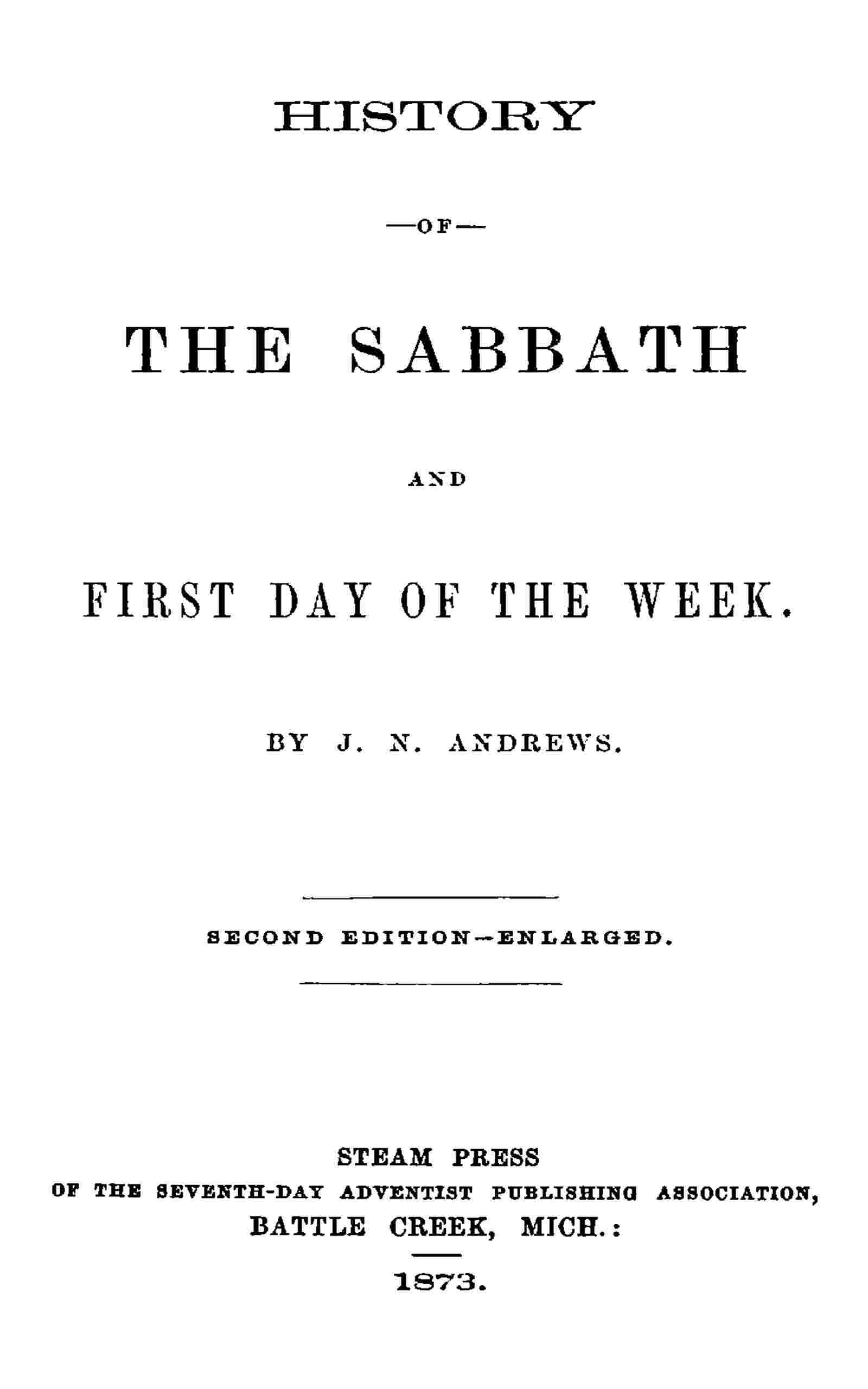
About This Book
The work surveys the origin and observance of the seventh-day Sabbath from the creation account through patriarchal, Mosaic, prophetic, and apostolic periods, presenting biblical evidence for continuous seventh-day practice. It then examines secular and early Christian writings to trace how first-day observance emerged, evaluating claims that attribute that practice to the apostles and weighing primary-source testimony. The narrative follows developments in the early church, the medieval era, and the Reformation, and concludes with discussion of later English and American defenders of seventh-day observance, contrasting documentary record with contested traditions.