
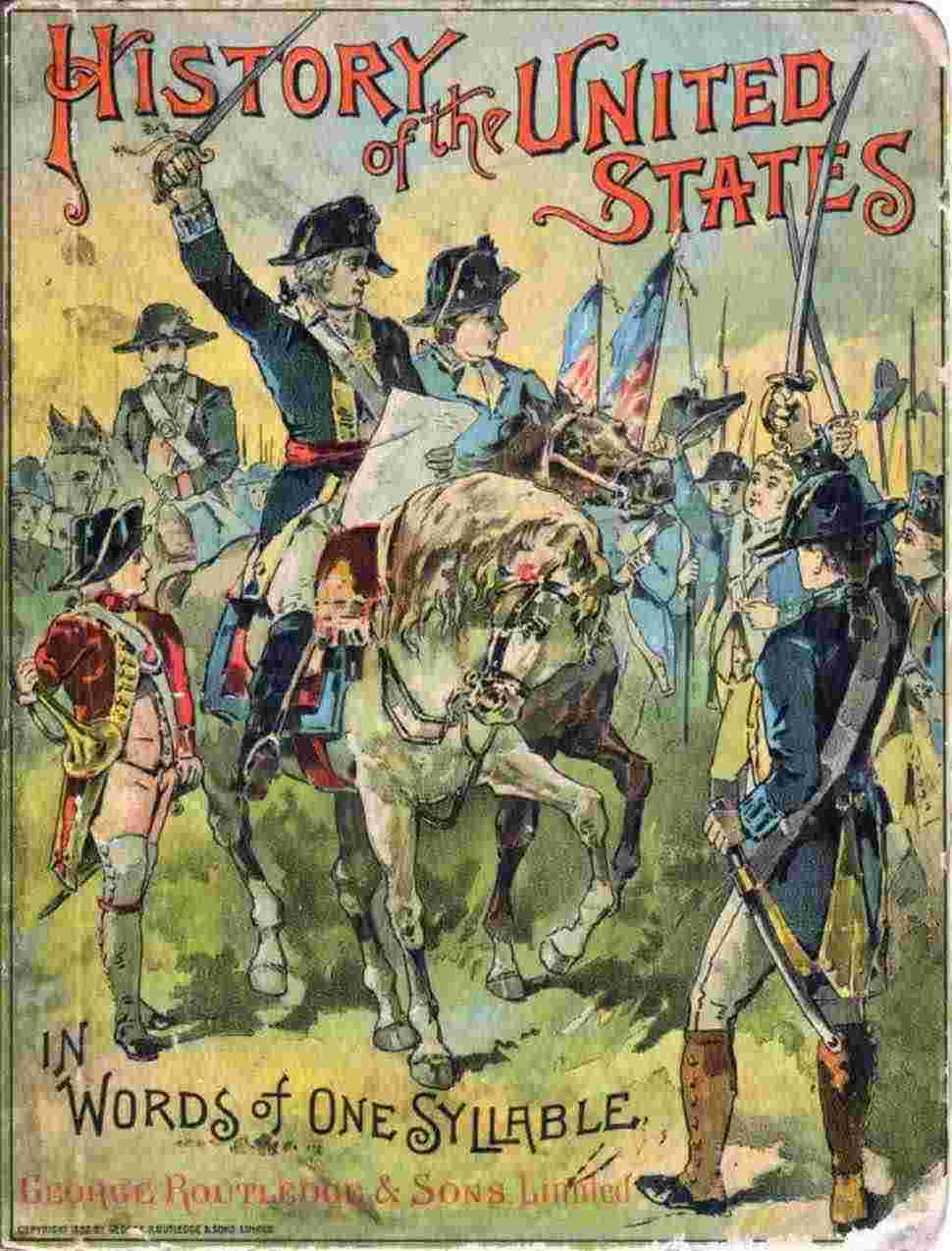
History of the United States.
CHAPTER I.
HOW THIS LAND WAS FOUND.
IN-DI-ANS HUNTING IN THE SNOW.
For a long time, in past years, it was not known that the world was round. If the men in those days had been told that a ship could start from a port and sail straight on for months and come round to the same place, it would have made them laugh as at a good joke. They did not know the real shape of the earth, but thought it was a flat plane.
In those days our land was the home of the In-di-ans, or red men, as we call them, from their dark skins. The red man does not live in a house, but in a sort of tent or hut. The tribes of red men had all this land for their own when Co-lum-bus was born. The great woods, the green plains, the bright streams, were all theirs. They made their wars in a strange and fierce style, and wore at their belts locks of hair, cut from the heads of those slain by their hands. These locks, cut from the head with part of the skin, they call a scalp. It was the pride of an In-di-an to have scalps hung at his belt. No one had taught him that this was wrong, and he did not have the Word of God to show him the right way.
When Co-lum-bus was a mere boy he was fond of the sea and ships. He would go and watch the waves, and think about how ships were made, and the best way to sail them. He was born in Gen-oa, which is by the blue sea; so when he was a small boy he could watch the white sails come in. Such queer ships they had there, with strange high prows! As time went on, and he grew of age, he made trips in these ships, and was in sea-fights, and once or twice he was in a wreck. So you see he had a chance to grow strong and brave for the work he had to do.
What he read in books taught him that the world was round, and not flat, as was thought in those times. So he knew that if he could sail west he would come to a new land. He thought of this a long time, and at last he grew more sure of it, but he could get no one else to think as he did. He spent ten years in this way. He was full of plans; but he could get no help and no gold. He was too poor to do all with no aid from his friends. At last he went to Spain.
There were a King and Queen there who were kind to Co-lum-bus; but at first they would not give their gold to help him. They thought this was a wild dream. At last, with a sad heart, he made up his mind to turn his back on the court of Spain.
While on his way, a man came to him from Queen Is-a-bel-la. She had sent him word that she would help him; "that she would pledge her own gems to give him aid." But she did not have to do this, as means were found when Co-lum-bus went back to the court. His heart was made glad; for they gave him a small fleet of three ships, and on the 3d of August, 1492, the sun rose on the fleet as it went forth on its way to the new land. All was strange to the new crew, and they had all sorts of queer thoughts and fears of the sea. They had not been out of sight of land in all their lives; and when they saw the deep, dark sea on all sides, they were full of fear that they would not see their homes again. The trade-wind which took them west so fast, would keep them, they thought, from their land when they had the wish to go back. At last they grew so full of fear, they swore they would not go on, and Co-lum-bus had hard work to make them. But soon there were signs of land, and some land birds flew by the ship; and one of the crew found a branch of a tree on the waves, which had some fresh red fruit on it.
Oh, how glad they were! Co-lum-bus felt so sure that he was near land, he gave word for the ships to lie by that night. No man thought of sleep. They all kept watch on deck to see this strange new coast for which they had borne so much.
In the night a cry of joy was heard. Co-lum-bus had seen a light far off, and a shout of "Land! land!" soon came from all sides.
When the sun rose they all saw a green strip of shore some five miles long. The men fell at the feet of Co-lum-bus and shed tears of joy. Then they sang a hymn of praise to God, who had kept them and brought them safe and sound to this new place. They got out the small boats and put men and arms in them, with flags, and a band to play a march of joy, and the crews made their way to the shore. Co-lum-bus, in a rich dress with his drawn sword in his hand, sprang on the beach, and then the crew came next. They set up a cross, and all knelt at its foot and gave thanks for their safe trip. Then Co-lum-bus set up the flag of Cas-tile and Le-on, and took the new land for the crown of Spain.
While they stood there with shouts of joy and songs, some strange dark shapes stole up with soft steps to their side. The crew thought these men must have come from a new world, as they saw their dark skins and the gay paint and plumes they wore. Co-lum-bus gave them the name of In-di-ans, for he thought the new coast was part of In-dia. He did not know that he had found a new land. These men with red skins were glad to kiss the feet of the Span-iards, and change their gold chains and rude rings for the beads and pins the crew gave to them.
Co-lum-bus spent some time in the new land he had found, and then he set sail for home to take his friends and the Queen the great news. A wild storm came on the way home, and Co-lum-bus thought that all was lost, so he wrote his tale on a cake of wax and put the cake in a cask and threw it in the sea; so that if he had gone down in the storm, all that he had found would not be lost to the world.
But God took care of Co-lum-bus and his crew. They got back to their homes once more and had a grand time. The King and Queen gave them a new and fine fleet; and in time they came back and saw new points of land on which to build homes, and they found, too, South A-mer-i-ca.
There were some in Spain who did not like Co-lum-bus, for he had won gold and fame, while they had none. So they told false tales of him; and when his friend, Queen Is-a-bel-la, died, he was once brought back from the land he had found in chains. How sad that was!—was it not? At last he had to die old and poor, and this land did not have his name. It had no name for some time; but at last an I-tal-ian, who made a few trips there, and wrote of what he saw, gave his name to the new world. His name was A-mer-i-cus Ves-pu-ci-us. That is a hard name for you to say, but you can all say A-mer-i-ca, and that is the name of our land.
CHAPTER II.
THE NEW WORLD.
When the news of this land of gold spread over the world, Eng-land and France and Spain all sent ships to see what they could find. They each thought they would like to have a slice. The Eng-lish thought they had some rights, as one of their men, named Ca-bot, had, in truth, been the first to touch this new shore. The next time he came, he made his way down the coast to what we call Vir-gin-ia, and set up a claim for Eng-land.
Then the King of France sent a man to plant his flag here, and he gave the name of New France to part of our coast. But though Eng-land and France both set claim to the land, they did not send men here to live for a long time.
At last Queen E-liz-a-beth gave one of the great men at court, called Sir Wal-ter Ral-eigh, a claim to a large tract of land in A-mer-i-ca. He came with two ships, and found the red skins kind. They brought him gifts, and he went back to tell of all the strange things he had seen, and some came to live on the new shores. But the red skins were hard to live with, and the small group of white men could get no food, and were near death, when a brave man, named Sir Fran-cis Drake, came with a ship and took them off to their homes. The next band that came met a sad fate, for they all fell by the hand of the red men.
There were some in Eng-land who had a great wish to see this new world. They thought they would like to live in a land with no King, and have a church where they could pray to God in their own way. They were called "Pil-grims," for they went from place to place and would sing psalms and pray, and they were full of joy at the thought of their new home.
Do you know the name of the ship they came in? It is a sweet name, and you must keep it in your mind—The May-flow-er. They did not have a smooth trip, and a storm blew them on to the coast of Mass-a-chu-setts. It was bare and cold, but it was nice to see land at all. There were all sorts of fowl there, and they saw a whale; but when they went to shoot it the gun burst. They made their way to a vale where there was a spring, and there they took their first drink in the new land.
IN-DI-AN FLINT-HEADED ARROW.
There was a rock called Plym-outh Rock, and here they made their homes and built the first house. It was in 1620, in a cold time of the year, that the May-flow-er brought her crew to Plym-outh Rock. There was not much food, and they had from the first a foe whom they could not trust or make a friend. These were a new race of men. They had brown skins; were tall and straight, with long, coarse black hair. They had no books, and got their food in the hunt, or caught fish in the streams. They made boats of birch bark—queer, long things, with a point at each end. They could make bows, and would pound their corn with two stones for their bread. They took the skins of beasts for their clothes, for they knew how to dress them. Each tribe had its head man, called a chief, and their great joy was in war. When their foes took them, they would not pray for their lives. They were brave in their own way, and would show no fear at the sight of the fire that was to burn their flesh.
Their wives, the squaws, would dress the food and do all the hard work at home. They were the ones who dug each small patch of ground and put in the beans and corn. The men had a scorn for work. They were made to fight, they thought. They would say, "The Great Chief gave the white man a plow and the red man a bow, and sent them in the world to gain food, each in his own way."
In this new land there was not a horse, cow, sheep, cat, dog, or hen to be found. You would not like such a place, would you? What did the young people do for pets in those days? No chicks to feed, no puss with her soft, warm fur, for small hands to stroke.
But the new homes were not left in peace. The red men saw that their doom was near. They felt that they would have to move on and on, to give place to these men who knew so much; who read books and had schools, and taught their young ones to pray. So they took the guns that they had bought from the white men and went to war with them. When they took them they would tie them fast to stakes, burn them to death, and all the time the flames were at work, these fierce red men would dance a war dance of joy. They bought rum from the white men, and it made them like brutes.
They knew that the white men had come to take their land, and that was cause for their hate. And so the white men, in their turn, felt no love for the red skin, and thought they did well to push him back more and more, and take all they could from him. The white men were to blame, for they first gave the vile rum to the red men, and that made them wild. They would burn down the white man's house at night, and kill his wife and babes. Think how sad it must be to wake up in the night and find the hot blaze of a fire in your face, and the wild war-whoop of an In-di-an in your ears. But you can lie down in your bed in peace, for there is no one to harm you—you live in good times.
But those who were brave enough to come and live in this new land, had a hard life at first. There were no snug farms as now, with fields of green corn and wheat. At times the poor men could not get much to eat, and one wrote home: "The crumbs that fall from your meals would be sweet to me. When I can get a cup of meal and boil It with a pinch of salt, I give thanks as for a great feast. The In-di-ans at times bring corn and trade it for clothes or knives. One day they gave me a peck of corn for a small dog. It would be a strange thing to see a piece of roast beef or veal here."
PIL-GRIMS ON THEIR WAY TO CHURCH.
It will not seem strange, then, that, in such hard times, death came to these small bands and took some away. But those who were left kept up brave hearts, and would not go back to their old homes; and though all were so poor, there was not a case of theft in four years. They grew to like the land, and one said, "A sup of New Eng-land air is worth more than a draught of Old Eng-land ale."
For one of the first bands of men who came here, made their homes in a place to which they gave the name of New Eng-land, after their old home. As time went on each place grew to be a town, and soon had a church and a school of its own. If we had gone in one of those towns on the Lord's day, we would have seen some strange sights. As the clocks struck nine, there would come out a man who would beat a drum or blow a conch shell, or ring a bell to call all the folks to church. As we drew near to this church, we would have seen that it was built of logs, with a small flag to wave on it. There would be a fence of stakes round it, and a man with a gun on guard near it. Those who went in left all their guns in his care.
If you look at this church you will see that it has no glass panes like ours, but small and dull and thick ones set in lead. It is the style now to like that old thick glass, and to use it once more. You might see on the front of this church, near the door, the heads of wolves that had been slain in the hunt in the past year.
In this church the old men sat on one side, and the young men were not with them. They had their own place. So, too, the boys did not sit by the girls. Most of the boys sat on the stairs, and there was a man there as a sort of guard to see that they did not talk. He had a long rod or wand in his hand, with a hare's foot on one end, and a hare's tail on the other. He would let no one go to sleep. If he saw a girl nod, he would touch her on the face with the soft brush of the hare's tail; but if it were a boy who was caught in a nap, he got a sharp rap from the hare's foot. So you see in those times one could not make such a snug nest in the pew and take a long sleep as one does now; and they had to stay three or four hours in church. It must have been hard for small folks not to nod at times.
When they sung, it was out of a book by the name of "The Bay Psalm Book," and they did not know more than ten tunes. In those days no one could stay from church but for a good cause, or else they had to pay a fine. And if a man staid from church a month, he was put in the stocks, or in a cage of wood, where all could see him and laugh and jeer at him.
You do not know what stocks are in these times, but if you had stood in a New Eng-land town then, you would have seen a strange thing made of wood, by the road near the church. This queer frame of wood would hold a man fast so that he could not move, and you may think a day in the stocks would be hard to bear, and would make one's bones ache.
A house in such a town, in those days, was all built on the ground floor; so there were no stairs. It was made of earth or logs, and had a steep roof of thatch. The place for the fire was built of rough stones. It was large enough to burn logs four feet long, and had so much room in it that a man and his wife and boys and girls could sit in it and look up at the sky.
The dress in those days was not the same as it is now. The men wore small clothes, which came to the knee like a small boy's in these times, and they had stiff ruffs round their necks and caps of rich stuff on their heads. The young men wore fine belts, and great high boots which were made with a roll at the top. The girls wore silk hoods in the streets, and stiff rich gowns, with long waists, and lace caps on feast-days. But folks could not wear gay clothes if the law did not think they had means to spend for such fine things.
They had some queer laws in those days. Those who had done wrong had to stand in the stocks, which held them by the feet and neck, so they could not get away, or they had to mount stools in church. If a man had a wife who had the name of a bad scold, a cleft stick was put on her tongue, or she was made to take a cold dip in a stream. I dare say you think those were hard laws, and you are glad to live in these days. But that was a race who had the fear of God in their hearts; their aim was to do just right and to rule the land in the best way.
CHAPTER III.
THE RED MEN AND THEIR WARS.
At first, before they had time to plant the fields, the men could but hunt and fish for food; but as years went by, they had farms, and made glass and things for trade; they wove cloth of wool, and some from a plant that grows in the south, of which you may know the name. It is white and soft.
They had not much coin, and so they had to do the best they could with skins and corn, or what they could get for trade. The first mint to make coin was set up in Mass-a-chu-setts in 1652. This coin had a pine tree on one side, and the name of the State. One side had a date and N. E. for New Eng-land. All this coin was known as "pine-tree coin." In time the land at Plym-outh Bay and those near took one name, "Mass-a-chu-setts."
In the meanwhile the small band who had made homes in Vir-gin-ia had come to grief. They had been men of good birth in their own land, and did not know much of hard work. They had come in search of wealth. Great tales had been told of the gold here. It had been said one could pick up great lumps of gold, as large as a hen's egg, in the streams. They found that all this was not true, and that a man had to work hard to live. They grew sick, and death came in their midst to make things more sad; so that they lost more than half of their small band.
BUILD-ING IN VIR-GIN-IA.
JOHN SMITH.
One man, John Smith by name, did great things for them. He had been brave from his birth. He had been in wars oft, and once he built him a lodge of boughs in a forest and took his books with him, that he might learn the art of war. Once he went to fight the Turks. He is said to have been sold as a slave. It may be all these tales are not true; but it is true he taught his own friends in Vir-gin-ia how to live. He got them to build a fort and log huts for the cold times. He made friends as far as he could of the In-di-ans, so that he could get boat loads of food from them. He said that "he who would not work might not eat;" so no man could be a drone in the hive. Each one must learn to swing the axe in the woods or to hunt and to fish.
Once the In-di-ans took him and they told him that he must die. Their great chief Pow-ha-tan had said the word; so his head was laid upon a stone, and a huge war club raised to strike the blow. But a young girl was seen to spring to his side, throw her arms round his neck, and pray that he might be set free. She was the pet of the tribe, for she was the child of their chief; and so Cap-tain Smith was set free. You may be sure he was full of thanks to his kind young friend, and it is said she might have been seen on her way to James-town more than once, as time went on, with small stores of corn for the white men. And when she grew up a white man made her his wife.
TO-BAC-CO PLANT.
But at last a bad wound made Cap-tain Smith go back to Eng-land, and things grew worse and worse in Vir-gin-ia. Food was more and more scarce, and a sad time came, which was long known as "Starving Time." It was in 1609. At last they all made up their minds to go back to their old home. None shed a tear as the sun rose on that day; they had known bad times in the new land, and did not grieve to go. But as their ship made its way down the bay, they met Lord Del-a-ware, with a great stock of food, and new men to swell the ranks. So they were glad to turn back and try the place once more; and in the course of time they throve and built and spread, and that part of the land made a new State, which we know as Vir-gin-ia. In that State was first grown a weed which you have seen men smoke and chew.
The folks in Mass-a-chu-setts went by the name of "Pu-ri-tans." They had left their old home that they might pray to God in their own way, and they thought that their own way was the right one. When men came in their midst who did not think as they did, they were sent out of the place. There was a class called Quak-ers, or Friends, who were mild, and did all they could for peace; but they thought they had their rights as well as the rest, and might serve God in their own way. They did not believe in wars, and would not bear arms. They would not hire a man to preach for them; but when they met, each one spoke as he felt the thought come in his heart. They kept the laws, and did to all men as they wished them to do to them. They said "thee and thou" for "you," and "yea and nay" for "yes and no;" but this could hurt no one, and it seems strange to us that they were not let stay in the place. They had to fly for their lives, and four were put to death. In these days all men are free to serve God in their own way.
And in that time there was one man to raise his voice for the poor Quak-ers, and all who were like them. This man was Rog-er Will-iams. He held that the State had no right to say what men should think and feel. You may be sure those who were high in place did not like to hear that; so he had to fly from his home one cold day, and for a time he hid in the woods. But the In-di-ans gave him a home, and one chief made him a gift of a piece of land, which he called "Prov-i-dence," as it was to him like a gift from God. And so the State of Rhode Isl-and, where this town was built, was known as a place where thought was free. The Quak-ers were glad to find a home in that State, where they could dwell in peace.
IN-DI-ANS RID-ING.
In 1675, a war, known as King Phil-ip's war, broke out in Mass-a-chu-setts. King Phil-ip was an In-di-an chief who saw that the white man would soon own all the land, and he knew that meant death to his race. He made a plan to kill all the white men. The first blow fell on the Lord's day, as the folks were on their way home from church. The men flew to arms, and did not dare to lay them down when they were in the field at work, or at their homes. When they went to church they would stack them at the door.
King Phil-ip and his men made their camp in a great swamp, where it was hard for the white men to reach them. Here they laid up a store of food, and had great tribes of red men. They would not fight in the wide fields, but would skulk in nooks, and rush out and hold all the land in fear, for the foe would seem to be on all sides. At last they were made to leave their strong hold, and could find no place to hide. There was a fight, and the In-di-ans fell thick and fast. Phil-ip ran, but one of his own tribe, who had a grudge, shot him dead. He had done all he could for his own folk, but fell by the hand of one of them at last.
All this time the King of Eng-land was at the head of this land as well, and the men he sent were wont to rule things with a high hand. They would not grant what our men thought to be their rights. Dutch ships had come in to trade for furs with the In-di-ans. Some of the crews stayed here and made their homes in a place they called New Am-ster-dam. It is now known by the name of New York. These first Dutch men bought the land from the In-di-ans, and it was to go to their heirs through all time.
THE DUTCH AT NEW AM-STER-DAM.
A band of Swedes made their home in Del-a-ware. A Quak-er by the name of Will-iam Penn bought a grant of land from the King. He thought to make a home for all his sect, who had as hard a time in Eng-land as they did here. He sent a band of these men here, and the next year he came too. He met the In-di-ans by a great elm tree. He was a kind and good man, and would not take their land from them. He bought it and made them his friends. "We will live in love with Will-iam Penn and his heirs," said they, "as long as the sun and moon shall shine." And it is said that to this day a red man is loathe to shed Quak-er blood.
IN-DI-AN PIPES.
In 1683, Penn bought land from the Swedes and laid out a town, to which he gave the name of Phil-a-del-phia. It stood in the midst of a wood, and the wild deer ran by the men who came to take a look at their new home. When Penn came, he sent out a call for all the men to meet in one place, and there he met with them, and they laid out the code or kind of laws they were to have. This code was known as "The Great Law." No one could vote that did not believe in Christ; and all might pray to God in their own way. So you see the Quak-ers did not wish to force men to believe as they did. They felt that was not right or just.
Penn did all he could for his sect, and was mild and good to the red men. He said to them, "We meet on the broad path of good faith and good will. I will deal with you in love. We are one flesh and blood."
So our land grew, and State by State was laid out, and towns were built, and all this time the King of Eng-land was at the head of the whole. There were more In-di-an wars; for the red men gave the new folk no peace. They would come down from the depths of the woods of Can-a-da on their snow shoes, and drag men and their wives from their beds and scalp them and set their homes on fire. Many a child, too, had to fly with the rest in the cold night, with bare feet and few clothes on, to seek a place to hide from this fierce foe.
IN-DI-AN SNOW SHOE.
In 1754, a war broke out which we call the "French and In-di-an War." The Eng-lish had at this time a great strip of land on our coast which they held as their own. It was like a string to the great bow of French land, which went from Que-bec to New Or-leans. Both French and Eng-lish laid claim to part of the land; and those who had the wish to live in peace could not but look on in fear.
The French built three forts, and that made all feel that they meant to hold the land. A young man by the name of George Wash-ing-ton, was sent to ask that they should pull down these forts. You have heard of George Wash-ing-ton, I know. You have been told that he was "first in peace, first in war, and first in the hearts of all." You have, I am sure, heard the tale of the fruit tree that he cut, and how he could not tell a lie to save him. He was a boy then, and some one had made his heart glad with the gift of a small axe. What should a boy do with such a thing, if he could not cut with it? So George went round to try the sharp edge of his axe, and, as bad luck would have it, he came on a young fruit tree. It may be that the fruit was of a rare kind, and so when it was found that the bark of the tree had been cut in such a way that one could hope for no more fruit, the cry rang out on all sides, "Who has done this deed?"
Our small boy was not at peace in his own mind. He did not know in what shape the wrath might fall on him; but he came forth in a brave way and said, "I did it, Father, I can not tell a lie. I cut it." We are glad there has been one boy who could not tell a lie, and we hope there are some in our own times.
So this George Wash-ing-ton, then a young man, was sent to the French man who was at the head of the forts, to say that he must take them down at once. He had a hard time to get there, for it was cold, and the streams were big with the rains. The snow fell and froze as it fell. His horse gave out, and he had to go on foot. He had one man with him, and they struck out in to the woods. They had to cross a stream on a rude raft, and they were caught in the ice. It bore them on with great speed, and when Wash-ing-ton threw out his pole to check the speed, he fell in the stream. But he knew how to swim, and so he got to land. When day came, it grew still more cold, and the stream froze in such a way that he could walk on it to the place where he would be.
The men at the French forts would not say that they would give them up. In fact, they made boasts that they could hold them in spite of all, and so the war went on. The French would dart out and seize Eng-lish ships, and then the Eng-lish would march on the French, and do them all the harm they could. Wash-ing-ton fought on the side of the Eng-lish in this war. Once the In-di-ans laid in wait for them in the wood, and as the men were on the march with their flags and beat of drum, they heard the fierce war whoop on all sides. The Brit-ish troops did not know how to deal with such a foe; but our men sprang down and fought them in their own way.
One chief made a vow that he would kill Wash-ing-ton. Four balls were sent through his clothes. Twice his horse was shot. Gen-er-al Brad-dock, who was at the head of the Eng-lish troops, was shot and borne from the field to die. There was a great fright, and the men fled on all sides. Wash-ing-ton did what he could to save them from the foe, like a brave man. But the French went on and built more forts, and our men were at their wits' end to hold their own with foes on all sides.
There were six tribes of the red men who were their friends, and I would tell you their names if they were not too long and hard.
But you will find in the State of New York lakes and streams which bear the same names. We ought to bear them in mind, as they were of great use in those times. So it was thought best for all our men to meet in a town by the name of Al-ba-ny, to fix on a way to keep these six tribes our friends, and to join with them to fight the French. Al-ba-ny was then a small town with few in it; but it had a stone fort. Here our men met the chiefs and had a talk with them. The chiefs told our clan they were not so wise and brave as the French, or they would build forts like them.
But there was one wise man in our midst, Ben-ja-min Frank-lin. He had been a poor boy, so poor that when he went in to the great town of Phil-a-del-phia, he had but a few cents. But he knew how to print; and more than that he was fond of books, and so could learn all sorts of things. He brought with him a small print on which was shown a snake cut in parts. Each part had on it the name of one of the States. He said they must be made one or die, and that to be one was the way to be great. But our men did not see their way clear to do this yet. We know they made the States one in time.
The death of Gen-er-al Brad-dock was a great blow to their hopes. They saw that all the red-coats, as we call the Eng-lish, were not brave; but could run as fast as the rest. Still they took some forts, with long names, from the French in this war. They made a move on them at Que-bec, with Gen-er-al Wolfe at the head of our troops.
A DUTCH HOUSEHOLD IN NEW AM-STER-DAM, NOW NEW YORK.
Quebec was one of the strong forts of the world. At first Gen-er-al Wolfe lost at all points. But he found at last a way to go in boats. With no noise they made their way to land, and up a steep hill, and at dawn the French woke to see red-coats on all sides. Their Gen-er-al Mont-calm led them out of the fort to fight. If he had not, he might have won the day, for the fort was strong. But he chose to fight in the wide field, and so we won.
At the time of the fight, Gen-er-al Wolfe, who had been struck by a death shot, heard shouts of joy, "They fly—they fly!" "Who fly!" came from his white lips. "The French." "Then praise God, I die at peace," he said, with his last breath.
Gen-er-al Mont-calm, too, on the French side, had a wound, and was told he could not live. "I am glad of it," he said, "for then I shall not live to see my town yield to the foe." So you see they were two brave men who fell that day. In five days a peace was made with France; for she gave up most of the land to which she had laid claim.
But there were some of the red men who did not want this peace with the Eng-lish. They had seen the red-coats run away from them, and they thought they might now strike a blow for their own homes and land. The French made them think they would help them. "The King of France has but slept for a time," they said, "but he will soon wake up, and then he will drive the foe from the homes of the red men, and give them back their land."
IN-DI-AN CHIEF.
There was one brave chief, Pon-ti-ac, who heard all this with a glad heart. "I will live and die a French man," he said, and he sent men to each town to bear a belt with red or black beads on it, and a knife with a red stain on it; these meant war. The knife was of the kind with which they were wont to scalp the foe, and the red stain told that deeds of blood were at hand. When this belt and knife were kept, Pon-ti-ac knew that the chiefs there would join the war. Their first move was on a fort at De-troit.
IRON TOM-A-HAWK.
STONE TOM-A-HAWK.
This was Pon-ti-ac's plan. He would go some day to the fort with some men and ask leave to come in and show them a war dance. While some were in the dance, a few would stroll through the fort and see all that could be seen. Then they would go once more as if for a call, with arms hid in their clothes, and strike down the white men when they did not look for it. The first part of this plan went on all right; but one of the squaws, who was a friend to the head man of the fort, told him what the red men meant to do. So when Pon-ti-ac and his men went in the fort, each with his gun hid in his clothes, they found ranks of men with arms to meet them, and they were glad to get out with their lives.
But Pon-ti-ac would not give up, for he made more friends, and laid siege to De-troit in 1763. It was a long siege for the red man, but it held out, though food was scarce, and the men in it felt that they must soon starve. Pon-ti-ac at last had to make peace, and met his own death at the hands of a red man, who was mad with drink; and so the French and In-di-an war came to an end.
CHAPTER IV.
THE WAR THAT MADE US FREE.
For a time all were at peace; but at last a war broke out that took more time, and cost more men, than all the wars of the past. You have heard of it, it may be, by the name of the Rev-o-lu-tion.
There are some old men who fought in that war, who are alive this day. You see the cause of this war came out of what our men thought to be their wrongs. They thought the rule of Eng-land too hard, and that they should have their own men to rule them. They would have gone on as they were, if they had thought that Eng-land was just to them; but she put a tax on the things they had to use. She had a large debt to pay, and so she thought it fair our men should help to pay it; and our men held that they ought to have a voice as to what the tax should be, and fix what they knew to be right.
Do you know what a tax means? It meant, in this case, that when our men bought a thing, they had to pay a few cents more than its real price, and these few cents were to go to Eng-land. Of course these few cents from all sides grew to be a good sum, and was quite a help. Eng-land, at this time, made a law which we know by the name of the "Stamp Act." This law, which gave to Eng-land a tax on all deeds, was one great cause of the wrath of our men. One man made a speech on it that was put in print, and the boys in the schools spoke it. In all the States men took the same view; so that the Stamp Act may be said to have lit the fire which in time made such a blaze.
In all the States men stood up for what they thought their rights, and they made up their mind that they would not pay this tax on Eng-lish things, but would learn to make them of their own. Men and their wives took a vow that the fine clothes from their old home should not tempt them, but they would spin and weave, and wear what they made, though it might be poor and coarse. One brave dame wrote to her friends, "I hope there are none of us but would wrap up in the skins of sheep and goats to keep us warm, if we must else pay a tax which is not just on the goods of Eng-land."
The wrath at the Stamp Act grew more fierce each day, and the men who were sent to put it in force did not dare to do so. One was caught and made to say that he would give the thing up. He was made to fling up his hat and cry as they told him, three times, in words which meant that they were right and the King was wrong. No one was found so bold as to put the Stamp Act in force; and the news went to the King and set him in a great rage. Some of their own great men were on our side, and were glad we did not yield.
At last the King gave up the Stamp Act, but said he had a right to tax us as he chose. There was great joy here at the news that the Stamp Act was to be heard from no more. The bells were rung, and flags were flung out on the breeze, and all who were held for debt were made free. For a year there was no more heard of a tax; but then a new act came. This tax was made on tea and glass, and such things, which were in use all the time. This woke new wrath, and troops had to come out to keep the peace, which our men said they would not bear. The boys from the schools felt the wrong, and would call the "red-coats" in scorn by that name; and the young men made a vow that they would drive them from the town.
There were street fights each day; and the men were more and more set to have their rights. The folk wore the rough clothes which they spun and wove, and would not buy a yard of Eng-lish cloth. Then they sought to find some plant that they might use for tea, so that they would not have to buy tea and pay the tax on it. They must have had some queer drinks at that time. When the King found they were so set in their way, he gave up all but the tax on tea. Then he sent three large ship loads of it here, in the hope that our folk would want it so much when they saw it, that they would be glad to pay the tax.
But our men had made up their minds that this tea should not land. So when the tea ships came in, a guard was set on them by our men as they lay at the wharf, so that the tea should not be brought to shore. A large crowd of men met in a Hall in Bos-ton, to say what should be done with the tea; and at last they gave out, that if the tea were sent back where it came from, all would be well. But the head man, who was sent here to rule us by the King, would not do this, and said so. When this was told to the crowd, a war-whoop was heard at the porch, and some men in the dress of In-di-ans made a rush down to the wharf, and went on board of the three tea ships, and cast all the chests of tea in the bay. Then they went home in peace and did no one harm. This was the "Bos-ton Tea Par-ty," and is so known at this day.
At New York and Bos-ton they did not try to land the tea when they heard of this, but took it back. At one time the tea was set on fire. All this made our men more and more set on their own way; and the King grew in a rage with them. He made some strong laws, sent troops to Bos-ton, and put in force a bill called a Port Bill, which would not let a boat go in or out the port, save that it brought food or wood. One of their own men stood up and said this was a "bill to make us slaves." And the wood and food had to be brought in a new route, and not straight in the bay. Not a stick of wood or a pound of flour could be brought in a row boat, or straight in from a near point; it must all go round to the place where the Eng-lish saw fit, where they could stop it and see just what was there.
Of course this was hard for the good folk of Bos-ton, and they did not bear their wrongs in peace. They had gifts sent them by land—of grain and salt fish and sheep. From the South came flour and rice, and some times gold for the poor. So that the Port Bill made all feel to them like friends, for all towns took up the cause of Bos-ton as their own.
This was just what the wise men at the court of King George had said would be the case. They knew it would make our folk more strong to drive them with hard laws to fight. And so it came to pass, as the two great men, Burke and Fox, had said, King George was set in his way, and would not change, but did his best to push the laws through. The Bos-ton Port Bill was one of the things that made the States one. For they had but one mind on these harsh laws, and stood as one man for the right. The day when this Port Bill was first put in force, the Town Hall in one of the towns was hung with black, as for a death; the Bill was on it, and the toll of bells was heard all day.
If we could have stood in Bos-ton in those days, we would have seen that there was not much work, and no ships at the wharves but those of Eng-land. There were guns in view, and men with red-coats in the streets. There were tents on the green, and clubs that met each night, to talk of this strange turn in things, and what was best to do. They did not want war, but saw no way to get out of it. Great men spoke of it here and there, and each speech was read at the clubs.
"We must fight," grew to be the cry. But there were some, of course, who felt sad at all this, who thought it wrong not to do the will of the King in all things. They said this land would come to grief, for we were the ones who had the most to lose by war. These men had the name of "To-ries," and the rest did not look on them as friends, but held them as foes. Some of these men went back to their old homes, and came here in the troops of the King to fight their old friends. Some stayed and came round to new views, and took part in the wars that came to pass in time. All knew that the ranks of the King would be made of men who had fought in wars, and were known to be brave; while on our side they would be raw men, who did not know the art of war. But still our men were brave, and they said, with strong hearts, "The strife may be long, but the end is sure. We will fight for our homes, for our lands, for the right. We will be free!"
CHAPTER V.
THREE GREAT FIGHTS.
In each town, at this time, men thought but of war, and how to train for it; so that in case of need each one could spring to arms at once. Guns were put in a safe place, and stores of food were bought. The Brit-ish in their turn kept watch on all, and more troops were brought in.
Our men made a plan, that when it should be known that a large force of the Brit-ish were to move out of Bos-ton at night, a light should be hung out of the North Church by way of a sign. One night the watch by the Charles saw the light gleam high on the church, and they knew some move was on hand. At once all was stir and noise. Men rode here and there to find out what it meant. One went in a boat, and then took a fleet horse to seek out two of the wise and great men, and see what was best to do. The man who took this ride, and went from house to house with a call to those who slept, was Paul Re-vere. There is a song this day on that ride.
You may be sure there was no more sleep in a house that night. When he rode by—"Do not make so much noise," said one on guard.
"Noise," said Paul Re-vere, "there will be noise ere long; the foe is on us!"
All this time the Eng-lish troops had made a swift, still march. They thought no one had seen or known their move; but all at once the bells in each church rang out a wild peal. In each town the church bell sent a call to each home. So it was plain that all was known. Paul Re-vere and the scouts had done the work well. The Brit-ish sent back for more troops. They came, and they were told to hold the bridge at Con-cord. But when Ma-jor Pit-cairn, who was at the head of the Brit-ish, came to Lex-ing-ton at dawn, he found a great crowd of men with arms.
"What do ye here?" he said, in wrath, "go to your homes! Why don't ye lay down your arms?" But as they made no move to go, his troops sent forth a fire on them, which they gave back with a will. Eight of our men got their death wounds that day, and this was the first blood shed in the war.
The Brit-ish then gave three cheers and set out on a march to Con-cord. The people of that town made haste to move their stores of food and arms to a safe place in the woods. Their scouts took the North bridge, and could see that the Brit-ish were in the streets of the town; that they had set the court house on fire, and cut down the pole, and laid waste the stores they found. So the men on the bridge made up their minds they would try to drive this foe out. There were but few of them, but they had strong hearts.
One of their head men said, "I have not a man who fears to go." He was the first who was shot, and fell dead. Still they went on and made a brave fire, so that the Brit-ish set out to run. But they could not go back as they came; for by this time our men for miles round, came in on all sides. Some were in their shirt sleeves, they had come in such haste; but each one had a gun in his hand, and took his place back of a tree or stone wall, where he could get good aim. One of the Brit-ish wrote home that the men came so fast, they would seem to drop from the sky.
At each step the Brit-ish troops took, a shot would come from some side, and a man would fall dead. At last such a fear came on our foe, that they broke into a run. They did not know what to do. They had no more shot, and could not give back the fire. One of them wrote, "They had to lie down for rest on the ground, and their tongues hung out of their mouths like dogs spent by the chase." All the way to Bos-ton they felt the fire of our men, and they were glad to get back to their great ships, the men of war, and rest where they could be safe. They had lost three times more men than the A-mer-i-cans.
There was a great stir in the court of the King when the news was brought that their troops had run from a hand full of raw men, who had no skill in the art of war. Poor Lord Per-cy, who had been at the head of the Eng-lish, came in for hard names, though he was a brave man. They were mad, and had to give vent to their wrath on some one. In A-mer-i-ca it was felt that this was the first blow struck; and Sam-u-el Ad-ams, when he heard the news at Lex-ing-ton, said, "Oh, what a grand day this is!" for he knew this strife would not end till all the States were free.
There were some hills near Bos-ton, and our men knew that there was a plan to gain them, and make a place for Eng-lish troops on them. You see, if the foe had such high ground, they could have a grand chance to fire down on those in the town. So our men stole out by night and threw up earth works, and took all the troops they could get from all parts, and put them in charge there. In the mean while they sent their wives and young ones out of the town, so that none but Brit-ish troop were left there. They made no noise in their march that night; no one heard them, and the bells in the church struck twelve ere they dug a sod. But they were soon at work, and could hear the guard on the man-of-war cry out each hour, "All's well."
When the day came, and the sun rose, the earth works were seen from the ships, and at once they sent out a fire on them. So in Bos-ton the troops woke to see the true state of things, and were not slow to do their best. But our men went on with their work, spite of the shots. One of the foe had a glass through which he could see each move of our men round the works. "Will they fight?" said he. "To the last drop of their blood," said one who stood near.
So they made up their minds to lose no time, but to make a raid on the works that day. It was a hot day in June. Part of our men stood by a rail fence, on the edge of a hill, by the name of Bun-ker Hill; part were back of the mounds which were but half made. Then the rail fence was made to screen the men back of it, by a lot of new mown hay, put in to fill up the gaps.