
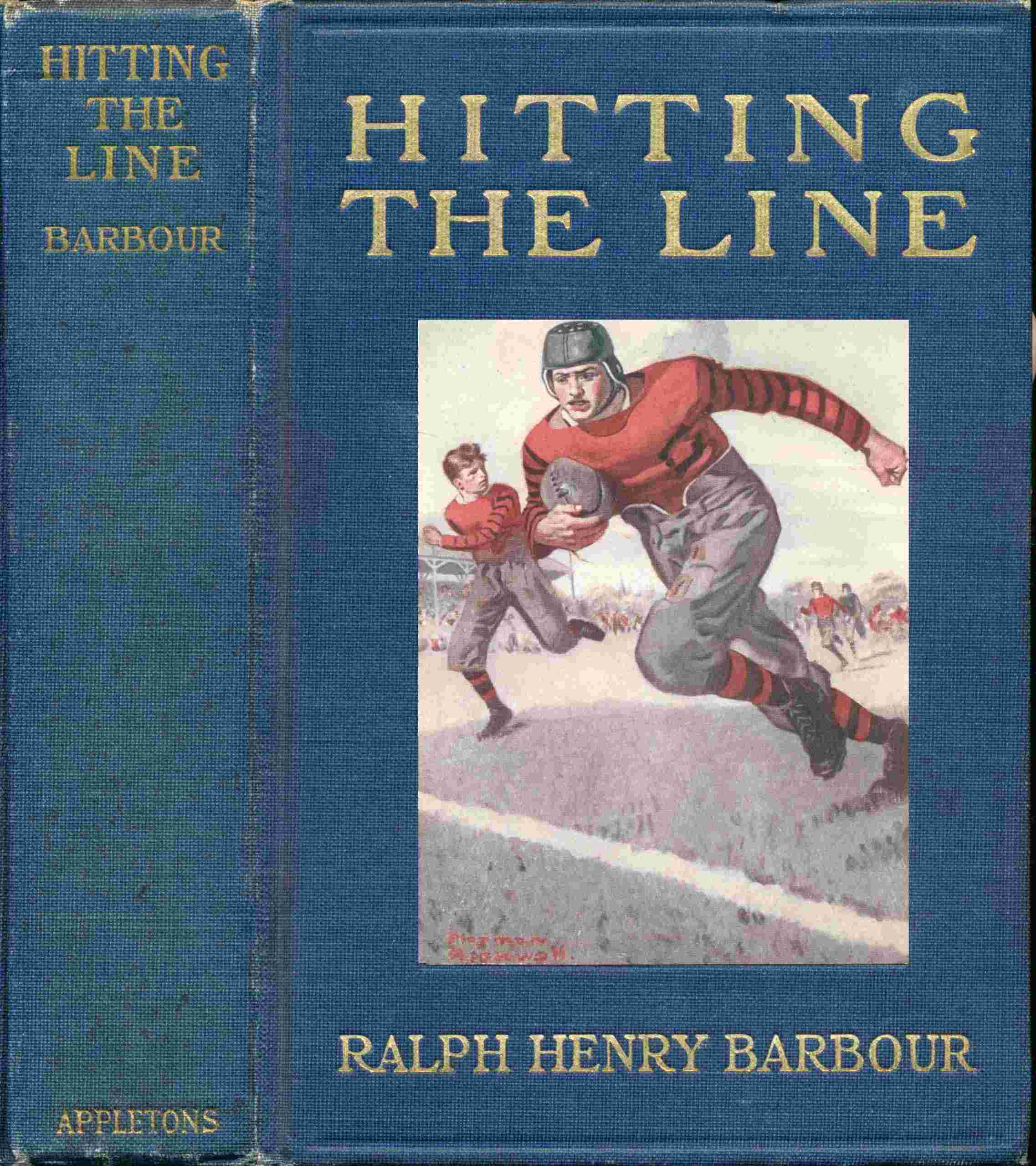
The next day Monty appeared, appropriately clad, on the football field at a few minutes before three-thirty, and gazed inquiringly around. Most, if not all, of the candidates were on hand, and the rest were dribbling along the path from the direction of the field house. Mr. Bonner, however, was not in sight, nor was Pete Gowen, and Monty wondered whether he was supposed to simply stroll out and join the nearest squad or to report to someone and get instructions. He decided to make inquiries as to the usual methods pursued in such cases, and walked up to a youth of eighteen or thereabouts, who, dressed in football togs that had apparently never been worn before, presented an immaculate and almost unapproachable appearance. He was a tall, finely-built, and very good-looking youth, but his good looks were somewhat marred by an air and expression of arrogance.
“Say, partner,” observed Monty, “I want to get into this. What do I do?”
Starling Meyer turned slowly and viewed the questioner with languid surprise and contempt, or so it seemed to Monty. Meyer’s eyebrows went up and a flicker of amusement showed in his eyes as his gaze traveled deliberately from Monty’s head to the tips of his scuffed shoes and back again. Finally: “Really,” he replied, “I don’t care what you do. But I’d suggest that you have your hair cut.”
Monty’s eyes narrowed a trifle, but he only smiled pleasantly. “You don’t understand,” he said gently. “What I wanted to know was about getting on the football team. You see, I’ve decided to play, and I don’t know whether I ought to tell the captain about it or—or what. And you looked as if you might be the coach or something.”
Meyer frowned suspiciously, but the other boy’s smile was so innocent and placating that the frown vanished, and the look of amusement deepened. Meyer even chuckled a bit. “Oh, so you’ve decided to play football, have you?” he asked. “That’s fine, isn’t it? What position have you selected?”
“I think I’d like to be one of the fellows who take the ball and run with it,” responded Monty almost shyly. “You call them halfbacks, don’t you? I can run pretty fast, I can. But Alvin Standart, who’s my roommate, says that maybe they won’t use more than two halfbacks this year, and if they don’t, I wouldn’t get to be one, because they’ve got two already. Do you know if they’re going to have more than two?”
“Three or four, I understand,” answered Meyer gravely. “If I were you I’d see Mr. Bonner, the coach, and tell him I had decided to be third halfback. Better do it before some other fellow asks for the place. He’s coming now. Better get right at it.”
“I will,” declared Monty brightly. “And I’m ever so much obliged to you. Are you one of the players?”
Meyer nodded. “I’m right and left guard,” he replied. “By the way, what’s your name?”
“Crail. What is yours, please?”
“Heffelfinger. If you like, you may use my name to the coach. Just tell him Heffelfinger, Walter Heffelfinger sent you.”
“Oh, thank you! I—I think I’ve heard of you. I guess everyone has! You’re sure you don’t mind if I just say that you—you——”
“Not a bit.” Meyer waved a hand courteously. “Go as far as you like, Crail. Remember now; third halfback is what you’re after.”
“Third halfback, yes. Or maybe fourth, if someone has chosen to be third? Anyway, I’ll ask to be third first. Thank you so much, Harold.”
“No, not Harold; Walter; Walter Heffelfinger. Good-by, and don’t take any wooden money.”
Monty showed clearly that the latter advice puzzled him, but he nodded gratefully, and turned away. Meyer chuckled as he watched the other’s progress along the line in the direction of Coach Bonner. Then something in the boy’s swinging stride, or, perhaps, something in the capable poise of the head, brought suspicion back again, and the chuckle died away in his throat.
“I wonder if he—” But he didn’t go any further. Instead, he shook his head impatiently, banishing the unwelcome suspicion, and watched Monty approach the coach, speak to him, shake hands and engage in conversation for a minute before Mr. Bonner, pointing into the field, dispatched the new candidate to join one of the squads. Starling Meyer smiled. He wished he could have heard that conversation.
A half-hour later, when the squads had been cleared from the gridiron, and a first and second eleven were trotting out for the initial scrimmage of the year, Meyer, consigned with many others to a rôle of watchful waiting, approached Mr. Bonner, who was at the moment alone, near the side line. “Did that new fellow get the position he wanted, Mr. Bonner?” he asked with a chuckle.
The coach turned. “Hello, Meyer. What was it you asked?” Meyer repeated the question, and the coach looked puzzled. “What fellow was that?” he asked.
“Crail, or some such name. He wanted to be third or fourth halfback. Asked me if you were going to use more than two this year. I told him he had better see you before some other fellow got ahead of him,” laughed Meyer.
The coach frowned, and shrugged his shoulders. “The only Crail I know of is a candidate for guard. I’m afraid,” he added, as he turned away, “someone’s been stringing you, Meyer.”
And Meyer, his self-conceit horribly jolted, was afraid so, too!
Nothing especially notable occurred that afternoon, either to the new guard candidate or to anyone else. A tentative first squad went through two ten-minute periods against an equally tentative second, and neither scored. Substitutions were frequent, but neither Monty nor Meyer left the bench again until the practice was over. Monty had given his name and other particulars to a youth named Burgess, the manager, and later on, in the field house, he had stepped on the scales and tipped up a hundred and forty-one pounds. A little Welshman who went by the name of Davy, and whose official capacity was still a mystery to Monty, informed him that he was several pounds over weight. Monty refused to argue the matter, although Davy had the aggressive look of one who would have liked an argument better than his supper! Subsequently, Monty discovered that Davy Richards was the trainer. And subsequently, too, he made the acquaintance of Mr. Sargent, the physical director, and of Mr. “Dinny” Crowley, his assistant. These gentlemen controlled the physical, and, in a way, moral welfare of the football candidates, while Coach Bonner confined himself wholly to implanting in them as much knowledge of the game as his ability to teach and their ability to learn made possible. Football at Grafton School was taken seriously, and pursued systematically and efficiently. Compared to the happy-go-lucky methods in vogue at Dunning Military Academy, the Grafton system impressed Monty immensely. The only feature of it that he couldn’t quite approve of was the apparent disposition to lose sight of the individual. As Monty put it to Leon on one occasion, they threw every fellow into the same pot and boiled them all together! But that criticism came later. During the first fortnight of his stay at Grafton Monty formulated no criticisms. He was, perhaps, too busy getting shaken down into his new existence.
In those two weeks his preconceived ideas of boarding school life were much altered. He had unconsciously expected to hang up his hat, say “Howdy,” and instantly take his place in the school world. Rather to his surprise, he had discovered that there was no place awaiting him, that if he wanted a place he would have to make it. As far as he could see, no one bothered the least bit about him, neither principal, faculty nor students. If he didn’t want to study there was no one to insist on his doing so. He merely flunked, and nothing happened. At least, nothing happened for a considerable while. Eventually, though, something did happen. He went on probation, and was given a ridiculously brief space of time in which to recover his standing. If he didn’t he packed his trunk and disappeared. Many fellows did just that during the year. That Monty wasn’t among them was mainly because he asked questions, and reasoned things out and had the sense to see that the broad and easy path of idleness led eventually to the gulf of disaster. Besides, he wanted to study, anyhow. He wanted to know things. He wanted especially to get out of the lower middle class into the upper middle, for Alvin Standart’s jeer still rankled. As to making a place for himself, well, Monty meant to do that, too, and was only wondering how to go about it. The end of that first fortnight found him wiser, somewhat disillusioned, and quite resolved to make good.
On the football field he was still an unknown candidate for a guard position, working hard when he was given the chance, and making no spectacular success of it. But he learned a good deal. At Grafton they were extremely particular about the little things. Details that were scarcely considered at Dunning were held here of great importance. Mr. Bonner seemed to have a perfect passion for drilling the candidates in the rudiments. Monty sometimes wondered how the fellows had the courage and perseverance necessary to survive that first three weeks. For that matter, some of them didn’t. The eternal grind killed their ambitions, and they disappeared. Usually such defections passed unmourned, for it was the coach’s belief that those who couldn’t survive the grind and hard labor of that preliminary season were not of the quality he wanted. Gradually the number of candidates dwindled from some sixty-odd to around fifty, and this in spite of the fact that a call for more candidates had brought out a handful of late arrivals. The first cut in the squad came ten days after the beginning of the school year, and reduced the total to about forty. Monty survived that cut, but he had fears of the next, for it seemed to him that there was no place for his services. For the two guard positions there were to his certain knowledge six candidates besides himself, and each of the six were fellows who had played last year on either the first or second teams. Kinley and Gowen were the first-choice men, with Hersum, Bowen, Little and Williams struggling hard for substitute positions. Monty couldn’t see where he came in, and he began to consider his chances of finding a place on the second team which was due to be chosen in another week.
Grafton played her first game the second Saturday of the term, and defeated the Grafton High School eleven with no difficulty by the score of 21 to 0. The Scarlet and Gray played pretty raggedly, in spite of a team composed very largely of experienced players, and the four ten-minute periods provided scant interest for the audience. Leon declared that it was a sin to adjourn the tennis tournament for such a silly proceeding, and Jimmy Logan agreed with him. The tournament was three days old, and had reached the semi-final stage, and Leon was among the survivors. He had won two matches, one by default, and was looked on as certain to fight it out with the present champion in the last round. Jimmy, entered in the doubles with Brooks, had pulled out a victory that morning, and was due to play again Monday afternoon. But Jimmy had no expectation of surviving the next match. Jimmy’s particular chum, Dud Baker, had met his Waterloo in the first encounter, and was now rooting hard for Leon to come through.
Jimmy and Dud had taken Leon up with enthusiasm. Jimmy had fallen victim to Leon’s skill in that first game of tennis, and Jimmy had a worshipful admiration for anyone who could play good tennis. Later Jimmy suspected that Leon had purposely let him down easy on that occasion, since in subsequent encounters Leon had, to use Jimmy’s expressive description, “simply wiped up the blooming court with him.” Within a few days Jimmy and Dud and Leon and Monty had established a four-cornered friendship that bade fair to last, unless, as sometimes seemed possible, they fell out over the question of school societies. Jimmy was a member of the Literary and Dud of the Forum, and each sought to get Monty and Leon pledged for his own favorite. There were some rare arguments in Number 14 Lothrop, with Monty and Leon playing the rôle of audience. When discussion waxed too warm it was Monty’s way to announce that, for his part, when it became necessary to decide between the merits of the two societies he meant to toss up a coin! In the end, which wasn’t until the next term, the matter was settled in quite another fashion, but that doesn’t enter into this story.
Leeds High School was defeated, 39 to 0, the next Saturday, by which time Grafton had found herself to some extent. Monty got into that game for a very few moments toward the end, and perhaps because by that time the Leeds line was largely a substitute affair, did well enough at left guard. Both the Grafton High and Leeds High contests were looked on as merely practice games, and the first real encounter was that with St. Philip’s School, a week later. In preparation for that event, the first squad was started in on the development of an attack and Mr. Crowley rounded up his second team and began to put it through its paces. Rather to his surprise, Monty was neither drafted to the second nor banished from the first, but continued to adorn the bench during the scrimmages, sometimes being called on to substitute at one side or the other of Ned Musgrave or Brewster Longley, first and second choice centers. In those days the haughty Starling Meyer, or Star, as he was generally called, usually kept him company. Star, however, treated Monty with silent contempt, something that bothered Monty not at all. Star was trying for a back field position and was said to have designs on Ordway’s job at right half. Sometimes Monty surprised Star looking at him with a puzzled expression as though wondering where innocence left off and guile began. On such occasions Monty always smiled expansively and Star removed his gaze with much dignity.
But before the Leeds game arrived Leon had won honor and renown by capturing the Fall Tennis Tournament with ease. In the final match he won from Ainsworth, holder of the title, 6–1 6–3, 5–7, 6–4, and had shown a brand of tennis that was nothing short of a revelation at Grafton. That Leon would succeed to the Tennis Team captaincy in the spring was a foregone conclusion. The Campus devoted quite a half column to him in the November issue and predicted a decisive victory over Mount Morris next May. In such manner Leon became almost overnight a person of importance at Grafton, and especially amongst a fairly large tennis element. The result was that he viewed the fate which had exiled him to the cold and inhospitable north much more kindly and no longer seized every opportunity, as had been his custom, to compare New England unfavorably to his beloved south. Leon had made a place for himself, in short, and was fitting nicely into it.
Monty was still jostling around on the fringe of things, trying hard to convince himself that he “belonged,” and not succeeding. Two things were worrying him about then. He was having difficulty with both German and English and was not getting on at all smoothly with his roommate. He told himself that whether Alvin Standart liked him or whether he liked Alvin were matters too small to bother about, but nevertheless rooming with a chap who spent all his time nagging or glowering was not pleasant. Monty saw as little of Alvin as he could manage, but it wasn’t possible to avoid him entirely. Alvin, it seemed, was capable of nursing a grouch for ever and ever, and Monty had the feeling that the tow-headed youth was watching and waiting for an opportunity to revenge himself for the loss of that forty cents worth of witch hazel. Sometimes Monty wished he had replaced the precious fluid as Alvin had demanded. At the time the latter’s peevishness had seemed too childish to merit serious attention, and Monty had refused recompense, not from stinginess, but, as he put it to himself, to teach Alvin the virtue of generosity. Meanwhile Alvin had himself replenished the bottle at least once. Monty sometimes thought the boy bathed in it, for, as near as he could determine, Alvin seldom bathed in that more usual element, water. It was his dislike of water, and soap as well, that brought about the first physical encounter between the occupants of Number F.
One morning in the second week in October Alvin was in the process of performing his usual style of morning toilet, that process consisting of dabbing a moist washcloth over his eyes, nose and chin, and rubbing a toothbrush very sketchily across his teeth. Monty had witnessed like performances many times without protest, but this morning he lost patience.
“Don’t you ever wash yourself, Standart?” he asked contemptuously.
“What am I doing?” asked Standart, peering scowlingly over the folds of his towel.
“Search me! It’s what I’d call a lick and a promise, though. Why don’t you pour another spoonful of water into the bowl and use the soap and go after the dirt? Honest, Standart, I couldn’t tell from looking at the back of your neck whether you were a blonde or a brunette!”
“Oh, dry up! I wash myself as clean as you do,” muttered the other. “You think the more water you splash around the room the cleaner you are. And my neck isn’t dirty, either. You mind your own business, you—you cowboy!”
“It’s my business if I have to live with you, hombre,” replied Monty. “Go ahead now. Just try it once. It won’t hurt you. You might grow to like it.”
“Don’t you call me dirty!” cried Standart shrilly. “I’ll wash the way I want to, and if you don’t like it you can lump it!”
Monty glanced at the closed door and arose from the bed whereon he had been seated while awaiting his turn at the washstand, with a smile of anticipation. Standart, towel in hand, watched him suspiciously. “Let me show you, partner,” said Monty. “It isn’t half as bad as you think it is.”
“Keep away from me!” threatened Standart, dropping the towel and seizing his tooth-mug. “Don’t you dare touch me! If you come any nearer I’ll throw this!”
“If you do you’ll break it, son,” replied Monty. “And if you broke it you couldn’t brush your teeth any more. And if you couldn’t brush your teeth your heart would break, too. And——”
Whizz went the tooth-mug, but Monty ducked and it banged against the further wall, to the marring of the plaster and rolled under a bed. Just one instant later Standart was choking, sputtering, writhing and kicking as, held firmly in Monty’s grasp, he was subjected to ablutions as enthusiastic as they were informal. Monty scorned the few cupfuls of water in the basin. Instead, he dipped Standart’s washcloth in the pitcher, rubbed it on the soap and set to work. His left arm encircled Alvin’s neck and held tightly a generous fold of his pyjama jacket and his right wielded the cloth. The victim of his philanthropy said things, or tried to say things, that were, to say the least, ungentlemanly. Some of the expressions he sought to enunciate were of the sort never used in polite society. But whenever he threatened to become the least bit coherent Monty deftly introduced the soapy, dripping washcloth into his mouth, with the result that Standart’s remarks were for the most part made from between clenched teeth, and therefore they lacked conviction. But, at that, he managed to make considerable noise, and Monty, fearing that interruption would come before his task was completed, worked hard and fast.
“Behind the ears, Standart,” he said. “And around the back of the neck. That’s the ticket. Quiet, hombre! Where do you get that stuff, son? Aren’t you ashamed of yourself? All right, keep quiet then if you don’t like the taste of it. Sorry you’ve got these pyjamas on, because I’d like mighty well to do this job proper. Kicking won’t help! And never mind pinching! A little more water now——”
“If you don’t—gurgle—I’ll kill—gug, gug—you, you——!”
“Your language would make a horse-thief blush! I’m ashamed of you, Standart. Almost through now. You can’t expect me to get all the dirt off the first time, son, but if you behave nice I’ll have another go at you some day. I can almost see your skin here! Now, then, we’ll wash the soap off!” Whereupon Monty seized the half-filled pitcher and quickly and unsuspectedly inverted it over Standart’s head!
At the same instant, three occupants of neighboring rooms, having knocked and hailed without response, thrust open the door. Monty with the self-congratulating expression of one who has performed a difficult task with neatness and dispatch, had retreated from the scene of action, and Standart, gasping and spluttering incoherent vows of revenge, was standing, drenched to the skin, in an ever-widening pool of water. The boys in the doorway looked for a moment with wide-open mouths, and then three shrieks of laughter drowned Standart’s angry threats.
“Wha—what’s up?” gasped Joe Mullins delightedly.
“I’ve been helping Standart wash,” answered Monty calmly. “He couldn’t reach the back of his neck.”
“You wait!” shrilled Standart, darting shiveringly for his gown and throwing a malevolent glare at the amused audience in the doorway. “He held me and poured the pitcher over me! He—he——” But there Standart’s words became unprintable. Mullins called a halt sternly.
“Cut it out, Alvin!” he said. “You ought to have your mouth washed too. I’m glad Crail has washed your dirty face. It’s needed it for a week.”
Mullins closed the door again and the trio went chuckling off to bear the glad tidings that at last Standart’s neck and ears had been washed! In Number F the victim of Monty’s kindness sat on the edge of his bed trying to dry his drenched body and at the same time express in adequate terms his gratitude. He hadn’t nearly finished when Monty bore off the pitcher to the bathroom for refilling, nor was he through when the latter returned. But presently his words trailed off into vindictive mutterings and the mutterings into silence. But Standart’s expression said plainly that in his opinion the incident was not yet closed.
The affair made a pleasant break in the monotony of daily life at Morris House and Standart didn’t hear the last of it for some time. He fulfilled none of his threats to take the matter to faculty, probably because he had no taste for the incident publicity, nor did he complain to “Mother Morris.” But Mrs. Fair doubtless learned of the happening, for more than once when the others referred cryptically to the back of Standart’s neck, or asked interestedly: “How are the old ears today, Alvin?” Monty noticed a demure flicker of amusement cross the lady’s face.
So far as practical results for good were concerned, Monty’s object lesson in cleanliness was hardly a success, for after that Alvin took a huge delight in ostentatiously avoiding water and soap, and only had recourse to them when driven to it by threats. And so the incident was apparently at an end. But Alvin nursed his wrath and waited patiently for an opportunity to wreak vengeance, and when the opportunity came proved that the enmity of even a “Digger Indian” is not to be scoffed at!