
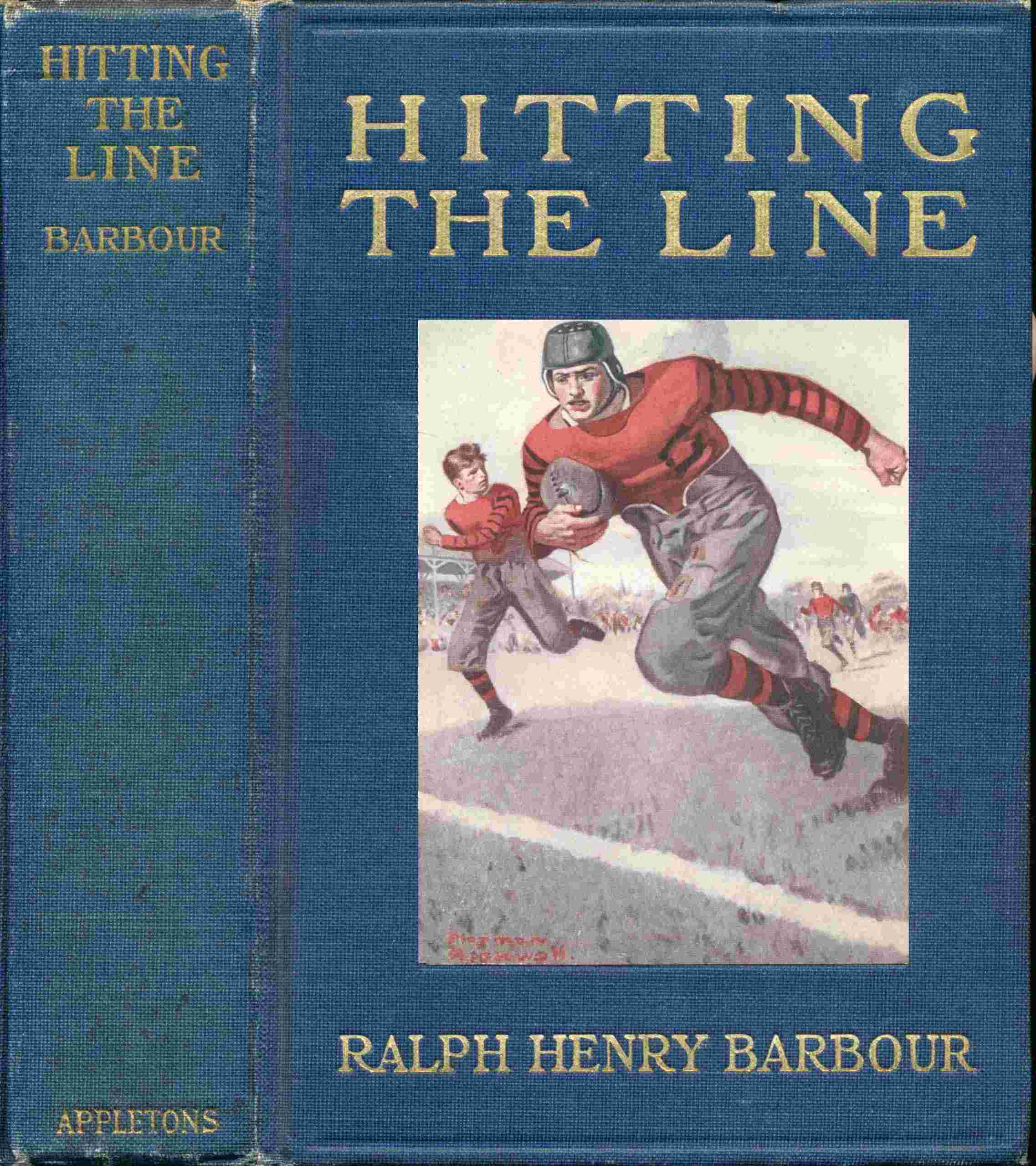
The St. Philip’s game proved a rude awakening for Grafton, for four twelve-minute periods—St. Philip’s had insisted on forty-eight minutes of playing time—left the two teams virtually where they had started, on an even footing. To be sure, each team had managed to secure one field-goal in that time, but the final score of 3 to 3 was indecisive. And from the Grafton point of view it was very disappointing. St. Philip’s was a new opponent and, while rumor credited her with football strength and Grafton had looked for a hard contest, she was not expected to prove the Tartar she had shown herself.
Grafton could find no consolation in the fact that, if she had not won, neither had she lost, for an unbiased analysis of the game showed that the home team had been out-played from first to last and that had the fortunes of war dealt fairly with each team St. Philip’s would have gone off with a 3 to 0, or even possibly a 6 to 0, victory.
As Captain Bert Winslow said afterwards, no light team had ever faced Grafton with so much punch in attack and dogged resistance in defence as the late adversary. Outweighed many pounds in the line, St. Philip’s had overcome that handicap by an almost phenomenal speed. Time after time her linemen had “got the jump” on Grafton, and time after time the best efforts of Winslow and Ordway and Manson and, later, their substitutes, had gone for little or nothing. Around-the-end attempts had been early shown futile, and Grafton, after many failures to puncture the line from tackle to tackle, had had recourse to the kicking game. But even there her opponent had bested her slightly, while the longest and best placed of Captain Winslow’s or Quarterback Blake’s punts had missed effectiveness by reason of the brilliant running back of the St. Philip’s quarter and left half. St. Philip’s had earned her lone tally honestly when, after four long runs from wide formation that started in her own territory and took the ball to Grafton’s twenty-six yards, she had twice failed at an advance and had sent her drop-kicker back to the thirty-five-yard line. Although the angle was fairly difficult, and although Pete Gowen and “Hobo” Ordway had both broken through, the kick was made slowly and carefully and went directly across the center of the bar. That was in the second period. Again, in the third, St. Philip’s came near to scoring another three when a place-kick from the thirty-eight yards struck the upright and bounded back.
Grafton’s single score had been secured in the last period. With defeat staring her in the face, she had commenced and executed a creditable march up the field in which a quarterback run and a forward-pass had featured and had eventually reached St. Philip’s twelve yards. There a fumble had cost her a down and lost her four yards. Subsequently, Ordway had been thrown back for a loss. Then, on third down, a fake forward-pass had sent the ball to Fullback Manson and that able-toed young gentleman had put the pigskin across easily enough from the thirty-yard line.
Monty had failed to get into that contest for even a minute and had watched it with mingled feelings from the bench. No one asked Monty’s opinion, but he had one nevertheless. To paraphrase a celebrated quotation: “Breathes there a boy with soul so dead who never to himself hath said: Things would have been different had I led!” Perhaps Monty didn’t say just that, but he did confide to Leon and Dud and Jimmy that evening that it was his firm conviction that Coach Bonner would do well to pay less attention to the little things and more to the big. “What’s the good,” he wanted to know, “of spending a month learning half a hundred unimportant details and not knowing how to use what you learn? If our backs had forgotten a lot of slush about standing just so and having one foot ahead of the other and counting one, two, three after the signal and all that, and had just taken the ball any old way and slammed into that line we might have done something. They were so busy remembering the by-laws that they never got started until the other fellows were tackling them!”
That led to an argument, with Jimmy Logan on the other end, which continued until Leon, yawning, requested them to dry up.
“It’s all very unimportant, anyhow,” he said. “Football’s a crazy game and only wild men play it.” And, of course, Monty had to deny that and another argument began.
There was a great deal of argument between the four, and they settled, to their own satisfaction, at least, many problems that autumn. The subjects left undiscussed were few indeed, and Number 14 Lothrop and Number 32 Trow were the scenes of many earnest debates. (The quartette seldom met in Monty’s room, since there was always the chance of Alvin Standart’s making himself an unwelcome fifth. None of the others could stomach Alvin. Leon, indeed, held him in the utmost loathing.) The debates were always good-tempered. Leon was the only one of the four in danger of losing his temper in the heat of an argument, and the others saw that he didn’t. It was usually a nonsensical remark by Jimmy that saved the situation.
But football was not the only interest at Grafton just then. October had come in with frosty nights and mornings and days that held just the right amount of snap to put zest into life. The maples fluttered their red and orange and yellow leaves down and the elms laid russet carpets on sidewalks and paths. The baseball players were holding fall practice each afternoon, and Dud, already slated to lead the pitching next spring, was very busy. Jimmy and Leon played tennis a good deal. There was work, too, for the track and field candidates, and as for the fellows who slammed little white balls for miles over the yellowing turf, why, they were in their element. The river of an afternoon, especially if the afternoon happened to be Sunday, was quite crowded with canoes. Monty, impatient of delays, purchased a maroon-colored canoe from Pete Gordon and, coached by Leon, became a skilled paddler in a surprisingly short time. The fine weather lasted the month through and life at Grafton was very pleasant. It would have been much pleasanter, in Monty’s opinion, had there been no such things as German and English, for he was not doing very well with them. He tried for permission to exchange German for Greek, but was denied. Mr. Rumford, however, told him he could make the substitution with the beginning of the mid-winter term if he managed promotion to the upper middle at that time. Monty saw no prospect of it, though.
The second week in October witnessed the final cut in the football squad and left just twenty-nine players extant. Of these eighteen constituted the regulars and enjoyed the distinction of eating at training table, while the remaining eleven substitutes got along as best they might with the assistance of a diet list, which, I fear, was seldom regarded. The second team also went to a training table. The second took itself very seriously and, under the care of Mr. Crowley, fast developed into a formidable aggregation. Monty survived the final cut, but still could figure himself no better than a third substitute. Starling Meyer terminated his connection with football, being too haughty to go out for his class team after being rejected by Coach Bonner. Doubtless it peeved him not a little to see that the boy whose amazing innocence he had laughed at had survived where he had failed!
Monty didn’t go with the team when it traveled away from home to play the Rotan College freshmen. He wasn’t included in the list of those to be taken along, and, while he would have liked to have gone with the half-hundred rooters who accompanied the team, a falling-out with Mr. Rumford prohibited. Jimmy thought it better for Monty to remain at school and labor on an English 2 composition. Last year Rotan had beaten Grafton on Lothrop Field by the score of 20 to 6, and Grafton wanted revenge. That she obtained it was due principally to Manson’s good right foot, for he barely managed to convert Grafton’s single touchdown into seven points, while the freshmen, after smashing out a touchdown in the first ten minutes of the contest, failed to kick goal. The score of 7 to 6 was not decisive, but it constituted a victory, and Grafton, team and rooters, returned home in triumph.
Grafton met her first defeat the following Saturday at the hands—or possibly it would be more proper to say the feet—of St. James Academy. The game was on Lothrop Field. St. James was unable to do much with the home team’s line and, after the two elevens had played each other to a stand-still for two periods, she opened up her bag of tricks and showed that both the Grafton ends were far from impregnable. When Foster Tray gave place to Milford, gains around the Scarlet-and-Gray’s right became less frequent, but Mann, who succeeded to Derry’s place, was no improvement. St. James worked forward-passes with fair success and used a split attack from kick formation in which quarterback took the ball outside tackle that made many gains until Grafton finally solved and smothered it. Grafton’s attack seemed very weak that day, but the truth was that her rival had a strong line that played low and hard. Once Hobo Ordway got loose for thirty-odd yards, and several times Brunswick, who went in for Captain Winslow in the third quarter, snaked through for gains of from three to six. But invariably St. James tightened inside her thirty-yard line and four times Grafton lost the ball on downs almost under the shadow of the opponent’s goal. Twice she might have tried field-goals and didn’t. It was explained later that Coach Bonner had forbidden them. St. James, with no such prohibition governing her attack, landed two drop-kicks over the bar and took the game home with her. As heretofore Grafton had always won, that 6 to 0 victory was a surprise to the Scarlet-and-Gray, and an unpleasant one. Monty played nearly the whole of the fourth period at right guard and handled himself well even if he created no sensation. He sustained an honorable injury in the form of a black eye, of which he was secretly very proud while it lasted.
By this time Monty’s circle of acquaintances had widened. That he had increased the number of his friends is doubtful, however. Acquaintanceship and friendship are different craft. He felt no need of more friends, though, for Leon and he were inseparable chums, while Jimmy and Dud were a good deal more than mere acquaintances. In a casual way he came to know half the fellows in the football squad, some quite well; Pete Gordon, the substitute center, Tom Hanrihan, the big tackle, Nick Blake, the innocent-visaged, mischievous quarter, “Hobo” Ordway, who played right half and who, so rumor had it, was an English Earl when he was at home! Bert Winslow, the captain, Monty counted as an acquaintance, too, but Bert was too busy and absorbed in his tasks to pay much attention to the substitute guard. And there were others: Foster Tray, who played right end, Gus Weston, the chap who was so earnestly striving to oust Blake from the quarterback position, Oscar Milford, a second-string end and Paige Burgess, the team’s manager. At Morris House, Monty knew his companions even more intimately and had revised his opinion of several. Joe Mullins, for instance, was not at all the “Indian” Monty had dubbed him, but a very decent fellow indeed who occupied the unofficial position of house captain and ruled them all with a light but firm hand. And there was, of course, Alvin Standart. And very often Monty wished heartily that there wasn’t.
In short, Monty was finding his place by degrees and enjoying himself in the meanwhile. He sometimes missed his beloved mountains and sometimes felt a bit lonesome for no reason that he could discover, but as time went on he took more kindly to the tranquil, well-kept country around him and the lonesome spells became less and less frequent. He often wondered what would have happened had he not pitched into that bullying newsboy in New York. In that case Jimmy Logan wouldn’t have spoken to him and he would have gone on to Mount Morris, as he had first intended. Probably he would have liked the Greenbank school quite as well as he now liked Grafton, but he wouldn’t have met Leon Desmarais. He concluded that Fate had treated him well, for he had grown very fond of Leon and couldn’t imagine an existence that didn’t include him. Of course they quarreled now and then. Leon had a temper like a spring-trap. It always went off suddenly and unexpectedly. When thoroughly angry he was, to use Monty’s metaphor, “a regular bob-cat.” But Leon’s rages soon burned out and, since it took a lot to make Monty lose his temper, their quarrels were usually rather one-sided and speedily over, and left no scars. Leon was inclined to be a bit snobbish in the matter of birth, something that Monty was quite indifferent to. Monty had once remarked that it didn’t seem to him to matter much who one’s great-grandfather was, and Leon had been quite scandalized.
“Do you mean that birth doesn’t count?” he had exclaimed incredulously.
“What do you mean, birth?” Monty had asked. “My father was a perfectly respectable American and my mother was a French woman. Neither of ’em was ever in jail.”
“Don’t be a silly ass! Anybody could tell that you come of good family, Monty. The west is full of families from the south and east, of course. But do you mean to tell me that generations of breeding and culture don’t count? If your grandfather had been a rag-picker—What are you laughing at?”
“You’re so serious! Suppose he had been a rag-picker? What of it? The man who picks rags today deals in them tomorrow and gets rich. His children go to school and his son sells the land the junk-shop was on and starts a dry-goods store on the next corner. And in a few years he’s rich, too, and becomes a bank director. And his son grows up and marries the daughter of the wealthiest man in town. And if you met his son on the campus tomorrow you’d think ‘There’s a chap with breeding!’”
“It takes more than three generations,” answered Leon stiffly.
“You mean it used to,” Monty had laughed. “Nowadays things move faster. Why not? We put up a two-million-dollar building in six months. We ought to be able to make a gentleman in two generations. I don’t know much about my family, but I remember my father telling of the time when he walked four miles to school in his bare feet, and so I guess there weren’t any lords or dukes on my family tree!”
“Poverty has nothing to do with it. Your father’s father——”
“It has a lot to do with it nowadays,” chuckled Monty. “Do you suppose I’d have had the courage to come east here and butt in on these high-brows with their silver-backed brushes and all if I hadn’t had a gob of money behind me? Yes, I would—not! Son, it’s having something in the old sock that gives you the right to shove through the crowd and take a front seat. If my father had been George Washington and my mother—er—Mary Antoinette, or whatever her name was, and I didn’t have any money, I’d just as soon thought of jumping off the Washington Monument as coming here to school!”
“That’s nonsense! Money has nothing to do with it!”
“Wait a bit! Your folks have money. You haven’t told me so, but your father’s a sugar dealer—factor, you call it, don’t you?—and you dress like a circus horse, and so I guess it’s a fair bet that they have. All right. But just suppose they hadn’t. Suppose you had just enough money to pay your fare up here and back and your tuition. A lot of good your old ancestors would do you!”
“I’d be just the same as I am now, wouldn’t I?”
“No, you wouldn’t, son! You’d be slinking around in a suit of old clothes that you were ashamed of and hating fellows who dressed decently. And you’d know two or three fellows like yourself and no one else. That’s how near you’d be to what you are now.”
“You talk like a—a snob!”
“Maybe I talk like one, but I’m not. I don’t care whether a fellow has money or hasn’t, and I care just as little whether his great-grandfather or his grandfather or his father came over with the Pilgrims in 1500 or whenever it was, or came last Friday in the steerage. If a chap is square, that’s enough for me. He doesn’t have to have silver military brushes with monograms on ’em, and I don’t give a hang if he says ‘ain’t’ for ‘isn’t’! Birth be blowed!”
“But you make money everything!” Leon had protested.
“I don’t! I make the confidence that having money gives you everything. Gee, I’m talking like a spell-binder at a country picnic! I don’t say that it’s a fine thing to have money just as money, but I say it’s a fine thing to have it for what it gets you. If I was poor, know what I’d do?” Leon shook his head. “Well, I’d make some money,” chuckled Monty.
“There are lots of better things to do!”
“Maybe, but you can do them better if you have the money, son. If I wanted to be—to be a musician, for instance, I’d make me a little pile first off. Or if I wanted to be a statesman, or—or anything else.”
“And by the time you’d got your money it would be too late to be anything!”
“Don’t you believe it! Making money isn’t hard.”
“Why doesn’t everyone have it then?”
“I’ll tell you, Leon. It’s a secret, but I’ll tell it to you. It’s because the way to make money is to work, and a lot of folks never learned that. They think you have to sit down and wait for it to drop into your pocket. Savvy?”
“I ‘savvy’ that you’re a perfect ass,” grumbled Leon. “And I don’t believe you believe——”
“All I believe? Right you are, son! And I don’t believe you believe that you are any better because your great-great-grandfather was fried in oil by Spanish inquisitors away back in 1100 B. C.”
“You’re strong on dates!” laughed Leon.
“Dates,” replied Monty untroubledly, “are as useless as ancestors. They’re like the frills they put on lamb chops. You can’t eat them and the chop would taste just as well without ’em. I know that Columbus or Amerigo Vespucci or Sebastian Cabot or some other guy discovered America. But I don’t know when, and I don’t care, and it doesn’t matter. And, say, who did do it, anyway? I’ll bet it was the Vespucci chap, because they named the country America after him, and Columbus only got the capital of Ohio named after him!”
“Well,” answered Leon, “if that’s your argument, the real discoverer must have been a fellow named United States!”