
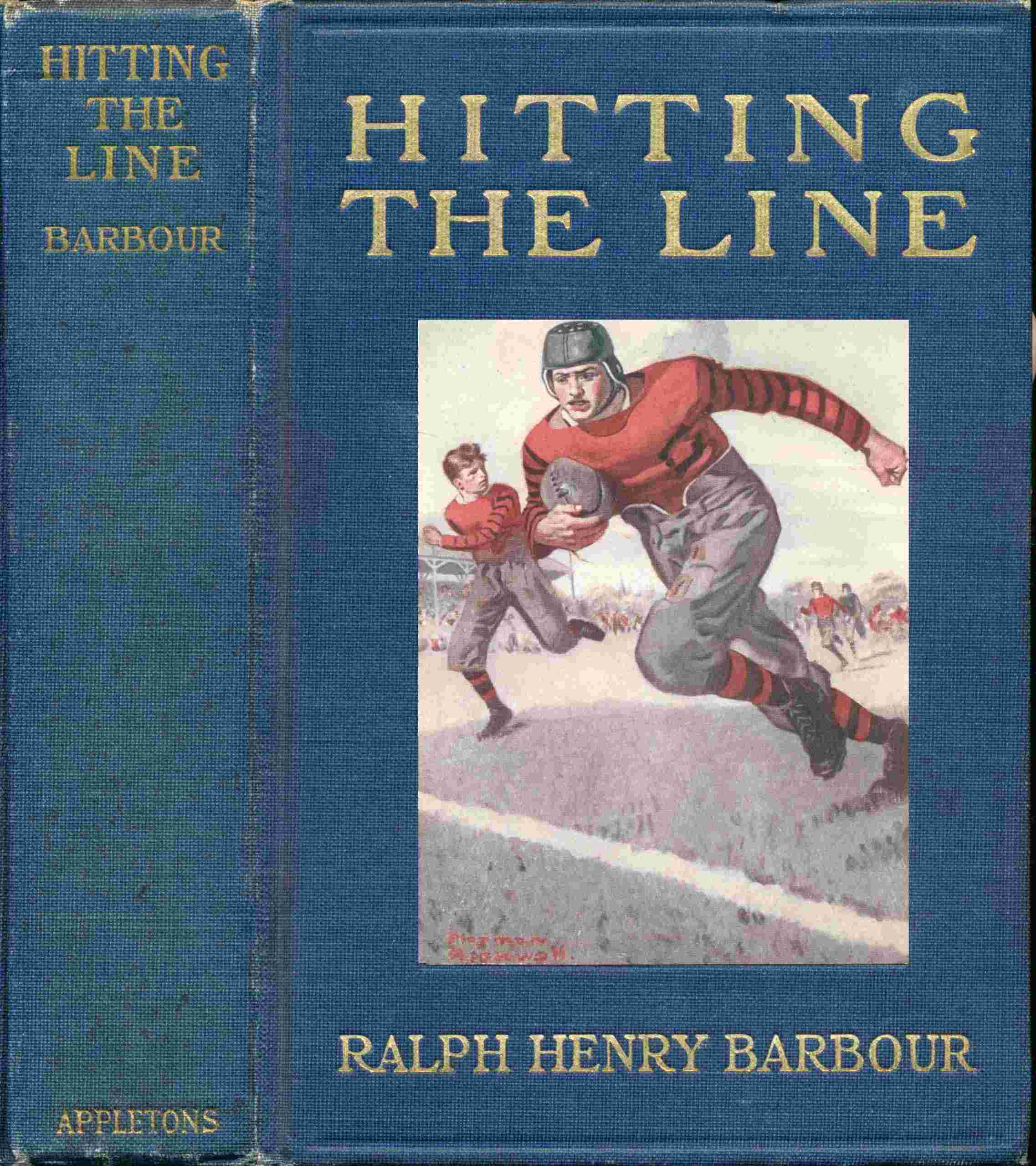
He heard the true story of that run on the way back to Grafton. What surprised him was that no one seemed to appreciate the humor of it as he did. To have nearly killed himself in order to beat one of his own team to the goal line struck Monty as being the height of humor—or irony; he wasn’t certain which! The Middleton pursuit had started late and had practically given up the race after Monty had crossed the fifty-yard-line. Bellows and Ordway had put two men out and Ordway had finally slowed down and trailed Monty to the line, pursued some twenty yards behind by the Middleton quarterback. The latter had tried to get Monty after he had crossed, to prevent him from centering the ball, and Ordway had dived into him. But no one appeared to think it in the least strange that Monty had driven himself at top-speed and his efforts to make them see the humor of it brought only smiles.
“A fellow doesn’t have a chance to see what’s coming,” said Will Brunswick seriously. “All he can do is put his head down and beat it! I remember a couple of years ago when I was playing on my class team I got the ball near the forty yards and was nearly to the end of the field before I looked around and found I was being chased by the umpire! There was no one else around!”
“You certainly cut out a pace for yourself,” said Pete Gowen.
“I certainly must have,” agreed Monty, ruefully stretching the aching muscles of his legs. “What gets me is my nearly running my feet off with no one after me.”
“Oh, they were after you all right at first,” said Pete. “How the dickens you slipped through that bunch I don’t see. I thought you were gone half a dozen times. Where did you learn to twist and dodge like that, Crail?”
“I didn’t know that I did twist,” laughed Monty. “To tell the truth, I don’t remember much about what happened from the time I got the ball until I was halfway to the goal! I guess it was pure luck, Gowen.”
“Well, it’s the sort of luck that looks a heap like science then. If we didn’t have a raft of good backs I’d look for Bonner to try you at half after today’s performance. Ever played behind?”
“No, I’ve never played anywhere but at guard and if it takes the sort of stunt I pulled off today I don’t think I want to! I guess running isn’t my stuff.”
“Well, you certainly footed it that time, Crail!”
“Yes, but I was a dead dog when I got there.”
Gowen shrugged. “You most always are. When you run eighty yards at that pace you don’t have much breath left to cheer with. You’ll be feeling fine tomorrow. Better go over to the gym in the morning, though, and get Davy to give you a good rubbing.”
That run didn’t make a hero of Monty, probably because the score wasn’t needed and little depended on its success. But it had been sufficiently thrilling for awhile to partly atone for that, and it did send Monty’s stock up considerably. From a practically unknown substitute he emerged a player of promise, one of whom something equally brilliant might be expected again. Members of the team nodded or spoke more familiarly to him when he met them and others who had before never noticed him were now careful to claim recognition. But the feat didn’t alter his standing on the squad so far as he could see, and it certainly didn’t cause his removal to the training table. After all, as he told himself, luck had played a big part in the performance. Luck had caused the ball to bound toward him instead of in another direction and luck had guided him through the ranks of the enemy. All he had done was run like the dickens! And one doesn’t get promotion for doing merely what is natural and instructive.
Leon, however, and Jimmy and Dud as well, insisted that he was a hero. Leon was quite incensed because Coach Bonner didn’t oust Gowen and put Monty in his place. Monty had been, he warmly maintained, the star of the game. Monty grinned. “A little piece of luck, Leon,” he said. “I might not do it again if I played football twenty years. I’m not half the player that Pete Gowen is, and I don’t believe I ever shall be.”
Jimmy’s comment was—well, more Jimmyish! “It’s only Bonner’s pig-headedness that keeps him from yanking you off the bench,” he declared. “Bonner hates to acknowledge that he’s made a mistake. All coaches do. You might as well hand in your resignation tomorrow, Monty. No matter what stupendous stunts you pull off now, you won’t get your deserts. They just won’t see them. I know, for I tried football myself once. I did things that no other football player ever even attempted, old dear, and did I get a kind word and an invitation to dinner with the coach? I did not. I got fired! There’s gratitude and appreciation for you! I guess—” Jimmy half closed his eyes and shook his head sadly—“I guess I’d have been captain by now.”
The effect on Alvin Standart of Monty’s touchdown in the Middleton game was peculiar. Alvin appeared to take it as a personal insult. He was quite depressed over it all Sunday, and never lost a chance to comment on it disagreeably. “I suppose you think you’re a regular hero now,” he sneered. “Trotted all the way down the field with the ball, didn’t you? I guess if the ball hadn’t jumped into your arms and someone hadn’t given you a shove you’d be standing around there yet. You’re waiting for Bert Winslow to step out and give you the captaincy, I dare say. When are they going to take you to training table? Have you and Bonner planned next week’s game yet?”
Most of Alvin’s wit, though, went unheeded. Monty had acquired an ability to let his roommate talk on and on without hearing him, a fortunate acquirement since otherwise Monty would have been tired or angry half the time. Life with Alvin Standart was not a bed of roses nowadays and almost anyone but Monty would have either dropped Alvin out a window or run away in self-defence. Sometimes Monty was tempted to do one or the other of those things, but he always managed to summon his sense of humor to his aid. After all, he reasoned, Alvin’s mouthings and meannesses were too silly to be taken seriously. One might much better laugh at them. But that Sunday afternoon, when Alvin had begun his nagging for the twentieth time since the game, Monty’s patience and sense of humor gave out. He was trying to compose one of his monthly letters to Mr. Holman, his guardian, and Alvin’s rasping voice was too much for him. So at last he arose and, not without trouble, put the objectionable roommate outside and locked the door on him. Alvin kicked and hammered and shouted until the others assembled en masse and read the riot act to him. After that he disappeared until supper time and Monty, making the most of the unaccustomed tranquillity, wrote a full seven pages to his guardian.
Of course he told about yesterday’s game and his part in it. He assured Mr. Holman several times that his contribution to the final total of twenty-two points was of no importance and had been entirely due to a piece of luck, but he dwelt on the event to the extent of two pages. Then he reported a slight betterment in class standing and subsequently gave a quite dispassionate account of the affair of the missing keys, and ended with:
So maybe they’ll get me some fine day and I’ll have to pull my freight. If I do I guess I’ll go home until January. I might try that school I started for, only they don’t think much of it here, you see. I guess some place out our way would do just as well. I’ll be kind of sorry if they do give me the gate because I like this outfit mighty well. Maybe you had better send me some money in case I leave hurriedly. I’m about down to the core of that roll I fetched away with me. There might be a fine to pay, too, because if Standart shoots off his mouth to the faculty I’m sure going to treat him brutal.
The next afternoon Monty found a surprise awaiting him at the field. After tackling practice, at which Monty had developed more than a fair degree of proficiency, he was on his way to join the third squad for signal work when Coach Bonner summoned him back.
“I’m going to give you a try at fullback, Crail,” said the coach. “You’ve never played behind the line, I suppose.”
“No, sir.”
“Well, I think you could. Anyway, you have a try at it. If you get the hang of playing full you’re likely to be useful the rest of the season. Have you any idea at all of a fullback’s duties?”
Monty shook his head doubtfully.
“I’m afraid not, sir. I know he carries the ball and kicks——”
“Never mind the kicking. Blake or Winslow will do that. You’d better put your blanket on and follow the play this afternoon. Watch Caner, and try to get an idea of what’s wanted. You showed some pretty good stuff Saturday, Crail, and it seems to me that if you buckled down, and really tried you could make a fairly good running back. Manson’s knee is going to trouble him for a couple of weeks, I guess, and you may have a chance to play against Hollywood. I’m not promising it, but there’s a fair chance, Crail. Now, get your blanket and keep your eyes open. Watch Caner’s position in the different plays, and remember what you learn. What are you doing tonight?”
“Nothing, sir.”
“I wish you’d drop around and see me at about eight. You know where I live? All right.”
So Monty, draped in a gray blanket, ambled around the field in the rear of the first squad during signal practice, and later, when the second came trotting over to try conclusions, hung around the flanks of the first team as it went up and down the field. Caner was not the fullback that Manson was, but he had experience, and was a good model for a tyro to copy. Now and then Mr. Bonner came up to Monty, and drew his attention to some feature of the play, but for the most he was left to master things as best he could. When practice was over—the second gave a good account of itself that day, and only allowed the first one touchdown—Monty followed to the field house in dejection. If, he told himself, he had learned anything as to the duties of a fullback he didn’t know what it was!
Consequently, he made his way in to the village that evening feeling somewhat dubious. If Mr. Bonner should ask him what he knew now about playing fullback that he hadn’t known before practice he would have to make the depressing confession that he knew nothing. Monty almost wished that the coach had not selected him for this new rôle.
But the interview wasn’t unpleasant, after all. Mr. Bonner made him comfortable in a deep armchair, and for the first twenty minutes kept the conversation far from football. Somewhat to his surprise, Monty found himself telling about a summer camping trip to the Big Horns, with the football coach listening with real interest. When he had finished, Mr. Bonner said: “I’d like mighty well to do that very thing some time, Crail, but I don’t suppose I ever shall. You must tell me some more about your part of the country some day. Well, now let’s see. Think you learned anything today?”
Monty frowned ruefully. “I don’t think I did, sir,” he answered.
“Oh, I guess you did,” replied the coach cheerfully. “Let’s find out. Suppose your team’s on the defensive. Where would you stand?”
“Behind center,” said Monty doubtfully.
“Well, how far behind?”
“Caner stood about six yards usually, sir.”
“Why?”
“So he could see what was coming, and stop it.”
“Right. That’s where he has an advantage over the other backs, Crail. He must be guided by the center, though. If his center plays up in the line he will be further in himself. In other words, the fullback measures his distance from his center, and not from his line. You see you did learn something after all.”
“Mighty little,” grumbled Monty.
“You probably learned more, and don’t know it,” laughed the coach. “I’m going to tell you a few fundamental things about the position, Crail, which is about all anyone can tell. The rest you’ll have to learn for yourself. After all, football isn’t different from any other game. It consists of applying common sense to physical ability. And a fullback is just a halfback under another name. Time was when there was more difference between a half and a full. Then the fullback was never used for plays outside of tackle. His business was to have a lot of weight and strength, and slam himself at the center of the line. Now he has to do a little of everything, buck the center, slide off the tackles, or run the ends. If he can kick besides, so much the better. If he can get forward passes off, still better. But in the final analysis, he’s a third halfback.
“Playing back where he can look over the lines and watch the opposing backfield, however, he’s in a position to diagnose the enemy’s plays quicker than any other man on his side. Of course, guessing what the other fellow is going to do is largely a matter of practice and experience, but it’s something that every fullback ought to learn to do. Watch the little signs, Crail. Watch the faces of the backs and the center. Many a time you’ll get a hunch from a look. Sometimes, too, a nervous or too-eager back will give the play away by an unconscious shifting of his body in the direction of the point of attack. You may get fooled on that point, though, for some backs will deliberately bluff; it’s an old trick. You must be on your toes every second, ready to follow the other fellow’s shift. Your duty is to find out where the play is coming, and be ready to meet it. You’ll get fooled at first, I guess, for some shifts are used simply to pull you and the other backs away from the play. Only experience can teach you when a shift is just a fake.”
“The next thing is to watch the ball, Crail, from the instant it goes into play. Keep it in sight until you know just where it is going, or until you can’t see it. Then make up your mind where you think it is, find the direction of the runner who has it, and get into position to meet him. Aim for the man with the ball, Crail. Never mind the interference. It’s the runner you want.”
“On punts by the other side your place is twelve or fifteen yards back. It’s up to you to put out anyone coming through between tackles, and after that to get into the interference for the runner back. Kicking you won’t have. Not this year, anyhow, although if you make good it will be worth your while to learn that end of the game. At present you will move up into Winslow’s place when he drops back to punt.”
“When you carry the ball, you will, as I told you, have to sample every opening in the line, and run the ends. You must learn to pick your holes quickly, ward off tackles, and get up your speed before you reach the line. There’s a lot in knowing how to use your speed, Crail, but I can’t instruct you. It’s another thing you just have to learn for yourself. Of course, you know you can’t carry the ball in one arm on plunges between tackles. Both hands on the ends then, and the ball well up against the body. Learn to keep your head up in running, Crail. Going it blind is poor policy. Besides, if you keep your head up and your chest out, and carry your knees high you get a machine-like motion, with every part of you working together. Now, I don’t expect you to remember all this stuff tomorrow, but I do expect you to remember some of it. I’m going to give you a chance tomorrow to show how much you do remember. To recapitulate, Crail: on defence, watch the other side for the play, keep your eyes on the ball, go for the runner every time. On offense, get started quick, hit the line hard, and don’t stop until you’re sure you can’t make another inch. Better think over what I’ve said on your way home, and then forget it until tomorrow. Good-night. Some day I want to hear more about that western country of yours. We’ll get together, and have another pow-wow if you like.”
Monty dutifully went over what he had been told, on his way back to Morris, and tried hard to picture himself playing against Hollywood School next Saturday in Manson’s place. But his imagination wasn’t equal to the task. And, besides that, he was, although he wouldn’t have acknowledged it to anyone, distinctly scared!