
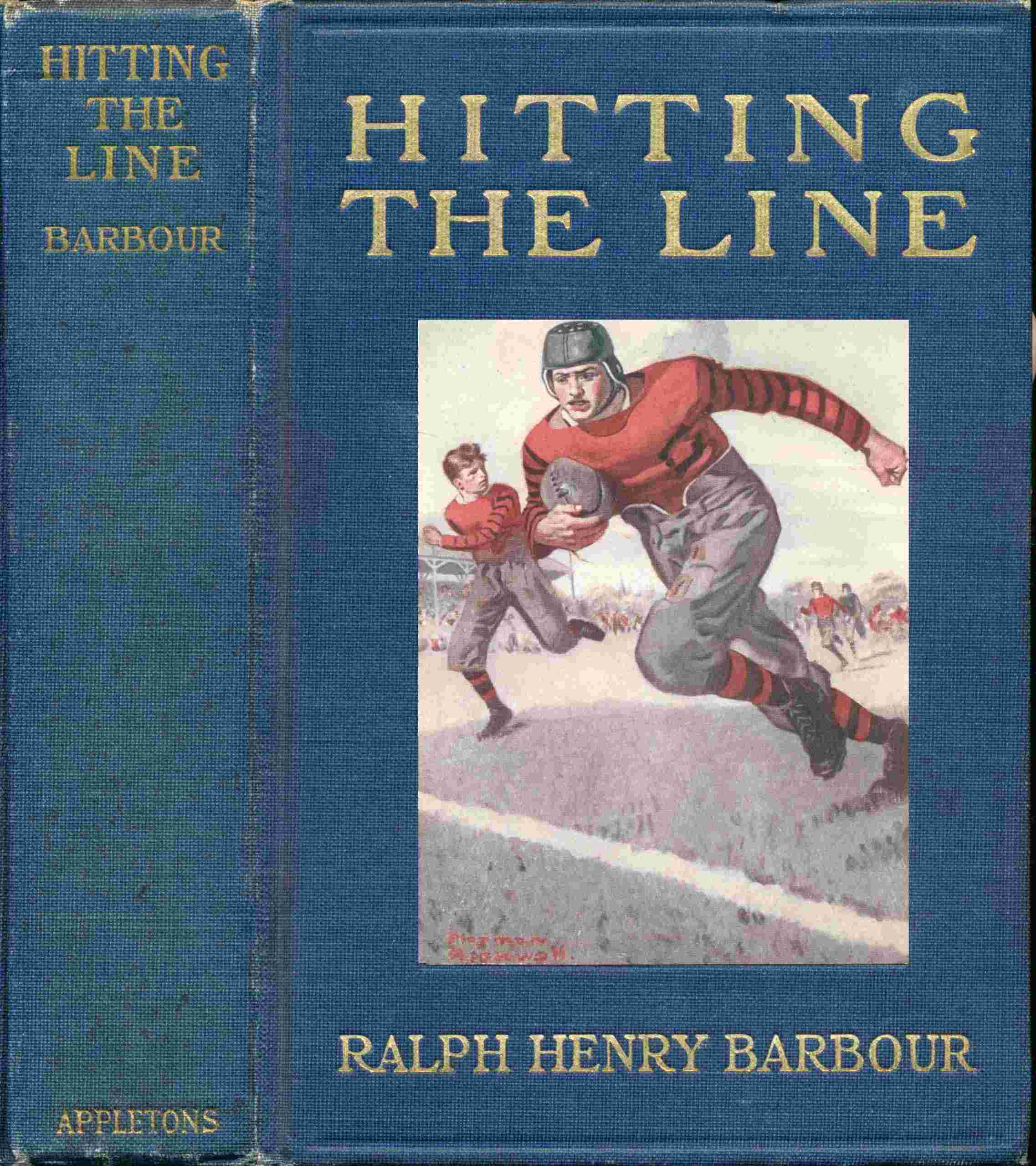
The next afternoon he again followed Caner about during signal work, while Nick Blake barked his demands, and the squad scurried this way and that in response. Then he went to the bench and watched the second team hold the first to no score during two ten-minute periods. He wondered whether Mr. Bonner had forgotten him, and was sometimes inclined to hope he had. But he hadn’t, for when the third period began, after a five-minute rest, with half a dozen second-string men in the line-up, Monty found himself standing down near the east goal in company with Weston, who had taken Blake’s place, and Brunswick and Ordway, feeling a bit conspicuous and decidedly nervous. He sincerely hoped the kick-off would not put the ball into his territory, for he was certain he wouldn’t be able to catch it. Fortunately, perhaps, it didn’t. It was Brunswick who fell heir to the slowly-descending, revolving pigskin, and Brunswick, who, snuggling in behind the interference, plunged along for ten yards or so under cover, and then, deprived of assistance, swerved to the left, and gained another five at the cost of a long run across the field. Monty had been spilled early in the proceedings, and now he picked himself up, and trotted across to the line-up, trying hard to recall some of the advice so generously bestowed last evening.
But he forgot about advice in a twinkling, for he was doing his best to clear out a hole inside left tackle for Ordway, and doing it, too. His weight and strength told when he hurled himself between the panting linesmen, and Hobo followed through for a fine four yards. Someone met Monty’s charge with a hard shoulder, and he plowed up the turf. But he didn’t mind that, for the ball was four yards nearer the west goal, and the fighting spirit was aroused. Twice more Ordway was given the ball, and twice more he won through, and it was first down. Then came an unsuccessful plunge by Brunswick at the center, and then the signal that made Monty’s heart pound a little harder. It was a delayed pass to fullback that Weston called for, and to save his life Monty couldn’t resist the impulse that made him shift his body a little to the right. Instantly, Coach Bonner’s voice exploded.
“Hold up!” He darted in and faced Monty scowlingly, a very different Mr. Bonner from the one who had listened smilingly to his camping yarns. “You gave that play away, Crail!” he snarled. “Don’t shift toward the point of attack, don’t look toward it! A child could have guessed that play! Change signals, Quarter! All right! Let’s show something now, First!”
“All right! Now get this, fellows!” cried Weston, after an insulting glare at Monty. It was Brunswick again, around the end, with Monty leading the way. But the second team end was waiting, and there was no gain. Again came the signal with Monty’s number, but this time it was a straight plunge into the center. He tried not to even wink. Then he was plunging ahead, his eyes on the ball in Weston’s hands. He got it, clasped it to him and bored into the opening. The halfs had crossed in front of him, and were charging past right tackle, and the diversion was fooling the opponent’s secondary defense. Monty banged through, was stopped momentarily, squirmed another yard, and went down with a quarter of a ton of the enemy on him. He had won the better part of three yards, and, as someone literally lifted him to his feet, he was inclined to be a trifle self-satisfied. But the self-satisfaction vanished when Coach Bonner called: “You missed a foot then, Crail, by holding the ball too low. When you’re stopped swing the ball up to your chest. It’s just as safe there. Every inch counts, Crail. Remember that next time.”
It was second down and seven to go, and Brunswick went back to punt. Monty slipped into his place at left half. “Over further,” directed Weston. “Watch that second team tackle, Crail.” Then came the signals, the ball sped past Monty, the lines heaved, and a big second team man charged down on him. In that instant Monty thought, “Why doesn’t he hurry? Isn’t he ever going to kick?” Then the second team man was on him, and Monty had his hands full. How it happened he couldn’t have told, but somehow that opponent swung him to the left, and went inside him, and someone collided with him as he staggered, and he went down, sprawling. And when he could look around the teams, save for three or four players, who, like he, had capsized, were jumbled furiously in quest of a trickling ball.
“That was up to you, Crail!” called Mr. Bonner. “You let that man inside you. Keep them out if you can’t stop them! You’ll have to do better than that.”
The big second team fellow who had outmanœuvered him grinned at Monty as the latter came up. There was nothing unkind in the grin, however, nor in the comment that accompanied it. “You’ll learn, Crail,” said the second team tackle.
Monty set his lips firmly, and trotted subduedly back to position. Tray had captured the ball for the first, and it was first down back near the twenty-five-yard line. Brunswick got a couple of yards off left tackle, and Ordway added two more around right end. Then Brunswick again went back. This time the big tackle was stopped in the line, and the kick was not blocked. Second worked the ends for small gains, and sent a forward pass obliquely across the field. It was not caught, however. Then she punted, and Weston came back with the ball to the first’s twenty-seven. Again Monty was called on, and again he struck the line for three yards. Ordway got clean away past left tackle for twelve. Monty slid off the same tackle for four, and was so thoroughly jarred when he was downed that he had to have time called for him. Brunswick made it first down a moment later, with Monty interfering, and the ball was past the middle of the field. Offside put the first back, however, and Ordway’s attempt to knife through was stopped. Brunswick took the ball on a wide end run for no gain. Brunswick went back, but the pigskin was thrown to Ordway, and that fleet-footed youth made eight around the left of the line. Monty got the signals mixed that time and started the wrong way, and Weston was on him savagely.
“What was wrong with you, you idiot?” he demanded. “If you don’t get the signal, sing out.”
Brunswick faked a kick and threw forward to Tray, and the latter was forced over the side line. But the tape gave the first team its distance. Weston got two straight ahead through center, and Monty tried the right end and banged squarely into the arms of an opposing tackle for a yard loss. Brunswick punted to the second’s five yards, and Tray threw the catcher on the ten. Second was put back half the distance to goal for holding on the next play, and then punted to her thirty-two. Monty had the ineffable pleasure of diving into the big second team tackle as he romped down the field, and sending him sprawling over the ground. The tackle only grinned as he picked himself up. Monty experienced a fine glow of satisfaction. The quarter ended with the ball on the second’s twenty-eight in possession of the first team.
“That’ll do, Crail,” said Mr. Bonner. “Trot in and don’t hang around. Fenton! Fullback, here!”
Monty trotted obediently to the field house, although he would much rather have walked, and subsided, panting on a bench. It had been for him a strenuous quarter of an hour. Playing in the line, and back of it were two vastly different things, he decided. As he got out of his togs he went over his performance in memory, and wondered just how bad he had been. If criticism was a criterion, he had played perfectly rotten, he thought, but he knew enough of football practice by now to realize that even the best players on a team are sometimes “bawled out” by the coaches. On the whole, he guessed, he had done no worse than might have been expected of an inexperienced fullback, and he took heart and dragged himself wearily to the shower, one hand rubbing a set of very lame ribs where the too intimate knee of a tackler had settled.
The rest of the players trooped in before he had completed a very leisurely dressing. To his surprise, Gus Weston, who had twice looked as if he could have choked him with much pleasure, came across and sat down beside him. “You did pretty well, Crail,” he said, as he began to unloose his shoes. “It’s always hard for a fellow who has played in the line to come back of it. He’s got to be a heap more active. You’ll get the hang of it in a few days, though.”
“I’m sorry about getting that signal wrong,” said Monty humbly.
“What signal was that? Oh, yes, I’d forgotten. Oh, we all do that. Say, you mustn’t mind what I do when a play goes wrong, Crail. I’m likely to call you all sorts of things. It’s part of the day’s work. A fellow gets sort of nutty when he’s running the team.” Weston kicked his shoes off, picked them up with a groan, and nodded encouragingly. “Speed up a little, Crail, and put more pep into it and you’ll come along fine.”
Monty looked gratefully after Weston as the latter went back to his locker. He had minded what Weston had said—and looked—but after this he wouldn’t. He put his things away, slammed the locker door and started out. On the steps he encountered Coach Bonner and Burgess, the manager. They were busy with their heads over the afternoon’s report, but the coach glanced up, smiled and nodded.
“Not bad, Crail,” he said. “A little more punch tomorrow, though.”
Monty went across to the tennis courts to find Leon, but that youth had finished his game and departed. On the way back to Morris, Monty puzzled over the recent criticisms. Weston had advised him to speed up and get more pep into his playing, and Coach Bonner had spoken of more punch. Pep and punch were undoubtedly synonymous, and since both critics had observed a lack of those qualities he had probably been deficient in them. But he couldn’t see how it was possible to play any harder than he had played, nor any faster. It seemed to him that, while he had undoubtedly blundered, he had been a marvel of speed and grim determination. If they expected him to play faster or hit the line harder tomorrow they were, he feared, doomed to disappointment. He shook his head over the problem as he skirted the house. “I guess,” he muttered, “I’m not cut out for a fullback!”
Collins, the colored factotum, who tended the furnaces in Morris and Fuller, emerged from the cellar as Monty passed the bulkhead. Collins was lazy and undependable, and forever in hot water around the place, but everyone liked him, Monty especially. Collins touched his hat and scraped.
“I give you good evening, Mr. Crail. A tolerably sharp evening, sir.”
“Hello, Collins,” responded Monty, pausing. “Yes, it is a bit chilly. How’s the old scrap pile down there?”
It was one of Collins’ pleasant fictions that the heating plants in the two dormitories were so old and decrepit that they no longer could perform what was expected of them, a fiction which proved very convenient when he sought an excuse for not providing enough heat.
“Well, sir, she’s just holding together. I got her going pretty good, and I reckon she’ll carry along till morning if the fire don’t fall down through the grate or something. You been playing football, Mr. Crail?”
“I’ve been trying to, Collins, but they tell me I’m not fast enough for them.”
“Land sakes, sir, don’t you pay no attention to what they tells you. Why, you’re one of the best players they’ve got this year. Yes, sir, I hear that everywhere I go.”
“Collins, you’re a very polite liar, aren’t you?” laughed Monty.
“Me, sir?” Collins looked horribly hurt. “That’s no lie, Mr. Crail, sir. Everybody’s talking about your playing, sir.”
“All right. Did you—er—want to see me about any little matter, Collins?”
“Yes, sir, I did, and that’s a fact,” beamed Collins. “You’ve been mighty accommodating to me, sir, and I’m not forgetting it.” He glanced warily toward the windows and lowered his voice. “If you could make me the loan of two-bits till pay-day, Mr. Crail, I’d be extremely obliged to you, sir, I would so.”
“What is it this time?” asked Monty gravely. “No more of the children sick, I hope?”
“No, sir; it ain’t that. It’s——”
“The one that had the whooping-cough is well again, is she? And the one that had appendicitis? And the one that had bubonic plague?”
“Didn’t any of them have that last thing, Mr. Crail. I reckon that’s all they ain’t had, too.” Collins chuckled. “No, sir; it ain’t the children, sir. It’s my lodge dues, Mr. Crail. I just got to pay them tonight or I loses my standing. They’s awfully strict about dues, Mr. Crail.”
“I see. All right. Here you are. That makes—how much, Collins?”
“Four dollars and a quarter, sir. Yes, sir, exactly four and a quarter. Thank you kindly, Mr. Crail. Just you speak to me about it when pay-day comes, case I forgets it.”
“Sure, but when is pay-day, Collins? Fourth of July?”
“No, sir, pay-day’s the first of every month.”
“Oh. Well, you sort of forgot me last time, didn’t you?”
“I’m afraid I did,” said Collins regretfully. “I’m afraid I did, sir, and that’s a fact. Money don’t last no time at all these days, sir, and I reckon it was all gone before I remembered about you, sir. But next time——”
“Next time it is, Collins,” said Monty cheerfully. “Don’t spend it all in one place now. Scatter it, scatter it!”
“Yes, sir; thank you, sir,” chuckled Collins. “I’ll scatter it like it was bird seed, Mr. Crail!”
Monty went upstairs smiling. It was always worth a quarter to hear Collins’ excuses for not repaying the loans made him, and Monty was not the only one who parted with some such sum almost weekly, although it is probable that he was more complaisant than the others. There was a note from Leon on the table, and Monty took it to the window and read it.
Come over to Jimmy’s after supper. There’s a meeting of the Clan. The password is “What’s in a name?” Don’t fail, on peril of your life!
Monty smiled as he crumpled up the note, and tossed it into the wastebasket. The Clan was a purely fictitious organization of Jimmy’s devising which had for its chief object the annihilation of the faculty. Jimmy had appointed himself Grand Visor, Leon was Custodian of the Crown, Dud was Leader of the Band, and Monty held the exalted office of Little-Button-on-Top. He was still smiling when Alvin Standart entered, and Alvin seized the opportunity to nag.
“Hello, Hero!” he greeted. “Make any more wonderful touchdowns today? I hear they have put you at fullback so you won’t get hurt by the rough linesmen.”
“You’ve got it, Standart. What’s the book?”
“New catalogue,” replied Alvin, laying the pamphlet in his hand very carefully on his own chiffonier. “Just out.”
“Catalogue of what?” asked Monty.
“School catalogue, you idiot.”
“Oh! Let’s have a look.”
“Go and get one of your own. They have them at the office. I want to send this one home, and don’t want it mussed up.”
“Snakes, but you’re an obliging hombre! Take your old catalogue, and fall out the window with it, will you?”
“Can’t you get one of your own, I’d like to know?”
“Maybe, if I mention your name. Standart, every day I associate with you I discover some new and lovable quality.”
“Oh, go to the dickens!” muttered Alvin.
Instead, Monty went in to see Joe Mullins. He ate an exceptionally hearty supper as a result of his exertions on the gridiron, and after chatting for awhile on the front steps, made his way through the early darkness across the campus to Lothrop. He was feeling in particularly good spirits this evening, and very kindly toward the whole world, and as he climbed the slate stairway to Number 14 he wondered smilingly what new absurdity Jimmy had thought up for the Clan to accomplish. Had he known what awaited him he would have smiled less genially.