
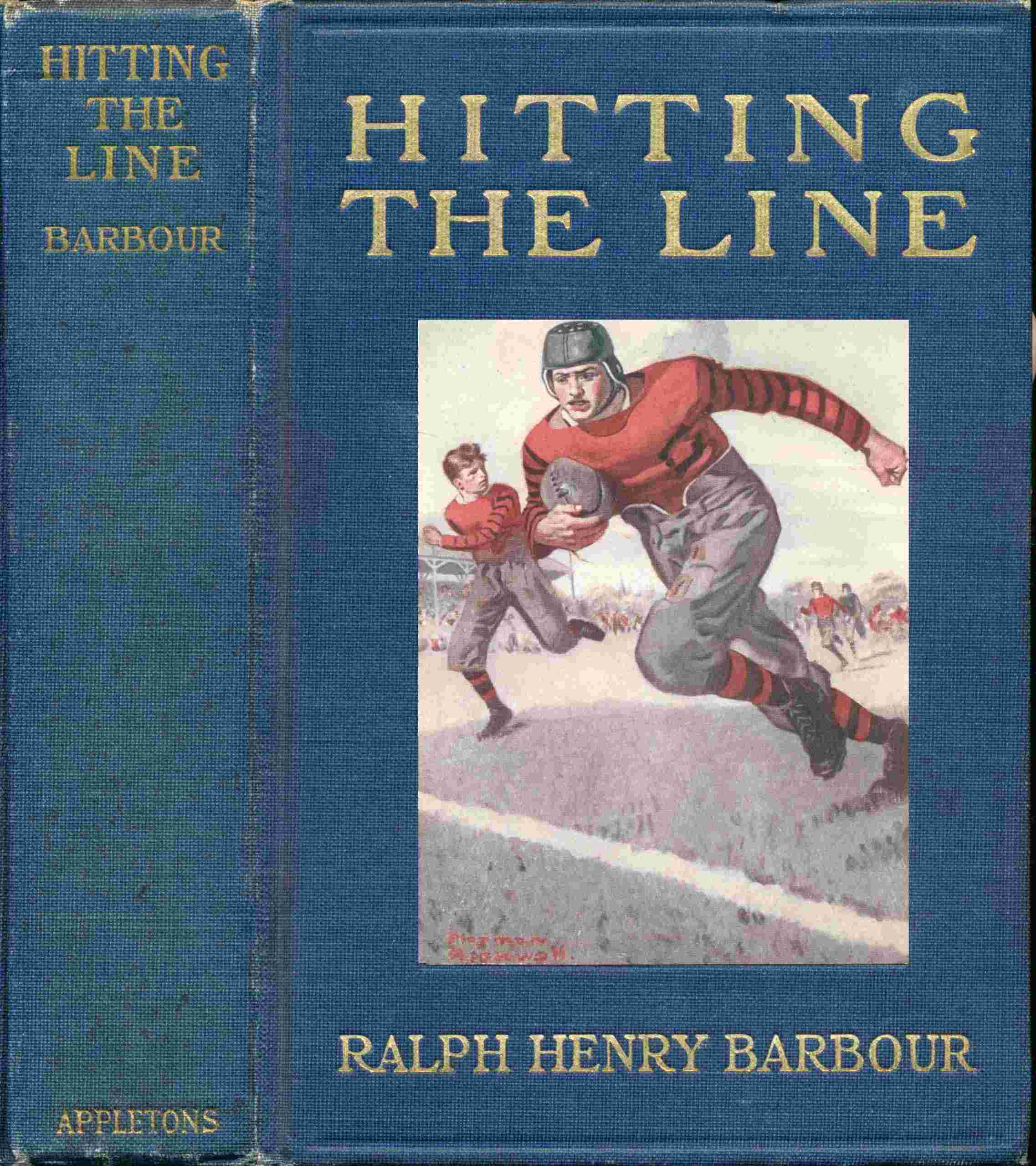
The next day was Wednesday by the calendar, and “Bull Run” according to the football crowd. Whether it was intentional or not, true it was that Coach Bonner invariably made Wednesday practice something to remember for at least forty-eight hours. That was his day for driving, and every player went down to the field fully convinced that, whether he lived to eat his supper or not, he was not due to die of ennui. On Wednesdays the scrimmage with the second went the full sixty minutes, with no let-up save such as the rules exacted, and no pauses for instructions. It was fight all the way, from first whistle to last. On the whole, “Bull Run” was by no means a misnomer.
On this particular Wednesday afternoon Monty doffed his street clothes, and pulled his togs on with misgivings. He wasn’t physically frightened, but he was very doubtful of his ability to hold his own in the real contest that was due. He walked from the field house over to the gridiron with Blake and Ordway, and he envied those experienced youths their gay and careless spirits. Personally, he was rather silent and preoccupied. He wanted to ask, yet scarcely liked to, whether Manson was likely to play, reasoning that if the regular fullback showed up, he, Monty, was not likely to be called on. And, when, a minute later, he descried Manson on the bench he didn’t know whether to be glad or sorry.
There was no tackling of the dummy today. The three squads went right to signal work, and Monty found himself on the second, with Weston, Brunswick and Hanser in the backfield with him. When, in the course of plunging up and down the field, he presently passed the first squad, he saw that Manson was not playing, after all. Still later, on returning to the side line, the fact was explained. Manson leaned on a good stout cane when he walked and limped perceptibly. The second team poured on the field like a lot of colts, evidently fully primed for their task, and, with a grim disregard of everything save the business of the day, Coach Bonner summoned the still breathless players from the benches.
“All right, First Team! Derry, Spalding, Kinley, Musgrave, Gowen, Gordon, Tray, Blake, Winslow, Ordway and Caner. Take the east goal and kick off to the second. Burgess, you all ready? Boynton, you find another fellow and hold the chain on this side. Hurry them, Burgess. Get to work!”
Monty sighed his relief when he heard Caner’s name instead of his, and he settled back on the bench, with his blanket snuggled around him, resolved to be very attentive, and learn all he might from watching the way Caner played. But that mode of imbibing knowledge was speedily denied him, for Manson limped up the moment the game had started.
“Crail, get a ball, and come over here, will you? Willard, you’re wanted, too.”
Wonderingly, Monty received a ball from the trainer, and, accompanied by Willard, a big, solid upper middle fellow, who ranked as third-string center, followed Manson. The latter led them to the end of the stand.
“Bonner wants you to learn to get the ball from center, Crail,” he explained. “We’ll be using the direct pass a good deal from now on, and you’d better be able to handle it. Willard, you go on about eight yards, please. Whoa, that’ll do! Now, Crail, get in place. Squarely behind, please. That’s the ticket. End run on the left first. No, no; don’t hold your hands out. Hide the play until the ball is coming. All right, Willard. One, two, three— Let her go! Get it, Crail! Shoot now! Hard! Run, you rascal! All right! That’s pretty good, but you want to be ready to start the minute the ball gets to you. Tuck it under your arm and swing off with the same movement. Here, I’ll show you. Oh, confound this leg! Snap her, Willard!”
Manson, having discarded his cane, poised himself, and when the ball, turning lazily over and over, came to him, with one motion slammed it into the crook of his left elbow and started away. The next moment he was full-length on the ground, but, as Monty observed, still held the ball. Monty helped him to his feet, and Manson ruefully shook his head.
“I guess I can’t give practical demonstrations,” he said, with a laugh. “Here you are, Willard. Now, try that again, Crail. You see what I mean by doing it together? You mustn’t lose any time doing those two things separately. Swing the ball under your arm, and step off with your left foot at the same instant. The two moves work right together. All right, Willard. One, two, three— Let her go!”
“Better,” he commented, a moment later, “but you must cut out that little hop with your right foot. Swing your left right out. Get your stride at once. That first step’s going to be shorter than the others, but learn to cover ground with it, just the same. Every fraction of a split-second counts, Crail.” Manson snapped his fingers. “Bing! You’ve done a yard! Bing! Bing! You’ve done two yards! Speed, speed, Crail! That’s what counts, laddie! Once more, please!”
“You got it that time. That was a lot better. Now try it to the left. Remember that you still step off with your left foot.”
“Left?” inquired Monty.
“Always when you take a pass from center to run right or left, Crail, because the ball goes under your arm. If you’re going straight ahead or nearly straight, so you carry the ball against your stomach, start naturally with your right foot. Now then, you’re running the left end. Ready, Willard!”
Once or twice there came a poor pass which Monty failed to get or, getting, mishandled, and once he fumbled a perfectly clean throw. But his catching was good, on the whole. After awhile he was moved closer to Willard and at one side and took the ball at an oblique pass. “The play’s a shift,” explained Manson, “with you three backs strung out in a line. At the ‘Hep!’ your quarter falls back and the ball shoots to you and you slide off their guard on the opposite side. Willard, you step forward as though you were breaking through. Your play is square over the spot Willard stands now, Crail. That’s that ‘44, 44’ shift, with ball to right half or fullback. I want you to get that pat.”
After a half-hour or so—Monty knew that it was about that time because the teams were back on the benches when he had time to look—Manson called a halt. “That’ll do for this time. Much obliged, Willard. Now, Crail, I’m going to talk a little while.” He limped back around the grandstand and sank onto a seat away from the bench. “Sit down and get your breath. Bonner may be wanting you in the next quarter. Crail, you strike me as a chap who was intended to play fullback and play it well. What I don’t understand is how you got into the line in the first place. Didn’t you ever think you’d like to play behind?”
“Never thought much about it,” answered Monty. “All the playing I’ve ever done was last fall at the military school out in Indiana. I didn’t know anything about football when I struck there and only went out because they got after me. They stuck me at tackle and I didn’t set the world on fire so you’d notice it.”
“Well, tackle wouldn’t be a bad place for you on a team that played a hard running game, Crail, but you’d be a misfit in that place with a team that played the plunging game. No, I think you’re meant for a fullback. Now I’m going to tell you something, and I don’t want you to breathe it to anyone before the Mount Morris game. That a bargain?”
“Yes, of course, Manson.”
“Well, I’m out of it for this season. I might play, I suppose. Doc says I may and Bonner thinks I’m going to. But I’m not. I’ve only got one knee on that leg, Crail, and next fall I’ll be at Dartmouth. My brother made a name for himself at Dartmouth and I’m expected to follow his example. Well, if I do I’m not going to do it with a bum knee. No, sir, that knee is going to have a rest from now until next fall. It may sound as though I was going back on the school, Crail, but I don’t figure it like that. I know well enough that I could go into the Mount Morris game and play for awhile. Maybe I’d last the game through. But if I did play this knee of mine would never be any real good again. I know that. Doc’s as good as said so. I want Grafton to win, you bet, but I’m not flattering myself enough to think that she can’t win without me. She can. Caner can play well enough, and there’s Fenton and you. If I take care of this old leg I’ll have four years of football at college. If I don’t I’ll have to get my letter on the Chess Team. Not only that: I might have a weak knee all my life, and that’s too much of a price to pay. Now, what do you say? Think I’m a squealer?”
“No, I don’t think so,” answered Monty thoughtfully. “I think you’re sensible, more sensible than most fellows would be about it. And I have a hunch that it’s a lot harder for you to give up playing the rest of the season than you’re letting on.”
“It is,” acknowledged Manson wryly. “It—well, it sort of hurts, Crail!” He was silent a moment. Then: “Sometimes I think I’ll take a chance,” he muttered. “I might get through all right. With a good pad—” His voice dwindled into silence again. Then: “Well, what I was getting at was that you’ve got a pretty fair chance to make a killing, Crail, if you buckle down and learn the—the fine points. It isn’t likely that Caner would play the Mount Morris game through. That bunch play hard and a back is likely to be pretty well used up by the end of the third period, if not before. Fenton’s all right, but he doesn’t carry enough weight for the job; or, rather, his weight isn’t low enough; he doesn’t keep his feet very well. So you’d probably get in if Caner came out. That’s something to work for, Crail, because you’d get your letter, if you didn’t do any more, and getting your G in your lower middle year is quite a feat. I’m telling you this because I want you to make good. I’ll do everything I can to help you along. I owe it to the team and the school to find a good substitute if I—desert them.”
“Thanks,” said Monty. “That’s mighty nice of you, and of course I’d like to make good; but I’m kind of scarey, Manson. Suppose I didn’t. Suppose I just—well, just made a beastly mess of it. You see, I haven’t played much.”
“You’ll have played much by that time,” said Manson grimly. “You’ll find yourself about the busiest chap in school, I guess. You’ll probably want to quit more than once, Crail. It won’t be any picnic, old man. But you won’t quit, because—well, because I guess you’re not the quitting kind. Besides that, you’ll want to do your bit against Mount Morris. It’s a chance that—There’s Bonner calling you!”
“Go in for Caner, Crail,” directed the coach when Monty trotted up. “Show a little more speed today. Play as though you meant it!”
The third quarter was nearly over. Caner, just about exhausted, made no demur at being taken out and handed over his head-guard with a weary air of relief. Monty pulled it on and encountered the glaring gaze of Weston, who had taken Blake’s place at the beginning of the second half. It was evident that friendship had ceased, for Weston snarled, “Now, for the love of Pete, Crail, show something! Don’t die on your feet! All right, fellows! Let’s have this!”
Neither side had scored. Substitutions had already been numerous on each team. Coach Bonner was driving the first relentlessly, while beyond the panting, restless lines, Dinny Crowley’s voice barked incessantly. The first had lost the ball on a fumble and the second had been slamming into the guard-tackle holes for short gains and had edged the pigskin back to the first team’s twenty-nine yards. Monty, watching, tried to guess the play, but dared not trust his judgment, and it was Captain Winslow who gave the warning as the opposing backs shifted to the left.
“Right! Right!” shouted Winslow. “Play in, Pete!”
Then the ball went from Monty’s sight, the backfield divided and the linesmen crashed together. For a moment the point of attack was in doubt. Then Monty, hesitating, saw that Winslow had predicted correctly. Hanser was already skirting the broken line and Monty followed. The right side of the second’s line was swinging around behind the runner. Monty saw Pete Gordon go down, saw Tray try for a tackle and miss. Then the runner was crashing toward him. Hanser had overshot the hole and it was Monty who took the brunt of that rush. The second team back went into him like a runaway horse, but Monty got his grip and, grunting as he was borne back under the impetus of the charge, held desperately. For an instant the enemy ploughed on, but then something that felt like a ton of bricks banged into Monty and he and the runner said “Ugh!” in the same breath, stopped, toppled and went over, the runner grunting “Down!” as he disappeared under a half-dozen bodies.
“Up! Up!” cried Weston. “Our ball, sir!”
“Second’s ball,” corrected Burgess, somewhere in the entanglement. “Second down! About seven to go!”
“All right! Signals!” chanted the opposing quarter. “Give it to ’em again, Second! They’re soft and mushy! Easy picking, fellows, easy picking! Signals!”
Again came the attack and Longley, at center, was toppled aside. But the backs stopped the runner for less than a yard gain. Third down now, and six to go. “Watch for a forward, First!” warned Winslow. “Spread a little, Hanser!” But the second chose to punt and Monty trailed back under the arching ball, warily, facing about at every other step to watch the oncoming enemy. Then the ends were threatening and he tried to get the first and failed, recovered in time to send the other sprawling, went down himself under the charge of a big second team lineman, scrambled to his feet again to find the tide flowing back toward him and did his best to get into the hasty interference. But Weston, ball in arm, slipped across the field, with only Hanser on his flank, and, turning, twisting, gaining and losing, was finally brought to earth near the side line after a twelve-yard run back. And before the next play could start the whistle piped.