
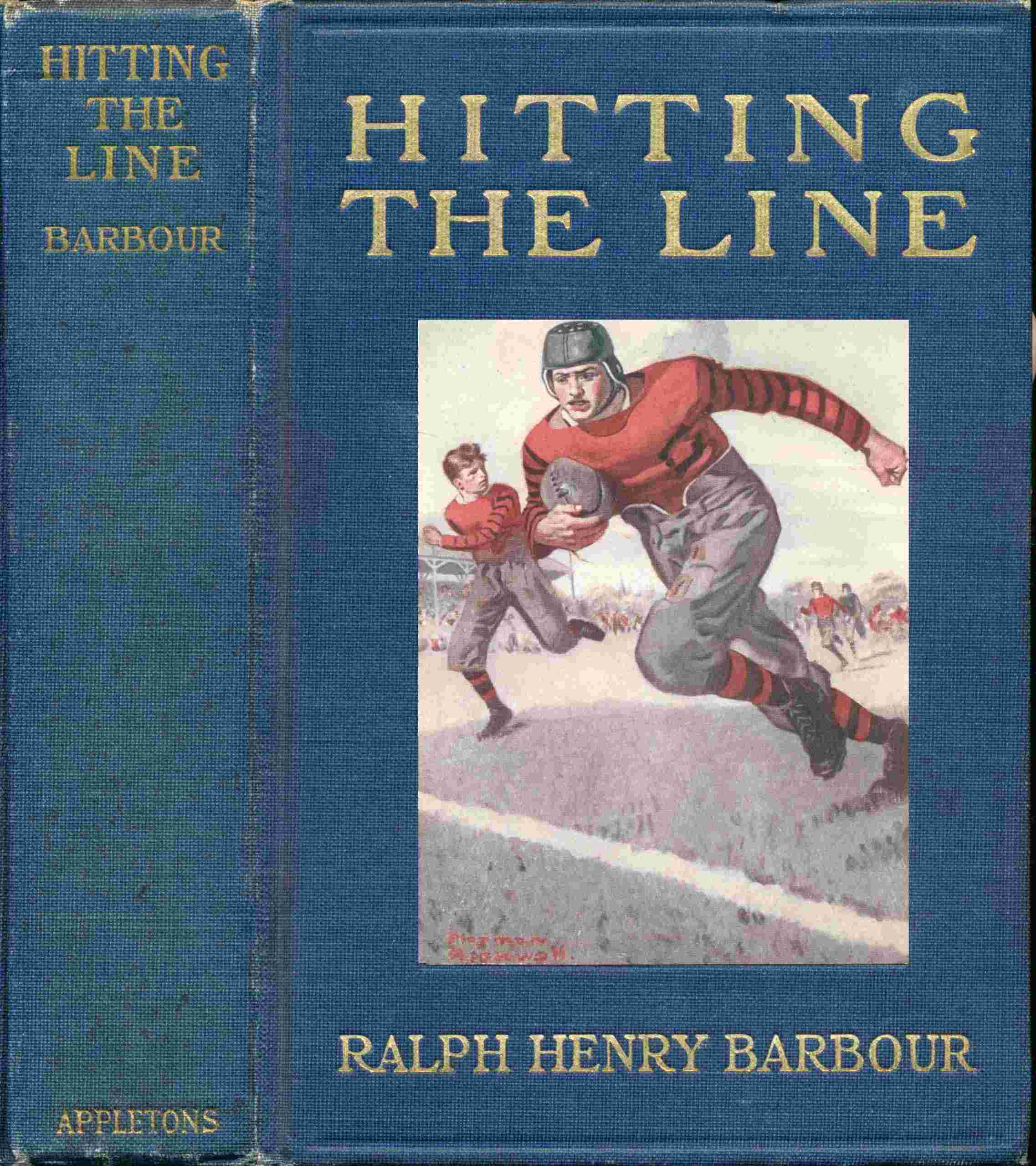
So Grafton took home a battered football and a 13 to 7 victory, and was vastly pleased, because Lawrence Textile was no mean antagonist and had won her previous games with Grafton with discouraging monotony. Monty was bruised but happy. Although none of the players had given him more than a slap on the back and a word of grinning approval, he nevertheless knew that he had in those four plunges established himself on the team. As Mr. Bonner would have phrased it, and as a fact did phrase it, to Captain Winslow, he had proved himself of first-team caliber. He didn’t have to be told that he had at last drawn ahead of Caner in the race. He knew it, and knew that next Saturday he would start the game as fullback for the Scarlet-and-Gray.
And yet, as pleased as Monty was, it is doubtful if he was any happier than Leon. Leon could talk of little else all that evening, and I think Jimmy was a bit bored by the conversation, even if he was too polite or, perhaps, sympathetic to show it. They had another concert in the common-room after supper, with first Monty and then Forbes officiating at the piano. In the end the concert turned itself into a tumultuous, wildly enthusiastic cheer-meeting, and the room was too small to hold all those who wanted to get in.
There was another assemblage in School Hall Monday night, but Monty didn’t attend. Nor did any of the players. There was a blackboard drill in the gymnasium that evening, and when it was over the cheer-meeting had adjourned to the campus, where, in spite of a twenty-mile wind out of the northeast, some hundred and fifty hilarious youths marched and snake-danced and sang and shouted until authority in the shape of several regretful but determined proctors put an end to the demonstration.
Monty thought, ate and slept football from Saturday to Thursday. Coach Bonner had put a stop to the morning practice at forward-passing, on the score that Monty would be overworked, but Manson still guarded and tutored Monty in his every spare moment. Manson was walking as well as ever now, but it had been decided that he was not to go back to work. Brunswick, too, was out of it, according to rumor, although it was more than likely that he would be run in toward the end of the game as a reward for his services and that he might be awarded his G. The daily papers that contained accounts of Mount Morris’s condition and that supplied prophecies as to the outcome of Saturday’s contest were eagerly awaited and perused. Mount Morris had played Corbin in her semi-final game and had had an easy time of it, winning about as she liked and with a patched-up team in the second half. But Corbin was not much of an opponent for a team of Mount Morris’s power, and so the victory was not viewed at Grafton with much awe.
There was a hard practice on Tuesday and another on Wednesday, and Monty was driven inexorably during most of each scrimmage. It was evident to the coaches that his forte was working the line between tackles rather than end rushing. He was now able to start quickly and get well under way before reaching the line, and when he got to it he usually went through. And once through he was remarkably hard to stop, for Manson had dinned “fight” into him for two weeks. “You’re not stopped until you’re pulled down or thrown back,” Manson would say. “Just as long as you can put one foot ahead of the other, Crail, keep going. Every inch counts in the long run. Put your head down, stick your shoulder out and keep on boring. You’ve got the weight and you’re as strong as an ox.” And Monty profited by the advice, and time after time, when opposed to the second team, made a foot or a yard or two yards after the enemy thought him stopped. He really enjoyed plowing along with two or three second team fellows clinging to his legs, waist and neck, it seemed. Of course, he was not yet a finished player. It would take more years than one to make him that. But he did the very best he knew, played every moment and could stand a heap of punishment. And, thanks to Manson perhaps, “died fighting.”
And so matters stood when, on Wednesday afternoon, almost on the verge of the big battle of the year, that blue envelope met his sight. It lay innocently enough on the marble-topped table in the hall of Morris House when he returned from practice. He had never received a “blue,” as the fellows called it, and scarcely took the trouble to read the name on it. But he did read it, and having read it bore it upstairs and ripped open the envelope with only mild curiosity. Alvin was absent at the time, perhaps intentionally. The single sheet of azure-hued paper inside bore printed lines, and Monty had to switch on the light before he could read them.
“The Principal requests the presence of Mr. Crail at the School Office at 4 p.m. Wednesday.”
His name and the hour and day had been filled in by typewriter. Monty frowned a moment. Then the meaning of the summons came to him and he turned involuntarily in search of Standart. But Alvin was not there. Monty folded the paper up and placed it back in the envelope. Well, it would have to be faced, he told himself. After all, it wasn’t likely that they’d make much trouble now. It had been so long ago that the importance of it had faded in his mind. For the last few days he had almost forgotten the prank and Alvin’s threats. Even now he was inclined to doubt that Alvin had really told. Perhaps it was only a summons to explain why he had not done better in his studies of late. If Alvin had meant to tell about those keys he would surely have done so long ago. Unless——
Monty sat down rather weakly in the chair beside him and stared at the “blue” with wide eyes. That was it, of course! Alvin had waited until the last moment on purpose, had all along planned to let Monty set his heart on playing in Saturday’s game so that the disappointment would be greater. Monty’s hands clenched and a wave of red swept into his cheeks. If only Standart were there! If he could just get his hands on him! He started up and was halfway to the door before the futility of searching for the other came to him. First he would make certain. After that—well, Standart couldn’t keep out of his way for long!
Then it occurred to him to look at the summons again. Hadn’t it said four o’clock? Yes, and it was now after five. It must have arrived after he had gone to the field for practice. He wondered what he should do, and finally decided to go directly to the office and explain. Doctor Duncan would not be there, he presumed, but the secretary would advise him. He felt very tired and rather dejected as he walked across the campus in the twilight. Beating Standart was going to be unsatisfactory recompense for losing his chance to play against Mount Morris!
Mr. Pounder, the secretary, was alone in the outer room when Monty reached the office. He nodded at the latter’s explanation. “Doctor Duncan left word that you were to call at his house in case you came before supper time. Otherwise he would see you in the morning.”
“Shall I go to his house, then?” asked Monty.
The secretary glanced at the clock and again nodded. “I should,” he answered.
“You—you don’t know what he wants to see me about, do you?” asked Monty, with his hand on the door-knob.
“I think I do, Crail,” responded the other dryly, “but I have not been instructed to inform you.”
“It’s that, then,” muttered Monty sadly as he went back through the empty corridor. “Here’s where I get it. Snakes, why couldn’t they wait until after Saturday?”
“Will you tell Doctor Duncan that Crail is here, please,” he said to the maid who answered the bell. “He—I think he expects me.”
“Yes, sir. Will you step into the study, please?”
He stumbled into a darkened room at the right, the maid turned the light on and went noiselessly away and Monty seated himself dejectedly on the edge of an uncomfortable chair and waited.
At a little after seven Monty climbed the stairs in Trow and knocked at the door of Number 32. Only the stout Granger was in. He looked up from the book he was reading and nodded with gracious dignity. “Hello, Crail,” he said. “Come in. Leon hasn’t shown up since supper, but I guess he will be along in a minute. How is the world treating you? I say, what’s up? You look like a funeral!”
“Nothing—much, thanks. I’ll find Leon downstairs.”
“All right.” Granger went back to his book with a sigh of relief. Visitors were always more or less disturbing when a fellow wanted to put his mind on a thing.
Monty met Leon halfway down the first flight and turned him back. “Got something to tell you,” he said.
“Well, come on up, then. It’s beastly cold outside. I’m frozen. They had a window open behind our table in dining hall.”
“Granger’s up there,” said Monty. “He’s sitting in the middle of his web like a big, fat spider. We’ll walk. You won’t be cold.”
“Oh, shucks! Well, all right.” Leon followed the other down the steps with a shiver and they turned along the bricks. “What’s your trouble, Monty?” he asked lightly.
“I’m through,” said Monty.
“Through? Through what?”
“Through here. I’m on pro. Standart squealed.”
Leon stopped. “He did? Why, the—the— But probation isn’t anything, is it? What do you mean by saying you’re through?”
“Probation queers me for football,” answered Monty. “I made up my mind that if they put me on pro. I’d clear out. What I did wasn’t anything, anyway, and it isn’t fair to sock it to me like this.”
“Don’t be a silly fool!” implored Leon. “Why should you leave school just on that account? It’s a shame about football, but—but there’s next year——”
“Maybe, but I won’t be here,” responded Monty quietly. “I’m going to settle things with Standart and pull my freight.”
“But that’s crazy!” Leon expostulated. “Don’t be an ass! Listen here, Monty. You’ve had a good time with football and you’ve made the team. That’s a whole lot, isn’t it? After all, you might not have got much out of playing on Saturday, anyway. You might have got a kick in the head or something right after the game started——”
“Sure,” laughed Monty mirthlessly, “and School Hall might fall on me. No, Leon, I’m through. That’s settled.”
“Well—well, what about me?” blurted Leon. “Where do I come in? Think I want to stay on here alone, you—you——”
“You won’t be alone exactly. Oh, I know what you mean, and I’m sorry, but—there isn’t anything else to do, Leon.”
“You mean you’re pig-headed,” corrected the other exasperatedly. “There are plenty of other things to do. You can stay here and behave like a sensible chap and not like a—a kid! Lots of fellows have been put on probation before this, but they didn’t get mad and leave school. What will Mr. Thingamabob, your guardian, say?”
“I don’t know. He won’t care much. I told him I might leave.”
They walked on in silence to the end of the bricks. Then Leon nodded at the lights in Doctor Duncan’s house. “What did he say, Monty?” he asked.
“Not much. He was decent—in a way. Or tried to be. The trouble is with Old Whiskers, Mr. Rumford. He insists that I purposely put the keys on his table, or whatever he calls it, to show my disrespect. Well, I didn’t. I didn’t know it was his study. I thought it belonged to one of the fellows. I told the Doctor that, but I don’t think he believed me. Anyway, Rumford insists on having me punished and Charley says I’m to go on pro. And that settles it.”
“But—but did you tell him it was just a joke?”
“I did. He said a joke wasn’t a joke unless it was taken as one, or something like that. Oh, I’ll give Charley credit for being decent. I think he’d have let me down a heap easier if it wasn’t for Rumford. Well, never mind. I thought I’d tell you. I might leave sort of suddenly, you know. I dare say Standart’ll make a fuss about being damaged. He’s a low-down, white-livered coyote, anyway.”
“You’re certain Standart told Charley?” asked Leon.
“He didn’t tell Charley. He told Rumford. I found that out. I asked what possible evidence there could be against me, sort of injured innocence act, you know, and Charley said that one of the keys had been seen in my possession. That means Standart. No one else saw the pesky thing. I wish he had more fight in him. It’s going to be like whipping a puppy.”
“Look here, Monty! Why not go and see Rumford? I don’t believe he’s a bad sort. If you told him frankly that you didn’t mean to get him into it I’ll bet he’d act decent.”
Monty shook his head. “No, thanks. He and I aren’t on very good terms just now, anyway. I’ve been rotten in English ever since Bonner put me in at full. And I wasn’t very good before. No, he wouldn’t believe me. Anyway, I don’t feel just like licking his boots. I guess I’ve had enough of this place, Leon. I’ve had a good time, all right, and I do like the school, but I guess I’m hoodooed. Someone put tallow on my feet and I can’t stay anywhere very long.” After a moment he added: “I’m going to miss you, old man.”
“Maybe I’ll beat it, too,” responded Leon dejectedly. “Only I wish you wouldn’t, Monty. Why can’t you take your punishment like a sport and stay on here? Look at all the good times we were going to have. You know what you promised about Christmas vacation, too.”
“Oh, I might visit you then, anyway,” said Monty. “I don’t believe I’ll start anywhere else until the first of the year. Well, you’re cold and we might as well go in. If I don’t see you again——”
“Forget it!” exploded Leon. “You’re not going to leave school, and you might as well know it! You’re going to stay here if I have to go and tell Charley!”
“He can’t make me stay,” replied Monty calmly. “I’ve got a right to leave any time I want to.”
“Well, then—then—” But Leon halted helplessly. Finally: “Then will you do this, Monty? Will you keep away from Standart until tomorrow and not hike out before tomorrow afternoon?”
“What’s the idea?”
“Because I want you to. Because I ask you to, Monty. You might do that much for me, considering that you’re going to leave me all alone here.”
Monty considered. “I’m willing to,” he said at last, “but the trouble is that when I run across Standart I may sort of forget.”
“Leave him alone until tomorrow. If you pitch into him tonight there’ll be a bunch of trouble and you can’t get a train until tomorrow, anyhow.”
“There’s one from the Junction, I think.”
“Oh, don’t be a silly chump! You’re not packed, are you? And how would you get to the Junction? Will you promise to wait until tomorrow?”
“Sure, if you want me to. I—I’ll stay out until Standart’s in bed, I guess. Maybe it would be best to tackle him tomorrow, anyhow. I could get him outside somewhere. If I lick him in the room he will squeal and everyone will come piling in. All right, Leon. But if you’re expecting me to change my mind, hombre, you’ll miss your guess.”
“Never mind. I’ll chance that. Now come on up to the room and keep out of mischief. Or shall we go over and see Jimmy and Dud?”
“N—no, I guess not. What’s the good of peddling your troubles? We’ll go up and make life miserable for Granger. Maybe he’s caught a fly by this time.”