
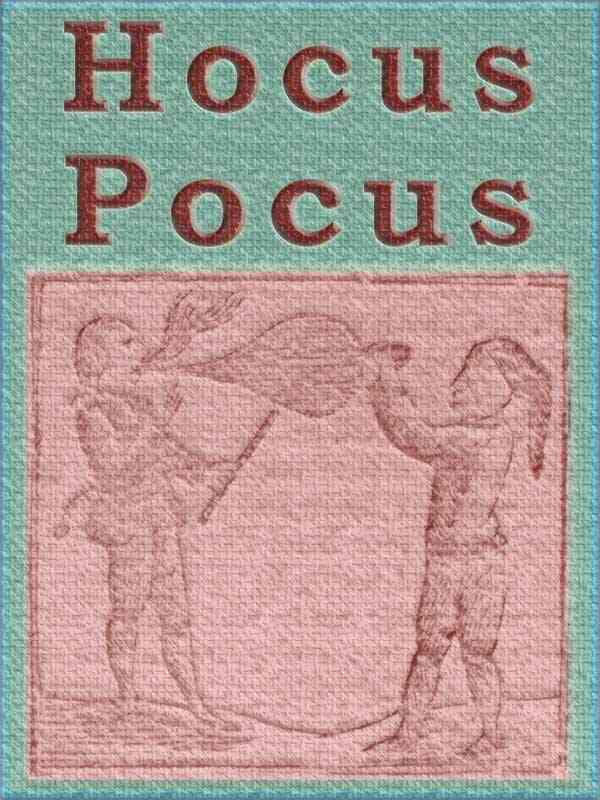
Bonus Genius: or Hiccius Doctius.
You must have the figure of a man made of wood, about the bigness of your little finger, the head whereof must be made to take off and put on at pleasure, by means of a wire that is in the neck: also, you must have a cloth cap with a little bag within to convey the head into; the bag must be neatly made that it may not easily be perceived: shew your man to the company, ‘Gentlemen, this I call my Bonus Genius;’ then shew the cap, saying, ‘This is his coat:’ say moreover, ‘Look now as stedfast as you can, nevertheless I will cozen you, for therefore am I come;’ then hold your cap above your face, and take your man in your right-hand, and put his head through the hole of the cap, saying, ‘Now he is ready to go on any message I have to send him, to Spain, or to Italy, or whether I will, but he must have somewhat to bear his charges,’ with that, pull out your right-hand from under the cap, and therewith, the body, but privately putting your right-hand into your pocket, as if you felt for money, where you may hide the body, and take out your hand and say, ‘There is three crowns for you, now be gone,’ then turn the head, and say, ‘But he will look about him before he goes;’ then say, setting your fore-finger upon his crown, ‘Just as I thrust my finger down so he shall vanish;’ and therewith by the assistance of your left-hand that is under the cap, convey his head into the little bag within the cap, then turn your cap about, and say, ‘See here he is gone;’ then take up your cap and hold it up again, throwing the head out of the little bag and say, ‘Hic mecus Genius,’ and in the mean time thrust the head through the hole of the cap, and holding the head by the wire, turn it about presently, and put the head into your pocket.
Note. Any person that is desirous to learn any part of this art, they may be taught by me.
H. Dean.
Of conveyance of Money.
The conveyance of money is not much inferior to the balls, but much easier to do; the principal place to hold a piece of money is the palm of your hand, the best piece to keep is a tester, but with exercise all will be alike; except the money be very small, and then it is to be between the fingers, almost at the finger’s ends, whereas the ball is to be kept below, near to the palm; the money must not be of too large a circumference.
To convey money out of one of your hands into the other by Legerdemain.
First, you must hold open your right-hand, and lay therein a tester or some big piece of money, then lay thereupon the top of your long left finger, and use words; and, upon a sudden, flip your right-hand from your finger wherewith you hold down the tester still therein, and suddenly, I say, drawing your right-hand through your left, you will seem to have left the tester there, especially when you shut, in due time, your left hand, which, that it may more plainly appear to be truly done, you may take a knife and seem to knock against it, so as it may make a great sound; this is pretty, if it is cunningly done, for both the ear and the eye are deceived by this device.
To convert money into counters, and counters into money.
Another way to deceive the lookers on is, to do as before with a tester, and keeping a counter in the palm of your left-hand secretly, to put the tester secretly thereinto, which being retained still in the right-hand, when the left-hand is opened, the tester will seem to be turned into a counter.
To put one tester into one hand, another into the other hand, and with words to bring them together.
He that hath once attained to the faculty of retaining one piece of money in his right-hand, may shew a hundred pleasant conceits by that means, and may reserve two or three as well as one; and so then you may seem to put one piece into your left-hand, and retaining it still in your right-hand, you may together therewith, take up another like piece, and so, with words, seem to bring both pieces together. Variety of tricks may be shown in juggling with money.
To put one tester into a stranger’s hand, and another into your own, and to convey both into the stranger’s hand with words.
Also, you may take two testers, evenly set together, and put the same instead of one tester into a stranger’s hand, and then making as though you did put one tester in your left-hand with words, you shall make it seem that you convey the tester in your hand into the stranger’s hand; for when you open your said left-hand, there shall be nothing seen, and he opening his hand, shall find two testers, which he thought was but one. By this device, I say a hundred conceits may be shewed.
How to shew the same, or the like feat otherwise.
To keep a tester betwixt your fingers, serveth, especially for this and such like purposes; hold out your hand, and cause one to lay a tester upon the palm thereof; then shake the same up almost to your finger’s end, and putting your thumb upon it, you shall easily, with a little practice, convey the edge betwixt the middle and fore-finger, whilst you proffer to put it into the other hand; provided always that the edge appears not through the fingers on the backside; which being done, take up another tester, which you may cause another stander-by to lay down, and put them both together, either closely, instead of one into a stranger’s hand, or keep them still in your own hand, and after some words spoken, open your hands, and there being nothing in one hand, and both pieces in the other, the beholders will wonder how they came together.
To throw a piece of money away, and to find it again where you left it.
You may with the middle or ring-finger of the right-hand, convey a tester into the palm with the same hand, and seem to cast it away, keeping it still, which, with confederacy, will seem strange: to wit, when you find it again, where another have bestowed the like piece, but these things without exercise cannot be done; therefore I will proceed to shew how things may be brought to pass with less difficulty, and yet as strange as the rest; being unknown, are marvellously commended, but being known, are derided and nothing at all regarded.
How to make a groat or tester to leap out of a pot, or run along upon a table.
You shall see a juggler take a tester and throw it into a pot, or lay it in the midst of a table, and with enchanting words cause the same to leap out of the pot, or run towards him, or from him along the table, which will seem miraculous until you know how it is done; which is thus, take a long black hair of a woman’s head fastened to the rim of a tester, by the means of a little hole driven through the same with a Spanish needle, in like sort you may use a knife, or any small thing, but if you would have it go from you, you must have a confederate, by which means all juggling is graced and amended; this feat is the stranger if it be done by night, and a candle placed between the spectators and the juggler; for by that means their eyes are hindered from discerning the conceit.
To make a groat or a tester to sink through a table, and to vanish out of a handkerchief strangely.
A juggler also will sometimes borrow a tester and mark it before you, and seem to put the same into the midst of a handkerchief, and wind it so as you may the better see and feel it; then will he take the handkerchief and bid you feel whether the tester be there or not, and he will also require you to put the same under a candlestick, or some such like thing; then he will send for a bason of water, and holding the same under the table right against the candlestick, he will use certain words of enchantment, and in short you will hear the tester fall into a bason; this done, let one take off the candlestick, and the juggler take the handkerchief by a tossel and shake it, but the money is gone, which seemeth as strange a feat as any whatsoever, but being known, the miracle is turned to a bauble, for it is nothing else but to sew a tester into a corner of a handkerchief, finely covered with a piece of linen a little bigger than your tester, which corner you must convey instead of the tester delivered to you into the middle of your handkerchief, leaving the other in your hand or lap, which afterwards you seem to pull through the table, letting it fall into the bason.