
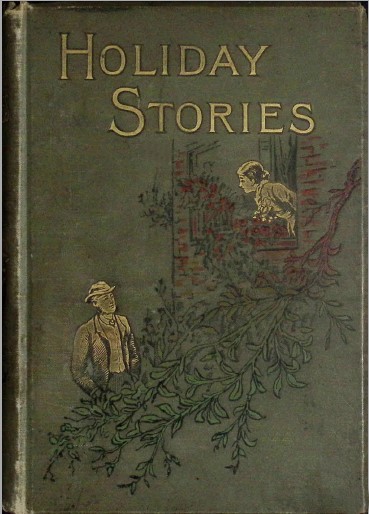
BY A GIRL'S HAND
CHAPTER I.
LIKE FATHER UNLIKE SON.
"AND so you want to be a-setting up for a gentleman, do you? You think you know better than anybody else, and that what has been good enough for me—and my father and grandfather too, for that matter—is not good enough for you. You are going to be dressed up in broadcloth on week days, and work with your coat on, are you? Grimblethorpe isn't big enough for a fine fellow like you to swagger about in. You must have a market-town, must you? And I suppose you'll be going up and down the streets o' nights, like plenty more of the same sort that are 'shamed of the honest work that their fathers took their coats off to do, and gloried in doing well. You'll be smoking cigars next, and wearing a top hat, and going in for all the new-fangled ways of spending money that young fellows practise nowadays, because they have never known what went to the earning of it. But you'll rue not having taken my advice, as sure as your name is Mark Walthew."
The speaker, Daniel Walthew, and father of Mark, paused for a minute, not because he had finished, or that he desired any reply from his son; he was only out of breath, and was fain to recover it.
More than once Mark had tried to answer these hard words, which pained him sorely; but all to no purpose. From his earliest childhood he had been told to speak when he was spoken to. But, though he was now long past childhood, he was rarely allowed to speak at all if his father were holding forth, and especially if he were not in a very happy frame of mind at the time.
Daniel Walthew had always prided himself on what he called "keeping to his own rut." By this he meant holding to the same opinions, keeping to the same habits, living on the same spot, doing the same kind of work as he had done ever since he could remember, and thus following in the steps of the father and grandfather who had gone before him. Each of these had saved a good bit of money, and handed it down to be added to by the next generation. Daniel Walthew had been the only son of his father, and though there had been three children born to himself, Mark was the only survivor.
Everybody in Grimblethorpe knew that Daniel Walthew must be well-off, but nobody, his wife and son included, could have told how well. Daniel considered that to let a woman or a young man know the length of his purse would be a great mistake, and only teach idleness, pride, and extravagance. It was commonly reported that even on his wedding-day he had half killed his bride by making her walk some twelve miles, on a hot summer's afternoon, from her native village, where they were married, to the cottage at Grimblethorpe which was to be her new home.
"We'll send the boxes by carrier," said Daniel; "you and I can walk. I mean to begin as we shall go on, Barbara."
So the newly-wedded couple walked the dozen miles, side by side when they started, the young wife plodding on behind, and being waited for at intervals when she could not keep up with the bridegroom's steady stride. Daniel was thirty-five at the time, and he had waited until after his mother's death before he made up his mind to marry. He meant to live in the old home always, married or single, and he did not believe in two mistresses under the same roof. He surprised everybody by taking to wife Barbara Sharp, aged twenty-two, and consequently thirteen years younger than himself.
A far-seeing man was Daniel, even in this matter. He had watched the girl closely, for she was in service at Grimblethorpe, before he popped the question. He knew how thrifty she was, and that, instead of wearing feathers and finery, and aping those who could afford such things, and whose position they became, she made her simple garments last twice as long as most did, and put them together with her own clever fingers. She liked saving almost as well as he did, and had a "nice bit" in the bank already.
Of course he might have married somebody higher up than a mere servant. But would one of the farmers' or tradesmens' daughters have stepped beside him in his rut? By no means. They would have wanted to drag him into a wider one, and to scatter to the winds some of the dearly-loved savings that it had been the work of three generations to bring together.
It would be different with Barbara Sharp. She would be lifted into a higher part of the road, albeit the rut might be narrow, and be mistress instead of maid, though in a much smaller dwelling than the one in which she served.
Even in the matter of age Daniel had made his calculations. "A wife should be a dozen years younger than her husband, so as to be able to nurse him when he gets a good way on in life. A woman gets looked after by other women folk; but for a man, his wife is the natural nurse." (Daniel said "natteral.") "And it is very upsetting for him to have anyone else about him in his latter days."
Self came first with Daniel, even in his way of looking right on to the very end of life.
He was dreadfully upset on his wedding-day, for just when home was reached, Barbara's face went white, and down she dropped in a dead faint on the floor of the "house," as the apartment was called which did everyday duty for sitting-room and kitchen. There was a parlour, but it was kept sacred to Sundays and state occasions.
This fainting fit filled Daniel with misgivings. Not so much on account of the hardships to which he had subjected his bride in making her walk so many miles during the heat of the day, but lest after all he had married a delicate woman, and might find her a burden instead of a helpmeet.
Such, however, was not the case. Barbara, on coming to, seemed properly ashamed of herself for having excited such a commotion; said such a thing had never happened before, and she did not think it would again. She had been mistimed, having worked early and late to do everything in the way of preparation for her marriage, instead of spending a needless shilling. On the top of all this, the walk had been too much for her—that was all, so Daniel was comforted.
Into the rut stepped Barbara, and kept therein close beside her husband. She had few relatives, and by degrees, as no visits were paid on either side, she lost sight of these. She was not an inquisitive woman, and was content to know that there was no fear of want before their eyes, and to work, that additions might be made to whatever savings already existed.
The few acres about the cottage belonged to Daniel, and furnished him with occupation. Her household work, the dairy, poultry, and pigs found enough for his wife to do. Too much when there was a baby as well. But Barbara managed. She never dreamed of employing a servant, and she was so habitually careful and orderly, that both work and expenditure were reduced to the lowest possible amount.
The two first children, both boys, died just when the toils of nursing were over, and each could patter unassisted over the red-tiled house-floor.
It was a very silent place after that. Barbara grieved, and worked more mechanically, and Daniel mourned after his fashion, thinking to himself that there was to be no son to follow father and grandfather in the old rut.
Yet the expenditure was not increased. Every apple in the orchard, every cabbage in the garden, every scrap of produce that could be turned into a penny or the half of one, was so turned to account. Slowly and surely the money kept growing, for the little holding furnished nearly all that the pair required, and clothes seemed, in Barbara's careful hands, to grow little the worse for wear.
Daniel's hoards grew—Mr. Mitcheson, the chief lawyer at Claybury, could have told how fast; for though Barbara did not know it, her husband was adding field to field, and rents and interest were being turned into principal, and let out on safe mortgages to increase the income that was never to be spent, but to go on increasing still.
Daniel liked Mr. Mitcheson, chiefly because he kept in the same rut as his father and grandfather had followed before him. It was as natural for a Mitcheson to be the chief lawyer at Claybury, as for Daniel Walthew to plough, sow, and reap the fields that his forefathers had first earned, then owned.
Daniel was forty-one and Barbara twenty-eight when their second child died. Five years later a third child was given them, and the gift remained. That he had all the affection of which his father was capable may well be imagined. In the depths of her heart, his mother longed to do more and better for her boy, to make his young life brighter and more childlike. But she had been trained to keep in one rut, and felt that there was no stepping out of it. She had no will but that of her husband, and she must teach little Mark to keep within the same bounds.
The child was not stinted in one way. He was fed with food convenient for him; his clothing was good and comfortable, and shaped to promote freedom of limb and preserve health, by the careful hands of his mother. She watched him, worked for him, nursed him, as no hireling could have done; though, thank God! There are many nurses not mothers who look for their reward less in pounds, shillings, and pence than in the well-being of the little ones committed to their charge.
But though little Mark's bodily wants were well supplied, his young heart hungered for young companionship, and no small feet except his own ever crossed the red-tiled floor. Father could not be troubled with other people's children; they would be noisy, and sometimes need asking to a meal. Mother had trained her own little man to the tidiest, cleanest ways imaginable. She rubbed and scraped his boot soles till his feet glowed again, and his tread left no mark of mud on step or ruddy floor. Mrs. Walthew had no time to look after other people's children, so, though a little schoolfellow might come with Mark as far as the gate, he came no further. Father and mother knew at what time to expect the boy, and, in their cut-to-pattern fashion, rejoiced at his coming.
But if he were later than usual, the time had to be accounted for, and he was ever admonished to come straight home, and not loiter or play on the road.
No wonder the boy grew old too fast, and felt that he was doing so—that in sheer desperation, he worked too hard at his books, and distanced the motley group of boys and girls that together made up the village school.
Fortunately, Mr. Mitcheson, after long striving, succeeded in persuading Mark's father to send him to a high-class grammar school at Claybury, the one at which he had been taught, and to which his own sons were now going.
Daniel Walthew hardly thought it possible for Mr. Mitcheson to make a mistake. All his investments, made by that gentleman's advice, had been so satisfactory, and the interest was so regularly paid, that he was delighted Mr. Mitcheson claimed no credit for this.
Daniel Walthew was too wise a man to ask for large percentages. He always said, "High interest means great risk. I want nothing beyond five per cent., and if that means risk, four and safety." So the lawyer found it easy to place his client's money in good hands, and insure the regular payments of interest in which Daniel delighted.
He alone knew what the sum total of these amounted to, but he was also aware that a good deal of money went straight into Daniel's hands every six months without passing through his own.
Mr. Mitcheson looked ahead, and in imagination saw the boy Mark grown into the man, and heir to all this wealth.
"It would be too terrible," he said, "if that fine lad were to have his life narrowed down to the limits which at present confine them. The old man's one ambition is that the boy may keep to the same rut as he walks in, but I will do my best to free him from such bondage."
Airs. Mitcheson agreed with her husband, and said, "If Mr. Walthew will send his boy to Claybury as a weekly boarder, we can do something to brighten the lad's life between Mondays and Saturdays. He will listen to you if he will to anybody."
But Mr. Mitcheson would have failed in his efforts but for the help of an unexpected ally, and an unforeseen trouble with regard to Mark himself.
CHAPTER II.
A PEEP INTO AN EARTHLY PARADISE,
AND A MEETING WITH EVE.
"HE is top of the school, and knows more than any of the other scholars, and all that I can teach him."
"That is good hearing," said Daniel Walthew, as the schoolmaster told this of Mark, then aged thirteen; but he was not equally gratified when he added, "The boy ought to go to a better place than this. Give him a chance, and you will be proud of him."
"I'm proud of him now. Top boy of Grimblethorpe school is good enough for me, and better than I could ever do."
Daniel Walthew went home rejoicing. His boy's education was completed to his own satisfaction, and there would be no more school fees to pay. Now he would take him in hand and guide his steps in the old rut.
But Daniel had planned what he could not carry out.
Mark had tasted of the fruit of the tree of knowledge, and hungered for more. There were no books at home that he did not know by heart. A weekly local newspaper was the only new literature that came within the door of the cottage. He had not even the companionship of his old schoolfellows; he was to share his father's occupations by day, and to be content with what sufficed to fill up the measure of his parents' days when working hours were over.
Mrs. Walthew doubted what the result would be, but did not say so. Mark felt his monotonous life unbearable, but had been too well trained to rebel. So he did as he was bid, and in a short time became silent, listless, careless about his food, and spiritless in everything, besides looking miserably ill.
His mother and father had little faith in doctors, except as persons who were all of one mind in having long bills. So Mrs. Walthew made herb tea of the kind drunk by three generations of Walthews, and the fourth took it from her hand, but grew no better. Then a doctor was called in. He knew the family history, and he said promptly enough, "Your boy needs no medicine such as I can give, Mr. Walthew."
Daniel looked cheerful on hearing this, and decided that advice without physic could not be very costly. He was grievously undeceived when he found that the advice of this doctor would cost a guinea, whereas the Grimblethorpe medical man only charged half-a-crown for a visit, and a bottle of medicine into the bargain.
"What your son wants is something to think about, work for mind as well as body, and young companions to work amongst. Give him change of scene, plenty of books, good teachers, bright companions, and you will save him. Here he will die, or lose his reason."
The doctor was a friend of Mr. Mitcheson's, and therefore to be trusted, and as the result of the combined advice of lawyer and doctor, Mark went to Claybury, and stayed there from Monday to Saturday in each week, whilst his father trod the old rut with only his wife to bear him company, and both sorely missing their boy's presence.
At first, Daniel Walthew had many misgivings as to the wisdom of the plan to which he had been brought to consent. Mark's feet had not taken kindly to the path which sufficed for his father, though he had never complained of it. But a new interest was created by the lad's very absence. He was terribly missed during the week; but how delightful it was to welcome him back on Saturdays, and to hear all he had to tell! So thought the mother.
But whilst Daniel rejoiced to see the hue of health coming back to his son's cheeks, and to hear the new glad ring in his voice, he was not so ready to listen, because with every week's work the lad's store of knowledge was increasing. He was getting new-fangled notions, and Grimblethorpe, which had been and still was his father's world, would never satisfy him when school days were over. "What next?" Daniel asked himself. But he was afraid to suggest an answer to the question.
Besides the wider school world, and world of books to which Mark had access now, there was another charmed circle into which he entered with bated breath. Mrs. Mitcheson did not forget the talk between her husband and herself about brightening the life of the solitary lad. She questioned her own sons about him. "How do you like young Walthew?" she asked.
"Oh, mother, he is most amusing," said Allan. "I do not mean in his talk, but he has such prim, quiet ways for a boy. He is going to be a model good boy, and as such most objectionable. He never blots his exercise-books, or leaves anything out of place, or tears a leaf, or speaks at a wrong time. He is hatefully goody-goody."
"You are too hard on him, Allan," interposed Fred, who was sixteen, and a couple of years his brother's senior. "You know how Mark has been brought up, mother, in such old-fashioned un-boylike ways—they are very good ways all the same. If I were half as careful and methodical, I should save myself many a lecture. But Mark is very clever, and his parents will be very proud of him one of these days. He is a year and a half younger than I am, but I shall have to work hard to hold my own against Mark."
"I wonder if Mr. Walthew really will be proud of the result of his son's school work. It is certain to interfere with his pet plan of tying the lad down to the same kind of life that he leads himself."
"Why, mother, Mr. Walthew could never expect Mark to go back to the old life at Grimblethorpe. To dig and delve, to sow and reap on that little holding, where two or three generations of miserly Walthews have gone on scraping and hoarding farthings, until they are as rich as —"
"Hush! Fred, your father would be displeased if he heard you talk in such a manner."
"No one can hear me but yourself, mother, or you may be sure I should not say a word."
"Tell me about Mark's manners, Fred. I have seen little of him. He is very shy, is he not?"
"Yes, but he has really nice manners. Old Mr. Walthew, though homely and countrified, had nothing coarse or uncouth about him."
"Then you think Mark will behave nicely if I ask him here?"
"No fear of that. Do ask him, mother. It will be a real kindness to him to bring him amongst younger children. He is so much too old for fourteen," said Fred.
Mark was accordingly invited to Mr. Mitcheson's, and there he entered on a new and hitherto undreamed-of life. Mrs. Mitcheson did the wisest and kindest thing possible by handing him over to the tender mercies of her younger children; for she had a very populous nursery, and Mark soon became an immense favourite with them all.
In the Walthews' home at Grimblethorpe there was hardly an article of furniture that had not done duty for two or three generations. This said much both for the makers and users thereof, but little for the good taste of either. Everything was hard, bare, and uncompromising, though exquisitely clean and orderly. Nothing ever seemed to wear out or get broken in Barbara's careful hands.
After Mark became familiar with the handsome table appointments, soft carpets, fine pictures, and furniture which combined beauty of form with comfort in use, he became painfully sensible of the bareness and ugliness of his home surroundings. How he longed to break those impossible animals in brown and white pottery which ornamented (?) the parlour mantelshelf—how he wished to remove the china mugs, with "A present from Blackshore" in gilt letters on their sides, from the rank of decorations to the crockery shelf in the cupboard!
Mark compared the hard Windsor chairs with printed patchwork covers, and the hearthrug made of scraps of cloth sewed on a canvas foundation, with the velvet-seated furniture, of which, at first, he had been almost afraid to make use at Mr. Mitcheson's. But there all the beautiful things were in constant use, and in his own home, the best, where all were ugly, might only be brought out on rare occasions.
In a general way, the Walthews used thick delft cups and saucers and two-pronged steel forks. The china tea service, really beautiful and dainty, seldom graced the board, and three-pronged forks were only seen on Sundays.
Yet Mark made no mistakes. He was too quietly observant for that, and Mrs. Mitcheson was greatly delighted with the manners of her young guest.
"He has been very nicely brought up," she said to her husband. "Who would guess, to see him at our table, that the very sight of many of its appliances was new to him but a month ago?"
"Poor fellow! I am not sure whether we are doing him a kindness," replied Mr. Mitcheson. "The father is bent on pinning his boy down to the same dreary life that he leads, and every day's absence from Grimblethorpe makes it less likely that he will submit to it."
The lawyer's children were boys with one exception. There were three—Fred, Allan, and Maurice—then the only girl, Dorothy, who was nearly twelve years old when Mark paid his first visit to the house.
After her came four little masculine steps, the very youngest being only a few months old.
Dorothy, or Dolly, was the darling of the household, alike the pet and tyrant of the boys. The elder ones were continually contriving pleasures for their sister, she as continually playing little mother to the smaller people in the nursery, each of whom in turn learned to trot after her as soon as they could trot independently, and to look for her help in every difficulty.
It was twelve-year-old Dolly who took possession of fourteen-year-old Mark, questioned him about his home, and pitied him with all her heart when she found that he had neither brother, sister, nor even a cousin within reach.
"You poor lonely boy!" she exclaimed. "You say there is only yourself at home, and no one ever comes to play at your house. What do you do with yourself on Saturday afternoons and Sundays?"
"I get lessons ready for Monday first of all. Sometimes I fetch things from the shop for mother, or help father in the garden when there is anything I can do. On Sundays I go to church once—there is only one service."
"And then, I suppose, you have somebody to talk to."
"Not often, except my father and mother. I used to have very little fresh to say to them, but now it is better, for we are not all seeing the same things the week through, and I can speak about school, and all that happens at Claybury between Monday and Saturday."
"Next time you are at home you will tell them about me," said Dolly, with childish frankness, and a little sagacious nod of the head.
Mark assented.
"What else? About the little ones, and how nice it is to be one of a lot of children—though they do bother you at times, you know," said Dolly.
"Oh yes. And I shall say how kind your mamma has been to me, and—"
But Mark checked himself, and his face flushed suddenly.
"And what?" persisted Dolly.
"You can guess what," replied Mark. "Think of all that I shall see new; of any kind words said to me, and then you will know for yourself."
"But if anyone says unkind words, what then?"
"I will keep them to myself. Repeating things helps me to remember them, and I would rather forget unkind words if I can."
"Now, if anybody vexes me, I always go straight to mamma, and tell her; or if she is not in, I tell Fred. I believe you were going to say something to me, only you stopped all in a minute. I saw you go quite red, too."
The observant little lady was right. Mark was going to say that he should tell his mother how beautiful everything was at Mr. Mitcheson's, and how different from his own home surroundings. But he felt that silence on this point would be best. Somehow, he shrank from drawing too exact a picture of the cottage at Grimblethorpe.
"Then have you no cousins at all?' persisted Dolly.
"No own cousins or near relatives."
"How horribly poor you must feel! Don't you want any?"
"I should be glad if I had brothers and sisters. There were two baby boys before me, but they died. If I could choose, I would have a brother and a sister."
"It's no good troubling now," said Dolly. "If any were to come, they would be no good for companions, so you would be as well without. Being a boy, you would not want to nurse a baby, like I always do. They are such darlings—at least ours are," claiming proprietary right in the nursery treasures. "Are not your father and mother sorry you have no cousins or anybody?"
"They grieved when the other children died, but I do not think they care about relatives. Father says the fewer people have the better; for if they are richer, they look down on you, and if they are poorer, they always want to borrow money from you."
Mark said this innocently enough, just repeating his father's words. But these made Dolly thoughtful, and she remained silent, puzzling over and trying to understand the difference between this boy's life and parents and her own.
The Mitchesons were strong in family affection, never disowning their kindred, but readily responding to all reasonable claims for help and sympathy one amongst another.
There were no loose links in their family chain; through evil report and good report, they clung together. They helped the weak, cheered the troubled, and, if misfortune pursued one of their number, the prosperous held out kind hands—not empty hands—and set him on his legs again.
Even if there were a black sheep amongst them, love flung a mantle over his faults, so that the world at large should not scoff at the sable fleece, which, maybe, grew whiter in time, as grey hairs replace black ones, with advancing years and better judgment.
Mark was a problem to Dolly which she could not solve.
She had heard people say that his father was rich; yet, she was sure he worked in the fields, and wore a coat on week days, like the cottagers round Claybury. There was no servant—Mark had accidentally told so much—and therefore his mother must sweep, scrub, and make fires, and cook, and wash up dishes; no wonder she did not want company. And they did not care for aunts and uncles and cousins! It must be all very horrid. But Mark was nice, and so Dolly magnanimously resolved that she would not "bother"—her favourite, though inelegant, expression—but would be as good as ever she could to the lonely boy. So she sent her problem to the winds, and said to Mark—
"I have seven brothers—three older, four younger than I am. One more does not make much difference; so I will have you to go amongst the big lot, and make it into four. Then I shall be exactly in the middle, and you will have eight of us belonging to you. There!"
And Dolly, having settled this matter to her own satisfaction, gave herself no further anxiety on the subject, but managed to give Mark something to talk about by initiating him into the mysteries of tennis, and laughing and making him laugh at his awkwardness.
CHAPTER III.
MR. WALTHEW IS FAR FROM EASY IN HIS MIND.
DANIEL WALTHEW'S mind was much exercised by the fact that his son had been invited to Mr. Mitcheson's, and treated like one of his own boys, for the solicitor was a very great man in his eyes. He was not only a lawyer, but the lawyer to whom noblemen, the first in the county, went for advice. He had property, too, which made him independent of his profession, and Mrs. Mitcheson had not come to him empty-handed. He entertained his aristocratic clients, and was entertained by them, and, as Mr. Walthew put it, "He thinks no more of a Member of Parliament coming to dinner, than I should of asking my next-door neighbour to a cup of tea."
Doubtless he thought less—for it was only after much deliberation that even such modest hospitality was dispensed at the cottage board at Grimblethorpe, and such occasions were few and far between.
Daniel Walthew was proud of the honour done to Mark, and yet it troubled him for two reasons. The first was because he could not understand that a lady like Mrs. Mitcheson had invited a simple country lad to her house from sheer kindness of heart, and with the single desire to brighten his young life.
Secondly, he felt that Mr. Mitcheson's life path lay on a much higher level than his own, and if Mark got accustomed to mix with grand people, how would he ever come down to that humble part of the road on which was his own rut?
"What do you think about it, Barbara?" he asked his wife.
"That Mrs. Mitcheson is very kind to Mark, and I am very thankful to her."
"But why should she ask him? That's what I want to know. I should like to know what will be the outcome of it."
"Maybe because you are a customer of her husband, and your father went and paid good money to his father. I reckon your custom has been worth a good bit to them from first to last."
"What I am afraid of is that Mark will get stuck-up notions, and when he has done with schooling, he will not want to settle down here again. If I were to see him with a cigar in his mouth, swaggering up and down like some of those empty-headed puppies that think fathers were only meant to work and scrape money together for them to waste, I should almost wish that he had followed the others when he was little."
"There is no better boy than Mark; and what is the worth of the money if neither I nor he is ever to be any the happier for it?" asked Barbara, stung to speak as she had never done before during more than twenty-five years of married life. "Why," she continued, "should Mark be tied to Grimblethorpe? He will be fit for something better, and I hope he will get it."
Very wroth was Daniel Walthew when these rebellious words met his ear. He had not married Barbara to teach him what he ought to do, or talk about money as if she brought him any.
"So you mean to encourage the lad in stuck-up ways, do you?" he asked. "You want Mark to be a fine, do-nothing gentleman when he leaves school? I wish I had never sent him, but I've promised him three years, and I never broke my word yet. He shall have his time, and then—"
There was comfort in the thought. Daniel Walthew never boasted of his money. It was happiness enough to know of his hoards, and how they grew—grew, day by day, as the grass grew, without being watched. No need that others should share the knowledge with him. But Daniel liked every one to regard him as a man of his word, and he would keep a promise at any cost to himself. So Barbara knew that Mark was safe up to seventeen, and by that time something might happen.
However much Mr. Walthew might wish to keep the actual amount of his property a secret, and perhaps most of all to his son, lest Mark should thereon found a claim to live as a gentleman, other people talked and calculated, unassisted by any hint from him. The talk reached Mark's ears, and he tried to speak about it to his mother.
"Everybody says my father is a very rich man. If he is, why should we not have a different house from this, and live like other people? It seems a shame that you should do the cleaning and washing, and that father should work just like a labouring man, when we might have things as pretty as the Mitchesons have. It is so pleasant even to look round one of their rooms, and to sit at a table where the silver and glass glitter when the light falls on them, and the table-cloth shines like satin. If we only had a few pretty vases to put flowers here and there, they would brighten the table, and we have plenty in the garden."
Mrs. Walthew looked terrified when Mark spoke of his father's wealth.
"Hush, dear!" she said. "People talk of things they know nothing about. How should they? Your father keeps his affairs to himself. As to him and me dressing up like gentlefolks, and having servants to wait on us in a big house, we should be fish out of water. We are used to our work, we couldn't be idle, and if we had to change our ways, we should be miserable. Let us alone, lad. We are best as we are. As to sticking flowers about the place, why, you have only to turn your head, and there they are all in sight, and the sweet smell coming in at the open door, so that you cannot help knowing they are there."
Mark had to be silent, for he could get no information from his mother with regard to his father's wealth; only a hurried, frightened whisper, for Mr. Walthew's step was heard on the gravel.
"Don't trouble yourself! There is only you for everything, but you will have to humour father, for he can do as he likes with what belongs to him."
"But, mother, he talks of my coming and living here in his way and working as he works. I never shall. Do you think if a blind man's eyes were suddenly opened, and he had the power either to keep his sight or go back to his old state, he would shut them and choose blindness? I have seen a better, brighter life, mother. I can never settle down at Grimblethorpe again."
Mr. Walthew's entrance prevented more conversation, and Mark, seeing that an allusion to money matters or his own future only troubled his mother, said no more, but worked harder than ever, and bided his time. He had, however, a confederate and devoted friend in Dolly Mitcheson. Dolly was the very soul of honour, and to be trusted. Her brothers, big and little, chose her as the repository of their secrets, and the one girl of the family was never known to "peach." It mattered not to her whether the smallest toddles in the nursery, or Fred, who was growing tall and manly, chose to speak confidentially, or whether the subject was trivial or important, she was equally trustworthy in every case.
When Dolly adopted Mark as a brother, in order to make a double fraternal quartet, she did him a vast service by giving him a friend on whose truth and good sense he could rely at all times.
At first, when the girl spoke to him in her frank fashion about his home, and asked him if this and the other in her own were like it, Mark hesitated, and scarcely knew what to say, whilst his face flushed painfully. How could this dainty maiden realise the difference between her parents beautiful house and its surroundings and the cottage he called home! So he turned the talk from furniture to flowers, and being great on this subject, he delighted and instructed Dolly by telling her about those she loved, and such as grew in his father's garden.
As time went on, Mark, after thinking over the matter, decided to tell this girl friend the exact story of his past life, and to describe, with the utmost minuteness, the cottage home and its contents, as well as the narrow circle in which his parents were satisfied to move.
Dolly listened attentively, picturing the while all that Mark was taking such pains to make clear to her. She could guess, too, what it cost him; but when he finished she bravely looked in his face and said—
"When people have lived so long in one way they cannot change, Mark, can they? They are like old trees—if you try to take them up and plant them somewhere else, the roots cling, and there is no moving them without breaking some. If people choose to live in a little house and wait on themselves, instead of in a big one and be waited on by other people, it is their own business, and nobody has a right to find fault. One working bee is worth a lot of drones, is he not? Any way, if your mother has no servants, she has not them to grumble about all the time she is out calling, as my mamma's visitors do. I do get tired of hearing them, when I am dressed up and sitting in the drawing-room sometimes, and I wish they would talk of something else. So does mamma. I mean to learn how to do everything, and then when I am grown-up, and have a house and servants, I shall be able to tell them what they do not know."
Mark agreed with the wisdom of this resolution; then he said:
"You must not think we are without anything that is really necessary. We have good food, beautifully cooked, and clothes, only they have to be taken great care of. I know my parents are very fond of me; only somehow, I have never been a boy like other boys. I never ran, and jumped, and raced, and got into scrapes, and tore my clothes, or got sent off to bed, as the neighbours' lads did. I think I was born rather old."
Dorothy laughed at this, and Mark joined her, then added that he had been growing younger every day since he came to Claybury, and it was all through Mr. and Mrs. Mitcheson and herself.
"But you work fearfully hard, Fred says."
"Because I want to get one scholarship at least—two if possible. I cannot live at Grimblethorpe always, and unless I can give a very good reason for doing so, my father will insist on my going home, and working as he does. He calls it 'keeping in the old rut.' If I had known no different life, I might have done it, but not now."
Months grew into years. Mark Walthew laboured incessantly at his studies. Daniel would have been more or less than human if he had not been proud of the place won by his son, of the reports which came at each term's end, and the prizes he carried off. Mrs. Walthew's glad tears ran down her cheeks, and even her husband had to turn his back upon her, that she might not see why his spectacles needed so much polishing before he could read what "schoolmaster had written about Mark."
The boy was no country lout or awkward bookworm to look at, but was growing into a fine youth, whose manners would disgrace no society. His mother's training had given him right habits to begin with, and under Mr. Mitcheson's roof he had learnt those practised by persons in a higher position. Frank, yet modest, simple but refined, sincere without forwardness, and with a mind richly stored for one so young, Mark Walthew was indeed a son on whom a father might have rejoiced to bestow all the advantages money could give.
But all the while Mr. Walthew was saying, "Barbara, this is Mark's last term. In July, he will come home to stay."
She, with a sinking of the heart, could only answer, "Yes; he will have had the three years you promised him," and hope for a solution as to future difficulties which she could foresee, though her husband could not. Whilst he, nevertheless, confessed that he was not altogether easy in his mind as to what all this learning would lead to.
CHAPTER IV.
A NEW FACE.
CLAYBURY SCHOOL was richly endowed, and had many valuable scholarships open to candidates born within a certain radius of its walls. It had been Mark Walthew's desire to win one of these, believing that if he succeeded his father would consent to his continuing his studies after the allotted three years.
His success exceeded his most sanguine hopes. He won two of the best, and even without further help from Mr. Walthew, might work on for three more years, and, he trusted, win further distinctions.
"Scholarships!" said old Daniel, when informed of Mark's success. "Hasn't he been getting scholarships these last three years? He went for learning, and he should have put some by for future use by this time. I don't know what you mean by two scholarships. I always lumped the whole concern, and called it learning. Well, if he has got a double dose, so much the better; I reckon it will last longer. And when he is settled down at home, he will have plenty to serve him his lifetime."
Then came the struggle. Mark bared his heart, and told his hopes to his father, and was answered by a torrent of reproaches—told that he wanted to set up for a fine gentleman, instead of keeping to the old rut, and doing the work his father had been proud to do well.
This story begins with some of the words used by the wrathful old man; many others, far more bitter and cruel, sank deep into Mark's memory, and grieved him to the heart, but they need not be repeated here.
"If," said Mr. Walthew, "you are resolved to turn your back on home, and choose a new road for yourself, go, and never darken my doors again. But if you think of being kept in idleness by the old father's money, you will find your mistake out; I will never leave you a penny! You choose now—once and for all!"
"Then I must choose to go, father," said Mark. "God has given me some talents to account for, and I must use them. I will never ask you for money; but some day I hope I shall hear you say I have chosen wisely. If you are not now proud of my success—and, oh, I had so counted on hearing you and mother say, 'Well done, Mark!'—you shall not be ashamed of me in after years."
"I am proud of you, Mark," cried Mrs. Walthew, "so proud that I would not have you stay and be tied down from youth to age, to such a life as we have led! We are too old to change; but for you it would be a living death. Go, my son, my one darling, if so be you can choose, and have no fear of want before your eyes. I have been twenty-eight years always going the same daily round, without change in anything, except the growing older. Talk of money! What is it worth if it never gives a day's brightness, and the only pleasure the owner has is the being able to say, 'I have so many thousands of pounds, or hundreds of acres'?"
"Listen, my boy. It is terrible for a wife to take the opposite side to her husband, but I could not bear to think of your growing into a man like your father. Not that he is dishonest! To gain a hundred pounds, he would not take a penny wrongfully, or refuse to pay what is fairly due. He has only robbed himself and me of everything that money could have bought in the way of happiness for ourselves, or enabled us to give it to other people. Those who have wealth, and neither the heart to spend nor give of their abundance, are the poorest of the poor. You may be blessedly rich with very little money."
Need it be said that Daniel Walthew was not present when his wife spoke these words to her son? They cheered Mark, for they told him that his mother's blessing would be on his head, his mother's prayers ever offered on his behalf. And both hoped that in time the father's views might change. How could he stand singly against the world?
The world meant Claybury and the country round, for naturally Mark's success had made his friends proud of him—none more so than the Mitchesons, and most of all his friend Dolly. Many a time the true-hearted girl had cheered the boy on, until her own brothers used to say that the adopted one took the first place of all in her thoughts, and had more than an eighth share thereof.
Mr. Mitcheson tried to move Mr. Walthew from his resolve, but in vain. The headmaster of the school used his influence, and spoke in such terms of Mark's talents and industry, that any other man would have been delighted beyond measure to call him son.
Not so Daniel Walthew. "I don't hold with learning that takes a man out of his proper spear, and makes him ashamed of the honest work his father does," said he, and refused to hear any argument on the other side, or to speak again on the subject.
So the cottage door closed behind Mark Walthew, and all the articles purchased for his use went with him. The old man would not suffer a scrap belonging to him to remain, and the goodly pile of handsome books which had brightened the dingy parlour no longer lay on its table, to tell of the boy's school victories.
Daniel Walthew neither spoke of Mark nor allowed any other person to mention his name.
In his heart he must have felt for the sorrow of his faithful wife, for he did not hinder her from receiving letters; and he knew that the tidings they brought must be good by the glad light on her face, though tears often accompanied it—tears because her husband did not share her joy.
Mr. Mitcheson still transacted Daniel's legal business, found new investments for his hoards, and made out deeds when some fresh purchase was completed. But he felt equal pity and indignation at the sight of his self-willed client, and his inability to value the good gift bestowed on him in the shape of his talented and worthy son.
Years passed on. Mark did wonders, and his friends rejoiced that his career had more than fulfilled their most sanguine expectations.
He was at Claybury, the honoured guest of the headmaster of the old school, and his name was mentioned in the columns of the principal local papers. Copies of these came to Mrs. Walthew, who, entering the kitchen gently, found her husband eagerly reading the paragraphs relating to his boy.
At sight of her, he angrily thrust the paper between the bars and saw it burn to ashes. But his wife had caught the expression on his face as he read, and thanked God for this, as for a ray of light and hope.
"He is not so hard as he seems," she said to herself. And this she not only thought, but told her son in a letter, written in a cramped hand and imperfectly spelled, but which the youth kissed—soft-hearted fellow that he was—because it came from that dear unselfish mother whom he had only seen very rarely for seven long years.
He was turned four-and-twenty, tall, straight, and healthy, despite hard brain work, for he had lived temperately, taken outdoor exercises, and not "burned the candle at both ends."
There was a fair face that lighted at his coming—a warm, loving heart that did not try to hide its gladness, when, at an evening gathering at the headmaster's house, in honour of his old pupil, Dolly Mitcheson's hand was clasped in that of Mark Walthew.
Dorothy was twenty-two now, and for years past she and Mark had known that each held the first place in the other's heart. Friends—adopted brother and sister!—these might be and were sweet relationships; but that which subsisted now was nearer and dearer still.
Dolly had been wooed by wealthy suitors. Mark's father would never break his word, so that he had only himself to rely upon; but she knew that a time would come when her lover would be able to claim his bride, and offer a home of his own winning. And Mark knew that wealth had sought in vain for Dorothy's regard, and that she would wait, no matter how long, for her one love.
"There is one chance as to old Daniel," said Mr. Mitcheson to his wife. "He will hate to go to any other lawyer; it would be stepping out of his rut. He may not make a will at all. He has said he will leave nothing to Mark. Let him die intestate, and the lad will get the money, and the old man keep his word."
The same thought had passed through Mrs. Walthew's mind; and, if truth may be told, through that of Daniel also.
Before Mark left Claybury, he paid a brief visit to Grimblethorpe, and saw his mother; not in the cottage—never would he cross its threshold without his father's leave—but in a field-path, between the waving corn, they walked and talked together, whilst Daniel Walthew kept a business appointment with Mr. Mitcheson at Claybury.
The mother fed on that happy meeting for many a day—looking back on it, and forward to the next.
Winter came, and sturdy old Daniel, who had never known a day's illness before, was attacked by severe bronchitis, and confined, not only to house, but to bed for many weeks. It would have been going out of the regular rut to have outside help; so Barbara toiled and watched, and nursed him tenderly, getting often hard words and never thanks—for Daniel was a most impatient patient. It was only when he was fairly well again, and grumbling over his sadly-neglected plots, that Barbara's strength gave way. She was simply worn out with loss of rest and overwork. She had been as hale as Daniel; as independent of doctors and their physic; but now a great dread fell upon her husband. What if his wife were to die? He had always made sure she would outlive him, and counted on her careful nursing to the last.
Who was to nurse her? They had kept themselves to themselves. They had no neighbours in the ordinary sense, and were unused to asking favours of anyone.
Worse still, Daniel must go to Claybury on the very day that Barbara broke down, as deeds had to be signed, and the other party to them would come a long way to meet him.
Barbara suggested the name of an elderly woman who would bear her company during his absence, and she further said, "There are nurses at Claybury. Ask Mr. Mitcheson to give you the name of one."
The lawyer felt sorry to see the trouble of his stout old client, despite his stubbornness and unreasonable treatment of Mark, and called Mrs. Mitcheson into consultation about finding a nurse for Mrs. Walthew.
"I think I can find one," she said. "I will do my best, for I am grieved to hear of Mrs. Walthew's illness. No doubt she has broken down through overwork and anxiety."
When Daniel Walthew was ready to return, the nurse was forthcoming. She was young, and pleasant to look upon, but such a picture of neatness! No frizzled hair or finery, but smooth braids under a cottage bonnet, whilst wholesome-looking prints, ample aprons, and snug caps, with stout serviceable boots for outside, and noiseless slippers for indoor wear, composed her visible wardrobe.
How deft she was in her movements! How tender in her manner towards the poor invalid! How clever in preparing little things to tempt her appetite, and how patient and considerate to Daniel himself!
The old man saw his wife's face become more hopeful-looking, and in time overspread with a faint colour. He noted that her spirits improved, and that this young presence had a cheering effect on himself, for the nurse told bright tales, and as her patient gained strength, went singing about the cottage in a voice that sounded wondrously sweet, when compared with anything he had ever heard.
Barbara and her young nurse had always plenty to talk about, but sometimes they stopped suddenly when Daniel came in. He noticed, too, that she had very pretty ways, and what he called "lady hands," and yet how clever they were at whatever they attempted!
Barbara went on improving to a certain point, and then stopped. The doctor was puzzled, and said so. Day after day passed, and no progress was made. Then she began to go back a little. In mortal dread, Daniel consulted the nurse, who calmly answered, "Mrs. Walthew wants a medicine which only you can give her. She wants her son's arms round her neck, and the sight of his face."
An angry exclamation fell from Daniel's lips, and he left the cottage for a time. When he returned the nurse was standing with her outdoor garments on and her box packed ready to depart, as it was the carrier's day for Claybury.
"You will not leave her!" he cried, aghast at the sight and at the tears of his wife.
"I would not, if I could do more for her, but I cannot stay to see her die when it is in your power to save her. If Mrs. Walthew dies, the blame will be on your head."
The nurse looked fearlessly at Daniel, who turned from her to his wife as these plain words fell on his ears.
"Have your will," he said. "She must be saved. It is human nature for a mother to want her only son."
Joyfully the nurse prepared a telegram, and ran with it to the post-office, Daniel watching the while beside his wife. Not many hours later Mark stood by his mother, and that too by his father's wish, and from that moment Mrs. Walthew began to mend.
"I may have been wrong in keeping in one rut all my life, and keeping other people at a distance," said old Daniel. "Nurse Dora has taught me a good many lessons in a few weeks, more than I had learned in seventy years before. I don't know how we shall do without her, and she will have to leave us soon, she says. Here is Mark, far and away happier without money than mine has ever made me. That is a good thing. For I have said I will not leave him any, and I will not break my word."
"Do not make a will at all," said Nurse Dora.
"But I shall, my dear," said the old man, his eyes twinkling with a knowing expression, such as Mark had never seen in them before. "I shall make a will, that I may leave you a legacy. And there is no need to trouble for a way out of the difficulty. I never said I would not give Mark anything. I am free to do that, and I am not sure but what there is more pleasure in giving than leaving, for you can see the fruits of one, and not the other."
"Ah, Miss Dorothy," he continued, "the old man is not quite so blind as you thought! You have not come to speak to me of late years, but you have some of the child's face left yet, and you favour your mother. And my ears have caught old words now and then, and I know how good and true a heart my lad has won, and what a clever housewife and nurse can be joined to a born lady. You have won old Daniel as well as young Mark, and all I can say is, 'May God bless you both, and forgive me!'"
Is it worth while to add another word? To tell how Dolly Mitcheson's wise resolve, "to learn everything," brought good fruit, or to speak of the way in which Daniel opened his purse as well as his heart, or of the renewed health of Mrs. Walthew, the changed cottage, the abandoned rut, the perfect union between the faithful young pair when they twain became one, or of the manner in which Daniel kept his word?
He gave a handsome sum to Mark, and that, too, before his marriage; and when he and Barbara have done with the rest, it will go to "Nurse Dora," as old Daniel delights to call his daughter-in-law. No fear that this bequest will disturb the true union between Mark and his wife, despite the power put into her capable hands by the Married Women's Property Act!
Dorothy tells her husband in confidence, that however proud she may be of him, his devoted love and his great attainments, the conquest on which she plumes herself most of all is her victory over old Daniel's prejudices, and on having coaxed him out of the narrow path to which he had restricted himself for threescore years and ten.
THE END.
Richard Clay & Sons, Limited, London & Bungay.