
Till they forget themselves, till all’s forgot,
Till the deep sleep falls on them in that bed
From which no morrow’s mischief knocks them up.”
II
THE EAST
“I regard the man who has not sojourned in a tent as one who has not
thoroughly lived.”
W. H. H.
The first period of life was over. The mystic letters were used no more; after the savage onslaughts of the press it had been determined that Pre-Raphaelites should be recognised by their work alone, not by any arbitrary signal. Henceforth each of the Brothers followed his own line. Marriage came in due course. Mr. Holman Hunt has been twice married; he has two sons and a daughter.
“You know that in the most beautiful former conceptions of the Flight into Egypt, the Holy Family were always represented as watched over and ministered to by attendant angels. But only the safety and peace of the Divine Child and its mother are thought of. No sadness or wonder of meditation returns to the desolate homes of Bethlehem.
“But in this English picture all the story of the escape, as of the
flight, is told in fulness of peace and yet of compassion. The travel
is in the dead of the night, the way unseen and unknown; but
partly stooping from the starlight, and partly floating on the desert
mirage, move with the Holy Family the glorified souls of the Innocents.
Clear in celestial light, and gathered into child garlands of
gladness, they look to the Child in whom they live, and yet for whom
they die. Waters of the River of Life flow before on the sands;
the Christ stretches out His arms to the nearest of them—leaning
from His mother’s breast.… You may well imagine for yourselves
how the painter’s … better than magical power of giving effects of
intense light, has aided the effort of his imagination, while the passion
of his subject has developed in him a swift grace of invention which,
for my own part, I never recognised in his design till now.”
Ruskin.
The canvas is now in the Walker Art Gallery, Liverpool. Mr. J. T. Middlemore has a replica.
Please click on the image for a larger image.
Please click here for a modern image of the painting.

“The Scapegoat”—a subject which he had thought of suggesting to Landseer—was painted by the shore of the Dead Sea. After many negotiations, for the country was in a troubled state and he risked his life by going, he encamped there, with a little band of followers to protect him, and a goat. Soleiman, one of the Arabs, desired—though only seven years younger than himself—to be his son. By what name should he call him? Hunt? That was no name at all. Holman? That was not much better. William, however, pronounced “Wullaum,” he “found very good.”
One night, when the dews fell heavily, and they were some way from the encampment, Hunt, afraid of the effect of a chill, began waltzing—with his gun for a partner—to keep himself warm. Soleiman was overcome with amazement. “Henceforth let me be your brother,” said he—unconscious that he had become a Pre-Raphaelite—as he flung his arms round the neck of this wonderful man. “You are indeed inspired; you dance like a dervish; you are one. Can you do it again?” “Yes, my brother,” and away the wonderful man went, a second and a third time, again and yet again. He was asked to repeat the performance for the benefit of the others, who yelled with delight when they heard of it, but this he declined to do; and the next day Soleiman invited him to marry the daughter of the sheik his uncle, and to become sheik instead of himself when the old man died, that he might lead the tribe in battle, and act as dancing-dervish in times of peace. Where had he been born? In London? What was London?—a mountain? or a plain? Not a city like Jerusalem with walls and gates and shops?—“Never, my brother! I will never believe that you are a citizen—never! I know you are an English bedawee, and you were born in a tent.” In spite of all this filial and fraternal affection, Soleiman was not much good when danger threatened. “There are robbers,” he declared one day; “they are coming this way—one, two, three, on horseback, and two—wait, three—yes, four on foot. You must put down your umbrella, shut up your picture, cover it with stones. They will not be here for an hour. We will go up in the mountains.” “No,” said Hunt, he should stay where he was, it was a good work that he had in hand; Allah would help him; he was quite content. After several passionate appeals, off went Soleiman by himself, taking the donkey. The robbers presently appeared, seven of them, on foot and on horseback, armed with long spears, with guns and swords and clubs. The painter painted on unconcernedly. They drew up in a semicircle round him, and the chief shouted for water. The artist looked at him from his head to his horse’s feet—at the others also, and then resumed his work. Again the chief clamoured. They might have water, the artist said at last, since the day was hot; but Englishmen were not the servants of Arabs, and he was an Englishman; they must fetch it themselves. And he continued to paint. “Are you here alone?” they inquired. “No; there was an Arab.” Thereupon they requested that he might be called. “But I don’t want him,” said the artist. “We want him.” “Well then, you call him. His name is Soleiman.” Soleiman, however, made no reply. “There is no one, or he would answer,” they said distrustfully. “He is afraid. You know best how to reassure him.” At length Soleiman came slowly down through the rocks, driving the donkey. A long conversation followed—a wonderful description by his “brother” of the gun with two souls which he had, of the pistol that would fire more than five times without reloading, of his accomplishments as a dancing-dervish and as a story-teller (especially about Lot), of the manner in which he wrote all day in coloured inks the sky, the mountains, the plain, the sea, even the salt, on that large paper.
The Arabs became intensely suspicious. What could these things mean? He had the white goat led over the ground, they supposed, to charm it. He was a magician. He would go back to England; he would wipe out the coloured inks with a sponge; he would find the Cities of the Plain underneath; he would be lord of a great treasure. For the present they agreed that they would let him alone; but he considered it prudent to waltz home that night.
“My dreams kept me with the Brotherhood,” he says. Once he had fallen asleep within his tent, he was back in England among the old set, “talking of plans and thoughts beloved of both.”
The Academy hung “The Scapegoat” on the line; and it was sold for £450, but “The Finding of the Saviour in the Temple,” begun in Jerusalem, could not be finished for some time; he was compelled to work at smaller pictures which would bring in ready money. In the end, after a friendly consultation with his old foe, Dickens, he asked and obtained for it £5500, the largest sum that had ever yet been paid for an English picture.
“Isabella” was painted in Florence in days of great sadness; a year after the artist completed, with his own hand, the marble monument designed for his young wife.
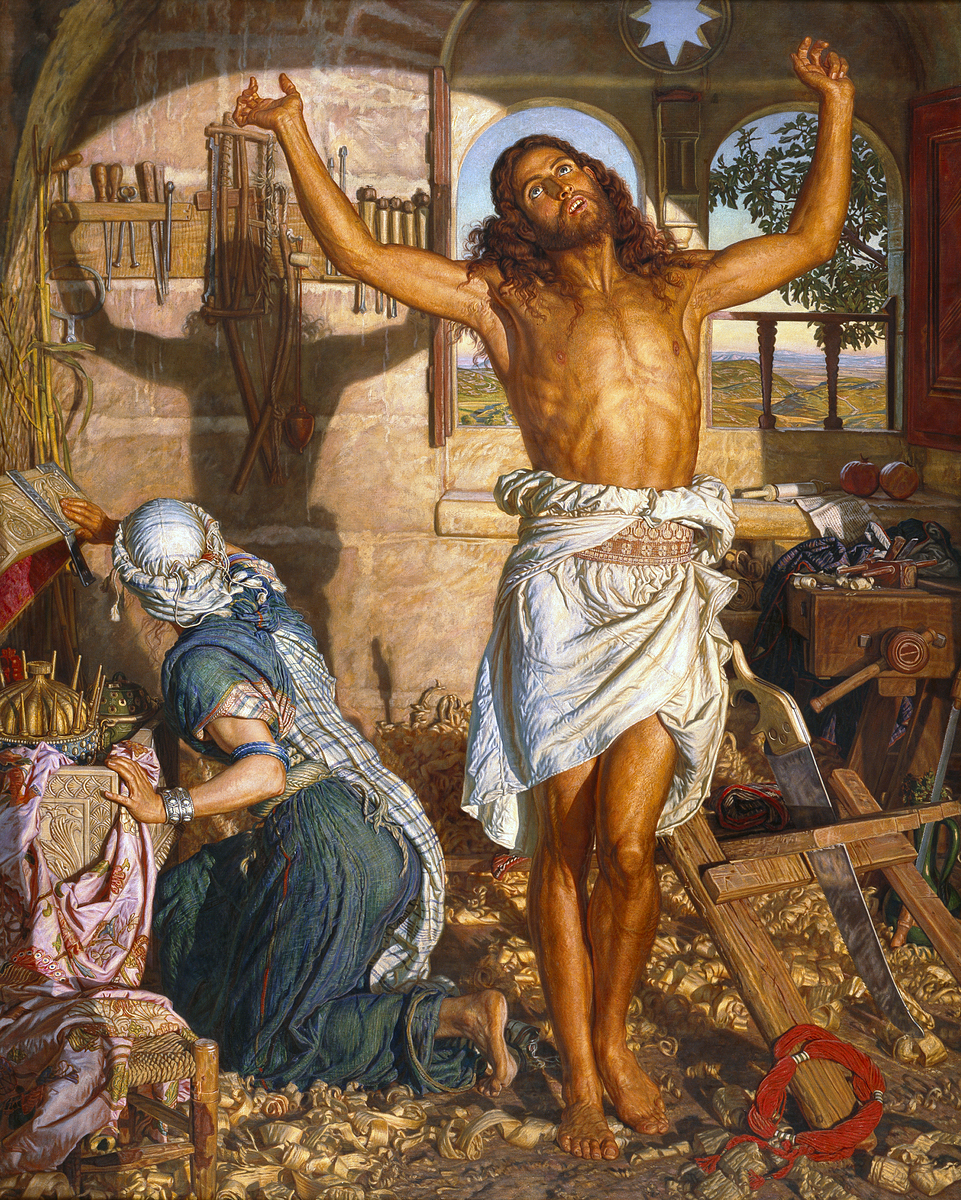
“The Shadow of Death” (“Is not this the Carpenter”?) was painted on his return to the East, and yet again he went thither, to bring back with him “The Triumph of the Innocents” and “The Holy Fire.” A number of Mahommedan ladies, from the harem of a neighbouring “effendi,” came to the house at Jerusalem, and asked to see “The Innocents,” while it was still in progress. The leading lady counted up the figures.
“Seventeen babies in the large picture, and several more in the smaller one, with the Sib Miriam,[7] Al Issa Messiah, and Mar Jusif. This is very well,” she said, “but on the Day of Judgment what will you do?” “Ah,” I returned, “I can trust only in the mercy of the Beneficent; but why, pray, ask me that question?” She returned, “Because the souls of these beings that you have made will be required of you, and what will you say then?” My reply, justified on metaphysical principles, was, “I hope every one of these will be present to justify me.” She looked bewildered, but then turning to her flock, re-echoed my assurance, saying, “Oh, if indeed you can satisfy God the Just with their souls, it will be well with you!”[8]
Music and rosy dawn are the inspiration of “May Morning”; on Magdalen Tower a band of choristers chant their hymn to the Light of Heaven, according to ancient custom, upon the 1st of May. “The Lady of Shalott” is fresh in the recollection of all who have seen her. A larger version of “The Light of the World” has been purchased recently by Mr. Charles Booth, for the benefit of the nation. Since that time the artist has not been able to work.
In 1881 Rossetti died. His former comrade offered to visit him when he heard of the illness; but the offer was courteously declined by Mr. William Rossetti. In 1896 grave fears began to be expressed about Millais. “The truth of his doomed condition, at first resolutely ignored, came very suddenly to him, and then day by day he stepped down into the grave, but never lost his composure or noble personality.” These quiet words are the fitting close of the tribute paid to him by his oldest and greatest friend, in that book which is a record as much of friendship as of art.
III
THE SUBJECT PICTURES
“One scarcely express purpose in our reform, left unsaid by reason of
its fundamental necessity, was to make art a hand-maid in the cause of justice
and truth.” W. H. H.
“The vital ambition of an artist is to serve as high priest and expounder of the excellence of the works of the Creator—choosing the highest types and combinations of His handiworks, as the Greeks taught the after-world to do, so that men’s admiration may be fascinated by the perfection of the works of the Great Author of all, and men’s life thus may be a continual joy and solace.”
The aim set forth in this declaration is not the aim of any school, however distinguished, but the aim, conscious or unconscious, of all great painters. It has been constantly pursued throughout the life of him who wrote these words; if we did not put this first, we should err.
The secondary purpose of his work—to give England what she has never had before, a school of artists of her own—of vast and infinite grandeur though it be, is yet subservient.
“As to the pure white ground, you had better adopt that at once,
as, I can assure you, you will be forced to do so ultimately, for Hunt
and Millais, whose works already kill everything in the exhibition
for brilliancy, will in a few years force every one who will not drag
behind them to use their methods.”
Ford Madox Brown to Lowes Dickenson.
This picture is to be seen at Manchester Art Gallery.
Please click on the image for a larger image.
Please click here for a modern image of the painting.
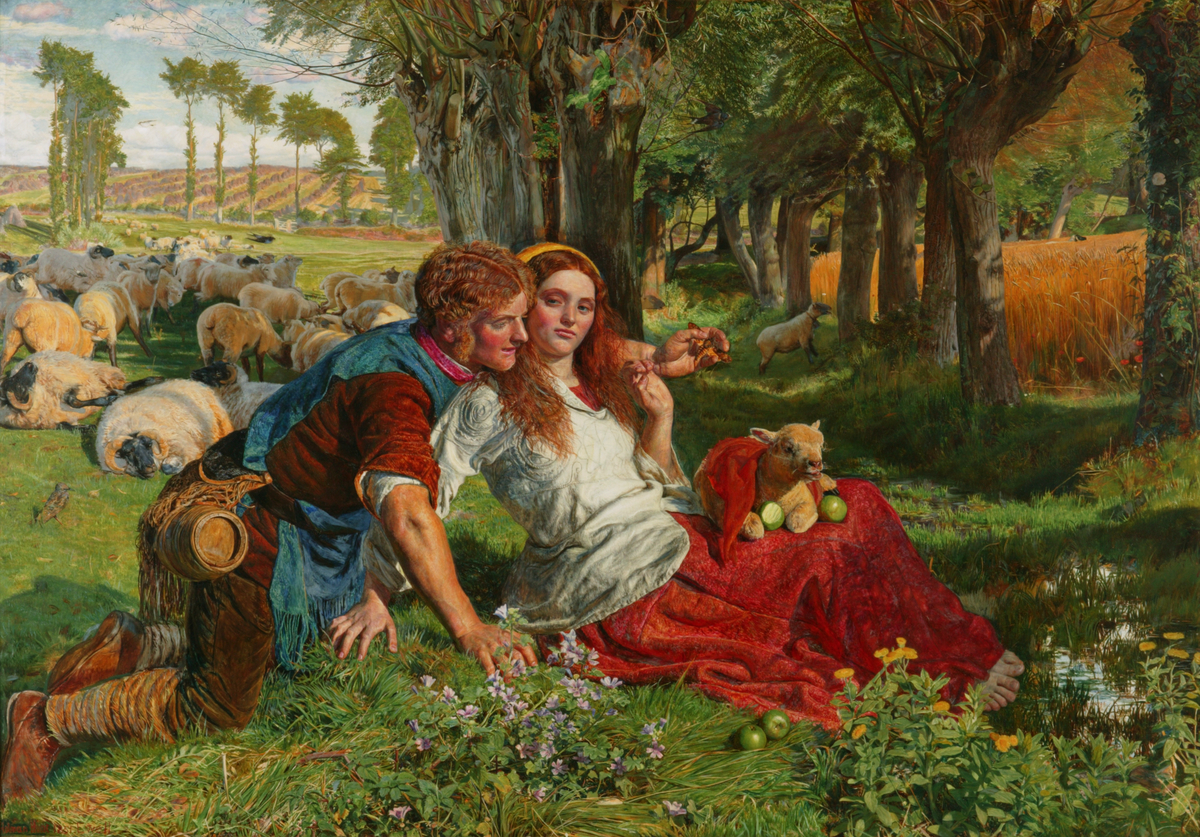
Many technical questions beset a true revival which are of deeper interest to the actors in it than to the public at large. Such was the question of the introduction of oil as a medium in the old days; such was the question of the proper way to render brightness in our air. “You vagabond!” said Millais—as he watched Hunt painting in transparent colour, with light sable brushes, over a ground of half-moist white, the landscape of “The Hireling Shepherd”—“that’s just the way I paint flowers!” They had arrived at this method by independent lines of thought. To them, and to their brother artists, it was most important. Millais, delighted, proposed that they should keep it a secret—and instantly confided it to Ford Madox Brown. The outer world was more concerned with the fact that the sun could be made to shine upon canvas than with the way in which it was brought about. The one inevitable condition of the truth of a revival is always, by one method or by another, a return to Nature. This had been accomplished; and the world, as ever, divided—the few hailing what they saw as a revelation, the many denouncing it as heresy.
When a picture by the first Pre-Raphaelite was carried in triumph through the streets of Florence there were those who named that quarter Borgo Allegri; but there were those who declared that art was at an end now the Byzantine tradition had been broken. When the pictures of the last Pre-Raphaelite shone out at Burlington House, there were happy people who vowed they looked like “openings in the wall”; there were also those who declared that art had come to an end now the tradition of Raphael was ignored. Steadily, through evil report and good report, the painter went his way. He did not hold—as Millais came to hold in after years—that it was the business of the artist to find out what most people wanted, and to paint that. He did not hold—as Rossetti held—that it was the business of the artist to impose his will on a select band of followers, trained by himself to believe that the age of Dante was the Golden Age, and that colour should be based on the principles of illumination. He held that an artist was accountable to God. He held that an Englishman should study those minds, those words, which have more power over England than any others—should help to make those clear.
Shakespeare had led him to “rate lightly that kind of art devised only for the initiated, and to suspect all philosophies which assume that the vulgar are to be left for ever unredeemed.”
He hated newspapers because “the influence of writers who have had no other qualification to judge of art matters than the possession of more or less literary facility, has been deterrent and ever fatal to a steady advance of taste.”
There are two aspects. Art “presents the form of a nation’s spirit, exactly as the sounding atoms on a vibrating plane make a constant and distinct pattern to the sound of a given note.” Likewise, “All art from the beginning served for the higher development of men’s minds. It has ever been valued as good to sustain strength for noble resolves.”
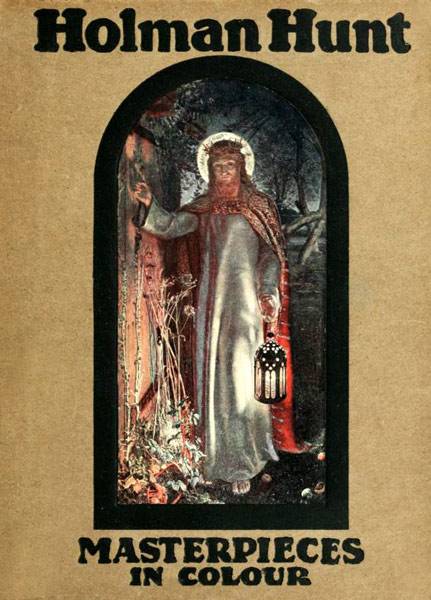
Determined to serve his generation, not as a playfellow, not as a tyrant, but as a master, he followed singly and faithfully that conviction which had led him from childhood to think of the Bible as the great factor in human existence. To the interpretation of the Life of Christ he gave the best years of his manhood. In order to understand it more thoroughly he broke away from comfort, he risked success at the moment when first she smiled on him, he left the friend whom he loved. It was not enough to paint “The Light of the World,” to set before the eyes of his countrymen the eternal King, the eternal Priest, knocking at the door of the human heart, barred darkly in behind the weeds of selfishness. He would go to the country where the King dwelt. He would show:
(1) The coming of God to earth, as it was seen by the dim eyes of tradition, of mortal learnedness, when there was found within the precincts of the Temple, among the Rabbis, a Child who had forgotten to return to his parents.
(2) The oneness of Creation in the form of the suffering creature dying by the Dead Sea shore—the Goat, the type of the Lamb.
(3) The sacredness of labour, in the form of the Son of Man resting from toil in that low workshop where the Virgin Mother hoarded the gifts of regal wisdom.
(4) The young immortal beauty ever to be seen by the Child of God, by the spirit of maiden purity, turning the torrent of death into the river of life, making the darkness as the noon-day.
To the Bible, Holman Hunt gave his manhood—to Shakespeare, his youth! No one who desires to add to the store of England’s thought but must, at one time or another, plunge deep into the mind of her greatest thinker. It is a sign of the unthinking nature of English art that, before this time, there were no illustrations of Shakespeare worth the name. It is characteristic of the pre-eminently thoughtful nature of this artist that he should have chosen two subjects that are often misunderstood, from two plays that are hardly ever acted—the subject of Forgiveness from the “Two Gentlemen of Verona;” the subject Death-to-be-preferred-before-slavery from “Measure for Measure.”
The duty of the Forgiveness of Sins—which has been well defined in the one word, Affection—a duty canvassed and discussed everywhere—is, in Shakespeare, deprived of the very aspect of a duty. It seems to have appeared to him not only natural but inevitable that anybody should forgive anybody anything. The most astounding of all his reconciliations is that of the “Two Gentlemen.” Valentine has to forgive Proteus; Sylvia has to forgive Proteus and Valentine into the bargain; Julia has to forgive Proteus; and Proteus has to forgive himself. Upon the stage we have seen an actress, in despair at the difficulty of the thing, turn her back to the audience and lean against a tree while the discussion was going on; but in the picture Sylvia kneels, her hand left trustingly in that of Valentine, and we have no sooner looked at it than we believe and understand. It is the same with that difficult moment of “Measure for Measure,” when the two sides of life speak in the brother and sister:
“And shamed life a hateful.”
The nun, we are sometimes told, is a repellent person; what business had she to urge her brother to die when she could save him by doing wrong herself? To look at “Claudio and Isabella” is to believe her and to understand.
Another picture owes its motto to one of Edgar’s mad bursts of song in “King Lear.”
Thy sheep be in the corn;
And yet one blast of thy minnikin mouth,
Thy sheep shall take no harm.”
It is not an actual shepherd and shepherdess who are seated in this leafy English landscape, among the green pastures and by the still waters. Still less is it the kind of shepherd and shepherdess that Watteau, Fragonard, and the china manufactory of Dresden have accustomed us to associate with the words. Who and what are they, those careless people in the bright sunshine, letting the sheep eat the corn that kills them and the unripe apples? The shepherd’s crook lies idle on the ground. He has found a death’s-head moth; he is too busy showing it to his companion to have any use for that. She is flattered and pleased that he should attend to her rather than to the sheep.
When this picture was painted, the Oxford Movement was in the air; the shepherd and the shepherdess were alike busy with the death’s-head moth.
Turning to modern minds, the poet whose word weighed most with England at the time was undoubtedly Tennyson. A verse from “In Memoriam” describes “The Ship.” “The Lady of Shalott” gave the subject of a work which took twelve years in painting. It was enlarged from a small design in a volume of Tennyson illustrated by Hunt, Millais, and Rossetti; and by several other artists, not of their persuasion. This particular illustration did not find favour with the poet, he objected to the lady’s hair, to her manner of wearing it. The dream has been changed into a profound allegory. The lady is—if we mistake not—the artist who, through neglect of the divine gift of reflective imagination, has failed in the high purpose of art. It was hers to weave the Quest of the Holy Grail, as she saw it in the magic mirror. If she had stayed at her appointed work, all had gone well. But she looked out of window to see Sir Lancelot—not the Sir Lancelot of Tennyson, but a boastful, pleasure-loving knight, going on his way in the sunlight, with two trumpeters before him. Then came the curse upon her, for the order of the world was broken, the order of the world all about her, in the flower of the earth, in the bird of the air, in the stars, governed and guided each by its own angel. On one side of her room order is strength as seen in Hercules—on the other submission, as typified in the earlier design by the Cross, in the later by the Nativity. This order she has broken, against this order she has sinned. The lovely picture of her weaving the likeness of the Holy Grail itself will come to naught. But up above there chimes the one word, Spes; even for those who have failed there is hope.
“This subject was the ceremony of May Morning, Magdalen
Tower, Oxford, at sunrise, when the choristers, in perpetuation of a
service which is a survival of primitive Sun-worship—perhaps
Druidical—sing a hymn as the sun appears above the horizon.…
For several weeks I mounted to the Tower roof about four in the
morning with my small canvas to watch for the first rays of the
rising sun, and to choose the sky which was most suitable for the
subject. When all was settled I repeated the composition upon a
larger canvas.”
W. H. H.
The picture is at the painter’s home in Kensington.
Please click on the image for a larger image.
Please click here for a modern image of the painting.

The lady was trying to be a realist:
The mirror cracked from side to side.”
“A man’s work must be the reflex of a living image in his own mind, and not the icy double of the facts themselves. It will be seen that we were never realists. I think art would have ceased to have the slightest interest for any of us had the object been only to make a representation, elaborate or unelaborate, of a fact in nature. Independently of the conviction that such a system would put out of operation the faculty making man “like a God,” it was apparent that a mere imitator gradually comes to see nature claylike and finite, as it seems when illness brings a cloud before the eyes.”
The practice of making independent studies for pictures which was dear to the heart of Rossetti, was discouraged by Hunt and Millais because they feared to lose unity of effect if they dwelt upon details except in their relation to the whole. They painted, first the background, after the manner described, straight from Nature; if possible, they placed the figures in the open air and studied them outside the studio walls.
There are curious differences to be noted whenever the picture is repeated, and they seem to be always in the direction of something more complex than the original. In the larger version of “The Hireling Shepherd,” he is far more subtle and sophisticated, while the shepherdess looks older and more scornful. In the smaller version of “The Triumph of the Innocents,” the hues of a soft, moonlit night prevail, the Virgin is just a sweet mother, the Child is blessing the children. In the larger version moonlight intensified, which was found by means of a lens to be that of the sun, bathes the children; the Virgin, who is much older, gazes upon them with eyes in which a joyful wonder seems to be fighting still with almost unconquerable sorrow; the Child, a wheat-ear in his hand, has thrown himself back in an ecstasy of divine laughter. The large water-colour of “Christ among the Rabbis,” the rainbow halo encircling the head of the Child as he meditates, while the dark-eyed boys, Nicodemus and Stephen, look on, is different in every respect from “The Finding in the Temple.”
IV
PORTRAITS AND OTHER WORKS
“An artist should always make sure that in his treatment of Nature alone
he is able to incorporate some new enchantment to justify his claim as a
master of his craft, doing this at times without any special interest in the
subject he may illustrate.” W. H. H.
The principle given above has been followed in such works as “Amaryllis,” “The Bride of Bethlehem,” and “Sorrow.”
There is but one portrait reproduced in this book, and that a copy of a very early one which was rescued from destruction by the artist’s mother. He was going to rub it out that he might use the ground for something else, and he objected to the rescue because it would cost him 3s. 6d.; but she stood firm. The portrait painted of himself in later life, palette in hand, was executed for the gallery of great artists by themselves at the Uffizi. The haunting “Head of Rossetti,” with fixed, intent eyes, was taken from a pastel sketch, made for Woolner when he was out in Melbourne. He had appealed to his Pre-Raphaelite Brothers to give him some tangible proof of their kinship which would help him to find clients, because their names were better known than his, and often in the paper. They held a meeting, therefore, in Millais’ studio, worked the whole day, and sent him out their portraits by each other. Rossetti’s absorbed gaze is explained by the fact that he was drawing Hunt at the moment. “Bianca” was painted in tempera from a beautiful young American.
One portrait called “The Birthday”—the picture of a lady—could not but be wronged by any description whatever.
Day after day last autumn, two little rooms in Leicester Square were crowded with eager thousands, thronging to gaze upon the pictures that, when they first appeared, no one would buy. Outside, the fog often held sway. Within, light shone from every wall, the light of dawn from “May Morning”; the glowing light of noonday from “The Strayed Sheep”; moonlight from “The Ship”; soft starlight from “The Triumph”; the light upon the sea, the downs, the mountains, the faces of men and women in the open field; the light of strange fire; the light of human eyes inspired with hope and purpose; the radiant light of spiritual force.
CHRONOLOGICAL LIST OF THE
CHIEF PICTURES MENTIONED
| Portrait of the Artist by Himself at Seventeen | 1844 |
| Woodstock (first picture sold—for £20) | 1846 |
| The Eve of St. Agnes (The Flight of Madeline’s Porphyro) | 1846 |
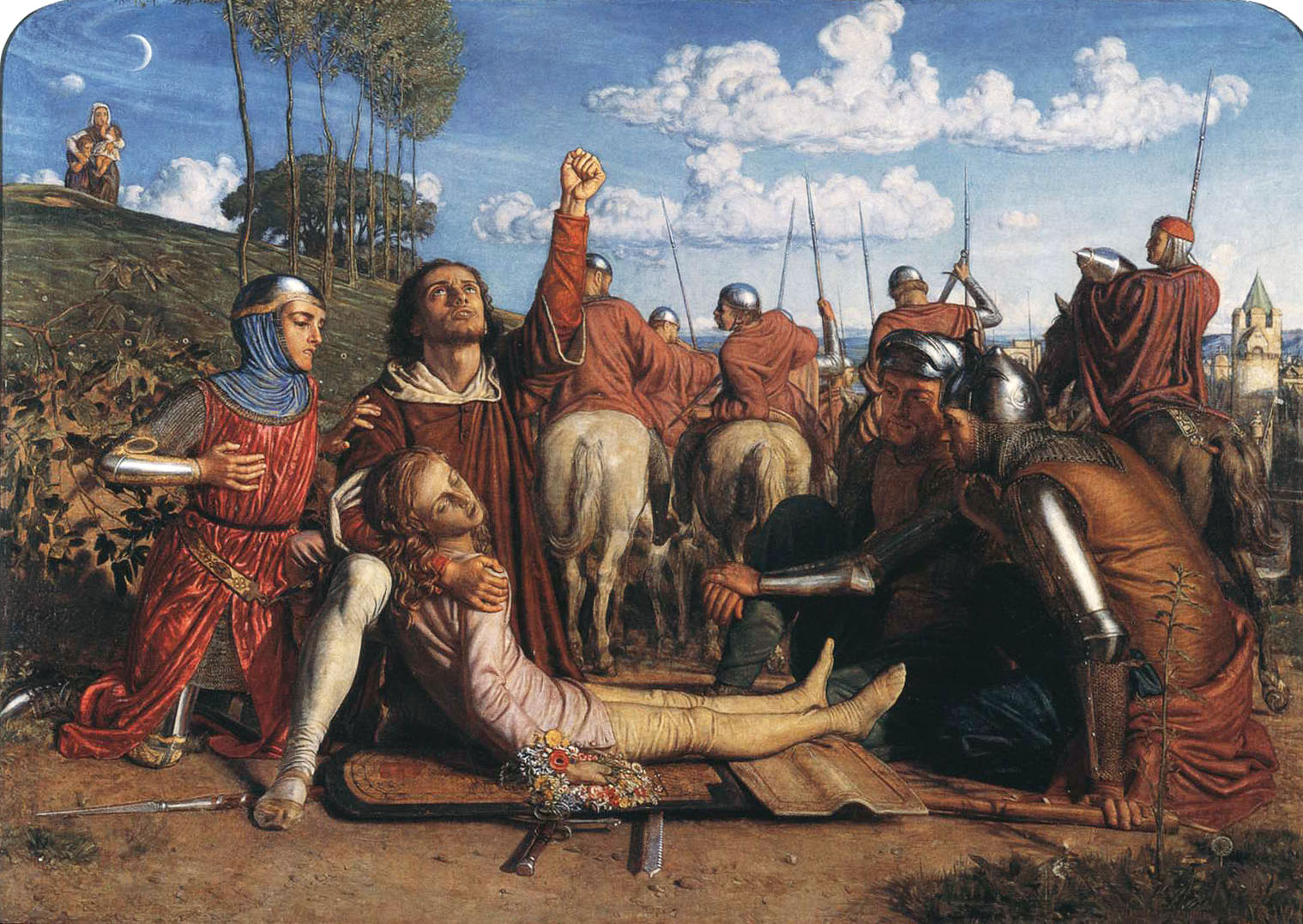
| Rienzi | 1848 |
| A Converted British Family sheltering a Missionary | 1850 |
| Claudio and Isabella | 1850 |
| Valentine and Sylvia | 1851 |
| The Hireling Shepherd | 1851 |
| The Strayed Sheep | 1852 |
| The Light of the World | 1853 |
| The Awakened Conscience | 1853 |
| The Scapegoat | 1854 |
| The Finding of Christ in the Temple | 1854 |
| Isabella, or The Pot of Basil | 1867 |
| The Shadow of Death | 1869 |
| The Ship | 1875 |
| The Triumph of the Innocents | 1875-1882 |
| May Morning | 1889 |
| The Lady of Shalott | 1889 |
| The Holy Fire | 1892 |



_-_Google_Art_Project.jpg)




These dates are approximate; the painting of many of the pictures extended over several years.
PRINTED IN GREAT BRITAIN AT
THE PRESS OF THE PUBLISHERS.
FOOTNOTES:
[1] “Pre-Raphaelitism and the Pre-Raphaelite Brotherhood,” vol. i., by W. Holman Hunt.
[2] “Pre-Raphaelitism,” vol. i. p. 56.
[3] “Pre-Raphaelitism,” vol. i. p. 61.
[4] “Pre-Raphaelitism,” vol. i. p. 19.
[5] “Pre-Raphaelitism,” etc., vol. i. p. 80.
[6] Hunt, who had written poetry himself, mostly in couplet form, and in the Spenserian stanza, gave it up on account of Rossetti’s greater proficiency.
[7] The Virgin Mary.
[8] “Pre-Raphaelitism,” etc., vol. ii p. 328.
Transcriber’s Notes:
The following corrections have been made, on page:
16 ” changed to ’ (my brush, is it?’ caught me up and)
37 “artistocrats” changed to “aristocrats” (hundreds of young aristocrats)
74 “incorporat” changed to “incorporate” (he is able to incorporate some).
All other inconsistencies in spelling, hyphenation and italisation were preserved from the original.
The illustrations have been moved slightly for reader convenience. The links in the Table of Contents are edited so that the reader will go to the correct page even though the original page numbers have been retained.
Links to the mentioned paintings have been added to The Chronological List of the Chief Pictures Mentioned. A picture of “Woodstock” however was not found.
Every effort has been made to faithfully preserve the illustrations of the original book. Newer representations of these and other paintings by Holman Hunt may be available on the internet, for instance here.