
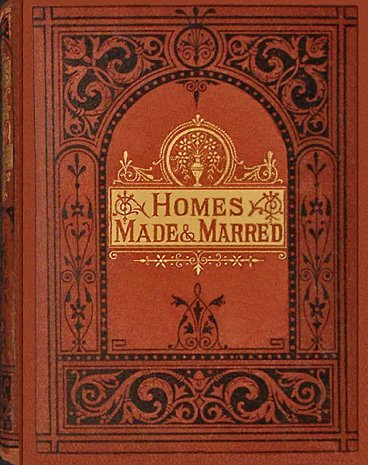
The Project Gutenberg eBook of Homes made and marred
Title: Homes made and marred
a book for working men and their wives.
Author: Lucy Ellen Guernsey
Release date: February 21, 2026 [eBook #77998]
Language: English
Original publication: London: The Religious Tract Society, 1873
Other information and formats: www.gutenberg.org/ebooks/77998
Transcriber's note: Unusual and inconsistent spelling is as printed.
A FAREWELL VISIT.
HOMES MADE AND MARRED.
A BOOK FOR
WORKING MEN AND THEIR WIVES.
[BY]
[LUCY ELLEN GUERNSEY]
LONDON:
THE RELIGIOUS TRACT SOCIETY
56, PATERNOSTER Row; 65, ST. PAUL'S CHURCHYARD;
AND 164, PICCADILLY.
CONTENTS.
CHAP.
III. MORE THINGS "PUT OUT" THAN THE BRICK
X. NEW SCENES AMONG OLD FRIENDS
XV. SOLEMN FACTS FOR SOCIAL SCIENCE
XVI. THE BOTTOM OF THE INCLINE
XIX. IN "THE SHADOW OF A GREAT ROCK"
XXIV. ADDITION WITHOUT IMPROVEMENT
HOMES MADE AND MARRED.
CHAPTER I.
HOPES AND PROSPECTS.
"MAMMA, do come and see our beautiful new swing!" cried a little boy, rushing into his mother's sitting-room. "Mr. Hill has finished, and he would like to know that you think it is all right."
Mrs. Oakland immediately rose and followed to inspect the new appliances which had been erected for amusement and exercise, and stood while an intelligent workman described to her the strength and the security of the plans. The lady was quite satisfied, and thanked him warmly for the skill and trouble he had bestowed upon his work.
He was a fine-looking young man, with a well-formed head, a clear, bright eye, and a strong arm, and might have stood as a model of a British workman. His cheek glowed and his heart warmed with the well-earned praise; and if the lady were pleased, so certainly was he.
The young man seemed to hesitate for a moment after receiving thanks for his work, and then, twisting his cap once or twice round on his hand,—
"If you please, ma'am," said he, "if it's not intruding too much, might I beg a few words with you?"
"Certainly, Mr. Hill," she replied. "Come to the house; we will leave the children to their new swing."
"I beg pardon, ma'am; but if you'll just walk a little this way, I would rather not go to the house." And Matthew Hill glanced involuntarily at his working jacket and tool-basket.
The lady, somewhat perplexed, walked with him towards the garden gate.
"I beg pardon, ma'am; but you know Jane?" said the young workman, abruptly.
"Jane, whom? My housemaid?" said Mrs. Oakland, and a new light broke upon her mind. "Oh yes, I have known Jane for several years."
"And you have been very kind to her, ma'am, I know."
"She is an orphan, and, having no other home, I have overlooked many things that might have deprived her of one with me," said Mrs. Oakland. She felt as if she must at least say so much, fearing that Matthew was thinking of placing his happiness in very precarious keeping.
Matthew's bright face clouded for an instant, but, recovering, he proceeded rapidly:
"Well, ma'am, you see Jane and I think of going to housekeeping together, and she seemed against asking you to spare her because she has been so long with you, and feels your house to be her home like. I hope you will not take it amiss that I made bold to speak for her."
"Certainly not, Mr. Hill, I have no right to feel anything but the sincerest wish for your mutual happiness."
"Many thanks to you, ma'am," said Hill, gratefully, "and Jane would not think of going until you are suited."
"Stay, Matthew," said Mrs. Oakland as he was about to leave the garden, "may I ask you a question about yourself?"
"Surely, ma'am, but I can pretty well guess what it is," said he, smiling; "you would ask if I've kept my word since that sad time at the fair. I have indeed, and I'm quite sure, with Jane to keep me at home, and make it happy there, I shall not even need the pledge any more."
"Ah, Matthew, do not depend on any earthly motive, however dear: you cannot tell how soon it might fail you. Avoid temptation on the principle of loving obedience to your forgiving Saviour, and his strength will be your safeguard. Jane is a valuable young woman in many things, but you must not fancy that she is so perfect as never to disappoint you in anything."
"I'm sure she will be only too good a wife for me, ma'am," said the lover, responding to Mrs. Oakland's smiling caution.
"Well, I trust she will not be of your opinion, Matthew, but will feel that she cannot do too much to enable you to maintain it. So Jane shall be at liberty whenever you both desire it."
Matthew again warmly thanked her and went his way, and Mrs. Oakland continued for some time to walk slowly up and down the path, as if counting the gravel stones at her feet.
Had she been quite true with Matthew? she asked herself. Was it her duty to warn him of a rock on which she feared his sunny hopes might be wrecked? She had certainly ventured to speak of himself. But ought she not to have spoken of Jane, and told him her experience of her character in the family—her frequent fits of sullenness, her pride, her bad temper? Probably it was now too late; he would be sure to hope the best, his heart would refuse to doubt or fear, and no good would be done. But she could speak earnestly to Jane, and did so without delay.
A respectable-looking and rather pretty young woman obeyed the summons to the dressing-room.
"Come in, Jane," said her mistress, kindly, "I want to have a little talk with you. Sit down, and try to feel that I really am what I have tried to prove myself, your sincere friend."
Jane had a tolerable notion, of what was coming, for she knew that Matthew Hill intended to "break it" to Mrs. Oakland, because she said she could not do it herself, and she knew that her mistress was sufficiently interested in him to think it no liberty that he should do so for her. So Jane only coloured a little, and picked up some tiny ends of thread which she spied on the carpet.
"I will not ask you if you thoroughly know your own mind with respect to Matthew Hill, Jane. He is a young man whose affection any young woman may feel honoured to possess, and I assume that in accepting it, you give him a heart full of affection in return, with a determination by God's help to be to him a true, good wife."
"I hope so, indeed, ma'am," said Jane; "I'm sure I mean it."
"But, Jane, let me remind you that you cannot treat Mr. Hill as you have too often treated me when anything vexed you. You cannot give him a month's notice, and bid him 'suit himself' when you get a little out of temper, Jane."
Jane could scarcely help laughing at the idea; yet she knew full well that it was to her mistress's forbearance and patience that she owed the home she had enjoyed so long, and that she had not been tossed from place to place at the mercy of her own temper.
"Now, Jane," continued Mrs. Oakland, kindly, "I do not want to bring up any of our old grievances, or to remind you needlessly of anything that we have agreed to forget; but, as I parted from Matthew just now, and saw his honest joy in the thought of having you to make him a happy home, I did feel a painful misgiving lest he should be disappointed. I am so fearful lest your temper should prove a hindrance to your comfort and his, and lest anything disagreeable at home should lessen his love for it, and cause him to seek other companionship and relaxation."
"He assures me there is no fear of it, ma'am," said Jane; "it was only once that he got overtaken, as it were, and he was so ashamed, he is not likely to do it again."
"But if, unhappily, he did under sudden temptation so far forget himself and all his promises and resolutions, how would you bear it, Jane? Would your temper be roused, and would you reproach and taunt him, and try to make him feel how he had fallen in your eyes? Or would you kneel, by him, pray for him, bear with him, forgive him, and let him see that he has grieved rather than angered you, and so lead him to hate his sin, and dread to throw away the love and respect of an affectionate, forbearing wife? Would you mourn his fall with him before God, or would you raise a storm about his offence against you? On the conduct of many a wife at such a moment of trial has hung the future of her own and her husband's happiness."
"I dare say I should be dreadfully put out," said Jane, "but I would try to do right, and I don't think there's any fear of Matthew."
"Well, I pray that it may be so," said the lady; "but suppose other more probable provocations—some hasty word that might seem to reflect on your management or doubt your wisdom, some little failure in attention to your wishes,—would you flaunt and toss your head, and declare that you are not going to be 'put upon' by anybody, that you won't be interfered with—you know your duty, and you don't want teaching, and so on? Or would you say, 'Matthew is tired; I won't say anything until he is rested, and then I can show him that I did my best;' or 'Matthew has had something vex him at his work; I know he does not mean to be unkind; he loves me and I love him, and we did not come together to quarrel over trifles; he shall have a nice peaceful evening, and I'll do all I can to make him forget outside worries in home blessings'? Will you do thus, Jane?"
"I can try," said Jane, softly, feeling how thoroughly her mistress had described her usual habit, while giving in contrast a description of duty.
"I know your house will be a model of neatness and cleanliness, Jane," continued Mrs. Oakland, kindly; "but only a loving, gentle spirit can make it truly home to a husband under all conditions of health, and feeling, and circumstance. Remember it is not a trial, a temporary engagement that either may put an end to at will, but for life, through good and ill, joy and sorrow, health and sickness, youth and middle life and old age; always, ever, needing to be kind, affectionate, attentive, punctual about meals and work, self-denying daily, hourly.
"Oh, Jane! It requires love, much love, constant love, patient love to sustain happily; it requires high principle to persevere uncomplainingly, acting always from right motives within, whatever be the temptations and provocations without. I don't want to discourage you, but wish you to look at it as it really is, and not only at the fair picture that you are both sketching so brightly as you think of each other in the prime of your days, and all things prospering round you.
"I am no longer an interested party, you know, except as I desire your happiness, therefore I venture to speak earnestly about those points on which I fear you may make trouble for yourself and others. When you have been out of temper with me, I could leave you to recover, and I fancied I knew how to treat and excuse you. But a husband cannot rightly get far out of your way, and he will not always excuse you. He will be surprised at first, then disappointed, then angry, and will forget his own faults in comparison with yours, or he will justify them by yours, and then will come a struggle for mastery that will drive peace and love from home and heart. Then—
"'Ruder words will soon rush in
To spread the breach that words begin,
And eyes forget the gentle ray
They wore in courtship's smiling day,
And voices lose the tone that shed
A tenderness round all they said,
Till fast declining one by one
The sweetnesses of love are gone,
And hearts, so late united, seem
Like broken clouds, or like the stream
That smiling left the mountain's brow,
As if its waters ne'er could sever,
Yet ere it reach the plain below,
Breaks into floods that part for ever.'
"I would not have it thus with you, Jane, and therefore I do entreat you to pray very earnestly for God's help to subdue your temper, and to attain that 'ornament of a meek and quiet spirit,' which, beautiful always and everywhere, is never more lovely than when it adorns the brow and heart of a trusted, honoured wife."
"Perhaps, ma'am," said Jane, struggling with a host of feelings that she could not have very well defined, "perhaps you think I ought not to get married at all."
"Oh no, Jane, certainly I do not, if, conscious of your weakness, you seek the only strength that can control and finally conquer in the battle you must fight with yourself. I know that God will be faithful to you, and if you fail, the fault will be wholly your own. Keeping close to the meek and lowly One, dear Jane, you may be a good and happy wife; but if you give way to your natural pride and temper, you will too soon have reason to wish you had remained unmarried. I shall hope the best, and shall enjoy witnessing it."
"And perhaps, ma'am, you will remind me if you see—if you think I am going wrong. Matthew thinks a great deal of your opinion, ma'am."
"Poor Matthew!" thought the lady. "He has not chosen wisely, I fear, but now only time can show."
Some weeks afterwards Jane was married from this her only place of service, and settled in a neat cottage, which it was her delight to keep like a little palace.
————————
CHAPTER II.
OUR OWN FIRESIDE.
FOR a time all went comfortably in the neat home of Matthew Hill and his thrifty wife, who imagined herself profited by the good advice of her mistress, while, in fact, few things occurred to test the reality of improvement in her temper. She had good health and her own way, and it is hard indeed if people cannot be good-tempered under such circumstances. It might happen occasionally that "nasty showers" took liberties with the nice clean clothes that hung to dry in the little garden, or a "stupid iron" made itself too hot at the bars; but the shower did not care for rude remarks upon its untimely interference, and the iron could do nothing but stand its ground quietly until it and its mistress got cool again. So Mrs. Hill under such and similar provocations always had both first and last word, and nobody seemed any the worse.
The first interruption to a species of selfishness in the order of her house and her time came in so pretty a form that Mrs. Hill could not possibly resent it, but no longer could she have so entirely her own way. With the beautiful bright eyes and the soft little hands came very stout lungs, and there was very soon no doubt who was master of the position.
"But, Matthew, we mustn't spoil him," said Jane one evening, as Matthew delightedly held a piece of sugar to the clamorous mouth, while Jane set the tea-table and broiled the savoury rasher.
"Oh no!" said Matthew, with a young father's smiling sense of his immense power over the tiny thing that sprawls helplessly in his arms. "Oh no, I hate spoiled children; but, dear me, he's sucked in the whole lump! Here, Jane, oh! What shall we do?"
And really it was an alarming question, the greedy baby was nearly choked, and got very dark in the face. Jane screamed and rushed to seize him, with a slap on his back and a violent shake, while Matthew, the picture of horror, stammered out an inquiry whether he should run for a doctor.
"Yes, no, stop a bit," said Jane; "oh dear, he's better now."
And she gave a sigh of relief as the sugar scratched its way down to dissolve at leisure, and the child, breathing again, made the most of his grievance.
Poor Matthew felt as if he could knock his own head off for his awkwardness, but a flush rose up to his very brow when Jane repulsed him from caressing the recovered sufferer, calling him "clumsy," and "a fool," and "not fit to touch anything so tender as an infant."
Mr. Hill did not care for his tea then, and sat moodily silent while his wife rocked her baby and herself with noisy vigour by the fireside. But at last, allowing generously for the roused instincts of maternal feeling over a suffering child, he tried to think no more of her insulting language, and to bring things round again to harmony and comfort.
But, nevertheless, mischief was done. Jane had shown what she could say and be; and her husband, while kindly forgiving, could not wholly forget it. He loved his babe as dearly as she did, and if he did not handle it with the same thoughtful care, it was not through wilful negligence, but simply through ignorance; and there is a wide difference between the two.
During three or four years many such interruptions to domestic concord occurred, and disagreements became more serious on both sides. Then Jane would go in tears to her former mistress, whose kind offices were exerted to reconcile differences, and again there was peace for a time, Matthew protesting that, if Jane would but keep her temper, there would not be a better wife in all the land, nor a kinder, soberer husband than himself.
It was during one of these lulls in the doubtful elements that Matthew came in one evening from work more than usually kind and pleasant. Tea was soon ready, and with face and hands clean through that self-respect which belongs to a true gentleman, even if he be a working man, he sat down to his own table.
Mrs. Hill looked round proud and happy, and thought that the scene before her really was as pretty a picture as any that could adorn a book. There was her good-looking husband, and little Josy with his picture-cards building up a house on his low table, and Bessy with little fat hands trying to help him, and a baby, plump and happy, dozing in the cradle, and a clean hearth and shining irons, and a very well-conducted cat, tolerated not because Mrs. Hill had much regard for cats, but because it amused the children, and never returned their rough caresses with any but velvet paws and approving purrs.
Surely it was a scene to enjoy, and to set forth "home," an Englishman's home, and to endear the country where such scenes can be, and to make life worth the toil and industry that maintains it in honour and peace.
Who should dare to intrude into this little "castle" to disturb the comfort of its lord, to ruffle the brow of its lady, and frighten its little olive-branches? Who indeed! Certainly nobody, and nothing that could get in at the door. But there are other ways of access to the fireside of a house, a respectable English house, and one is, down the chimney.
The little family sat enjoying their comfort, all the more, perhaps, that a storm had arisen without, and wind blew and rain pattered, making the contrast more striking. Suddenly there came thump, bump, and clatter down that chimney, and in an instant, a fierce blaze in the fire and a cloud of soot and smoke burst from the grate, covering with a dusky mantle everything within the room.
Matthew Hill started, Mrs. Hill groaned, the elder children shouted, and the baby screamed with fright at the noises they made. All was confusion and dismay.
Mrs. Hill was the first to break forth in another key. "Did ever anybody see such a thing? It's a nasty brick, I do declare, come right down the chimney! Where's baby's porridge? Oh, it's as black as soot! Oh dear, what shall I do? Stand still, Josy, don't you see the mess? Matthew, do lift them out of the room. Get the brush. Bessy, stop that baby's crying, I can't bear the noise. Get out of the way, all of you. Oh dear, you're all as black as tinkers, and my nice clean room too. Do look! Oh, I shall go wild. Stand still; don't set your feet in the nasty soot. Matthew, you're doing nothing—men have no sense; don't stand staring at me, man, get out of my way—you'll only make bad worse."
And between the red of anger and the black of soot, poor Mrs. Hill really was getting rather distressing to look at.
What a change came down that chimney! Was it possible that any one could enjoy such a scene? Yes, Mr. and Mrs. Hill had an enemy, and he enjoyed it immensely. From the very beginning of married life in Paradise, there was one who hated its beauty and delighted to ruin its happiness, and he began his scheme with the wife. He saw her great power for good or for evil over the man to whom she was given, with tender consideration, as the best of all his blessings, and he persuaded her to use it for evil. And ever since that fatal day, he has been busy in every Eden where love and happiness seek their home.
It must be confessed that soot is a very unmanageable visitor, and if bricks of a restless turn incline to ramble, soot is too ready to join in the fun, and down they come together, as if resolved to play out the game at a comfortable fireside. Brick, however, has the worst of it, and, having merely stirred up soot, is obliged to lie like a lump of burnt clay where it fell, quite incapable of further demonstration. But not so soot; soot is of a volatile character, and remarkably frisky; no sooner down than up again with the smallest encouragement from any puff that comes in to see what is the matter, and with every fling of poor Mrs. Hill's arms and every flourish of her brush started up with a defiant whirligig to settle down in another spot, and leave its impression in some other form.
Let housewives say what they please, it is better to be gentle with soot. There are two very awkward neighbours in a crowd, a sweep and a miller, and the more politely you make way for them, the better for you.
Howbeit Mrs. Hill was not now in a mood to be polite to anything, and, instead of treating the intruder gently and calmly, she seemed bent on drawing out its most mischievous propensities.
It danced and popped about as if enjoying its escape from the chimney, made black kisses on the children's cheeks, dotted their hair, nestled in the baby's blankets, and all in such light fashion that a shake or two would have prevented any very disastrous effects of the liberty.
But Mrs. Hill had a heavy hand as well as a hasty temper, two things that soot seems to enjoy defying, and so the battle raged between them for two or three hours.
Chased from one place it alighted in another, and when Mrs. Hill pounced upon her tantalising foe, it took revenge in such a trail of blackness as left no doubt what had been there.
There was no comfort now by "our own fireside;" the children went shivering to bed, and blackened the sheet in their haste to get out of their mother's way. Matthew having made several efforts to help, and been snubbed and abused for meddling, went to look out at his door because there was no seat within which he dared venture to take at present. The baby got very cross, and was scolded and petted by turns, and altogether the lights that twinkled in the distance through the mist gave a sort of hint that warmth and welcome might be found more conveniently just now at "The Crown." So Matthew slipped quietly out, and felt freer and bolder in the air.
Alas for the brick that came down the chimney!
————————
CHAPTER III.
MORE THINGS "PUT OUT" THAN THE BRICK.
FOR a long time Mrs. Hill cleaned, dusted, and straightened without noticing the absence of her husband. But when she had finished her task and there was no one to say, "How nice and clean everything looks again!" And the baby had followed the other children to sleep and she felt alone, a fear came over her, and each tick of the clock seemed to warn her of worse troubles than a brick down the chimney. She guessed too truly where her husband must be.
She knew how he had been tempted before; she knew that he could not take much to drink without speedily losing his self-control; she knew, too, deep down in her secret heart, that she had driven him from home that night, and that if she had controlled her temper, allowed him to help in the sudden confusion, and made the best of a temporary annoyance, he would have been at his own fireside now, to enjoy the comfort her exertions had in a measure restored. We say in a measure, for, after all, if kindness and forbearance and affection be wanting, the brightest hearth looks cheerless, and the tidiest room feels forlorn and chill.
Many a time did Mrs. Hill stir the fire and slide her hand in and out of the stocking she was mending without knowing exactly why, for she never wasted her coals, nor left a thin place undarned. But she was restless and disquieted, and tried to persuade herself that she was very tired, and very ill-used, and ought to feel very much offended.
Eleven o'clock, and Matthew not returned! Such a thing had not happened for more than a year, during which time he had resisted many a temptation to spend an evening at "The Crown," and had borne with many a rude and hasty speech from lips that should ever be graced with humility and breathe "the law of kindness."
Fear began to mingle with pride and displeasure, and Mrs. Hill went to the door to look out and listen. The rain pattered down and the night was cold and dreary, and, glancing at a peg in the wall of the lobby, she noticed that Matthew must have gone out in his thin house-jacket, for his comfortable coat hung where he usually placed it on coming home.
Suddenly she heard sounds as of laughter and singing, and the tramp of feet approaching.
"He was safe, at any rate," she thought, and should not have the satisfaction of finding that she had watched and waited for him, so she took her candle and went quietly upstairs.
But it was some time before Matthew Hill found his own door, and when he did so at last, he stumbled into darkness, and after a few ineffectual calls and complaints, lay down on the floor as the safest place for a man who did not quite know whether he stood on his head or his feet.
He had a confused notion of something having gone wrong, and that, not feeling sure of being altogether in the right himself, it was as well to keep out of Mrs. Hill's way.
But, notwithstanding her pride in concealing the fact, Mrs. Hill "was" watching and listening with anxious interest. Alas! What wife could help it, when she had any regard for her husband, or any apprehension of the consequences of his intemperance? A drunkard! Who would not shudder with horror at the thought of a drunken husband and father?
After listening for some time, disgusted and indignant, Mrs. Hill heard nothing but a low growl occasionally, which subsided into a snore, and bursting into a passionate fit of tears, she threw herself on the bed and sobbed herself to sleep, leaving her wretched husband to his deserts, as she thought, in wet clothes and a tight neckcloth. The neck cloth nearly choked him, and the wet clothes gave him a fever.
How long she slept she knew not, but her candle had burnt almost into its socket, when a strange sound below seemed to arouse her. She rushed downstairs in time to save her husband's life; he was already black in the face, and a few minutes more would have sent him all unprepared into eternity.
She succeeded, however, in arousing him, and getting him to bed. And it was well she did, for in a few hours he was prostrate with rheumatic fever and unable to move at all.
About half-past eight o'clock came a gentle tap at the house door, and a man engaged on some work with Matthew Hill looked in.
"Hope there's nothing the matter," said he, kindly, "but Hill hasn't been with us this morning."
"No, he isn't likely," said Mrs. Hill, in a disagreeable tone; "getting drunk at night isn't the way to be at work in the morning."
"Well, well, I 'am' sorry!" replied the man. "Sure something must have happened to turn him, for it was only yesterday he was saying he had tried keeping sober so long now, that he didn't believe he would ever be in liquor again, and he cared for nothing but to make you and the children comfortable."
Mrs. Hill felt a terrible prick in her conscience, but she made no remark to palliate her husband's fault, and chose rather to excite pity for herself as an injured person.
In less than an hour came another tap at the door. This time it was a messenger from Mrs. Oakland's—where she went occasionally to give a little assistance, and where she still received much kindness.
"Please, if it's quite convenient, and if the children are going to school this morning, missus will be glad to speak to you; and you are to bring the baby with you," said the errand-boy.
"Here, stop, boy! Is it anything particular, do you know?" inquired Mrs. Hill.
"I rather think it is," said the boy, "for the cook looked in a great fuss, and bade me run directly."
"What's the matter, I wonder!" grumbled Mrs. Hill to herself. "She hasn't got a brick down 'her' chimney, I suppose; such things don't happen to them as can afford it."
But being curious to know all about it, she dressed her baby very nicely, and, leaving the two older children at the infant school on her way, and without giving any explanation to the miserable sufferer in bed, she hastened to Mrs. Oakland's.
One of the young ladies seized the baby, and carried it off to the nursery, bidding Mrs. Hill go for pity's sake to mamma in the drawing-room.
There was Mrs. Oakland, with a little look of trouble in her face, but no ill-temper. Mrs. Hill took in the cause at a glance. All over the hearth, over the rug, over the beautiful carpet for at least two yards round, over the pretty furniture, the ornaments, the ottomans, over everything, more or less, that stood within range, lay a black cover of soot.
"Oh, dear!" exclaimed Mrs. Hill. "Has a brick come down the chimney?"
"I don't know," said the lady; "but the soot has, and spoiled all the covers that you did so nicely for me. I thought you could take them off, and see what can be done with them, before allowing any one else to touch them."
"The carpet's quite spoiled," said Mrs. Hill, inwardly glad that 'her' soot had found only a flagged floor. "Those ornaments will never come clean again," said she, pitifully; "and the new ottomans, with the young ladies' work, and the beautiful table-cover. Dear, dear! What a pity it is! What can be done?"
"We must make the best of it," said Mrs. Oakland, cheerfully. "I want to get the most delicate things away and shaken out before the carpet is touched. How thankful we should be that we had comfortable shelter last night. I suppose you felt the storm, Jane. How are your husband and children?"
Jane had then to tell what had happened, and Mrs. Oakland turned towards her with an earnest, anxious look.
"What made him go out last night, Jane?" she asked.
Mrs. Hill said she didn't know; she was cleaning up after the nasty brick had come down the chimney, and did not miss him until it got late.
"And did you ask him not to go out? Did you beg him to help you a little? Did you put your dear baby into his arms, and make it plead with him to keep from temptation?"
Jane's countenance fell before the appeal, and Mrs. Oakland guessed too truly how the miserable climax had been reached.
"Jane, Jane," said she, forgetting even the soot in her fear for the foolish woman before her, "you are deliberately ruining your own happiness, and helping your husband to add the ruin of home and family. Will nothing induce you to control that tongue and temper? Must you be taught your duty by terrible lessons in your own experience, such as I have often described to you from the experience of others? I do not wish to clear your husband of blame at your expense; his fault is very great, but I am sure his sorrow and shame will be great too. Pray go home at once, and attend to him kindly, and I will come and see him as soon as possible. Let us trust that all is not lost, and may God help you to fulfil the duty of a forgiving, loving wife."
Mrs. Hill was angry, and rudely replied that "she was not going to coax her husband to be good; that he knew his duty as well as she did, and was as much bound to do it; and she would not be dictated to by any one who could not see her side of the case; that he deserved to suffer, and she hoped he would;" and more to the same purpose.
But Mrs. Oakland took no notice, and following to the nursery whither the mother went for her child, she kissed the little bright face, and breathed over it a prayer that its baby life might be shielded from discords of home, and love and peace still unite the parents.
Jane was silenced but not softened, and went home to be as wilful and disagreeable as she considered the occasion required. Poor creature, she was very miserable too, as most people will be, and deserve to be, who forget "the beams" in their own eyes.
CHAPTER IV.
FROM DARKNESS TO LIGHT.
"WHAT a cross-grained woman that Mrs. Hill is!" said Benjamin Field to his wife, as he sat down to his supper. "If you had served me so, I don't know where we'd have been by this time." And he looked gratefully round his comfortable room, supplied as it was now with everything needful for use, and something more for good taste and mental cultivation. "But you didn't forget your promises, Nelly, though I—"
"Well, never mind, Ben. You don't forget, neither, now, and we're as happy as need be; only one thing, dear husband, don't let either of us forget that it is all of God's goodness to us, and nothing in ourselves. I do wonder how people get on at all who don't look to Him, and trust, and pray, and try to do His will. It seems as if a house must be terribly wanting for light and comfort where there's no God in it to bless keep it."
"You got Him to come here and do it all, Nelly," said Ben; "and I feel it more than ever after being at poor Hill's."
"I'm afraid Mrs. Hill forgets who can help her in her trouble," said Mrs. Field. "I never listen to gossip, but it grieved me sadly to hear that her husband has been drinking again after keeping so steady and industrious such a good long while. I was obliged to hear that, but I asked no questions about it."
"Well, it's my belief she'll have more trouble yet, for what do you think? She lets me go up to speak to him if I like; so I did. And there the poor fellow lies in pain, and, I may say, sorrow too, and she hasn't given him a kind word since, and won't let the children go near him. So he told me this evening that he shall get Mrs. Oakland to send him a ticket for the Infirmary, and he'll go there and be nursed, and give her no more trouble."
"Oh, Ben! Does she know? Will she bear to let strangers nurse him for charity, while she can do it herself for love?"
"I fancy she will, Nelly; there's no knowing what a proud, cross woman will do. 'You' wouldn't, unless you felt sure I'd be really better tended and more comfortable, which you know might happen in an accident or something sudden of that sort, and even then I don't know how I could be better off than with you for my nurse. Why, Nelly, wasn't it your kindness, your prayers, your forgiveness, your patience, that made me see and feel what a brute I was, and how I was breaking your heart and bringing you and the children to starvation?"
"Under God. Oh, Ben! He helped me, He taught me. I couldn't have done it of myself."
"Well, any way, it was you took in what the Lord taught you," persisted Ben, who never could separate the two as his humble, Christian wife did, ever blessing her God for the happy change in her husband, "and while I thank Him, do you think I can help thanking you too, my good, kind Nelly?" And tears—yes, not sentimental drops that meant nothing particular, but manly, honourable, beautiful tears—glistened in the husband's eyes, his heart's true tribute to a good wife's patient love and duty.
And Nelly, with sympathetic light in hers, made up of smiles and tears together, bent her matronly head as she rose to hand his cup of tea, and gave and received the kiss of true affection.
Well might Benjamin bless her, for she had been as a guardian angel to him.
"But, as I was saying, Nelly, it's a very bad thing for them both, this ugly temper of hers. For though I don't mean to excuse any man who sins—nay, I just loathe myself when I think of it—still, if a man doesn't fear God, he does make excuses for himself if he can. And a drunkard thinks he can silence anybody about it if he can say he has a cross-patch of a wife and a miserable home, and he can't be expected to abide her ways. It makes people pity him too, and his own real wickedness gets softened down or covered up altogether with a heap of blame on her—more, perhaps, a deal than she may really deserve; for, after all, it 'is' a shame, and it 'is' provoking to see a man drink away his earnings and make a sot of himself while his poor family want bread.
"Hill says if his wife had behaved different that night when the soot vexed her, he'd have helped her clean up or do anything she bade him, but her vixenish temper drove him out at last when he could bear it no longer.
"She was in the room when he said this, and, instead of letting it be, she flew out again, the foolish thing, and said 'she wasn't Job, and never pretended to be, to have bricks and soot down the chimney and think nothing about the mess, and that she'd as good a right to temper as he to his drink.'
"And then Hill said, wearily, 'Well, only remember the temper came first, that's all.'
"And then she went on again, determined to have the last word, until I was heart-sick to hear them. But I can't help being sorry for Hill."
And Mrs. Field was sorry for him too, and in her wifely heart tried to think what she could do to help.
"Perhaps the children are in her way," said she; "suppose I just run and offer to take care of them while Mr. Hill is laid up?"
"Suppose you do—a very good thought, Nelly; she said something about tiresome brats getting under her feet every minute, and the slap she gave the boy, he passed on to his little sister, and there was a terrible uproar for a bit."
"And, Nelly," continued Benjamin, "if she snubs you, don't mind it, but speak a kind word for poor Matthew. She might bear it from you if she knows—"
"She knows nothing from me, dear husband; but if I can do any good, I will advise her."
"Ay, Nelly, show her your way, and how you did."
"God's way, as the Bible taught it me," softly murmured Mrs. Field, as she put on her bonnet and set out on her neighbourly errand, leaving her husband in charge for a little while at home.
Mr. Field got up and stood looking after her as long as her neat, well-dressed figure was in sight. And when she just turned to nod to him, he thought it was the very nicest, handsomest face in all Great Britain, and no man had a wife at all to compare with his.
Then he turned in, shut the door, and sat down again. The younger children were in bed and asleep, the elder were spending the day at their grandmother's, and all was quiet. It was just between daylight and dark, a lawful time for a working man who has been busy all day to sit at ease by his own fireside, and look into the red coal and see all sorts of curious things there if he pleases.
And Benjamin Field sat and looked, and as he gazed, a very bright cinder shaped itself into the form of a young girl with a modest face and pleasant smile. And then a larger piece slid down beside her which was as like as it could be to a sincere admirer, and the two seemed to talk confidentially together.
After a while, a gentle fall occurred among the coals, and a large space, most reasonably supposed to represent a church or chapel, appeared, with a little group in the middle, and the youth and the maiden held hands and promised solemn things in solemn earnest before God and His people; and they bowed their heads, and a prayer was breathed over them, and a considerate cinder broke into a beautiful archway to let them pass, looking very happy.
Then somehow the church turned itself into a cottage, and the same young pair made home in it for some time. But a change came over everything; the youth lost his manly step and bold, strong look, and reeled about in a strange manner, and the girl's head drooped, and she was often weeping, weeping bitterly. And she would shrink from the rough voice with terror, and friends wondered at the care on her brow and the meek silence of her lips. Benjamin's brow knitted as memory still stung him, and a sudden collapse of the cottage recalled the moment when his cowardly hand first fell on the drooping head, and laid the light form prostrate at his feet.
The matter could no longer be hidden; angry faces now peered in, and the mother implored her heart-broken child to leave him to his sins and their punishment, to leave the husband to whom she had given her best, holiest affections to the drunken maniac's doom.
But she could not, she did not.
"Oh, mother!" she said. "It was for better, for worse, in sickness, and in health. If I can stay, I will; he is sick—oh, how sick, because of sin! Who will have pity if his wife will not?"
So she stayed, alone, yet not alone, for sorrow had brought her to the Friend of the sorrowful, and He had been faithful and true to her, and henceforth would never leave her nor forsake her.
He had shown her what sin is—something, at least, of what it is—and she saw herself a sinner too. She had set up idols and forgotten God. She saw herself to blame in the early days of her husband's temptation, but now a gentle voice breathed in her soul, a firm hand upheld and guided her steps, and Ellen Field learned to know herself and her God at the cross of Christ. She thought, and justly, in her self-abasement that the blood which was shed for her was shed for any who would believe in it. She thought, and truly, that if she had not been rejected, "none who come unto God by Jesus would be cast out;" and when she had given herself to Him and turned to face the world and life and duty again, the aspect of all was changed. A new life was imparted, a new mission begun, and she would never, never give up until her husband should have "like precious faith," and be partaker of her joy.
Benjamin Field writhed under certain recollections as his thoughts pursued their theme, and though he changed his attitude a little, the fire seemed to fascinate him, and he continued to gaze. A little room appeared next, and a bed, and a once strong man as weak as an infant lay there apparently unconscious. But he saw the faithful watcher as she noiselessly moved about, he felt the tender care, he heard the soft but earnest petitions to the God of mercy for his life, for his pardon, for his renewal by the Holy Spirit. He heard now and then a verse of the Holy Book telling of the only Saviour, the only hope, the only way, and truth, and life; of the blood that cleanseth from all sin, the free invitation to come and be cleansed, accepted, blessed; the condition of the sinner without Christ, consequently without anything but his sins; the condition of the believer in Christ, sin forgiven, and consequently the possessor of "all things" in Him.
He heard comforting words, soothing hymns; and a holy atmosphere seemed floating around him; while the house was kept so still, and everything he could need provided; while the scant portion of the watcher was often nothing all day, and many days, but a crust of bread and a cup of sugarless, milkless tea. Then the deep penitence, the shame, the privation, discovered to its full extent—the despair of reparation; then the gleam of hope, the smile of encouragement, the regaining of opportunity, of work, of confidence, of good opinion; restoration by degrees of home comforts, clothing, sufficient food, strength of body, peace of mind.
"Ellen, I dare swear a solemn oath that I will never, never touch intoxicating drink again," he had said.
"Oh, swear not at all, dear husband," she replied. "Put no trust in your own resolutions, but pray constantly to God. He knows how weak we are; He wants trust, not oaths. Ask for help to do right, and that is better than a thousand resolutions. Asking, praying, brings us into keeping company with God, and when we love His company, we can't go and do what He hates."
"But shouldn't I sign the pledge, Nelly?"
"Oh yes, that will be right enough, but it is only a promise before man—a good, right promise, and people will feel that you have taken the right side, and mean to be reckoned on. But it's the heart that's at the bottom of it all, Ben, and only God can manage that."
So Benjamin signed the pledge, and men called him "a total abstainer," and laughed at him or approved of him according to their ideas on the subject; but he also took his poor, broken heart to God through Jesus Christ his Saviour, and there was joy in heaven over the repentant sinner. No, Benjamin Field could not be a drunkard again.
And just as the last sweet thoughts chased the frown which preceding ones had brought upon his brow, he saw that the fire wanted coal, or would be out before Ellen came in; and so ended the retrospection.
————————
CHAPTER V.
TURNED INSIDE OUT.
"WELL, well, who'd have thought it?" said one of a group of women who stood supporting a street corner while the operation was going forward of getting a poor invalid, wrapped in blankets, out of a neat cottage at a little distance into a carriage that stood at its door.
The speaker was a type of a class needing no introduction. The bit of black cap over the wilful dark hair that after affording a nestling-place for dust of every quality, receives an occasional plaister of grease to quiet it down; the little shawl pinned together over the shoulders to hide the decay, dirt, and ill-fit of the every-day gown, the torn bottom of which is spread over a crinoline that no longer describes a circle; the boots, with broken elastic sticking out in little brown ends from the sides, one heel loose, and one toe gaping; the bold, sharp stare, the lazy attitude, the unattractive voice, are only too familiar sights in the streets of our towns.
No industrious, managing, true-hearted wife can be a gossip—she has too much that is useful, and good, and interesting to do, too much that is affectionate and anxious to think of. And her only interference in the affairs of her neighbours is when she can speak a kind word to some one in trouble, or shake up a pillow, and make something nice for one who is sick.
But this was not Mrs. Swinden's way, and the more she talked about other people, the worse and worse still became her own particular affairs.
"Well, well, who would have thought it? What do you think?" said she, as the carriage drove off with the sick man from the cottage. "That's Mrs. 'Oatland's' fine doings. She's gone and sent poor Mr. Hill to the infirmary; he that can have all he wants at home, as comfortable as a lord. Isn't it a shame?"
"To be sure it is," said a congenial spirit with a similar cap and gown, but instead of a similar shawl, an old blacker brown jacket with broken button-holes and two buttons hanging despairingly down, while a steel pin from a broken brooch does their duty in a slovenly manner.
"To be sure it is a shame, while deserving people would be the better of a little help. But they say it's all because of that termagant wife of his."
"Well, that's likely enough," responded Mrs. Swinden; "you see it has a very ugly look, and if he had died, who knows what might have happened to Mrs. Hill. I know all about it on the best authority."
"She'd have been hung," said another of the group, decidedly.
"Hush, Mrs. Boult; it isn't always wise to say all you think, but among ourselves, I may say that I never did think any good would come of her ways. Why, she makes the poor little children sit without shoes for fear of dirtying the floor, and go to bed in daylight to save candle. What can 'she' need to save her money for, I wonder? It looks suspicious, 'I' think, for all she made Matthew take the pledge before she would marry him. But they do say that she and he have awful fights over the money-box, and the other night he got hold of it, and went off and spent every penny, spite of her, at the 'Crown.' And when he came in, she nearly strangled him with rage, and made him stay in the kitchen all night in his wet clothes, and she wished he might die, the wicked creature. So Mrs. 'Oatland,' instead of making peace between them as she ought—oughtn't she now?—"
"Of course she ought; it's shameful of her!" chimed in two other of these peace-loving ladies.
"Well, she comes and takes him away to the hospital, at least she helps him to go, poor man, instead of letting him be nursed and tended by his own wife. Such meddling and making in families, I've no patience with it. That's the way they want to keep us down, those meddlesome district people with their tracts and their talk. Why, she actually wanted to make me go to her meetings! Who's she, I wonder, to take upon herself, when I can go to any church or chapel and hear any parson I please, and send my children to school too? Me, indeed! As if I wanted dictating where I'd go, and what I should do with my own children. It's coming to something, indeed, if we're not to be mistresses in our own homes."
Leaving the excited neighbours to talk it out and rehearse the pleasant consequences that might ensue if Matthew Hill should die, with the inquest, and the verdict against the unnatural wife, and her committal, trial, and execution, all which stood out in distinct probability before their fertile imaginations, let us just enter that door, and survey the "home" of which Mrs. Swinden indignantly proclaimed her resolution to be sole mistress.
Three chairs, one without a bottom, and another with a broken back, and a box turned over to represent a fourth; a rickety table which broke its leg in a squabble, and had been re-set by unskilled hands; a heap of cups, plates, jugs, and bottles on a shelf, huddled together as if mutually commiserating broken noses, cut lips, and other misfortunes which had befallen them in their domestic experience; a bed not yet "made," and a bundle of something that was intended for another bed in one corner; dirty floors, an expiring fire with a heap of dust and ashes beneath it; a kettle that has never sung since its lid was lost, and the bottom of an old tin case substituted, which it took the liberty of unseating as soon as the water got hot—on purpose, as Mrs. Swinden said, that she might scald her fingers in getting it out, such freaks have kettles, specially lidless ones. A poker, a shovel without a handle, a frying pan with sundry holes burnt through it, a little skeleton of clock with a wry face and fingers that indicated some great internal disorder, with a few more odds and ends of make-shift housekeeping, completed the short list of furniture of Mrs. Swinden's "home."
There had been other possessions; whither had they decamped? Is an explanation needed? Is there any housewife who would hesitate to point instinctively to two well-known receptacles whence character and property seldom revisit the scenes of their better days? The public-house and the pawnshop could have told solemn tales of both in Mrs. Swinden's family chronicle.