
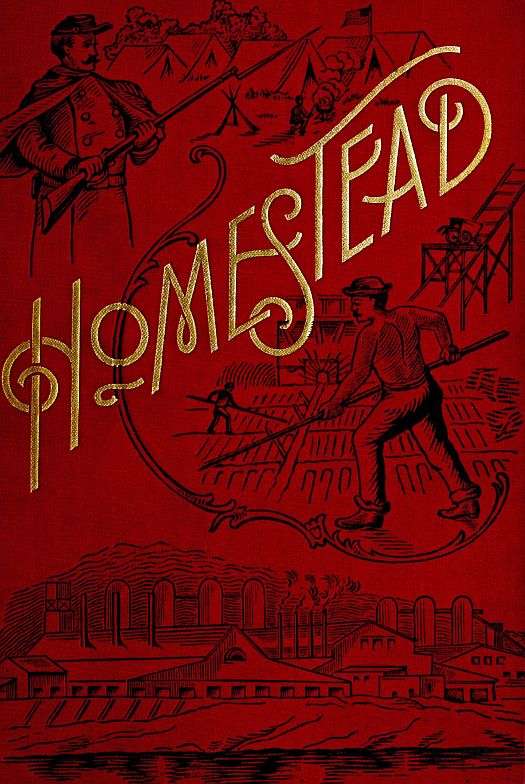
There was a flavor of coke region discipline about the Frick ultimatum which was not calculated to promote good feeling at Homestead. Nor did it. The men who drove the sheriff's deputies out of Homestead in 1889 might yield to milder measures, but the crack of the whip was irritating. "Are we to be lashed into Mr. Frick's way of thinking?" men asked one another, and the very thought bred insurrection.
If there was a calm now, it was the calm that preceded a hurricane.
As if to accentuate the sentiment of disaffection among the Homestead people, Mr. Frick accompanied the issuance of his ultimatum with preparations of a warlike character. A large force of men was employed upon the construction of a solid board fence, three miles in extent, surrounding the property of the firm between the Pittsburgh, Virginia & Charleston railroad and the Monongahela river. All the workshops were included within this enclosure. The offices and stables, situated on the other side of the railroad, were similarly enclosed. An elevated wooden bridge connected the two enclosures. The fence was surmounted with strands of barbed wire, and perforated at intervals, as if for the convenience of sharpshooters stationed within, although Mr. Frick, in his testimony before a committee of Congress, averred that the holes were simply for the purpose of observation. High in the air, at the ends of the tall mill buildings, twelve-foot platforms were erected, on which were placed electric search-lights, designed to enable sentinels to keep watch at night over every part of the mill yard.
There was a cold and sanguinary determination about these provisions which boded ill for the workmen. Clearly, the redoubtable tamer of the coke-workers had made up his mind to force a bloody conflict with organized labor, and the wage ultimatum was his defi. One of King John's barons could not equip his feudal castle with more elaborate offensiveness than this nineteenth century ironmaster displayed in fortifying his mill, with the apparent intention of making war—actual war with arms upon the men of Homestead. So it was that the men viewed the preparations at the mill. The supposition that Mr. Frick might regard their disposition as one of invincible stubbornness, sure to lead to deeds of violence, and that his fences, barbed wire, loopholes, platforms and search-lights might be pure measures of self-defense was not entertained for an instant.
The fortification of the mill was a huge threat—a challenge—an insult. With this exhibition of brute force held up before them, the workmen deemed their manhood, as well as the life of their organization to be at stake. Come what might, they must now burn their boats behind them, as the firm had done, and refuse to recede an inch from their demands.
While affairs were taking this ominous turn at Homestead, the annual convention of the Amalgamated Association met at Pittsburgh, the session opening on June 7. Of the stormy conditions under which the delegates came together and which caused their deliberations to be protracted for an unusual period, mention is reserved for another chapter. Suffice it to state here that the delegates from Homestead duly submitted their scale; that it received the indorsement of the association, and that the local lodges were empowered to persist in their demand for the retention of the rate of $25 a ton on billets as the minimum basis of tonnage men's wages. This made it optional with the local lodges to declare a strike, although it followed by implication only, and not of necessity, that the strike, if ordered, would receive the sanction and support of the association.
Excitement in Homestead mounted rapidly to fever heat.
The first concerted public demonstration on the part of the men was on Sunday, June 19, when the lodges held an open meeting in the opera house. Some of the leading officials of the association and many delegates to the Pittsburgh convention from other states were present. The gathering included almost the entire working force of the Homestead mill. William A. Carney, First Vice-President of the association acted as chairman. The speechmakers, for the most part, while exhorting the men to stand firm, counseled moderation and respect for the law.
A young vice-president of the association, Jere Doherty, touched upon the place of the wage-worker in politics and the efficacy of the Homestead struggle as a test of the protection guaranteed to labor by the Republican party.
The crowning address of the day was made by John McLuckie, the burgess of the town, a simple, earnest, straightforward man, whose rugged eloquence told more forcibly with the brawny multitude who heard him than if it had been couched in the language of a Cicero or a Demosthenes. Burgess McLuckie said:
"What brings you here this morning? Is it idle curiosity, or is there a real, tangible reason beyond? The cause of this wage trouble is not generally understood. We were persuaded to vote the Republican ticket four years ago in order that our wages might be maintained. As soon as the election was over a widespread feeling on the part of the manufacturers towards a reduction of wages was exhibited all over the land. As soon as the McKinley bill was passed, the article in the production of which we work was the only article that suffered a reduction. It is Sunday morning, and we ought to be in church, but we are here to-day to see if we are going to live as white men in the future. The constitution of this country guarantees all men the right to live, but in order to live we must keep up a continuous struggle. This is the effect of legislation and nothing else. The McKinley bill reduced the tariff on the four-inch billet, and the reduction of our wages is the result. You men who voted the Republican ticket voted for high tariff and you get high fences, Pinkerton detectives, thugs and militia!"
There was politics in this speech, but almost every member of a labor organization is a politician in a small way, and McLuckie's bill of indictment against the Republican party struck fairly home. It had been freely charged that, when the McKinley tariff bill was being prepared, Andrew Carnegie had waited on the conference committee which put the finishing touches to the measure and secured as a return for his generous contributions to the Republican campaign funds, a reduction in the duty on steel billets, this product being the single standard of wages in his Homestead works. As the Carnegie firm controlled the billet market, there was nothing to hinder a depression of prices, as a seeming consequence of a lower duty, and this was to serve as a cover for the new scale and the Frick ultimatum.
The plausibility of this story, and the bluntness with which McLuckie, himself a poorly paid workman of the Carnegie Company, put the political duplicity involved before his fellow workmen exercised a telling effect. Particularly did the pointed allusion to "high fences, Pinkerton detectives, thugs and militia" carry weight in the estimation of the workingmen present at that Sunday morning meeting. Nor did it stop there, for within the next twenty-four hours this, the first public arraignment of the Republican party and the Carnegie Company jointly was flashed over the telegraph wires to newspapers in all parts of the United States, and the country at large began to realize that there were two ways of looking at the doctrine of "protection to American labor," and that the difference between them was on the eve of receiving an impressive demonstration.
The temper of the people of Homestead after the meeting of the lodges, was, in spite of the scarcely concealed militant resolution harbored in the breasts of the men as individuals, moderate and orderly. There was still time, they reasoned, for Mr. Frick to withdraw his defiant ultimatum. Nearly two weeks remained until the new wage scale would be enforced. In the mean time there would be conferences. Possibly Mr. Carnegie might be heard from over the cable. Perhaps even the great men who were interested in proving that protection protects would use their influence to obviate the astounding object lesson which would be presented to the world if the Carnegie firm, at the noontide of its prosperity, should reduce the wages of its employees. If there was hope in this way of looking at the prospect, it was a forlorn hope, and the most sanguine of the tonnage men, who were the first to be affected by a change in the scale, could not consider it otherwise.
The cloud was plain to be seen, but of the silver lining not a vestige was perceptible.
So the men went to bed on that Sunday night with McLuckie's bold words ringing in their ears, and a strong conviction deep down in their hearts that a crash was coming, that somebody was destined to go under, and that, come what might, the victors of 1889 would not show the white feather.
CHAPTER III.
Frick's Allies—A Plan of General Assault on the Amalgamated Association Falls to the Ground—The Labor Question in Politics—Democrats Make Capital out of Wage Reductions—Frick Confers with a Workmen's Committee and Rejects a Compromise—Mills Shut Down and are Declared Non-Union—"Fort Frick"—Lodges Appoint an Advisory Committee. Guarding the Town.
ABOUT the time of the assembling of the delegates to the convention of the Amalgamated Association, the Pittsburgh Post, a Democratic newspaper, printed an article in which it was alleged that the impending conflict at Homestead was to be precipitated not in the interest of the Carnegie Company alone, but in that of all the iron and steel manufacturers of Western Pennsylvania and Eastern Ohio. Homestead, it was said, was chosen as a battle ground, (1) because of the ease with which the mill property could be equipped for offensive and defensive purposes; (2) because the ruin wrought in that town by a disastrous strike would be more sweeping and complete than could be effected anywhere else, and (3) because the Carnegie Company had the largest interests to serve and should, therefore, be willing to bear the brunt of the battle. If war was declared, and the lodges at Homestead were broken up, the other manufacturers were to follow the lead of the Carnegie Company, defy the Amalgamated Association and reduce the wages of their employees to an extent varying from 20 to 60 per cent.
The Post's story received little credence when it appeared, but later on the course of events gave it a strong coloring of probability. Mr. Frick proceeded to fortify the Homestead mills with every evidence of inviting a desperate conflict. At the same time, the other manufacturers commenced to show their hand, those of the Mahoning and Shenango Valley, a district located about fifty miles from Pittsburgh, taking the initiative by announcing a general reduction of wages ranging from 20 to 60 per cent. The Pittsburgh manufacturers avoided taking a distinctly aggressive stand, but gave out significant statements to the effect that the condition of the iron and steel market rendered it impossible for them to continue paying the rate of wages maintained during the previous year.
These symptoms of depression in one of the most generously protected industries within a short time after the passage of the McKinley tariff bill afforded a prolific subject of commentary to the opponents of the high tariff system. Both political parties made their nominations for the presidency in the month of June, when the labor trouble was waxing warm, and it became only too plainly perceptible that, since the Republican party took its stand mainly on the benefit resulting to American labor from the protective tariff, Republicanism would be held answerable by the working classes for the proposed wage reductions in Pennsylvania. As a matter of fact the efficacy of the tariff as a wage-maintaining agency had been grossly overdrawn by stump orators and over-zealous partisan newspapers. For years it had been dinned into the ears of the workingman that it was his duty to vote for Republican candidates because the Republicans in Congress maintained the high protective tariff and the high protective tariff meant high wages.
But now, at the opening of a presidential contest, the workingman was confronted with what seemed to be proof positive that the high tariff had lost its virtue, and when the Democratic press pointed to the astonishing spectacle of wage reductions ordered by the "pampered iron barons" of Pennsylvania, as illustrating that the protective system was a sham and a fraud, what wonder that organized labor was quick to accept the indictment as a just one!
The Democratic national convention did not lose sight of the opportunity thus offered, and in the platform on which Grover Cleveland was nominated at Chicago perhaps the most telling plank was that which denounced the protective system as fraudulent and referred to the strikes in the iron trade as an immediate attestation of the failure of "McKinleyism."
Meanwhile, newspapers friendly to President Harrison sought to dissuade the iron and steel manufacturers from making the threatened cut in wages and precipitating a general conflict with the operatives. In Pittsburgh, especially, a bitter discussion was carried on, the papers controlled by the manufacturers persistently asserting that the tariff has nothing to do with the making of wage scales and that a general wage reduction and consequent strikes during a presidential campaign could not be construed as reflecting upon the efficacy of the McKinley bill and the Republican party's pledges to American labor; while the Democratic and independent press subjected the manufacturers to merciless criticism.
All this was full of encouragement to the workingmen. They felt that their cause was expanding from the dimensions of a mere local trouble to those of an affair of national importance, affecting the destinies of the dominant political parties. At Homestead, which had previously been a Republican stronghold, the Democratic propaganda found special favor. "If all else should fail us," thought the men, "we can, at least, have revenge at the polls in November."
And they kept their word.
It is not within the province of the writer of this narrative to analyze the peculiar aspect put upon the case of the workingmen by political agitators for campaign purposes. Merely the facts are stated here, leaving it to the reader to make his own deductions as to the justice or injustice of the assaults on the American system of protection to labor provoked by the seeming selfishness of tariff-enriched manufacturers. Suffice it to state that every shot told and that, if the whole truth were known, it would be found that political considerations went a long way to prevent the other manufacturers from joining Mr. Frick in a body and using their combined resources to destroy the Amalgamated Association and strip their employees of all means of self-defense.
It will be seen that the position of the Homestead workers was greatly strengthened by the common danger. Homestead was not to be alone in its fight. The entire Amalgamated Association was threatened, and the spirit of mutual helpfulness was, therefore, powerfully stimulated at all points. The good old unionist principle, "One for all, and all for one," was bound to receive a full and magnificent exemplification.
On June 15, the convention of the Amalgamated Association completed the general wage scale for iron mills and presented it to the manufacturers' committee. The manufacturers responded by producing a scale of their own, embodying extensive reductions. This was the beginning of a dispute, stubborn on both sides, which was kept up long after the final adjournment of the convention, that body assigning the duty of conferring with the manufacturers to a special wage committee.
The consideration of the scales for steel mills, including that prepared by the Homestead lodges, was not completed by the convention until June 23. On that day, a committee, headed by William Roberts, one of the most intelligent of the Homestead mill workers, appeared at the offices of the Carnegie Company, on Fifth Avenue, Pittsburgh, and was escorted to Mr. H. C. Frick's private room. Mr. Frick, General Manager Potter, H. L. Childs and F. T. F. Lovejoy acted for the company in the conference which followed. Mr. Roberts, acting as spokesman for his colleagues, presented the Homestead scale as approved by the convention, and explained that the employees were prepared to concede several points, admitting, however, of no reduction exceeding 15 per cent, in any department. The men were willing even to reduce the minimum selling price of billets on which the rate of wages should be estimated to $24 per ton, but the firm insisted upon the $23 rate, which, as previously explained, signified a serious depression in wages.
The conference, after a discussion lasting several hours, broke up without accomplishing anything.
The following day, June 24, had been fixed by Mr. Frick as the last on which the Carnegie firm would treat with its employees as members of the Amalgamated Association. The day passed without a conference. It was believed, however, that, in view of the concessions which the men had stated their willingness to make, even though they refused to make the complete surrender which Mr. Frick demanded, the firm would consent to fresh conferences with the committee. Yet the fact that the firm, which had sufficient orders on hand to keep the mill busy for many months, was canceling these orders, coupled with the extraordinary preparations for warfare which were being made at the mills, cast a damper on the hopes of the men. There was hardly a ray of sunshine to brighten the gloomy outlook.
On June 25, Mr. Lovejoy, secretary of the Carnegie Company, stated through the newspapers that the conferences were at an end, that the firm had decided to make the rate of $23 a ton on billets the basis of wages, and that this rate would be enforced without regard to the opinion of the Amalgamated Association. It was also the intention to change the time of fixing the wage schedule from June to January, so that if a strike or lock-out should occur, the hardships of the winter season would strengthen the company's hand. So, at least, the men interpreted the proposed change.
Mr. Lovejoy's statement, although given out in an informal way, was generally accepted as meaning that the ax was forthwith to be let fall upon the neck of organized labor at Homestead, and that no human power could stay the hand of the executioner.
Still all was quiet at Homestead. June 25 was Saturday and pay-day, but the day was marked by less activity and bustle than usual. The stores were not crowded, and little money was spent. In the face of trouble, the end of which it was impossible to foresee, men carefully put away the contents of their pay envelopes. The wolf might come to the door before long and resources had to be husbanded. Few cared for the little Saturday jollifications common at other times. Wherever a group of mill men came together, the one theme of discussion was the ultimatum of the firm, the prospect of a wholesale discharge of union men on July 1 and the meaning of the warlike equipment of the mill property.
A new and significant name was devised for the Carnegie enclosure, with its ramparts, watch towers, search-lights and other suggestions of war, and flew from mouth to mouth with the rapidity of lightning.
"Fort Frick."
An ill-omened name it was, bristling with offensive associations; but its propriety as a descriptive epithet could not be questioned.
Who was to occupy the "fort?" Whose guns were to be used through those loopholes?
"Pinkerton detectives," said some, and the rumor that an army of "Pinkertons" had been hired and might already be on its way to garrison the works and shed the blood of the men of Homestead found ready credence and deepened the feeling of resentment abroad in the town. Many were disposed to believe that Pinkerton scouts had arrived and were making things ready for the coming of the main guard.
On Tuesday, June 28, the company ordered the armor-plate mill and the open-hearth department shut down, throwing 800 men out of employment.
This was the beginning of the lock-out, for a lock-out it was, and not a strike, as has been very generally represented.
A strike occurs when dissatisfied workingmen cease work of their own accord and refuse to return until the cause of dissatisfaction is removed.
A lock-out originates with the employing individual or corporation, and consists in the refusal to let the employees work until they come to terms with the employer.
As Mr. Frick took the initiative, the trouble at Homestead was distinctively a lock-out, although, if Mr. Frick had chosen, he could have permitted it to take the form of a strike.
It made little difference in the end which of the contestants took the first aggressive step. Once the Frick ultimatum was promulgated, a struggle was inevitable, and if the firm had not thrown down the gauntlet, the men most assuredly would have forced the fighting on their own account.
The night of June 28 witnessed strange scenes in Homestead. The pent-up feelings of the men now found vent unrestrainedly. Effigies of Frick and Potter were hung on telegraph poles. Denunciations of the firm and its policy were heard on every hand. Knots of angry men gathered outside the board fence that hedged the mill enclosure, peered through the loopholes at the watchmen on duty within and talked defiantly of what would happen if the methods that triumphed over the poor, disorganized serfs in the coke regions were to be tried upon four thousand sturdy and intelligent steelworkers. If an apostle of non-unionism had ventured upon the streets of Homestead that night he would have fared badly.
The next morning, at the call of the officers of the local lodges, 3,000 steelworkers met in the opera house. The chairman of the executive committee stated to the meeting that, at a conference of committeemen representing the eight lodges, held on the preceding evening, it had been decided to submit the question of shutting down the mechanical department of the mills to the steelworkers en masse, irrespective of affiliation with the lodges, and that the decision thus arrived at should be binding on all. This report was approved and a motion was made that a committee be appointed to request the mechanics and day laborers to quit work at once. A workman asked if the watchmen were to be included, and another answered: "Three years ago the watchmen wanted to come out and now they must come."
The motion passed amid tremendous cheering.
The chairman of the executive committee, resuming his address, refuted the report spread through the newspapers that six or seven hundred mechanics and day laborers had signed a scale arranged by the firm. A committee of this class of workmen, he said, had waited on General Manager Potter and had been thrust aside pending the settlement of the tonnage men's wages. After this, the mechanics and laborers had resolved to cast their lot with the Amalgamated Association, and had signified their decision to the lodges.
William Roberts, chairman of the conference committee, which had waited on Mr. Frick by authority of the Amalgamated convention, took the platform and detailed the action of his committee. Mr. Roberts told of the committee's offer to concede a basis of $24 and of the firm's demand that the scale terminate on the last day of the year. "We wouldn't agree to this," he said, "and I now ask you had we any right to do so?"
"No! No! No!" shouted 3,000 voices.
The speaker described how, when the committee presented as its last and only demands that a $24 basis be adopted and that the scale expire on the last day of June, Mr. Frick jumped to his feet and exclaimed hotly: "Gentlemen, that ends all conferences between you and this firm." "So you see," Mr. Roberts went on to say, "This is not a strike. The firm put a snag in our road.... We filled our contract. Now the firm has laid the entire mill off one day ahead of time. Has it lived up to its contract?"
Again 3,000 voices shouted "No," and the action of the wage conference committee was ratified without a dissenting voice.
A resolution was offered providing that, in case any man left Homestead during the coming trouble without permission from the lodge officials, the men should refuse to work with him on his return. The chairman asked all who were in favor of the resolution to rise. Instantly every man in the hall sprang to his feet and the resolution was adopted with three cheers and a tiger, followed with hisses for H. C. Frick.
A motion to appoint a press committee, consisting of one member from each of the eight lodges, was carried after a discussion as to unreliable reports. The membership of this committee was kept secret for the time being.
A whirlwind of excitement was roused when a speaker told of a report that 200 non-union workmen were coming to Homestead disguised in the blue uniform of Pinkerton detectives. "Watch the depots," was the unanimous cry that followed this alarmist statement.
When, after a session of two hours, the meeting adjourned, there remained not the least doubt as to the unity of feeling among all classes of workers in the town. Every man was ready to enter upon relentless strife, and if there was a coward or malingerer in any quarter, he wisely held his peace.
After the general meeting, the eight lodges held a secret session, at which an advisory committee was appointed, with full power to direct the workmen's campaign. This body, which played the most important part in the tragic drama soon afterwards enacted, was composed of the following members: David H. Shannon, John McLuckie, David Lynch, Thomas J. Crawford, Hugh O'Donnell, Harry Bayne, Elmer E. Ball, Isaac Byers, Henry Bayard, T. W. Brown, George W. Champene, Isaac Critchlow, Miller Colgan, John Coyle, Jack Clifford, Dennis M. Cush, William McConeghy, Michael Cummings, William Combs, John Durkes, Patrick Fagan, W. S. Gaches, Nathan Harris, Reid Kennedy, John Miller, O. O. Searight, John Murray, M. H. Thompson, Martin Murray, Hugh Ross, William T. Roberts, George Rylands and George W. Sarver.
Special committees were appointed to patrol the river stations and all entrances to the town. The patrols were directed to cover their beats night and day and report to the advisory committee. Arrangements were also made to have the river patrolled in skiffs, and the steamboat "Edna" was secured to aid in this service.
Headquarters were established in a commodious public hall, with accommodations for telegraph operators, the committee being expected to maintain communication with all parts of the country, so as to obtain instant information of any movement of non-union men designed for service at Homestead. The liquor saloons were visited and the proprietors requested to use special precautions against the promotion of drunkenness and disorderly gatherings, under pain of being required to close their establishments.
Eight effigies of Carnegie officials were cut down by the committee, and notice was given that persons outraging decency in this manner in the future would be disciplined.
The burgess of the town, John McLuckie, was informed that he might call upon the Amalgamated Association for whatever number of men he might deem necessary to assist him in preserving the peace.
In short, the government of Homestead had now passed absolutely into the hands of the advisory committee of the Amalgamated lodges, and the committee was determined to use its arbitrary authority for the preservation of order and decency and the protection of life and property as well as the exclusion from Homestead of non-union men, better known to the unionist as "scabs" or "black sheep."
On July 2 the entire force of employees at the Carnegie mills was paid off and served with notices of discharge.
With the exception of a slight altercation between General Manager Potter and some of the men who were guarding one of the gates of the mill there was no disorder.
Secretary Lovejoy now made his final statement on behalf of the firm declaring the mill to be permanently non-unionized. "Hereafter," he said, "the Homestead steel works will be operated as a non-union mill. We shall not recognize the Amalgamated Association of Iron and Steel Workers in our dealings with the men. The mill will be an open one where all men may work regardless of their affiliation with a labor organization. There will be, no doubt, a scale of wages; but we shall deal with the men individually; not with any organization. Such a thing as a union will not be recognized. There will be no further conferences with the Amalgamated Association."
The mammoth steel plant was now deserted, except by a few watchmen and the government steel inspectors, with whom the advisory committee did not interfere.
The locked-out men were perfectly organized and ready to fight against any odds at a moment's notice. A report that strangers were on the way to Homestead along either of the railroads brought a battalion of stalwart fellows to the stations on the outskirts.
Mr. Frick might as well have undertaken to storm Gibraltar as to introduce a force of non-unionists into the town.
Meanwhile the convention of the Amalgamated Association had finished its business, elected new officers, including a successor to President Weihe in the person of Mahlon M. Garland, and left it to a committee to fight it out with the manufacturers. This the committee was doing with considerable success. The ominous turn which affairs were taking at Homestead, together with the endless reproaches heaped upon the graceless beneficiaries of the protective tariff by Mr. Harrison's campaign managers had a most discouraging effect on the manufacturers' committee and it was plain to be seen that the "fight all along the line," inaugurated a month before, was to end in a compromise favorable to the Amalgamated Association.
Mr. Frick was left to do his own fighting, single-handed and alone.
CHAPTER IV.
Planning a Siege—History of the Pinkertons—Hatred of Organized Labor For Soldier Policemen—Frick's Cold-Blooded Letter—The Sheriff of Allegheny County is Enlisted in the Carnegie Forces—Millmen Dispose of a Sheriff's Posse—The Gathering of the Invaders—Departure of the Pinkerton Barges for Homestead.
WHILE Mr. Frick's men were busily engaged in perfecting a martial organization and putting the government of the town of Homestead on a war footing, Mr. Frick himself was not idle. He did not waste any time in considering projects for immediately introducing non-union men into the mills, being well aware that, if men foolhardy enough to take the risk of "blacksheeping" at Homestead could be found, it would still be impracticable to get them past the picket lines of the locked-out steelworkers, and that, even if a force of non-unionists could be piloted into the mill their presence would be the signal for an attack by the union men and possibly for the destruction of the firm's property.
Mr. Frick had another plan—a plan suggested by his successful encounters with the Connellsville coke-workers. He conceived the idea of garrisoning "Fort Frick" with a sufficient number of armed and disciplined Pinkerton guards to hold any attacking force at bay and later on to bring in non-union workmen under cover of the Pinkerton men's rifles.
How long this project had been maturing in the mind of the Carnegie Company's chairman cannot be told. Certain it is that he had made up his mind to carry it out long before he met the wage conference committee for the last time, and that when, on June 23, he went through the form of a discussion with Mr. Roberts and Mr. Roberts' confreres, he had not the least notion of coming to any kind of an understanding other than that which might be brought about by force.
Mr. Frick was too well acquainted with the estimation in which the Pinkerton men are held by the labor unions to underrate the import of his action, and can hardly have been ignorant of the fact that in bringing on these myrmidons, he was making doubly sure of sanguinary times at Homestead.
A sketch of the personnel and methods of the "Pinkerton National Detective Agency," as it is styled by its chiefs, will make clear to the reader the reasons for the hatred and contempt entertained for this body by workingmen everywhere.
The agency was founded in 1850 by Allan Pinkerton, a young Scotchman, who had been brought into public notice at Elgin, Ill., by his success in ferreting out a counterfeiter. Allan Pinkerton's fame as a detective became national. He organized a war secret service, was trusted by Lincoln, whose life he once saved; by Grant and other national leaders in war times, and aroused continual interest by his strokes of skill and daring. The enterprise from which sprang the Pinkerton "standing army" of to-day was set on foot in a shabby little office in La Salle Street, Chicago, and there the headquarters of the agency still remain.
Pinkerton detectives came into great request and were soon engaged in the unraveling of crimes and the hunting down of criminals all over the continent. Allan Pinkerton meanwhile discerned a fresh source of profit and turned it to account by hiring out his men as watchmen for banks and great commercial houses. The "Pinkerton Preventive Watch," composed of trained men, uniformed and armed, and acting independently of the municipal police, was established.
The emblem adopted by the agency was a suggestive one. It consisted of an eye and the motto, "We never sleep."
As old age came on Allan Pinkerton and his business kept growing, he turned over the work of supervision to his sons, William A. and Robert A. Robert was placed in charge of a branch bureau in New York and William remained in Chicago. Agencies with regular forces of men were established in Philadelphia, Boston, St. Paul, Kansas City and Denver. By communication with these centres, the chiefs could control, at a few days' notice, a force of 2,000 drilled men, and this could be expanded by drawing on the reserves registered on the books of the agency for service on demand, to 30,000, if necessary,—more men than are enrolled in the standing army of the United States.
When a large number of recruits is needed, the Pinkertons usually advertise in the newspapers asking for able-bodied men of courage, but without stating for whose service. In New York, prospective recruits are brought to a building on lower Broadway where the Pinkertons have an armory, stocked with Winchester rifles, revolvers, policemen's clubs and uniforms. After the number of men needed is secured, the addresses of the eligible applicants for whom there are no places are taken and they are notified to hold themselves in readiness for a future call. Men who have served in the army or as policemen receive the preference.
Pinkerton detectives have no real authority to make arrests. They are rarely sworn in as special constables or as deputy sheriffs and the uniform which they wear is merely for show.
Of late years they have been employed very frequently to protect the property of great manufacturing corporations during strikes or lock-outs. This is, without exception, the most trying and perilous service which they have to undergo. The pay is good, however, the rate agreed upon for duty at Homestead, for example, being $5 a day for each man.
In the great strike on the New York Central railroad, which cost the Vanderbilt corporation $2,000,000, the item for Pinkerton service was about $15,000. The guards were posted at danger points all along the line. Conflicts with the strikers were frequent, and, in many cases, the guards used their rifles with deadly effect. On August 17, 1890, they killed five persons, one a woman. So freely were the Pinkerton rifles brought into play during this trouble that the people of New York state became thoroughly aroused and forced the legislature to pass an anti-Pinkerton bill.
The agency was responsible for the killing of a boy during a longshoremen's strike in Jersey and at Chicago during the Lake Shore railroad strike a man named Bagley fell a victim to Pinkerton lead. The guard who shot Bagley was spirited away and never brought to justice.
Pinkerton guards have done duty in the miners' strikes in the Hocking Valley, at the H. C. Frick Company's mines in the Connellsville region and at Braidwood, Ill., as well as in all the great railroad strikes since 1877.
In recent years, the conversion of the guards into an irresponsible military organization, with self-constituted authority to overawe striking workmen has provoked a feeling of intense hatred on the part of organized labor towards these soldier-policemen. Attempts to abolish the Pinkerton system by legislation have succeeded in only a few states, New York and New Jersey among the number, for the reason that the corporations which find use for armed mercenaries have sufficient wealth and influence to control legislative action.
Congressman Thomas Watson, of Alabama, a representative of the Farmers' Alliance, introduced a bill in Congress making it illegal for private persons to maintain a "standing army" to usurp the police powers of the states, and made a strong plea for its passage, but the measure failed. The great industrial corporations have a hold upon the federal legislature too strong to be broken by the insistence of common people.
As has already been told, the men of Homestead entertained a profound abhorrence of the Pinkertons and were resolved to push resistance to any extreme rather than permit themselves to be whipped into submission by armed hirelings. They had no knowledge of Mr. Frick's dealings with the agency, although their familiarity with the Frick policy in the coke regions, coupled with the equipment of the mill property for occupation by a garrison excited a well-defined suspicion of what was coming.
Mr. Frick gave the final order for a supply of guards in a letter written to Robert A. Pinkerton, of New York, on June 25, the day after his meeting with the wage committee from the Amalgamated convention. The order was given in as matter-of-fact a manner as if the Carnegie chairman were bespeaking a supply of coke or pig-iron.
"We will want 300 guards," he wrote, "for service at our Homestead mills as a measure of precaution against interference with our plan to start the operation of the works again on July 6, 1892."
"These guards," Mr. Frick went on to direct, "should be assembled at Ashtabula, O., not later than the morning of July 5, when they may be taken by train to McKees Rocks, or some other point on the Ohio River below Pittsburgh, where they can be transferred to boats and landed within the enclosures of our premises at Homestead. We think absolute secresy essential in the movement of these men, so that no demonstration can be made while they are en route."
As Mr. Frick acknowledged in his letter the receipt of "your favor of the 22d," it was evident that the negotiations with the Pinkerton agency had been pending for some time.
Immediately after having despatched his order for a Pinkerton battalion, Mr. Frick sent for Captain Rodgers, of the towboat Little Bill, and directed him to fit up two barges with sleeping accommodations and provisions for 300 men, who were to be taken on board at some point not then determined, brought to the works at Homestead, and subsequently lodged and boarded on the barges.
He also notified the sheriff of Allegheny county, William H. McCleary, through Messrs. Knox & Reed, attorneys for the Carnegie Company, that there would be a strike at Homestead and that 300 Pinkerton watchmen had been engaged, and requested the sheriff to deputize the entire force; that is to say, to appoint them police agents of the county. The sheriff maintained afterwards that, on the advice of his attorney, he had declined to deputize the Pinkerton men until they should be installed in the mill and had reserved the right to act at his discretion when that time came. Mr. Frick, on the other hand, declared on the witness stand that the sheriff consented to deputize the men and assigned his chief deputy to swear them in.
The train was now laid; the fuse was lit, and all that remained to be done in the Carnegie camp was to wait for the explosion.
To disarm suspicion on the other side, however, Mr. Frick, as the crisis approached, gave out information leading the public in general and the locked-out men in particular to believe that he meant to rely on the ordinary processes of law to protect him in the non-unionizing of his works. On the evening of July 4, after a conference with the other chief officers of the firm, he furnished a statement to the newspapers alleging that there was no trouble to be feared, that the men were weakening, a large number of them being anxious to get back to work, and that the plant would be placed in the hands of the county, the sheriff being requested to furnish enough deputies to ensure adequate protection.
With all his firmness, the doughty chairman of the Carnegie Company dared not make a clean breast of his program. The way for the coup de grace had to be cleared by strategy and dissimulation.
The locked-out men celebrated Independence Day with due patriotic fervor. The force of guards was increased from 350 to 1,000, the picket system being expanded so as to form an outline five miles in extent, covering both sides of the river.
In the afternoon an alarm was sent in to headquarters. Two men had been seen landing from a boat near the works and were taken for spies. Quick as a flash a thousand men rushed to the river bank and inclosed within a semi-circle of stalwart forms the place where the suspects had landed. It proved that the latter were merely honest citizens of the town returning from a picnic across the river, but the incident showed how effectually the men kept themselves on the qui vive, precluding the entry of an enemy at any point.
When Sheriff McCleary reached his office in the Allegheny County court-house, on the morning of July 5, he found awaiting him a formal application from the Carnegie Company for the services of one hundred deputies at Homestead. The Sheriff was discomfited by the demand. His predecessor in office, Dr. McCandless, had been forced to engage in a long and irksome legal battle in order to recover from the Carnegie Company the money due for the service of deputies at Homestead in 1889, and the prospect of a fresh dispute over the pay of special officers was not inviting. So Mr. McCleary, who was gifted by nature with a strong tendency to evasiveness, returned an evasive answer, and conceived the idea of going to Homestead with his own office force of twelve men and making some sort of dignified showing pending the arrival of that army of Pinkertons, which he already knew to be moving on the devoted town.
The Sheriff and his little posse proceeded accordingly to Homestead and were received by the men, if not with cordiality, at all events with decent consideration. A proclamation was issued embodying the usual warning against breaches of the peace. Then a phalanx of strong-limbed steel workers escorted the officers to the mill and pointed out that nobody was trespassing upon or damaging the Carnegie Company's fortified territory.
The sheriff stated that, under the law, the company should be permitted to bring in whatever men it chose and to operate its own works.
The men responded that neither the county authorities nor anyone else would be permitted to bring non-union men into the mill, and, having thus emphatically signified their purposes, escorted the sheriff and his followers—all of them more or less afflicted with nervousness—to the railroad station and saw the little party safely out of town.
Had the sheriff been less evasive, less nervous, less of a politician and more of a man, there was still time for him to avert disaster. He, as chief police officer of the county, had been informed of the coming of Mr. Frick's hired army. He could not fail to be aware that a collision between the Pinkerton men and the 4,000 steelworkers was bound to come, that blood would run like water at Homestead, that demoralization and disgrace, and perhaps even heavy financial loss to the county would follow, and that, therefore, to remain supine in the face of all this, to let the crash come and not lift a finger to prevent it was literally a dereliction of duty.
There was no obligation resting on this official to keep Mr. Frick's operations secret. On the contrary, he was under a strong moral obligation to prevent the execution of those operations at all hazards by giving them prompt publicity and enabling the exhaustion of all available legal means of stopping an invasion of the county by armed mercenaries of a class condemned by law in two neighboring states and bitterly hated by workingmen in every state of the Union.
It did not appear to occur to the sheriff that the hiring of Pinkerton detectives was an offensive arraignment of himself as the county's chief executive officer. The one idea uppermost in his mind seemed to be to steer clear of the whole unpleasant business as far as he conveniently could and to trust to luck and the Pinkertons to pull Frick through somehow.
Decidedly a weak and inefficient man, this sheriff. For the time being, he had abdicated in favor of Frick and the Pinkertons and it would not be his fault if the devil were not unchained.
And now from a score of cities came the Pinkerton myrmidons to the headquarters at Chicago, few among them knowing or caring on what mission they were bound, as long as they got their daily rations and their daily pay, but all comprehending that blind obedience was the watchword. Captain F. H. Heinde had been detailed to take charge of the expedition, and under his guidance the men proceeded from Chicago to Youngstown, and thence to Bellevue, on the Fort Wayne railroad, opposite the Davis Island dam, arriving at this point at 10:30 o'clock on the evening of July 5.
Early in the day, Mr. Frick had issued final orders to Captain Rodgers, directing him to tow his two barges down the Ohio River to the dam in time to meet the battalion of Pinkerton guards. Captain Rodgers duly carried out his orders. With the boats Little Bill and Tide, each having a barge in tow, he arrived at the dam at 10 P. M. There he was met by Colonel Joseph H. Gray, Sheriff McCleary's chief deputy, who had been dispatched by the sheriff to "keep the peace," if his own testimony and that of the sheriff are to be accepted, whereas, according to Mr. Frick's story, his real mission was to deputize the Pinkerton guards and thus render the county liable for the acts of these strangers.
At 10:30 P. M., the trainload of guards arrived; the men embarked in the barges; the Little Bill and the Tide puffed away as cheerfully as if they were towing a pleasure party, and in the stillness of the beautiful July night the expedition moved slowly in the direction of Homestead.