
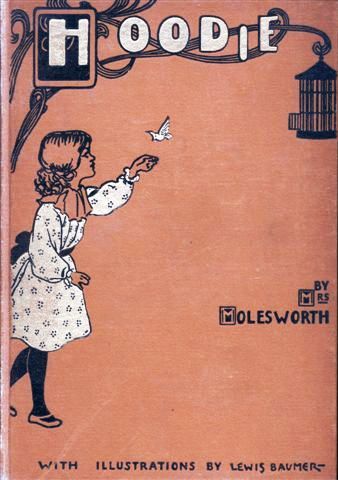
"Up in the nursley," said Hoodie coolly
And with this account of her doings Martin was obliged to be content.
CHAPTER V.
STORIES TELLING.
Late that night, no, very early the next morning, just as dawn was breaking, the peacefully sleeping inhabitants of Mr. Caryll's house were awakened by strange and alarming sounds which seemed to come from the direction of the nursery. The children's mother was one of the first to wake, and yet the sounds which had roused her having been heard indistinctly through her sleep, she was not able to say what they were.
"It must be one of the children with croup—I am sure it sounded like what I have heard croup described, or like that dreadful illness they call the crowing cough," she said to Mr. Caryll, as she rushed out of the room in a fright.
She had only got to the end of the long passage leading to the children's rooms when she ran against Miss King, closely followed by her maid and one, two, three other servants all pale and alarmed.
"What can it be?" each said to the other.
"Martin, Martin," cried Mrs. Caryll, "are you there? What is the matter?"
But before any Martin was to be seen, again the sounds shrilled through the house.
"Kurroo—kurallarrallo-oo-ook!" with a queer sudden sort of pull-up at the end, it seemed to sound.
They all turned to look at each other.
"It must be a real cock," said Miss King, looking less frightened.
"It certainly doesn't sound like croup," said Mrs. Caryll.
"It's just one of them mischievous bantams, ma'am," said the cook, a countrywoman who had made a study of cocks and hens. "They always give that sort of catchy croak at the end of their crows. But, to be sure, what a fright it's gave us all! And where can the creature be?"
As she spoke, Martin appeared at the end of the passage, a basket in her arms, her face pale, leading by the hand a small figure in a white nightgown, a figure that pulled and pushed and kicked valiantly in its extreme reluctance to come any farther.
"I won't be takened to Mamma. I won't, I won't. I'm not naughty. It's zou that's ugly and naughty," it screamed.
Mrs. Caryll gave a despairing glance at her cousin.
"Hoodie again!" she said.
Martin hastened forward as fast as she could, considering the difficulties in her way.
"Oh, ma'am," she exclaimed, looking nearly ready to cry, "I am so sorry, so sorry and ashamed to have such an upset in the house at this time of the night, or morning, I should say. It really must seem with all these troubles as if I wasn't fit to manage the children. And just as Miss King has come, too. But oh dear, ma'am, I don't know what to do with Miss Hoodie and her queer ways."
"But what is it, Martin? What has Hoodie been doing?" said Mrs. Caryll, rather impatiently. "Stop crying, Hoodie. You must," she added sternly, turning to the little girl, who was now regularly set agoing on one of her roars.
Hoodie took not the slightest notice, but roared on. Her mother turned again to Martin, shaking her head.
"No, ma'am," said Martin, "it's not the least use speaking to her. She has wakened all the others, of course—first with that nasty creature and then with her screaming."
"What nasty creature? For goodness' sake explain yourself, Martin."
"The cock, ma'am—the bantam cock," replied Martin, seeming quite astonished that Mrs. Caryll did not know all about it by instinct. "Miss Hoodie fetched it in in her basket, unbeknown to me, last night, and had it hidden under her bed. The creature was quite quiet all night, as is its nature, I suppose, and very likely frightened and not knowing where it was. But this morning all of a sudden it started the most awful screeching; it really sounded much worse than common crowing, or else it was hearing it half in one's sleep like. I thought, to be sure, one of those dear boys had got some awful fit. And to think it was nothing but Miss Hoodie's naughtiness—real mischievous naughtiness." Martin stopped, quite out of breath, and Hoodie's roars increased in violence.
"Had she really no reason for it but mischief?" said Miss King.
Martin hesitated.
"She did begin some nonsense, ma'am, about having brought it in to lay an egg, or something like that."
"Hoodie," said Magdalen, "can't you leave off screaming and tell us about it?"
"No," said Hoodie, stopping at once and with perfect ease, "I can't leave off sc'eaming, and I won't. But I'll tell zou, 'cos it was for zou. I brought the little cock in to lay a egg for zour breakfast, 'cos zou said zou likened zem kite fresh, and now Martin's spoilt it all. Of course it c'owed to tell me it was going to lay the egg, and now it won't. It's all spoilt, and I must sc'eam."
True to her determination she set to work again and roared so that it was almost impossible to hear one's voice.
"What shall we do with her?" said her mother.
"May I take her to my room?" said Cousin Magdalen. "It is farther away from the other children, so she can't disturb them even if she screams all day."
Hoodie stopped again as suddenly as before.
"I won't go to zour room," she said. "I don't like zou now—not one bit."
Magdalen glanced at Mrs. Caryll.
"May I take my own way with her!" her glance seemed to say. Mrs. Caryll nodded her head, and notwithstanding Martin's whispered warning, "Oh, Miss King, you don't know what a work you'll have with her," Magdalen turned to Hoodie, and before the child in the least understood what she was about, she had picked her up in her strong young arms and was half way down the passage before Hoodie's surprise had given her breath to begin her roars again.
She was opening her mouth to do so, when her cousin stopped for a moment.
"Now, Hoodie," she said, "listen. It was kind of you to want to get me a quite fresh egg for my breakfast, but it isn't kind of you at all to make that disagreeable noise, and to kick and fight so because I want to take you to my room."
"I don't care," said Hoodie, "I don't like zou, and I will cry if I like. I don't like any people."
"I am very sorry to find you are so silly," said Cousin Magdalen. "If you were older and understood better you would not talk like that."
"I would if I liked," persisted Hoodie. "Big peoples can do whatever zey likes, and if I was big I could too."
"Big people can't do whatever they like," said Miss King, "and nice big people never like to do things that other people don't like too."
"Don't zey?" said Hoodie, meditatively. By this time they were safely shut into Miss King's room and Hoodie was plumped down into the middle of her cousin's bed—"Don't zey? Zen I don't want to be a nice big people. I want to be the kind that does whatever zey likes zerselves."
Miss King gave a slight sigh—half of amusement, half of despair. She was beginning to understand that Hoodie's reformation was indeed no easy matter.
"Very well, then. You had better go on screaming if you like it so much," she said, sitting down on the side of the bed and wondering to herself what would become of the world, if all the children in it were as tiresome to manage as Hoodie. In at the window the daylight was creeping timidly; all kinds of pretty colours were to be seen in the sky, and the birds were beginning their cheerful chatter. Still it was very early, and poor cousin Magdalen was sleepy. Was there anything that could make Hoodie go to sleep for an hour or two?
"The little birds in the nests are kind to each other. They don't wake each other up in the night and scream so that there is no peace. I wonder why children can't be good too," she said.
"I'm not sc'eaming," said Hoodie indignantly. "I've stoppened."
"I'm glad to hear it. But if I get into bed and lie down and try to go to sleep, perhaps you'll begin again, as you don't care for what other people like."
Hoodie was silent for a minute.
"Does you want to go to sleep?"
"Yes," said Magdalen. "I'm very tired."
"Zen I won't sc'eam."
Her cousin felt inclined to clap her hands, but wisely forbore.
"Thank you," she said quietly, as she lay down.
Hoodie wriggled.
"No, zou isn't to say zank zou," she said. "I don't like zou. I don't like any people, 'cos they stopped my getting zat nice fresh egg. I won't get zou eggs no more. I don't like zou."
"Very well," said her cousin.
Some minutes' quiet followed. Then Hoodie's voice again.
"When will zou tell us that story?" she inquired coolly.
"What story?"
"Zat story about oldwashion fairies, or some'sing like zat."
"Oh, I said I'd try to think of a story for you," said Miss King, sleepily. "Well, I won't forget."
"Zou must get it ready quick," said Hoodie. "Zou must tell it me, zou know, 'cos I've been so good about not sc'eaming."
"But not now. You don't want me to tell you stories now," said her cousin in alarm.
"No, zou may go to sleep now," replied Hoodie, condescendingly, adding after a moment's pause, "I can tell stories, lovely stories."
"Can you? well, you had better think of one, and have it all ready," said Magdalen in fresh alarm.
"Mine's is always zeady, but zou may go to sleep now," was the reply, to her great relief, the truth being that Hoodie herself was as sleepy as she could be, for in two minutes her soft even breathing told that for a while her fidgety little spirit was at rest.
Magdalen lay awake some time longer. In a half-dreamy way she was thinking over in her own mind the old fairy tales she had loved as a little girl—with them there mingled in her fancy the scenes and memories of her own childhood. She was glad to find Hoodie so eager for stories, it might be one way of winning the strange-tempered little creature's confidence, and she tried to call to mind some of the tales most likely to interest her. And somehow, "between sleeping and waking," there came back to her mind the shadow of a fanciful little story she had either read or heard or imagined long ago, and as she fell asleep she said to herself, "Yes, that will do. I will tell them the story of 'The Chintz Curtains.'"
When Magdalen awoke again that morning it was, as might have been expected, a good deal later than usual. Hoodie was still sleeping soundly. Magdalen got up and dressed quietly. She was nearly quite ready when Hoodie awoke. A little movement in the bed caught Miss King's notice: she turned round. There was Hoodie, staring at her with wide-open eyes.
"Well, Hoodie," she said, "how are you this morning?"
Hoodie did not reply, but continued staring, so her cousin went on fastening up her hair. In a minute or two there came a remark, or question rather.
"Has zou had a nice sleep?"
"Has zou had a nice sleep?"
"Yes, thank you."
"Has zou thinkened of a story?"
"Yes," said Magdalen. "I almost think I have."
"I has too," said Hoodie, with a queer twinkle in her eyes.
"Have you," said her cousin, "that's very clever of you."
"Yes," replied the little girl, "zou didn't know Hoodie was so c'ever, did zou?"
"You'd better tell me the story first, and then I'll say what I think of it," said Magdalen.
"Now?" inquired Hoodie, "sall I tell it now? It isn't a long one."
"If you like," replied Magdalen, "you can tell it me while I finish doing my hair."
"Well," began Hoodie, solemnly, "just a long time ago—oh no, that's a mistake, it should be just 'onst—'"
"Or 'once,'" corrected her cousin, "'once' is a proper word, and 'onst' isn't."
"I don't care," said Hoodie, frowning. "I like to say 'onst.' If zou don't zink my words pretty you'll make one come, and if one comes I can't tell you stories."
"Very well," said Magdalen, remembering Maudie's explanation of the mysterious phrase, "very well. I won't interrupt you. You may say any words you like."
"Well then," began Hoodie again. "Onst there was a little girl. She was called—no, I won't tell zou what she was called—she had a papa and mamma and bruvvers and a sister, but zey didn't like her much."
She stopped.
"Dear me," said Magdalen, finding she was expected to say something, "that was very sad."
"Yes," said Hoodie, "vezy sad."
"Why didn't they like her?"
"'Cos zey thoughtened she was naughty. Zey was alvays saying she was naughty."
"Perhaps she was," said Magdalen.
"Nebber mind," said Hoodie, "I want to go on. One day a lady comed what wasn't hern godmozer, so she didn't like her, and she toldened her she was ugly. But zen—oh zen she founded out that she wasn't ugly but she was pretty, vezy, vezy pretty—oh, she was so nice, and the little girl liked her vezy much—wasn't zat a nice story?"
"Beautiful," said Miss King. "All except the part about her papa and mamma and sister and brothers not liking her. I don't like that part."
"Nebber mind," replied Hoodie again. "Nebber mind about zat part zen. Doesn't zou like about the lady? Can zou guess who it was?"
"Let me see," said Magdalen, solemnly. "I must think. A lady came that wasn't her godmother—dear me, who could it be?"
"It was zou; it was zou," cried Hoodie, jumping up in bed and rushing at her cousin. "And the little girl was Hoodie, 'cos I do like zou now. I do, I do, and I'll be vezy good all day, to please you."
"That's my dear little girl," said Cousin Magdalen, really gratified. "But won't you try to be good to please your papa and mamma too—and most of all, Hoodie dear, to please God."
She lowered her voice a little, and Hoodie looked at her gravely.
"I don't know," she said. "I couldn't try such a long time and zey alvays says I'm naughty. No, I'll just please zou; nobody else, and if zou aren't pleased, I'll sc'eam. I can sc'eam in a minute."
Magdalen grew alarmed.
"Please don't," she said. "I'll be very pleased if you don't. And when you see how nice it is to please me, perhaps you'll go on trying to please everybody."
Hoodie shook her head.
"Zey alvays says I'm naughty," she repeated.
Just then there came a knock at the door, and Martin put her head in.
"Is Miss Hoodie awake yet, ma'am?" she inquired. "And I do hope she's let you have some sleep?"
"Oh, yes indeed, thank you, Martin," said Miss King, cheerfully. "We have got on very well, haven't we, Hoodie? And I think you are going to have a very good little girl in the nursery to-day."
"I hope so, I'm sure, ma'am," said Martin, rather dolefully. Her tone did not sound as if her hopes were very high, and Hoodie's next remark did not make them higher.
"Yes," she said, "I is going to be good—vezy, vezy good, too good. But it isn't to please zou, Martin. It's all to please her," pointing to Miss King, "and not zou, one bit. 'Cos I like her; she didn't scold me about the cock—she zanked me, and she's going to tell me a story."
"Hoodie," said Magdalen gravely, "I don't call it beginning to be good to tell Martin you don't care to please her one bit."
"Can't please ev'ybody," said Hoodie, with a toss of her shaggy head; "takes such a long time."
"But speaking that way to Martin doesn't please me," persisted Magdalen.
"Very well zen, I won't," said Hoodie, with unusual amiability. "I'll give Martin a kiss if you like. Only you must have the story ready the minute moment Maudie's done her letsons—will zou?"
"Yes," said Magdalen, "it'll be quite ready."
So Hoodie went off triumphantly in Martin's arms, things looking so promising that by the time they reached the nursery, the two were the best of friends.
And, "what a nice little young lady you might be, Miss Hoodie," said Martin, encouragingly, "if you was always good."
Magdalen was ready for the children as she had promised. It was such a mild beautiful day, though only April, that she got leave to take them out-of-doors for the story-telling, and in a favourite corner, sunny yet sheltered, they settled their little camp-stools in a circle round her and prepared to listen.
"Only," said wise Maudie, "if Hec and Duke get very tired they may run about a little, mayn't they, Cousin Magdalen?"
"If even they get a little tired they may run about," said her godmother. "But I don't think they will. It is a sort of nonsense story, not clever enough to tire any of you."
"What's it called, please?" said Maudie.
"I'm not sure that it has a name," said Magdalen, "but if you'd rather it had one, we'll call it 'The Chintz Curtains.'"
"Please begin then, and say it in very little words for Hec and Duke to understand, won't you?"
Magdalen nodded her head, and began.
"Once," she said, "once there was a little girl."
"That's how my story began," said Hoodie, with the funny twinkle in her eyes again.
"Never mind, don't interrumpt," said Maudie.
"Well," Magdalen went on, "this little girl had no brothers or sisters, and though her father and mother were very kind to her she was sometimes rather lonely. And she often wished for other children to play with her. It happened one winter that she got ill—I am not sure what the illness was—measles, or something like that, it wasn't anything very, very bad, but still she was ill enough to be several days quite in bed, and several more partly in bed, and even after that a good many more before she could get up early to breakfast as usual, and do her lessons and run about in the garden, and play like well children. She didn't much mind being ill, not as much as you would, I don't think. For, you see, except just for the few days that she felt weak and giddy and really ill, staying in bed didn't seem to make very much difference to her, indeed in some ways it was rather nicer. She had lots of storybooks to read—several of her friends sent her presents of new ones—and certainly more dainty things to eat than when she was well—"
"Delly?" said Hec. "Duke and me had delly when we was ill."
"Yes," said Maudie, "last winter Hec and Duke had the independent fever, and they had to have jelly and beef-tea and things like that to make them strong again."
"Yes," said Magdalen, "that was why Lena—I forgot to tell you that that was the little girl's name—that was why they gave all those nice things to little Lena. But the worst of it was she didn't like them nearly as much as when she was well, and she often wished they would give her just common things, bread and butter and rice-pudding, you know, when she was ill, and keep all the very nice things for a treat when she was well and could enjoy them. She was getting well, of course; by the time it comes to thinking about what you have to eat, children generally are getting well; but she was rather slow about it, and even when she was up and about again as usual, she didn't feel or look a bit like usual. She was thin and white, and whatever she did tired her. Something queer seemed to have come over all her dolls and toys; they had all grown stupid in some tiresome way, and when she tried to sew, which she was generally rather clever at, all her fingers seemed to have turned into thumbs."
"How dedful," said Hoodie, stretching out her two chubby hands and gravely gazing at them. "All zumbs wouldn't look pretty at all. I hope mine won't never be like that if I get ill."
"My dear Hoodie," said Magdalen, as soon as she could speak for laughing. "I didn't mean it that way. Not really. I just meant that her fingers had got clumsy, you know, with her being weak and ill. It is just a way of speaking."
"Oh!" said Hoodie, rather mystified still, "I'm glad them wasn't zeally all zumbs."
"Only, Hoodie, I do wish"—began Maudie, but Magdalen went on before she had time to finish her sentence.
"And as the days went on and she didn't seem to be getting back to be like herself, her mother grew rather anxious about her.
"'We must do something about Lena,' she said to her father, 'she is not getting strong again. The doctor says she should have a change of air, but I don't see how to manage it. I cannot leave home while my mother is so ill,'—for Lena's grandmother lived with them and was rather an old and delicate lady—'and you, of course, cannot.'
"Lena's father was always very busy. It was seldom he could leave home, not very often, indeed, that he had time to see much of his little girl, even at home. But he was very fond of her, and anxious to do everything for her good. So he and her mother talked it well over together, and at last they thought of a good plan, and when it was all settled her mother told Lena about it.
"She called her to her one day when the little girl was sitting rather sadly trying to amuse herself with her dolls. But her head ached, and all her ideas seemed to have gone out of her mind. She could not think of any new plays for them, and she began to fancy their faces looked stupid.
"'I almost think I'm getting too big for dolls,' she was saying to herself, when she heard her mother's voice calling her. And she slowly got down from her chair and went up-stairs to the drawing-room, where her mother was sitting writing.
"'Are you very tired, dear?' she said kindly.
"'Yes, mamma, I think so,' said Lena, as if she didn't much care whether she was tired or not.
"'You seem often tired now, my poor little girl,' said her mother. 'I think it is that you have not got properly strong since you were ill. The doctor says a change of air would be the best thing for you, but just now neither your father nor I can leave home. Would you mind very much going away for a little without us?'
"'Would it be very far, mamma?' said Lena. She liked the idea of going away, she had not often left home, and she had a great fancy for travelling, but still you can understand to go quite away without either her father or mother seemed rather lonely."
"Hadn't she a nice nurse?" asked Maudie.
"No, she hadn't a nurse quite all for herself. She was the only child, you know, and her father and mother were not very rich people, so the maid who waited on her had other work to do too. Her mother went on to explain to her that it was not to any very far-away place they thought of her going. It was to a pretty little sheltered village near the sea, where in an old-fashioned farmhouse there lived a very kind old woman who had been her mother's nurse long before Lena was born. Lena had seen her two or three times and liked her very much, and Mrs. Denny, that was the old nurse's name, had often told her about her pretty home where she lived with her son, who had never married, and for many years had taken care of this farm for the gentleman it belonged to. Mrs. Denny had promised Lena that if she came to see her she should have as much new milk as she could drink, and plenty of quite fresh eggs, and all sorts of nice country things. She had also promised her a particular bedroom all to herself—and Lena had forgotten none of these things, so that when her mother told her that it was to Rockrose Farm they were thinking of sending her, Lena, in her quiet way, felt quite pleased. She was not a little girl that made a fuss about things—she had lived too much alone to be anything but quiet—and just now she felt too tired to seem very eager. But her mother was pleased to see the bright look that came into her eyes, and to hear the cheerful sound in her voice when she replied, 'Oh, if it is to Mrs. Denny's, mamma, I should like to go very much. And I wonder if she will let me sleep in the room where the bed has such beautiful chintz curtains, all covered with pictures, mamma?'
"Her mother smiled.
"'I daresay she will, dear,' she said. 'I'm just writing to nurse now, and if you like I'll ask her to be sure to let you have the bedroom—with——'"
CHAPTER VI.
"THE CHINTZ CURTAINS."
You are so bright and fair."
"The chintz curtains."
Cousin Magdalen stopped for a minute.
"Are you getting tired, dears, any of you?" she said.
All the four heads were shaken at once.
"Oh dear no," said Maudie.
"In course not," said Hoodie.
And "It's a vezy pretty story," said Hec; while Duke faintly echoed, "Vezy pretty."
So Magdalen, thus encouraged, went on.
"You begin to understand now why I said you might call the story 'the chintz curtains,'" she said. "We're now got like to the real beginning. At least I needn't explain any more about Lena—you must just fancy her arriving one afternoon at Rockrose Farm. It was a nice bright afternoon, though the winter was scarcely over, and little Lena already began to feel stronger and better when she ran out into the garden at one side of the house for a breath of fresh air after the long drive from the railway. Her father had brought her to the station, and there Mrs. Denny had met her, so that he might go straight back by the next train without losing any time.
"'Oh, how nice it is,' she said to Mrs. Denny, as she stood in the middle of the little grass-plot beside the old sun-dial, and felt the sweet fresh air blowing softly over her face. 'How pretty the garden must be in summer.'
"'Yes, my dear,' said Mrs. Denny. 'The flowers are very sweet. It seems to me there never were such sweet ones. And do you hear that sort of soft roar, Miss Lena? Do you know what that is?"
"Lena stood quite still to listen, and a pleased look came over her face.
"'Yes,' she said, 'I believe it is the sea. It is like far-away organs, isn't it?'
"'And sometimes in stormy weather it is like great cannons booming,' said Mrs. Denny.
"But just then it was difficult to think of storms or cannons, or anything so unpeaceful. Nothing could seem more perfectly calm and at rest than that dear old garden the first time Lena ever saw it. I don't think anything (any place perhaps I should say) can be more delicious than a little nest of a place like Rockrose, sheltered from the high winds by beautiful old trees, and yet open enough for the sea breezes to creep and flutter about it, and sometimes even to give what Lena called 'a salty taste' to the air, if you stood with your mouth open and got a good drink of it. But I mustn't go on talking so much about the outside of the house, or I never shall get to the inside, shall I?
"Well, after Lena had admired the garden, and promised herself many nice runs in it, Mrs. Denny took her into the house again. They passed through the kitchen, which had a little parlour out of it, where already tea was set out—it was such a delicious old kitchen, the paved floor as white and clean as constant scrubbing could make it, and the old cupboards and settles of dark wood shining like mirrors—they passed through the kitchen and across a little stone hall with whitewashed walls, out of which opened the best parlour, only used on very grand occasions, and up two flights of stone steps ending in a wide short passage running right across the house. At one end of this passage Mrs. Denny opened a door, which led into a sort of little ante-room, and here another rather low door being opened, Lena followed Mrs. Denny into the bedroom which was to be hers. It was not a very little room—there were two windows, one at each side—one of them looked out on to the garden, the other had a lovely view far away over the downs, to where one knew the sea was, though one could not see it. But fond as Lena was of pretty views, she did not run to the window to look out. She stood still for a moment and then ran forward eagerly to the end of the room, where the bed was placed, crying out with delight,
"'Oh, that's the bed—that's the very bed you told me about, dear Mrs. Denny—the bed I did so want to sleep in. Thank you so much for remembering about it. Oh, how beautiful it is—I shouldn't mind being ill if I was in that bed.'
"It really was a rather wonderful bed. It was a regular four-poster, if you know what that is—a bed with wooden posts at each corner, and curtains running all round, so that once you were inside it, you could if you liked draw them so close that it was like being in a tent."
"I know," said Maudie, "I've seen beds like that. But I don't think Hoodie and the boys have—let me see; oh yes, I can tell them what it's like. It's like the bed in our best doll-house—the one with pink curtains trimmed with white. You know?"
"Yes," said Hoodie, "the one where Miss Victoria has been so ill in, since she's got too ugly to sit in the drawing-room. I know."
"But it's such a weeny bed," said Hec, "was zour little girl no bigger than zat little dolly, Cousin Magdalen?"
"Of course," said Maudie, hastily. "How stupid you are, Hec."
"Maudie," said her godmother, and Maudie got very red. "Maudie meant it was the same shape as that, but much bigger, Hec dear. Just the same as the piano in the study is the same shape as the one in the doll-house, only much bigger."
"Oh zes," said Hec.
"A great deal bigger than any of the beds people have now," continued Magdalen. "It was really big enough to have held six little Lenas instead of one. But it was the curtains that made it so particularly wonderful. They were very old, but the colours were still quite bright, they had been washed so carefully. And the pattern was something I really could not describe if I tried—it was the most delicious muddle of flowers, and trailing leaves and birds, and here and there a sort of little basket-work pattern that looked like a summer-house or the entrance to a grotto.
"Lena stood feasting her eyes upon these marvellous curtains.
"'I never did see anything so nice,' she said. 'Can I see the pictures when I'm in the bed, Mrs. Denny?'
"'Oh yes, my dear, they're double—the same inside as out,' said Mrs. Denny, turning them as she spoke.
"'How nice!' said Lena; 'well, if I'm late for breakfast, Mrs. Denny, you'll know that it'll be with looking at the curtains.'
"'I'm not afraid but that you'll sleep well in this bed, Miss Lena,' said the old nurse. 'There's something very lucky about it. Many a one has told me they never had such sweet sleep or such pretty dreams as in our old bed. It's maybe that the room is a very pleasant one, never either too hot or too cold, and there's a beautiful scent of lavender, Miss Lena, all through the bed, as you'll find.'
"Lena poked her little nose into the pillows on the spot.
"'Oh yes,' she said, 'it's beautiful.'
"'But you must be, or any way you should be, hungry, my dear,' said nurse. 'And tea's all ready. Come away down-stairs, and then you must go to bed early, you know. I must take great care of you, so that you'll look quite a different little girl when you go home again.'
"Lena did justice to the tea, I assure you. She thought she had never enjoyed anything so much before as the nice things Mrs. Denny had got ready for her. And after tea there was her little box to unpack, and her things to arrange neatly in the old-fashioned bureau and on the shelves of the large light closet, opening out of the room. And by the time all this was done Lena began to feel both sleepy and tired, and was not at all sorry when Mrs. Denny told her that she thought it was quite time for her to go to bed.
"And oh how very comfortable she felt when she was fairly settled in the dear old bed! It was so snug—just soft enough, but not too soft—not the kind of suffocatingly soft feather-bed in which you get down into a hole and never get out of it all night. It was springy as well as soft, and though the linen was not perhaps so fine as what Lena was accustomed to at home, it was real homespun for all that—and through everything there was the delicious wild thymy sort of scent of lavender which Mrs. Denny had promised her. Lena went to sleep really burrowing her nose, which was rather a snub one to begin with unfortunately, into the pillow, and the last words she thought to herself were, 'I could really fancy myself in a sort of fairy-land. And oh how nice it will be in the morning to lie awake and look at those lovely curtains.'
"There was not so very much lying awake however the first morning as she had expected. It was so late when she awoke that the sun was quite a good way up in the sky, and Mrs. Denny was standing by the bed smiling at her little visitor, and wondering if she would have to make fresh bread and milk for her, as the bowlful that was ready would be quite spoilt with waiting so long. Up jumped Lena.
"'Oh, dear Mrs. Denny,' she said, 'I have had such a beautiful, lovely sleep. And you don't know what funny dreams I had. I dreamt that there were fairies hidden in all the little crinks of the curtains, and I heard them talking about me and telling each other that it was the first time I had slept there, and they wondered if I was a good little girl. And then I thought I heard one say "if she is good we can please her well." Wasn't it funny, Mrs. Denny?'
"'Very funny,' said Mrs. Denny, smiling. 'But you know, Miss Lena, I told you you'd have beautiful sleeps and dreams here, didn't I?'
"'Yes,' said Lena, 'and I'm so hungry, you don't know how hungry I am.'
"So she jumped up and washed and dressed and said her prayers, and came down to the kitchen as fresh and bright as a little girl could look. And Farmer Denny declared, if the roses in the gardens had been in bloom, he could have thought she had been stealing some for her cheeks—for already there was certainly more colour in them than when she had arrived. So the time passed very happily, and Lena did not feel the least dull either by day or by night.
"It had not been the time of the full moon when she first came, but a few days later it happened to be so, and as the weather was beautifully fine just then there were almost no clouds in the sky, and the moon had it all her own pretty way. One night Lena woke up suddenly—it seemed to her that she had been asleep a long, long time, and she didn't feel the least heavy or confused, but quite fresh and brisk as if she had had all the sleep she needed. And the shining moonlight came pouring in at the windows in a sort of wide band of light falling right across the bed and showing out most beautifully the colours and patterns on the old-fashioned curtains. They looked even brighter than by daylight, and as Lena lay and looked at them, she saw wonderful new pictures that she had never noticed before—the sort of pathway between the green branches and foliage that seemed to lead up to one of the little bowers or grottos grew more distinct, and as Lena tried to trace it out with her eyes, she suddenly saw a little figure moving along the path she was looking at. She rubbed her eyes and looked again—the figure had disappeared, but instead she saw clearly in the moonlight two butterflies flitting about the same path, darting first backwards, then forwards, as if inviting her to follow them.
"'If only I were a fly and could walk straight up a wall,' thought Lena, 'I'd really step up that curtain and see if I couldn't make my way into that grotto,' and then she laughed to herself at the fancy—'as if any one could walk into a picture!' she said.
"And then it seemed to her that the butterflies melted into the leaves—and there was no movement at all on the curtains.
"'It must have been the trembling of the moonlight that made me fancy it,' Lena said to herself. And the next morning when she awoke she stood up on tiptoe to examine the particular spot where she had seen these curious things. It looked just the same as the other parts of the curtains—only half hidden among the bushy leaves near the rustic doorway that Lena called the arbour, she found out a queer brown little face that she had not seen before. It seemed to her to peep out at her suddenly, and she fancied that it was the face of the figure she had watched moving along the path in the moonlight.
"'How funny that I never noticed it before,' she said, for when she looked at the same place on the pattern in other parts of the curtains she noticed the same queer little brown face, just like a monkey peeping from among the branches.
"She was so surprised that she thought she would ask Mrs. Denny if she had ever noticed 'the monkeys,' but somehow it went quite out of her head. It was not till the next night that she remembered anything more about them.
"For the next night, strange to say, she wakened again in the same sudden way. And again the moonlight was shining right on the curtains, and this time Lena felt more sure than the night before, that something was moving about among the leaves and flowers and branches that seemed to stand out so brightly.
"'Oh dear,' she thought to herself, 'I do wish I could creep up quite quietly and see if it is one of those monkeys that has got loose. Oh please, Mr. Monkey, if you are a fairy, do come down and fetch me,' she added, laughing.
"But her laughter stopped suddenly. Almost as she said the words the most curious sound reached her ears—at first it seemed like the buzzing of lots and lots of flies, bluebottles, midges, bees, cockchafers—every sort of creature of the kind, so that Lena started up in a fright. But no—no flies of any sort were to be seen, but nearer and nearer, louder and louder came the sound, till at last it grew into a sort of chant, as if a great number of little feet were stepping along together, and a great number of little buzzing voices singing in time to them. And glancing up at the curtains Lena plainly saw a whole quantity of tiny brown figures stepping—you couldn't call it sliding, they moved too regularly—downwards in the direction of her face. And if she had looked closer, she would have seen that every place in the pattern where the wee brown faces peeped out was empty! The monkeys had come to fetch her! Where to?
"That I must try to tell you—but as to how she got there, that is a different matter. She never knew it herself, so how could any one else know it? All I can tell you is this—she found herself standing in front of a little house—a pretty little house, something like the carved Swiss cottages that your mamma has in the library—there was a garden all round it, thick trees and bushes at the sides, and as Lena suddenly, as it were, seemed to awake to find herself there, she heard at the same moment a sort of scuttling all about her, just as if a lot of hares or rabbits had taken flight. And when she quickly turned round to look, she saw disappearing among the shrubs ever so many—quantities of pairs of little brown legs and feet—the bodies and heads belonging to them being already hidden in the green.
"'It must be the monkeys,' thought Lena, and as this came into her mind it struck her too that this place where she found herself was the very place where she had wished to be. Till this moment she had somehow forgotten about it, but now she looked about her with great interest—yes—this cottage must be the very place she had called an arbour, for the fence in front of it was of rustic work like dried branches twisted together, and there at the side was one of the trees with the thick leaves where the monkey's face had peeped out—and at the other side were the plants with the big bobbing red flowers, and the other ones with the hanging yellow lilies—all the things she had noticed so often. Lena had really got her wish. She was in the chintz curtains. Only there were no birds, no butterflies, nothing moving at all—no monkeys' faces peeping at her from among the leaves. Everything was perfectly still.
"'What shall I do?' thought Lena. 'Shall I go into the house and look about me? I wonder if it would be rude.'
"It didn't seem so, for the door was left open—wide open, as if on purpose; so, after knocking once or twice and no one coming, Lena walked in. Such a pretty, but such a queer little house it was. It was more like a nest than a house. There was a little kitchen with cupboards all round, with open lattice-work doors through which you could see what was in them. They were filled with all sorts of queer provisions, nuts, acorns, apples of different kinds, and some fruits that Lena had never seen before. Then in the parlour the carpet was the prettiest you could imagine. Lena could not think what it was till she stooped down and felt it with her hands, and then she found it was moss, real live growing moss, so bright and green, and so soft and springy. And the sofa and chairs were all made of growing plants, twisted and trained so that the roots made the seat and the branches the back. Each was different. Lena sat down in one or two, and could not tell which was the most comfortable, they were all so nice, and so pretty. For each was ornamented with a different flower that seemed to grow in a wreath on purpose round the back and down the arms. There was no fireplace in the room, but there were some nice furry-looking rugs lying about, and when Lena looked at them closely she saw they were made of moss too—moss of a different kind, browner than the other, plaited together in some wonderful way with the soft flowery tufts kept outside. Lena lay down on the sofa and covered herself up with one of these rugs.
"'How comfortable it is! What an awfully nice little house this is!' she said to herself. 'But how I do wish some one would come to speak to me. It feels rather like Silverhair in the Three Bears. Mr. Monkey, if this is your house, please come and speak to me.'
"No sooner had she said this than there stood before her a wee brown figure—brown all over, face, hands, feet and all—only his eyes, which sparkled brightly like beads, were black. He was dressed in a short scarlet jacket, and on his head was a scarlet cap with a long, very long tassel. He took off the cap and bowed low—very low at Lena's feet—the top of his head when he stood upright reached about to her knees, and he bowed so low that his nose nearly touched her toes. Lena felt rather uncomfortable—she was not used to such very great respect, and she felt a little startled to think that she had called out to the little man, as 'Mr. Monkey.' No doubt he was rather like a monkey, but still—