
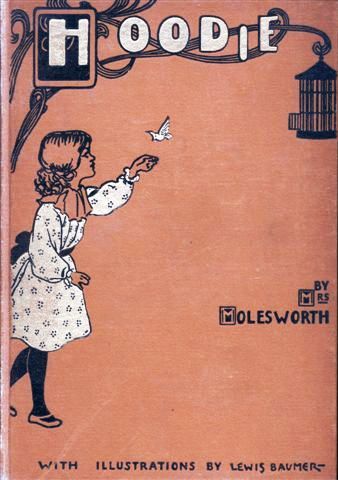
"The darling," said Hoodie ecstatically
But Magdalen told her it was better to leave the bird for the present in her handkerchief, which she had made into a comfortable little nest for it, "till we can find a cage for it; there is sure to be an empty cage of some kind about the house. And then we must see if your mother will give you leave to keep it for a while."
"For alvays!" said Hoodie. "I must keep it for alvays, Maudie's godmother. Maudie has two calanies in a cage, so I might have one bird—mightn't I, Cousin Magdalen?"
"We'll ask your mother," repeated Magdalen, afraid of committing herself to a child like Hoodie, who never, under any circumstances, forgot anything in the shape of a promise that was made to her, or had the least mercy on any unfortunate "big person" that showed any signs of "crying off" from such.
CHAPTER IX.
THE GOLDEN CAGE.
Hop about, and chirp, and eat."
"Yes," repeated Hoodie to herself, as she followed her cousin into the house, "I'll keep the little bird alvays, and I'll teach it to love me; I'll be so vezzy kind to it."
And as they entered the billiard-room where, true to her charge, faithful little Maudie was drying and warming the twins' feet by the fire, Hoodie exclaimed with great triumph—
"It's a bird, Maudie, a most bootiful bird, and I'm going to have it all for my vezzy own and keep it in a cage alvays. Cousin Magdalen is going to ask Mamma. May I go and tell her to come now quick, Cousin Magdalen?"
"No, my dear, certainly not. Your mother's busy and must not be interrupted. You may go and ask for a little milk and a bit of bread, and I'll try if I can make the little bird eat something. It's opening its mouth as if it was hungry. But no—stop, Hoodie. I was forgetting what a state you are in. Maudie, take off her shoes and stockings too—that's a kind little girl. I'll help you in a minute when I've found a safe place for the little bird. There now—that'll do beautifully," as she spoke taking the skeins of wool out of her little work-basket and putting the bird in instead and carefully closing the lid. The children looked on with great interest.
"Is him always to live in zere, Cousin Magdalen?" inquired Hec.
Magdalen was by this time employed in examining into the state of Hoodie's garments. It was rather deplorable!
"It's no good, Maudie," she exclaimed at last. "She must be thoroughly undressed, for she's damp all over. I must take her up to Martin—oh, dear, what a pity! Just when we had had such a nice morning."
"But it was a vezzy good thing I saw the little bird felling down, wasn't it?" said Hoodie complacently, as she trotted off with her cousin's hand. "And Martin won't 'cold me, 'cos it was your fault for letting me go out in the wet; wasn't it, Cousin Magdalen?" she added with great satisfaction.
Magdalen, to tell the truth, found it rather difficult to keep her temper with Hoodie just then.
"Hoodie," she said sharply. "It is not right to speak like that. You know you ran away out before I could stop you."
"But if you hadn't opened the door, I couldn't have goned," was Hoodie's calm reply, with mischievous triumph in her bright eyes.
Martin received the misfortune very philosophically—perhaps she was not sorry, at the bottom of her heart, that some one else should have some experience of the trials she had with Hoodie.
"Not that she means always to be naughty, of course, Miss," she explained to Magdalen. "But she's that heedless and tiresome—oh dear! Though one could manage that if it wasn't for her queer temper—queer indeed! queer's no word for it."
"Martin, Martin," came in Hoodie's shrill voice from the inner room, where she was sitting, minus the greater part of her attire, while Martin "aired" the clean clothes, unexpectedly required, at the nursery fire. "Martin, you must go down to the kitchen at oncest, and get some bread and milk for my bird. I'm going to keep it alvays, Martin, and you mustn't let Duke and Hec touch it never."
"Well, well, Missie, we'll see," said Martin; "you must get your Mamma's leave first, you know."
"By the bye, I'd better go and speak to her about it," said Magdalen. "Shall I tell the other children to come up-stairs, Martin? And my poor letter," she said, smiling rather dolefully, as she went out of the nursery, "I'll never get it written before luncheon, for I must superintend the feeding of the bird, otherwise the children will certainly kill it with kindness."
Magdalen had a good deal of experience in rearing little birds and little lambs, and all such small unfortunates. She had always lived in the country, and having neither brothers nor sisters her tender heart had given its affections to the dumb creatures about her. It was fortunate for the foundling bird that it fell into her hands, as had it been left to Hoodie's affectionate cares its history would certainly have been quickly told. She was very indignant with Magdalen for the very tiny portions of bread and milk, which was all she would allow it to have, and asked her indignantly if she meant to "'tarve" the poor little pet.
"Hush, Hoodie," said her mother, who had come to see the little bird. "If you speak so to Cousin Magdalen I certainly will not let you keep the bird. You should thank her very much for being so kind to you and giving up all her morning to you."
Hoodie did not condescend to take any notice of her mother's reproof.
"Hoodie," said Mrs. Caryll, "do you not hear what I say?"
No reply.
"Hoodie," more sternly.
Hoodie looked up at last.
"Mamma dear," she said sweetly, "may I keep the little bird for my vezzy own? Cousin Magdalen said she would ask you if I might."
Her mother looked puzzled.
"If you are good perhaps I will let you keep it," she replied.
Hoodie looked up sharply.
"Did Cousin Magdalen ask you to let me keep it, Mamma?" she inquired.
"Yes," said her mother.
Hoodie turned to Magdalen.
"Thank you, Maudie's godmother," she said condescendingly. "I thought perhaps you had forgottened."
"And you wouldn't thank me till you were sure—was that it—eh, Hoodie?" said Magdalen.
One of her funny twinkles came into Hoodie's green eyes.
"I like peoples what doesn't forget," she remarked, with a toss of her shaggy head.
Magdalen turned away to hide her amusement, but Hoodie's mother whispered rather dolefully, "Magdalen, was there ever such a child?"
And Hoodie heard the words, and her little face grew hard and sullen.
"I'm always naughty," she said to herself. "Naughty when I tell true, and naughty when I don't tell true. Nobody loves me, but I'll teach my bird to love me."
"What is to be done about a cage for this little creature?" said Magdalen, looking up from her occupation of feeding the greenfinch with quillfuls of bread and milk. "Isn't there an old one anywhere about, that would do?"
"I'm afraid not," said Hoodie's mother. "What can we do?"
"Leave it in the basket for the present," said Magdalen. "And—if Hoodie is very good, perhaps——"
"Perhaps what?" said Hoodie, very eagerly.
"Perhaps some kind fairy will fly down with a cage for the poor little bird," said Magdalen, mysteriously.
Again Hoodie's eyes twinkled with fun.
"I know who the kind fairy will be," she said, skipping about in delight. Then suddenly she flung herself upon her cousin and hugged her valorously.
"I do love you, Cousin Magdalen," she whispered. "I do. I do. And I'd love Mamma too," she added—her mother having left the room—"if she wouldn't alvays say I'm naughty."
"But Hoodie, my dear little girl, do you really think you are always good?" said Magdalen.
"In course not," said Hoodie, "but I'm not alvays naughty neither."
Just then the luncheon-bell rang, and the interesting discussion, greatly, it is to be feared, to Hoodie's satisfaction, could not be continued.
"You're going to be very good to-day, any way, aren't you, Hoodie?" whispered Magdalen, as they went into the dining-room, where the children dined at the big people's luncheon.
"P'raps," replied Hoodie.
"Because you know the kind fairy can't give you the cage if you're not," said Magdalen, smiling.
"I forgot about that," observed Hoodie, coolly.
And her behaviour during the meal left nothing to be desired. But to do her justice, her naughtiness did not as a rule show itself in such circumstances, and according to Martin this was the "provokingest" part of it. "That a little lady who could be so pretty behaved if she chose should stamp and scream and rage like a little wild bear"—though where Martin had seen these wonderful performances of little wild bears, I am sorry to say I cannot tell you—was aggravating, there is no doubt. And as Magdalen watched Hoodie through luncheon, and saw her pretty way of handling her knife and fork, and noticed how she never asked for anything but waited till it was offered her, never forgot her "if you please's" and "thank you's," and was always perfectly content with whatever was given her, she repeated to herself in other words Martin's often expressed opinion.
"What a nice child she might be! What a nice child she is, when she likes! Oh, Hoodie, what a pity it is that you ever let the little black dog climb on to your shoulders or the little cross imps get into your heart!"
Just at that moment Hoodie caught her eye. She drew herself straight up on her chair with a little air of inviting approval.
"Am I not vezzy good?" Magdalen could almost fancy she heard her saying, and in spite of herself, she could not help smiling back at the funny little girl.
Luncheon over, the children were dismissed for their walk, for the rain was now quite over and the afternoon promised to be fine and sunny. As they were leaving the room Hoodie threw her arms round Magdalen's neck and drew her head down that she might whisper into her ear.
"Will the fairy come, does you think?" she asked.
"I hope so," said Magdalen, in the same tone; "but, Hoodie, you must promise me one thing. You must not touch the little bird while I am away. I have put it on my table in the basket and it will be quite safe there. You may go in to look at it with Maudie, but you must not touch it."
"Won't it be hungry?" inquired Hoodie.
"Oh no, I'll give it a little more before I go out, and then it will be all right till I come in. You promise, Hoodie?"
Hoodie nodded her head.
"P'omise," she repeated.
Magdalen looked after her anxiously.
"Poor little Hoodie," she said to herself, as she watched the neat little figure tripping out of the room. Just then the children's mother came over to her.
"Magdalen, my dear child," she said, "you must not worry yourself about these children. You have been looking quite careworn all the morning, and I can't have it."
"But I wanted to help you with them, so that you might have a little rest and get quite strong again, dear Beatrice," said Magdalen. "You have never been really well since your illness last winter, and Mamma and I thought I should be able to help you—and—and—" the tears came into Cousin Magdalen's pretty eyes.
"Well, dear, and who could have done more to help me than you, since you have been here? I shall miss you terribly when you go, especially about Hoodie," and in spite of her wish to cheer Magdalen, Hoodie's mother gave a little sigh.
"It was about Hoodie I was thinking," said Magdalen. "I was so anxious to do her good."
"And don't you think you have?"
Magdalen hesitated.
"I don't know. Sometimes I think I have made an impression on her, and then it seems all to have gone off again. She is such a queer mixture—in some ways so old for her age, and in some ways such a baby."
"Yes," said Mrs. Caryll. "It is so very difficult to know how to treat her. But she is very fond of you, Magdalen, and I am so glad to see it. We really used to think it wasn't in her to be fond of any one."
"But I am sure it is in her," said Magdalen, "only—I hardly can say what I mean—if she could be made to believe that other people love her, that she could be of use to others—I think that would take away the sort of defiance and hardness one sees in her sometimes. It is so unlike a child. She is always imagining people don't care for her, and then she takes actual pleasure in being as naughty as she can be."
"Yes," said Hoodie's mother; "there really are days when she goes out of her way to be naughty, one might say,—when it is enough for Martin to tell her to do or not to do anything, for her to wish to do or not to do the opposite. Still she has been better lately, Magdalen, and it is all thanks to you."
"Poor little Hoodie!" said her cousin, "I wonder why it should be so very difficult for her to be good. But we must get ready now, must we not, Beatrice? And whatever I do I must not forget the cage, or any good I can ever hope to do Hoodie will be at an end!"
"But she is only to have it if she really has been good?" said Mrs. Caryll, who was sometimes afraid that Magdalen was rather inclined to spoil Hoodie.
"Only if she has been good, you may be sure," said Magdalen. "And there is one thing about Hoodie—she does keep a promise."
"You think she is honest and truthful?" said Mrs. Caryll.
"By nature I am sure she is. But her brain is so full of fancies that she hardly understands herself, that I can quite see how sometimes it must seem as if she were not straightforward. Not that the fancies would do her any harm if they were all happy and pretty ones—but I do wish she could get rid of the idea that no one cares for her. It is that that sours her and spoils her, poor little girl."
Hoodie's mother looked affectionately at Magdalen.
"Where have you learnt to be so wise about children, Magda?" she said. "You seem to understand them as if you had lived among them all your life."
"It is only because I love them so much," said Magdalen, simply. "And often somehow——" she hesitated.
"Often what?" said her cousin, smiling.
"I was going to say—but I stopped because I thought perhaps you would not like it as we were talking of your children who have everything to make them happy—" said Magdalen. "I was going to say that sometimes, often, I am so very, very sorry for children. Even their naughtinesses and sillinesses make me sorry for them. They are so strange to it all—and it is so difficult to learn wisdom."
Hoodie's mother smiled again.
"You are such a venerable owl yourself, you funny child," she said. "However, I do understand you, and I agree with you. I do feel very sorry for poor Hoodie sometimes, even though she really goes out of her way to make herself unhappy. But what is one to do?"
"Yes, that is the puzzle," said Magdalen. "In the first place any way, I am going to buy her a cage for her bird—it will be good for her to take regular care of the bird. I am so glad you said she might keep it."
"I only hope we shall be able to rear it," said Mrs. Caryll. "Hoodie would indeed think all the powers were against her if it died. That is the worst of pets."
"I think this bird will get on, if it is taken care of and not over-fed," said Magdalen. "It is a greenfinch, you know, and greenfinches take kindly to domestic life. Besides, it is not so very young a bird, and it looks quite bright and happy now that it has got over its fright," and so saying she followed Hoodie's mother out of the room to prepare for their drive.
It was nearly five o'clock in the afternoon when they returned. Cousin Magdalen ran joyously up-stairs to the nursery carrying a very funnily-shaped parcel in her hand. The children were all at tea. She heard their voices and the clatter and tinkle that always accompanies a nursery meal as she came along the passage, and she opened the door so softly that for a moment or two she stood watching the little party before any of them noticed her.
How nice and pretty and happy they looked! Martin, a perfect picture of a kind, tidy nurse, sat pouring out the tea, looking for once quite easy-minded and at rest; Maudie, a little model of neatness as usual, her small sweet face wearing an expression of the utmost gravity as she carefully spread some honey on Hec's bread and butter; Duke, frowning with eagerness to understand some mysterious communication which his neighbour Hoodie was making to him in a low voice, her eyes bright with excitement, her cheeks rosy, and her pretty fat shoulders "shruggled" up, as she bent to whisper to her little brother.
"What do you say, Hoodie? I don't under'tand. How could it be all of gold?" were the first words that met Magdalen's ears.
"Hush, Duke," said Hoodie, placing her sticky little hand on his mouth, "you're not to tell. I didn't say it would be all gold. I said p'raps the little points at the top would be goldy—like the shiny top of the point on the church. But you're too little to know what I mean. You must wait till—Oh!" with a scream of delight, "there's Maudie's godmother! Oh, Maudie's godmother, Maudie's godmother, have you got it?"
She was off her seat and in Magdalen's arms in an instant—hugging, jumping, kissing, dancing with eagerness. It was all Magdalen could do not at once to hold out to her the parcel, but her promise to Hoodie's mother must not be broken.
"Yes," she said, "I have got it. But first tell me, Hoodie dear—have you been really a good little girl all the afternoon? Has she, Martin?"
"Oh, trually I've been good—vezzy good—haven't I, Martin?" said Hoodie.
"Yes, Miss. I must really say she has been very good. I don't remember ever having a more peacefuller afternoon," said Martin with great satisfaction.
"I am so glad," said Magdalen. "And you didn't touch the bird, Hoodie?"
"No, oh no, I didn't touch it one bit," said Hoodie earnestly. "I went and lookened at it, but I didn't touch it. Martin will tell you."
"No, Miss, she was quite good. She just stood and peeped at it, but she didn't touch it, I'm sure, for I went with her to your room and stayed there a few minutes while she looked at the bird."
"That was very nice," said Magdalen.
"We didn't let Hec and Duke go," said Hoodie, "for they'd have wanted to touch the bird, wouldn't they? They're so little, you see, and Hec says he likes smooving down the feavers on little birds's backs, so Martin and me thought we'd better not let them be temptationed to touch the bird."
"Ah, yes, that was very wise. And as Martin stayed with you, you weren't temptationed either, were you, Hoodie?"
Somewhat to her surprise, at this Hoodie grew rather red.
"I didn't stay all the time, Miss," said Martin. "I heard the little boys calling me, so I left Miss Hoodie for a minute or two feeling sure I might trust her."
"So there's nothing to prevent my giving you the cage. That's very nice," said Magdalen. She lifted the funny-looking parcel on to the table and unfastened the paper. There stood the cage—and such a pretty one! It was painted white and green, and greatly and specially to Hoodie's satisfaction the pointed tops of the pagoda-like roof were gilt.
"Didn't I tell you so," she said to Duke in a tone of great superiority, "I told you there'd be goldy points on the top."
"Yes," said Duke, much impressed; "I wonder how you knowed, Hoodie?"
Hoodie tossed her head.
"Knowed, in course I knowed," she said.
Only Hec did not seem as much interested and delighted as the others. He just glanced at the cage and then subsided again to his bread and honey.
"What's the matter with Hec?" said Cousin Magdalen. "He doesn't look as bright as usual, does he, Martin?"
"He's been very quiet all the afternoon," said Martin, "but I don't think he can be ill. He's eaten a good tea, hasn't he, Miss Maudie?"
"Very," said Maudie. "Three big slices first—only with butter, you know, and then six with honey. We always have to eat three plain first, on honey days," she added by way of explanation to her cousin.
"Nine slices," said Magdalen, opening her eyes. "Martin, isn't that enough to make him ill?"
"Bless you, no, Miss," said Martin, laughing. "As long as it's bread and butter, there's not much fear."
"Or bread and honey," corrected Hoodie. "One day Duke and Hec and me—Maudie wasn't there—one day Duke and Hec and me eatened firty-two slices—Martin counted. It was when we was at the seaside."
"My dear Hoodie!" exclaimed Magdalen, and the astonishment on her face made them all laugh.
The consumption of bread and butter and honey seemed however over for the present, so Magdalen led the way to her own room, followed by Hoodie carrying the precious cage which she would entrust to no other hands, Maudie, the twins, and Martin bringing up the rear.
Magdalen opened the door and crossed the room, which was a large one, to the side window, on the writing-table, in front of which, she had left the basket containing the bird. She had placed it carefully, with a little circle of books round it to prevent the bird's fluttering knocking it over. As she came near the table, she gave an exclamation of surprise and vexation. The circle of books was still there undisturbed, but the basket was no longer in the centre—indeed, at the first glance Magdalen could not see it at all.
"Oh dear!" she exclaimed. "Where can the basket be? Hoodie, you surely didn't touch it?"
The moment she had said the words she regretted them—but just at first she had not time to look at Hoodie to see how she had taken them, for another glance at the table showed her the basket peeping up behind the edge where it had slipped down, though fortunately the table was pushed too near the wall for it to have fallen quite on to the floor.
Magdalen darted forward and carefully drew out the basket, in considerable fear and trembling as to the state of the little bird inside. But to her relief it seemed all right. It had had another fright, no doubt, poor thing—it must have thought life a very queer series of falls and bumps and knocks, I should think, judging by its own experience, but still it seemed to have a happy faculty of recovering itself, and though its position in the toppled-over basket could not have been very comfortable, it looked quite bright and chirpy when Magdalen gently lifted the lid to examine it.
"It is hungry, I'm sure," she said; "can't you give me a little bread soaked in milk for it again, Martin. There's some milk on the nursery table, isn't there?"
"To be sure, Miss," said Martin, starting off at once. To her surprise, as she left the room she felt a hand slipped into hers. It was Hoodie's.
"I'll go with you," said the child, and Martin, thinking she only wanted to go with her to see about the bread and milk, made no objection. It was not till they reached the nursery that Martin noticed the expression of the little girl's face. It was stormy in the extreme.
"I won't go back to Maudie's godmother's room," she exclaimed. "I won't have the cage. I won't speak to her—nasty, ugly Maudie's godmother."
"Miss Hoodie!" said Martin, in amazement and distress. "You speaking that naughty way of your cousin who has been so very nice and kind to you."
"I don't care," said Hoodie, fairly on the way to one of her grandest tempers, "I don't care. She's not nice and kind. She doesn't believe what I say. I toldened her I didn't touch the basket, and she said I did."
"Oh no, Miss Hoodie, my dear, I'm sure she didn't say that. She only asked you if you were quite sure you didn't. And who could have done it, I'm sure I can't think," said Martin, herself by no means satisfied that Hoodie's indignation was not a sign of her knowing herself to blame. "No one was in the room but you and me this afternoon, for none of the servants ever go near it till dressing time. Besides, they wouldn't go touching the bird. If it had been one of the little boys now. It's just what they might have done, reaching up to get it. But they weren't there at all."
"I don't care," reiterated Hoodie. "I didn't do it, but Maudie's godmother doesn't believe me. I don't care. But I won't have the cage." And in spite of all Martin could say, the child resolutely refused to leave the nursery.
Hoodie sat there alone, nursing her wrath and bitter feelings.
"I don't care," she kept repeating to herself. "Nobody likes me. I'm alvays naughty. What's the good of being good? I did so want to touch the bird when Martin went out of the room and left me alone, but I didn't, 'cos I'd p'omised. I might as well, 'cos Maudie's godmother doesn't believe me. It's very unkind of God to make it seem that I'm alvays naughty. It's not my fault. I don't care."
In Magdalen's room Martin was relating Hoodie's indignation.
"Oh, how sorry I am for saying that," said Magdalen. "It will just make her lose her trust in me. And I do believe her. I'm sure she didn't touch it. Don't you think so, Martin?"
Martin hesitated.
"Yes, Miss, I do think I believe her. Only didn't you notice how red she got when I said I wasn't with her all the time in your room this afternoon?"
"Yes," said Magdalen; "but I thought it was just that she felt so eager for me to know she had kept her promise. I don't think she touched it, Martin. I really don't. But I am afraid it will be difficult to make her believe I don't."
Just then a sudden sound of weeping made them all start, thinking for a moment that it must be Hoodie herself, who had run back from the nursery. But no—it was not Hoodie—it was Hec. The little fellow had crept under the table unobserved, and there had been listening to the conversation.
"What's the matter, dear? What's the matter, my darling? Don't cry so, Master Hec," said Martin, as she drew him out.
"Poor Hec! Poor little Hec! Has he hurt himself?" exclaimed all the others.
"No, no, I hasn't hurt myself," sobbed Hec. "I'm crying 'cos it was me. It was me that tumbled the basket down, and Cousin Magdalen 'colded Hoodie. It wasn't poor Hoodie. It was all me."
And for some minutes, conscience-stricken Hec refused to be comforted.
Hec refused to be comforted
CHAPTER X.
FLOWN.
Hoodie sat alone in the nursery, wrathful and sore. All the pleasure in the little bird and the beautiful cage seemed to have gone.
"I don't love her neither, not now," she said to herself. "I don't think—no, I really don't think I love anybody, 'cos nobody loves me, and ev'ybody thinks I'm naughty. Never mind—I'll go away some day. As soon as ever I'm big enough I'll go kite away and never come back again, and I sha'n't care what anybody says then."
There was some comfort though of a rather vague kind in this thought. Hoodie sat swinging her legs backwards and forwards, while queer fancies of where she would go—what she would do, once she was "big enough," chased each other round her busy little brain.
Suddenly a sound in the passage outside the nursery door made her look up just in time to see the door open and Magdalen, leading tearful Hec by the hand, followed by Maudie, Duke, and Martin, come in.
Hoodie looked up with some curiosity.
"Hoodie," said Magdalen, "Hec wants to tell you how sorry he is that you have got blamed on his account. It was he that touched the basket and knocked it over. He ran into my room to look at the bird without Martin's knowing he had left the nursery, and he was so afraid that he had hurt the little bird, by knocking it over, that he didn't like to tell. Kiss him and speak kindly to him, poor little boy, Hoodie dear. He has been so unhappy."
Hoodie gravely contemplated her little brother, but without giving any signs of obeying her cousin's request.
"I have been unhappy too," she said, "and it wasn't my fault. It was Hec's."
"Well, then," said Magdalen, "it should make you the more sorry for Hec. He has had the unhappiness of knowing it was his fault, which is the worst unhappiness of all."
Hoodie threw back her head.
"I don't think so," she said. "I think the worst is when people alvays says you're naughty when you're not."
"I am sorry you thought I said you were naughty when you weren't, Hoodie," said Magdalen, "but you thought I meant more than I did. As soon as I thought about it quietly I felt sure you hadn't touched the basket—and even more sure, that if you had been tempted to touch it, you would have said so."
"'Cos Hec toldened you it was him," said Hoodie.
"No, before Hec said a word, I said to Martin I was sure it wasn't you."
Hoodie looked up with a new light in her eyes.
"Did you?" she said, as if hardly able to believe it.
"Yes, indeed, Miss Hoodie," said Martin, "Miss King did say so. And very kind of her it was, to trust you so, for you did look very funny when I said you had been a few minutes alone in the room."
Hoodie flamed round upon her.
"It's vezzy nasty of you to say that, Martin," she exclaimed violently. "Vezzy nasty. You alvays think I'm naughty. I daresay I did look funny, 'cos I was temptationed, awful temptationed to touch the bird, but I wouldn't, no I wouldn't, 'cos I'd p'omised."
And at last her mingled feelings found relief in a burst of sobs.
The sight was too much for Hec, already in a sorely depressed and tearful condition. He threw his arms round Hoodie, nearly dragging her off her chair in his endeavours to get her shaggy head down to the level of his own close-cropped dark one for an embrace.
"Oh Hoodie, Hoodie, dear Hoodie, don't cry," he beseeched her. "It's all Hec's fault. Naughty Hec. Oh Hoodie, please 'agive me and kiss me, and I'll never, never touch your bird again."
"Please 'agive me and kiss me."
Hoodie was quite melted.
"Dear Hec—poor Hec," she cried in her turn. "Don't cry, dear Hec," and the two little creatures hugged and kissed and cried, all in one.
"Let's kiss Maudie's godmother too. She didn't think you was naughty, Hoodie," suggested Hec, and Hoodie at once took his advice, so the kissing and hugging were transferred to poor Magdalen, who bore them heroically, till at last she was so very nearly smothered that she was obliged to cry for mercy.
"And let us go back to my room now," she said, "and introduce the little bird to its new house. It hasn't seen it yet, you know, Hoodie."
"Hasn't it?" said Hoodie.
"Of course not. The cage is yours—your very own. I waited for you to come before putting the bird in it."
"That was vezzy good of you," said Hoodie, approvingly; and as happy and light-hearted as if no temper or trouble of any kind had ever come near her, she took Hec's hand and trotted off with her cousin to help in the installation of the bird in its beautiful cage.
"What funny creatures children are," said Magdalen to herself, "and of them all surely Hoodie is the funniest."
It would be impossible to tell the pleasure that the possession of the little bird gave to Hoodie, and the devotion she showed to it. For some days its cage remained in Miss King's room, that Cousin Magdalen herself might watch how the little creature got on, and there, as Martin said, "morning, noon, and night," Hoodie was to be found. It was the prettiest sight to see her, seated by the table, her elbows resting upon it, and her chubby face leaning on her hands, while her eyes eagerly followed every movement of her favourite. She was never tired of sitting thus, she was never cross or impatient, nor did she ever attempt to touch the greenfinch without Magdalen's leave. And finding that the little girl was so gentle and obedient, and that the bird gave her such pleasure, Magdalen kindly did her utmost to increase this pleasure. She taught Hoodie how to tame and make friends with her pet, to call to it with her soft little voice—for no one could have a softer or prettier voice than Hoodie when she chose—always in the same tone, till the bird learnt to recognize it and to come at her summons. And oh the delight of the first time this happened! Hoodie was holding out her hand, the forefinger outstretched to the open door of the cage, half-cooing, half-whistling, in the pretty way Magdalen had taught her, when birdie, its head cocked on one side as if half in timidity, half in coquetry, at last mustered up courage and hopped on to the fat little pink finger.
Hoodie nearly screamed with delight, but recollected herself just in time not to frighten the bird.
"Oh, Cousin Magdalen," she whispered in the most tremendous excitement, "Him is pouching, him's pouching on my finger. Oh the darling,—look, look, Maudie's godmother."
But before Maudie's godmother could get across the room to look, Mr. Birdie had hopped off its new perch, and the experiment had to be repeated.
"Come and pouch, birdie, dear birdie; do come and pouch on my finger," said Hoodie, beseechingly.
"Call it the way I taught you," whispered Magdalen.
Hoodie did so, and at the sound of her well-known call, the greenfinch cocked its head, looked round on all sides, appeared to consider, and at last condescended again to hop on to its little Mistress's finger.
"Isn't it sweet?" said Hoodie ecstatically, though scarcely daring to breathe for fear of disturbing it.
"If you take care never to startle it," said Magdalen, "it will get in the way of coming regularly whenever you call it. Never let it hear you speaking angrily or roughly, Hoodie. That would startle it more than anything."
"Would it?" said Hoodie, regarding her pet with affection not unmingled with respect. "Would it know I was naughty? Cousin Magdalen," she added, looking up into her friend's face with considerable awe in her bright green eyes; "Cousin Magdalen, do you think p'raps my bird's a fairy, and that God sent it to teach me to be good?"
Fortunately by this time Magdalen's intercourse with Hoodie had taught her the necessity of great control of herself. Whatever Hoodie said or did, she must not be laughed at—not even smiled at, if in the smile there lurked the slightest shadow of ridicule. Once let Hoodie imagine she was being made fun of and all hope of leading her and making her love and trust you was over.
So Magdalen's face remained quite grave as she replied to Hoodie's question,
"I think that everything nice and pretty that comes to us is sent by God, dear. And He means them all to teach us to be good. But I don't think you need fancy your little bird is a fairy."
"It's so clever," said Hoodie. "Fancy him knowing when I call. Do you think some day it'll learn to speak, Cousin Magdalen?"
Cousin Magdalen shook her head.
"I'm afraid not. It isn't the kind of bird that ever learns to speak," she replied, as gravely as before. "But I shouldn't wonder if it learns to know you very well—to come in a moment when it hears you call, and to show you that it is pleased to see you."
"Oh how lovely that'll be," said Hoodie, dancing about with delight. "Fancy it coming on my finger whenever I say 'Birdie dear, come and pouch.' I'll never let it hear me speak c'oss, Cousin Magdalen. Whenever I feel it coming I'll go out of the room and shut the door tight so it sha'n't hear me."
"Whenever you feel what coming?" asked Magdalen.
"It," repeated Hoodie, "c'ossness, you know. It must come sometimes—all chindrel is c'oss sometimes," she added complacently.
"Well, but suppose some children were to make up their minds to be cross no times," said Magdalen with a smile. "Wouldn't that be a good thing? Suppose a little girl I know, not very far from here, was to set the example."
Hoodie laughed.
"Cousin Magdalen," she said, with an accent on the name that she always gave when amused. "Cousin Magdalen, how funny you are! I know who you mean—yes, I do, kite well. But she couldn't, that little girl couldn't help being c'oss sometimes."
She shook her head sagaciously.
"Well, any way," said Magdalen, "try and let the 'sometimes' come as seldom as possible. Won't you do that, Hoodie?"
Just then there came a tap at the door.
"Miss Hoodie," said Martin's voice. "Come to tea, please. It's quite ready."
Hoodie gave an impatient shake. Fortunately the bird was no longer on her finger, otherwise its nerves would have been considerably startled. Hoodie had been on the point of putting her hand into the cage to entice it to hop on to her finger and thus to lift it out when Martin's summons came.
"I don't want any tea," she said; "do go away, Martin. You alvays come for me when I don't want to go."
"Hoodie," whispered Magdalen, "the bird will be quite frightened to hear you speak like that."
Hoodie looked startled.
"Oh dear," she said. "I quite forgot. You see, Cousin Magdalen, it will come. There's no good trying to keep it away."
"Yes, there is," said Magdalen. "There's good in trying to keep it away, and there's good in trying to send it away even after it's come. You're sending it away now, Hoodie, I think."
"Am I?" said Hoodie, doubtfully. Then with a sudden change of tone, "Well, I will then. I'll go goodly with Martin. Martin," she said amiably, turning to her nurse, "I'm coming. I'll go out of the room kite goodly and quiet, and then perhaps birdie won't remember about my speaking c'oss."
"I daresay he won't," said Magdalen encouragingly. "I'll give him some fresh seed to eat, as it's rather low in his box, and that will give him something else to think of. But I won't speak to him, Hoodie. I never do, because I want him to learn to know your voice."
"That's out of the Bible," was Hoodie's parting remark, as she went off with Martin, quite "goodly," as she had promised.
Day by day Hoodie loved her bird more and more, and her love was repaid by great success in taming the little creature. It grew to know her wonderfully well, to hop on to her rosy finger when she called to it, adding always, "Birdie, birdie, come and pouch," with a soft clear note of delight that it was quite a pleasure to hear. Its cage was placed in the window of a little ante-room, out of which Miss King's room opened. There had been some talk of putting it in the nursery, but Hoodie pleaded against this. The cat had been known to enter the nursery, for Hec and Duke were rather fond of old pussy, and Prince was a frequent visitor there. And besides this, Hoodie could not feel quite sure that her little brothers might not be some day "temptationed" to touch her favourite. It was pretty clear any way that birdie's residence in the nursery would be a source of quarrels, so Mother and Magdalen and Martin agreed that the ante-room window would be the best and safest place.
"It isn't as if winter was coming instead of summer," said Magdalen. "In that case a room without a fire would be too cold for it. But every day, now, the weather is getting brighter and warmer. What are you looking so grave about, Hoodie?"
Hoodie looked up solemnly.
"I were just thinking," she replied, "what a pity it would be if winter comed back again instead of summer, just when we've settled about my bird so nicely—by mistake you know."
"But winter and summer don't come of themselves, Miss Hoodie," said Martin. "You know God sends them, and He never makes mistakes."
"But supposing He did," said Hoodie, "you are so stupid, Martin. You might suppose."
"Hoodie!" said Magdalen, warningly.
Hoodie gave a wriggle, but said no more. Not that she was vanquished however. She waited till bed-time, and then, after saying aloud as usual her little evening prayer, added a special clause for Martin's edification. "And p'ease, dear God, be sure not to forget to send the nice warm summer for my little bird, and don't let cold winter come back again by mistake."
"It'll do no harm to 'amind God, any way," she observed with satisfaction, as she lay down in bed and composed herself for her night's repose.
Weeks passed on and the nice warm summer came. Hoodie's devotion to her bird seemed to increase as time went on, and so much of her time was spent beside its cage that the nursery peace and quiet were much greater than before its arrival.
One day, just after the nursery breakfast, she hastened to her pet as usual. Rather to her vexation she saw that her two little brothers were standing by the cage, of which the door was open, Miss King beside them. Hoodie frowned, but did not venture to say anything.
"See, Hoodie," said Magdalen, "see how very confiding birdie has learnt to be. He has actually hopped on to Duke's finger when he whistled to him the way you do. It will do him no harm now to be friendly to other people too—now that he knows you so well. Look at him."
"See, Hoodie," cried Duke in delight, holding up his stumpy little forefinger, on which birdie was contentedly perched.
An ugly black cloud came over Hoodie's face. She darted forward, furious with anger.
"I won't have him pouch on your finger, Duke," she cried. "I won't have anybody call him but me. I won't. I won't—he's the only thing that loves me and nobody's to touch him. Go away, naughty Duke; ugly Duke."
She pushed Duke aside with one hand and with the other attempted, gently, notwithstanding her passion, to take the bird. The window was wide open, and the children were standing beside it. Magdalen, who was at the other side of the table on which stood the cage, hurried forward, but too late. Startled by Hoodie's loud voice, not recognizing in the furious little girl its gentle mistress, and with some instinct of self-preservation, the greenfinch, with a frightened uncertain note, flew off Duke's finger, alighted for one instant on the window-sill, from which it seemed for a moment to look at the group in the room, as if in farewell, then, before Magdalen could do anything, before Hoodie had taken in the idea of the misfortune that threatened her, raised its pretty wings with another soft reproachful note, and flew away—away out in the bright sunny garden, over the bushes and flowers, away—away—to some leafy corner up among the high trees, where there would be no angry voices to startle it, no quarrelsome children to frighten its tender little heart—no sound but the soft brush of the squirrel's furry tail among the branches, and the gentle flutter of the summer breeze. Away, away! But what did that "away" mean to poor broken-hearted Hoodie?
She stood motionless with surprise and horror—she did not dart to the window as one would have expected—ready almost to throw herself out of it in fruitless pursuit of her favourite—she stood perfectly still, as if turned into stone. But the expression on her face was so strange and unnatural that Miss King felt frightened.
"Hoodie," she exclaimed. "Hoodie, child, don't stand like that. Come to the window and call to your bird. Perhaps he will hear you and fly back."
She said it more to rouse Hoodie out of the depth of her misery than because she really thought the bird would return, for in the bottom of her heart she feared much that it had truly flown away, and that once it felt itself out in the open air its natural instinct of freedom would prevent its returning to its cage.
Hoodie started.
"Come back? Do you think he'll come back, Cousin Magdalen?" she exclaimed, and rushing to the window, and leaning out so far that Magdalen was obliged to hold her for fear she should fall over, she gave the soft clear call which her cousin had taught her—over and over again, till, tired and out of breath, she drew in her head and looked up in Magdalen's face despairingly.
"He won't come," she said, "he won't come. P'raps he's flied away too far to hear me. P'raps he can hear me but he doesn't want to come. Oh dear, oh dear, what shall I do? My bird, my bird—you always said he would fly away if he heard me speak c'oss, and I did speak c'oss, dedful c'oss. Oh! what shall I do?"
Hoodie sank down on the floor—a little heap of tears and misery. Hec and Duke flung their arms around her, beseeching her not to cry so, but there was no comfort for Hoodie.
"It was my own fault," she kept repeating, "my own fault for speaking so c'oss. The bird will never come back. Oh no, Hec and Duke, dear Hec and Duke, it isn't no good kissing me. I'll never, never be happy again, and it's my own fault."
It was impossible not to be sorry for her. Magdalen felt almost ready to burst into tears herself. She took Hoodie up in her arms and tried to comfort her.
"I don't think you should quite lose heart about birdie, Hoodie. He may come back again, once he has had a good fly. We must keep the window open, and you must keep calling to him every now and then, in the way he is used to. And perhaps it would be a good plan to go out in the garden and call—he may perhaps have flown up among the trees at the other side."
Hoodie was only too ready. Patiently, while her cousin went down to her breakfast, the little girl stood at the window calling to the truant. Every now and then the sobs that would continue to rise, made a sad little quaver in the middle, and once or twice poor Hoodie was obliged to stop altogether. But she soon began again, and every now and then between her whistles, she said in a beseeching, half heart-broken tone—
"Oh, birdie, won't you come? Come, dear birdie, oh do come and pouch on my finger. I'll never, never speak c'oss again—never, dear birdie, if only you'll come back and pouch on my finger."
It was very melancholy. Very melancholy too was the walking about the garden in vain hopes that birdie might be somewhere near and would fly down again. The whole day passed most sadly. Hoodie's eyes were swollen with crying, and she could scarcely eat any dinner or tea, and her distress naturally was felt by all the nursery party. It was one of the saddest days the children had ever known, and they all went to bed with sorely troubled little hearts.
Magdalen too was grieved and sorry.
"I blame myself," she said to Hoodie's mother. "Pets are always a risk, and Hoodie is such a strange mixture that one shouldn't run risks with her. I wish I had never suggested her keeping the bird as a pet, but I thought it might be good for her to have something of her very own to care for and attend to."
"And so it was," said Hoodie's mother. "It has done her a great deal of good; it has softened her wonderfully. We all noticed it. And even this trouble may do her good; it may teach her really to try to master that sad temper of hers."
"I had no idea she would have been so put out at Duke's playing with her bird," Magdalen went on, "or I would not have risked it."
"But she should not have been put out at it," said Mrs. Caryll. "You have nothing whatever to reproach yourself with, dear Magdalen. Hoodie must be taught that she cannot be allowed to yield to that selfish, jealous temper."
"I know," said Magdalen. "But how are we to teach her? that is the difficulty—the least severity or sternness which does good to other children, seems to rouse her very worst feelings and only to harden her. She is not hardened now, poor little soul, she is perfectly humble. Oh, how I do wish I could find her bird for her!"
"Don't trouble yourself so much about it, dear. You really must not," said Mrs. Caryll, as she bade her cousin good night.
But unfortunately those things which our friends beg us not to trouble ourselves about are generally the very things we find it the most impossible to put out of our minds. Magdalen could not leave off "troubling" about poor Hoodie. She slept little, and when she did sleep it was only to dream of the lost bird, sometimes that it was found again in all sorts of impossible places—sometimes that Hoodie was climbing a dreadfully high mountain, or attempting to swim across a deep river, where Magdalen felt that she would certainly be drowned,—in search of it. And once she dreamt that the bird flew into her room and perched at the foot of her bed, and when she exclaimed with delight at seeing it again it suddenly began to speak to her, and its voice sounded exactly like Hoodie's.
"I have come to say good-bye to you, Maudie's godmother," it said. "Nobody loves me, and I am always naughty, so I'd better go away."
And as Magdalen started up to catch the bird, or Hoodie, whichever it was—in her dream it seemed both—she awoke.
It was bright daylight already, though only five o'clock. Outside in the garden the sun was shining beautifully, the air, as Magdalen opened her window, felt deliciously fresh and sweet, everything had the peaceful untroubled look of very early morning—of a very early spring morning especially—when the birds and the flowers and the sunshine and the breezes have had it all to themselves, as it were, undisturbed by the troubles and difficulties and disagreements that busy day is sure to bring with it, as long as there are men and women, and boys and girls, in this puzzling world of ours.
Though, after all, it is better to be a child than a bird or a flower—whatever mistakes we may make, whatever wrong we may do, all, alas, adding to the great mass of mistakes and wrong—whatever sorrows we may have to bear, it is something to feel in us the power of bearing them, the power of trying to put right even what we may have helped to put wrong—best of all the power of loving each other, and of helping each other in a way that the happy, innocent birds and flowers know nothing about. Is it not better to be ourselves, after all?
Magdalen leant out of the window, enjoying the sweet air and sunshine, but thinking all the time how much more she would have enjoyed this bright morning but for her sympathy with poor Hoodie's trouble.
Suddenly a thought struck her. Possibly the bird, chilled and hungry after some hours' freedom, unaccustomed to be out in the dark, or to find food for itself—possibly he might have returned to his cage in the night. Magdalen threw on her dressing-gown and hurried into the ante-room. The window was open, the cage-door stood open too, everything was ready to welcome the little wanderer—fresh seed in the box, fresh water in the glass—Hoodie had seen to it all herself before going to bed—but that was all!
There was no little feathered occupant in the cage—it was empty, and with a fresh feeling of disappointment, Magdalen stood by the window again, looking out at the bright morning, and wondering what she could do to comfort poor Hoodie. Outside, the birds were singing merrily.
"Should I get her another bird?" thought Magdalen, "a canary, perhaps, accustomed to cage life? No, I think not. It might only lead to fresh disappointment; besides, I don't think Hoodie is the sort of child to care for another, instead. No, that wouldn't do."
Suddenly a sort of flutter in the leaves round the window-frame—Mr. Caryll's house was an old one; there were creepers all over the walls—made Magdalen look up.
"Can there be a nest in the eaves?" she said to herself, for the flutter was evidently that of a bird; and as she was watching, she saw it fly out—fly down rather from the projecting window-roof, and—to her amazement, after seeming for an instant or two to hesitate, it summoned up courage and flew a little way into the room—too high up for her to reach however, and not far enough into the room for her to venture to shut the window. She stood breathless, for as it at last settled for a moment on the curtain-rod, she saw what at first she had scarcely ventured to believe, that it was Hoodie's bird.
It stayed a moment on the rod, then it flew off again—made a turn round the room—"oh," thought Magdalen, "if it would but settle somewhere further from the window, so that I could shut it in"—But no, off it flew again—out into the open air, and Magdalen's heart sank. Patience! Another moment and it was back again, with designs on its cage apparently, but it hesitated half way. Now was the critical moment. Magdalen hesitated. Should she risk it? She stretched out her hand towards the bird and softly and tremulously whistled to it in Hoodie's well-known call. The wavering balance of birdie's intentions was turned—it cocked its head on one side, and with a pretty chirp flew towards Magdalen and perched on her finger! Slowly and cautiously, whistling softly all the time, she slipped her hand into the cage, and quickly withdrawing it the instant birdie hopped off he found himself caught.