
XIII. LET THROUGH THE ROOF
MARK 2.4
LET THROUGH THE ROOF
MARK 2.4
THE poor man, who you see in this picture, had been very ill for a long time.
He had four friends who loved him very much, and who had heard that the Lord Jesus could heal those who were sick.
When these friends heard that Jesus was in their city, they were very anxious to get the sick man to Him. But he was so helpless that he could only lie on his bed, waited on by those around him.
But these four friends firmly believed that Jesus could heal the sick man, and they decided to carry him, just as he was on his bed, and ask Jesus to cure him.
But when they reached the house where Jesus was, there was such a crowd that they could not even get near the door.
You can imagine how they tried to persuade the people to make room for them to get in; but everyone was so anxious to see the Lord Jesus, and to hear Him speak, that they could not even get near the door.
What was to be done now? Should they turn back?
What? get so near to Jesus, and not be healed after all!
Then the four friends thought of another plan.
They would get the invalid up the outside staircase that there often is in Eastern houses, and would get on to the roof!
So they carried the poor sick man carefully up the staircase, and when they had uncovered a place in the roof, they let down his bed right through the ceiling to the feet of Jesus.
Ah! what do you think the dear Lord said then?
When He saw their faith—the faith of those men who had brought the sick man to Jesus—He said to the poor trembling invalid, "Son, be of good cheer, thy sins be forgiven thee!"
And then when the people wondered very much at Jesus being able to forgive sins, He showed them His great power, by making the sick man quite well the very next moment.
He asked the people which was the easiest for God to do, to forgive sins, or to make people well in an instant?
Then He said to the man, sick of the palsy, "Arise, take up thy bed, and go unto thine house."
Jesus made him so well that though he had to be carried there on a bed, he received strength to obey, and walked back to his home, carrying his bed in his arms!
This wonderful story of one of the miracles of Jesus helps us to understand three things: first, the great power of Jesus; and next, that we should bring our friends to Jesus, to get blessed; and third, that we should let no difficulties stop us in coming to Him.
He is in heaven now, but He is always close to us, and we can speak to Him at any moment; and no difficulty, however great it seems to us, is beyond His power to overcome.
XIV. "ASK—SEEK—KNOCK!"
[LUKE 11.5]
THESE words are a wonderful encouragement, and a wonderful promise.
As our Lord Jesus looked into the anxious faces of the multitude round Him, He revealed to them some of the deepest needs of our hearts.
His words are very simple, and the youngest child can understand a little about them.
"Ask," He says. Do you not know how the tiny child asks his mother for what he wants? And how the little girl runs to her father, and says, "May I have it?"
So when we remember how full of love God is, we can go to Him at any moment, and tell Him what we need. It may be forgiveness; or it may be help in some trouble; or comfort in some disappointment; or ease in some bad pain. Yes, He says, "Ask!"
And when God says, "Seek" and "Knock," He expects you to be looking for an answer. He does not always answer at once; He waits to see if we are in earnest in what we are asking. He says, "Men ought always to pray and not to faint."
Our Lord Jesus tells us a beautiful little story about knocking and asking, in the 11th of Luke, verse 5.
"And He said unto them, which of you shall have a friend, and shall go to him at midnight, and say unto him, 'Friend, lend me three loaves: for a friend of mine in his journey is come to me, and I have nothing to set before him.'"
"And he from within shall answer and say, 'Trouble me not: the door is now shut, and my children are with me in bed; I cannot rise and give thee.'"
"I say unto you, Though he will not rise and give him, because he is his friend, yet because of his importunity he will rise and give him as many as he needeth."
"And I say unto you, Ask, and it shall be given you; seek, and ye shall find; knock, and it shall be opened unto you. For everyone that asketh receiveth; and he that seeketh findeth; and to him that knocketh it shall be opened."
XV. THE PRECIOUS OINTMENT
JOHN 12.3, and MATTHEW 26.6
"Then took Mary ~~~ ointment of spikenard, ~~~ and
anointed the feet of Jesus, and wiped his feet with her hair."
John 12.3.
THREE of the chief friends of our Lord Jesus lived at Bethany, which was a village near Jerusalem, just on the other side of the Mount of Olives.
Their names were Martha and Mary, and their brother Lazarus.
Jesus often went to their home when He was staying at Jerusalem, and they loved Him very much, and He loved them dearly, too.
Only a little time before our Lord Jesus died on the Cross, and while He was some distance away from Bethany, Lazarus was taken very ill, and his sisters sent in haste to Jesus to beg Him to come and heal their brother.
But our Lord Jesus waited for two whole days before He set out to their help. And you must hear why.
This was not because He did not care about their trouble: Oh, no! But He had a great reason in staying away.
He knew that Lazarus was dying, and He intended to come and raise him from the dead!
And when Jesus reached Bethany, Lazarus had died, and had been buried four days before.
When Martha had the news that Jesus was coming, she hastened to meet Him, and in her grief she exclaimed, "Lord, if Thou hadst been here, my brother would not have died!"
But Jesus told her that her brother should rise again; and that He, Himself, was the Resurrection and the Life: and He said that if only she would believe, she should see the glory of God!
And when Jesus came to the grave, and they rolled away the big stone, then Jesus lifted up His eyes, and said: "Father, I thank Thee that Thou hast heard Me. And I knew that Thou hearest Me always: but because of the people which stand by I said it!" ... And when He had thus spoken, He cried with a loud voice: "Lazarus, come forth."
And Lazarus came out of the grave, and they unbound his grave clothes, and he was alive again.
So Martha did see "the glory of God!"
From this time, many of the Jews determined to destroy Jesus; and would gladly also have put Lazarus to death.
Not long after this, Simon the leper, who lived at Bethany, made a feast for Jesus.
Martha helped to serve the guests, but Lazarus sat down to the table with the Lord.
Many Jews were also guests, who came, not only to see Jesus, but to see Lazarus, whom He had raised from the dead.
Then, as Jesus sat at supper, Mary, the sister of Lazarus, brought an alabaster box of precious ointment, and poured it over His head and His feet, and the room was filled with the lovely odour.
Some who were there were indignant at what they thought was waste, but the Lord said, "Let her alone ... she hath done what she could; she is come beforehand to anoint My body for the burying."
And then He added this wonderful promise—"Verily I say unto you, 'Wheresoever this gospel shall be preached throughout the whole world, this also, that she hath done, shall be spoken of for a memorial of her.'"
XVI. TEN THOUSAND TALENTS
MATTHEW 18.24
TEN THOUSAND TALENTS
MATTHEW 18.24.
ONE day Peter asked Jesus how often we ought to forgive anyone who had done us a wrong?
And our Lord told them this story—
There was a certain king, who wished to settle up his accounts with his servants; and when he had begun to reckon with them, one was brought before him who owed him ten thousand talents.
It was quite impossible for the servant to pay, and as he had not the money, the king commanded that he and all his family should be sold, and payment made.
Then the servant fell at the king's feet and besought him to have pity, and he would try to pay it all.
And the king was sorry for him, and had compassion, and forgave every bit of it, and set him free!
But what do you think that forgiven servant did?
He found one of his fellow-servants who owed him a hundred pence; and he seized him, and said, "Pay me what thou owest!"
And the poor fellow-servant said, "Have patience with me, and I will pay you all!"
But the servant who had been forgiven, would not; but cast his fellow-servant into prison till he should pay the debt.
So the other servants were very sorry, and went and told their Lord all about it.
And the king called that unforgiving servant, and said to him: "I forgave thee all that debt; shouldest not thou have had compassion on thy fellow-servant, even as I had pity on thee?"
And the king was angry, and said he would have to be punished, and to pay the debt.
And our dear Lord Jesus adds this solemn warning to us all—
"So likewise shall my Heavenly Father do also unto you, if ye from your hearts do not forgive everyone his brother their trespasses."
Now this brings us to ourselves. Perhaps you know yourselves how difficult it is to forgive?
Now, suppose someone has done you a wrong, or you think so, and you feel it is quite impossible for you to forgive that person: Then what is to be done?
Go into your room, or some quiet spot, or speak to God in your heart, and say, "Heavenly Father, I can't forgive So-and-so, but do help me to! Do give me a forgiving spirit!"
Very soon, if you wait quietly for a few minutes, you will find softer feelings coming into your heart. You will, perhaps, begin to find excuses for the person who has done you the wrong.
Sometimes we can only reverently pray that beautiful prayer of our dear Lord on the Cross, "Father, forgive them, for they know not what they do."
And if you do, I am sure you will find that His loving Spirit will come into your hearts; and you will find the battle is over, and you have forgiven, and have won the Victory.
"As Christ forgave you, so also do ye."
XVII. THE LOST PIECE OF SILVER
[LUKE 15.8]
YOU see that woman? She has lost something which she is most anxious to find.
Yesterday she had ten pieces of silver in her hand, which she was counting up with joy, but this morning—somehow—one was missing! She was sure she had them all right last night!
So she looked all over the rooms, but not a trace could she find of her piece of silver.
Her neighbours were sorry for her trouble, but when they had sympathized with her, they returned to their own affairs.
At length, she thought of getting a light, and a broom—perhaps she would find it that way.
And so she searched all over again; and would not allow herself to leave off until she found it.
Then clasping her precious coin in her hand, she ran out to her neighbours, calling to them to rejoice with her, as she had found the piece that was lost!
And then our Lord seems to turn to His disciples, and to us now, as He says, "Likewise I say unto you, there is joy in the presence of the angels of God, over one sinner that repenteth."
That woman sought until she found it! and this lesson comes home to us to-day, as we travel along life's pathway.
Perhaps we know someone who has wandered away into wrong-doing! That is like the coin that was lost!
We look sorrowfully round, and wonder if there is anything we can do?
And at last we take the candle and the broom, and begin to seek.
What do "the candle and the broom" mean to us?
The candle seems to me to be the Light of God's loving promises to help.
And the broom seems to me to link us with those words, "Pray without ceasing!"
God says: "Do not stop praying till you find the one that was lost is brought back to God!"
And then our dear Lord's words come back to us again: "I say unto you, there is joy in the presence of the angels of God over one sinner that repenteth."
XVIII. THERE AROSE A GREAT STORM
MARK 4.37
"And there arose a great storm of wind, and the waves
beat into the ship,—" Mark 4.37.
YOU have often heard of the Lake of Gennesaret, or the Sea of Galilee, for the gospels tell us many beautiful stories of what happened around those shores.
Several large cities had been built, and the lovely Lake was surrounded by mountains, and there were numbers of ships and boats which went across the Lake, some with fishermen plying their trade, and others carrying merchandise to the opposite shores.
But the Lake, looking so beautiful in the sunshine, and reflecting in its waters every shade of colour of the sky, or of the surrounding mountains, sometimes had violent storms, instead of calm on its lovely waters.
The wind suddenly rose, and swept down between the mountains; and almost before the sailors could furl their sails, the wind would drive the boat before it, as if it would swamp it altogether.
But one day, when all was beautiful and bright, Jesus was walking by the Lake, and a number of people out of the cities around came out to see Him, for they longed to hear His words; no one had ever spoken to them as He did, nor comforted them with assurances that their sins might be forgiven.
As the Lord saw the multitudes around Him, He entered into one of the fishing boats which were moored to the shore, and He talked to the people from there, because they could hear Him better.
So all day He sat and talked to them, until evening came on, and then He said to His disciples, "Let us go over to the other side of the lake."
And when His disciples had sent the multitude away, they took Jesus, just as He was, in the ship. And there were other little ships with Him.
But soon a great storm of wind swept down between the mountains, and the waves beat into the ship so that it was now full.
And He was in the hinder part of the ship, asleep on a pillow. And they awoke Him, and said unto Him, "Master, carest Thou not that we perish?"
And Jesus arose, and rebuked the wind, and said to the sea, "Peace, be still!"
And the wind ceased, and there was a great calm.
And Jesus said to them, "Why are ye so fearful? How is it that ye have no faith?"
And the disciples feared exceedingly, and said one to another, "What manner of man is this, that even the wind and the sea obey Him?"
Children! It is because Jesus is the Son of God, that He can do these wonderful miracles!
If we are in any trouble we can look up to Jesus in heaven and say, "Lord, help me!"
If we are sad, we can ask Him to comfort us.
If we have done what is wrong, we can ask Him to forgive us. He has all power in Heaven and Earth, and He will listen to our cry, and come to our help, as He helped the disciples in that great storm!
XIX. HIS VESTURE
MATTHEW 27.35
HIS VESTURE
MATTHEW 27.35.
PERHAPS you ask, "What are these men so busily doing?"
Little did they know that hundreds of years before it had been written by God's Prophet: "They parted my garments among them, and upon my vesture did they cast lots."
Those four soldiers, whom Pilate had ordered to crucify the Lord of glory, and who had heard our dear Lord say, when they had nailed Him to the Cross, "Father, forgive them, for they know not what they do!"—those four soldiers, did not take any heed of the matchless love of those words of forgiveness. They were only thinking about dividing His clothes.
They had crucified Jesus, the Saviour of the world, and two malefactors with Him, one on the right hand and the other on the left, and Jesus in the midst.
And now the people who were watching, saw the four soldiers carry away His raiment to a little distance, to divide it between themselves.
When they found that His coat, or under-robe, was seamless, and woven in one piece, they cast lots for that, so that it should not be torn or divided, as God had said, so long ago.
In this picture we do not see the Cross on which our dear Lord was crucified, but it must have been very near to the men.
There was a piece of parchment nailed on the Cross; and though Pilate had said, "I find no fault in Him," yet when he sat down to write his accusation on the parchment, he was obliged to put something; and he wrote, in Hebrew, and in Greek, and in Latin, "JESUS OF NAZARETH—THE KING OF THE JEWS."
This writing was read by many people, because the place where Jesus was crucified was near to Jerusalem, and many were passing backwards and forwards at this Passover time.
The cruel Jews, who had urged Pilate to crucify Jesus, wanted him to take the writing down from the Cross.
They said, "Do not say that He is the King of the Jews! But say that He said He was!"
But Pilate would not alter it. "What I have written, I have written," he said.
So when Jesus died, this was His accusation—that He is King!
Then the rulers who were standing by mocked him, saying, "He saved others, Himself He cannot save! Let Him come down from the Cross!"
Perhaps some of you who read this may think that it was the cruel nails which held His dear hands fast, so that he could not come down?
But that was not the reason—oh no!
It was love that made the Son of God stay there; love to you, and to me. "He gave His life a ransom for us."
He stayed there that He might die for us; that His precious Blood should be shed to pay the price of our sins.
No one can tell the depth of woe and loneliness which Jesus suffered, while the load of our sins rested upon Him; but the more we understand it, the more we shall love Him, for His great love.
XX. THE LAST SUPPER
THE night before our Lord was crucified for us, He gathered His twelve disciples together, and sat down to eat the Passover Supper with them in the Upper Room.
And as they were eating, Jesus was troubled in spirit, and told them that one of them would betray Him.
Close to His side, leaning on His bosom, was the disciple whom Jesus loved; and Peter beckoned to him to ask the Lord who it was who should betray Him.
So John, leaning on Jesus' bosom, whispered, "Who is it, Lord?"
And Jesus answered, "It is he to whom I give a sop when I have dipped it."
And He gave the sop to Judas Iscariot.
And as they were eating, "Jesus took bread, and gave thanks and brake it, and gave unto them, saying: 'This is My Body which is given for you: this do in remembrance of Me.' Likewise also the cup, after supper, saying: 'This cup is the New Testament (covenant) in My Blood which is shed for you.'"
And from that Last Supper before His death till now, nearly two thousand years after, in one unbroken chain, week after week, those who love Christ have partaken of this Holy Feast, in remembrance of Him till He comes back again.
The Holy Supper was over. Judas had already left them to go and betray his Master to the Chief Priests, for thirty pieces of silver, and he had gone out into the darkness.
In that wonderful conversation, as Jesus talked
with the disciples for the last time, He told them many things
which they understood more clearly afterwards.
In that wonderful conversation, as Jesus talked with the disciples for the last time, He told them many things which they understood more clearly afterwards.
He told them He would not leave them comfortless, and that He was going to prepare a place for all who loved Him, in the many mansions of His Father's house.
And then they sang a hymn together—Jesus and His disciples—and after that they went into the Garden of Gethsemane, where the Easter moon was shining among the sombre trees: and there it was that Judas found Him, and betrayed Him to the multitude.
XXI. DOWN A STEEP PLACE
MARK 5.13
"And the herd ran violently down a steep place
into the sea,—" Mark 5.13.
AFTER the Lord Jesus had stilled the great storm, and the disciples had been so amazed that even the wind and the sea obeyed Him, they landed on the other side of the Lake from that from which they had started.
And directly the Lord stepped on the shore from the boat, He performed another great miracle in the sight of the astonished disciples.
For there was a man there who lived among the tombs. He wore no clothes, and he did nothing but wander about and cry and cut himself with stones.
People had tried to bind him, but he broke the chains, and no man could tame him.
For it was Satan who had put wicked spirits to live in him, and this was what made him so miserable.
But when the poor man saw Jesus come out of the ship, he hurried to Him, and worshipped Him; and begged Him not to torment him, for he said that he knew that Jesus was the Son of the most high God!
But Jesus had said at once, "Come out of the man, thou unclean spirit!"
Then the Lord Jesus asked the man to tell him his name? And the man said it was Legion, for that many devils lived in him.
Then the devils asked Jesus not to send them far away, and begged Him to send them into the herd of swine which were feeding near on the mountain.
So Jesus gave them leave, and the wicked spirits entered into the swine; and instantly the whole herd ran violently down a steep place and were drowned in the sea.
Then the keepers of the swine hurried away to the town, to tell the people what had happened; for there were over two thousand swine buried in the sea.
But when the people came out to see for themselves, a wonderful sight met their eyes.
For there was the man, whom Jesus had healed, sitting quietly by Him, with clothes on, and in his right mind! The wicked spirits had gone out of him, and he was happy beyond expression. He only wanted to be near Jesus, and to show Him how thankful he was! And he begged Jesus to let him stay with Him always.
But Jesus answered him that He did not wish him to do that, because He wanted him to go home to his friends and to tell them what great things the Lord had done for him, and how He had had compassion on him.
So the poor man, happy now because Jesus had healed him, went back to Decapolis and told everybody he met what Jesus had done for him.
And it seems to me that this story tells its own tale to each one of us:
Jesus is the Son of God, and has all power.
Satan likes to trouble us, and make us sin; and if he can succeed in his wicked wishes, he binds us by the very sins he has made us do.
But Jesus Christ, the Son of God, is much more powerful than Satan; and if we go to Him for forgiveness, He will send Satan away, and He will forgive us, and make us clean and white. For on the Cross He died to wash away our sins, if we will but look to Him and be saved!
Then we can go, ever so happily, and tell other people what He has done for us!
XXII. GOODLY PEARLS
MATTHEW 13.45
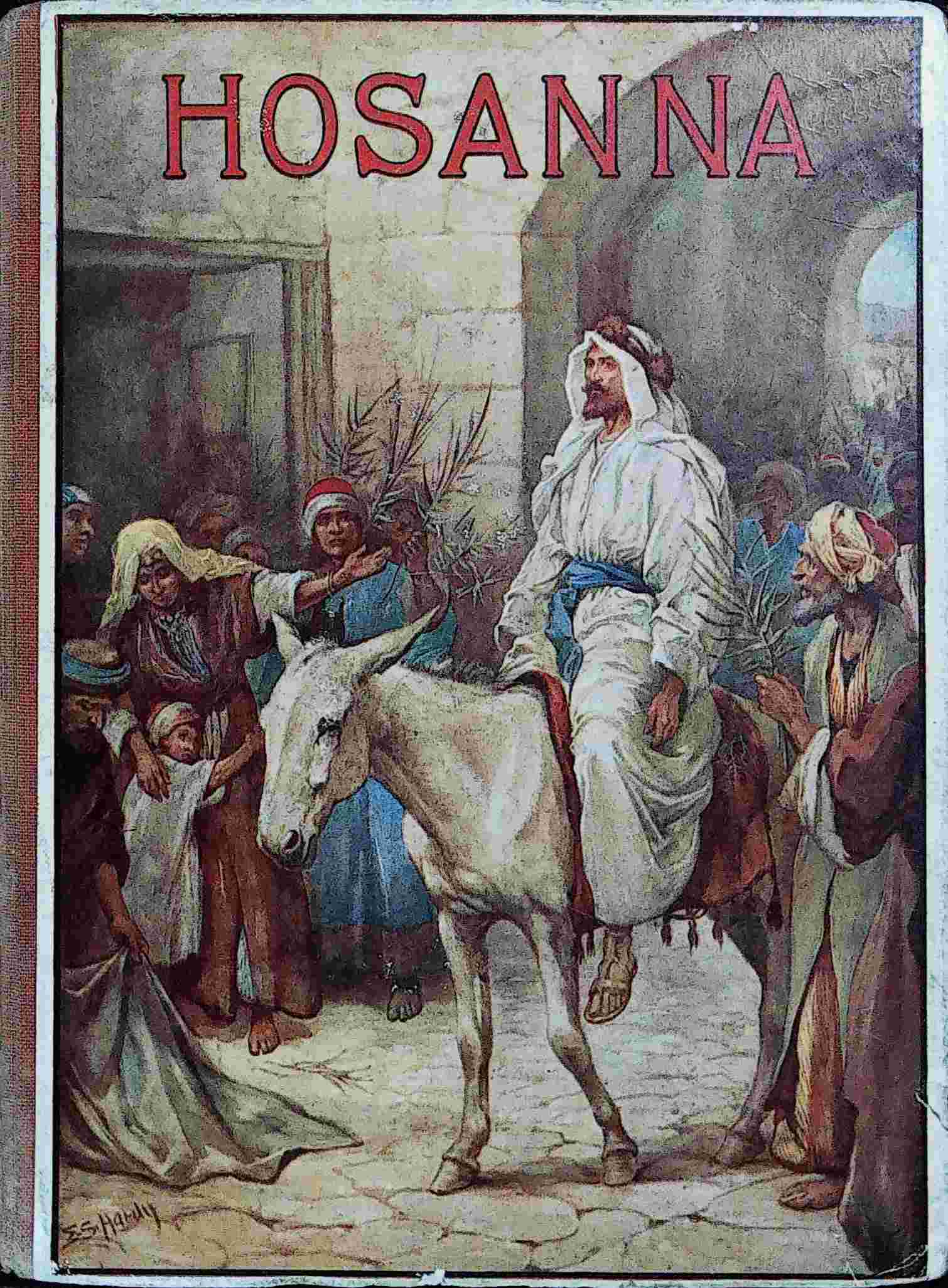
HOSANNA!
GOODLY PEARLS
MATT. 13.45.
OUR Lord Jesus said: "The kingdom of heaven is like unto a merchant-man seeking goodly pearls: who, when he had found one pearl of great price, went and sold all that he had, and bought it."
Now all of us are seeking for all sorts of things; and each one, in our different ways, desires most earnestly to find the thing we desire.
You boys want to be splendid at football, or cricket, or games at school! Or you want to be very clever at your lessons, and top of your class, and hoping to be put up higher next term.
And you strive and strive for these things, and like the merchant-man, you seek them, as he did his pearls.
And you girls—what do you think most about?
To be a girl-guide? To be top of your class? To be elected "captain" in your school? To be a clever artist, or a good musician?
And then with older people? All the world seems after fame, or riches, or pleasure, more things than I can count; and like the merchant-man, they value them very much.
But one day this merchant-man comes across a man who offers him the most beautiful pearl he has ever seen.
It is large, and so pure, so brilliant, and so rare; he takes it in his hand, and is lost in amazement.
The one who offers it to him, tells him that he will have to give up all his other pearls to buy it!
Then the merchant-man goes into his chamber, and looks earnestly at his own pearls. But the desire for the one Treasure is overwhelming—and at length he returns to his visitor, and he says, "I will give everything I possess, if you will give me this One Pearl of great Price!"
This is an allegory; but we may well ask, "What is this Pearl of great Price?"
It is—to take Jesus to be our Saviour.
To ask Him to wash away our sins; to help us to be pure, and good; to be our light in our darkest hours; to be our joy, our life, and our happiness, if we have taken Him for our own Saviour.
Years ago, when I was a little girl of twelve, I heard a sermon in which we were asked to take Jesus into our hearts, then and there.
I remember how, directly I reached home, I ran up into my room, and knelt down, and asked Him to take me.
Since then, Jesus has been all the world to me. And He has helped me through a long life to try to bring others to love Him.
A little girl was asked by the Vicar a few Sundays ago, whether she had understood what he had said?
She looked up sweetly, and answered: "You said, 'we must do all we can for Jesus Christ'!"
XXIII. THE WIDOW'S MITE
ONE day, our dear Lord was teaching in God's Temple at Jerusalem, and preaching the Gospel. He had been warning the people against the scribes who made long prayers for a show, but who oppressed poor widows and took away their houses.
The Lord looked straight into people's hearts, and He could not bear for the scribes to seem so very good outside, and to be so wicked inside!
Jesus was sitting near the Treasury, which was a chest in which people put their offerings of money for God's service.
After He had been speaking about those scribes that oppressed the widows, He raised His eyes and saw the people casting their gifts into the Treasury; and many that were rich cast in much.
And just then a poor widow drew near, and she put in two mites, which make a farthing.
Jesus saw it all! He could see into her empty pocket; He knew all about it!
Then He called His disciples to Him, and said to them, "This poor widow has cast more in than all the others who have cast into the Treasury: for they did cast in of their abundance; but she of her want did cast in all that she had, even all her living!"
There was another poor widow in the time of Elijah, God's Prophet.
Elijah had come a long journey, in a time of famine, and he was starving and nearly dying of thirst.
He came to Sarepta, and saw this poor widow picking up sticks outside the city, and asked her for food and water.
She told him she had only a handful of meal and a little oil, and when that was eaten she and her boy must die.
Then Elijah begged her to make a little cake for him, too; and he promised her that God would give her some more meal and oil, as long as the famine lasted.
So she believed God, and made him a cake; and the barrel of meal did not get empty, and the cruse of oil did not fail, as the Lord had said.
XXIV. SO RUN, THAT YE MAY OBTAIN
I CORINTHIANS 9.24
"Know ye not that they which run in a race run all,
but one receiveth the prize?" I Corinthians 9.24.
YOU have heard of the Olympic games which were practised in old times, hundreds and hundreds of years ago, and you may have seen pictures of the old ruins of the Colosseum at Rome, with its tiers and tiers of seats all round, so that thousands of people could witness the things that went on in the arena. Some very cruel things; but some, on the other hand, were simply men racing with all their might to receive a great prize.
These men were trained, for many months, to the highest point of perfection. They were taught how to run, looking forward to the spot where the crown was to be given them, without faltering or looking back.
The Apostle Paul described these games. He says, "They all ran, but only one could get the prize;" but he reminds us that in the Heavenly race, we may all obtain the prize!
This race that we are to run, is to try to please God in our everyday life! And he again reminds us that we must lay aside every weight (like those runners did of old) and the sin that so easily besets us, and we must run with patience the race set before us. And as the competitors did in those old days—they looked at the goal, and ran with all their might—so we must look to Jesus, who has told us to run this heavenly race, and who is waiting for us to finish it, through faith in Him.
Those runners cast aside every impediment; they were trained with the utmost care, so as to leave nothing undone which could help them.
And Jesus our Saviour, Who is looking on at all those who have undertaken His race, assures us, with most beautiful promises, that we shall surely receive the Crown of Life, which He has promised to those who obey Him.
You boys and girls in these days are all running a race of some sort!
I do not mean only your Sports' Day! That is most interesting to you all, and, doubtless, is very good for you.
But there are heaps of other races which come into your lives—your difficult lessons, your music, your drawing, your languages, and a dozen other efforts; to have a good education, and to get on in the world!
But Jesus is watching you all with the deepest interest. He says to you, that He longs to see you come to Him and join His great Race, and, like Matthew, "rise up and follow Him."
Then if you do, you have undertaken to be in the Race whose crown is Everlasting Life.
And for this race, the "looking unto Jesus" is the safety and the joy of it.
Satan loves to tempt us, and at our first failure, perhaps he says, "You will never do it; give it up!"
But Jesus our Saviour says to you, "Do not be discouraged; do not think of Satan, but think of ME. Remember, for the joy that was before ME, I endured to die on the Cross for your sakes, and I am the Author and the Finisher of your faith."
"It is I Who am standing at the goal watching, and it is I Who will give you the Crown of Righteousness that fadeth not away—'reserved in Heaven for you who are kept by the power of God.'"