
“The ultimate struggle of earthly feeling came when this proud self-reliance was forced to give way, and she was obliged to leave herself helpless in the hands of others. ‘God requires that I should give up my last form of self-will,’ she said; ‘now I have resigned this, perhaps He will let me go home.’
“In a good old age, Death, the friend, came and opened the door of this mortal state, and a great soul, that had served a long appenticeship to little things, went forth into the joy of its Lord; a life of self-sacrifice and self-abnegation passed into a life of endless rest.”
“But,” said Rudolph, “I rebel at this life of self-abnegation and self-sacrifice. I do not think it the duty of noble women, who have beautiful natures and enlarged and cultivated tastes, to make themselves the slaves of the sick-room and nursery.”
“Such was not the teaching of our New England faith,” said I. “Absolute unselfishness,—the death of self,—such were its teachings, and such as Esther’s the characters it made. ‘Do the duty nearest thee’ was the only message it gave to ‘women with a mission;’ and from duty to duty, from one self-denial to another, they rose to a majesty of moral strength impossible to any form of mere self-indulgence. It is of souls thus sculptured and chiseled by self-denial and self-discipline that the living temple of the perfect hereafter is to be built. The pain of the discipline is short, but the glory of the fruition is eternal.”
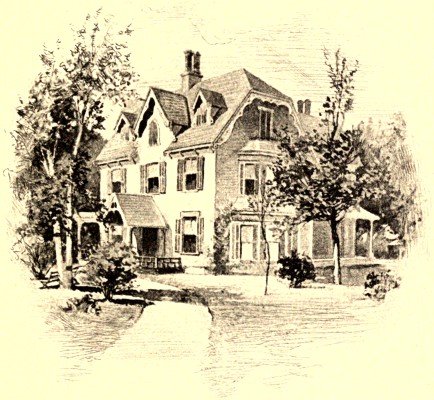
Here comes the First of January, Eighteen Hundred and Sixty-Five, and we are all settled comfortably into our winter places, with our winter surroundings and belongings; all cracks and openings are calked and listed, the double windows are in, the furnace dragon in the cellar is ruddy and in good liking, sending up his warming respirations through every pipe and register in the house; and yet, though an artificial summer reigns everywhere, like bees we have our swarming place,—in my library. There is my chimney-corner, and my table permanently established on one side of the hearth; and each of the female genus has, so to speak, pitched her own winter tent within sight of the blaze of my camp-fire. I discerned to-day that Jenny had surreptitiously appropriated one of the drawers of my study-table to knitting-needles and worsted; and wicker work-baskets and stands of various heights and sizes seem to be planted here and there for permanence among the bookcases. The canary-bird has a sunny window, and the plants spread out their leaves and unfold their blossoms as if there were no ice and snow in the street, and Rover makes a hearth-rug of himself in winking satisfaction in front of my fire, except when Jenny is taken with a fit of discipline, when he beats a retreat, and secretes himself under my table.
Peaceable, ah, how peaceable, home and quiet and warmth in winter! And how, when we hear the wind 426 whistle, we think of you, O our brave brothers, our saviors and defenders, who for our sake have no home but the muddy camp, the hard pillow of the barrack, the weary march, the uncertain fare,—you, the rank and file, the thousand unnoticed ones, who have left warm fires, dear wives, loving little children, without even the hope of glory or fame,—without even the hope of doing anything remarkable or perceptible for the cause you love,—resigned only to fill the ditch or bridge the chasm over which your country shall walk to peace and joy! Good men and true, brave unknown hearts, we salute you, and feel that we, in our soft peace and security, are not worthy of you! When we think of you, our simple comforts seem luxuries all too good for us, who give so little when you give all!
But there are others to whom from our bright homes, our cheerful firesides, we would fain say a word, if we dared.
Think of a mother receiving a letter with such a passage as this in it! It is extracted from one we have just seen, written by a private in the army of Sheridan, describing the death of a private. “He fell instantly, gave a peculiar smile and look, and then closed his eyes. We laid him down gently at the foot of a large tree. I crossed his hands over his breast, closed his eyelids down, but the smile was still on his face. I wrapt him in his tent, spread my pocket-handkerchief over his face, wrote his name on a piece of paper, and pinned it on his breast, and there we left him: we could not find pick or shovel to dig a grave.” There it is!—a history that is multiplying itself by hundreds daily, the substance of what has come to so many homes, and must come to so many more before the great price of our ransom is paid!
What can we say to you, in those many, many homes where the light has gone out forever?—you, O fathers, 427 mothers, wives, sisters, haunted by a name that has ceased to be spoken on earth,—you, for whom there is no more news from the camp, no more reading of lists, no more tracing of maps, no more letters, but only a blank, dead silence! The battlecry goes on, but for you it is passed by! the victory comes, but, oh, never more to bring him back to you! your offering to this great cause has been made, and been taken; you have thrown into it all your living, even all that you had, and from henceforth your house is left unto you desolate! O ye watchers of the cross, ye waiters by the sepulchre, what can be said to you? We could almost extinguish our own home-fires, that seem too bright when we think of your darkness; the laugh dies on our lip, the lamp burns dim through our tears, and we seem scarcely worthy to speak words of comfort, lest we seem as those who mock a grief they cannot know.
But is there no consolation? Is it nothing to have had such a treasure to give, and to have given it freely for the noblest cause for which ever battle was set,—for the salvation of your country, for the freedom of all mankind? Had he died a fruitless death, in the track of common life, blasted by fever, smitten or rent by crushing accident, then might his most precious life seem to be as water spilled upon the ground; but now it has been given for a cause and a purpose worthy even the anguish of your loss and sacrifice. He has been counted worthy to be numbered with those who stood with precious incense between the living and the dead, that the plague which was consuming us might be stayed. The blood of these young martyrs shall be the seed of the future church of liberty, and from every drop shall spring up flowers of healing. O widow! O mother! blessed among bereaved women! there remains to you a treasure that belongs not to those who have lost in any other wise,—the power to say, “He died for his country.” In all the good that comes of this anguish you shall 428 have a right and share by virtue of this sacrifice. The joy of freedmen bursting from chains, the glory of a nation new-born, the assurance of a triumphant future for your country and the world,—all these become yours by the purchase-money of that precious blood.
Besides this, there are other treasures that come through sorrow, and sorrow alone. There are celestial plants of root so long and so deep that the land must be torn and furrowed, ploughed up from the very foundation, before they can strike and nourish; and when we see how God’s plough is driving backward and forward and across this nation, rending, tearing up tender shoots, and burying soft wild-flowers, we ask ourselves, What is He going to plant?
Not the first year, nor the second, after the ground has been broken up, does the purpose of the husbandman appear. At first we see only what is uprooted and ploughed in,—the daisy drabbled, and the violet crushed,—and the first trees planted amid the unsightly furrows stand dumb and disconsolate, irresolute in leaf, and without flower or fruit. Their work is under the ground. In darkness and silence they are putting forth long fibres, searching hither and thither under the black soil for the strength that years hence shall burst into bloom and bearing.
What is true of nations is true of individuals. It may seem now winter and desolation with you. Your hearts have been ploughed and harrowed and are now frozen up. There is not a flower left, not a blade of grass, not a bird to sing,—and it is hard to believe that any brighter flowers, any greener herbage, shall spring up than those which have been torn away; and yet there will. Nature herself teaches you to-day. Outdoors nothing but bare branches and shrouding snow; and yet you know that there is not a tree that is not patiently holding out at the end of its boughs next year’s buds, frozen indeed, but unkilled. The rhododendron and the lilac have their blossoms all ready, 429 wrapped in cere-cloth, waiting in patient faith. Under the frozen ground the crocus and the hyacinth and the tulip hide in their hearts the perfect forms of future flowers. And it is even so with you: your leaf buds of the future are frozen, but not killed; the soil of your heart has many flowers under it cold and still now, but they will yet come up and bloom.
The dear old book of comfort tells of no present healing for sorrow. No chastening for the present seemeth joyous, but grievous, but afterwards it yieldeth peaceable fruits of righteousness. We, as individuals, as a nation, need to have faith in that AFTERWARDS. It is sure to come,—sure as spring and summer to follow winter.
There is a certain amount of suffering which must follow the rending of the great cords of life, suffering which is natural and inevitable; it cannot be argued down; it cannot be stilled; it can no more be soothed by any effort of faith and reason than the pain of a fractured limb, or the agony of fire on the living flesh. All that we can do is to brace ourselves to bear it, calling on God, as the martyrs did in the fire, and resigning ourselves to let it burn on. We must be willing to suffer, since God so wills. There are just so many waves to go over us, just so many arrows of stinging thought to be shot into our soul, just so many faintings and sinkings and revivings only to suffer again, belonging to and inherent in our portion of sorrow; and there is a work of healing that God has placed in the hands of Time alone.
Time heals all things at last; yet it depends much on us in our suffering, whether time shall send us forth healed, indeed, but maimed and crippled and callous, or whether, looking to the great Physician of sorrows, and co-working with him, we come forth stronger and fairer even for our wounds.
We call ourselves a Christian people, and the peculiarity 430 of Christianity is that it is a worship and doctrine of sorrow. The five wounds of Jesus, the instruments of the passion, the cross, the sepulchre,—these are its emblems and watchwords. In thousands of churches, amid gold and gems and altars fragrant with perfume, are seen the crown of thorns, the nails, the spear, the cup of vinegar mingled with gall, the sponge that could not slake that burning death-thirst; and in a voice choked with anguish the Church in many lands and divers tongues prays from age to age, “By thine agony and bloody sweat, by thy cross and passion, by thy precious death and burial!”—mighty words of comfort, whose meaning reveals itself only to souls fainting in the cold death-sweat of mortal anguish! They tell all Christians that by uttermost distress alone was the Captain of their salvation made perfect as a Saviour.
Sorrow brings us into the true unity of the Church,—that unity which underlies all external creeds, and unites all hearts that have suffered deeply enough to know that when sorrow is at its utmost there is but one kind of sorrow, and but one remedy. What matter, in extremis, whether we be called Romanist, or Protestant, or Greek, or Calvinist?
We suffer, and Christ suffered; we die, and Christ died; he conquered suffering and death, he rose and lives and reigns,—and we shall conquer, rise, live, and reign. The hours on the cross were long, the thirst was bitter, the darkness and horror real,—but they ended. After the wail, “My God, why hast thou forsaken me?” came the calm, “It is finished;” pledge to us all that our “It is finished” shall come also.
Christ arose, fresh, joyous, no more to die; and it is written that, when the disciples were gathered together in fear and sorrow, he stood in the midst of them, and showed unto them his hands and his side; and then were they glad. 431 Already had the healed wounds of Jesus become pledges of consolation to innumerable thousands; and those who, like Christ, have suffered the weary struggles, the dim horrors of the cross,—who have lain, like him, cold and chilled in the hopeless sepulchre,—if his spirit wakes them to life, shall come forth with healing power for others who have suffered and are suffering.
Count the good and beautiful ministrations that have been wrought in this world of need and labor, and how many of them have been wrought by hands wounded and scarred, by hearts that had scarcely ceased to bleed!
How many priests of consolation is God now ordaining by the fiery imposition of sorrow! how many Sisters of the Bleeding Heart, Daughters of Mercy, Sisters of Charity, are receiving their first vocation in tears and blood!
The report of every battle strikes into some home; and heads fall low, and hearts are shattered, and only God sees the joy that is set before them, and that shall come out of their sorrow. He sees our morning at the same moment that He sees our night,—sees us comforted, healed, risen to a higher life, at the same moment that He sees us crushed and broken in the dust; and so, though tenderer than we, He bears our great sorrows for the joy that is set before us.
After the Napoleonic wars had desolated Europe, the country was, like all countries after war, full of shattered households, of widows and orphans and homeless wanderers. A nobleman of Silesia, the Baron von Kottwitz, who had lost his wife and all his family in the reverses and sorrows of the times, found himself alone in the world, which looked more dreary and miserable through the multiplying lenses of his own tears. But he was one of those whose heart had been quickened in its death anguish by the resurrection voice of Christ; and he came forth to life and comfort. He bravely resolved to do all that one man could to lessen the great sum of misery. He sold his estates in Silesia, 432 bought in Berlin a large building that had been used as barracks for the soldiers, and, fitting it up in plain, commodious apartments, formed there a great family-establishment, into which he received the wrecks and fragments of families that had been broken up by the war,—orphan children, widowed and helpless women, decrepit old people, disabled soldiers. These he made his family, and constituted himself their father and chief. He abode with them, and cared for them as a parent. He had schools for the children; the more advanced he put to trades and employments; he set up a hospital for the sick; and for all he had the priestly ministrations of his own Christ-like heart. The celebrated Professor Tholuck, one of the most learned men of modern Germany, was an early protégé of the old Baron’s, who, discerning his talents, put him in the way of a liberal education. In his earlier years, like many others of the young who play with life, ignorant of its needs, Tholuck piqued himself on a lordly skepticism with regard to the commonly received Christianity, and even wrote an essay to prove the superiority of the Mohammedan to the Christian religion. In speaking of his conversion, he says,—“What moved me was no argument, nor any spoken reproof, but simply that divine image of the old Baron walking before my soul. That life was an argument always present to me, and which I never could answer; and so I became a Christian.” In the life of this man we see the victory over sorrow. How many with means like his, when desolated by like bereavements, have lain coldly and idly gazing on the miseries of life, and weaving around themselves icy tissues of doubt and despair,—doubting the being of a God, doubting the reality of a Providence, doubting the divine love, embittered and rebellious against the power which they could not resist, yet to which they would not submit! In such a chill heart-freeze lies the danger of sorrow. And it is a mortal danger. It is a torpor that must be resisted, as the man in 433 the whirling snows must bestir himself, or he will perish. The apathy of melancholy must be broken by an effort of religion and duty. The stagnant blood must be made to flow by active work, and the cold hand warmed by clasping the hands outstretched towards it in sympathy or supplication. One orphan child taken in, to be fed, clothed, and nurtured, may save a heart from freezing to death: and God knows this war is making but too many orphans!
It is easy to subscribe to an orphan asylum, and go on in one’s despair and loneliness. Such ministries may do good to the children who are thereby saved from the street, but they impart little warmth and comfort to the giver. One destitute child housed, taught, cared for, and tended personally, will bring more solace to a suffering heart than a dozen maintained in an asylum. Not that the child will probably prove an angel, or even an uncommonly interesting mortal. It is a prosaic work, this bringing-up of children, and there can be little rose-water in it. The child may not appreciate what is done for him, may not be particularly grateful, may have disagreeable faults, and continue to have them after much pains on your part to eradicate them,—and yet it is a fact, that to redeem one human being from destitution and ruin, even in some homely every-day course of ministrations, is one of the best possible tonics and alteratives to a sick and wounded spirit.
But this is not the only avenue to beneficence which the war opens. We need but name the service of hospitals, the care and education of the freedmen,—for these are charities that have long been before the eyes of the community, and have employed thousands of busy hands: thousands of sick and dying beds to tend, a race to be educated, civilized, and Christianized, surely were work enough for one age; and yet this is not all. War shatters everything, and it is hard to say what in society will not need rebuilding and binding up and strengthening anew. Not the least of the evils of 434 war are the vices which a great army engenders wherever it moves,—vices peculiar to military life, as others are peculiar to peace. The poor soldier perils for us not merely his body, but his soul. He leads a life of harassing and exhausting toil and privation, of violent strain on the nervous energies, alternating with sudden collapse, creating a craving for stimulants, and endangering the formation of fatal habits. What furies and harpies are those that follow the army, and that seek out the soldier in his tent, far from home, mother, wife and sister, tired, disheartened, and tempt him to forget his troubles in a momentary exhilaration, that burns only to chill and to destroy! Evil angels are always active and indefatigable, and there must be good angels enlisted to face them; and here is employment for the slack hand of grief. Ah, we have known mothers bereft of sons in this war, who have seemed at once to open wide their hearts, and to become mothers to every brave soldier in the field. They have lived only to work,—and in place of one lost, their sons have been counted by thousands.
And not least of all the fields for exertion and Christian charity opened by this war is that presented by womanhood. The war is abstracting from the community its protecting and sheltering elements, and leaving the helpless and dependent in vast disproportion. For years to come, the average of lone women will be largely increased; and the demand, always great, for some means by which they may provide for themselves, in the rude jostle of the world, will become more urgent and imperative.
Will any one sit pining away in inert grief, when two streets off are the midnight dance-houses, where girls of twelve, thirteen, and fourteen are being lured into the way of swift destruction? How many of these are daughters of soldiers who have given their hearts’ blood for us and our liberties!
Two noble women of the Society of Friends have lately 435 been taking the gauge of suffering and misery in our land, visiting the hospitals at every accessible point, pausing in our great cities, and going in their purity to those midnight orgies where mere children are being trained for a life of vice and infamy. They have talked with these poor bewildered souls, entangled in toils as terrible and inexorable as those of the slave-market, and many of whom are frightened and distressed at the life they are beginning to lead, and earnestly looking for the means of escape. In the judgment of these holy women, at least one third of those with whom they have talked are children so recently entrapped, and so capable of reformation, that there would be the greatest hope in efforts for their salvation. While such things are to be done in our land, is there any reason why any one should die of grief? One soul redeemed will do more to lift the burden of sorrow than all the blandishments and diversions of art, all the alleviations of luxury, all the sympathy of friends.
In the Roman Catholic Church there is an order of women called the Sisters of the Good Shepherd, who have renounced the world to devote themselves, their talents and property, entirely to the work of seeking out and saving the fallen of their own sex; and the wonders worked by their self-denying love on the hearts and lives of even the most depraved are credible only to those who know that the Good Shepherd himself ever lives and works with such spirits engaged in such a work. A similar order of women exists in New York, under the direction of the Episcopal Church, in connection with St. Luke’s Hospital; and another in England, who tend the “House of Mercy” of Clewer.
Such benevolent associations offer objects of interest to that class which most needs something to fill the void made by bereavement. The wounds of grief are less apt to find a cure in that rank of life where the sufferer has wealth and 436 leisure. The poor widow, whoso husband was her all, must break the paralysis of grief. The hard necessities of life are her physicians; they send her out to unwelcome, yet friendly toil, which, hard as it seems, has yet its healing power. But the sufferer surrounded by the appliances of wealth and luxury may long indulge the baleful apathy, and remain in the damp shadows of the valley of death till strength and health are irrecoverably lost. How Christ-like is the thought of a woman, graceful, elegant, cultivated, refined, whose voice has been trained to melody, whose fingers can make sweet harmony with every touch, whose pencil and whose needle can awake the beautiful creations of art, devoting all these powers to the work of charming back to the sheepfold those wandering and bewildered lambs whom the Good Shepherd still calls his own! Jenny Lind once, when she sang at a concert for destitute children, exclaimed in her enthusiasm, “Is it not beautiful that I can sing so?” And so may not every woman feel, when her graces and accomplishments draw the wanderer, and charm away evil demons, and soothe the sore and sickened spirit, and make the Christian fold more attractive than the dizzy gardens of false pleasure?
In such associations, and others of kindred nature, how many of the stricken and bereaved women of our country might find at once a home and an object in life! Motherless hearts might be made glad in a better and higher motherhood; and the stock of earthly life that seemed cut off at the root, and dead past recovery, may be grafted upon with a shoot from the tree of life which is in the Paradise of God.
So the beginning of this eventful 1865, which finds us still treading the wine-press of our great conflict, should bring with it a serene and solemn hope, a joy such as those had with whom in the midst of the fiery furnace there walked one like unto the Son of God.
The great affliction that has come upon our country is so evidently the purifying chastening of a Father, rather than 437 the avenging anger of a Destroyer, that all hearts may submit themselves in a solemn and holy calm still to bear the burning that shall make us clean from dross and bring us forth to a higher national life. Never, in the whole course of our history, have such teachings of the pure abstract Right been so commended and forced upon us by Providence. Never have public men been so constrained to humble themselves before God, and to acknowledge that there is a Judge that ruleth in the earth. Verily his inquisition for blood has been strict and awful; and for every stricken household of the poor and lowly hundreds of households of the oppressor have been scattered. The land where the family of the slave was first annihilated, and the negro, with all the loves and hopes of a man, was proclaimed to be a beast to be bred and sold in market with the horse and the swine,—that land, with its fair name, Virginia, has been made a desolation so signal, so wonderful, that the blindest passer-by cannot but ask for what sin so awful a doom has been meted out. The prophetic visions of Nat Turner, who saw the leaves drop blood and the land darkened, have been fulfilled. The work of justice which he predicted is being executed to the uttermost.
But when this strange work of judgment and justice is consummated, when our country, through a thousand battles and ten thousands of precious deaths, shall have come forth from this long agony, redeemed and regenerated, then God himself shall return and dwell with us, and the Lord God shall wipe away all tears from all faces, and the rebuke of his people shall he utterly take away.
When the first number of the Chimney-Corner appeared, the snow lay white on the ground, the buds on the trees were closed and frozen, and beneath the hard frost-bound soil lay buried the last year’s flower-roots, waiting for a resurrection.
So in our hearts it was winter,—a winter of patient suffering and expectancy,—a winter of suppressed sobs, of inward bleedings,—a cold, choked, compressed anguish of endurance, for how long and how much God only could tell us.
The first paper of the Chimney-Corner, as was most meet and fitting, was given to those homes made sacred and venerable by the cross of martyrdom,—by the chrism of a great sorrow. That Chimney-Corner made bright by home firelight seemed a fitting place for a solemn act of reverent sympathy for the homes by whose darkness our homes had been preserved bright, by whose emptiness our homes had been kept full, by whose losses our homes had been enriched; and so we ventured with trembling to utter these words of sympathy and cheer to those whom God had chosen to this great sacrifice of sorrow.
The winter months passed with silent footsteps, spring returned, and the sun, with ever waxing power, unsealed the snowy sepulchre of buds and leaves,—birds reappeared, brooks were unchained, flowers filled every desolate dell with blossoms and perfume. And with returning spring, in like manner, the chill frost of our fears and of our dangers 439 melted before the breath of the Lord. The great war, which lay like a mountain of ice upon our hearts, suddenly dissolved and was gone. The fears of the past were as a dream when one awaketh, and now we scarce realize our deliverance. A thousand hopes are springing up everywhere, like spring flowers in the forest. All is hopefulness, all is bewildering joy.
But this our joy has been ordained to be changed into a wail of sorrow. The kind hard hand, that held the helm so steadily in the desperate tossings of the storm, has been stricken down just as we entered port,—the fatherly heart that bore all our sorrows can take no earthly part in our joys. His were the cares, the watchings, the toils, the agonies, of a nation in mortal struggle; and God, looking down, was so well pleased with his humble faithfulness, his patient continuance in well-doing, that earthly rewards and honors seemed all too poor for him, so he reached down and took him to immortal glories. “Well done, good and faithful servant, enter thou into the joy of thy Lord!”
Henceforth the place of Abraham Lincoln is first among that noble army of martyrs who have given their blood to the cause of human freedom. The eyes are yet too dim with tears that would seek calmly to trace out his place in history. He has been a marvel and a phenomenon among statesmen, a new kind of ruler in the earth. There has been something even unearthly about his extreme unselfishness, his utter want of personal ambition, personal self-valuation, personal feeling.
The most unsparing criticism, denunciation, and ridicule never moved him to a single bitter expression, never seemed to awaken in him a single bitter thought. The most exultant hour of party victory brought no exultation to him; he accepted power not as an honor, but as a responsibility; and when, after a severe struggle, that power came a second time 440 into his hands, there was something preternatural in the calmness of his acceptance of it. The first impulse seemed to be a disclaimer of all triumph over the party that had strained their utmost to push him from his seat, and then a sober girding up of his loins to go on with the work to which he was appointed. His last inaugural was characterized by a tone so peculiarly solemn and free from earthly passion, that it seems to us now, who look back on it in the light of what has followed, as if his soul had already parted from earthly things, and felt the powers of the world to come. It was not the formal state paper of the chief of a party in an hour of victory, so much as the solemn soliloquy of a great soul reviewing its course under a vast responsibility, and appealing from all earthly judgments to the tribunal of Infinite Justice. It was the solemn clearing of his soul for the great sacrament of Death, and the words that he quoted in it with such thrilling power were those of the adoring spirits that veil their faces before the throne,—“Just and true are thy ways, thou King of saints!”
Among the rich treasures which this bitter struggle has brought to our country, not the least is the moral wealth which has come to us in the memory of our martyrs. Thousands of men, women, and children too, in this great conflict, have “endured tortures, not accepting deliverance,” counting not their lives dear unto them in the holy cause; and they have done this as understandingly and thoughtfully as the first Christians who sealed their witness with their blood.
Let us in our hour of deliverance and victory record the solemn vow, that our right hand shall forget her cunning before we forget them and their sufferings,—that our tongue shall cleave to the roof of our mouth if we remember them not above our chief joy.
Least suffering among that noble band were those who 441 laid down their lives on the battlefield, to whom was given a brief and speedy passage to the victor’s meed. The mourners who mourn for such as these must give place to another and more august band, who have sounded lower deeps of anguish, and drained bitterer drops out of our great cup of trembling.
The narrative of the lingering tortures, indignities, and sufferings of our soldiers in Rebel prisons has been something so harrowing that we have not dared to dwell upon it. We have been helplessly dumb before it, and have turned away our eyes from what we could not relieve, and therefore could not endure to look upon. But now, when the nation is called to strike the great and solemn balance of justice, and to decide measures of final retribution, it behooves us all that we should at least watch with our brethren for one hour, and take into our account what they have been made to suffer for us.
Sterne said he could realize the miseries of captivity only by setting before him the image of a miserable captive with hollow cheek and wasted eye, notching upon a stick, day after day, the weary record of the flight of time. So we can form a more vivid picture of the sufferings of our martyrs from one simple story than from any general description; and therefore we will speak right on, and tell one story which might stand as a specimen of what has been done and suffered by thousands.
In the town of Andover, Massachusetts, a boy of sixteen, named Walter Raymond, enlisted among our volunteers. He was under the prescribed age, but his eager zeal led him to follow the footsteps of an elder brother who had already enlisted; and the father of the boy, though these two were all the sons he had, instead of availing himself of his legal right to withdraw him, indorsed the act in the following letter addressed to his captain:—
Andover, Mass., August 15, 1862.
Captain Hunt,—My eldest son has enlisted in your company. I send you his younger brother. He is, and always has been, in perfect health, of more than the ordinary power of endurance, honest, truthful, and courageous. I doubt not you will find him on trial all you can ask, except his age, and that I am sorry to say is only sixteen; yet if our country needs his service, take him.
Your obedient servant,
Samuel Raymond.
The boy went forth to real service, and to successive battles at Kingston, at Whitehall, and at Goldsborough; and in all this did his duty bravely and faithfully. He met the temptations and dangers of a soldier’s life with the pure-hearted firmness of a Christian child, neither afraid nor ashamed to remember his baptismal vows, his Sunday-school teachings, and his mother’s wishes.
He had passed his promise to his mother against drinking and smoking, and held it with a simple, childlike steadiness. When in the midst of malarious swamps, physicians and officers advised the use of tobacco. The boy writes to his mother: “A great many have begun to smoke, but I shall not do it without your permission, though I think it does a great deal of good.”
In his leisure hours, he was found in his tent reading; and before battle he prepared his soul with the beautiful psalms and collects for the day, as appointed by his church, and writes with simplicity to his friends:—
“I prayed God that he would watch over me, and if I fell, receive my soul in heaven; and I also prayed that I might not forget the cause I was fighting for, and turn my back in fear.”
After nine months’ service, he returned with a soldier’s experience, though with a frame weakened by sickness in a 443 malarious region. But no sooner did health and strength return than he again enlisted, in the Massachusetts cavalry service, and passed many months of constant activity and adventure, being in some severe skirmishes and battles with that portion of Sheridan’s troops who approached nearest to Richmond, getting within a mile and a half of the city. At the close of this raid, so hard had been the service, that only thirty horses were left out of seventy-four in his company, and Walter and two others were the sole survivors among eight who occupied the same tent.
On the sixteenth of August, Walter was taken prisoner in a skirmish; and from the time that this news reached his parents, until the 18th of the following March, they could ascertain nothing of his fate. A general exchange of prisoners having been then effected, they learned that he had died on Christmas Day in Salisbury Prison, of hardship and privation.
What these hardships were is, alas! easy to be known from those too well-authenticated accounts published by our government of the treatment experienced by our soldiers in the Rebel prisons.
Robbed of clothing, of money, of the soldier’s best friend, his sheltering blanket,—herded in shivering nakedness on the bare ground,—deprived of every implement by which men of energy and spirit had soon bettered their lot,—forbidden to cut in adjacent forests branches for shelter, or fuel to cook their coarse food,—fed on a pint of corn-and-cob-meal per day, with some slight addition of molasses or rancid meat,—denied all mental resources, all letters from home, all writing to friends,—these men were cut off from the land of the living while yet they lived,—they were made to dwell in darkness as those that have been long dead.
By such slow, lingering tortures,—such weary, wasting anguish and sickness of body and soul,—it was the infernal 444 policy of the Rebel government either to wring from them an abjuration of their country, or by slow and steady draining away of the vital forces to render them forever unfit to serve in her armies.
Walter’s constitution bore four months of this usage, when death came to his release. A fellow sufferer, who was with him in his last hours, brought the account to his parents.
Through all his terrible privations, even the lingering pains of slow starvation, Walter preserved his steady simplicity, his faith in God, and unswerving fidelity to the cause for which he was suffering.
When the Rebels had kept the prisoners fasting for days, and then brought in delicacies to tempt their appetite, hoping thereby to induce them to desert their flag, he only answered, “I would rather be carried out in that dead-cart!”
When told by some that he must steal from his fellow sufferers, as many did, in order to relieve the pangs of hunger, he answered, “No, I was not brought up to that!” And so when his weakened system would no longer receive the cobmeal which was his principal allowance, he set his face calmly towards death. He grew gradually weaker and weaker and fainter and fainter, and at last disease of the lungs set in, and it became apparent that the end was at hand.
On Christmas Day, while thousands among us were bowing in our garlanded churches or surrounding festive tables, this young martyr lay on the cold, damp ground, watched over by his destitute friends, who sought to soothe his last hours with such scanty comforts as their utter poverty afforded,—raising his head on the block of wood which was his only pillow, and moistening his brow and lips with water, while his life ebbed slowly away, until about two o’clock, when he suddenly roused himself, stretched out his 445 hand, and, drawing to him his dearest friend among those around him, said, in a strong, clear voice:—
“I am going to die. Go tell my father I am ready to die, for I die for God and my country,”—and, looking up with a triumphant smile, he passed to the reward of the faithful.
And now, men and brethren, if this story were a single one, it were worthy to be had in remembrance; but Walter Raymond is not the only noble-hearted boy or man that has been slowly tortured and starved and done to death, by the fiendish policy of Jefferson Davis and Robert Edmund Lee. No,—wherever this simple history shall be read, there will arise hundreds of men and women who will testify, “Just so died my son!” “So died my brother!” “So died my husband!” “So died my father!” The numbers who have died in these lingering tortures are to be counted, not by hundreds, or even by thousands, but by tens of thousands.
And is there to be no retribution for a cruelty so vast, so aggravated, so cowardly and base? And if there is retribution, on whose head should it fall? Shall we seize and hang the poor, ignorant, stupid, imbruted semi-barbarians who were set as jailers to keep these hells of torment and inflict these insults and cruelties? or shall we punish the educated, intelligent chiefs who were the head and brain of the iniquity?
If General Lee had been determined not to have prisoners starved or abused, does any one doubt that he could have prevented these things? Nobody doubts it. His raiment is red with the blood of his helpless captives. Does any one doubt that Jefferson Davis, living in ease and luxury in Richmond, knew that men were dying by inches in filth and squalor and privation in the Libby Prison, within bowshot of his own door? Nobody doubts it. It was his will, his deliberate policy, thus to destroy those who fell 446 into his hands. The chief of a so-called Confederacy, who could calmly consider among his official documents incendiary plots for the secret destruction of ships, hotels, and cities full of peaceable people, is a chief well worthy to preside over such cruelties; but his only just title is President of Assassins, and the whole civilized world should make common cause against such a miscreant.
There has been, on both sides of the water, much weak, ill-advised talk of mercy and magnanimity to be extended to these men, whose crimes have produced a misery so vast and incalculable. The wretches who have tortured the weak and the helpless, who have secretly plotted to supplement, by dastardly schemes of murder and arson, that strength which failed them in fair fight, have been commiserated as brave generals and unfortunate patriots, and efforts are made to place them within the comities of war.
It is no feeling of personal vengeance, but a sense of the eternal fitness of things, that makes us rejoice, when criminals who have so outraged every sentiment of humanity are arrested and arraigned and awarded due retribution at the bar of their country’s justice. There are crimes against God and human nature which it is treason alike to God and man not to punish; and such have been the crimes of the traitors who were banded together in Richmond.
If there be those whose hearts lean to pity, we can show them where all the pity of their hearts may be better bestowed than in deploring the woes of assassins. Let them think of the thousands of fathers, mothers, wives, sisters, whose lives will be forever haunted with memories of the slow tortures in which their best and bravest were done to death.
The sufferings of those brave men are ended. Nearly a hundred thousand are sleeping in those sad nameless graves,—and may their rest be sweet! “There the wicked cease from troubling; and there the weary be at rest. There the 447 prisoners rest together; they hear not the voice of the oppressor.” But, O ye who have pity to spare, spare it for the broken-hearted friends, who, to life’s end, will suffer over and over all that their dear ones endured. Pity the mothers who hear their sons’ faint calls in dreams, who in many a weary night-watch see them pining and wasting, and yearn with a lifelong, unappeasable yearning to have been able to soothe those forsaken, lonely death-beds. O man or woman, if you have pity to spare, spend it not on Lee or Davis,—spend it on their victims, on the thousands of living hearts which these men of sin have doomed to an anguish that will end only with life!
Blessed are the mothers whose sons passed in battle,—a quick, a painless, a glorious death! Blessed in comparison,—yet we weep for them. We rise up and give place at sight of their mourning-garments. We reverence the sanctity of their sorrow. But before this other sorrow we are dumb in awful silence. We find no words with which to console such grief. We feel that our peace, our liberties, have been bought at a fearful price, when we think of the sufferings of our martyred soldiers. Let us think of them. It was for us they bore hunger and cold and nakedness. They might have had food and raiment and comforts, if they would have deserted our cause,—and they did not. Cut off from all communication with home or friends or brethren, dragging on the weary months, apparently forgotten,—still they would not yield, they would not fight against us; and so for us at last they died.
What return can we make them? Peace has come, and we take up all our blessings restored and brightened; but if we look, we shall see on every blessing a bloody cross.
When three brave men broke through the ranks of the enemy, to bring to King David a draught from the home well, for which he longed, the generous-hearted prince would not drink it, but poured it out as an offering before 448 the Lord; for he said, “Is not this the blood of the men that went in jeopardy of their lives?”
Thousands of noble hearts have been slowly consumed to secure to us the blessings we are rejoicing in. We owe a duty to these our martyrs,—the only one we can pay.
In every place, honored by such a history and example, let a monument be raised at the public expense, on which shall be inscribed the names of those who died for their country, and the manner of their death. Such monuments will educate our young men in heroic virtue, and keep alive to future ages the flame of patriotism. And thus, too, to the aching heart of bereaved love shall be given the only consolation of which its sorrows admit, in the reverence which is paid to its lost loved ones.
Our establishment on Beacon Street had been for some days in a revolutionary state, owing to the fact that our second girl had gone from us into the holy estate of matrimony. Alice was a pretty, tidy, neat-handed creature, and, like many other blessings of life, so good as to be little appreciated while with us. It was not till she had left us that we began to learn that clean glass, bright silver, spotless and untumbled table-linen, and, in short, all the appetizing arrangements and appointments of our daily meals, were not always and in all hands matters of course.
In a day or two, our silver began to have the appearance of old pewter, and our glass looked as if nothing but muddy water could be found. On coming down to our meals, we found the dishes in all sorts of conversational attitudes on the table,—the meat placed diagonally, the potatoes crosswise, and the other vegetables scattered here and there,—while the table itself stood rakishly aslant, and wore the air of a table slightly intoxicated.
Our beautiful china, moreover, began to have little chipped places in the edges, most unusual and distressing to our eyes; the handles vanished from our teacups, and here and there a small mouthful appeared to be bitten out of the nose of some pretty fancy pitchers, which had been the delight of my eyes.
Now, if there is anything which I specially affect, it is a refined and pretty table arrangement, and at our house for years and years such had prevailed. All of us had rather a weakness for china, and the attractions of the fragile 450 world, as presented in the great crockery-stores, had been many times too much for our prudence and purse. Consequently we had all sorts of little domestic idols of the breakfast and dinner table,—Bohemian-glass drinking-mugs of antique shape, lovely bits of biscuit choicely moulded in classic patterns, beauties, oddities, and quaintnesses in the way of especial teacups and saucers, devoted to different members of the family, wherein each took a particular and individual delight. Our especial china or glass pets of the table often started interesting conversations on the state of the plastic arts as applied to every-day life, and the charm of being encircled, even in the material act of feeding our mortal bodies, with a sort of halo of art and beauty.
All this time none of us ever thought in how great degree our feeling for elegance and refinement owed its gratification at the hour of meals to the care, the tidiness, and neat handling of our now lost and wedded Alice.
Nothing presents so forlorn an appearance as battered and neglected finery of any kind; and elegant pitchers with their noses knocked off, cut glass with cracked edges, and fragments of artistic teacups and saucers on a tumbled tablecloth, have a peculiarly dismal appearance. In fact, we had really occasion to wonder at the perfectly weird and bewitched effect which one of our two Hibernian successors to the pretty Alice succeeded in establishing in our table department. Every caprice in the use and employment of dishes, short of serving cream in the gravy-boats and using the sugar-bowl for pickled oysters and the cream-pitcher for vinegar, seemed possible and permissible. My horror was completed one morning on finding a china hen, artistically represented as brooding on a nest, made to cover, not boiled eggs, but a lot of greasy hash, over which she sat so that her head and tail bewilderingly projected beyond the sides of the nest, instead of keeping lengthwise within it, as a respectable hen in her senses might be expected to do. 451 There certainly is a great amount of native vigor shown by these untrained Hibernians in always finding an unexpected wrong way of doing the simplest thing. It quite enlarges one’s ideas of human possibilities.
In a paroxysm of vexation, I reviled matrimony and Murphy O’Connor, who had stolen our household treasure, and further expressed my griefs, as elder sons are apt to do, by earnest expostulations with the maternal officer on the discouraging state of things; declaring most earnestly, morning, noon, and night, that all was going to ruin, that everything was being spoiled, that nothing was even decent, and that, if things went on so much longer, I should be obliged to go out and board,—by which style of remark I nearly drove that long-suffering woman frantic.
“Do be reasonable, Tom,” said she. “Can I make girls to order? Can I do anything more than try such as apply, when they seem to give promise of success? Delicacy of hand, neatness, nicety of eye, are not things likely to be cultivated in the Irish boarding-houses from which our candidates emerge. What chance have the most of them had to learn anything except the most ordinary rough housework? A trained girl is rare as a nugget of gold amid the sands of the washings; but let us persevere in trying, and one will come at last.”
“Well, I hope, at any rate, you have sent off that Bridget,” I said, in high disdain. “I verily believe, if that girl stays a week longer, I shall have to leave the house.”
“Compose yourself,” said my mother; “Bridget’s bundle is made up, and she is going. I’m sorry for her too, poor thing; for she seemed anxious to keep the place.”
At this moment the doorbell rang. “I presume that’s the new girl whom they have sent round for me to see,” said my mother.
I opened the door, and there in fact stood a girl dressed in a neat-fitting dark calico, with a straw bonnet, simply 452 tied with some dark ribbon, and a veil which concealed her face.
“Is Mrs. Seymour at home?”
“She is.”
“I was told that she wanted a girl.”
“She does; will you walk in?”
I pique myself somewhat on the power of judging character, and there was something about this applicant which inspired hope; so that, before I introduced her into the room, I felt it necessary to enlighten my mother with a little of my wisdom. I therefore whispered in her ear, with the decisive tone of an eldest son, “I think, mother, this one will do; you had better engage her at once.”
“Have you lived out much?” said my mother, commencing the usual inquiries.
“I have not, ma’am. I am but lately come to the city.”
“Are you Irish?”
“No, ma’am; I am American.”
“Have you been accustomed to the care of the table,—silver, glass, and china?”
“I think, ma’am, I understand what is necessary for that.”
All this while the speaker remained standing with her veil down; her answers seemed to be the briefest possible; and yet, notwithstanding the homely plainness of her dress, there was something about her that impressed both my mother and me with an idea of cultivation and refinement above her apparent station,—there was a composure and quiet decision in her manner of speaking which produced the same impression on us both.
“What wages do you expect?” said my mother.
“Whatever you have been accustomed to give to a girl in that place will satisfy me,” she said.
“There is only one thing I would like to ask,” she 453 added, with a slight hesitation and embarrassment of manner; “would it be convenient for me to have a room by myself?”
I nodded to my mother to answer in the affirmative.
The three girls who composed our establishment had usually roomed in one large apartment, but there was a small closet of a room which I had taken for books, fishing-rods, guns, and any miscellaneous property of my own. I mentally turned these out, and devoted the room to the newcomer, whose appearance interested me.
And, as my mother hesitated, I remarked, with the assured tone of master of the house, that “certainly she could have a small room to herself.”
“It is all I ask,” she briefly answered. “In that case, I will come for the same wages you paid the last girl in my situation.”
“When will you come?” said my mother.
“I am ready to come immediately. I only want time to go and order my things to be sent here.”
She rose and left us, saying that we might expect her that afternoon.
“Well, sir,” said my mother, “you seem to have taken it upon you to settle this matter on your own authority.”
“My dear little mother,” said I, in a patronizing tone, “I have an instinctive certainty that she will do. I wanted to make sure of a prize for you.”
“But the single room.”
“Never mind; I’ll move all my traps out of the little third-story room. It’s my belief that this girl or woman has seen better days; and if she has, a room to herself will be a necessity of her case,—poor thing!”
“I don’t know,” said my mother hesitatingly. “I never wish to employ in my service those above their station,—they always make trouble; and there is something in this woman’s air and manner and pronunciation that makes me 454 feel as if she had been born and bred in cultivated society.”
“Supposing she has,” said I; “it’s quite evident that she, for some reason, means to conform to this position. You seldom have a girl apply for work who comes dressed with such severe simplicity; her manner is retiring, and she seemed perfectly willing and desirous to undertake any of the things which you mentioned as among her daily tasks.”
On the afternoon of that day our new assistant came, and my mother was delighted with the way she set herself at work. The china-closet, desecrated and disordered in the preceding reigns of terror and confusion, immediately underwent a most quiet but thorough transformation. Everything was cleaned, brightened, and arranged with a system and thoroughness which showed, as my mother remarked, a good head; and all this was done so silently and quietly that it seemed like magic. By the time we came down to breakfast the next morning, we perceived that the reforms of our new prime minister had extended everywhere. The dining-room was clean, cool, thoroughly dusted, and freshly aired; the tablecloth and napkins were smooth and clean; the glass glittered like crystal, and the silver wore a cheerful brightness. Added to this were some extra touches of refinement, which I should call table coquetry. The cold meat was laid out with green fringes of parsley; and a bunch of heliotrope, lemon verbena, and mignonette, with a fresh rosebud, all culled from our little back yard, stood in a wineglass on my mother’s waiter.
“Well, Mary, you have done wonders,” said my mother, as she took her place; “your arrangements restore appetite to all of us.”
Mary received our praises with a gracious smile, yet with a composed gravity which somewhat puzzled me. She seemed perfectly obliging and amiable, yet there was a 455 serious reticence about her that quite piqued my curiosity. I could not help recurring to the idea of a lady in disguise; though I scarcely knew to what circumstance about her I could attach the idea. So far from the least effort to play the lady, her dress was, in homely plainness, a perfect contrast to that of the girls who had preceded her. It consisted of strong dark-blue stuff, made perfectly plain to her figure, with a narrow band of white linen around her throat. Her dark brown hair was brushed smoothly away from her face, and confined simply behind in a net; there was not the slightest pretension to coquetry in its arrangement; in fact, the object seemed to be to get it snugly out of the way, rather than to make it a matter of ornament. Nevertheless, I could not help remarking that there was a good deal of it, and that it waved very prettily, notwithstanding the care that had been taken to brush the curl out of it.
She was apparently about twenty years of age. Her face was not handsome, but it was a refined and intelligent one. The skin had a sallow hue, which told of ill health or of misfortune; there were lines of trouble about the eye; but the mouth and chin had that unmistakable look of firmness which speaks a person able and resolved to do a quiet battle with adverse fate, and to go through to the end with whatever is needed to be done, without fretfulness and without complaint. She had large, cool, gray eyes, attentive and thoughtful, and she met the look of any one who addressed her with an honest firmness; she seemed to be, in fact, simply and only interested to know and to do the work she had undertaken,—but what there might be behind and beyond that I could not conjecture.
One thing about her dress most in contrast with that of the other servants was that she evidently wore no crinoline. The exuberance of this article in the toilet of our domestics had become threatening of late, apparently requiring that the kitchens and pantries should be torn down and rebuilt. 456 As matters were, our three girls never could be in our kitchen at one time without reefings and manœuvrings of their apparel which much impeded any other labor, and caused some loss of temper; and our china-closet was altogether too small for the officials who had to wash the china there, and they were constantly at odds with my mother for her firmness in resisting their tendency to carry our china and silver to the general mélée of the kitchen sink. Moreover, our dining-room not having been constructed with an eye to modern expansions of the female toilet, it happened that, if our table was to be enlarged for guests, there arose serious questions of the waiter’s crinoline to complicate the calculations; and for all these reasons, I was inclined to look with increasing wonder on a being in female form who could so far defy the tyranny of custom as to dress in a convenient and comfortable manner, adapted to the work which she undertook to perform. A good-looking girl without crinoline had a sort of unworldly freshness of air that really constituted a charm. If it had been a piece of refined coquetry,—as certainly it was not,—it could not have been better planned.
Nothing could be more perfectly proper than the demeanor of this girl in relation to all the proprieties of her position. She seemed to give her whole mind to it with an anxious exactness; but she appeared to desire no relations with the family other than those of a mere business character. It was impossible to draw her into conversation. If a good-natured remark was addressed to her on any subject such as in kindly disposed families is often extended as an invitation to a servant to talk a little with an employer, Mary met it with the briefest and gravest response that was compatible with propriety, and with a definite and marked respectfulness of demeanor which had precisely the effect of throwing us all at a distance, like ceremonious politeness in the intercourse of good society.