
However, when Teddy sweetly and with great gallantry pinned one of his share of the roses to Polly's jacket, she smiled her crossness out of sight, and everything was cheerful again. As they drove along the children saw many other curious things, and stored them away in their memories to talk over together and tell to their little friends at home. Finally they arrived at the hotel, and were shown to their rooms, which overlooked the bay.
Old Vesuvius, which had been through a state of fierce eruption (you all know about volcanos, of course, and must have heard about Mount Vesuvius, so that you will know what a volcanic eruption means, and I need not explain it here) some time before this, was now settling down into quite a calm state again, but that night after the sky had grown dark our little couple noticed the dull red glow on the crater's head, and saw little thin streaks of fire down upon the side of the mountain nearest the bay; and Papa told them all about the famous old mountain and its bad habits, and promised to take them to the ruins of the once beautiful and ancient city of Pompeii (I shouldn't wonder if my little readers had studied about it in their geographies), and tell them of the way old Vesuvius went to work, long, long, long ago to destroy the city and its inhabitants by throwing lava and hot ashes down upon it, on a day when everybody was happy, and careless, and little dreaming what was coming to them all.
After looking out upon the shining waters of the bay, and seeing the pretty reflection of the stars in them by-and-by, and listening to the twinkling music of mandolins and the tuneful voices of the Italian street-singers awhile, our little Teddy and Polly went sleepily to bed, and never even had a dream, their slumber was so sound.
CHAPTER VIII.
They enjoyed the street scenes, too, as they walked along. The long-eared donkeys, which carried on either side of their short round backs such enormous and heavily loaded paniers that sometimes all you could see of the little animals were their slender legs, their long wagging ears, and their tails. But they didn't seem to mind their burdens at all, and plodded along thinking their own donkey thoughts, and no doubt wondering what Teddy and Polly were laughing at them for! And then there were the little shops where fruits were sold, and over the doorways of which were hanging great branches full of oranges and lemons, just as the boughs were broken from the trees (as we in our country, you know, like to break a bough hanging full of cherries from our cherry-trees).
It was wonderful to Polly and Teddy to see such a sight, and to see, as they had seen at their meals in the hotel, those large oval lemons and the golden round oranges served to the hotel guests on the stems, with the clustering leaves adorning them. (You don't see such things as those in New York, do you?)
Well, and then there were the beautiful gardens, rising one above the other in a bewildering mass of foliage of orange, lemon, and olive trees rich in fruit. Those gardens belonged to the wealthy class of Neapolitans, and their pretty dwelling-houses stood amongst the gardens on their terraces, overlooking the city like sentinels on the hills.
There were queer streets—side streets they were—which consisted only of a series of stone steps running straight up hill, like steps dug out of a steep cliff-side; and along the sides of those "step-streets," as Teddy called them, were little bits of houses and shops scooped out of the walls of the terraces and made comfortable, after a fashion, for those who lived in them, and who kept their tiny stores.
Polly and Teddy looked up at them as they passed, and noticed that the stone steps—from top to bottom—were swarming with children, men, and women, and nearly all of them, even the wee little people, carried baskets and various burdens as easily on their heads as in their hands; and the strange part was that some of those bundles, which were poised so safely on the heads, would have made a fair load for a horse, so large were they.
Another funny thing the little couple were greatly interested in was the sight of those peculiar decorations each horse, donkey, and cow, and even the oxen were wearing when in harness. It consisted of a long feather, as though from a rooster's tail, which was stuck securely over the animal's forehead, and waved and waggled to and fro as the animal walked along.
When there was no feather to be seen, there was always a tuft of hair or a tuft of fur fastened in place either between the animal's ears or on the harness, and it was considered a very wrong thing if either of those peculiar decorations was forgotten when harnessing.
Why? Well, because, unfortunately, the lower classes of Italians have many foolish superstitions, and that is one of them, for they fancy that "ill luck" is kept off and the "evil eye" of misfortune turned aside by the use of the feathers, the hair, or the fur in the manner I have described.
Polly and Teddy agreed that it was a very silly idea, and I'm afraid they didn't have much respect for the drivers of the animals they saw decorated in that absurd style.
One day Papa and Mamma took the children to the island of Capri. They had seen the island from their windows rising out of the bay in the distance, and the guide-book told them that it would be a fine excursion on a fair day. So they started off one lovely morning in the little excursion boat that takes passengers to and fro between Naples and the island of Capri and other points of interest in the bay.
I cannot take time to give all the particulars of the boat trip and its delights, but must tell you about the famous "Blue Grotto," which they reached before arriving at Capri.
The "Blue Grotto" is a cave in the rocks of one of the cliffs, and when the water is smooth a row-boat can be paddled through the low opening which makes the mouth of the cave; but in rough weather no boat can make the passage, as the opening is so very small.
The rock on one side of the cave does not go to the bottom, but is only sunken a little way below the water. So the sunlight strikes down under the rock, as well as under the entrance hole, and is reflected upwards again through the water in the cave, which causes a wonderful silvery light, and a beautiful pale blue tint to the water and the roof of the cave.
Visitors to Capri always stop at the "Blue Grotto" on the way, and when the big boat—the excursion boat—stops at that part of the cliff there are a crowd of men in little row-boats, waiting to take passengers who wish to go into the cave and show them the wonders of it, for a small coin each passenger. So of course our little couple must see it, and so must Mamma. Papa, who had seen it all once before (when he and Mamma had taken a trip alone, before Polly could remember), did not go, for the boatman would only carry three passengers on the trip.
You may imagine how they enjoyed it, and when they saw a boatman from another boat jump over into the water and splash about to show his passengers how like a silver blue water-sprite he could look the children gave one of their delighted whoops right there, and then nearly fell out of their own boat with fright at the loud strange echo the cave gave back at their shout.
Well, after the passengers returned from the cave, the steamboat went on its way, and in due time the landing at Capri was made, and the passengers were told that they would have two hours of time in which to see everything of interest on the beautiful island, before the boat should start on to Sorrento (which is another charming resort not far from Capri).
Such a crowd of donkey boys and donkey girls as were on the dock when the steamboat stopped! They were all yelling at one time, trying to coax passengers to use their donkeys or their cabs, and pay them so much per hour.
Now, you see, Capri is a funny sort of island, for it is "taller than it is broad," as people say. It rises right out of the bay in a lot of terraced cliffs, and as far up as you can see it is just a mass of green gardens and woods.
At the base of the island are the village streets, and odd little houses, and shops and hotels, and at one of the hotels our party of four ate a good dinner, before taking a carriage up the mountain road to Anacapri, a funny little bit of a village right at the very top of the island.
When the dinner was finished Mamma and Papa took the back seat in the open little "victoria" (as the carriage was called, though it was very small and crampy in its proportions), and the little couple, gay as larks, and wide-eyed with wonder, sat close together on the small footstool of a seat in front of the "grown-ups," and with a crack of the whip (which the horse didn't even jump at, because he is so used to it, and best of all, because the "crack" is only in the air and not against his bony sides) they all started off for "Anacapri."
I could tell you of a great many things they saw on the way, and of the natives they passed, who bobbed and curtsied to the travelers, and showed their white teeth, and held up their little brown babies, hoping for the gift of a coin or two. And I would like to describe the magnificent sight of the olive-gardens, and of the trees hanging full of lemons and oranges, and of the beautiful flowering vines which grew by the roadside, and the shade trees, and particularly of the grand sight which greeted their eyes with every turn of the winding road which brought the Bay of Naples (stretching itself far and wide and dotted all over with odd little ships and boats) into view. But I must skip all those things, and get you at last with the dear little couple to the mite of a village mentioned as "Anacapri."
From there our friends looked right down upon the bay and over at Naples, and if they had been little birds they would have spread their wings and taken a good fly into the blue sunny space before them—at least, that is what Teddy whispered in Polly's ear he would like to do.
CHAPTER IX.
That made our little couple indignant, and vexed also the Mamma and kind-hearted Papa. So he paid over a coin, and up, up, up into the sunny space above flew little birdie, and the children—our children—shouted with pleasure to see the poor captive free. But—what do you think came next? Why, that cruel boy put his hand inside his shirt again, and out came another bird, and with it the same request for "monie." Of course, he was frowned upon, and not another coin was given him, for Papa found he had a "bunch of birds" hidden there to earn their freedom by coin-giving, at every chance offered, and as those same birds, after being freed, would be caught again in time, the outlook was discouraging, wasn't it?
And now, the horse being rested, the party turned about to go back to the steamboat landing below, and to the small Scotchie and his Italian brother only did Mr. Darling give a farewell gift of coin, as they drove away and finally left the little village behind them.
When they reached Sorrento a little while after, it was late in the afternoon, and Papa said they must spend the night there and go on by carriage to see the ruins of Pompeii the next day.
It was a delightful experience to our little European travelers when they saw that the steamboat did not go close up beside the landing dock, as at Capri, but that the passengers were to be taken off in small boats and rowed ashore. They could hardly wait their turn for it, but finally the blissful moment arrived, and the children were seated in the stern of the little boat, gliding over the blue waters. Oh! you have no idea how very blue and clear the water there really is. It is like beautiful azure blue ribbon, satin ribbon, and you feel as if you'd like to carry home bottles of it. But as it is the sunshine and the condition of the depths of water and bottom of the bay all combined which produce that color there—you would not be able to bottle it, would you?
Well, when the landing was reached, the children had to lift their eyes to a height on top of a steep cliff wall before they could see the hotel in which the night was to be spent.
"I never in the world, Teddy Terry, can climb up there!" said puzzled little Polly. But Ted thought it would be real fun to climb it, and was quite disappointed when Papa pointed to a narrow railroad which ran up, up, up the cliff through a tunnel beginning not far from where they had left the boat. "It is called a 'funicular,' or, as the Italians call it, a 'funicolare,'" explained Papa, "and the little car we are to enter presently is drawn up to the top of the cliff by a cable, a strong wire rope, very thick and quite able to do its work safely, so you needn't look so frightened, little goosey," to Polly, for her eyes were full of anxious wonderment, and she took tight hold of her Father's hand.
"I'm not a bit frightened," declared Teddy, but I really think he was a tiny bit afraid, for he grasped the tail of Papa's coat pretty closely as they followed Mamma into the little car, which seemed to be standing almost on end, and looked as though at any moment it might roll backwards down the incline. However, they arrived in good condition at the top before long, and were able to rest themselves and by-and-by eat a good dinner in the fine hotel, which was located in the midst of a wonderful garden right there on top of the cliff. Next morning they visited the little shops where beautiful olive-wood articles were sold, and Papa bought a fine ruler for Ted, and a dainty little clothes-brush (both of carved olive-wood) for Polly.
Then it was time to drive to Pompeii, and after a long, rather dusty drive down the mountain road, they found themselves amongst the ruins of that ancient city at last. Of course such little folks as Polly and Teddy couldn't take quite as much interest in the old city as grown-up visitors were taking, but they were quick to observe everything especially interesting: the ruts in the paved streets worn deeply by the wheels of the chariots used in those days (something like the chariots you have seen, no doubt, when Barnum's big circus comes along, and all little folks go to see it, of course); the big flat stepping-stones in the streets, which were placed there so that people could have a clean, dry, and raised crossing from one side to the other (very nice for rainy, muddy weather, wasn't it?); the bake ovens where loaves of bread were baking at the very moment the flood of hot cinders and lava came thickly down upon the city and destroyed it so suddenly and so soon; the old drinking-fountains still bearing the worn impressions and dents made by the hands which used to rest upon the fountain basins so long ago. Papa explained that according to history the city was seven hundred years old when destroyed, and it lay over a thousand years under twenty feet of ashes. You see, the ashes cooled, and the lava hardened, and there was no sign of any city there till all those many years had passed, and then by accident, history tells us, it was discovered that there was a city away down under all that earth (grass had grown over it in all that long time, and it looked like meadows). Then people set to work digging, and lo and behold! uncovered so much of it that everybody flocked to see it. So that is how Polly and Teddy at last got there, and people are still digging away, clearing more and more of the big city from the earth over it.
Papa made it all very interesting to our little couple (and when they got home what did Teddy do but bury away down deep in his garden, in the deepest hole he could dig with his little spade, a whole toy village of Polly's, and cover it up, and pound the earth and grass over it again, and by-and-by play he was "discovering Pompeii" and set to work to excavate the little city again).
CHAPTER X.
Polly's little golden head ached, and Teddy's stocking had gotten into a wrinkle on his heel, and it hurt him to walk, and they both agreed that they didn't care one bit if "Vesulivus" did cover old "Pompawy" all over with ashes and dirt. They wanted to go home and rest Polly's head and Teddy's lame heel, and so Papa and Mamma confessed to being pretty tired also, and soon they were in the train, speeding rapidly towards Naples, having had two days of "round trip excursion," and a "jolly good time," as the children expressed it.
I would like to tell you about all the little couple did and all they saw while there for four happy weeks, but I must leave it all to your lively imagination, dear little readers, and whatever beautiful times you imagine for the children you may be sure they had.
Papa was obliged to return to his business at home after a month of good times abroad, and so the day came when the trunks were packed again, and the clock was being watched, and the hotel "bus" being listened for, etc., and our little couple again in haste to go on board the steamship, for, much as they had enjoyed themselves, they confided secretly to each other the grand truth that—"After all, they liked their own gardens and playtimes at home lots better'n European things, and that Bridgie and Ann made things taste nicer to eat than the queer cooks in Naples; and 'sides all that, they hadn't seen any tree at all that was half so nice as their own apple-tree where they could sit in amongst the leaves together, and—and—they guessed 'Merican things were nicer for little boys and girls, any way!"
Teddy had put into a snug corner of his small trunk a few little gifts for "dear own Mamma and Papa," and a nice present for his Bridget and Polly's Ann.
And Polly had carefully stowed away in Mamma's trunk also some pretty gifts for "Auntie Terry and Uncle Terry," and a present each for her Ann and Teddy's Bridgie; and the things they planned to do and the good times they planned to have when once more at their own pretty cottage homes, where the old apple-tree and the much-loved gap in the fence near it were waiting for them I can't begin to tell you.
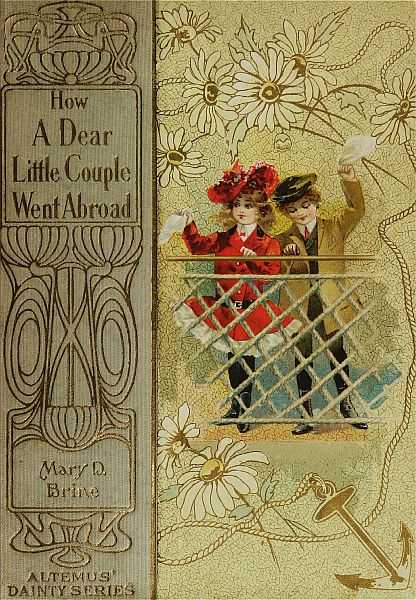
We see them now—as they stand together with Teddy's loving arm about Polly, and her soft cheek pressed close to his—at the railing in the stern of the ocean liner, taking a farewell look at sunny Naples and Italian shores, and waving handkerchiefs to the men, women, and children in the small row-boats which were skipping about in the bay in the wake of the steamship, while shrill Italian voices were shouting: "Addio! addio!"
"We've had the beautifullest time that ever could be, and we've liked being European travelers ever so much, haven't we, Teddy Terry?" remarked Polly at last, as the children followed Mr. Darling to their steamer chairs; "and I must say," she added quite proudly, "that I think we've been such good children that some day maybe Papa'll take us to some other places. Won't that be fun?"
Teddy thought it would, but he could not be so conscientiously sure of having been as "good" as Polly fancied, for he had a distinct remembrance of certain occasions (of which I haven't had the heart to tell my little readers) when Mamma Darling had had to scold pretty severely, and he had been more humiliated about it than Polly, on account of his promise to his own Mamma. Thinking it all over now, as he sat in his chair beside Mrs. Darling on deck, he suddenly drew her head down to him and earnestly whispered: "Say, Auntie, I have almost kept my promise to my Mamma and tried to be a good boy, haven't I? You see, I wouldn't like her to say I broke my word after she'd been and trusted me, you know, Auntie!"
Mrs. Darling put a tender kiss on the soft little tanned forehead, and whispered back: "I'm going to tell Mamma Terry that her boy was the best-behaved little traveler I ever saw, so cheer up, Teddy boy!"
It was a very happy little laddie who settled back in that big steamer chair and slipped his hand into Polly's after "Auntie" had made her whispered speech.
And now we must say good-bye to them, as the steamship speeds on towards America's shores, and I hope this story of more of the doings of our dear little couple will have given as much pleasure as your first account of them. The world is full of "Dear Little Couples," isn't it?
Transcriber's Notes:
Page 16, "city" changed to "City" (York City)
Page 21, repeated line of text was deleted. Original read:
steamer, under Papa's guidance, pretty thoroughly. You know
the steamer, under Papa's guidance, pretty thoroughly. You know
children like to explore, and go scampering about to see all that can