
The deer came to the big maple
Had the frosty air watered her eye? was it a tear of joy and gratitude that dimmed the clearness of its sight? or were the half-frozen fingers unable to steady the cold barrel at the instant of its explosion? We know not. We only know that in spite of prayer, in spite of noblest effort, she missed the game. For, as the rifle cracked, the buck gave a snort of fear, and with swift bounds flew up the mountain; while the poor woman, dropping the gun with a groan, fell fainting on the snow.
III.
At the same moment the rifle sounded, two men, the Trapper with his pack, and Wild Bill with his sled heavily loaded, were descending the western slope of the mountain, not a mile from the clearing in which stood the lonely cabin. The sound of the piece brought them to a halt as quickly as if the bullet had cut through the air in front of their faces. For several minutes both stood in the attitude of listening.
"Down into the snow with ye, pups!" exclaimed the Trapper, in a hoarse whisper. "Down into the snow with ye, I say! Rover, ef ye lift yer muzzle agin, I'll warm yer back with the ramrod. By the Lord, Bill, the buck is comin' this way; ye can see his horns lift above the leetle balsams as he breaks through the thicket yender. Ef he strikes the runway, he'll sartinly come within range;" and the old Trapper slipped his arms from the pack, and, lowering it to the earth, sank on his knees beside it, where he waited as motionless as if the breath had departed his body.
Onward came the game. As the Trapper had suggested, the buck, with mighty and far-reaching bounds, cleared the shrubby obstructions, and, entering the runway, tore up the familiar path with the violence of a tornado. Onward he came, his head flung upward, his antlers laid well back, tongue lolling from his mouth, and his nostrils smoking with the hot breaths that burst in streaming columns from them. Not until his swift career had brought him exactly in front of his position did the old man stir a muscle. But then, quick as the motion of the leaping game, his rifle jumped to his cheek, and even as the buck was at the central point of his leap, and suspended in the air, the piece cracked sharp and clear, and the deer, stricken to his death, fell with a crash to the ground. The quivering hounds rose to their feet, and bayed long and deep; Wild Bill swung his hat and yelled; and for a moment the woods rang with the wild cries of dogs and man.
The piece cracked sharp and clear
"Lord-a-massy, Bill, what a mouth ye have when ye open it!" exclaimed the Trapper, as he leisurely poured the powder into the still smoking barrel. "Atween ye and the pups, it's enough to drive a man crazy. I should sartinly think ye had never seed a deer shot afore, by the way ye be actin'."
"I've seen a good many, as you know, John Norton; but I never saw one tumbled over by a single bullet when at the very top of his jump, as that one was. I surely thought you had waited too long, and I wouldn't have given a cent for your chances when you pulled. It was a wonderful shot, John Norton, and I would take just such another tramp as I have had, to see you do it again, old man."
"It wasn't bad," returned the Trapper; "no, it sartinly wasn't bad, fur he was goin' as ef the Old Harry was arter him. I shouldn't wonder ef he had felt the tech of lead down there in the holler, and the smart of his hurt kept him flyin'. Let's go and look him over, and see ef we can't find the markin's of the bullit on him."
In a moment the two stood above the dead deer.
"It is as I thought," said the Trapper, as he pointed with his ramrod to a stain of blood on one of the hams of the buck. "The bullit drove through his thigh here, but it didn't tech the bone, and was a sheer waste of lead, fur it only sot him goin' like an arrer. Bill, I sartinly doubt," continued the old man, as he measured the noble animal with his eye, "I sartinly doubt ef I ever seed a bigger deer. There's seven prongs on his horns, and I'd bet a horn of powder agin a chargerful that he'd weigh three hundred pounds as he lies. Lord, what a Christmas gift he'll be fur the woman! The skin will make a blanket fit fur a queen to sleep under, and the meat, jediciously cared for, will last her all winter. We must manage to git it to the edge of the clearin', anyhow, or the wolves might make free with our venison, Bill. Yer sled is a strong un, and it'll bear the loadin', ef ye go keerful."
The Trapper and his companion set themselves to their task with the energy of men accustomed to surmount every obstacle, and in a short half-hour the sled, with its double loading, stopped at the door of the lonely cabin.
"I don't understand this, Wild Bill," said the Trapper. "Here be a woman's tracks in the snow, and the door be left a leetle ajar, but there be no smoke in the chimney, and they sartinly ain't very noisy inside. I'll jest give a knock or two, and see ef they be stirrin';" and, suiting the action to the word, he knocked long and loud on the large door. But to his noisy summons there came no response, and without a moment of farther hesitation he shoved open the door, and entered. "God of marcy! Wild Bill," exclaimed the Trapper, "look in here!"
A huge room dimly lighted, holes in the roof, here and there a heap of snow on the floor, an immense fireplace with no fire in it, and a group of scared, wild-looking children huddled together in the farther corner, like young and timid animals that had fled in affright from the nest where they had slept, at some fearful intrusion. That is what the Trapper saw.
"I"—Whatever Wild Bill was about to say, his astonishment, and we may add his pity, were too profound for him to complete his ejaculation.
"Don't ye be afeerd, leetle uns," said the Trapper, as he advanced into the centre of the room to more fully survey the wretched place. "This be Christmas morn, and me and Wild Bill and the pups have come over the mountain to wish ye all a merry Christmas. But where be yer mother?" queried the old man, as he looked kindly at the startled group. "We don't know where she is," answered the older of the two girls; "we thought she was in bed with us, till you woke us. We don't know where she has gone."
"I have it, I have it, Wild Bill!" exclaimed the Trapper, whose eyes had been busy scanning the place while talking with the children. "The rifle be gone from the hangings, and the tracks in the snow be hern. Yis, yis, I see it all. She went out in hope of gittin' the leetle uns here somethin' to eat, and that was her rifle we heerd, and her bullet made that hole in the ham of the buck. What a disappointment to the poor creetur when she seed she hadn't hit him! Her heart eena'most broke, I dare say. But the Lord was in it—leastwise, he didn't go ag'in the proper shapin' of things arterwards. Come, Bill, let's stir round lively, and get the shanty in shape a leetle, and some vict'als on the table afore she comes. Yis, git out yer axe, and slash into that dead beech at the corner of the cabin, while I sorter clean up inside. A fire is the fust thing on sech a mornin' as this; so scurry round, Bill, and bring in the wood as ef ye was a good deal in 'arnest, and do ye cut to the measure of the fireplace, and don't waste yer time in shortenin' it, fur the longer the fireplace, the longer the wood; that is, ef ye want to make it a heater."
His companion obeyed with alacrity; and by the time the Trapper had cleaned out the snow, and swept down the soot from the sides of the fireplace, and put things partially to rights, Bill had stacked the dry logs into the huge opening, nearly to the upper jamb, and, with the help of some large sheets of birch-bark, kindled them to a flame. "Come here, leetle uns," said the Trapper, as he turned his good-natured face toward the children,—"come here, and put yer leetle feet on the h'arthstun, fur it's warmin', and I conceit yer toes be about freezin'."
It was not in the power of children to withstand the attraction of such an invitation, extended with such a hearty voice and such benevolence of feature. The children came promptly forward, and stood in a row on the great stone, and warmed their little shivering bodies by the abundant flames.
"Now, leetle folks," said the Trapper, "jest git yerselves well warmed, then git on what clothes ye've got, and we'll have some breakfast,—yis, we'll have breakfast ready by the time yer mother gits back, fur I know where she be gone, and she'll be hungry and cold when she gits in. I don't conceit that this little chap here can help much, but ye girls be big enough to help a good deal. So, when ye be warm, do ye put away the bed to the furderest corner, and shove out the table in front of the fire, and put on the dishes, sech as ye have, and be smart about it, too, fur yer mother will sartinly be comin' soon, and we must be ahead of her with the cookin'."
What a change the next half-hour made in the appearance of the cabin! The huge fire sent its heat to the farthest corner of the great room. The miserable bed had been removed out of sight, and the table, drawn up in front of the fire, was set with the needed dishes. On the hearthstone a large platter of venison steak, broiled by the Trapper's skill, simmered in the heat. A mighty pile of cakes, brown to a turn, flanked one side, while a stack of potatoes baked in the ashes supported the other. The teapot sent forth its refreshing odor through the room. The children, with their faces washed and hair partially, at least, combed, ran about with bare feet on the warm floor, comfortable and happy. To them it was as a beautiful dream. The breakfast was ready, and the visitors sat waiting for the coming of her to whose assistance the angel of Christmas Eve had sent them.
"Sh!" whispered the Trapper, whose quick ear had caught the sound of a dragging step in the snow. "She's comin'!"
Too weary and faint, too sick at heart and exhausted in body to observe the unaccustomed signs of human presence around her dwelling, the poor woman dragged herself to the door, and opened it. The gun she still held in her hand fell rattling to the floor, and, with eyes wildly opened, she gazed bewildered at the spectacle. The blazing fire, the set table, the food on the hearthstone, the smiling children, the two men! She passed her hands across her eyes as one waking from sleep. Was she dreaming? Was this cabin the miserable hut she had left at daybreak? Was that the same fireplace in front of whose cold and cheerless recess she had crouched the night before? And were those two strangers there men, or were they angels? Was what she saw real, or was it only a fevered vision born of her weakness?
Her senses actually reeled to and fro, and she trembled for a moment on the verge of unconsciousness. Indeed, the shock was so overwhelming that in another instant she would have swooned and fallen to the floor had not the growing faintness been checked by the sound of a human voice.
"A merry Christmas to ye, my good woman," said the Trapper. "A merry Christmas to ye and yourn!"
The woman started as the hearty tones fell on her ear, and, steadying herself by the door, she said, speaking as one partially dazed,—
"Are you John Norton the Trapper, or are you an ang—"
"Ye needn't sight agin," interrupted the old man. "Yis, I'm old John Norton himself, nothin' better and nothin' wuss; and the man in the chair here by my side is Wild Bill, and ye couldn't make an angel out of him, ef ye tried from now till next Christmas. Yis, my good woman, I'm John Norton, and this is Wild Bill, and we've come over the mountain to wish ye a merry Christmas, ye and yer leetle uns, and help ye keep the day; and, ye see, we've been stirrin' a leetle in yer absence, and breakfast be waitin'. Wild Bill and me will jest go out and cut a leetle more wood, while ye warm and wash yerself; and when ye be ready to eat, ye may call us, and we'll see which can git into the house fust."
So saying, the Trapper, followed by his companion, passed out of the door, while the poor woman, without a word, moved toward the fire, and, casting one look at her children, at the table, at the food on the hearthstone, dropped on her knees by a chair, and buried her face in her hands.
"I say," said Wild Bill to the Trapper, as he crept softly away from the door, to which he had returned to shut it more closely, "I say, John Norton, the woman is on her knees by a chair."
"Very likely, very likely," returned the old man reverently; and then he began to chop vigorously at a huge log, with his back toward his comrade.
Perhaps some of you who read this tale will come some time, when weary and heart-sick, to something drearier than an empty house, some bleak, cold day, some lonely morn, and with a starving heart and benumbed soul,—ay, and empty-handed, too,—enter in only to find it swept and garnished, and what you most needed and longed for waiting for you. Then will you, too, drop upon your knees, and cover your face with your hands, ashamed that you had murmured against the hardness of your lot, or forgotten the goodness of Him who suffered you to be tried only that you might more fully appreciate the triumph.
"My good woman," said the Trapper, when the breakfast was eaten, "we've come, as we said, to spend the day with you; and accordin' to custom—and a pleasant un it be fur sartin—we've brought ye some presents. A good many of them come from him who called on ye as he and me passed through the lake last fall. I dare say ye remember him, and he sartinly has remembered ye. Fur last evening when I was makin' up a leetle pack to bring ye myself,—fur I conceited I had better come over and spend the day with ye,—Wild Bill came to my door with a box on his sled that the boy had sent in from his home in the city; and in the box he had put a great many presents fur him and me; and in the lower half of the box he had put a good many presents fur ye and yer leetle uns, and we've brought them all over with us. Some of the things be fur eatin' and some of them be fur wearin'; and that there may be no misunderstanding I would say that all the things that be in the pack-basket there, and all the things that be on the sled, too, belong to ye. And as I see the woodpile isn't a very big un fur this time of the year, Bill and me be goin' out to settle our breakfast a leetle with the axes. And while we be gone, I conceit ye had better rummage the things over, and them that be good fur eatin' ye had better put in the cupboard, and them that be good fur wearin' ye had better put on yerself and yer leetle uns; and then we'll all be ready to make a fair start. Fur this be Christmas Day, and we be goin' to keep it as it orter be kept. Ef we've had sorrers, we'll forgit 'em; and we'll laugh, and eat, and be merry. Fur this be Christmas, my good woman! children, this be Christmas! Wild Bill, my boy, this be Christmas; and pups, this be Christmas! And we'll all laugh, and eat, and be merry."
The joyfulness of the old man was contagious. His happiness flowed over as waters flow over the rim of a fountain. Wild Bill laughed as he seized his axe, the woman rose from the table smiling, the girls giggled, the little boy stamped, and the hounds, catching the spirit of their merry master, swung their tails round, and bayed in canine gladness; and amid the joyful uproar the old Trapper spun himself out of the door, and chased Wild Bill through the snow like a boy.
The dinner was to be served at two o'clock; and what a dinner it was, and what preparations preceded! The snow had been shovelled from around the cabin, the holes in the roof roughly but effectually thatched. A good pile of wood was stacked in front of the doorway. The spring that bubbled from the bank had been cleared of ice, and a protection constructed over it. The huge buck had been dressed, and hung high above the reach of wolves. Cedar and balsam branches had been placed in the corners and along the sides of the room. Great sprays of the tasselled pine and the feathery tamarack were suspended from the ceiling. The table had been enlarged, and extra seats extemporized. The long-unused oven had been cleaned out, and under its vast dome the red flames flashed and rolled upward. What a change a few hours had brought to that lonely cabin and its wretched inmates! The woman, dressed in her new garments, her hair smoothly combed, her face lighted with smiles, looked positively comely. The girls, happy in their fine clothes and marvellous toys, danced round the room, wild with delight; while the little boy strutted about the floor in his new boots, proudly showing them to each person for the hundredth time.
The hostess's attention was equally divided between the temperature of the oven and the adornment of the table. A snow-white sheet, one of a dozen she had found in the box, was drafted peremptorily into service, and did duty as a tablecloth. Oh, the innocent and funny make-shifts of poverty, and the goodly distance it can make a little go! Perhaps some of us, as we stand in our rich dining-rooms, and gaze with pride at the silver, the gold, the cut-glass, and the transparent china, can recall a little kitchen in a homely house far away, where our good mothers once set their tables for their guests, and what a brave show the few extra dishes made when they brought them out on the rare festive days!
However it might strike you, fair reader, to the poor woman and her guests there was nothing incongruous in a sheet serving as a tablecloth. Was it not white and clean and properly shaped, and would it not have been a tablecloth if it hadn't been a sheet? How very nice and particular some people can be over the trifling matter of a name! And this sheet had no right to be a sheet; for any one with half an eye could see at a glance that it was predestined from the first to be a tablecloth, for it sat as smoothly on the wooden surface as pious looks on a deacon's face, while the easy and nonchalant way it draped itself at the corners was perfectly jaunty.
The edges of this square of white sheeting that had thus providentially found its true and predestined use were ornamented with the leaves of the wild myrtle, stitched on in the form of scallops. In the centre, with a brave show of artistic skill, were the words, "Merry Christmas," prettily worked with the small brown cones of the pines. This, the joint product of Wild Bill's industry and the woman's taste, commanded the enthusiastic admiration of all; and even the little boy, from the height of a chair into which he had climbed, was profoundly affected by the show it made.
The Trapper had charge of the meat department, and it is safe to say that no Delmonico could undertake to serve venison in greater variety than did he. To him it was a grand occasion, and—in a culinary sense—he rose grandly to meet it. What bosom is without its little vanities? and shall we laugh at the dear old man because he looked upon the opportunity before him with feeling other than pure benevolence,—even of complacency that what he was doing was being done as no one else could do it?
There was venison roasted, and venison broiled, and venison fried; there was hashed venison, and venison spitted; there was a side-dish of venison sausage, strong with the odor of sage, and slightly dashed with wild thyme; and a huge kettle of soup, on whose rich creamy surface pieces of bread and here and there a slice of potato floated.
"I tell ye, Bill," said the Trapper to his companion, as he stirred the soup with a long ladle, "this pot isn't actilly runnin' over with taters, but ye can see a bit occasionally ef ye look sharp and keep the ladle goin' round pretty lively. No, the taters ain't over-plenty," continued the old man, peering into the pot, and sinking his voice to a whisper, "but there wasn't but fifteen in the bag, and the woman took twelve of 'em fur her kittle, and ye can't make three taters look actilly crowded in two gallons of soup, can ye, Bill?" And the old man punched that personage in the ribs with the thumb of the hand that was free from service, while he kept the ladle going with the other.
"Lord!" exclaimed the Trapper, speaking to Bill, who, having taken a look into the old man's kettle, was digging his knuckles into his eyes to free them from the spray that was jetted into them from the fountains of mirth within that were now in full play,—"Lord! ef there isn't another piece of tater gone all to pieces! Bill, ef I make another circle with this ladle, there won't be a whole slice left, and ye'll swear there wasn't a tater in the soup." And the two men, with their faces within twenty inches, laughed and laughed like boys.
How sweet it is to think that when the Maker set up this strange instrument we call ourselves, and strung it for service, he selected of the heavy chords so few, and of the lighter ones so many! Some muffled ones there are; some slow and solemn sounds swell sadly forth at intervals, but blessed be God that we are so easily tickled, and the world is so funny that within it, even when exiled from home and friends, we find, as the days come and go, the causes and occasions of hilarity!
Wild Bill had been placed in charge of the liquids. What a satire there is in circumstances, and how those of to-day laugh at those of yesterday! Yes, Wild Bill had charge of the liquids,—no mean charge, when the occasion is considered. Nor was the position without its embarrassments, as few honorable positions are, for it brought him face to face with the problem of the day—dishes; for, between the two cooks of the occasion, every dish in the cabin had been brought into requisition, and poor Bill was left in the predicament of having to make tea and coffee with no pots to make them in.
But Bill was not lacking in wit, if he was in pots, and he solved the conundrum how to make tea without a teapot in a manner that extorted the woman's laughter, and commanded the old Trapper's admiration.
In ransacking the lofts above the apartment, he had lighted on several large, stone jugs, which, with the courage—shall we call it the audacity?—of genius, he had seized upon; and, having thoroughly rinsed them, and freed them from certain odors,—which we are free to say Bill was more or less familiar with,—he brought them forward as substitutes for kettle and pot. Indeed, they worked admirably, for in them the berry and the leaves might not only be properly steeped, but the flavor could be retained beyond what it might in many of our famous and high-sounding patented articles.
But Bill, while ingenious and courageous to the last degree, was lacking in education, especially in scientific directions. He had never been made acquainted with that great promoter of modern civilization—the expansive properties of steam. The corks he had whittled out for his bravely extemporized tea and coffee pots were of the closest fit; and, as they had been inserted with the energy of a man who, having conquered a serious difficulty, is determined to reap the full benefit of his triumph, there was at least no danger that the flavor of the concoctions would escape through any leakage at the muzzle. Having thus prepared them for steeping, he placed the jugs in his corner of the fireplace, and pushed them well up through the ashes to the live coals.
"Wild Bill," said the Trapper, who wished to give his companion the needed warning in as delicate and easy a manner as possible, "Wild Bill, ye have sartinly got the right idee techin' the makin' of tea and coffee, fur the yarb should be steeped, and the berry too,—leastwise, arter it's biled up once or twice,—and therefore it be only reasonable that the nozzles should be closed moderately tight; but a man wants considerable experience in the business, or he's likely to overdo it jest a leetle, and ef ye don't cut some slots in them wooden corks ye've driven into them nozzles, Bill, there'll be a good deal of tea and coffee floatin' round in your corner of the fireplace afore many minutes, and I conceit there'll be a man about your size lookin' for a couple of corks and pieces of jugs out there in the clearin', too."
"Do you think so?" answered Bill incredulously. "Don't you be scared, old man, but keep on stirring your soup and turning the meat, and I'll keep my eye on the bottles."
"That's right, Bill," returned the Trapper; "ye keep yer eye right on 'em, specially on that un that's furderest in toward the butt of the beech log there; fur ef there's any vartue in signs, that jug be gittin' oneasy. Yis," continued the old man, after a minute's pause, during which his eye hadn't left the jug, "yis, that jug will want more room afore many minutes, ef I'm any jedge, and I conceit I had better give it the biggest part of the fireplace;" and the Trapper hastily moved the soap and his half-dozen plates of cooked meats to the other end of the hearthstone, whither he retired himself, like one who, feeling that he is called upon to contend with unknown forces, wisely beats a retreat. He even put himself behind a stack of wood that lay piled up in his corner, like one who does not despise, in a sudden emergency, an artificial protection.
"Bill," called the Trapper, "edge round a leetle,—edge round, and git in closer to the jamb. It's sheer foolishness standin' where ye be, fur the water will be wallopin' in a minit, and ef the corks be swelled in the nozzle, there'll be an explosion. Git in toward the jamb, and watch the ambushment under kiver."
"Old man," answered Bill, as he turned his back carelessly toward the fireplace, "I've got the bearin's of this trail, and know what I'm about. The jugs are as strong as iron kittles, and I ain't afraid of their bust"—
Bill never finished the sentence, for the explosion predicted by the Trapper occurred. It was a tremendous one, and the huge fireplace was filled with flying brands, ashes, and clouds of steam. The Trapper ducked his head, the woman screamed, and the hounds rushed howling to the farthest end of the room; while Bill, with half a somersault, disappeared under the table.
"Hurrah!" shouted the Trapper, lifting his head from behind the wood, and critically surveying the scene. "Hurrah, Bill!" he shouted, as he swung the ladle over his head. "Come out from under the table, and man yer battery agin. Yer old mortars was loaded to the muzzle, and ef ye had depressed the pieces a leetle, ye'd 'a' blowed the cabin to splinters; as it was, the chimney got the biggest part of the chargin', and ye'll find yer rammers on the other side of the mountain."
It was, in truth, a scene of uproarious hilarity; for once the explosion was over, and the woman and children saw there was no danger, and apprehended the character of the performance, they joined unrestrainedly in the Trapper's laughter, in which they were assisted by Wild Bill, as if he were not the victim of his own over-confidence.
"I say, old Trapper," he called from under the table, "did both guns go off? I was gitting under cover when the battery opened, and didn't notice whether the firing was in sections or along the whole line. If there's a piece left, I think I will stay where I am; for I am in a good position to observe the range, and watch the effect of the shot. I say, hadn't you better get behind the wood-pile again?"
"No, no," interrupted the Trapper; "the whole battery went at the word, Bill, and there isn't a gun or a gun-carriage left in the casement. Ye've wasted a gill of the yarb, and a quarter of a pound of the berry; and ye must hurry up with another outfit of bottles, or we'll have nothin' but water to drink at the dinner."
The dinner! That great event of the day, the crown and diadem to its royalty, and which became it so well, was ready promptly to the hour. The table, enlarged as it was to nearly double its original dimensions, could scarcely accommodate the abundance of the feast. Ah, if some sweet power would only enlarge our hearts when, on festive days, we enlarge our tables, how many of the world's poor, that now go hungry while we feast, would then be fed!
At one end of the table sat the Trapper, Wild Bill at the other. The woman's chair was at the centre of one of the sides, so that she sat facing the fire, whose generous flames might well symbolize the abundance which amid cold and hunger had so suddenly come to her. On her right hand the two girls sat; on her left, the boy. A goodly table, a goodly fire, and a goodly company,—what more could the Angel of Christmas ask to see?
Thus were they seated, ready to begin the repast; but the plates remained untouched, and the happy noises which had to that moment filled the cabin ceased; for the Angel of Silence, with noiseless step, had suddenly entered the room. There's a silence of grief, there's a silence of hatred, there's a silence of dread; of these, men may speak, and these they can describe. But the silence of our happiness, who can describe that? When the heart is full, when the long longing is suddenly met, when love gives to love abundantly, when the soul lacketh nothing and is content,—then language is useless, and the Angel of Silence becomes our only adequate interpreter. A humble table, surely, and humble folk around it; but not in the houses of the rich or the palaces of kings does gratitude find her only home, but in more lowly abodes and with lowly folk—ay, and often at the scant table, too—she sitteth a perpetual guest. Was it memory? Did the Trapper at that brief moment visit his absent friend? Did Wild Bill recall his wayward past? Were the thoughts of the woman busy with sweet scenes of earlier days? And did memory, by thus reminding them of the absent and the past, of the sweet things that had been and were, stir within their hearts thoughts of Him from whom all gifts descend, and of His blessed Son, in whose honor the day was named?
O memory! thou tuneful bell that ringeth on forever, friend at our feasts, and friend, too, let us call thee, at our burial, what music can equal thine? For in thy mystic globe all tunes abide,—the birthday note for kings, the marriage peal, the funeral knell, the gleeful jingle of merry mirth, and those sweet chimes that float our thoughts, like fragrant ships upon a fragrant sea, toward heaven,—all are thine! Ring on, thou tuneful bell; ring on, while these glad ears may drink thy melody; and when thy chimes are heard by me no more, ring loud and clear above my grave that peal which echoes to the heavens, and tells the world of immortality, that they who come to mourn may check their tears, and say, "Why do we weep? He liveth still!"
"The Lord be praised fur his goodness!" said the Trapper, whose thoughts unconsciously broke into speech. "The Lord be praised fur his goodness, and make us grateful fur his past marcies, and the plenty that be here!" And looking down upon the viands spread before him, he added, "The Lord be good to the boy, and make him as happy in his city home as be they who be wearin' and eatin' his gifts in the woods!"
"Amen!" said the woman softly, and a grateful tear fell on her plate.
"A—hem!" said Wild Bill; and then looking down upon his warm suit, he lifted his voice, and bringing it out in a clear, strong tone, said, "Amen! hit or miss!"
At many a table that day more formal grace was said, by priest and layman alike, and at many a table, by lips of old and young, response was given to the benediction; but we doubt if over all the earth a more honest grace was said or assented to than the Lord heard from the cabin in the woods.
The feast and the merry-making now began. The old Trapper was in his best mood, and fairly bubbled over with humor. The wit of Wild Bill was naturally keen, and it flashed at its best as he ate. The children stuffed and laughed as only children on such an elastic occasion can. And as for the poor woman, it was impossible for her, in the midst of such a scene, to be otherwise than happy, and she joined modestly in the conversation, and laughed heartily at the witty sallies.
But why should we strive to put on paper the wise, the funny, and the pleasant things that were said, the exclamations, the laughter, the story, the joke, the verbal thrust and parry of such an occasion? These, springing from the centre of the circumstance, and flashed into being at the instant, cannot be preserved for after-rehearsal. Like the effervescence of champagne, they jet and are gone; their force passes away with the noise that accompanied its out-coming.
Is it not enough to record that the dinner was a success, that the Trapper's meats were put upon the table in a manner worthy of his reputation, that the woman's efforts at pastry-making were generously applauded, and that Wild Bill's tea and coffee were pronounced by the hostess the best she had ever tasted? Perhaps no meal was ever more enjoyed, as certainly none was ever more heartily eaten.
Perhaps no meal was ever more enjoyed
The wonder and pride of the table was the pudding,—a creation of Indian-meal, flour, suet, and raisins, re-enforced and assisted by innumerable spicy elements supposed to be too mysterious to be grasped by the masculine mind. In the production of this wonderful centre-piece,—for it had been unanimously voted the place of honor,—the poor woman had summoned all the latent resources of her skill, and in reference to it her pride and fear contended, while the anxiety with which she rose to serve it was only too plainly depicted on her countenance. What if it should prove a failure? What if she had made a miscalculation as to the amount of suet required,—a point upon which she had been somewhat confused? What if the raisins were not sufficiently distributed? What if it wasn't done through, and should turn out pasty? Great heavens! The last thought was of so overwhelming a character that no feminine courage could encounter it. Who may describe the look with which she watched the Trapper as he tasted it, or the expression of relief which brightened her anxious face when he pronounced warmly in its favor?
"It's a wonderful bit of cookin'," he said, addressing himself to Wild Bill, "and I sartinly doubt ef there be anything in the settlements to-day that can equal it. There be jest enough of the suet, and there be a plum fur every mouthful; and it be solid enough to stay in the mouth ontil ye've had time to chew it, and git a taste of the corn,—and I wouldn't give a cent for a puddin' ef it gits away from yer teeth fast. Yis, it be a wonderful bit of cookin'," and, turning to the woman, he added, "ye may well be proud of it."
What higher praise could be bestowed? And as it was re-echoed by all present, and plate after plate was passed for a second filling, the dinner came to an end with the greatest good feeling and hilarity.
IV.
"Now fur the sled!" exclaimed the Trapper, as he rose from the table. "It be a good many years since I've straddled one, but nothin' settles a dinner quicker, or suits the leetle folks better. I conceit the crust be thick enough to bear us up, and, ef it is, we can fetch a course from the upper edge of the clearin' fifty rods into the lake. Come, childun, git on yer mittens and yer tippets, and h'ist along to the big pine, and ye shall have some fun ye won't forgit ontil yer heads be whiter than mine."
It is needless to record that the children hailed with delight the proposition of the Trapper, or that they were at the appointed spot long before the speaker and his companion reached it with the sled.
"Wild Bill," said the Trapper, as they stood on the crest of the slope down which they were to glide, "the crust be smooth as glass, and the hill be a steep un. I sartinly doubt ef mortal man ever rode faster than this sled'll be goin' by the time it gits to where the bank pitches into the lake; and ef ye should git a leetle careless in yer steering Bill, and hit a stump, I conceit that nothin' but the help of the Lord or the rottenness of the stump would save ye from etarnity."
Now, Wild Bill was blessed with a sanguine temperament. To him no obstacle seemed serious if bravely faced. Indeed, his natural confidence in himself bordered on recklessness, to which the drinking habits of his life had, perhaps, contributed.
When the Trapper had finished speaking, Bill ran his eye carelessly down the steep hillside, smooth and shiny as polished steel, and said, "Oh, this isn't anything extry for a hill. I've steered a good many steeper ones, and in nights when the moon was at the half, and the sled overloaded at that. It don't make any difference how fast you go," he added, "if you only keep in the path, and don't hit anything."
"That's it, that's it," replied the Trapper. "But the trouble here be to keep in the path, fur, in the fust place, there isn't any path, and the stumps be pretty thick, and I doubt ef ye can line a trail from here to the bank by the lake without one or more sudden twists in it, and a twist in the trail, goin' as fast as we'll be goin', has got to be taken jediciously, or somethin' will happen. I say, Bill, what p'int will ye steer fur?"
Wild Bill, thus addressed, proceeded to give his opinion touching the proper direction of the flight they were to make. Indeed, he had been closely examining the ground while the Trapper was speaking, and therefore gave his opinion promptly and with confidence.
"Ye have chosen the course with jedgment," said the old man approvingly, after he had studied the line his companion pointed out critically for a moment. "Yis, Bill, ye have a nateral eye for the business, and I sartinly have more confidence in ye than I had a minit ago, when ye was talkin' about a steeper hill than this; fur this hill drops mighty sudden in the pitches, and the crust be smooth as ice, and the sled'll go like a streak when it gits started. But the course ye've p'inted out be a good un, fur there be only one bad turn in it, and good steerin' orter put a sled round that. I say," continued the old man, turning toward his companion, and pointing out the crook in the course at the bottom of the second dip, "can ye swing around that big stump there without upsettin' when ye come to it?"
"Swing around? Of course I can," retorted Wild Bill positively. "There's plenty room to the left, and"—
"Ay, ay; there be plenty of room, as ye say, ef ye don't take too much of it," interrupted the Trapper. "But"—
"I tell you," broke in the other, "I'll turn my back to no man in steering a sled; and I can put this sled, and you on it, around that stump a hundred times, and never lift a runner."
"Well, well," responded the Trapper, "have it your own way. I dare say ye be good at steerin', and I sartinly know I'm good at ridin'; and I can ride as fast as ye can steer, ef ye hit every stump in the clearin'. Now, childun," continued the old man, turning to the little group, "we be goin' to try the course; and ef the crust holds up, and Wild Bill keeps clear of the stumps, and nothin' onusual happens, ye shall have all the slidin' ye want afore ye go in. Come, Bill, git yer sled p'inted right, and I'll be gittin' on, and we'll see ef ye can steer an old man round a stump as handily as ye say ye can."
The directions of the Trapper were promptly obeyed, and in an instant the sled was in a right position, and the Trapper proceeded to seat himself with the carefulness of one who feels he is embarking on a somewhat uncertain venture, and has grave misgivings as to what will be the upshot of the undertaking. The sled was large and strongly built; and it added not a little to his comfort to feel that he could put entire confidence in the structure beneath them.
"The sled'll hold," he said to himself, "ef the loadin' goes to the jedgment."
The Trapper was no sooner seated than Wild Bill threw himself upon the sled, with one leg under him and the other stretched at full length behind. This was a method of steering that had come into vogue since the Trapper's boyhood, for in his day the steersman sat astride the sled, with his feet thrust forward, and steered by the pressure of either heel upon the snow.
One leg under him and the other stretched at full length behind
"Hold on, Bill!" exclaimed the Trapper, whose eye this novel method of steering had not escaped. "Hold on, and hold up a minit. Heavens and 'arth! ye don't mean to steer this sled with one toe, do ye, and that, too, the length of a rifle-barrel astarn? Wheel round, and spread yer legs out as ye orter, and steer this sled in an honest fashion, or there'll be trouble aboard afore ye git to the bottom."
"Sit round!" retorted Bill. "How could I see to steer if I was sitting right back of you? For you're nigh a foot taller than I be, and your shoulders are as broad as the sled."
"Yer p'ints be well taken, fur sartin," replied the Trapper; "fur it be no more than reasonable that the man that steers should see where he be goin', and I am anxious as ye be that ye should. Yis, I sartinly want ye to see where ye be goin' on this trip, anyhow, fur the crew be a fresh un, and the channel be a leetle crooked. But be ye sartin, Bill, that ye can fetch round that stump there as it orter be did, with nothin' but yer toe out behind? It may be the best way, as ye say, but it don't look like honest steerin' to a man of my years."
"I have used both ways," answered Bill, "and I give you my word, old man, that this is the best one. You can git a big swing with your foot stretched out in this fashion, and the sled feels the least pressure of the toe. Yes, it's all right. John Norton, are you ready?"
"Yis, yis, as ready as I ever shall be," answered the Trapper, in a voice in which doubt and resignation were equally mingled. "It may be as ye say," he continued; "but the rudder be too fur behind to suit me, and ef anything happens on this cruise, jest remember, Wild Bill, that my jedgment"—
The sentence the Trapper was uttering was abruptly cut short at this point; for Bill had started the sled with a sudden push, and leaped to his seat behind the Trapper as it glided downward and away. In an instant the sled was under full headway, for the dip was a sharp one, and the crust smooth as ice. Scarce had it gone ten rods from the point where it started before it was in full flight, and was gliding downward with what would have been, to any but a man of the steadiest nerve, a frightful velocity. But the Trapper was of too cool and courageous temperament to be disturbed even by actual danger. Indeed, the swiftness of their downward career, as the sled with a buzz and a roar swept along over the resounding crust, stirred the old man's blood with a tingle of excitement; while the splendid manner with which Wild Bill was keeping it to the course settled upon filled him with admiration, and was fast making him a convert to the new method of steering.
Downward they flashed. The Trapper's cap had been blown from his head; and as the old man sat bolt-upright on his sled, his feet bravely planted on the round, his face flushed, and his white hair streaming, he looked the very picture of hearty enjoyment. Above his head the face of Wild Bill looked actually sharpened by the pressure of the air on either cheek as it clove through it; but his lips were bravely set, and his eyes were fastened without winking on the big stump ahead, toward which they were rushing.
It was at this point that Wild Bill vindicated his ability as a steersman, and at the same time barely escaped shipwreck. At the proper moment he swept his foot to the left, and the sled, in obedience to the pressure, swooped in that direction. But in his anxiety to give the stump a wide berth, Bill overdid the pressure that was needed a trifle; for in calculating the curve required he had failed to allow for the sidewise motion of the sled, and, instead of hitting one stump, it looked for an instant as if he would be precipitated among a dozen.
"Heave her starn up, Wild Bill! up with her starn, I say," yelled the Trapper, "or there won't be a stump left in the clearin'."
With a quickness and courage that would have done credit to any steersman,—for the speed at which they were going was terrific,—Bill swept his foot to the right, leaning his body well over at the same instant. The Trapper instinctively seconded his endeavors, and with hands that gripped either side of the sled he hung over that side which was upon the point of going into the air. For several rods the sled glided along on a single runner, and then, righting itself with a lurch, jumped the summit of the last dip, and raced away, like a swallow in full flight, toward the lake.
Now, at the edge of the clearing that bounded the shore was a bank of considerable size. Shrubs and stunted bushes fringed the crest of it. These had been buried beneath the snow, and the crust had formed smoothly over them; and as it was upheld by no stronger support than such as the hidden shrubbery furnished, it was incapable of sustaining any considerable pressure.
Certainly no sled was ever moving faster than was Wild Bill's, when it came to this point; and certainly no sled ever stopped quicker, for the treacherous crust dropped suddenly under it, and the sled was left with nothing but the hind part of one of the runners sticking up in sight. But though the sled was suddenly checked in its career, the Trapper and Wild Bill continued their flight. The former slid from the sled without meeting any obstruction, and with the same velocity with which he had been moving. Indeed, so little was his position changed, that one almost might fancy that no accident had happened, and that the old man was gliding forward to the end of the course with an adequate structure under him. But with the latter it "was far different; for, as the sled stopped, he was projected sharply upward into the air, and, after turning several somersaults, he actually landed in front of the Trapper, and glided along on the slippery surface ahead of him. And so the two men shot onward, one after the other, while the children cackled from the hill-top, and the woman swung her bonnet over her head, and laughed from her position in the doorway.
"Bill," called the Trapper, when by dint of much effort they had managed to check their motion somewhat, "Bill, ef the cruise be about over, I conceit we'd better anchor hereabouts. But I shipped fur the voyage, and ye be capt'in, and as ye've finally got the right way to steer, I feel pretty safe techin' the futur."
It was not until they had come to a full stop, and looked around them, that they realized the distance they had come; for they had in truth slid nearly across the bay.
"I've boated a good many times on these waters, and under sarcumstances that called fur 'arnest motion, but I sartinly never went across this bay as fast as I've did it to-day. How do ye feel, Bill, how do ye feel?"
"A good deal shaken up," was the answer, "a good deal shaken up."
"I conceit as much," answered the Trapper, "I conceit as much, fur ye left the sled with mighty leetle deliberation; and when I saw yer legs comin' through the air, I sartinly doubted ef the ice would hold ye. But ye steered with jedgment; yis, ye steered with jedgment, Bill; and I'd said it ef we'd gone to the bottom."
The sun was already set when they returned to the cabin; for, selecting a safer course, they had given the children an hour's happy sliding. The woman had prepared some fresh tea and a lunch, which they ate with lessened appetites, but with humor that never flagged. When it was ended, the old Trapper rose to depart, and with a dignity and tenderness peculiarly his own, thus spoke:—
"My good woman," he said, "the moon will soon be up, and the time has come fur me to be goin'. I've had a happy day with ye and the leetle uns; and the trail over the mountain will seem shorter, as the pups and me go home, thinkin' on't. Wild Bill will stay a few days, and put things a leetle more to rights, and git up a wood-pile that will keep ye from choppin' fur a good while. It's his own thought, and ye can thank him accordin'ly." Then, having kissed each of the children, and spoken a few words to Wild Bill, he took the woman's hand, and said,—
"The sorrers of life be many, but the Lord never forgits. I've lived ontil my head be whitenin', and I've noted that though he moves slowly, he fetches most things round about the time we need 'em; and the things that be late in comin', I conceit we shall git somewhere furder on. Ye didn't kill the big buck this mornin', but the meat ye needed hangs at yer door, nevertheless." And, shaking the woman heartily by the hand, he whistled to the hounds, and passed out of the door. The inmates of the cabin stood and watched him, until, having climbed the slope of the clearing, he disappeared in the shadows of the forest; and then they closed the door. But more than once Wild Bill noted that as the woman stood wiping her dishes, she wiped her eyes as well; and more than once he heard her say softly to herself. "God bless the dear old man!"
Ay, ay, poor woman, we join thee in thy prayer. God bless the dear old man! and not only him, but all who do the deeds he did. God bless them one and all!
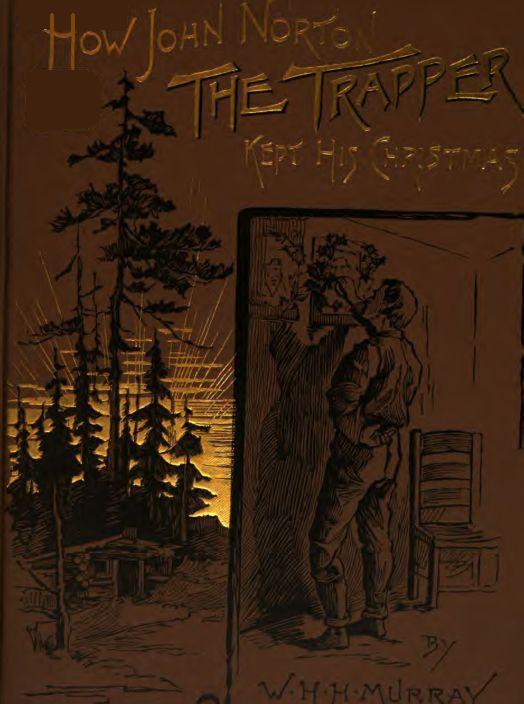
Over the crusted snow the Trapper held his course, until he came, with a happy heart, to his cabin. Soon a fire was burning on his own hearthstone, and the hounds were in their accustomed place. He drew the table in front, where the fire's fine light fell on his work, and, taking some green vines and branches from the basket, began to twine a wreath. One he twined, and then he began another; and often, as he twined the fadeless branches in, he paused, and long and lovingly looked at the two pictures hanging on the wall; and when the wreaths were twined, he hung them on the frames, and, standing in front of the dumb reminders of his absent ones, he said, "I miss them so!"